At the turn of August and September of 1914, Galician Ukrainian volunteers formed the Legion of Ukrainian Sich Riflemen (Ukrains′ki Sichovi Stril′tsi or Ukrainische Sitschower Schützen) as a unit separate from the simultaneously created Polish Legions. Sich referred to the historical headquarters of the Zaporozhian Cossacks located on the Dnieper River. In photographs, however, the Sich Riflemen look like ordinary Austrian-Hungarian soldiers. There is nothing specifically “Cossack” about their appearance. In 1914, Sich simply stood for the military or paramilitary activity of young Ukrainian males. Every soldier in the Legion of Ukrainian Sich Riflemen was now, by definition, a Sich man, a Cossack. The Cossack characteristics suggested by the term “Sich” had become inextricably linked with alleged Ukrainian martial valor.
At the beginning of the twentieth century, the figure of the Cossack was perceived in Austrian Galicia as an indisputably Ukrainian nationalist symbol. This had not always been the case. As has been noted by Andriy Zayarnyuk, in the climactic revolutionary year of 1848 “[n]owhere … does one find stories of Ukrainian Cossacks and Hetmans” employed by Ruthenian national activists.Footnote 1 Although some Cossack motifs were present in the writings of populist Ruthenian nation builders of the late 1830s (Iakiv Holovats′kyi, Ivan Holovats′kyi, Markiian Shashkevych, Mykola Ustyianovych, Ivan Vahylevych), they were far from occupying the crucial position that they would gain as a Ukrainian nationalist symbol by the end of the nineteenth century.Footnote 2 The use of Cossack stories and related symbols allowed these early authors to heighten the importance of the community that they claimed to represent: first, by depicting Ruthenian commoners as knightly warriors who had historical achievements of their own and, second, by emphasizing their unity with the millions of Ukrainians under the Russian rule. Overall, however, in the works of early Ruthenian authors in Galicia, it was usually the Carpathian highlanders and banditti recruited from among them, the so-called opryshky, that fulfilled the role of idealized embodiments of völkisch masculinity. Likewise, stories about the Cossacks and symbols related to them were only marginal in the genuine folklore of Galician Ruthenian peasants.Footnote 3
In Galicia in the Vormärz period, most representations of Ukrainian Cossacks appeared in Polish-language literature. These texts addressed the social issue of armed resistance and rebellions of the popular classes exploited by the nobility. Ethnic differences and national self-determination were not their main concern. In the first half of the nineteenth century, Galician authors writing in Polish took it for granted that Cossack history was part of their national heritage. Their treatment of the topic could be categorized as a hegemonic appropriation stemming from the spirit of Romantic nationalism. Historical and literary studies of Romantic nationalism are rich and sophisticated, but because of their exclusive focus on nationalisms, they often neglect other dimensions of the phenomena with which they deal.Footnote 4 Not all actions that had nation-building consequences and/or in which nationalist symbols were employed were necessarily motivated by nationalist goals. In this contribution I would like to offer a different interpretation of Romantic politics, one in which nationalism is not its main driving force. Symbols of ethnic belonging and stories of ethnic conflict could be instrumentalized in partisan struggles that were not fundamentally nationalist but were reinterpreted as such only by later generations.
This article will analyze the politics of several Cossack-themed texts from Galicia written in Polish between the Congress of Vienna and the Crisis of 1848. One of the crucial questions identified in the Vormärz sources was the opposition between liberalism and democracy. These two ideologies crystallized in Europe in the 1810s and 1820s. They both drew on the Enlightenment myth of progress and improvement. After 1830, this proximity only exacerbated the rivalry between their adherents. Democrats throughout Europe endeavored to establish a society in which all adult males would be equally empowered as citizens. They sought to achieve their goals through violent revolution, which would bring not only legal-political but also radical socioeconomic changes. Galician democrats demanded the abolition of the corvée with no compensation owed to noble landholders, transforming peasants into freeholders. In contrast, post-1830 liberalism was an elitist ideology. Liberals opposed hereditary noble privilege and the authoritarianism of nonelected state officials. However, they rejected the empowerment of the masses. For liberals, power in society should remain with its natural leaders: enlightened and economically independent males. Although sharply delimited by economic and educational criteria, this pool of idealized citizens was at the same time believed to embody the abstract principle of popular sovereignty and universal humanist values. Unsurprisingly, the protection of private property became the single most important concern for liberals. In political practice, they could be hard to distinguish from moderate conservatives adhering to the ideal of “noble Enlightenment.” The latter, however, accentuated the importance of historical continuity and the preservation of an organic hierarchy in society. Moderate conservatives accepted the need for improvement but believed that such changes should be induced top-down by enlightened aristocrats and could not be allowed to undermine the privileged position of the Catholic Church.Footnote 5
I argue that in the Polish-language context the Cossacks served as the most potent symbol of popular rebellion, comparable to the French Revolution. They played a central role in reflections about modern politics, especially about violence and social change, and hence the study of Cossack-themed texts is indispensable to decipher the partisan alignments of the time. More specifically, when we use the lens of Cossack-themed pieces, it turns out that the crucial fault line in Galician politics was not the one between reactionaries and progressives or between pro-independence Polish-Lithuanian insurrectionaries and Habsburg loyalists.Footnote 6 The key ideological conflict visible in these sources is the argument between reformist liberals and revolutionary democrats. Paradoxically, the focus on the Cossack, an emblematic East European figure, allows us to see that in the first half of the nineteenth century Galicia's political landscape was much more in line with the trends predominant in French-, German-, and Italian-speaking Europe than is usually admitted.Footnote 7 Lastly, the article offers a dissenting genealogy for a later nationalist symbol, one that emphasizes its partisan-ideological dimension rather than its allegedly inescapable ethnic character.
The first section explores the political roles played by Cossack themes in the wider Polish-language culture of the time. I then analyze the politics of several Cossack-themed literary texts from Galicia written in Polish between the Congress of Vienna and the Crisis of 1848. Although not all the authors studied here are completely forgotten nowadays, none of them is a household name in Poland, Ukraine, or anywhere else. They have been selected as representatives of Polish-language political literature from Galicia, because in the early nineteenth century belles-lettres was an important arena of political debate. The main concern here is the way in which each work links to trends and developments in the politics of the Galician Vormärz.Footnote 8 As Gabriel Pacquette has argued, “Literary forms were not mere disguises for the (semi-)covert expression of political ideas. Rather, recourse to, and employment of, literary forms, styles, and modes of representation was construed by many as a political intervention in itself … [T]he demarcation of the study of literary texts from political philosophy has distorted the canon of political thought by reducing the range and variety of texts considered worthy of study by historians.”Footnote 9
The Cossacks and Haidamaky as a Polish-Lithuanian Lieu de Mémoire
The Cossacks were a powerful political symbol in the Polish-language culture of the late eighteenth and early nineteenth centuries. To fully appreciate the peculiarity of those representations, we need to have a cursory look at the ways in which the figure of Cossack was employed in other intellectual environments. As already mentioned, for the early Galician Ruthenian nation builders the figure of Cossack was of secondary importance, if not completely marginal. Although the young Ruthenian writers in many ways shared in the Polish-Lithuanian cultural heritage, they sought to develop an alternative public sphere and political lexicon and thus delimit themselves from their Polonophone counterparts. It was the Russian Decembrists who politicized the literary representations of Cossacks in a way much closer to that of Polish-language authors. Fedor Glinka and Kondratii Ryleev appropriated the Ukrainian Cossack stories and figures and used them as metaphors for the East Slavs’ chivalric struggle against the encroachments of foreign invaders and the power-hungry monarch. In other words, the Decembrists presented the Zaporozhian Cossacks as a historical prefiguration of themselves: elite liberals who first fought the French and then moved to plot against the absolute power of their own emperor.Footnote 10
In the Polish-language culture the Cossacks were the most important element of all—not simply democratic—imaginings of violent social revolution. References to the Cossacks’ Khmel′nyts′kyi Uprising of mid-seventeenth century and the unrest of 1768, the so-called koliivshchyna incited by the haidamaky (Cossack brigands), served to articulate fears of the peasantry inherent in the worldview of Polish-speaking nobles. Indeed, those two lieux de mémoire were seen as the Polish-Lithuanian counterparts to the revolutionary violence experienced in France in the 1790s.
At the end of the eighteenth century, the predominant image of the Polish-Lithuanian–ruled part of Ukraine was that of a land of dread and lawlessness where the isolated manors of the “Polish” noblemen were besieged by the mass of savage Ruthenian peasantry and bloodthirsty haidamaky, a vision that still resonated in J. N. Kamiński's play Helena (1819).Footnote 11 This basic consensus about Ruthenian peasants and Cossack haidamaky as a threat to nobles’ social domination and personal security was passed down to the nineteenth century and served as one of the staple motifs used by the authors identified as the “Ukrainian school” of Polish-language Romanticism.Footnote 12
These writers agreed that the Cossacks represented an expressly masculine and commoner agency, which posed a vital threat to a social hierarchy dominated by the nobility. Some authors welcomed it, others feared it, but they all accepted this minimal definition of the Cossack. The Cossacks stood not merely for a dream of a more just society, but also for an ideal of rebellious masculinity and a violent struggle against the old order. Throughout the first half of the nineteenth century, this figure of the Cossack remained a productive political reference that traversed ideological divisions.Footnote 13
The authors lumped together under the heading of the Ukrainian school exploited the negative stereotypes about the Ruthenian commoners and the territories inhabited by them to endow their works with an exciting atmosphere that combined frontier exoticism and gothic horror. As was noted by Maurycy Mochnacki, an influential revolutionary conspirator and literary scholar of the time (and a native of Galicia, though he spent most of his adult life in Warsaw), Ukraine was “Poland's Scotland,” which meant that it was best fitted to serve as a setting for stories of adventure and violence characteristic for the Romantic Schauerliteratur.Footnote 14 George Grabowicz observes that “the Cossack myth is a nexus of Romantic themes and antinomies. It is on the one hand the vision of freedom, of communion and even integration with nature, of exotic life and bold exploits. It is also a grim vision, of the bloodshed of fratricidal war, and the sadness of the destruction of a heroic way of life.”Footnote 15 Ukrainian settings enabled authors to create plots that combined stylized banditti, at the same time ethnically different and intimately close, with elements of the fantastic world, such as demons and revenants (the Ruthenian populace was usually depicted in the Polish-language sources as exceptionally benighted and superstitious).Footnote 16
For the purposes of this article the most important author of the Ukrainian school is Seweryn Goszczyński, a lifelong democratic conspirator and a resident of Galicia in the early 1830s. He was convinced that, thanks to the living memory of the Cossack past, the Ruthenian peasants would embrace revolutionary propaganda “more sincerely” than their Polish-speaking, Latin Catholic counterparts.Footnote 17 In his epic poem Zamek kaniowski (The Castle of Kaniv, published in Warsaw in 1828) he depicted a rebellious mob of haidamaky pillaging a noble household. This was how he imagined the coming popular revolution: as an infernal rebellion of bloodthirsty, frenzied commoners incited by ruthless and sensuous Cossack banditti. Moreover, the terrifying social revolt was accompanied by interventions of sinister supernatural beings. The thrust of this gothic vision was by no means optimistic. Rather, it was a warning similar to that of conservatives.
All over Europe, inherently conservative and negative visions of revolution were widespread even among convinced democrats. Think, for instance, of Daniele Manin, a revolutionary republican leader in 1848 who feared social conflict so much that he stifled almost all attempts at a military and political activation of the Venetian masses and eventually surrendered to the Austrians.Footnote 18 Yet, the sinister mood in which Goszczyński painted his haidamaky reveals also a contradiction that was specific to the situation of the Polish-Lithuanian democratic revolutionaries. Although they strove to build a new political order in which power would be given to the people (thus, mostly to the peasants), they were recruited almost exclusively from the nobility and communicated best with the members of this estate. Often, the real-life commoners were no allies for them, but constituted yet another hurdle to overcome. Most conspirators came from very poor and underprivileged noble families (for instance, Goszczyński). Yet, this low status did not diminish the conflicted nature of the nobility's relationship with the commoners. Actually, the poorest and lowliest nobles were the ones that were most likely to enter into open hostilities with the peasants, as it was they who had to perform the most onerous roles of estate supervisors or accountants.Footnote 19 Hence, the internal contradictions of the Polish-Lithuanian democratic ideology as expressed, for instance, by the mainstream émigré Towarzystwo Demokratyczne Polskie (Polish Democratic Association) and the resulting ambiguities in the democrats’ attitude toward the Cossack myth.Footnote 20
On the Threshold of Romanticism: Jan Nepomucen Kamiński and Tymon Zaborowski
Before the arrival of Romanticism, the figure of the Cossack was a reference that was only marginally meaningful for both elite and commoner Galicians. The growing popularity of Cossack themes in Galicia from the 1820s onward must be attributed to the expansion of European trends that have more to do with modern print culture than with the oral folk heritage with which they wish to disguise themselves. Especially important was the fashion for the literary figures of brigands (Räuber, banditti, Jacobite clansmen, and the like).
At the turn of 1810s and 1820s, a spate of Polish-language authors started to aggressively promote the new esthetics of Romanticism. Galicia was affected by the Romantic stimuli from both Polish- and German-speaking areas. At least in two respects, L′viv did not lag behind Warsaw and Vilnius: first, in its acquaintance with and assimilation of the German-language Sturm und Drang literature, with pride of place given to Friedrich Schiller, and second, in the development of the Slavophile fascinations stimulated by the work of Czech, Russian, Serbian, and Slovak intellectuals.Footnote 21
Romanticism, as understood here, is a worldview characterized by a dynamic vision of reality in which sundry elements clash violently, while feeling is presented as a cognitive instrument superior to rational inquiry. These assumptions are accompanied by an aesthetic fascination with ethnicist and medievalist motifs (both harking back to the late Enlightenment but acquiring a new magnitude) and sensationalist plots. Romanticism evolved in opposition to the late Enlightenment, which also emphasizes the importance of feeling as an element of cognitive process, but not at the expense of reason. The conservative, postrevolutionary variety of Enlightenment offers a static vision of the world, praising God-given nature: a stable and harmonious order to which imperfect human institutions need to be adjusted gradually. Both worldviews entail specific political and aesthetic solutions, though they also leave an ample room for maneuver. Authors whose works will be analyzed in this section, Jan Nepomucen Kamiński and Tymon Zaborowski, stand on the threshold between late-Enlightenment Sentimentalism and early Romanticism.Footnote 22
The earliest piece under consideration here is Kamiński's melodrama Helena czyli hajdamacy na Ukrainie (Helena or the Haidamaky in Ukraine) from 1819.Footnote 23 Its author was a versatile individual: a lyrical poet, journalist, actor, playwright, and translator from German and French, among others.Footnote 24 Most importantly however, Kamiński was an antreprener, that is, in the Polish parlance of the period, a theater producer. Though ultimately insolvent, Kamiński's L′viv theater proved to be the most important Polish-language scene active without interruptions in the first half of the nineteenth century. Interestingly, the first character that Kamiński played after his eventual establishment in L′viv in 1809 was that of a Cossack hetman in August von Kotzebue's Graf Benjowsky oder die Verschwörung auf Kamtschatka (Count Beniowski or the Conspiracy on the Kamchatka, translated into Polish by himself).Footnote 25 The figure was a ludicrous rustic, neither noble nor exceptionally sinister.
Helena czyli hajdamacy na Ukrainie premiered in L′viv in December 1819. It was an unusually tense period. As has been argued by Larry Wolff, it was only two years earlier that Austrian rule in Galicia had stabilized after the insecurity of the Napoleonic period that had seen the creation of the Grand Duchy of Warsaw.Footnote 26 Helena was an instant hit; it was also staged in Cracow, Vilnius, and Warsaw. However, Kamiński's play was by no means original. The second part of its title read A Drama in Three Acts Imitated from Körner and Adjusted to the Events of 1768 by J. N. Kamiński, and this is what it was, a translation of Theodor Körner's Hedwig, die Banditenbraut (Hedwig the Bandit's Bride) that was a bowdlerized reworking of Schiller's The Robbers. In turn, Kamiński's Helena served as a direct inspiration for Juliusz Słowacki's mystical drama, Sen srebrny Salomei (The Silver Dream of Salomea, 1843), one of the masterpieces of Polish-language Romanticism, employing the sinister Cossack motifs to convey the atmosphere of gothic horror.Footnote 27
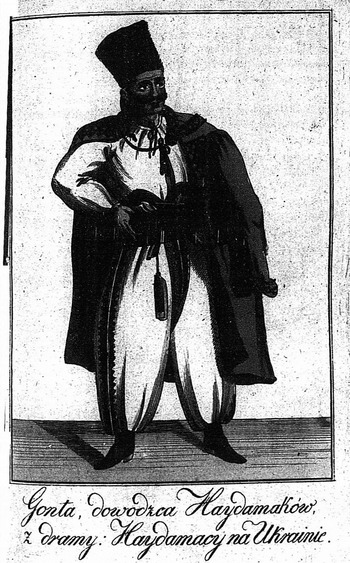
It is highly symptomatic of the prevailing tastes that Kamiński chose to give his translation the local Polish-Lithuanian color, that he selected the memory of the Zaporozhian brigandage as his focus, and that the final product proved so successful with the public. Körner's original drama had been set on the Austro-Italian borderland and had featured “average robbers,” but Kamiński moved the story to a generic Ukrainian environment. The name of “Ukraine” is mentioned already in the title. In the Polish-language use of the time the term “Ukraine” denoted only the territories of the Dnieper basin, more or less today's central Ukraine, a region quite distant and exotic for the Galicians, who would have associated it with the Cossacks and Tatars. More precisely, the play is set in Chyhyryn (Polish: Czehryń) on the banks of the Dniester. The real Chyhyryn is located on the banks of the Dnieper, and it is difficult to guess whether the Dniester name is there due to a copyist's mistake or whether Kamiński intentionally chose the river that ran through the Galician territories to appeal to his public that had only a very vague sense of Ukraine's geography. However, the choice of Chyhyryn is very telling, as it was a capital of the seventeenth-century Cossack Hetmanate. Though few Galicians at that time would have understood Chyhyryn's historical role, the very name was clearly associated with the Cossack history and the bloody wars of that period. Lastly, it is specified that the events take place in 1768, during the koliivshchyna unrest in the Commonwealth's part of Ukraine, which, at least until the events of 1846, was remembered as the most horrific peasant rebellion in Polish-Lithuanian history. The reference is further strengthened by the fact that Kamiński's brigands are named after famous haidamaky of the 1760s: Gonta, Charko, and Żeleźniak. A picture published in a L′viv periodical in 1819 shows an actor impersonating Gonta, possibly Kamiński, dressed as a Cossack with two pistols, wide pants, and a black moustache (Figure 1). Some elements of his garb (coat and hat) resemble more that of the Ruthenian highlanders of Galicia.Footnote 28 This is probably no accident: Carpathian Ruthenian opryshky were much closer to the experiences of Galician readers and theatergoers than the Ukrainian Cossacks. They would be more recognizable to the L′viv public, which would associate them with the rebellious masculinity of the Ruthenian commoners.
Image of an actor dressed as the Cossack leader Gonta. Pszczoła Polska, no. 1 (1820).

Haidamaky, Ukraine, 1768, Chyhyryn, Dnieper, Dniester, Gonta, Żeleźniak, clearly the setting was painted with very broad strokes, but all the elements point in the same directions: Ukraine as an exotic past land of Cossack brigandage and widespread fear of commoners’ violence. Taken together, the derivative character of the work, the dearth of details, and the spurious nature of those few that have been provided (the Dniester/Dnieper slip) showcase the peculiar way in which the Galician public knew Ukraine. Their knowledge was shallow, composed of a very small stock of commonplaces, but still this meager repertory could be activated to evoke powerful, if somewhat contradictory, feelings. On the one hand, Körner's drama was made more Polish-Lithuanian, more native and familiar, while on the other, the original's indistinctive robbers were replaced with exotic figures from an imagined borderland. For the Galicians, Ukraine was a frontier that was more appealing and exciting than Lombardy. The Polish-language public was eager to watch productions that would quench their thirst for the exotic, but at the same time present stories with which they could easily identify as noble-born citizens and landowners (aspiring or real). The arrival of the Cossack brigands on stage heralded new, violent esthetics, which were met with mixed responses, but the overall success enjoyed by this play showed that the classical theater was in retreat.
Kamiński's play presents a world driven by elemental passions and social conflicts. It is a story of an orphaned girl, Helena, raised by a family of landowning nobles. She secretly loves her benefactors’ son (and is reciprocated) but tries to suppress her feelings because she is not an equal match for him. Her stepparents promise her hand to their sinister servant Tymeńko, but they eventually overcome their social prejudices and agree to their son's marriage with Helena. Thus, they break the word given to Tymeńko, who is in fact a runaway haidamaka. Passionate about Helena and infuriated by his masters’ treachery, he facilitates a Cossacks’ assault on their manor. Eventually, all ends well for Helena and her adoptive noble family.
The plot allows some disturbing scenes of violence to transpire on stage. This was something shockingly new for the Polish-language public of the time. One enraged reviewer from Lithuania described how he had escaped with his children from the theater where he had seen so many sabers, knives, and rifles, not to mention a hut that burnt down on the stage. Later that night he was woken up by his son's moans: The boy had a nightmare about the haidamaky.Footnote 29 Ultimately, these formal innovations, though smacking of Romanticism, conveyed an unmistakably sentimentalist and conservative message: It is the loyal servants, loving children, and, above all, benevolent parents that can make this imperfect and unjust world a better place. True, at least some of the evildoers were provoked into rebelling against the right order of things by the wrongs that they had suffered at the hands of the unjust notables. This admission, however, does not diminish their culpability. Instead, it strengthens the sense that they are deprived of any meaningful agency and control of their lives.
Tymeńko, the central villain of the drama, is a tragic figure but “not a natural-born Cossack.”Footnote 30 Born out of wedlock to a powerful lord, his relatives deprived him of the part of inheritance that his father had arranged for him. Seeking revenge, he becomes a haidamaka. He is torn between the world of the Cossacks, which is one of criminal violence and mindless revelry, and that of the landed nobility. The latter is an orderly, stratified society, imperfect, but steadily developing in a more humane direction. It is an embodiment “of decentralized, noble Enlightenment” with its idealized “educated landowner, paternal towards the peasants, understanding the case for reforms but at the same time seeing the necessity of retaining ancient traditions.”Footnote 31 In the context of Vormärz Galicia such a position can be identified with, for example, Tadeusz Wasilewski and Prince Leon Sapieha who in the 1840s tried to persuade the Crownland's estates diet to abolish the corvée.Footnote 32
The haidamaky, the real ones, not like Tymeńko, are presented as barbarous felons who just like to pillage, slaughter, and rob. Alcohol seems to be their only entertainment and courage their only virtue.Footnote 33 There are no women among them, and they seem to disdain women completely.Footnote 34 The possibility of a pleasant future in Zaporozhia is mentioned in passing, but the overall impression is that violence and destruction are the real telos of their actions.Footnote 35 Although a good deal of the plot revolves around a young female character, the haidamaky never seem to be interested in any sexual gratification. This may be partly due to the sensibilities of the time. On one occasion Gonta appreciates Helena's beauty: “What a pretty girl. It's such a pity that I need to spare her life, but I gave my word.”Footnote 36 Perhaps one should not understand these words literally, but rather as an allusion to rape. Nevertheless, pure destruction remains the order of the day: “Death and blood is our password.”Footnote 37
The portrayal of the Cossacks offered by Jan Nepomucen Kamiński in his Helena is a faithful continuation of the Polish-Lithuanian noble tradition that presented the violent rebellions of the Ruthenian commoners as acts of mindless savagery, perpetrated by creatures incapable of rational thinking or controlling their actions, in other words, deprived of true agency.Footnote 38 In Kamiński's play a manor inhabited by noble-born and noble-minded landowners is besieged (and wilily penetrated) by the savage haidamaky, but eventually the forces of light manage to defeat both the elite prejudice and the plebeian violence. The overall message is that of Enlightened conservative reformism that Kamiński's adaptation has enriched with elements of cultural and class determinism.
The next author whose work will be analyzed here is also one of the most interesting literary personalities of his time. Tymon Zaborowski came from a landowning family from Eastern Galicia.Footnote 39 He was born in 1799 and studied in the prestigious Liceum in Kremenets′ in the nearby region of Volhynia in the Russian Empire, where he was a member of a student writing club. He worked for a while as a government official in Warsaw, at that time the capital of the rump Kingdom of Poland (the so-called Congress Poland). After that, he returned home, where he committed suicide in 1828.
During his short life he wrote several literary works.Footnote 40 Few of them were printed, but he was not an unknown poet: His poems circulated in manuscript copies, and he was universally recognized as an accomplished artist. His works are still more Classicist than Romantic, but one notices in them that a change was already in the air. Especially characteristic is Zaborowski's interest in his region's history. He was most fond of the early medieval Rus′, especially the pagan period and the times just after the arrival of Christianity. Kyiv-based archeologists Oleksii Komar and Nataliia Khamaiko argue that the so-called Zbruch idol, a limestone statue discovered near his family estate in 1848 and displayed in the Archaeological Museum of Cracow ever since, is in fact one of Zaborowski's garden ornaments that was mistaken after his death for a real ninth-century cult image.Footnote 41 Zaborowski's pagan longings resemble the later Ziewonia group. Some of its members were also interested in Cossack themes, for example, Augustyn Bielowski and Lucjan Siemieński. Both the pre-Christian past and the Cossack struggles could be conceptualized as instances of a freer and more genuine Slavic way of life.
For the purposes of this article, the most relevant work of Zaborowski is his manuscript drama about the Cossack hetman Bohdan Khmel′nyts′kyi. The piece comes from 1823 and, according to the dedication, it was the author's first finished play. However, it was not published during his lifetime and its reach must have been very limited.Footnote 42 Zaborowski followed the Classicist rules in an exemplary fashion: the events take place during one night, there are only four characters, and no violence is shown on the stage. Overall, it is a model but flat example of literary Classicism, although the author's fondness for settings full of rocks suggests Romantic inclinations.Footnote 43 The two most important Cossack protagonists are Bohdan Chmielnicki and his son Tymotej (Polish spelling of names that are present in Zaborowski's text is used here). The latter is very close to the ideal Romantic hero: young, noble-spirited, and tormented by an internal conflict.
The two passions that fuel Tymotej's internal struggle are, on the one hand, his hatred of the Polish-Lithuanian nobles, who wronged his parents (especially his mother whom they disgraced), and, on the other, his love for his wife, the Moldavian Princess Helena, presented as an angelical creature. Both emotions belong to the wider realm of family love, but the marital one could be said to have more to do with selfish self-fulfillment, whereas the filial one is both more violent and more altruistic or patriotic.
Tymotej is a secondary figure in comparison with his father Bohdan. Hetman Chmielnicki is presented as a tragic but undeniably wise and noble statesman, who transforms his private struggle for revenge into an all-out national revolution. The nation and fatherland in question are identified as the Slavs and Poland: Ostensibly, the two are interchangeable. Chmielnicki rejects the vision of becoming a Eurasian conqueror and empire builder and instead declares that “Poland is my fatherland, whereas freedom is my element.”Footnote 44 Such an explicit rejection of imperialism and emphasis on liberation is a direct and critical commentary on the cult of Napoleon.Footnote 45 Chmielnicki's ultimate goal is to crush the Commonwealth dominated by the magnates and build a new one in its place where “liberty and an aurora of peace” would reign: “Poland had to collapse, but from its rubble must/Rise a new edifice of a Ruthenia united with Poland./This intention, sword and book of human laws in hand,/I plan to support with all the might of Slavs … The violators of laws will fall—the nation will survive/And free it shall continue the erased history of free ancestors.”Footnote 46 Another crucial detail is that Zaborowski's Chmielnicki does not mention God, but “supreme Beings! You celestial powers/That can bind with an invisible chain/These many worlds animated with spirit.”Footnote 47 This is in line with both the Classical lexicon that prevailed in tragedies and with the Romantics’ fascinations with the “primordial” religion of freedom-loving Slavs.Footnote 48 In short, Zaborowski presents Chmielnicki as some sort of neopagan and a visionary leader of democratic revolution that never was, but which the author wishes was otherwise. Eventually, betrayed by another Cossack commander, Chmielnicki loses, but the deeper cause of his downfall is more complex. One hint is given in the already mentioned fragment in which he rejects the possibility of building an empire extending to India and China.Footnote 49 Chmielnicki presents this decision as a rebellion against the verdicts of fate. In the world of Classical and Classicist drama such a rebellion, even if motivated by compassion for the oppressed, falls under the rubric of hubris and cannot go unpunished.Footnote 50
The Cossack coloring was not developed by Zaborowski. In fact, Bohdan and Tymotej are surrounded in the play by the Moldavian knights from the entourage of Helena, rather than the Zaporozhian Cossacks. Chmielnicki is an indistinct, tragic hero. His one original trait is his political agenda of liberty and peace, which makes him a sort of democratic hero of the Commonwealth. It is here that it becomes clear that the Cossacks are not a completely meaningless label. They have been selected by Zaborowski because of their associations with freedom that were useful for his purposes. There is no trace of the fears and prejudices that have been exploited with such a skill by Jan Nepomucen Kamiński. Instead, Zaborowski's Cossacks evoke the glorious Polish-Lithuanian past and epitomize the democratic struggle of the disenfranchised masses against the great lords’ oppressive power.
At one point, Chmielnicki's faithful lieutenant Wodowicz explains that he, who was brought up in the Zaporozhia and thus filled with the love of truth, will never become a flatterer.Footnote 51 Elsewhere, Chmielnicki talks of “the free shrubs of Zaporozhia,” suggesting a link between Ukraine's nature and the Cossacks’ love of freedom.Footnote 52 The Zaporozhian way of life is unequivocally associated with being straightforward, free, and courageous, traits that can be opposed to the duplicitous and effeminate ways of courtiers and aristocrats.Footnote 53 It is also clear here that Chmielnicki and his Cossacks are of Ruthenian ethnicity, which is separate from the Polish. However, the nature of the relationship between the Poles and the Ruthenians is far from transparent because they are very close and form one historical and political entity. It seems that Zaborowski's failure to develop the Cossack coloring was caused by the limitations imposed by his ambition to write a highbrow Classicist tragedy, not by his lack of interest in the Cossack identity.
Zaborowski's drama is a historically valuable piece that depicts in resolutely positive terms a charismatic male hero leading a democratic rebellion against the traditional social order (a treatment of the topic much more radical than anything that can be found in the works of, say, Markiian Shashkevych). The subversive character of the piece becomes especially evident when we compare it with Kamiński's Helena. To render his topic serious and lofty, Zaborowski employs the format of a classical tragedy, which he fills with Cossack content and a revolutionary message. Overall, it is not a convincing artistic achievement, but it does document the author's pursuit of a political drama that would convey his fascination with masculine leadership in charge of the violent masses fighting for emancipation. Even before the arrival of full-blown Romanticism, the Cossack myth seems to have been the best vessel for such radical messages.
Romanticism Victorious: Lucjan Siemieński
The rise of Polish-Language Romanticism in Galicia coincides with a period of relative tranquility and political optimism, which is epitomized by the Bohemian Prince August Longin von Lobkowitz, who held the post of imperial governor of the Crownland from 1823 to 1832. Lobkowitz was a Polonophile of sorts and when, in 1831, a revolution in the rump Kingdom of Poland was followed by a war with Russia, the governor (not without Metternich's tacit consent) allowed Galicia to become a haven for Poles from the north. Whatever the original causes and intentions behind it, Prince Lobkowitz came to stand for the relative liberalism and benevolence of the Austrian authorities of that period. His departure in September 1832, followed by the Münchengrätz Convention, heralded a policy change and from that moment on the aspiring revolutionaries saw the Austrian government as an enemy no less malicious than its Russian counterpart.Footnote 54 It was also then that Romanticism finally became the order of the day and its followers no longer needed to justify their allegiance.
The 1830s and 1840s were a period of intense conspiratorial work in Galicia that peaked in the years 1835–38 and 1845–46.Footnote 55 After the end of the Polish-Russian War of 1831, thousands of émigrés from the Romanov-ruled Kingdom of Poland were scattered all around Europe, mostly in France, but also in Belgium, the German Confederation, and those territories of the former Commonwealth that lay beyond the borders of the Russian Empire, that is in the Free City of Cracow (formally independent until 1846), the Austrian Crownland of Galicia, and the Prussian Grand Duchy of Poznań. The émigrés were mostly young, single males without professions and as such exceptionally susceptible to the allure of conspiratorial and revolutionary activities.Footnote 56 Some of them took also to writing about the Cossacks.
Truly Romantic Cossacks had arrived in the Galician public sphere even earlier, in the second half of the 1820s. A few Cossack-themed poems by Józef Bohdan Zaleski were reprinted in the second volume of Jan Julian Szczepański's Polihymnia, a pioneering six-volume anthology of Polish-language poetry, which was allegedly present in every cultured household in L′viv.Footnote 57 Largely forgotten nowadays, in 1827, Zaleski was certainly “the Cossack poet.” He was involved in democratic organizations, but his works published in Polihymnia do not have any explicitly political thrust. Yet, the Cossacks whom Zaleski depicted were easy to associate with the virile nonconformism, love of freedom, and the sociopolitical disenfranchisement—terms in which the young sympathizers of democratic conspiracies liked to think of themselves.
Perhaps the most important non-Galician Cossack-themed piece easily available in L′viv was Seweryn Goszczyński's Zamek kaniowski (The Castle of Kaniv), published in Warsaw in 1828. For example, Markiian Shashkevych, a poor seminarian, included a translation of its fragments in Rusalka dnistrovaia (The Dniester Nymph). Cossack themes were also explored by less prominent Galician authors, such as Stanisław Jaszowski, Wincenty Pol, or Augustyn Bielowski, the leader of Ziewonia, an influential paganist Slavophile literary group.Footnote 58 In the Ossolineum library the inhabitants of L′viv could also find Mykhailo Maksymovych's collections of Ukrainian folklore with many Cossack-themed pieces.Footnote 59 Overall, by the 1830s Cossack motifs became quite widespread in the Galician public sphere.
The author that best demonstrates the way in which the Cossacks were used in Galician literature of the 1830s is Lucjan Siemieński.Footnote 60 He was born in 1807 into a noble family that leased an estate from an aristocrat. He fought as a volunteer in the Polish-Russian War of 1831 and after the defeat he returned to Galicia, where he became active in several antigovernment plots. It was there that he befriended Seweryn Goszczyński. Together, they were active in the already mentioned Ziewonia.Footnote 61 The paganist fascination of authors grouped under this label can be explained by two factors: first, the hostility toward the popes who tended to support the post-1815 monarchical governments and opposed the Polish-Lithuanian insurrectionary conspiracies and second, the search for the pure and democratic essence of the Slavic peoples, unspoiled by the Latin Catholicism imported from the West.Footnote 62 The latter motivation also partly explains the interest in the figures of Cossacks.
Later in his life, Siemieński made a complete U-turn and adopted the more restrictive brand of Galician conservatism (not unlike many other democrats of his generation). At that time, he would rework and censor the pieces he had published in his youth to blunt their radical thrust. Siemieński's Cossack-themed works come from the earlier period of his life when he was still a revolutionary conspirator in L′viv, under the strong influence of his fellow writer and clandestine activist Seweryn Goszczyński. In 1835, Siemieński published a short story titled “Wieś Serby” (The Village Serby) in the Rozmaitości (Varieties), a supplement to the Gazeta Lwowska (The L′viv Gazette), which means that it was easily available to the educated strata of the Galician public. This work was a sort of homage to Goszczyński: Siemieński adorned it with epigraphs from Zamek kaniowski, and “Wieś Serby” can be seen as an attempt at transplanting the topics and devices of Goszczyński's gothic poem to the genre of short story. Three years later, Siemieński's poetical collection entitled Dumki (Ballads) appeared in Prague. Most of its contents were unorthodox translations from Little Russian Folksongs published by Mykhailo Maksymovych in the Russian Empire.
Siemieński's works are written in a more distinctly “Cossack style” than those published in the preceding periods. One can see that there is already a stable and universally recognizable repertoire of Cossack motifs and narrative devices on which the authors can draw. At least in part, this enrichment and stabilization can be attributed to the better acquaintance of the urban public, including Siemieński and his readers, with Ukrainian folk culture. The most striking feature of Siemieński's Cossack works is their radical thrust. He heralds the approaching violent revolution so openly that it leaves the present-day reader wondering about the efficacy of Austrian censorship, especially given the fact that it often suppressed some truly innocent texts.Footnote 63 When Siemieński is not following the folk songs in describing the Cossacks as manly, solitary warriors, disinherited wandering knights, or captives at the mercy of infidels, he leaves no doubt that they represent the militant people that will sooner or later overthrow the unjust regime. In the Dumki, there are only two pieces that are Siemieński's original compositions: “Napierski” and “Czerniawa” (Rabble Riot). The first describes the execution of an obscure historical personage, Aleksander Kostka-Napierski.Footnote 64 He was a leader of an antinoble uprising that broke out among the Latin Catholic highlanders of the Tatra foothills region during the Khmel′nyts′kyi's Uprising. The topic was especially attractive to the Polish-Lithuanian revolutionary democrats, as it allowed them to erase the ethnoconfessional dimension of the greatest Cossack uprising and present it as a Commonwealth-wide social revolution. Czerniawa, in turn, is the last poem of the volume, which suggests that it is meant to be a summary or epilogue. It describes how the peasants long for a bloody overthrow of the nobles’ power.Footnote 65 It is clear that the change must be violent and that there is an insurmountable fear and hostility between the masters and their subjects, although Siemieński also introduces a noble-born revolutionary plotting with the peasants.
“The Village Serby” short story could seem innocuous, but Siemieński invested great effort into charging it with his antinoble politics.Footnote 66 On the surface, it is merely an exercise in Romantic conventions: taking a typical folk plot as a point of departure Siemieński creates a sensational piece about a haidamaka’s amour and his consequent capture by the Polish-Lithuanian military. However, not only is the central haidamaka protagonist presented as a positive figure, but more importantly, he is identified as Ivan Gonta, one of the main villains in Polish-Lithuanian historical memory: the Cossack commander responsible for the slaughter of thousands of noble and Jewish civilians in Uman′ in 1768. The young ensign, Gonta's main competitor, is a cowardly aristocrat, motivated only by lust and haughtiness: He pays a greedy miller to have his pretty young wife Tetiana, but he does not know that she is Gonta's lover. True, there is also the figure of the ensign's righteous, noble-born, old servant, but this only serves to emphasize the corrupt nature of the world dominated by powerful rogues of illustrious birth who can ill-treat their worthy retainers.
Gonta is an accomplished specimen of Romantic hero: a dexterous and hypermasculine warrior, but at the same time a commoner, a true son of his people: “Everything in his appearance was Ukrainian and belonged to a Ukrainian, a Cossack.”Footnote 67 Gonta is fully immersed in both the folk culture and the nature of his homeland. At one point, in accordance with the stereotype already codified by Herder, the narrator states that a native of Ukraine is a “son of poetry” and later he has Gonta sing a folk dumka about love.Footnote 68 Gonta, however, is by no means an idyllic figure resembling the harp-playing Ossian. He is extremely violent and his soul is tormented by diabolical forces and memories of committed crimes, leading him to the verge of madness.Footnote 69 Most importantly, Gonta is haunted by the images of the social rebellion that he led and that is reduced by Siemieński (in line with the Polish-Lithuanian historical memory) to the massacre of Uman′: “The Moon looks into his eyes, the crow drags his damned soul to the abyss of the past populated by dancing specters of burned rubbles, tremulous hearts and skeletons defiled by the carnage. Caws into his ears the scream of the people drowned in the well of Uman′, of the infants smashed against the walls. His body is drilled by the pain of the flayed strips of skin, of breasts cut off, choking with smoke.”Footnote 70 The commoners’ rebellion is presented as a stylized, gothic feast of violence, which does not necessarily deflect the reader's sympathy from the person of its leader, but rather endows him with a sinister allure of a Byronic villain. Gonta's main opponent, the noble-born Polish-Lithuanian ensign, has a vision similarly revealing about his past and psyche:
Imagination, the tightrope walker, started to gambol above the ground, ever lighter and sprightlier floating above roofs and balconies and cupolas of the capital city's towers. A hall in the royal castle: a ball, scores of candles glowing in diamond chandeliers; walls of mirrors, vaults of mirrors, floors of mirrors … He, transformed into a butterfly, skirts of his tailcoat shaped as wings, a colourful powder spilt by his blonde allongé wig … Invisible angelical music swayed his heart to bliss, blowing in his wings like a light wind. He soars, glides, penetrates with his eye. He shall dive upon the chalice of the blossomed rose.Footnote 71
Not unlike his contemporaries Faddei Bulgarin and Nikolai Gogol′, Siemieński others the Polish-Lithuanian nobles as effeminate, narcissist, and Westernized fops and contrasts this image with the resolute yet ultimately destructive masculinity of the Ruthenian commoners. He does not downplay the ethnic dimension of the conflict (Poland vs. Ruthenia), but rather emphasizes it by frequently using the term “Lach” (in Ukrainian and Russian Liakh), the traditional Ruthenian term for the Polish-speaking, Latin Catholic nobility (but not the commoners, usually referred to as Mazury). For Siemieński the Ruthenian plebeians embody the Volksgeist of Poland-Lithuania better than the traditional Polonophone elite.
There is an evident gender dynamic that structures this story. Gonta and his Cossacks represent the masculine sphere, whereas the miller's wife and the lecherous ensign represent the feminine. Gonta's masculine environment is characterized by freedom of movement and transparent rules that allow fair confrontations among equal males. Yet, Gonta is suffering, haunted by the committed crimes and the lack of stability. He dreams of settling down as a family man presiding over his former fellow Cossacks turned tillers. In other words, he wants to emasculate himself and become a noble landowner: “Before dawn we will rush to Moldavia: I have enough money, I have thirty lads, we shall establish a settlement upon a hill. There will be a white manor in an oak grove. You will be the lady, my sweetheart, and I will live like a boyar, feasting and loving.”Footnote 72 Eventually, Gonta perishes, because he lets himself be lured into the treacherous feminine realm where his masculine skills are neutralized. When his companions call him to join them in battle against the Poles, Tetiana's sexual charm paralyzes him:
“Get up, ataman!Footnote 73 The Pole is rushing from the village!”
The ataman does not hear: he is sucking pink berries, he is drowning in gazes, he drags there with his whole soul.
The Cossack assaulted him with a question:
“Ataman! What shall we do?”
… And the commander tore himself from Tetiana's lips, released her from his embrace and leapt to his feet. It was a spark struck with iron …
The ataman puts his foot in the stirrup, he already grabs the mane, but has a demon pulled his hair, so that he lets go the stirrup and the mane? The ataman glanced in the direction where Tetiana stood. Her look melted into him. Beams radiated from her eyes as if from the Moon. They attracted the Cossack's soul with a strange power of spell, invincible, stronger than the iron will of the man. She stood there with her hands bent to embrace him, with burning lips, with breast elevated by sigh. And the ataman sucked the pink berries again, drowned in gazes and forgot about the world in her embrace.Footnote 74
At the end of the story it is revealed that the miller's wife is a witch, who from the very beginning meant to destroy the Cossack leader. It is left unresolved whether she is a sellout and her actions are deliberately malicious or rather she truly loves him, but her feminine essence tragically contradicts Gonta's masculinity. In any case, it cannot be denied that, on the one hand, there stands a manly freedom-loving Cossack, while on the other, a female witch and an effeminate arrogant lecher of noble birth.
The politicized use of the Cossacks and related symbols of commoner resistance culminates in the early works of Siemieński. He constructs a clear opposition between the Cossacks’ masculinity, as defined by their bellicosity and love of freedom, on the one hand, and the effeminacy of the nobles, characterized by immorality and oppressiveness, on the other.Footnote 75 There can be no doubt that Siemieński, as a narrator, fervently sympathizes with the former realm. The picture offered by him is black and white and excludes everything that does not fit his ideal of virile revolutionary firmness. In comparison with this one-dimensional vision, it is easier to appreciate the playful gender dynamics of Michał Suchorowski's vaudeville analyzed in the next section, dynamics that enabled him to convey an alternative vision of civic emancipation and question the myth of democratic male brotherhood.
In Search of Alternatives: Michał Suchorowski and Liberal Patriotism
Michał Suchorowski is the most enigmatic author of all those studied in this article.Footnote 76 In 1827, he graduated as a doctor of law from the University of Padua and started a lawyer's career in L′viv. A few years later, involved in some sort of fraud, he was stripped of the right to practice his profession. In 1839, he was found guilty of armed robbery and murder and sentenced to twenty years in prison, which he served in the notorious Moravian fortress of Špilberk (now part of the city of Brno) until its closure in 1855. Apparently, his case was purely criminal and had no political dimension.
Suchorowski published several unusual works during his lifetime, among them, a multilingual volume with songs celebrating the millennium since the Christianization of Slavs by Saints Cyril and Methodius (using his own universal orthography for all the Slavic languages) and a collection of light dramas. He was a convinced Slavophile and an avid eulogist of the Habsburgs, whom he presented as successors to the Commonwealth's kings and thus the best suited to unite Central Europe (he produced a genealogical summary showing their descent from John III Sobieski, the liberator of Vienna).Footnote 77 Suchorowski's Cossack contribution stands out because it is the only piece here that was ostensibly designed for popular entertainment. His vaudeville Wanda Potocka czyli schronienie w Lasku św. Zofii (Wanda Potocka or the Refuge in the Forest of Saint Sophia) was published in L′viv in 1832, when he was still a respectable barrister.Footnote 78 Apparently, the play was never staged.
The eponymous protagonist of the piece is a mute girl who saves the city of L′viv from the haidamaky. This choice of topic was an easily recognizable allusion to the opera La muette de Portici (The Mute Girl of Portici, premiered in Paris in 1828, music by D. F. Auber, libretto by G. Delavigne) about the Neapolitan Revolution of 1647.Footnote 79 In the 1830s, La muette de Portici was one of the key symbols of rebellion: For example, the unrest that led to the establishment of a liberal Belgian monarchy started during the performance of this opera in Brussels. In the 1830s, the story of a mute girl ready to suffer for the sake of others was one of the most popular renderings of the myth of revolutionary sacrifice, and Suchorowski must have deliberately addressed this very particular motif.
Neither the plot nor specific developments of the story could have seemed plausible to the public, but it probably did not matter too much. The main goal was to amuse and excite, and so the action oscillates between frenetic violence and carefree burlesque. The drama opens with an overture no doubt shocking to a public steeped in the Classicist decorum that tended to suppress any acts of overt violence. It is, in the author's own words, “an awful picture” representing “a rocky and solitary wilderness.”Footnote 80 The orchestra plays an allegro furioso while a group of haidamaky slaughter a youth and then force his mute sister to kneel and swear that she would remain silent. One is left to wonder why the Cossacks would force a mute girl to make such a promise and how it could be conveyed in a scene without dialogue. From the very first moment violence and unintended absurdity seem to be the guiding principles of Suchorowski's drama.
Wanda Potocka tells the story of a haidamaky’s party that, according to a local tradition recounted by the author in the preface, came from Ukraine to sack L′viv in June 1769. The fact that the events take place on the outskirts of L′viv is probably meant to provide some additional pleasure to the public, who should recognize familiar places such as the Church of Saint Sophia and its namesake forest. At the same time, the author tries to capitalize on the Cossacks’ exoticism: In the first scene after the overture, the haidamaky sing in Ruthenian about the joy of Cossacks attacking their Polish enemies. The latter are enjoined not to take any precautions and to keep drinking wine.
The text emphasizes that the haidamaky include representatives of all kinds of peasants that would have been recognizable to the Galician public: the Mazury (Polish-speaking Latin Catholics of Eastern Galicia), the Cracovians (Polish-speaking Latin Catholics of Western Galicia), the Ruthenians (Ruthenian-speaking Greek Catholics of Eastern Galicia), and the Highlanders (most probably, the Ruthenian-speakers of the Eastern Galician Carpathians). None of these would have been associated with the Ukrainian Cossacks proper. Thus, the play conveys that the haidamaky are simply commoners wronged by their superiors and that their actions are a protest against injustices (which are listed in detail by a haidamaka lieutenant).Footnote 81 In this case, the markers of Cossack identity do not represent any profound ethnic separateness, rather they serve as a means to stage resistance. Like Tymeńko in Kamiński's Helena, Suchorowski's haidamaky are portrayed as victims of oppression, pushed to appalling criminal activities by unjust masters. In contrast to Kamiński's rendering, however, these haidamaky are not agency-less, irrational monsters, but ordinary commoners let loose. Now that they find themselves beyond the bounds of lawful order, they want to get what their masters always kept away from them: valuable goods and attractive women.
Although the tale is not thought through very carefully, its final effect is nevertheless interesting. The haidamaky are not embellished in any way. They are presented as savage, repulsive, and driven by selfish motivations, such as greed and lust. Yet, the social context of the peasantry's oppression is not concealed, which makes the haidamaky’s actions to some extent understandable. In accordance with the vaudeville convention, the whole situation is presented very lightly.
The protagonists of the play are the haidamaka leader, Szwaczka, and his lieutenant, Mykoła, the overture's mute, Wanda Potocka (evidently, no relation to the illustrious family of Counts Potocki), and Jagusia, the flirtatious wife of a jealous and simple-minded milkman. It is these two women who stage the resistance to the haidamaky and save the city. The choice of women as heroines serves several purposes. It enables Suchorowski to make the whole story more playful. The competition between the two sides represented by men and women allows him to exploit the erotic tension between them. On the one hand, the haidamaky’s manly vitality attracts the female protagonists, on the other, it is stated explicitly that the brigands want to appropriate not only the valuable goods, but also the attractive, young women of the L′viv elite, quite a departure from the earlier sensibility that allowed only a hint toward sexual violence. Eventually, the fact that they are defeated in battle by armed females amounts to a complete embarrassment and failure of the haidamaky.
Arguably, the female protagonists fulfill yet another important role. They are, by definition, representatives of the disempowered sections of nineteenth-century society. What is more, their two leaders, the mute Wanda and the merry Jagusia, are both commoners. It is their loyalty to their city and to their compatriots, and it is their skillful mobilization of the noble girls under their protection, that saves L′viv. In the haidamaky, Suchorowski portrayed the wronged commoners who rejected society's rules and violently reached for power and goods that were always denied to them. This is how a respectable bourgeois imagined the revolution. With his commoner female protagonists, the author offered an alternative vision: that of empowerment through patriotism. By rising to defend the social order and their home city, the women become patriotic agents. This is symbolically marked by the fact that they carry rifles and wear the traditional square hats of the Polish-Lithuanian cavalry.Footnote 82 These items suggest that the women have become empowered citizens, as the Polish-Lithuanian national cavalry was a civic formation composed of noble-born “fellows” (Polish plural towarzysze). The haidamaky also pretend to be noble cavalrymen, but they are soon revealed as selfish and destructive rebels.
The value ascribed by Suchorowski to passionate patriotism is exemplified in his treatment of Jagusia. Though a married woman, she consistently flirts with a haidamaka lieutenant whom she considers a noble-born Polish-Lithuanian cavalryman. As soon as she learns of his real identity and intentions, she turns decidedly hostile. On the one hand, the issue of marital fidelity is taken very lightly here: A handsome defender of the fatherland might expect to be awarded some unusual favors by dissatisfied wives of ignorant milkmen. On the other, any dealings with the enemy are unacceptable, no matter how attractive he might be.
The biggest merit in saving the city from the haidamaky is accorded by Suchorowski to the mute Wanda, who, due to her disability, is ostensibly even more powerless than other commoners, but becomes a heroine thanks to her patriotic dedication. This showcases the right sort of commoners’ emancipation suggested by the author. This reading is confirmed by the scene in which Jagusia, after killing some of the ringleaders, turns to the remaining captured haidamaky:
JAGUSIA (looking carefully at the haidamaky): What do I see here, am I not misled by my eyes? Here's our Ruthenian and there are the L′vivians. And it is you who dared to raise your arms against us? Ingrates! Do you have hearts and courage to stain your hands with the blood of your brethren? Did the Polish and Ruthenian soil feed you, so that you turned it into ashes and soaked it with the blood of your fathers and mothers?
HAIDAMAKY (falling on their knees): We beg you to forgive us!
JAGUSIA (moved): Oh no! It was the vile mammon of this world that blinded you, treasures and riches. Rise, brothers! (they do) There are heroic hearts beating in your chests. Give me your hands, take the guns and let's hurry together to save the city.
HAIDAMAKY (taking guns): Hurrah!Footnote 83
Jagusia's example enables the wicked commoner revolutionaries to become empowered commoner patriots. Thanks to her intervention, they return to the civic community, but one that is no longer an exclusively male brotherhood, as it also encompasses patriotic women. Another characteristic detail is that ethnic markers are not erased altogether (in another scene Jagusia even speaks in Ruthenian), but rather amalgamated and presented as belonging to one overarching nationality, that of the former Poland-Lithuania (or perhaps Galicia).Footnote 84 The ideal civic nation imagined by Suchorowski is diverse in both gender and ethnic terms.
Suchorowski's haidamaky stand for social revolution. The revolution is presented in a very simplified vulgarized manner, not as a profound change in the way in which the politics is done and society organized, but as a violent takeover of goods and women by disenfranchised commoner men. The haidamaky’s masculinity is unquestionable and even impressive, but ultimately destructive. The Cossack brigands play a secondary role that can be properly interpreted only in the polemic context offered by the presence of commoner females who stand for an alternative route to empowerment, that of civic participation and sacrifice. Suchorowski questions the revolutionary myth of noble brotherhoods of free males and subverts the then-predominant identification of liberty, virtue, and virility.Footnote 85
It is this piece, written by the most obscure of authors, that goes beyond the commonsensical gender order of its times to capture the crucial opposition between revolutionary democracy and post-1830 liberalism, as well as the latter's main attraction: its promise to combine progress and emancipation with the preservation of social hierarchies and internal peace. In the political field, a similar counterintuitive cocktail of staunch populism and hostility toward any openly revolutionary activities was devised only in the later 1830s by the new sort of Ruthenian activists and then taken up by their ideological inheritors in the early 1860s. Among the Polish-speaking Latin Catholics it was to emerge even later, in the 1870s, when Stanisław Stojałowski launched his peasant periodicals.Footnote 86
Suchorowski's marginality illustrates well how difficult it was to imagine and promote a noninsurrectionary progressive ideology in the Polish-speaking environment of the first half of the nineteenth century. The relative absence of a genuinely bourgeois politics and the predominance of noble memories and political traditions centered on confederacies, insurrections, and French military assistance, made it almost impossible to devise explicitly nonviolent forms of resistance against the encroachments of Austrian government. The domination of the noble estate in public life did not result in the unquestioned hegemony of conservative or reactionary tendencies, but rather strengthened a radical democracy at the expense of liberal reformism. Many politically active Galicians would not fully embrace revolutionary democracy with all its consequences, but they failed to formulate a convincing alternative. As a result, the best they could do was to attempt to water down the radicalism of the conspiracies in which they participated. Unlike in Venetia, there was to be no lotta legale in Vormärz Galicia.Footnote 87
Thus, although riven with unintended absurdities, Suchorowski's play proves to be an innovative political text, successfully conveying the antirevolutionary ideology of liberal patriotism. For the context of the early 1830s, it can serve as a fair illustration of how fundamentally hostile the agendas of democracy and liberalism were toward each other. Suchorowski's marginality also shows the limits of the ideological spectrum available to the adherents of the Polish-Lithuanian national cause at that time. This, in turn, helps us to understand why some individuals and eventually whole social groups chose to abandon this particular national allegiance and embark upon constructing a new one. In the 1830s and 1840s, by choosing the Ruthenian national identification, its (still very few) adherents succeeded in remaking themselves as modern, liberal, and critical citizens, in contrast to Polish-Lithuanian-style conspirators and rebels.Footnote 88
Conclusion
In the first half of the nineteenth century, the figure of the Cossack was already politicized, but not yet nationalized. It was political visions, not ethnic differences, that shaped the nationalist positions in Galicia and determined the ways in which the Vormärz authors employed the literary Cossacks. From the 1820s to the 1840, the representations of the Zaporozhian Cossacks and haidamaky in Galicia depended not so much on the national choices made by the writers, as on their attitude toward the gothic dream of violent revolution. The proper interpretation of these Cossack stories allows us to locate their authors in the spectrum extending from the moderate conservatism through reformist liberalism to revolutionary democracy. These political currents prevalent in Vormärz Galicia do not seem to differ much from the tendencies in the rest of Restoration Europe.
The national choices made by public actors in Galicia were secondary to their factional-ideological allegiances, either conservative, liberal, or democratic. And while the Cossacks may eventually have become the most important ethnic-nationalist symbol for the Ruthenians, during the Vormärz the topic of revolution was the real concern of Cossack-themed belles-lettres. I have therefore removed the nationalist issues from center stage to concentrate instead on the social and political ideals that Cossacks were meant to embody. For J. N. Kamiński, the Cossacks were simply irrational monster-like commoner rebels who threatened the destruction of the social order and the natural hierarchy. Tymon Zaborowski, in turn, appropriated and reversed the negative Polish-Lithuanian stereotypes of the Cossacks to portray a charismatic leader of a genuine Slavic revolution. Lucjan Siemieński did the same, but his attempt was more successful, because he could draw on already established literary models of Ukrainian folk songs published by Maksymovych and of the haidamaky’s gothic violence offered by Goszczyński. The comparison of Zaborowski to Siemieński shows that although Romanticism per se was not a single political ideology, it substantially facilitated the formulation of radical messages. The last author studied here, Michał Suchorowski, did not vilify the Cossacks as irrational monsters (as had the conservative J. N. Kamiński), but instead approached the myth in a critical fashion that allowed him to problematize the very ideal of the democratic male brotherhood and to offer an alternative scenario of civic empowerment through liberal patriotism.
Characteristically, the early Galician Ruthenian nation builders (Iakiv Holovats′kyi, Markiian Shashkevych, and others), whose works have not been analyzed in this article, made only very limited use of Cossack stories and symbols. They were neither revolutionary democrats who extolled violent rebellions, nor paternalistic conservatives who vilified Cossack revolts as irrational gory outbursts. Consequently, they did not find the Cossack motifs convenient for their purposes. The rendering of Cossack stories by each author studied here depended on whether he was more a revolutionary democrat or a reformist liberal in his politics. This nonnationalist, partisan divide was primary and fundamental. The nation-building ideologies of this period were erected on this basis and profoundly conditioned by it. Later development of the politicized Cossack stories and symbols and their eventual appropriation and nationalization by the Ruthenian nation builders can be sketched only very cursorily here.
The Cossack myth came to be embraced by the Galician Ruthenian nationalists in the 1860s, when a new brand of Ruthenian populists emerged to oppose not only the old Polish-Lithuanian nationalists, but also the Ruthenian liberals and conservatives. Though not necessarily revolutionary, these new populists were unequivocally democratic in their outlook and eagerly took up the Cossack-related symbols and stories, drawing directly from the work of Ukrainian nation builders from the Russian Empire, not least that of Taras Shevchenko.Footnote 89
Ideologically, the Poles switched places with the Ruthenians. In the early 1860s, the Polish-Lithuanian revolutionary democrats regained some political momentum for a short while, but after the disaster of the January Uprising in the Kingdom of Poland (1863–64) they would become reliable collaborators of the Galician conservatives who transformed the now autonomous Crownland into the best of all possible Polish fatherlands.Footnote 90 In the imagination of such docile democrats there was no place for the rebellious Cossacks. It was the Ruthenian populists who stepped into the shoes of militant defenders of the people and took over the Cossack symbols and stories. Eventually, they managed to impose their nation-building ideology on the Galician Ruthenian public and the Cossack motifs became virtually synonymous with Ukrainian nationhood, as it was called since the end of the nineteenth century.Footnote 91 This shift explains the choice of name for the Ukrainian Sich Riflemen of 1914.
In this interpretation, politics, understood as a competition between supporters of differing visions of socioeconomic organization, regains its due weight, while ethnoconfessional markers no longer need to be seen as the driving force behind national divisions separating the Galician Poles from the Galician Ruthenians. Eventually, clearly delimited and ethnically differentiated national communities did emerge, but even then, their partisan origins would limit the scope of political debates within them. By this I do not wish to suggest that there was a direct filiation between specific political ideologies and national identifications. One cannot simply reduce Polish nationalism to revolutionary democracy and Ukrainian nationalism to liberal populism. Nevertheless, the specific configuration of political proposals available in the 1830s and 1840s conditioned the contents of each national field and left indelible traces in them.