For feminist critics, the gendered ontology of Plato's Timaeus is infamously problematic. Some, like Genevieve Lloyd, argue that insofar as the Timaeus explicitly associates the nurse and receptacle of Becoming with, at best, the passive placeholder for Form or, at worst, the unruly mother who frustrates the “rational” prerogatives of the demiurgic father, this cosmological picture solidifies, as natural, a gendered and exclusionary matrix that casts the “feminine” as masculine privation—a process that sequesters the feminine to the domain of the Other, to the simple contrary of or counter-pole to order and reason, namely, nothing more than the space or matter of creation versus a true or substantial cause in herself (Lloyd Reference Lloyd1984/1993, 3–7; see also Genova Reference Genova and On1994, 41–51). Even more strongly, psychoanalyst and philosopher Luce Irigaray argues that the feminine does not actually appear in Plato's cosmological project, even in a subordinated role, insofar as the receptacle, nurse, and/or mother merely images the patriarchal desire for domination, producing an other to itself in order that it might have something to control or suppress, and therein situate itself or, rather, himself as primary and superior. In other words, for Irigaray, the image of a passive but also unruly receptacle is not the feminine other as such, but the specular feminine, which is produced as though it were a veritable other simply in order to be able to reinforce masculine prerogative.Footnote 1 Ultimately, for Irigaray, what gendered metaphysical schemas like the Timaeus produce is not a real difference between the masculine and the feminine but merely masculine sex encore (Butler Reference Butler1990, 12), the inversion of itself, an upside-down mirror reflecting what the subject desires to excise from itself or, as Irigaray neatly deems it, an “other-of-the-same.” As Irigaray writes: “For if the other is not defined in his or her actual reality, there is only an other me, not real others.” The feminine within this economy, then, is merely “the complement to man, his inverse, his scraps, his need, his other. Which means that she cannot be truly other. The other that she is remains trapped in the economy or the horizon of a single subject” (Irigaray Reference Irigaray and Martin1996, 61 and 63). Continuing this line of thought and expanding the criticism to include the overt obligatory heterosexuality undergirding the reign of the demiurge in Plato's cosmology, Judith Butler further diagnoses the problem of the Timaeus, arguing that it secures “a given fantasy of heterosexual intercourse and male autogenesis. For the receptacle is not a woman, but is a figure that women become within the dream-world of this metaphysical cosmogony . . .” (Butler Reference Butler1993, 26).Footnote 2 In short, the gender trouble of Plato's Timaeus is that it reinforces obligatory heterosexuality so as to “naturalize” the reality of a strict binary between male and female whereby the former is seen as superior to the latter. Ultimately, the masculine project frames the feminine receptacle as the grotesque, but seductive, complement, a specter of the real, a thing of illusions without quality in herself, a placeholder that can only hope to mean anything if it placidly reflects the will/being of the demiurgic father.
This, indeed, is a bleak picture of Plato's likely story and one that certainly casts the philosopher as one who does not break or queer the typical regulative binaries of classical antiquity but, rather, dangerously reinforces and reproduces them.Footnote 3 Undeniably, many of the late antique Platonists, in their attempt to make sense of Plato's Timaeus in relation to their own understanding of his cosmological and metaphysical projects, replicate this problematic gendered and sexual framework, relegating the feminine to the domain of the specular copy, casting her as an unruly other who must be either tamed into submission or, perhaps, avoided altogether. This strain of Platonic thinking is evident in Plotinus who, leaning on Aristotle, identifies matter with the Platonic receptacle,Footnote 4 and, therein, the feminine. Seemingly embarrassed by Plato's identification of the receptacle as a kind of mother, Plotinus ultimately reinforces the identification only after he reduces the definition of mother to that which receives the seed, who can bring forth nothing without masculine form.
The forms which enter into matter as their mother do it no wrong, nor again do they do it any good . . . so that receptacle and nurse are more proper terms for [the receptacle]; but mother is only used in a manner of speaking, for matter itself brings forth nothing. But those people seem to call it mother who claim that the mother holds the position of matter in respect to her children, in that she only receives [the seed] and contributes nothing to the children. . . . (Plotinus Reference Armstrong1966–1988, III 6.19.1–41)Footnote 5
As would be expected, Plotinus emphasizes the receptacle's passivity and lack of being, its need for form and, as such, he falls prey to the Irigarayan charge of producing an “other-of-the-same” insofar as matter is simply Being's ghostly image of itself, what Being dictates as not itself by excising it from itself, thereby leaving the receptacle/matter to lack all quality/power in herself.Footnote 6 Rather revealingly, Plotinus continuously associates feminine matter with lying and deceit, as well as vanity and an inability to grasp anything substantially.Footnote 7 For Plotinus, the feminine receptacle is utterly unalterable, unaffected, and evil (insofar as it is untouched by the good) and, as such, she is nothing, not even able to hold onto masculine form without producing deceit. As Plotinus writes, “[I]t must remain the same when the forms come into it and stay unaffected when they leave it, so that something may always be coming into it and leaving it. So certainly what comes into it comes as a phantom, untrue into untrue.”Footnote 8 Again, as Butler and Irigaray would charge of Plotinus's feminine matter, the receptacle simply survives as the inscriptional space, the specular surface that receives the marks of a phallic signifying act, writing on her only in order to produce a reflection that images back the seeming “reality” of masculine self-sufficiency, creativity, and independence (Butler Reference Butler1993, 13). Put otherwise, masculine Being seems to produce its own other—the perverted illusion, the bastard copy of the real—seeing its self-inversion as deceit and thereby producing an internal threat to its own self-image, thus reifying the “reality” of its own superiority.
This assigning of the feminine to the realm of the other-of-the-same, to that which merely reflects the inverse of masculine subjectivity, is continuously reproduced throughout the Platonic tradition. One need only reference Olympiodorus who, while retaining the Republic's controversially feminist belief that women can be philosophers/philosopher-rulers,Footnote 9 tempers this progressive stance by reinforcing the identification that women as women (not as philosophers) are receptacles/receivers versus producers who, notably, take pleasure not in rational activity but in grief (Olympiodorus Reference Olympiodorus, Jackson, Lycos and Tarrant1998, 33.3). They are tempters to the world of appearing, lovers of money (Reference Olympiodorus and Griffin2016 164, 3), and enslaved to fate and the body (so much so that Olympiodorus suggests that if a woman looked into a mirror while menstruating she would stain the glass) (Reference Olympiodorus and Griffin2016 220, 1. See also Olympiodorus Reference Olympiodorus, Jackson, Lycos and Tarrant1998, 39.1 and Olympiodorus Reference Olympiodorus and Griffin2016, 168, 5–10). Olympiodorus consistently uses “womanish” as a term of disparagement and often employs it to support his prejudices against foreign powers like the Persians (Olympiodorus Reference Olympiodorus, Jackson, Lycos and Tarrant1998, 6 2), and even refers to women explicitly as property (6 8), that is, they, like the body, are mere instruments of masculine rational agency. Explicitly reinforcing the masculinist/sexist ideology that associates errors (or temptations away from the good) with the feminine, Olympiodorus disparages the body and imagination (associating both with the feminine), referring to the latter as being as seductive and deceitful as Calypso and Circe respectively (Olympiodorus Reference Olympiodorus and Westerink1976, 6, 2, 5–10).Footnote 10
Overall, these associations within the Neoplatonic tradition can certainly give feminists pause, causing them to question the value of a philosophical system that reinforces discourses that cast the feminine as the object of domination or control, the passive or unruly being who needs the agency of the masculine.Footnote 11 Now as many would expect, this feminist concern has not historically been a part of most Neoplatonic research, with very few scholars explicitly discussing these problematics.Footnote 12 Nevertheless, there is a growing trend in late Neoplatonic scholarship, particularly on Iamblichus and Proclus, that has begun focusing on how their respective philosophies redeem what has been conventionally consigned to the realm of the feminine, for example, embodied/temporal life, the world of becoming, and the seeming bedlam of generation (see Shaw Reference Shaw1995; Addey Reference Addey, Johnston and Samuel2013; Layne Reference Layne2019). Indeed, this trend in scholarship highlights the possibility that the late Neoplatonists might offer new ways to think “power” outside of standard patriarchal conceptions of power as domination, that is, as power over (an) other(s),Footnote 13 for example, the masculine over the feminine, form over matter, the Demiurge who subjugates the feminine receptacle, and so on. Contrariwise, there is a strand, still to be fully retrieved, in Platonism that explicitly juxtaposes coercive conceptions of power as an external, limiting force that attempts to control an inferior with power understood in a more robust sense,Footnote 14 that is, in a sense not necessarily constrained to the quest for sovereignty over or mere control so much as that which constitutes the being or life of things.Footnote 15 As we shall see in Proclus's commentary on the Timaeus, genuine power (δύνᾰμις) is to be conceived causally or generatively as a kind of empowering of the Other, an engendering of real and unlimited alterity. Moreover, in Proclus's theological metaphysics, power is not that which merely divides and excludes as a means of control and subordination so much as it secures connection, contact, or a relationship among all things. In other words, there is a form of power for Proclus that is antithetical to power as it is often conceived within patriarchal discourses wherein power culminates in the domination and subjugation of the other, particularly the subjugation of the feminine. Rather, power is conceived by Proclus as a generative and creative principle that empowers and engenders genuine plurality while allowing for transformative relations that enable and support dynamic generation rather than an annexation that seeks to contain or limit all things to the orbit of the same. Markedly, Proclus deems this contrasting form of power in his system the principle of Life (ζωὴ) and, interestingly for our purposes, associates this fundamental element of reality with the feminine.Footnote 16
Consequently, the following will turn to Proclus's conceptualization of this life-giving power and its connection with the feminine in his commentary on the Timaeus. I will first show how Proclus toes the masculinist line that reinforces the naturalness of a gender binary and obligatory heterosexuality (that is, a sexual system that reinforces the superiority of the masculine term as natural), as he certainly asserts the superiority of masculine principles and deities over their feminine counterparts. Nevertheless, when we take a closer look at Proclus's system, we shall see that he does not sequester the feminine to the domain of the passive receptacle, nor is she simply charged with being a bastard image of the masculine that must be controlled or subdued. Rather, in discussing the gendered deities, particularly the goddess Night as well as her image in creation as the mixing bowl in Plato's Timaeus, she and all of her reflections exemplify a life-giving (ζῳογονικῆς) power that produces and sustains the value of authentic otherness, be it intelligible, psychic, or corporeal, while further reinforcing her connective, relational power. In the final section, we shall also focus on those passages wherein Proclus explicitly queers the essentialist and exclusionary nature of the gender binary insofar as nothing in his system is solely male or female, masculine or feminine. To the contrary, insofar as Proclus follows the Neoplatonic principle of panta en pasin (all things are in all things), both masculine and feminine causes, for example, the limiting and the unlimited, sameness and difference, the Demiurge and the Mixing Bowl, or, more mythically stated in his commentary on the Timaeus, Phanes and Night, the human soul and all of creation reflect erotic ambiguity.
Proclus's Gendered Metaphysics
To begin an analysis of Proclus's account of the feminine in his metaphysical schema, it behooves any honest author to emphasize first his reinforcement of the gendered distinction between 1) that which arranges and 2) that which is arranged, or 1) that which fills and 2) that which is filled (Proclus Reference Tarrant2007a, I 132.10). For Proclus, “one should postulate that rivalry everywhere—as it is in gods, intellects, souls, and bodies. At that [first] level it is limit and unlimited, in intellects it is sameness and otherness, in soul it is same and different, and in bodies heaven and generation . . .” (I 132.12–15). Proclus, following the Pythagoreans, expectantly regards male and female as divine attributes, corresponding to the binaries of odd and even, unifying and dividing, static and moving (cf. I, 131.23–26), situating the latter half of the binary as “always drawn up in dependence on the better ones” (I, 132.15–16). Moreover, despite defending a literal reading of Socrates's equality of the sexes in the Republic, whereby men and women are regarded as the same species with the same virtues (I 46. 1–12), Proclus, like Glaucon before him and Olympiodorus after him, reinforces the inferiority of the female during his allegorical/cosmological reading of such equality:
Even where gender had been divided, male and female of the same rank have the same tasks; it is accomplished in an initial way by the male and in a subordinate way by the female. Hence in mortal creatures too nature has revealed the female as weaker in all things than the male. Indeed everything which proceeds from the male is also brought to birth by the female, preserving its subordinate role. (Proclus Reference Tarrant2007a, I 46.17–47.8)
Proclus further solidifies gender subordination within a heterosexual matrix by consistently reminding his readers of the divine couplings between gods like Hera and Zeus, Rhea and Kronos, Gaia and Uranus while further insisting that the feminine marker gives “birth in a derivative way to whatever the others bring forth in their fatherly and unitary way.” As we can here see, Proclus appears to be guilty of appropriating childbirth as a masculine virtue by relegating the role the feminine “agent” plays in delivery to something merely derivative (I 47.15–22).Footnote 17 Consider Proclus's account of the Moon's generative subordination to the Sun:
Here you have the coalition of male and female among intelligible gods, among intellective ones, and among hypercosmic ones. See, then, how the same thing applies to the heaven, since all generation takes its directions from the Sun and Moon, predominantly and in a fatherly way from the former, and secondarily from the latter. Hence she [the Moon] has been described by some as “a lesser Sun.” (I 47.7–13)
At the level of the corporeal, Proclus further naturalizes heterosexuality via reproductive arguments concerned with physiological differences, explaining, “as far as the organs are concerned, nature has made for them a single task” (I 48.1–3). Again, while appealing to the Republic's drawing of lots, Proclus offers an allegorical reading and argues that the divine guardians have carefully contrived the coupling of appropriate males or forms with their corresponding females or receptacles (I 49.17–21), writing: “For in the things of nature too receptacles are distributed so as to suit the forms, and each of the forms would hold its own standing in relation to the changes it undergoes . . . ” (I 51.5–6).Footnote 18
Overall, along with Plotinus before him and Olympiodorus after him, Proclus deploys masculinist ideology throughout his metaphysical project, explicitly promoting not only gender subordination but also reproductive heterosexual tropes that reduce women to passive receptacles.Footnote 19 In this regard, Proclus indeed appeals to patriarchal conceptions of power as domination, relegating the feminine to that which must be governed in order to reinforce paternal sovereignty. Nevertheless, in the rest of this section, I would like to turn to those aspects of Proclus's system that problematize from within his philosophical system both the inferiority of the feminine as well as the reduction of the feminine to a mere receptacle or passive placeholder for form.Footnote 20 Here, we shall see that Proclus leans on a very different conception of power insofar as power is defined as the principle of Life (ζωὴ) itself that is erotically imbued in all things. It will, in fact, be this conception of power that is more central to Proclus's metaphysical system than merely the power whereby X subjugates Y in order to sustain its own ends, in this instance the masculine (sameness/unity/demiurge) dominating or reigning over the feminine (difference/multiplicity/receptacle), that is, the masculine's pseudo-other, in order to have an artifice on which to cast its own inverted self-reflection.
To understand this internal reimaging of power away from the more patriarchal conception of power as dominance and as a constant reproduction of sameness, we should note that for Proclus, prior to the initial hypostasis of Being (itself a mixture of limit and unlimitedness), there exists substantially and independently (Proclus Reference Dodds1932, §90) the archai of the Limit (πέρας) and the Unlimited (ἄπειρον), wherein the former is expectantly the source of all unity, stability, and reality, and the latter is the source of all dynamism and life. The Limit is the principle of wholeness and unification, whereas every differentiation, that is, generation into otherness or plurality, is brought about by the Unlimited. In sum, Limit enables and expresses the identity of things and the Unlimited enables and expresses the erotic outpouring (proodos) of the One, and is, as such, perfect or absolute dunamis, always becoming other to itself while still remaining (mone) itself. In short, the Unlimited is that which undergirds all procession and therein constitutes the Life or vitality of reality, reflected notably in 1) the absolute power (dunamis) of the Intelligible realm, 2) the self-movement of soul, and 3) nature's infinitely productive and generative capacity. While emphasizing the generative and fertile powers of the cosmos, Proclus even couches his language in historically gendered terms, referring to the Limit as a kind of paternal archê (Proclus Reference Dodds1932, §151) and referring to the Unlimited in femininized/maternal terms, arguing that processive power “mirrors that Unlimited which is the primordial parent of the universe, whence proceeded all the generative potency whose transcendent prerogative it is to diffuse the divine gifts in their unfailing succession.”Footnote 21
As can be expected, this distinction between the Limit and the Unlimited ultimately comes to inform the gender binary whereby male or masculine deities are the cause of being “while the female embraces that which projects from itself all manner of processions and distinctions, together with their measures of life and generative powers” (Proclus Reference Runia and Share2008, I 220.5–10. Cf. I 220.15–28). From the uppermost limits of Proclus's system to the lowest, all things are regulated along the lines of this basic masculine/feminine distinction.
[I]n that case (1) Limit and the Unlimited took their starting-points from the gods and penetrated through the whole of reality in whatever manner it exists. They are in fact found in the intelligible realm in virtue of the (2) stable and generative cause of the intelligible beings; they are also found in the intellective realm in virtue of the (3) paternal and maternal principle of the intellective gods; they are also found in the hypercosmic realm in virtue of the (4) demiurgic monad and the zoogonic dyad, and lastly also in virtue of the (5) creative and fructifying potencies. (Proclus Reference Runia and Share2008, I, 226.7–14)
Here it should be noted that despite his reinforcement of a rigid gender binary and the patriarchal propensity to reinforce the “maternal” or “fecund” nature of the feminine, this is not the standard “wandering womb” that needs to be controlled or domesticated by masculine intellect. Rather, Proclus emphasizes that the unlimited, generative principle is the source of procession and, as we shall see, mediation whereby the feminine becomes a divine (rather than errant) cause (see also Schultz Reference Schultz2018; Reference Schultz2019). Ultimately, it will be shown in the conclusion how this seemingly strict dualism between masculine and feminine deities or “divine causes” can be queered and problematized, but for now it should be emphasized that the feminine is identified with the dynamic and processive power of the Unlimited, which ought not be confused with an uncontrollable force that cannot help but “body forth.” Furthermore, this power is found at all levels of reality, be it in the intelligible and stable “generation” of eternal Ideas or in the fructifying capacities of nature.
At the level of Being, the principle of the Unlimited is reflected in the absolute active potency of Life, the middle term between inchoate Being (what is often referred to as the intelligible), and its corresponding term, Intellect (what is often referred to as intellective). Between intelligible Being and intellective Intellect there is the Life of Being (the intelligible-intellective).Footnote 22 Put otherwise, Life is the procession of Being that mirrors the Unlimited in its power of producing infinite distinction, difference, and otherness. Ergo, Life is the actual thinking of Being, through which inchoate Being comes to “know itself” as determinate Intellect. At the level of the noetic, Life is absolute or perfect power (dunamis) and, as such, this procession or connection between Being and Intellect is isomorphic or seamless, truly allowing Being to become an object for itself so that Life generates the unity of thought thinking itself. Ultimately, this highlights how Life is generative but also binding, connecting differences and safeguarding plurality even at the level of Intellect insofar as Proclus insists on the separation between Being and Intellect. Indeed, by insisting on their separation/otherness, the perfection of the processive power to connect through likeness rather than identity/sameness is guaranteed. To emphasize the point, beyond the noetic world, the principle of Life continues to sustain the dynamic procession of reality in the emergence of Soul and the world of generation while also being the principle that maintains their connection to the intelligible and, by consequence, the Good beyond Being, the One. In other words, the principle of Life is that which connects effects to their causes, allowing continuity (sunecheia) without collapsing everything into sameness, that is, into the orbit of self-reflection.
Overall, the principle of Life, which is marked rather consistently throughout Proclus's corpus as feminine, ensures genuine reproduction of otherness, multiplicity, difference, and so on rather than the other-of-the-same or the same encore—a necessary event if the cosmos is not simply to reflect but to embody the Good at the level of becoming and creation. Ultimately, this is true power for Proclus, a kind of power centered on the value of connection and vitalism that, strangely enough, is best understood once we turn to Proclus's overt attempts to map Orphic and Chaldean deities onto his already complicated gendered metaphysical schema.
From Night to the Mixing Bowl: Proclus's Life-giving Goddesses
The importance of the gendered nature of Proclus's higher ontological realities and the particularly potent power of the feminine is more clearly seen in his attempt to square Plato's Timaeus with the gods and goddesses of Orphic mythology and the Chaldean oracles.Footnote 23 To foreshadow the conclusions of this section, the key to understanding feminine power centers on Proclus's characterization of the first gendered deity, Night, and how her Life informs all further feminine emanations, including the power of the mixing bowl in the Timaeus as well as the power of Soul itself. Moreover, Night's role as advisor to the Demiurge, wherein she acts as the paradigmatic deity securing the bonds of sympatheia, highlights the role of feminine power as that which connects or erotically links all that is and all that comes to be.Footnote 24
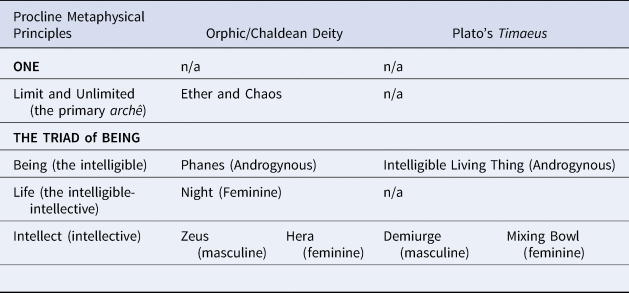
As mentioned, the Neoplatonist synthesizes his metaphysical worldview with the deities of Orphic mythology and the Chaldean oracles as well as images from Plato's Timaeus. To assist readers in understanding this sometimes-bedazzling collapse of metaphysical principles with esoteric mythology and Plato's Timaeus, a rudimentary outline of Proclus's allegorical schema is summarized in Table 1. Its contents will be clarified as we proceed.
Proclus's Theological Metaphysics Applied to Plato's Timaeus Footnote 25

To unpack this syncretic cosmology, Proclus begins with the Orphic/Chaldean deities of Ether and Chaos. For Proclus, Ether and Chaos are to be read as allegorical images of the primordial Limit and Unlimited insofar as “the former of which is situated at the limit of the Intelligibles, the latter in the [region of the] Unlimited; for the former is the root of all things, while for the latter ‘there was no limit’” (Proclus Reference Runia and Share2008, I 428.3–7).Footnote 26 From Ether and Chaos emerges the Orphic egg, representing, for Proclus, primary Being or Being itself in its initial emanation. From the Orphic egg emerges Phanes, housed at the last level of the Intelligible and correspondent to Plato's Living-Thing-Itself from the Timaeus (I 428.10–12).Footnote 27 Here, we should note that primarily Phanes, sometimes referred to as Protogonos, acts as a paradigm of every living thing, whether intellectual, vital, or corporeal, and, as such, is explicitly characterized by both maleness and femaleness insofar it must be a mixture of limit and unlimitedness.
[The Intelligible Living Being] includes both male and female simultaneously, for these [sexes] are present in every order of living thing in an appropriate manner—being present in one manner in gods, but in another in daemons and yet another among mortal beings—and it is necessary that the primary henads of these [sexes] pre-exist within the single comprehension of Living things. From this dyad [of male and female] comes the four forms of living things so that as a result it has also been established as a tetrad. . . . The single form, Living Being Itself, exists up there, and so too does the dyad, male and female. (Proclus Reference Baltzly2013, III 106.10–24)Footnote 28
While essentializing the reality of the sex binary, this passage nevertheless destabilizes the reality of a singular sex presentation, because, as we shall see in the conclusion, the Living Being itself acts a paradigm for all things, therein establishing that each procession, eventually including individual souls, carries within it an image of the dyad of male and female. Again, accentuating the completeness and therein the extent of Phanes's (Plato's Intelligible Living Thing) causal responsibility, Proclus further cements the god's necessary androgyny.
This is why the Theologian fashions a most universal living thing, placing on it the heads of a ram, a bull, a lion and a serpent, and why both maleness and femaleness are first of all in it as being the first living thing—“female and begetter is the mighty god Erikepaios [another name for Phanes],” says the Theologian (Kern Reference Kern1922, 81)–and he was also the first to have wings. (Proclus Reference Runia and Share2008, I 429.27–430.1)
Moving along from this primary androgyne, as we shall discuss their influence further in the conclusion, the first explicitly gendered deity emerges only once the androgynous god, Phanes, parthenogenically gives birth to Night,Footnote 29 celebrated as [both] “female and begetter” (Proclus Reference Runia and Share2008, I 429.27–430.1. cf. Kern Reference Kern1922, 163). Here, Night maps onto the intelligible-intellective order of Life and, as such, is the image of the primordial Unlimited. Sometimes referred to as Maia insofar as she is associated with being the mother of the cosmos,Footnote 30 Proclus depicts Night as initiating the life-giving series of divinities and is thereby predominantly that which constitutes multiplicity and difference at all levels of reality. As that which clearly separates effects from causes as “the separative role is appropriate for the female . . .” (Proclus Reference Tarrant2017, III 179.28–30).Footnote 31 Night emerges as the genesis of authentic otherness as opposed to a merely upside-down or inverse image of the masculine, as through her things actually come into being as distinct and separate from their cause.Footnote 32
Further, as the primary life-giving deity, Night is the first mediating principle of reality insofar as at the noetic level Life joins Being with Intellect, the intelligible with the intellective or, more mythically phrased in Proclus's commentary on the Timaeus, unites Phanes/the Intelligible Living Thing with Zeus/the Demiurge and therein establishes the link of likeness between the Intelligible Living Thing (Phanes) and the intellective creator of the sense-perceptible cosmos (Demiurge).Footnote 33 As the primary mediator, Proclus characterizes Night as the mother of prophecy and truth, an association also confirmed in Hermias's commentary on Plato's Phaedrus. In this account, Hermias emphasizes that the order of Night is the plane of Truth insofar as Night gives “prediction without falsehood” and is thereby a prophet of the Gods (Hermias Reference Hermias, Lucarini and Moreschini2012, II, 153.38–154.3). As such, she is again characterized as the living mediating power between the intelligible (Phanes as Being) and the intellective (Zeus/Demiurge as Intellect), allowing Zeus, the Demiurge, to see and internalize Phanes, the Intelligible Living Thing. Hermias writes,
What is interesting in both Proclus's and Hermias's account is that Night's mediation manifests (makes known) the original, making the transcendent, intelligible light visible at all. Without her mediation, there is no truth or providence insofar as the light would embrace all and thus there would be no distinction, nothing separate to identify—nothing to think, live, or be. All would be absolute sameness, a problem for Proclus even at the level of the noetic. The oracular advice of Night to the demiurgic Zeus, rehearsed at least half a dozen times in Proclus's commentary,Footnote 34 ultimately manifests this unique role of the goddess in engendering otherness not only within the intelligible realm but also in the corporeal. While explaining how Timaeus imitates the Demiurge in his account of the coming-into-being of the cosmos, Proclus writes of the Demiurge's reversion to Night:
[The Demiurge] before undertaking the entire creative task is said to enter the oracular shrine of Night to fill himself with divine thoughts from there, to receive the principles of the creative task and, if it is permissible to speak thus, to resolve all difficulties and above all to encourage his father [Kronos]Footnote 35 to collaborate with him in the creative task. This is what he is recorded as saying by the Theologian in his poem:
Mother, supreme among the gods, immortal Night, how, tell me,
How should I establish a resolute beginning for the immortals?
And from her he hears:
Surround all things with unutterable ether, and in the middle place heaven.
And he is then instructed about the remainder of the creative work. (Proclus Reference Runia and Share2008, I 206.28–207.20; cf. Kern Reference Kern1922 164, 165, 155 and I.2)
Here we should note that Zeus, the Demiurge, is described as entering the oracular shrine of Night—indeed, still an image of penetration into the feminine, but a subversive reimagining of such penetration insofar as the role of insemination is reversed. Night's advice is what plants seed in the Demiurge. She reveals to him how the creative task is to be resolved, how tensions involved in the production of multiplicity and otherness may ultimately remain in contact/communion with their causes. Predominantly, the Demiurge is looking for a way to constitute an other, the sensible living cosmos, that despite its alienation, that is, radical disjunction from the intelligible, can nevertheless still return home, still remain connected, still bask in the light of Phanes or, less mythically understood, can still be. This power of Night to bind or to give advice that assists the Demiurge in crafting a product that will both constitute an other, the sense-perceptible world, while also being erotically joined in kinship, is further invoked when Zeus/the Demiurge asks Night a particularly stunning question just before embarking on his creative task.
[Zeus asks]
How will all things be one for me and also each separate from the other?
[Night replies]
Wrap all things around with unspeakable Ether, and inside it in the middle place Heaven; then inside it place unbounded Earth, inside it place the Sea, inside it place all the constellations with which Heaven is crowned.
Moreover concerning all the other works of creation she further proposed:
But when you stretch a powerful bond over everything
—This is certainly the powerful and indissoluble bond which proceeds from nature and soul and intellect, for Plato too says that “living things were born bound by bonds made up of soul (38e5)—
A golden chain suspended from the Ether. (Proclus Reference Runia and Share2008, I 314.1–16)
Confirming that Night's counsel prescribes the emergence of cosmic sympatheia, Proclus connects Night and her “golden chain” rather cleverly to the procession of Necessity and the Fates at the level of the sensible, thus explicitly resisting a conception of the feminine as an agent of disorder and irrationality (as mentioned, the principle of Life is not the standard wandering womb). Rather Night, that is, the principle of Life, ultimately “causes Law to be enthroned beside him [the Demiurge]” (I 315.13–15) alongside authentic friendship or connection between all things, as, for Proclus, the bond is the paradigm for proportion “engendering sympathy and harmony of opposites” (Reference Baltzly2007b, II 53.28).Footnote 36
Overall, Night models the power of procession and mediation as the principle of intelligible-intellective Life, elucidating how unlimited generative power does not mark the feminine as nothing more than fecund mother nature. Rather, she is the agent of providential power, securing, in her advice to the Demiurge, difference/multiplicity, safeguarding that all things are bound not by absolute identity and hence ensuring that generation is never simply the production of an “other-of-the-same.”Footnote 37 Rather, what is sustained in her procession is a point of contact, a golden chain of friendship, which fortifies authentic difference while retaining sympatheia. In other words, she is arguably the first erotic principle of reality, wherein the erotic does not subsume the beloved into the lover but does the work of both assisting the other in “giving birth” but also connecting terms that seem so disparate, for example, sameness and difference, the beautiful and the ugly, the mortal and the immortal. Rather, her power symbolized in the advice or counsel she provides Zeus/Demiurge enables things to be touched by the good in the other, the beauty and being of things in their relation, in their contact and sympathy so that all things may be both one and many, limited and unlimited. As a consequence, Proclus states that Night's advice or divinely deemed Counsel (literally the goddess Metis—the feminine we, like Zeus, must swallow and internalize), is “the first creator and Eros of many delights” (Reference Baltzly2007b, II 54.26, cf. I 169.18–20).Footnote 38
Returning to the generally paradigmatic role of both Phanes (Being) and Night (Life), Proclus is quick to emphasize that their union is not a marriage, that is, the symbol of divine mixture, and, as such, Proclus is emphasizing that their coupling is not a blending of the two into identity. Rather, Proclus accentuates the importance of their distinction insofar as they are “united with each other conceptually, but are among those things that even with their unification display the separate nature of their powers and their activities” (Proclus Reference Tarrant2007a, I 176.20–24).Footnote 39As Proclus writes of their distinction and their corresponding analogies at different levels of reality:
Consequently some say that he has left it to us to seek some of them by analogy with the two rulers in the heavens, I mean Phanes and Night. For it is necessary for those of a superior rank to act also among encosmic things, because even before the cosmos they lead the intellective gods, founded eternally in the impenetrable chamber of Phanes himself as Orpheus says, calling their secret unrevealing order an impenetrable chamber. So if one wants to enlist the rotation of the Same and of the Other to reveal them by analogy, as being male and female or paternal and generative, one would not miss the truth; and if [one wants to enlist] the sun and moon as juxtaposed powers among the planets, the sun will preserve its likeness to Phanes and the moon to Night. And if this is correct, as it seems to me, [one would not miss the truth] by making the one Demiurge of the universe stand in relation to Phanes the father, an intellect [father] himself—for the theologian [says that even if the birth of the worlds is the job of this latter, it is the former's job to make them], just as this one is [father] of heaven and earth—and making the life-generating mixing bowl [stand in relation to] Night who brings forth all life from the unseen along with Phanes, for the mixing bowl too gives birth to the entire soul for things within the cosmos. For it is better to conceive of both as prior to the cosmos, and to make the Demiurge analogous to Phanes, since he too is said to be assimilated to him in his act of universal creation, and to make the power that is in harness with him and brings forth the universe [analogous to] Night, who produces all things in obscure fashion from the father. (Proclus Reference Tarrant2017, III 169.15–170.14)
Passing over momentarily the problematic identification of the androgynous Phanes with a paternal figure, as this will be discussed in the next section, for now we should focus on the essential role of the goddess in procession. As we have already seen with Hermias, only the goddess, that is, only Night (Life), can enter the impenetrable chamber of Phanes (Being). In other words, only the feminine is that which can penetrate the androgyny, the absolute mixture of Limit and Unlimited, which constitutes Being and all the “secret unrevealing orders” of the All. Accordingly, Night, the power of Life, is that which grants to Phanes the possibility of their progeny, making the inchoate Being determinate Intellect, therein constituting the demiurgic order and the procession of authentic otherness constitutive of the world of generation. Moreover, in the above passage, Proclus makes a final analogy of Night to the mixing bowl, whereby the feminine mixing bowl, rather than the Demiurge, expresses the power (dunamis) of the cosmos's ceaseless but perfective multiplicity. As an image of Night, it is the mixing bowl that adds life to soul, that is, the generative and connective power—a necessary constituent of both Soul Itself, the World Soul as well as individual souls. Proclus writes:
For the souls were brought forth from the Demiurge as far as their being is concerned, but from the mixing bowl as far as their life is concerned—for [the mixing bowl] is the animating cause of the soul's substantive life. Since [souls] are principally lives and made to belong to the life-generating order, on this account their blending begins with the Demiurge but is completed in the mixing bowl. (Proclus Reference Tarrant2017, III 248.13–16)Footnote 40
Remarkably, the mixing bowl is neither a mere object submissively receiving the ingredients from the Demiurge nor is the action of creation completed by the Demiurge's blending. By emphasizing that the act of the soul's creation is only completed by the mixing bowl, Proclus depicts the feminine as an active animating power contributing decisively to the creation of the soul; particularly, she is the soul's constitutive power as that which is essentially animated or living and as that which eternally animates or gives life, fosters dynamism in the world of becoming.Footnote 41
To be sure, the exact identification of the mixing bowl corresponding to a particular feminine deity is sometimes obscured in Proclus's recreation of Orphic/Chaldean mythology but seems to be most often associated with Hera.Footnote 42 She is described as the animating deity embracing all the springs of life, including the divine, angelic, daimonic, psychical, and natural,Footnote 43 and whose virtue is described as explicitly springing from her λᾰγών (Proclus Reference Tarrant2017, III 249.14),Footnote 44 her reproductive powers. She is further characterized as one of the fontal (πηγαῖος) goddessesFootnote 45 who is an “equal accomplisher with the father” (Proclus Reference Tarrant2017, III 249.5) in the production of the cosmos and is coordinate with “the Demiurge like mother with father” (III 249.21). Consequently, “she is the leader of the entire Titanic division and the cause of the division made manifest in souls in accordance with their fated portions” (III 249.22–25). In other words, at this level of reality the life-giving goddess depicted by Hera (again, the mixing bowl in Plato's Timaeus) favors division and multiplicity, ensuring that this world is populated with unlimited otherness: “For she prompts all things towards procession and multiplies them, and makes them fertile through her own illuminations” (III 251.17–22). As such, Proclus offers an allegorical reading of Hera's association with making heroes mad, as, unlike Zeus, who is the cause of rational behavior, the path demanded by the goddess is one in which the hero will be tried by the contests of becoming, of ceaseless otherness.Footnote 46
Ultimately, all souls owe their own living power to the mixing bowl/Hera, whose own proximate causes extend to Night (Life itself) and to the Unlimited, and, as such, souls at once communicate extension into multiplicity in their temporal acts as well as possessing a connective/mediating power to join the sense-perceptible to the intelligible, to assist the other in coming into contact with (rather than being subsumed by) the same. For Proclus, this is the unique power of soul insofar as “the defining characteristic of life is to be attributed to the soul, and the soul is also established in conjunction with the life-giving goddess when the kinds of Being are mixed in the mixing bowl” (Proclus Reference Runia and Share2008, I 151.5–10). He further writes:
[F]or the goddess who is the cause of the soul also has a middle position among the gods—a rank she also appeared to have to the Theologians since she provides the link between the two Fathers and projects from her womb the life of the Soul. [emphasis in italics are mine] (Proclus Reference Baltzly2009, II 129.24–130)Footnote 47
Interestingly, then, we see that soul, like Night, acts as the erotic bridge and is thus generalized as feminine. This is clearly the case when Proclus describes soul as the “womb”Footnote 48 which, as the above quote indicates, receives life from the womb of the goddess, enacting a kind of feminine to feminine inheritance.
Overall, unlike Plotinus and others who reproduce patriarchal conceptions of the feminine as merely an other-of-the-same or as impotent or unruly matter, Proclus emphasizes the power of the feminine and its guidance in securing the unique life of the soul as between the intelligible and the sensible, as the connection or erotic mediator between the two. Ultimately she is that which “holds the guidance of the universe” insofar as “in the middle the soul demonstrates both extremes, and by this fact imitates its cause [the goddess] who is ‘visible on both sides’ and has ‘faces on both sides.’” Overall, “‘soul sends forth the channels of corporeal life and contains within herself the center of the procession of all being’ (Proclus Reference Baltzly2009, II 130,25. Cf. Lewy Reference Lewy and Tardieu1956/2011, 135 and Majercik, Reference Majercik1989).”Footnote 49
Conclusion: Gender Ambiguity and Feminist Criticisms
It is clear that, despite valorizing the Limit over the Unlimited and consequently male over female in the realm of generation, we can see that the feminine is not at all associated with impotence or passivity but with a peculiar kind of power, that is, with processive/mediating power, a kind of engendering and empowering power. Proclus explicitly regards this power as bringing about the life or dynamism of reality as well as law, counsel, and friendship, all of which mutually establish one another. Further, this image of feminine Life squares with Proclus's descriptions of Night as that which distinguishes or causes difference/alterity and as that which connects without subsuming all things in the same. Ultimately, this understanding of a kind of life-giving feminine power undermines the patriarchal obsession with dominating power, showing that such a form of power is, perhaps, not even power at all, perhaps even impotence insofar as masculine systems of dominance and control cannot produce/see/sustain/love an other that does not simply reflect itself. In contrast, what is coded as feminine Life is a kind of power that loves the other, sees its beauty and kinship without appropriating or dominating it, instead allotting the other a space wherein it can manifest its own life, its own good. Furthermore, as we saw with the god Phanes, Proclus's gender system begins with a primordial ambiguity that undergirds the fact that all existence is a combination or mixture insofar as “every such entity contains both a unity and a plurality within itself” (Cf. Proclus Reference Proclus, Saffrey and Westerink1968–1997 III 8.32.27–28 and Proclus Reference Baltzly2013, III 106.10–18). Due to this, Proclus's metaphysical schema continuously problematizes the stability of a neat separation between the masculine and the feminine, the paternal and the maternal. For example, just before a particular instance in which Proclus valorizes the superiority of the masculine, the philosopher backpedals and reinforces how much these principles are intertwined:
However, so that we can admire Plato's plan all the more, we should turn our attention to the wider issues, that is, to the organization of the universe, where we shall find an amazing integration of the lives of male and female. For among the gods these things are so intertwined, that a single individual can actually be designated male-female such as the Sun, Hermes, and certain others. (Proclus Reference Tarrant2007a, I 46.16–22)Footnote 50
Throughout his commentary Proclus continues to emphasize “the coalition of male and female among intelligible gods, among intellective ones, and among hypercosmic ones” (I 47.8–9). Again referring to the political analogy of the Republic, Proclus accentuates the importance of both sexes as bound together because “either sex is infertile in isolation, reproduction requiring both” (I 47.29–48.1),Footnote 51 whereby, for Proclus, fertility is not limited to genital sex but extends to all forms of generation and production, therein emphasizing that the feminine is necessarily a dynamic cause of coming-into-being. Due to this, like Phanes, who is explicitly androgynous (versus gender-neutral) and so enabled to constitute the completeness of Being, all deities and their effects reflect a mixed life and a take on both masculine and feminine characteristics (problematizing the centrality of heterosexual intercourse insofar as all generation occurs through ambiguous/queer principles copulating with other ambiguous/queer principles). For example, Proclus describes the gender bending of the god Ocean, who
insofar as he is male, resembles the paternal cause, but insofar as he is the provider of motion he resembles the maternal cause of processions while Tethys resembles the fertile cause, but insofar as she creates a stable state for their respective lives within the producers resembles the creative [cause]. For analogous to the monadic is the male, but to the dyadic the female; and to the former the stable, but to the latter the mobile. For a dyad that proceeds from a dyad and through its entire self comes to resemble the dyad that has generated it, keeps its causes distinct as well as all the number that comes after it, so that we may in every case attribute the power of discriminating to the order of Ocean and Tethys. (Proclus Reference Tarrant2017, III 180.24–181.3)
In this passage, Proclus dances rather precariously on the lines of reinforcing and subverting gender essentialism. By emphasizing that Ocean resembles the maternal in one act or another, or that Tethys resembles the paternal in one act or another, both deities embrace a kind of drag, appearing like the gender with which they are not identified and therein seemingly reinforcing the reality, the distinctness of the binary of male and female, masculine and feminine activities. Nevertheless, in that drag, the deities reveal the precariousness of any singular sexual identity, exposing how there is always a play, a fragile dance, between resembling the masculine or feminine and being the masculine or feminine. This play reveals their actual mixture, their erotic dance between being both masculine/feminine, one/multiple, identical but also different-to-self. In other words, like the original Phanes, all realities from first to last are fundamentally androgynous, never absolutely male or female but not neutral, not sexually indifferent. Rather, everything is always playfully queered in fundamental ways, not only in the gods but also in individual souls. Even more stunningly and with a hint of abandoning the heterosexual framework that regulates gender on the basis of bodily morphology, the role and value of gender ambiguity is stressed during Proclus's defense of Timaeus's prescription that the soul descend initially into the male:
For it is also true that what is definite here is more undefined than what is indefinite there, so that in every case the fall will be to something worse, whereas “worse” will sometimes be towards what is stronger, and sometimes towards what is further, in correspondence with the rank given to them there. In this way, then, even the lunar soul may descend into birth as a man, as they say the soul of Musaeus did, and the Apollinine soul into that of a woman, as they say the Sibyl did. That those souls there have also been divided into male and female and common-to-both is also shown by the myth of Aristophanes in the Symposium (189d5–193a7), and that it is not always the case that male souls go into the birth of men and the females into that of women. . . . (Reference Tarrant2017, III 283.33–284.10)
Like the previous passage, one can again see Proclus's gender essentialism, but again one that permits a kind of “cross-dressing” in which the body itself is the costume, whereby the genitals fail to reveal the reality, a reality that is further understood as not essentially or strictly male or female but a mixture, an androgyne like Phanes (like Being itself). In other words, it is in the play between bodily presentation and the erotic ambiguity of the soul that individuals can witness the feminine in the masculine and the masculine in the feminine, a mixture that constitutes the All. Ultimately, Proclus goes on to insist that since these principles are shared at the highest levels, so should they also be shared in human lives. “Why ever should it be, then, that this same principle is observed in the universe, but seems paradoxical when applied to human lives?”
For we are in possession of active intelligence, and rational soul that proceeds from the same father and the same life-giving goddess as the universe, and a vehicle of aether that has the same role [for us] as the heaven does [for the universe], and an earthly body composed of the four elements—to these it is also coordinate. (Proclus Reference Tarrant2007a, I 5.12–17)
Here, intelligence and rationality, the earthly body and its elements, are all a product of both the Demiurge (Zeus) and the mixing bowl (Hera) as well as the higher principles of Phanes and Night, and as such we are tasked with reflecting that mixture, that queerness of the divine in our own lives both in body and soul. In other words, for Proclus nothing is essentially male or female, masculine or feminine, heterosexual or homosexual insofar as such strict separation would fail to reflect the androgyny of the original term, Phanes/Being, the playful fusion (rather than neutrality) at the origins of reality.
In the end, Proclus's gendered metaphysics advances a dynamic/processive feminine that constitutes the unlimited erotic/causal power of creation, a power that does not simply produce inferior others to regulate and control—a kind of power that feminists like Irigaray have coded as masculine. Rather, Procline Life produces the power that not only constitutes authentic procession toward multiplicity and difference but also the power to return and come into contact with each procession, each child of androgynous Being. This is the causal power constituting the life of human souls, a life that is not merely limited to knowing/controlling others as objects, as this does not actually cause anything to live or to be. Life-giving power, by contrast, is the power of the human soul to infinitely generate new ideas, creations, worlds while also allowing for a connection, a playful touching that links together even the most disparate of things. In this way, one comes to embrace the Good at all levels of reality.Footnote 52
Of course, many feminist critics may still interpret the intelligible-intellective Life-giving power of Night as the handmaiden to masculine prerogative, for example, Irigaray may argue that Proclus's metaphysics reinforces the dominance of the specular and servicing other. Having Night as the first gendered deity proceeding from the androgynous is, admittedly, not particularly promising for feminist epistemologists, as it merely reinforces that the feminine is the sex par excellence, that is, she is the cause/marker of sexual difference whereas Phanes is simply the masculine disguised as the sexually indifferent. Further, despite being originally androgynous, Phanes becomes the paradigm of paternity (see Proclus Reference Tarrant2017, III 169.15–170.14 quoted above) and therein we see how the masculine invents itself through marking the other as other. As such, we see an explicit myth that reveals how masculinity needs the feminine to be what it is, as none of Phanes's light would have been seen without Night. In other words, without marking some other as other, the subject could not gain its power over the other. Consequently, feminine power in this system can certainly still be regarded as derivative and reduced to a tool used by the masculine to position itself as primary. Yet despite this criticism and with marked reservations, I come back to the value of the erotic mixture at the heart of Proclus's metaphysics, as well as the connective and generative principle of Life that causes us to be paradoxically separate and connected, same and other, one and many. This eroticism, this mixture that constitutes life is the movement/dynamism of reality that lets the other be other, but an other that is neither totally lost, estranged, or fallen nor annexed or sublimated as nothing more than the other-of-the-same. This eroticism always is in its unlimited desire for the good, a good embodied in our concrete gendered and sexual lives that are not reduced to some essentialized reading of bodily morphology but to the fundamental ambiguity or mixture of sex/gender in Being itself. So, notwithstanding its problematic essentialism and his repeated appeal to masculinist/patriarchal tropes, Proclus still offers us a feminine power and a queering of the binary that pushes back against gendered metaphysical schemas that seek to control, stifle, or efface entirely the Life and ambiguity at the heart of all things.
Acknowledgments
First, I would like to thank participants in two conferences at which this article was originally presented: Gonzaga University's online conference Otherwise Than the Binary, held in the summer of 2017, and the International Society for Neoplatonic Studies at their annual conference in 2018. Particular mention should be made of Elizabeth Hill, Marilynn Lawrence, Greg Shaw, Jessica Decker, Jana Schultz, Gary Gabor, and John Finamore, as each of them posed questions and ideas that helped me to think more acutely about the problems presented in this article. Further, I am indebted to Edward Butler and Tyler Tritten for their comments on both early and later drafts of this article. Finally, I am grateful to the anonymous reviewer of this article who brilliantly pushed me to rethink several important premises in ways that allowed me to explore new directions and arguments that have already become the basis for forthcoming research.
Danielle A. Layne is Associate Professor of philosophy at Gonzaga University in Spokane, Washington. She is the co-editor of The Neoplatonic Socrates with Harold Tarrant, Proclus and his Legacy with David Butorac, and The Brill Companion to the Reception of Plato in Antiquity with Harold Tarrant, Dirk Baltzly, and François Renaud. Currently, she is working on a feminist rereading of Plato entitled “Erotic Pedagogy, Feminism, and Politics.”