




No CrossRef data available.
One Piece at a Time: The Role of Timing and Sequencing in Pivotal Politics
Published online by Cambridge University Press: 10 June 2004
Abstract
To get a person in the majority party to vote against one of their own colleagues, you have to give them good government reasons to do it.
—Bill Reardon, Democratic state representative, Kansas
Information
- Type
- Perspectives
- Information
- Copyright
- 2004 by the American Political Science Association
State representatives and lobbyists have told me many times that good legislative strategy means focusing on swing voters, whose support is essential to winning a close vote. As Keith Krehbiel notes, political parties are not particularly strong in the United States; and even in cases of unified party control, there is no guarantee that the party leaders' agenda will pass muster. Control lies instead in building a majority with “pivotal” voters.1
Krehbiel 1998.
Additionally, Krehbiel asserts that the “pivotal point” in passing a bill depends on institutional arrangements. For example, if the president opposes a bill, the pivotal point is the last vote required in each house of Congress for an over-ride. When a bill faces filibuster in the U.S. Senate, the pivotal point to end debate and move the bill forward is the 60th vote. It is such “pivotal politics,” Krehbiel argues, not party control, that explains outcomes in the U.S. political system.2
Ibid.
We also see pivotal politics at the state level, where those seeking to sway pivotal voters need good timing and a sense of legislative strategy to build a winning coalition. In fact, Burdett Loomis contends, time is the most important factor in a “legislative year.” Loomis's study of the Kansas legislature's 1989 session demonstrates that time management shaped political outcomes and constrained legislative action. He points out that maneuvering, debating, lobbying, and committee voting on key bills all built to a crescendo. In the very last weeks—indeed, days—of the session, most key bills were hammered out in an atmosphere of nearly frantic deal making and coalition building. As Loomis notes, “the best politicians possess a well-honed sense of time and timing, but such talent often seems instinctive, not studied.” He adds that his conclusions are generalizable beyond Kansas and beyond a single legislative year: “Most legislative cycles look a lot like the one described here.”3
Loomis 1994, 5.
In this essay, I take a similar approach to Loomis's and examine the roles of timing and sequencing in a single floor vote in the Kansas House of Representatives. The year was 2002. The issue: redistricting for the state house. The protagonists: two state house Democrats—Representative Bill Reardon (Kansas City), who was dean of the house (the longest-serving member), and Representative Jerry Henry (Cummings). Reardon and Henry set in a motion a sequence of votes that did what a single vote could not. They wooed the pivotal voters—in this case, moderate Republicans—and built a winning coalition.4
The quotations and observations cited in this paper derive from research I conducted by studying the Kansas legislature's regular session in 2002. The research is part of a larger project comparing legislative proceedings in several states, some with term limits on legislators and some without them. All quotations and observations are from my notes. Statements made on the state house floor should be clear from context; others come from interviews that I conducted with legislators after the floor vote.
Redistricting and Kansas
The U.S. Supreme Court ruled in Reynolds v. Sims (1964) that all states must redraw the boundaries of districts for the U.S. House, the state house, and the state senate every 10 years, following the most recent U.S. Census. The districts are required to uphold a “one person, one vote” principle. A modest amount of deviation is allowed in order to keep together precincts and “communities of interest,” such as counties, cities, or school districts. Redistricting can factionalize chambers—pitting urban, suburban, and rural sections against one another and heightening competition among metropolitan areas or regions of a state. Even determining the fates of individual members can result in cleavages.5
Reynolds v. Sims.
Because Kansas's population had shifted from a rural majority to a suburban one, the state's already beleaguered Democrats were at a disadvantage for redistricting in 2002. Wyandotte County, the only solidly Democratic county in the state, lost a full state house seat's worth of residents. So did traditionally Democratic (but changing) southeastern Kansas, with its large Catholic population and history of strong mineworkers' unions. Democrats remained competitive for some seats in north-eastern and western Kansas, but these areas also lost people. Explosive growth in Johnson County (suburban Kansas City) virtually ensured that this community would get about three new state house seats and one new state senate seat. Wealthy, predominantly white, and suburban, Johnson County has traditionally voted Republican.6
Peirce and Hagstrom 1984.
Several other states have elected to turn the redistricting process over to bipartisan commissions, in an effort to avoid rancor.7
But in Kansas, each chamber passes redistricting bills much like regular legislation, except that there is a norm of deference among chambers regarding redistricting maps. Once the house approves its own map, the senate approves it with few if any changes, and the house extends the same courtesy to the senate regarding its map.Kansas Republicans' huge majority contains divisions—the largest one being between moderates and conservatives. As Loomis notes, these two factions act as if they were from different parties, maintaining separate fundraising lists and running candidates against one another.8
Loomis 1994.
The Disputed Districts
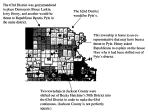
Democrat Bruce Larkin and Republican Dennis Pyle represented districts that would have been merged under a bipartisan compromise. Larkin, a longtime incumbent, had better name recognition at home. One representative told me: “The issue has always been the northeast. It's always been Mr. Larkin. He's always been the problem, because you couldn't put him with anybody. He'd beat anybody you'd put him with.” Pyle, a staunch conservative, did not engender so many kind words. Moderate Republicans did not like either his philosophy or his personality. One said, “There are some people that hate the institution of government in which they serve…. [Pyle] hates government…. He will never be part of the solution. No matter what we do, he won't be one of the 63 [votes needed to pass legislation].”
Just days before the floor vote on redistricting, the agreement between the parties collapsed. Republicans on the committee did not want to alienate a member of their own caucus, Pyle, by districting him with Larkin. The 63rd District, gerrymandered to protect Pyle, was rather contorted (see Figure 1). The majority leader then scheduled a vote on the new house map, with Democrats fuming. Here is how the process unfolded:

Step 1: The first try
On the morning of the redistricting vote, the majority leader reminded the Republican caucus of its planned strategy: stay together, defeat all amendments, and approve the map retaining Pyle's district, all on a party-line vote. The state house would meet at 11:00 a.m., after committee hearings. The majority leader predicted adjournment by lunchtime.
The redistricting vote was scheduled last. The house convened a “committee of the whole” to consider the bill. Michael O'Neal, Republican redistricting chair of the Judicial Committee, introduced it, saying, “The process of redistricting is by its nature partisan…. [We made an] effort to try to reach consensus.” He added that there was “probably not unanimous support” for the map.9
Kansas House of Representatives 2002.
At this point, Republican Representative Doug Mays (Topeka) proposed a technical amendment making minor changes to zero-population precincts in one district. Representative O'Neal spoke in opposition. He reminded house Republicans to “honor the agreement on the map” by “voting no on all amendments.” This first motion to amend was defeated 45 to 73.
Democratic Representative Reardon spoke next. Recounting the history of the term gerrymandering, he told the body: “My high school government students could pick out this [Bruce Larkin–Jerry Henry] district as a gerrymander.” By undoing a number of the last-minute shifts made to protect Pyle's district, Reardon said, his amendment would “make three countries in northeast Kansas whole”—that is, it would keep each one entirely within a single house district. In short, he proposed to revert to the map that had been fashioned a week earlier, before Republicans stopped it to protect Pyle. O'Neal replied, addressing the Republicans: “This amendment is not about gerrymandering. It's about who we're going to put against [whom].”
A vote was called. Although the amendment was defeated 54 to 61 (some representatives in the 125-member body did not vote), the tally indicated that some Republicans went with the united, minority Democrats. Reardon had taken the first step toward victory: he had signaled that the bill might be vulnerable to amendments. Perhaps a more minor amendment would have a better chance.
Step 2: Challenging leadership
Next, Representative Henry proposed an amendment to move a single township out of his district and into Pyle's and thus make Doniphan County whole. Few voters would be affected, and none of the incumbent matchups would change. The amendment appeared to be minor and technical. Henry had not pre-filed the amendment, so there was some discussion regarding whether it was too late. However, Henry noted that several other amendments had been filed just before the floor vote.
Why had the Republican map on the floor moved this single township from Pyle's district to Henry's? Two Republican leaders later told me that the township was home to a former state representative, one who had twice defeated Pyle. Pyle did not win until this Democrat retired. This ex-representative was rumored to be considering a political comeback. Republicans therefore proposed moving the ex-representative's home township into Henry's district, in order to protect Pyle.
On the floor, Henry confronted Mays, a key Republican leader, on why this township had been moved in the leadership's proposal. Mays did not want to give the real explanation in the public setting. Instead, addressing the entire house, Mays told Henry: “You can run an amendment on it if you want. I don't know if it will pass, but it would have a good chance of passing.” Henry put Mays into an awkward position; Mays responded by encouraging the amendment.
At that point, organized floor activity stopped for more than 30 minutes, for the drafting of the new (Henry) amendment. Pyle expressed anger with the few defecting Republicans who supported the earlier, more dramatic Reardon amendment. Moderate Republicans talked among themselves. As they did so, a few grew increasingly uneasy with their decision to support the party line, protect the unpopular Pyle, and alienate the Democrats. This long break to consider the Henry amendment was a crucial block of time. It was well past the majority leader's goal of a noon recess by the time this issue was resolved. Without an amendment or a vote, Mays and Henry reached a compromise: they would ask the state senate to add Henry's proposal to the house map before approving it. This compromise ended Republican leaders' hopes for an unamended redistricting bill. It also made Pyle vulnerable by restoring a potential opponent to his district. However, at this point, the bill had still not officially been amended in the house. In spite of this initial victory, Henry and other Democrats then rose to make speeches expressing anger and disappointment over the redistricting process. They had time. The Republicans had not made their goal of closing debate quickly and voting on a “clean” bill.
Step 3: The first amendment
Another minor technical amendment followed. Like the earlier one, also proposed by a Republican, it regarded a few zero- or nearly zero-population precincts that would other-wise have been split among districts.10
Some precincts, drawn for geographical convenience, have few or no households. These may include parks and forests, graveyards, areas that are underwater, farmland, and so forth. Legislators and staffers told me privately that some of their colleagues, for symbolic reasons, will often fight over having these zero-population precincts in their districts: a historic grave-yard, for example, may be an important symbol to have in one's district, though it brings no registered voters.
Step 4: The first major amendment
Next, Republican Representative Becky Hutchins rose to offer the first major amendment proposed by a Republican; and the environment radically changed. During the long recesses to haggle over Henry's amendment and the ensuing technical ones, the ranks of dissident Republican members had grown. Hutchins's amendment incorporated part of Reardon's earlier proposal—a part that concerned a single county, which she wanted to have restored to her own district in its entirety. “Keep Jackson County whole!” Hutchins exhorted, noting that local leaders back home wanted it that way. Republicans knew that many in the house leadership did not want major amendments, but they also knew that house leaders had failed to reach their goals of an amendment-free bill, a quick vote, and a noon recess. At this point, some moderate Republicans wanted to restore the bipartisan compromise map from a few days before—the one that did not protect Pyle—instead of upholding what was left of the leadership's original goals for the day.
Even the leaders began to switch strategies. Thinking on the fly (and using somewhat disjointed language), Representative O'Neal told the house: “The Republican caucus I encouraged to keep the process very efficient, but we've been very accommodating. [Now] I encourage members to listen to, and support, Representative Hutchins's amendment.” Even more dramatic was Speaker Pro Tem Clay Aurand's change of heart. Aurand told me afterward, “Quite frankly, … what [Reardon] said at the mike unfortunately was absolutely true, and my stomach was hurting.”
The Hutchins amendment passed 77 to 31.
Step 5: Finishing the job
The Hutchins amendment set the stage for Reardon's and Henry's coups. Several changes occurred. First, Aurand asked Reardon to offer his amendment once more. Aurand told me:
When it came to the point where we realized that we were treading in a quicksand of an area of the state, when the obvious solution was sitting there all the time, I quite frankly got frustrated and had talked to a couple other people in my caucus and realized that maybe what we thought [should occur] was going to create a great rift in our caucus, [and] we might have underestimated our caucus's ability to do the right thing. And at that point, I went over and asked Representative Reardon if he could change a couple words and re-offer his amendment.
In a subsequent interview with me, Reardon suggested that Speaker Kent Glasscock may also have signaled his willingness to consider a re-vote:
The Speaker would be engaged for while, then he would become disengaged. He would push a little bit, but when members of his own party didn't want to go where he wanted to, in terms of our leadership talking to him about a fairer map, [my amendment] was one of the things that they showed him that I think he may have had some interest in.
Republican leaders were instrumental in allowing this Reardon-sponsored compromise. Why did they switch tactics? There was the timing issue: Glasscock and Aurand did not want the process to break down and alienate the Democrats, whose votes would be needed for the budget vote later in the session. They also did not want the process to take up any of the time set aside to fashion and pass a budget bill. Additionally, as moderates themselves, Glasscock, O'Neal, and Aurand may not have been strong supporters of Pyle and the politics he represented.
So Representative Reardon re-introduced virtually the same amendment that had been defeated 54 to 61 only hours earlier. Technically, it violated house rules to propose an amendment twice, but Reardon made a minor technical change, drawing on his extensive knowledge of house rules. He noted that this amendment overlapped with the Hutchins amendment, which already “fixed” part of the gerrymandering concern. Why not finish the job?
This time, Reardon's amendment elicited remarkable exchanges on the house floor. O'Neal objected to it, suggesting that there may be constitutional problems with the minor technical change (it delayed implementation by two days, compared with the original, failed amendment). O'Neal and Reardon fashioned a compromise: they agreed that if the amendment passed, they would ask the senate to remove the delay.
Reardon then moved the amendment. The tally board showed that several Republican leaders had switched from “nay” (red) to “aye” (green). The Reardon amendment—substantively the same amendment defeated a few hours ago—passed 59 to 55. I spoke to one moderate, pivotal voter who switched from “nay” on the first vote to “aye” on the second. “I tried to vote no until the last,” he said, “but I saw Republicans put those other amendments on, and finally I said, [The hell with it!]” When the house reconvened the committee of the whole at 5:00 p.m. on the same day, the amended map passed easily on voice vote (see Figure 2).

Overwhelmingly, the vote-switchers were moderate Republicans, including Aurand. Reardon and Henry had managed to convince moderates that their interests for the rest of the session lay not in protecting the outspoken and hapless Pyle, but in beginning to rebuild fences with Democrats in preparation for the tough budget votes to come. Pyle helped the process along by alienating the few moderate Republicans who had supported Reardon and Henry from the beginning, thus causing some moderate leaders to have stomachaches and second thoughts about how committed they were to protecting Pyle.
Pivotal Politics, Timing, and Sequencing
Returning to Krehbiel's pivotal politics, this was a situation in which two representatives broadened their coalition by using both timing and sequencing as strategies.
The timing of the vote was crucial: the governor and legislative leaders, all Republicans, were anxious to move beyond redistricting by midsession and pass a budget that would ease a dramatic revenue shortfall. Furthermore, the redistricting process in the state senate had broken down completely; both the governor and the house leaders wanted to keep the lower chamber's process more orderly. Governor Bill Graves, a moderate Republican, could not stomach the deep cuts to education and highway funding that would be needed to balance the budget without tax increases.11
Although Governor Graves had vetoed the state senate's redistricting map, he did not signal any concern during the debate over the house map. Graves seemed to be fighting more with the conservative Republicans, whose votes were pivotal in passing the senate map, than with house Democrats, whose support he would ultimately need to pass a budget.
Because the pivotal, moderate Republicans would not accept major change to the redistricting map at once, Democratic legislators began to amend the map one piece at a time, with a sequence of votes—sometimes at the request of Democrats, but more often to please Republicans whose self-interest conflicted with their party leaders' goals. Eventually, the Republican leaders changed their objectives: they started out seeking an unamended map, but then strove to appear bipartisan and, finally, to end a series of amendments that they saw spinning out of their control.
The final bill's passage, then, was determined by the pivotal voters. The pivotal point in this case is easy to identify, because the bill had already passed out of committee, the governor's signature on a final bill was virtually ensured, and the historical norm called for the state senate to pass whatever map the state house wanted. The house floor became the center of activity. With some unintentional help from the angry Pyle, Reardon and Henry swayed their pivotal voters, the moderate Republicans, one amendment at a time. Per Krehbiel, unified party control in both houses and the executive did not guarantee that the majority party would determine the outcome. It was the pivotal voters, not party leaders, whose decisions prevailed.
Afterword
In the November 2002 general election, Bruce Larkin defeated Dennis Pyle, 4,818 votes to 3,443 votes, or 58 percent to 42 percent. Jerry Henry and Becky Hutchins were each re-elected with no opposition.12
Elections data, certified by the Kansas secretary of state's office, are available at www.kssos.org/elections/elections_statistics.html.
He received his Ph.D. in 2000 from the University of Missouri-Columbia. Smith's book Bringing Representation Home is now available from the University of Missouri Press. The author offers acknowledgements and sincere thanks to the state legislators quoted in this article. Special thanks also go to Robert Tomlinson and Mary Best for their patience with and support for this research agenda.
References
Kansas House of Representatives.
2002.
Representive Michael O'Neal of Reno County speaking on proposed Kansas house district plan, per aspera.
Sub HB 2625, 2002 session, 13 February.
Krehbiel Keith.
1998.
Pivotal Politics: A Theory of U.S. Lawmaking.
Chicago:
University of Chicago Press.
Loomis Burdett A.1994.
Time, Politics, and Policies: A Legislative Year.
Lawrence:
University Press of Kansas.
Peirce Neal R., and
Jerry Hagstrom.
1984.
The Book of America: Inside Fifty States Today.
New York:
Warner Books.
Reynolds v. Sims,
377 U.S. 533
(1964).
Seeberger Edward D.1997.
Sine Die: A Guide to the Washington State Legislative Process.
Rev. ed. Seattle:
University of Washington Press.
Van Der Slik,
Jack R., and
Kent D. Redfield.
1986.
Lawmaking in Illinois: Legislative Politics, People, and Processes.
Springfield, Ill.:
Office of Public Affairs Communication, Sangamon State University.

 You have
Access
- 4
- Cited by