INTRODUCTION
Determination of radiocarbon (14C) in a variety of environmental samples can be carried out by three different methods, which can be recognized as indirect—gas proportional counting (GPC) and liquid scintillation counting (LSC)—or direct, represented by accelerator mass spectrometry (AMS). While the former group utilizes for detection an interaction of beta particles emitted from 14C with a suitable material, the latter method is based on direct counting of 14C atoms present in a sample target, in which counting itself is conducted with the use of the interaction of accelerated ions with a material of a detector (Libby Reference Libby1961; Tuniz et al. Reference Tuniz, Bird, Fink and Herzog1998). Regarding short-time measurements of small samples, which is crucial for unique and valuable specimens, AMS is undoubtedly superior to GPC and LSC due to very high counting rate, however, the radiometric methods still excel in the detection efficiency, which is approximately by a factor of 30 higher than in the case of mass spectrometric techniques (Kutschera Reference Kutschera2005). If we compare a typical duration of sample pretreatment protocols, which are different but essential for all three methods, we can say that both groups perform similarly, though introduction of automated systems for sample processing and consequent graphitization (e.g., Wacker et al. Reference Wacker, Němec and Bourquin2010; Nagasawa et al. Reference Nagasawa, Kitagawa, Nakanishi, Tanabe and Hong2013; Kato et al. Reference Kato, Tokanai, Anshita, Sakurai and Ohashi2014; St-Jean et al. Reference St-Jean, Kieser, Crann and Murseli2016) in recent years could put AMS in more advantageous position. On the other hand, development in the GPC and LSC field has slowed down, unfortunately, as, for example, proposed multi-element proportional chambers or even time-projection chambers used in high energy physics showed promising potential for low-level beta counting (Povinec Reference Povinec1992), making GPC more competitive than AMS, which is much more expensive to both establish and operate (Theodórsson Reference Theodórsson1991). Despite the fact that AMS has become the preferred method for 14C determination, radiometric methods have still their places, especially if one is not limited by the sample size and/or measuring time.
Bones are one the categories of samples that have been routinely, though less frequently, 14C dated with the use of radiometric GPC and LSC even before the advent of AMS (e.g., Berger and Libby Reference Berger and Libby1966; Haynes Reference Haynes1967; Vogel and Waterbolk Reference Vogel and Waterbolk1967). A typical animal or human bone consists of an organic (20–25%) and inorganic (mineral) fraction (75–80%), however, people soon realized that the latter can be potentially easily contaminated by incorporation of exogenous carbon, thus, most of the time, not being suitable for reliable dating (Hedges and Van Klinken Reference Hedges and Van Klinken1992). Although the organic fraction, almost exclusively composed of a single protein (Type I collagen), is also susceptible to degradation via various diagenetic processes and chemical hydrolysis, it is generally considered to be rather resistant to alteration. Therefore, collagen which is supposed to represent the age of the whole bone is usually chosen as a final material for 14C dating. Extraction of pure collagen in the form of gelatin was pioneered by Longin (Reference Longin1971) whose method was based on dissolution of the bone inorganic fraction (demineralization) and subsequent denaturation of collagen in slightly acidic hot water. The method was later improved by addition of a base wash step after demineralization to remove humic substances and some lipids (Arslanov and Svezhentsev Reference Arslanov and Svezhentsev1993), which has been consecutively adapted in pretreatment protocols of many laboratories. Furthermore, use of ultrafiltration of gelatinized collagen to separate low molecular weight contaminants was proposed by Brown et al. Reference Brown, Nelson, Vogel and Southon1988; pros and cons of ultrafiltration have been recently intensely discussed in the literature (Brock et al. Reference Brock, Ramsey and Higham2007; Hüls et al. Reference Hüls, Grootes and Nadeau2007, Reference Hüls, Grootes and Nadeau2009; Fülöp et al. Reference Fülöp, Heinze, John and Rethemeyer2013; Cersoy et al. Reference Cersoy, Zazzo, Lebon, Rofes and Zirah2017). As we can see from the aforementioned short review, with a continuous development of methods for preparation of “ultrapure” bone collagen, they have become rather complicated, hence relatively laborious and costly.
Unlike bones, concentration of 14C in wines has been studied only sparingly, even though it can bring some interesting results, e.g. confirmation of 14C variations with the 11-year solar cycle (Burchuladze et al. Reference Burchuladze, Pagava, Povinec, Togonidze and Usačev1980), or vintage verification and uncovering of fraudulent wines with the help of 14C dating (Zoppi et al. Reference Zoppi, Skopec, Skopec, Jones, Fink, Hua, Jacobsen, Tuniz and Williams2004; Fahrni et al. Reference Fahrni, Fuller and Southon2015). In principle, 14C from the atmosphere is stored in grapes during the vegetation period, as carbon dioxide is transformed into sugars (glucose) through the process of photosynthesis. When a wine is produced, grape sugar in a metabolic process of anaerobic bacteria is first degraded to acetaldehyde, which is then reduced to ethanol. Besides ethanol, many other organic molecules, such as malic acid, tartaric acid, succinic acid or glycerol, can be found in wines as well. They are either formed during fermentation or are originally present in berries as products of ripening (Asenstorfer et al. Reference Asenstorfer, Jones, Laurence and Zoppi2011). However, concentration of organic acids and more or less complex molecules in wines is rather low, making ethanol, whose content can be in the range of 5.5–23%, depending strongly on a sort, type and climate in which grapes are grown, and which can be extracted and purified in a somewhat simple way, a good candidate for 14C determination. The main disadvantage of working with ethanol is that, because of its high volatility and flammability, it is prone to explode when mixed with oxygen in larger volumes, which might be especially problematic for its combustion, needed for production of a gas filling for GPC.
The Department of Nuclear Physics and Biophysics of the Faculty of Mathematics, Physics and Informatics at the Comenius University in Bratislava (DNPB FMPI CU) has a long history of exploiting GPC for determination of 14C activity of atmospheric CO2 samples (Povinec et al. Reference Povinec, Šáro, Chudý and Šeliga1968, Reference Povinec, Chudý, Šivo, Šimon, Holý and Richtáriková2009, Reference Povinec, Šivo, Ješkovský, Svetlik, Richtáriková and Kaizer2015a), tree rings (Attolini et al. Reference Attolini, Galli, Nanni and Povinec1989), groundwater (Povinec et al. Reference Povinec, Franko, Šivo, Richtáriková, Breier, Aggarwal and Araguás-Araguás2010,Reference Povinec, Ženišová, Šivo, Ogrinc, Richtáriková and Breier2013) and other samples (e.g., wood, charcoal, soil, mortar, peat) for dating purposes. In this study, we present results of 14C dating of 11 bone samples which were processed only with a straightforward ABA method, followed by combustion. This way produced CO2 was then used to prepare methane, a gas filling for GPC, in the same way as in all previous measurements. From the very same samples, we also extracted collagen whose 14C content shall be measured by AMS and compare with the results reported here in a near future. Additionally, we established and verified a methodology for 14C determination in wines with the use of proportional counters, based on separation of ethanol contained in the samples and its consequent combustion, slightly modified than in the case of solid samples. Parameters for optimization of procedures for processing of bone and wine samples, together with observed empiric factors influencing their efficiencies are discussed as well.
SAMPLES AND METHODS
Bone Samples
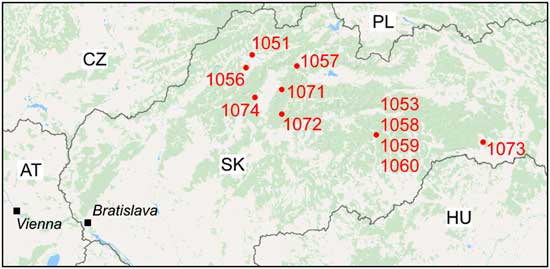
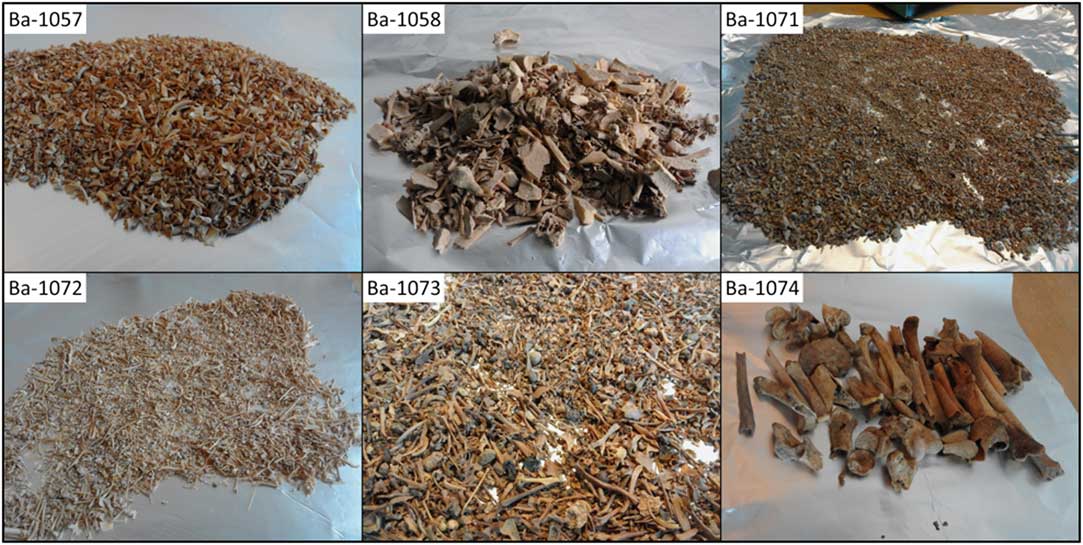
Eleven bone samples of vertebrates of unknown age with a mass ranging from 40.6 to 77.9 g were found in the undigested matter of predatory bird food (pellets). The samples originated from the caves located in different places in Slovakia (Figure 1), and were either excavated from a subsurface soil layer (max. 60 cm) or discovered as a part of predators’ nests. Sample Ba-1051 was found in a balk, supporting the roof of a medieval church. Bone samples varied substantially in basic characteristics, like shape, size and mass, and, in most cases, were heavily contaminated by components of the environment from which they were taken (e.g., soil dust, pebbles, plant remains), thus suggesting a possibility of strong degradation of the studied bones (Figure 2). Approximately 1.0–1.5 g of the material from each sample was used for collagen extraction and subsequent graphitization for AMS measurements, while the rest was processed in order to prepare methane (CH4) for GPC.
Sampling sites of bone samples in Slovakia.

Examples of the character variety of the dated vertebrate bone samples, found in the undigested matter of predatory bird food (pellets). In most cases, samples, whose size ranged from millimeters to centimeters, were heavily contaminated by components of the environment from which they were taken (e.g., soil dust, pebbles, plant remains). The samples shown here had already been sieved to remove coarse dust.

Portions of bone samples selected for determinations by GPC, mechanically cleaned from clearly identifiable exogenous material, were chemically pretreated by a simple acid-base-acid (ABA) method as follows. First, samples were ground and demineralized in 1 M HCl to dissolve all inorganic fraction (hydroxylapatite including calcite), then they were leached in 0.1 M NaOH to remove humics and in the end soaked again in 1 M HCl to prevent absorption of atmospheric carbon dioxide into a solution. Reagents of HCl and NaOH were replaced by fresh portions if the solution color had changed and samples were washed in-between the leaching steps with distilled water to neutral pH. After being filtrated and dried in an oven at 60°C, pretreated samples were combusted at 950°C in a flow of pure oxygen while oxidizing potentially produced CO to CO2 by CuO/CuO2 heated to 450°C and trapping emerging CO2 in liquid nitrogen (LN) traps. Cleaning of CO2 from water and possible contaminants is done in a dedicated vacuum glass line, shown in Figure 3, by passing the gas through a trap of cooled methanol (–50°C), which replaced one of the five inner circuit LN traps, high heated pure elemental copper (450°C), silver wool (350°C) and activated carbon (200°C). Methane, used as a gas filling for a proportional counter, was prepared from the sample CO2 by Ru-catalyzed hydrogenation at 480°C with a typical yield of ~97%, thus minimizing the possibility of fractionation (Povinec Reference Povinec1972).
Glass vacuum line for combusting and cleaning of samples for GPC measurements. For wine (ethanol) samples, the open quartz sample holder shown in this figure is replaced by a specially designed closed holder with a ~4 cm2 opening at its end for improved combustion, the electrical oven heating copper oxide is set only to 100°C, and a water trap of cooled methanol (around –50°C) is used after the oven, unlike for bones, where a liquid nitrogen (LN) trap is rather added. In the latter case, cleaning of sample CO2 from water is conducted with a trap of cooled methanol, placed in a position of one of the inner circuit LN traps. The system pressure is continuously controlled by a dedicated Hg manometer.

Extraction of collagen from the bone samples in the gelatin form was carried out by a procedure based on the improved Longin (Reference Longin1971) method and adapted from the protocol of the VERA 14C laboratory (Wild et al. Reference Wild, Neugebauer-Maresch, Einwögerer, Stadler, Steier and Brock2008). Initial steps are identical as in the previous method. To begin with, crushed and cleaned sample pieces were soaked in 1 M HCl. Then, after complete dissolution of mineral fraction, samples were put in 0.1 M NaOH and back to fresh 1 M HCl. The collagen solubilized in HCl solution (pH 3) at 90°C was filtrated using a pre-baked glass microfiber filter (porosity of 2.7 µm) and evaporated to dryness. Aliquot amounts of the collagen were carefully transferred to a quartz tube of the combustion apparatus connected to high-vacuum glass line, details of which are reported elsewhere (Kaizer et al. Reference Kaizer, Ješkovský, Povinec and Šivo2016). While combusting the collagen in the atmosphere of pure oxygen at 900°C, emerging water was trapped in a U-shaped tube by cooled methanol. Preceding graphitization with hydrogen which followed the steps presented in Povinec et al. (Reference Povinec, Masarik, Ješkovský, Kaizer, Šivo, Breier, Pánik, Staníček, Richtáriková, Zahoran and Zeman2015b), obtained CO2 is purified from impurities in a very similar way as described above.
Wine Samples
For testing and validation of the methodology for GPC determination of 14C in wines, we processed two samples of commercially available modern wines, a white one (Green Veltliner) and red one (Cuvée) which were declared by suppliers to contain 12% and 12.5% (v/v) of alcohol, respectively. Both originated from the western Slovakia region and were produced in 2015. The glass bottles with the wines were stored in dark and cold conditions prior processing of the samples and were opened just before being distilled to separate ethanol, as described below. The amount of wine used for distillation was exactly 100 mL in both cases.
The apparatus for distillation of the wine samples was equipped with a simple reflux column. After putting a round flask with a sample into the oil bath, the temperature of the oil, precisely controlled by a probe, was gradually increased until reaching the boiling point of the liquid. Then, the temperature of the oil was slowly raised further in 1–2°C steps to ensure that vapors could reach the distillation head, where their temperature was also measured; first drops of the condensate occurred at around 72°C. The distillation process was cancelled at the vapor temperature of 94–98°C when almost all ethanol should be separated.
Ethanol obtained from distillation was next combusted in a similar way as bone samples, however, due to its hazardous nature, some modifications had to be applied. Prior to combustion itself, the pre-evacuated combustion tube was filled with pure oxygen to the current atmospheric pressure, and the LN trap—the very first one after the tube—was replaced with a water trap of cooled methanol (Figure 3). After igniting the ethanol in a quartz sample holder with a ~4 cm2 opening on one side, specifically designed for ethanol samples, the tube was opened for a few seconds and the holder was quickly inserted inside. The equality of the oxygen pressure in the tube and the atmospheric pressure in the room and fast insertion of the ignited sample ensured that contamination by atmospheric CO2 during this step was negligible. The total pressure in the vacuum line was kept at 80 kPa with the optimal oxygen flow rate of 1.5–2.0 L min–1. To prevent water, and potentially, ethanol vapors from condensing, the copper oxide used for post-oxidation was heated but only to 100°C to avoid a possible explosion. Finally, sample carbon dioxide, trapped in liquid nitrogen, was cleaned and converted to methane for GPC identically as in the case of bone samples (Figure 3).
14C and δ13C Measurements
14C content in sample methane was measured by a multi-wire, large-volume, low-level gas proportional counter at the DNPB FMPI CU (Povinec Reference Povinec1978). The detector, located in a lead shield, consists of an inner and ring counter which are connected in the anticoincidence mode to improve the background. The total volume of the counter, which is always filled to a pressure of 106.66 kPa, is roughly 4.6 L. In case the amount of sample methane is too low to reach the preferred pressure, it is mixed with pre-prepared 14C-free methane. Samples are typically measured for 2–3 days with the detection efficiency of 89%, determined from measurements of oxalic acid standard (SRM 4990B; National Institute of Standards and Technology, Gaithersburg, Maryland, USA).
Determinations of δ13C in carbon dioxide, originated from combustion of the non-collagenized bone samples and one wine sample (Cuvée) and used for methane preparation for GPC, were conducted by isotope ratio mass spectrometry (IRMS) with the use of the Finnigan MAT 250 (Thermo Fisher Scientific) mass spectrometer at the State Geological Institute of Dionýz Štúr. The relative uncertainty of the measurements was less than 0.5%. Details of the procedure can be found elsewhere (Čech et al. Reference Čech, Grolmusová, Veis, Šivo and Povinec2015).
RESULTS AND DISCUSSION
Dating of Bones
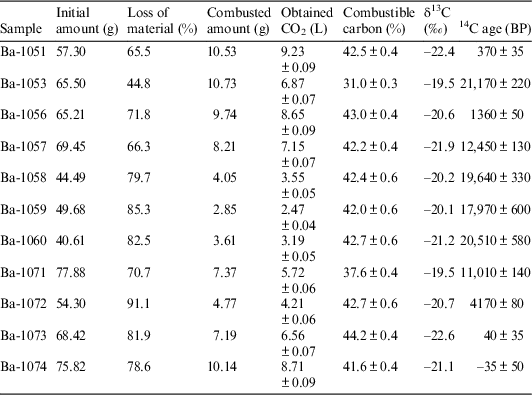
Results from processing of bone samples and their respective dating with the use of GPC are given in Table 1. The minimal loss was observed for the sample Ba-1053 (44.8%), while the largest amount of material, as much as 91.1%, was lost in the case of the sample Ba-1072. Almost all sample material was used after drying for combustion, meaning that the combusted amount values in the table represent the differences between the masses of the samples before and after combustion. If the value for sample Ba-1072, where up to 95.3% of the material was burned, is excluded, more than 46% of the sample matter was incinerated in average. The volumes of obtained CO2, calculated for the standard atmospheric pressure (101.33 kPa) and room temperature (23°C), were in a good correlation with the combusted amounts (Figure 4), though the sample Ba-1053 substantially deviated from the trend, yielding rather low amount of carbon dioxide, thus having overall carbon content (obtained amount of carbon divided by the combusted amount) below 10%. Carbon contents for other samples were in the range of 12.3–26.1%, with an exception of the sample Ba-1072 from which surprisingly large volume of CO2 was recovered, leading to the overall carbon content of 41.2%. Interestingly, the average value of the elaborated quotient of 20.4% (not including the samples Ba-1053 and Ba-1072) is in agreement with the content of the organic faction in a typical bone, stated earlier.
Correlation between combusted sample amount and volume of carbon dioxide obtained by combustion, calculated for standard atmospheric pressure (101.33 kPa) and room temperature (23°C). Clearly, the sample Ba-1053 deviates from the trend, lowering the value of the Pearson’s coefficient.

Results of processing and dating of eleven vertebrate bone samples.

Besides total content of carbon in the cleaned sample, discussed above, one can also examine how much carbon was obtained just from the combusted material to analyze from which part of the bone carbon dioxide actually originated. From the amino acid composition data of regular Type I collagen of mammals and birds, it was shown that it should contain approximately 42.2±0.2% of carbon (Szpak Reference Szpak2011). Except two samples (Ba-1053 and Ba-1071), contents of combustible carbon are in reasonable concordance with the reported value (Table 1), suggesting that the combusted material was almost exclusively collagen. However, the difference for two inconsistent samples, especially for sample Ba-1053, is indeed non-negligible and implies that these particular samples partially consisted of non-collagenous organic material, inorganic substances or were degraded by diagenetic processes. To confirm or disprove the latter statement, one can look at indicators (quality factors) other than percent content of carbon, such as atomic C:N ratio, total content of nitrogen, δ15N or δ13C (Van Klinken Reference Van Klinken1999). We measured only δ13C values for the samples, as determination of other indicators was beyond our current analyzing capabilities. All samples yielded δ13C values from –19.5 to –22.6%, which perfectly fits within the range for generally temperate, non-marine, non-C4 environment (Van Klinken Reference Van Klinken1999), that is the environment(s) where our samples were found and excavated. Nevertheless, in order to conclude whether the samples Ba-1053 and Ba-1071 were degraded and thus their given ages are somehow biased, it would be reasonable to obtain values for one, preferably two more quality factors.
Another indicator of the preservation state of bone to consider is collagen yield, usually calculated as a ratio of the obtained collagen (gelatin) mass to the mass of bone before pretreatment. Laboratories generally recognize three to four distinct categories of bone preservation depending on collagen yield (Hedges and Van Klinken Reference Hedges and Van Klinken1992). Collagen was successfully prepared for each sample we processed in this study giving a yield between 5.1 and 16.2%, which means that all samples, including Ba-1053 and Ba-1071, could be classified as well preserved (10–40 mg of collagen per 1 g of bone). Furthermore, sample collagen was combusted to obtain carbon dioxide, though the collected volumes of CO2, which is a measure of content of carbon in the combusted material was only around 15% in average, which is much lower than the aforementioned value of 42.2±0.2% (Szpak Reference Szpak2011). To explain such a significant difference, it may be reasoned that the burned material was not pure gelatinized collagen but contained relatively large amount of bound water, which incompletely evaporated during the drying step in the oven, as opposed to freeze drying, and was thus incorporated into the structure of the protein to form hydrates. Despite the combustion resulted in less than expected amounts of CO2, they were sufficient for hydrogen graphitization to produce 1–2 mg of carbon on iron carrier, more than enough for AMS measurements.
Looking at the dating results themselves, conventional 14C ages of samples determined by GPC showed a great variety, from very modern to as old as 21 kyr BP (Table 1), which would suggest that the methodology exploited in this work could be used for a wide spectrum of bone samples, regardless of their anticipated age. The most recent one was found to be the sample Ba-1074, on contrary, the oldest 14C age values were measured for the samples Ba-1053 and Ba-1060. If we compare relative uncertainty of the measured age of the sample Ba-1059 (3.3%) with the values for other non-modern samples of the 14C age of >4 kyr BP (1.0–2.8%), we can see that it is a bit higher which is mainly due to fact that in the case of this sample the amount of 14C-free methane used to obtain the gas volume required for the proportional counter was the largest, as the amount of produced sample CO2 and consequently CH4 was the smallest.
As we stated earlier, the age of all samples was unknown to us prior to the determination by GPC, however, there is at least some information available about the sample Ba-1051 which may help to verify its determined age. It was found in a nest of a barn owl (Tyto alba) in the church of St. Stephen the King which was, based on the archaeological evidence, built at the beginning of the 13th century and later renovated in a large scale, presumably in 1762 AD (Moravčík et al. Reference Moravčík, Škvarnová and Krušinský2002). Calibration of its 14C age by the OxCal program (Bronk Ramsey Reference Bronk Ramsey2009) using the IntCal13 curve (Reimer et al. Reference Reimer, Bard, Bayliss, Beck, Blackwell, Ramsey, Buck, Cheng, Edwards, Friedrich, Grootes, Guilderson, Haflidason, Hajdas, Hatté, Heaton, Hoffmann, Hogg, Hughen, Kaiser, Kromer, Manning, Niu, Reimer, Richards, Scott, Southon, Staff, Turney and van der Plicht2013) showed that with the 95.4% probability the sample originated from the time between 1450 and 1640 AD, implying that the barn owl built its nest before the renovation of the church.
14C Activity of Wines
14C concentration (Δ14C) in the recent Slovak wine samples (Green Veltliner and Cuvée) determined by GPC was 29.4±6.4‰ and 34.4±6.3‰, respectively, which is in very good agreement with the value for the atmosphere in western Slovakia (31.6±6.9‰) (Table 2), being regularly measured at the DNPB FMPI CU (e.g., Povinec et al. 2015). The value was calculated as an average of the monthly data from April to September 2015, which is the presumed period of grape vegetation of the investigated wines. The δ13C value of –27.1‰ for the Cuvée sample determined by IRMS matches quite well typical values reported for the respective region (Martin and Thibault Reference Martin and Thibault1995); for calculation of the Δ14C result for the Green Veltliner sample, we used an estimated δ13C value of –25‰. Although the results for first two samples looked promising, the mean overall yield of carbon (~59±3%) obtained by the procedure described above was much lower than expected, therefore we further focused on improvement of ethanol distillation and combustion, identified as critical steps of the whole methodology of processing wines for GPC measurements of 14C.
Results of processing and determination of 14C concentration in two modern wine samples, compared with the atmospheric data.

(a)Volume of pure ethanol in the distillate. (b)Combined yield of distillation and combustion.
During the distillation process, the ratio of carbon isotopes in the final distillate can significantly vary. The δ13C value, a good indicator of fractionation of carbon isotopes, was reported to decrease as distillation proceeds (Baudler et al. Reference Baudler, Adam, Rossmann, Versini and Engel2006). To eliminate such effect, efficiency of distillation should be as high as possible, i.e. almost all ethanol should be separated and end up in the distillate, though for the purpose of combustion, we found out that the content of ethanol should be kept within a specific range, as discussed below. The Green Veltliner and Cuvée samples were distilled with the use of a simple designed reflux column, yielding the distillate with the ethanol content of only around 73% (v/v), which was estimated from its density. To increase this value, we replaced the column with a Vigreux-like one, usable also for fraction distillation, and tested the new setup with 12% (v/v) ethanol-water mixtures. This way collected distillate showed the 94% (v/v) content of ethanol, basically the same as the maximum obtainable by non-azeotropic distillation (96.5% by volume). In conclusion, the yield (efficiency) of the modified process, calculated from the mass of carbon in the original mixture and distillate, was around 91%.
During testing of the combustion step, we found out that the fully open quartz sample holder used for solid samples (Figure 3) is unsuitable for ethanol samples, as they tend to burn inconsistently, i.e. much more intensively on a side closer to the oxygen supply while emerging CO2 significantly hinders combustion on the other side of the holder. Because of this, large portions of ethanol may just evaporate without being combusted, leading to poor yield of about 35%. Hence, we designed and experimented with a new type of sample holder—fully closed, with an opening (~4 cm2) at its end—which, if oriented towards the oxygen inlet, gave much better yield, approximately 90%. This setup was also used for the Green Veltliner and Cuvée samples. Moreover, testing of ethanol-water mixture samples with a various content of alcohol demonstrated that its ideal concentration is somewhere from 70 to 80% (v/v). While mixtures with the content below 70% (v/v) were difficult to ignite at the room temperature, concentrations higher than 80% (v/v) caused samples to burn so intensively that, right after insertion of the sample holder into the tube, flame could be exhausted spontaneously by produced carbon dioxide due to momentary thin supply of rapidly consumed oxygen.
CONCLUSIONS
Despite the fact that AMS is nowadays the go-to analytical method for determination of low level 14C, we have shown in this paper that conventional radiometric techniques, such as gas proportional counting (GPC), are still competitive, particularly for samples with the excess of material. Procedures for converting of bone and wine samples into methane, used as a gas filling for GPC, were established and extensively tested. Eleven bone samples of predatory bird food found at different locations of Slovakia were processed, and dated by GPC to be of a wide spectrum of the 14C age (from modern to 21 kyr BP). Except for one dubious sample (Ba-1053), several factors (content of combustible carbon, collagen yield, δ13C values) indicated that the bones were well preserved and the obtained dating results should represent their true age, which is also supported by the documented history of the sampling location of the sample Ba-1051. In the case of wine samples, the proposed methodology was verified on two modern western Slovakia vintages, whose determined 14C concentration matched the mean atmospheric level of the region and grape vegetation period which they originated from. By testing of specific ethanol-water mixtures, the method was further developed to increase its efficiency, thus eliminating a possible bias error from e.g. carbon isotopes fractionation.
ACKONWLEDGMENTS
Authors are grateful to J Haško for crafting of some necessary glassware and help with the distillation of wine samples, and Dr C Hatté for valuable comments. The Comenius University group also acknowledges a support provided by the EU Research and Development Operational Program funded by the ERDF (Projects No. 26240120012, 26240120026 and 26240220004) and by the International Atomic Energy Agency’s Technical Cooperation Program (Projects No. SLR/1001 and RER7/008).