Introduction
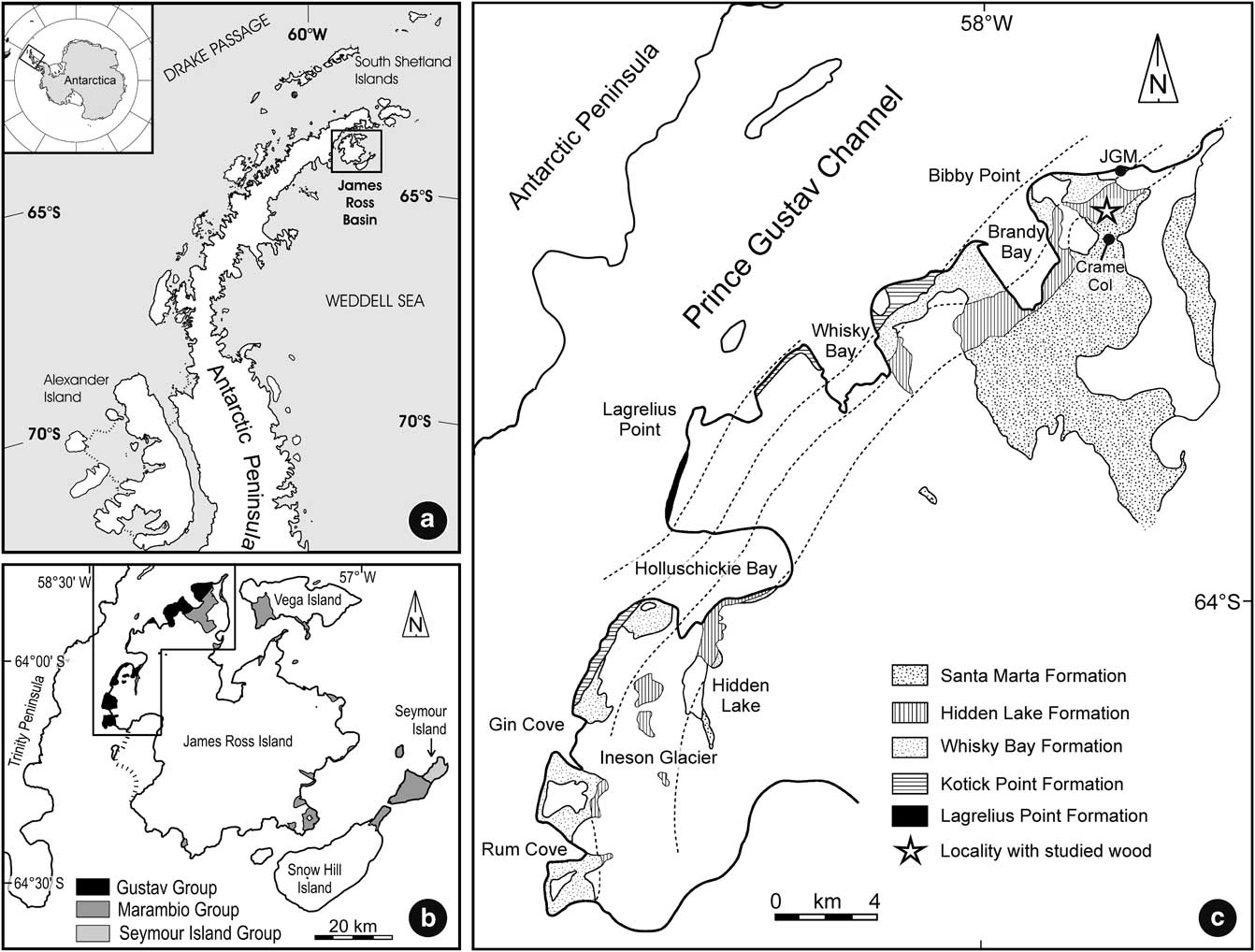
This work provides the first contribution resulting from the Czech Geological Survey Antarctic research project focusing on fossil wood from the Upper Cretaceous of James Ross Island lying to the east of the Antarctic Peninsula in the Larsen Basin (Fig. 1). During the field season January–February 2010, almost 350 specimens of fossil wood were collected. The majority of the specimens originated from the vicinity of Brandy Bay and the area between Johann Gregor Mendel Czech Antarctic Station (63°48′5.6′′S, 57°53′5.6′′W) and Crame Col, situated in the northern part of the James Ross Island (Fig. 1). The stratigraphic range covered by these fossils extends from the mid-Albian (base of the Whisky Bay Formation) through the Hidden Lake Formation (Coniacian) and into the lower part of the Santa Marta Formation (uppermost Coniacian–Santonian). Therefore, these fossils represent a complete, stratigraphically well-defined source of information, mainly with respect to the Cenomanian and Turonian which up to now has been poorly documented (cf. Cantrill & Poole Reference Cantrill and Poole2005, table 1). This paper provides a detailed anatomical description of a new species of angiosperm wood mentioned in the short preliminary report by Kvaček & Sakala (Reference Kvaček and Sakala2012).
a. Map showing the location of James Ross Island region. b. Geological sketch map of James Ross Island showing the Gustav, Marambio and Seymour Island groups for the James Ross Island region (based on Crame & Luther Reference Crame and Luther1997). c. Enlargement of the Cretaceous sediments outcropping in the north-western James Ross Island with the locality yielding the studied wood indicated. The dashed lines trace formation boundaries across sea and ice cover; JGM stands for Johann Gregor Mendel Czech Antarctic Station. Based on Ineson et al. (Reference Ineson, Crame and Thomson1986) and Whitham et al. (Reference Whitham, Ineson and Pirrie2006).
Material and methods
Every sample of fossil wood was documented in the field including the regular use of the so-called ‘reference points’ to which GPS coordinates and lithological and stratigraphical data were attributed. Care was taken to ensure any specimen collected was from one individual piece of wood and did not represent splinters from larger trunks. If specimens were deemed to be splinters originating from one original piece of wood then the sample number was suffixed by ‘A’, ‘B’, ‘C’, etc. Thin sections c. 40 μm thick were prepared following standard techniques and studied and photographed using optical microscopes (Olympus BX–51 and Nikon Eclipse, LV100Pol in Prague and a Nikon Eclipse 80i in Paris) in normal transmitted light. Some photos were subsequently treated with the software Helicon Focus 5.3 in order to create one completely focused image from several partially focused images by combining the focused areas (Fig. 3a, b & h). The anatomical description is in accordance with the IAWA Hardwood List (Wheeler et al. Reference Wheeler, Baas and Gasson1989, InsideWood 2004–onwards, http://insidewood.lib.ncsu.edu/search). All specimens as well as the corresponding thin slides are housed in the Czech Geological Survey in Prague, Czech Republic.
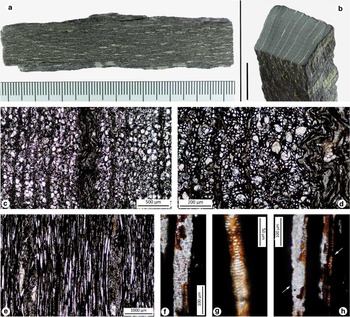
Antarctoxylon mixai Sakala, sp. nov. (holotype no. CGS A.061F.W2C). a. Tangential fracture of the specimen with light spindle-like structures marking the rays. b. View of the transverse section of specimen showing the distinct rays (scale bar = 1 cm). c. Transverse section showing diffuse-porous wood with mostly solitary vessels and rays of two distinct sizes with one wide ray in the middle (slide no. 47 925). d. Transverse section showing the seemingly angular vessels and unevenly sized and shaped fibres (both probably caused by deformation) on the left and dilatation of parenchyma cells (in black) by mineral inclusion (in grey) in a wide ray on the right (slide no. 47 925). e. Tangential longitudinal section showing rays of two distinct sizes with two wide rays, left one diagonally dissected by fibres (slide no. 47 927). f. Radial longitudinal section showing a typical scalariform perforation plate with around 30 bars (slide no. 47 926). g. Radial longitudinal section showing smaller vessel element with unusual scalariform perforation plate with fewer forked bars (slide no. 47 926). h. Radial longitudinal section showing vessel on the left with opposite to scalariform intervessel pits (upper left) passing into scalariform perforation plate (left arrow), to the right a second vessel element abuts a thinner strand of axial paratracheal parenchyma indicated by the right arrow (slide no. 47 926).

Geological setting
The Jurassic–Cenozoic sedimentary succession of the James Ross Island area has been interpreted as a small part of a large sedimentary basin, originally defined as the Larsen Basin (Macdonald et al. Reference Macdonald, Barker, Garrett, Ineson, Pirrie, Storey, Whitham, Kinghorn and Marshall1988). However, Elliot (Reference Elliot1988) used the term James Ross Basin for the Mesozoic–Cenozoic sequence in the James Ross Island area (Fig. 1). The Larsen Basin developed in Jurassic times as a result of continental rifting during the early stages of Gondwana break-up (Hathway Reference Hathway2000 and references therein).
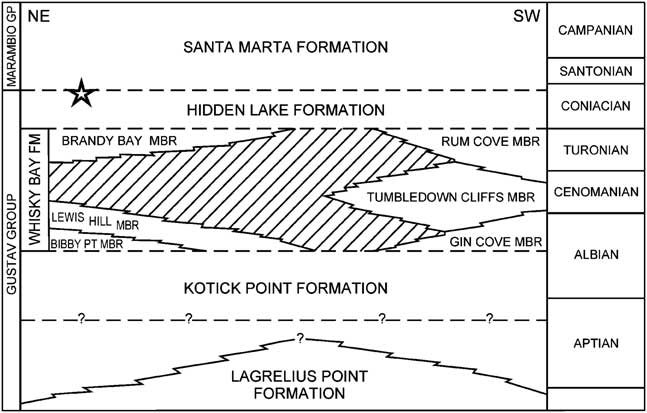
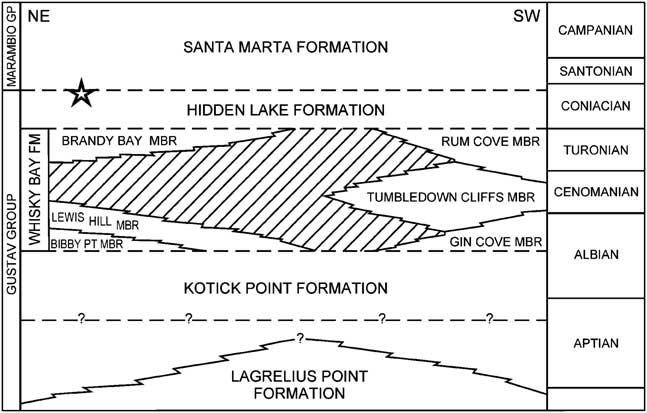
The silicified wood under study here (CGS A.061F.W2C) is one of four splinters (CGS A.061F.W2A–D), which all come from one sample (CGS A.061F.W2) representing one morphotype. Besides this angiosperm type, we found only 1–2 different morphotypes in the whole study area. They will, however, be the subject of further studies. The fossil wood was collected from the extensive Lower–Upper Cretaceous sedimentary sequence exposed on the western and north-western margins of James Ross Island (Fig. 1) (Ineson et al. Reference Ineson, Crame and Thomson1986, Rinaldi Reference Rinaldi1992). This sequence comprises part of a regressive mega-sequence of volcanic arc-related clastic and volcaniclastic marine rocks that has now been extensively studied and subdivided lithostratigraphically (Crame et al. Reference Crame, Pirrie and Riding2006, Whitham et al. Reference Whitham, Ineson and Pirrie2006 and references therein). The specimen was collected from platy tuffaceous sandstones of the uppermost Hidden Lake Formation (63°49′16.0′′S, 57°53′22.8′′W) of the Gustav Group (Fig. 2). The Hidden Lake Formation consists of 300–400 m of coarse-grained volcaniclastic conglomerates, sandstones and mudstones, representing base-of-slope, fan-delta and basin-floor environments of deposition in a relatively deep marine environment below wave base (Ineson et al. Reference Ineson, Crame and Thomson1986, Pirrie et al. Reference Pirrie, Whitham and Ineson1991, Whitham et al. Reference Whitham, Ineson and Pirrie2006). Macrofaunal and palynological studies originally suggested a probable age range of Coniacian–Santonian (e.g. Barreda et al. Reference Barreda, Palamarczuk and Medina1999), but strontium (Sr) isotope data confirm a Coniacian age (88.7–86.4 Ma) for this formation (McArthur et al. Reference McArthur, Crame and Thirlwall2000, Riding & Crame Reference Riding and Crame2002). Crame et al. (Reference Crame, Pirrie and Riding2006) examined the mid-Cretaceous stratigraphy of the James Ross Basin, using new macrofaunal and palynological data from the Brandy Bay area, confirming entirely Coniacian age for the Hidden Lake Formation.
Stratigraphic correlation of Cretaceous sediments in north-western James Ross Island with position of the locality yielding the studied wood indicated. Note the considerable lateral variation within the Whisky Bay Formation. Based on Crame et al. (Reference Crame, Pirrie and Riding2006).
Systematic palaeobotany
Family unknown
Antarctoxylon Poole & Cantrill
Antarctoxylon mixai Sakala, sp. nov. (Fig. 3)
Diagnosis: Heteroxylous diffuse-porous wood with indistinct growth ring boundaries. Vessels are mainly solitary, with scalariform perforation plates with around 30 bars and opposite to scalariform intervessel pits. Rays are slightly heterocellular of two distinct sizes: narrow 1–6-seriate and wide up to 18-seriate. Axial parenchyma is diffuse apotracheal and scanty paratracheal.
Holotype: One piece of wood (CGS A.061F.W2C) and three thin sections (47 925, 47 926, 47 927); all housed in the collections of the Czech Geological Survey, Prague, Czech Republic.
Type locality: Northern part of the James Ross Island, Antarctic Peninsula, Antarctica (63°49′16.0′′S, 57°53′22.8′′W).
Stratigraphic horizon: Coniacian of the Hidden Lake Formation.
Etymology: Named for the friend and head of the geological part of the Czech Antarctic project Petr Mixa.
Occurrence: Known from the type locality only.
Macroscopic description: One silicified piece of fossil wood, interpreted as fragment of trunk based on shape and growth ring curvature, dimensions of the analysed sample: 2 x 1.5 x 12 cm (Fig. 3a & b), black in colour with obvious (lighter, spindle-shaped) rays running through it (Fig. 3a & b).
Microscopic description: Growth rings: indistinct. Wood: diffuse-porous (Fig. 3c & d). Vessels: c. 80 per square mm, mainly solitary (90%) or in short radial pairs (Fig. 3d); tangential diameter 25–50–80 μm (minimum–mean–maximum), angular in outline in transverse section; perforation plates scalariform, typically with c. 30 bars (Fig. 3f) occasionally more, but in narrower vessels element bars can be fewer in number and forked (Fig. 3g); intervessel pits opposite to scalariform (Fig. 3h). Rays: slightly heterocellular of two distinct sizes (Fig. 3e), narrow 1–6-seriate and wide up to 18-seriate (0.3(–0.5) mm wide and 4 mm high for complete ray); wide rays separated by a distance of around 2.5 mm, often dissected by ground tissue and dilated tangentially (Fig. 3d & e); vessel-ray pits scalariform with much reduced borders. Axial parenchyma: both diffuse apotracheal and scanty paratracheal (Fig. 3h). Fibres: thin- to thick-walled, unevenly sized and shaped (Fig. 3d) with undistinguishable pits, septa not observed.
Discussion
Eight types of angiosperm wood have been described so far from the James Ross Island: Laurelites jamesrossii Poole et Francis (Poole & Francis Reference Poole and Francis1999), Winteroxylon jamesrossi Poole et Francis (Poole & Francis Reference Poole and Francis2000), Weinmannioxylon nordenskjoeldii Poole et al. (Poole et al. Reference Poole, Cantrill, Hayes and Francis2000a), Illicioxylon antarcticum Poole, Gottwald et Francis (Poole et al. Reference Poole, Gottwald and Francis2000b), Sassafrasoxylon gottwaldii Poole, Richter et Francis (Poole et al. Reference Poole, Richter and Francis2000c), Hedycaryoxylon tambourissoides Poole et Gottwald (Poole & Gottwald Reference Poole and Gottwald2001), Nothofagoxylon scalariforme Gothan and N. aconcaguaense Pons et Vincente (Poole Reference Poole2002). Our wood can be separated quite easily from the dicotyledonous vesselles Winteroxylon jamesrossi and the ring-porous S. gottwaldii. Both representatives of Nothofagoxylon from James Ross Island, i.e. N. scalariforme and N. aconcaguaense, are very different from our wood in having diffuse to semi-ring porous wood with very thin mostly uni- to biseriate rays. Laurelites jamesrossii and I. antarcticum also have significantly narrower rays (up to 5-seriate). Weinmannioxylon nordenskjoeldii shows a degree of similarity to our wood with scalariform perforation plates with numerous bars (up to 40), but its rays are only 1–4-seriate. On the other hand, H. tambourissoides shows multiseriate rays 4–18 cells wide, but its overall pattern of vessels with only 6–12 bars per perforation plate separates this morphotype from the one described here. Therefore, this specimen represents a new type to the James Ross Island area.
Greater similarity is shared with angiosperm woods described by Poole & Cantrill (Reference Poole and Cantrill2001) from the Upper Cretaceous at Williams Point on Livingston Island. The woods show features shared by the Magnoliidae, Hamamelidae and Rosidae today and thus Poole & Cantrill (Reference Poole and Cantrill2001) erected a widely defined morphogenus Antarctoxylon to accommodate such early angiospermous wood morphotypes from Antarctica. From comparisons with the five species of Antarctoxylon described so far, i.e. A. livingstonii Poole et Cantrill, A. multiseriatum Poole et Cantrill, A. heteroporosum Poole et Cantrill, A. uniperforatum Poole et Cantrill (Poole & Cantrill Reference Poole and Cantrill2001) and A. juglandoides Poole, Mennega et Cantrill (Poole et al. Reference Poole, Mennega and Cantrill2003), the anatomy of our wood shares greatest similarity to A. multiseriatum in having both rays of two sizes, vessels with opposite and scalariform pitting, and numerous bars in their scalariform perforation plates. However, the fossil described here from James Ross Island has more numerous bars (i.e. 30 and more compared with up to 22) and significantly wider maximum ray widths (18-seriate as compared with 11-seriate in A. multiseriatum); note the absolute maximal width of rays (0.5 mm) in CGS A.061F.W2C can lead to overestimations due to the secondary dilatation of cells. Although this specimen could be considered to be ‘an end member of the A. multiseriatum type’ (Poole, personal communication 2011), we consider that the quantitative differences of these two features constitute a real difference between our wood and A. multiseriatum, and do not represent differences resulting from intraspecific variation or intrinsic differences (such as relative chronological age). Therefore, we propose a new species of Antarctoxylon: A. mixai Sakala, sp. nov.
Concerning its anatomical similarity to A. multiseriatum the same taxonomic argument put forward by Poole & Cantrill (Reference Poole and Cantrill2001) will also apply to this fossil. Systematic affinities are shared with woods belonging to several families such as the Chloranthaceae, Eupteleaceae, Icacinaceae, Monimiaceae and Trimeniaceae (Poole, personal communication 2011, Poole & Cantrill Reference Poole and Cantrill2001). When the anatomical information is fed into the InsideWood Database (http://insidewood.lib.ncsu.edu/search), the results returned suggest affinities with the Monimiaceae (e.g. Hedycarya arborea J.R. Forst et G. Forst or Kibara sp.) and Rousseaceae (e.g. Carpodetus serratus J.R. Forst with distinctly heterocellular rays), both of which bear some resemblance to our wood. However, as it is often the case with early angiosperms from the Cretaceous (e.g. Chapman & Smellie Reference Chapman and Smellie1992, Poole & Cantrill Reference Poole and Cantrill2001, Gryc et al. Reference Gryc, Vavrčík and Sakala2009) the anatomy shows characteristically ‘primitive’ features (according to the Baileyan trends, see Wheeler & Baas Reference Wheeler and Baas1993) preventing any match with extant taxa.
The Coniacian age of the fossil described here is considered to be coeval with the oldest angiosperm wood record from James Ross Island, i.e. Weinmannioxylon nordenskjoeldii (cf. Poole et al. Reference Poole, Cantrill, Hayes and Francis2000a and Cantrill & Poole Reference Cantrill and Poole2005, fig. 3). Moreover, the age of both these woods from James Ross Island might even be similar in age to the oldest angiosperm woods so far recorded from Antarctica, namely the Antarctoxylon woods from the Williams Point on Livingston Island, which have been dated to Coniacian–Santonian age (85 Ma) using argon-argon dating (Cantrill & Poole Reference Cantrill and Poole2012). While it may well be the oldest wood, there are many papers that document older angiosperm material, even from Lower Cretaceous, including leaves (e.g. Cantrill & Nichols Reference Cantrill and Nichols1996; late Albian) and pollen (e.g. Dettmann & Thomson Reference Dettmann and Thomson1987; early Albian).
Conclusions
Our fossil wood from the Coniacian of the Hidden Lake Formation on James Ross Island shows a characteristic combination of ‘primitive’ angiospermous features that include indistinct growth ring boundaries, scalariform perforation plates with numerous bars and rays of two distinct sizes. Given this combination of characters the wood belongs to the morphogenus Antarctoxylon and might represent the A. multiseriatum type. However, its rays are wider and bars more numerous than in A. multiseriatum, so we propose a new species Antarctoxylon mixai Sakala, sp. nov. This fossil, which represents one of the oldest angiosperm wood records in Antarctica, increases the geographical spread of the early arboreal angiosperms in the Antarctic Peninsula region and provides important information crucial to our understanding of the biodiversity, long-term vegetation changes and palaeoclimate of unique high-latitude palaeoenvironments that have no modern analogues today.
Acknowledgements
We are grateful to Catherine Privé-Gill for help and valuable comments concerning the wood anatomy and to Imogen Poole for providing information on dating of the Williams Point material and discussion regarding the systematic affinity of our material. We are also indebted to Anaïs Boura for her assistance with Nikon Eclipse 80i microscope and to Jakub Prokop for his help with Helicon Focus software. Finally, our special thanks go to the British Antarctic Survey, especially to its former director Professor Nicholas Owens, for logistical help in transporting the fossil material from Antarctica to Europe. The manuscript was greatly improved by the thorough review of I. Poole and D.J. Cantrill. The field and laboratory work were undertaken with the financial support of Ministry of Environment of the Czech Republic, project no. VaV SP II 1a9/23/07. The research was also partly supported by the grants MSM0021620855 and PRVOUK P44.