Risky behaviors, specifically substance use, conduct problems, and sexual risk taking, are the primary direct and indirect causes of morbidity and mortality among adolescents (Blum, Reference Blum2009; Eaton et al., Reference Eaton, Kann, Kinchen, Shanklin, Ross and Hawkins2010; Feigelman & Gorman, Reference Feigelman and Gorman2010). Although these behaviors are often studied individually, research indicates that they frequently occur together, although more information is needed regarding the relationships among and development of these behaviors over time in different populations (Biglan, Brennan, Foster, & Holder, Reference Biglan, Brennan, Foster and Holder2004; Krueger, Markon, Patrick, Benning, & Kramer, Reference Krueger, Markon, Patrick, Benning and Kramer2007; Wu, Witkiewitz, McMahon, & Dodge, Reference Wu, Witkiewitz, McMahon and Dodge2010). The current study focused on the clustering of three types of risky behaviors in a very low-income African American population of adolescents in the southern United States. This particular population is at an increased risk compared to other ethnic, geographic, and income groups for several types of negative mental and physical health outcomes, including victimization due to violence, HIV infection, incarceration, and death at an early age (Eaton et al., Reference Eaton, Kann, Kinchen, Shanklin, Ross and Hawkins2010; Massoglia, Reference Massoglia2008). Our analysis draws on problem behavior theory (PBT) and developmental theories to explain the clustering of substance use, conduct problems, and risky sex behaviors from early to late adolescence.
Although some experimentation is normative, risk taking has the potential for many negative consequences, especially when it occurs at a younger age (Kandel & Yamaguchi, Reference Kandel and Yamaguchi1993) or when youths are from disadvantaged backgrounds (Elliott et al., Reference Elliott, Wilson, Huizinga, Sampson, Elliott and Rankin1996). Furthermore, early sexual debut is one of the best predictors of HIV infection and unplanned pregnancy (Bunnell et al., Reference Bunnell, Dahlberg, Rolfs, Ransom, Gershman and Farshy1999; McBride, Paikoff, & Holmbeck, Reference McBride, Paikoff and Holmbeck2003; O'Donnell, O'Donnell, & Stueve, Reference O'Donnell, O'Donnell and Stueve2001), childhood externalizing behaviors are one of the best predictors of adolescent and adult aggressive behaviors (Farrington, Reference Farrington1989; Fergusson, Lynskey, & Horwood, Reference Fergusson, Lynskey and Horwood1996; Moffitt, Reference Moffitt1993), and early alcohol use is one of the best predictors of later alcohol problems (Grant & Dawson, Reference Grant and Dawson1997; Hawkins et al., Reference Hawkins, Graham, Maguin, Abbott, Hill and Catalano1997; McGue, Iacono, Legrand, & Elkins, Reference McGue, Iacono, Legrand and Elkins2001; Stueve & O'Donnell, Reference Stueve and O'Donnell2005). This suggests the importance of studying these behaviors at an early age to predict engagement in later risky behaviors.
Adolescent Health Risk Behaviors
Substance use
The rates of teenage substance use are high nationally, with 30-day use rates at 20% for cigarettes, 42% for alcohol, and 21% for marijuana (Eaton et al., Reference Eaton, Kann, Kinchen, Shanklin, Ross and Hawkins2010). A convincing body of research documents that cigarette (Biglan et al., Reference Biglan, Brennan, Foster and Holder2004), drug, and alcohol use are less prevalent among African American youths compared to White and Hispanic youths (Bachman et al., Reference Bachman, Wallace, O'Malley, Johnston, Kurth and Neighbors1991; Johnston, O'Malley, & Bachman, Reference Johnston, O'Malley and Bachman1993; Maddahian, Newcomb, & Bentler, Reference Maddahian, Newcomb and Bentler1988; Wallace et al., Reference Wallace, Bachman, O'Malley, Schulenberg, Cooper and Johnston2003) even when only including youths living in high-poverty areas (Bolland et al., Reference Bolland, Bryant, Lian, McCallum, Vazsonyi and Barth2007). However, when substance use does occur, the associated social, health, occupational, and financial short- and long-term consequences are often more pronounced among African American adolescents and young adults (Dawkins & Dawkins, Reference Dawkins and Dawkins1983; National Institute on Drug Abuse, 2003).
Conduct problems
A national survey found that about one in five adolescents had a behavior disorder, with half of these beginning by age 11 (Merikangas et al., Reference Merikangas, He, Burstein, Swanson, Avenevoli and Cui2010). In addition, about 18% of adolescents reported carrying a weapon in the past 30 days, whereas 32% reported being in a physical fight in the past year (Eaton et al., Reference Eaton, Kann, Kinchen, Shanklin, Ross and Hawkins2010). Conduct problems include a variety of rule-breaking behaviors that violate the rights of others or societal norms, including aggression, destruction of property, deceitfulness or theft, and serious violation of rules. Externalizing behaviors are defined as impulsive, aggressive, and oppositional patterns of behavior that have maladaptive consequences. Violent and aggressive behaviors can lead to injury and other health outcomes in both the perpetrators and the victims and is a serious public health concern. Moreover, early onset of conduct problems is associated with long-term problems with illegal behavior (Committee on the Science of Adolescence, 2010).
Although the rates of conduct problems are serious among all youths in the United States, the rates and consequences of conduct problems are even more serious among African American youth, who have higher rates of adolescent victimization (Kilpatrick, Saunders, & Smith, Reference Kilpatrick, Saunders and Smith2003) and perpetration of violence (Centers for Disease Control and Prevention [CDC], 2008b; Eaton et al., Reference Eaton, Kann, Kinchen, Ross, Hawkins and Harris2006, Reference Eaton, Kann, Kinchen, Shanklin, Ross and Hawkins2010). Engaging in delinquency at a young age can have cascading and long-lasting effects on incarceration for African American youths in particular, because they are overrepresented among those sent on to more severe levels of adjudication (Bewley-Taylor, Hallam, & Allen, Reference Bewley-Taylor, Hallam and Allen2009; National Council on Crime and Delinquency, 2007).
Sexual risk taking
Sexual risk taking may result in HIV/AIDS and other sexually transmitted infections (STIs) as well as unplanned pregnancies. Despite declining rates of AIDS in the United States overall, HIV infections among adolescents are rising (CDC, 2008a). African American youths are disproportionately affected, accounting for 75% of new HIV infections in youths age 13–19 in 2008 (CDC, 2010). Teens accounted for 33% of new STIs in 2008, and African American teens had higher rates of STIs than did other racial/ethnic groups (CDC, 2011). Teens are most likely to acquire HIV through sexual activity (DiClemente, Hansen, & Ponton, Reference DiClemente, Hansen and Ponton1996), and African American teens are more likely to have had intercourse, to have had first intercourse before the age of 13, and to have had four or more sexual partners during their life (Eaton et al., Reference Eaton, Kann, Kinchen, Ross, Hawkins and Harris2006). Over 80% of teen pregnancies are unplanned, and African American teens also have higher teen pregnancy rates than their white peers (Alan Guttmacher Institute, 2010). Although there is also evidence that low socioeconomic status increases rates of adolescent pregnancy and STIs, the mechanism of impact of poverty on sexual behaviors is still not well understood (Santelli, Lowry, Brener, & Robin, Reference Santelli, Lowry, Brener and Robin2000).
Theoretical Approach
PBT is based on the concept that risky adolescent behaviors cluster together owing to common causal factors (Hawkins & Monahan, Reference Hawkins and Monahan2009; Jessor, Reference Jessor1987; Jessor & Jessor, Reference Jessor and Jessor1977; Jessor et al., Reference Jessor, Turbin, Costa, Dong, Zhang and Wang2003). PBT is a social–psychological framework that includes explanatory variables for the perceived-environment system, the personality system, and the behavior system. The explanatory variables are either risk or protective factors for engaging in problem behavior. For decades, research has documented the clustering of substance use, risky sexual behavior, and externalizing behaviors in adolescents (DiClemente et al., Reference DiClemente, Hansen and Ponton1996; Lowry et al., Reference Lowry, Holtzman, Truman, Kann, Collins and Kolbe1994; Mason et al., Reference Mason, Hitch, Kosterman, McCarty, Herrenkohl and Hawkins2010; Reiss, Reference Reiss1970; Turbin, Jessor, & Costa, Reference Turbin, Jessor and Costa2000). These relationships have been replicated using a variety of methodological techniques and across diverse ethnic groups, including African Americans in urban areas (Barone et al., Reference Barone, Weissberg, Kasprow, Voyce, Arthur and Shriver1995; Brook, Balka, Abernathy, & Hamburg, Reference Brook, Balka, Abernathy and Hamburg1994; Fagan, Weis, & Cheng, Reference Fagan, Weis and Cheng1990; Farrell, Danish, & Howard, Reference Farrell, Danish and Howard1992; Zimmerman & Maton, Reference Zimmerman and Maton1992), with few inconsistencies (Ensminger, Reference Ensminger1990; Stanton et al., Reference Stanton, Romer, Ricardo, Black, Feigelman and Galbraith1993). Although rates of some risk-taking behaviors differ by sex, clustering of these risk behaviors is observed in both sexes (Biglan et al., Reference Biglan, Brennan, Foster and Holder2004). A number of theories have been put forward to explain this clustering, ranging from each behavior being considered a manifestation of underlying propensity toward deviance to each behavior having distinct etiologies (Farrell et al., Reference Farrell, Danish and Howard1992).
Clustering of Adolescent Risk Behaviors
Despite the well-documented pattern of linkages among different risky behaviors, most research focuses on single behaviors in isolation of other adolescent risk behaviors (Perrino, Gonzalez-Soldevilla, Pantin, & Szapocznik, Reference Perrino, Gonzalez-Soldevilla, Pantin and Szapocznik2000). This focus is problematic for a number of reasons. First, studying these behaviors in isolation could lead to spurious conclusions (i.e., only studying drug use and HIV risk among adolescents engaging in multiple risk behaviors may lead to the conclusion that drug use is causing HIV infection, when in reality a number of correlated risk behaviors may be occurring with similar increased risk). Second, adolescents who engage in multiple risk behaviors may differ in important ways from youths who engage in a single risk behavior (Ensminger, Reference Ensminger1990; Perrino et al., Reference Perrino, Gonzalez-Soldevilla, Pantin and Szapocznik2000). There is evidence that risk behaviors act in an additive fashion, with each one incrementally increasing the likelihood of a negative outcome (Biglan et al., Reference Biglan, Brennan, Foster and Holder2004; Mustanski, Garofalo, Herrick, & Donenberg, Reference Mustanski, Garofalo, Herrick and Donenberg2007). Third, a better understanding of the risk and protective mechanisms related to multiple risk behaviors may guide more comprehensive interventions that could achieve broader and longer lasting effects.
In terms of related existing research, Wu et al. (Reference Wu, Witkiewitz, McMahon and Dodge2010) looked at the clustering of two of these three risk behaviors. Using a sample of children at high risk for conduct problems in kindergarten, they used a two-step method to examine the relationship among childhood conduct problems, adolescent classes of conduct problems and substance use, and adolescent risky sexual behavior. The results of their parallel growth mixture modeling (GMM) of adolescent conduct problems and substance use indicated that a four-class model had the best fit. They found that high childhood conduct problems predicted membership in more problematic conduct and substance use classes in adolescence, which then predicted riskier sexual behaviors during adolescence. In terms of sex differences, being male increased the chances of risky sexual behaviors, but there were no differences in conduct problems and substance use by sex. Although this study used childhood problems to predict adolescent conduct problems and substance use, which in turn predicted adolescent sexual behavior, no study has yet to examine classes of individuals formed by concurrent trajectories of all three outcomes.
A developmental perspective is also important when interpreting research on risky behaviors. Experimentation with risk behaviors is common during adolescence and may be part of a normative process in which youths use engagement in risk behaviors as a way to establish independence and autonomy (Arnett, Reference Arnett1992; Black, Ricardo, & Stanton, Reference Black, Ricardo and Stanton1997). Consistent with the range of outcomes associated with different levels of adolescent risk taking, developmental psychopathology theory (Cicchetti & Rogosch, Reference Cicchetti and Rogosch2002; Cicchetti & Sroufe, Reference Cicchetti and Sroufe2000; Rutter & Sroufe, Reference Rutter and Sroufe2000) highlights the existence of both normative and maladaptive patterns of behavior change. For example, two trajectories identified in the literature on antisocial behavior are adolescent limited and life-course persistent; the former is where behavior shows a steady increase, peaking at a certain age and then decreasing, whereas the latter applies to a smaller group of individuals and is characterized by early onset of risk factors and persistent problems into adulthood (Moffitt, Reference Moffitt1993; Moffitt, Caspi, Harrington, & Milne, Reference Moffitt, Caspi, Harrington and Milne2002; Odgers et al., Reference Odgers, Moffitt, Broadbent, Dickson, Hancox and Harrington2008). In the majority of cases, experimentation with risk is normative and transient and does not lead to chronic patterns of high-risk behavior (Newcomb & Bentler, Reference Newcomb and Bentler1988; Shedler & Block, Reference Shedler and Block1990). Thus, understanding the development of the cluster of adolescent risk behaviors requires attention to various trajectories of normative and maladaptive patterns of risk taking. Merging PBT with a developmental perspective leads to the important question of the interdependent patterning of the development of multiple problem behaviors. For example, are there groups of youths that show an adolescent-limited trajectory across multiple risk behaviors, or is this pattern limited to conduct problems? If youths show an adolescent-limited pattern for one risk behavior, do they tend to show the same pattern for other risk behaviors that tend to co-occur?
The Benefits of Using a Longitudinal Approach
Longitudinal research is particularly well suited to understanding how these risk behaviors develop in concert (Fergus, Zimmerman, & Caldwell, Reference Fergus, Zimmerman and Caldwell2007). Studies that examine the co-occurrence of risky behaviors at only one point in time (Willoughby, Chalmers, & Busseri, Reference Willoughby, Chalmers and Busseri2004) cannot adequately measure persistent, long-term involvement with problem behaviors. Loeber, Farrington, Stouthamer-Loeber, and Van Kammen (Reference Loeber, Farrington, Stouthamer-Loeber and Van Kammen1998) note the importance of looking at age shifts to better conceptualize the interrelationships among problem behaviors, and Moffitt (Reference Moffitt1993) highlights the importance of understanding how behavior during adolescence explains or does not explain later antisocial behaviors in adulthood.
Analytical methods for modeling pathways of change for different clusters or classes of individuals in the population have only become available in the past 20 years. To date, most studies of the development of risk behaviors have modeled the trajectory of only one outcome at a time. Some work is beginning to include one risk behavior as a predictor of trajectory class of another risk factor. For example, Maldonado-Molina, Jennings, and Komro (Reference Maldonado-Molina, Jennings and Komro2010) examined the influence of alcohol use on the likelihood that adolescents would follow one trajectory of aggression versus another.
Sex Differences in Adolescent Risky Behaviors
The rates and consequences of risky behaviors may vary for boys and girls. National prevalence data indicate that compared to girls, overall as well as specifically for African Americans, boys had higher rates of substance use, sexual risk behaviors, and weapon carrying and fighting (Eaton et al., Reference Eaton, Kann, Kinchen, Shanklin, Ross and Hawkins2010). However, because rates change by age, race/ethnicity, and socioeconomic characteristics, it is difficult, based on current research, to make broad claims about the relationship between sex and risk trajectories. For example, Hawkins and Monahan (Reference Hawkins and Monahan2009) note that research is unclear as to the effect of sex on risk relationships of delinquency and substance use. Other researchers note that there are sex differences in how boys and girls experience risk and protective factors that may impact their involvement in delinquent behaviors (Fagan, Van Horn, Hawkins, & Arthur, Reference Fagan, Van Horn, Hawkins and Arthur2007). A study that examined sexual behavior growth trajectories found that boys had more sexual risk taking early in high school but that girls had higher risk by 12th grade; therefore, it is important to study the trajectory rather than examine cross-sectional data (Fergus et al., Reference Fergus, Zimmerman and Caldwell2007). In terms of substance use, researchers note the importance of age, race, and specific substance in considering sex differences in drug use and abuse (Cotto et al., Reference Cotto, Davis, Dowling, Elcano, Staton and Weiss2010).
Current Study
Our study adds to the literature by examining multiple trajectories of sexual risk taking, substance use, and conduct problems from early to late adolescence in an urban, low-income, African American population. Although many studies have used school-based samples, which may exclude high-risk adolescents who are not in school, our sample recruited youths from public housing and high poverty neighborhoods. Each participant contributed between three and seven waves of data with at least 1 year between waves. Although there have been studies of one or two of these risk behaviors, little is known about this population in terms of development of all three risk behaviors during adolescence. In addition, few studies have looked at the relationship of trajectory class to later negative outcomes (e.g., sexual health outcomes), which we investigate in the current study.
In this work we used GMM to examine trajectories of sexual risk, substance use, and conduct problems among 12- to 18-year-old African American youths who were followed annually beginning in 1998 as part of the Mobile Youth Study (MYS). Our study uses 9 years of data from 1998 through 2006. The study aims were to determine the following:
1. How many latent growth classes best summarize the heterogeneity in trajectories of substance use, conduct problems, and sexual-risk behaviors for a sample of low-income African American adolescents aged 12 to 18? Building on research and theory of problem behavior and developmental psychopathology, we hypothesized that there would be at least three latent classes including a normative class (i.e., a group that engaged in relatively low levels of each of the three risk behaviors), a high-risk class (i.e., a group that engaged in high levels of substance use, conduct problems, and sexual risk behaviors during the entire period of adolescence), and an adolescent-limited class (i.e., a group that experimented with some of these risky behaviors but experienced lower levels of engagement in risky behaviors in later adolescence; Moffitt, Reference Moffitt1993).
2. How is class membership associated with sexual health outcomes (i.e., STIs and pregnancy)? As other literature has found, we hypothesized that our higher risk class(es) would have higher rates of pregnancy and STI diagnoses than the normative sample at periods of development associated with increased risk taking.
Methods
Participants and procedures
The MYS is a community-based, multiple cohort longitudinal study with annual data collection. It focuses on 9- to 19-year-old adolescents who live in extremely impoverished neighborhoods in the Mobile, Alabama, metropolitan statistical area. The MYS began in 1998 by sampling adolescents from 13 neighborhoods, which were selected because they had the lowest median household income in the metropolitan statistical area based on 1990 Census data. Seven of the neighborhoods are public housing developments, and the other 6 are nonpublic housing. The targeted neighborhoods are 95% African American, with over 99% of MYS participants identifying as African American or mixed race Caucasian and African American (Bolland, Reference Bolland2007).
In 1998 the MYS researchers randomly selected about half of the apartments in the public housing neighborhoods where youths between the ages of 10 and 18 lived, according to housing authority records. In the nonpublic housing neighborhoods, they randomly selected approximately half of the houses and apartments. These became the active recruitment samples. They passively recruited other adolescents by posting fliers and by word of mouth. In 1998, 1,775 youths were surveyed. Each year after, they attempted to resurvey the previous sample and added a new random, actively recruited sample as well. Previous MYS participants were actively recruited even if they had relocated (Bolland et al., Reference Bolland, Bryant, Lian, McCallum, Vazsonyi and Barth2007). Parental consent and youths assent were obtained. Participants were paid $10 for completing the survey before 2005 and $15 for each survey after 2005. By 2006 there were 7,664 respondents. Response rates vary across years, but the annual cooperation rate has been estimated at 88% between 1999 and 2005 (Bolland, Reference Bolland2007). Data published elsewhere indicate that the cohorts are generally similar to each other on demographic factors (Bolland et al., Reference Bolland, Bryant, Lian, McCallum, Vazsonyi and Barth2007). Study procedures for the MYS were approved by the institutional review board at a local university, and informed assent and guardian permission were obtained.
For this analysis, we included adolescents age 12 through 18 who had completed at least three waves of data collection between 1998 and 2006, and who had valid data at either age 12 or age 18. Based on these criteria, 1,406 participants were included in our analysis. Males accounted for 48.4% of our sample.
Measures
The MYS included a structured instrument protocol with questions concerning respondents' self-reported risk behaviors. Sex and age were reported at each wave.
Sexual risk taking
Researchers often study sexual risk by examining frequency of intercourse, consistency of condom use, number of partners, and age at first intercourse (Committee on the Science of Adolescence, 2010). Similar to the approach used by Fergus et al. (Reference Fergus, Zimmerman and Caldwell2007) and Mustanski, Donenberg, and Emerson (Reference Mustanski, Donenberg and Emerson2006), responses about number of sexual partners in the previous year and condom use in the previous 90 days were combined to create a sexual risk scale. Abstinence was given a score of 0, one partner/always use condoms was scored as 1, multiple partners/always use condoms and one partner/not always use condoms were both scored as 2, and multiple partners/not always use condoms was scored as 3. In addition, we used presence or absence of self-reported STI and having been pregnant/got someone else pregnant in the past year as outcome variables.
Substance use
Participants were asked about their use of cigarettes, alcohol, and marijuana in the previous month and cocaine in the previous year. A score of 0 was given for no use, 1 for used once, and 2 for used more than once. The scores were added up for a composite variable that ranged from 0 to 8. Although it is possible that someone who scored low only used marijuana or cocaine and not the other substances, research shows that it is common for youths to begin with tobacco or alcohol, progress to marijuana, and then on to other illicit drugs (Hawkins & Monahan, Reference Hawkins and Monahan2009). Other studies have used similar variables and scales to measure substance use (Willoughby et al., Reference Willoughby, Chalmers and Busseri2004; Wu et al., Reference Wu, Witkiewitz, McMahon and Dodge2010). A principal components analysis of Wave 1 data indicated appropriateness of combining these items into a single composite variable (component eigenvalue = 2.16; item variance accounted for = 53.9%).
Conduct problems
Six items were used for the conduct problem composite variable: (a) suspended from school in the previous year; (b) expelled from school in the previous year; (c) arrested in the previous year; (d) hung out with gang members; (e) was in a physical fight in the past 3 months; or (f) carried a knife, razor, or gun in the past 3 months. The first four items were coded 0 for no or 1 for yes. The latter two items were coded as 0 for no, 1 for once, or 2 for more than once. The composite ranged from 0 to 8. This composite variable builds on previous work that included similar items to assess antisocial behavior trajectories using MYS data (Park, Lee, Bolland, Vazsonyi, & Sun, Reference Park, Lee, Bolland, Vazsonyi and Sun2008). A principal components analysis of Wave 1 data indicated appropriateness of combining these items into a composite variable (component eigenvalue = 2.14, item variance accounted for = 35.69%).
Analysis plan
We used GMMs to model growth in the three risk behaviors and identify classes characterized by unique trajectory patterns of all three risk behaviors. All models were estimated in Mplus version 6.0 (Muthen & Muthen, Reference Muthen and Muthen2007) using similar approaches to parallel process GMMs used to model problem behaviors in other studies (Greenbaum & Dedrick, Reference Greenbaum and Dedrick2007; Wu et al., Reference Wu, Witkiewitz, McMahon and Dodge2010). Our MPlus syntax is provided in Appendix A. In addition, we computed odds ratios comparing each latent class to the normative group in terms of reporting an STI and being/getting someone else pregnant in the past year.
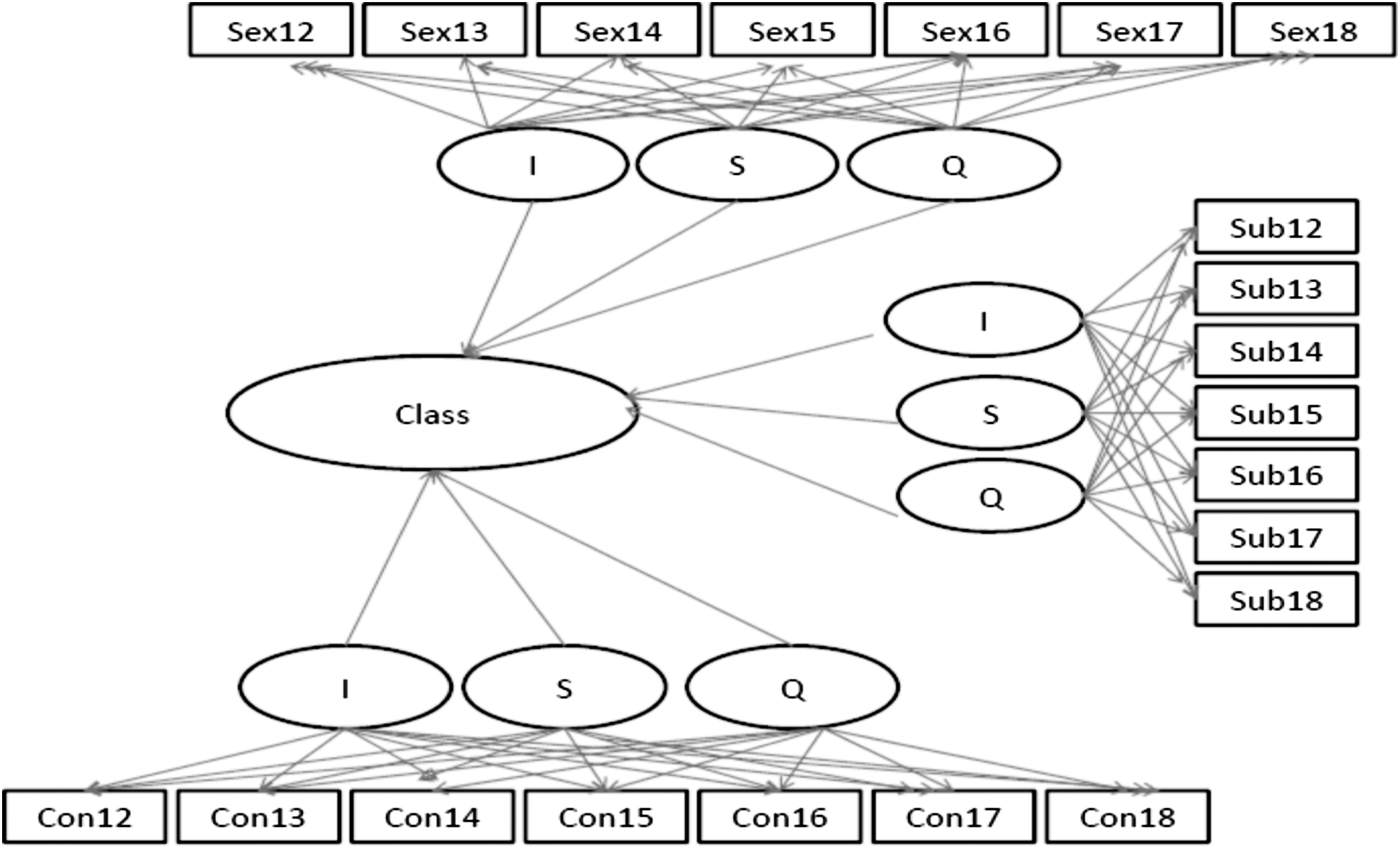
Composite variables for substance use, conduct problems, and sexual risk behaviors were created for each subject at each wave of data as described above. We coded each subject's risk behavior scores with the age of the subject at the wave when the data were collected. Thus, a subject with all seven waves of data would have had variables indicating substance use at each age from 12 to 18, as well as similar variables for conduct problems and sexual risk. This data file was then restructured so that risk behaviors were organized by age rather than wave. These variables were used to create the latent growth curve models that were clustered in the GMMs (Duncan & Duncan, Reference Duncan and Duncan2004). Three unconditional models of growth were tested for each outcome: (a) intercept only; (b) intercept and linear slope; and (c) intercept, linear slope, and quadratic slope. The growth models with intercept, linear, and quadratic slopes fit best for each outcome, and in the cases of sexual risk, χ2 (19, N = 1,406) = 17.46, ns, and drug use, χ2 (19, N = 1,406) = 20.93, ns, these models fit the data nearly perfectly. Based on these results, we created a GMM with growth defined by intercepts, linear, and quadratic slopes, as is illustrated in Figure 1.
The hypothesized model of the current study. Numbers correspond to the age for each behavior. Con, conduct problems; sub, substance use; sex, sexual risk behaviors; I, intercept; S, slope; Q, quadratic.

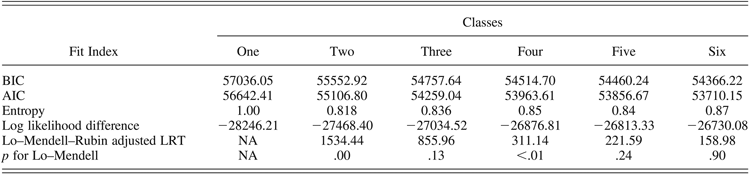
We next compared models with one to six latent classes of growth patterns. In concert with our theoretical approach, we used four criteria to determine the best fitting model: (a) the Lo–Mendell–Rubin test (Lo, Mendell, & Rubin, Reference Lo, Mendell and Rubin2001); (b) Akaike information criteria (Akaike, Reference Akaike1987); (c) Bayesian information criteria (BIC; Kass & Raftery, Reference Kass and Raftery1995); and (d) entropy. The Lo–Mendell–Rubin test quantifies the likelihood of describing the data better with one fewer class and was assessed at α = 0.05 level (Muthen, Reference Muthen2003). The Akaike information criteria and BIC provide information about the best fitting and most parsimonious models, with smaller values indicating better fit (Schwartz, Reference Schwartz1978). Entropy provides information about the degree to which the latent classes are clearly distinguishable by the data and can be estimated using class probabilities for each variable (Muthen et al., Reference Muthen, Brown, Masyn, Jo, Khoo and Yang2002). Values closer to one indicate accurate classifications.
Missing data
We had information from three waves for 442 youths (31.4%), from four waves for 419 youths (29.8%), from five waves for 277 youths (19.7%), from six waves for 196 youths (13.9%), and from all seven waves for 72 youths (5.1%). Mplus estimates all missing data values using the expectation maximization algorithm to obtain maximum likelihood estimates with robust standard errors (Allison, Reference Allison2002), which is an acceptable approach to handle missingness when data are missing at random (Little & Rubin, Reference Little and Rubin2002).
We examined the differences between excluded and included participants for the composite scales and sex. The effect sizes for differences between included and excluded participants were estimated for the three composite scales at ages 12 through 18 and showed very small differences consistently (d ≤ 0.2). However, there was a marginally higher proportion of males in the excluded group compared to the included group (52.3% vs. 48.4%, χ2 = 6.91, p < .01).
We used chi-square tests to determine whether there were differences on the composite variables between subjects with differing numbers of nonmissing waves of measurement. Out of the 21 analyses done (seven ages for each of three composite variables), there were only significant differences in three cases: at ages 16 (p < .05) and 18 (p < .01) for the sex risk scale and at age 17 for the substance use scale, based on number of waves. A greater proportion of participants with seven waves of data at ages 17 (45.8%) and 18 (40.3%) had not had sex in the previous 12 months compared to participants with fewer waves of data (range = 26.0%–30.7% at age 17 and 20.6%–30.0% at age 18).
Results
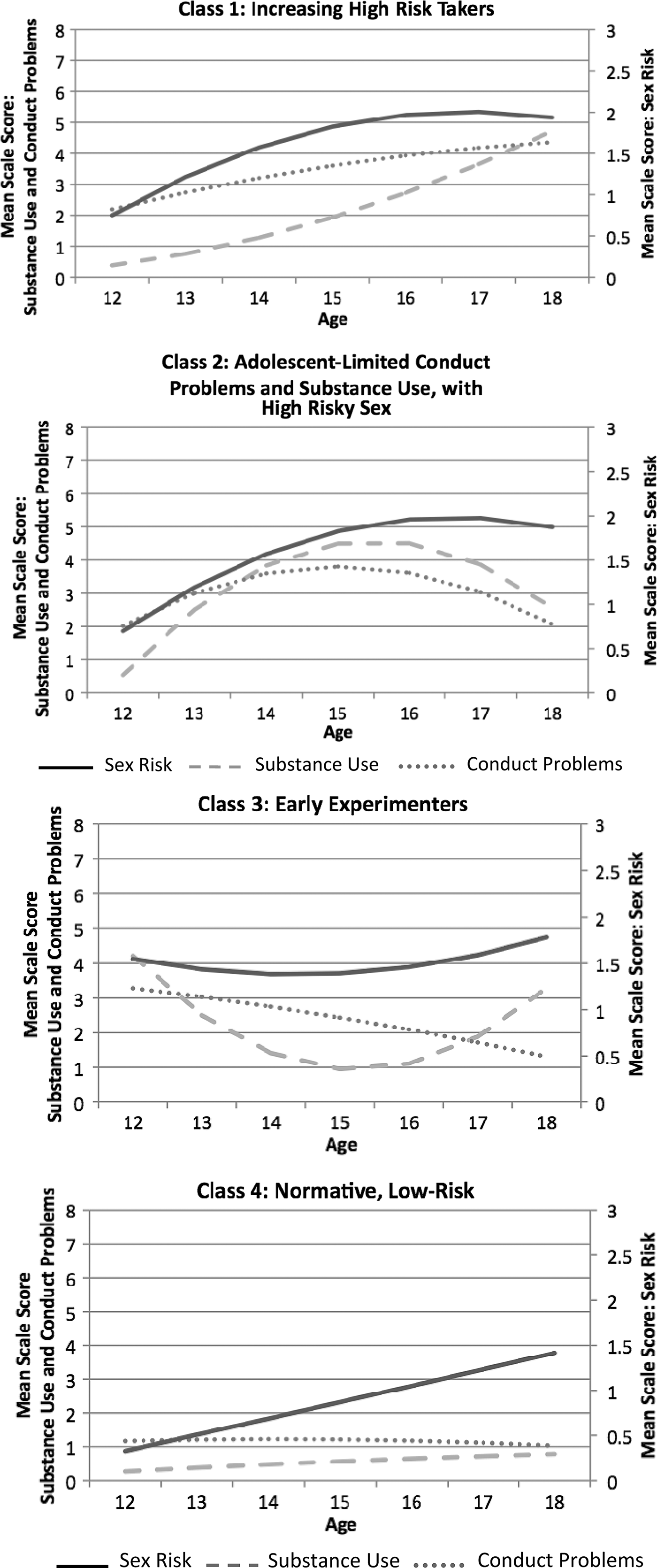
Table 1 reports the fit statistics for models of one to six latent classes of growth parameters. We used a combination of model fit and substantive meaning derived from PBT and existing developmental psychopathology research to arrive at the four-class solution. In our test of a one-class solution, there was significant variability in the linear slopes and the Lo–Mendell–Rubin tests attest to the presence of significant variability in average slopes among classes. Fit statistics indicated that the four-class solution fit the data best (log likelihood = –26876.81, BIC = 54514.70, entropy = 0.85; Table 1). The sexual risk, conduct problems, and substance use trajectories of the four classes are shown in Figure 2. The mean probability for being in each class was 81.8% for Class 1, 88.5% for Class 2, 88.9% for Class 3, and 94.7% for Class 4, indicating a high level of specificity in classifications across all four classes.
Risk trajectories by class.
Fit indices for one through six class solutions
Note: BIC, Bayesian information criterion; AIC, Akaike information criterion; LRT, likelihood ratio test.
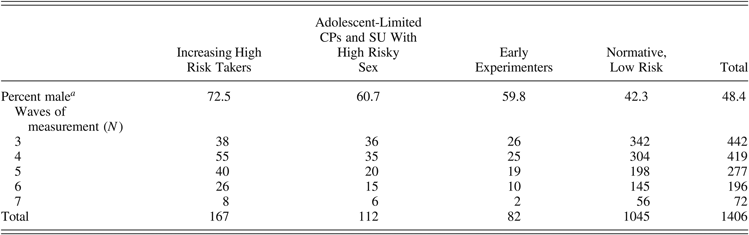
We examined whether sex composition and number of waves of data differed by latent class (Table 2). The number of waves of nonmissing data did not differ significantly among the latent classes, χ2 (12, N = 1,406) = 9.76, ns, indicating that the class solution is not due to different amounts of data in each class. In addition, an analysis of class membership by cohort was not significant, χ2 (18, N = 1,406) = 22.05, ns, indicating that the likelihood of class membership did not vary by enrollment cohort. Almost half (48.4%) of the participants were male. Males were significantly overrepresented in Class 1 (increasing high-risk takers) and underrepresented in Class 4 (normative, low risk).
Sex and number of waves by latent class
Note: CPs, conduct problems; SU, substance use.
aχ2 (3, N = 1,406) = 65.23, p < .001.
Class 1, the increasing high-risk takers (11.9% of sample), exhibited increasing high risk in all three areas; substance use for individuals in this group increased dramatically and steadily from ages 12 to 18 and conduct problems increased and seemed to level off by age 18, whereas sexual risk increased to age 15 then leveled off to be relatively consistent with the other classes. Eight percent of the sample fell into Class 2, the adolescent-limited group, which showed increasing high sexual risk, high adolescent-limited conduct problems, and high adolescent-limited substance use. Substance use for this class peaked at ages 15 and 16, conduct problems peaked at age 15 before starting to decline, and sexual risk increased until age 16 and then remained fairly constant. Class 3 demonstrated consistent high sexual risk, steadily decreasing conduct problems, and high-to-low-to-high increasing drug risk (5.8%; early experimenters). Risk behaviors for the early experimenters were higher risk at age 12 for all three behaviors than the other classes. In addition, sexual risk for this class was consistent at all ages but indicated a possible upward trend at age 18, conduct problems decreased steadily, and substance use showed a U-shaped trajectory that reached a low at age 15 only to begin increasing again. The normative, low-risk class (Class 4, 74.3%) was characterized by steadily increasing but low sexual risk with minimal conduct problems and minimal drug risk.
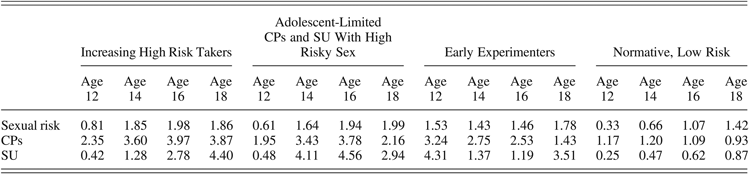
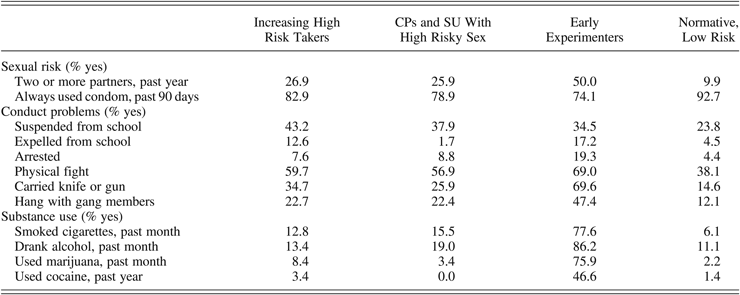
The mean composite scores for each class at ages 12, 14, 16, and 18 are reported in Table 3 (scores at ages 13, 15, and 17 are excluded in the interest of space, but they follow the same pattern). The differences of each construct at each age by class are significantly different (p < .001), which provides support for the four classes. We also examined whether there were significant differences by class membership in the items that made up the composite variables; results are only presented for age 12 (Table 4) although analysis was conducted for composite variables and individual items at ages 14, 16, and 18 as well. As expected, the normative, low-risk group had consistently lower risk behaviors than the other three classes; for example, 23.8% of members in this class had been suspended from school in the past year, compared to 34.5% of early experimenters, 37.9% from the adolescent-limited conduct problems and drug risk with high risky sex group, and 43.2% of increasing high-risk takers. For the other ages, all items were significant except for cocaine use at age 14.
Average composite scores by age and class membership
Note: Differences of each construct at each age by class are significant at p < .001. CPs, conduct problems; SU, substance use.
Differences in composite scale variables among the four groups at age 12
Note: This analysis was also done for ages 14, 16, and 18; all items were significant except for cocaine use at age 14. CPs, conduct problems; SU, substance use.
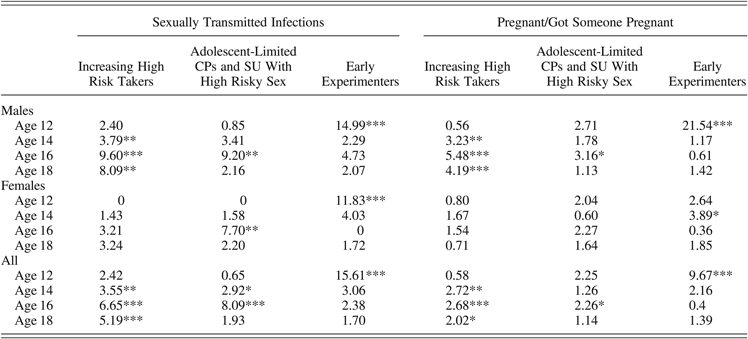
In order to examine the consequences of trajectory grouping on one domain of health (sexual health), we examined the odds ratios for STI and pregnancy outcomes in the past year by age and sex, with each group compared to the normative, low-risk group as the referent (Table 5). Data are reported for even year ages (ages 12, 14, 16, and 18) in the interest of parsimony, but the pattern is similar at odd year ages. For youths in Class 1, who increased their risk taking behaviors across development, STI risk was similar to the normative group at younger ages but higher at older ages, as would be expected as a consequence of their increased risk taking behaviors. For Class 2, youths with adolescent-limited risk-taking behaviors, elevated STI risk was also limited to the middle-adolescent years. For Class 3, youths with early risk-taking behaviors, elevated STI risk was only present at the youngest ages. This pattern of results of the STI outcomes illustrate that different sexual health consequences occur at different developmental periods depending on trajectory group membership. The results for pregnancy are generally parallel to those for STIs, although the effects are generally smaller. Overall, there were smaller differences for females than for males between each class and the normative, low-risk class.
Odds ratios for selected outcomes by age and sex versus Class 4 normative, low-risk
Note: CPs, conduct problems; SU, substance use; Class 1, increasing high risk takers; Class 2, adolescent-limited CPs and drug risk with high risky sex; Class 3, early experimenters; Class 4, normative, low risk.
*p < .05. **p < .01. ***p < .001.
Sensitivity analysis
Based on an inspection of the distribution of posterior probabilities used to assign individuals to classes, we conducted a sensitivity analysis, removing the 76 cases having class assignment probabilities less than 0.6. When we reran the 72 analyses to compare the odds of contracting STIs and getting pregnant/getting someone pregnant by class membership, age, and sex, the results changed in only two instances, providing support that these cases did not unduly bias our findings. At age 14, the odds of contracting an STI was no longer significant for youths in the adolescent-limited group compared to youths in the normative, low-risk group (odds ratio [OR] = 2.92, p < .05, to OR = 2.78, ns), whereas youths in the early experimenting group were more likely to contract STIs (OR = 3.06, ns, to OR = 3.45, p < .05) than youths in the normative, low-risk group. All other results in Table 5 were similar without these 76 cases. We also conducted a sensitivity analysis by rerunning the model with sex as a covariate, which produced a similar four-class solution, thereby further confirming our findings.
Discussion
This study is the first to our knowledge to examine the interdependent trajectories of three related adolescent risk behaviors: sexual risk, substance use, and conduct problems. Our sample comprised an understudied and underserved population: low-income, African American adolescents. An important finding of this study is that almost three-fourths of this sample (74.3%) was classified in the normative, low-risk group, exhibiting minimal risk behaviors. Most adolescents, even those living in high-risk environments, were making good choices and showing developmentally appropriate adolescent behaviors. Similar percentages of adolescents in low-risk groups were found in the National Longitudinal Survey of Adolescent Health, in which 46% of children in Grades 7 through 12 exhibited no risk behaviors and 26% participated in only one risk behavior (Porter & Lindberg, Reference Porter and Lindberg2000). Therefore, consistent with resilience theory (Fergus & Zimmerman, Reference Fergus and Zimmerman2005; Luthar, Cicchetti, & Becker, Reference Luthar, Cicchetti and Becker2000), it will be important for future work to examine the assets and resources that enable children in a high-risk environment to avoid risky adolescent behavior.
Consistent with prior cross-sectional studies and longitudinal studies of two risk behaviors, our longitudinal analyses suggest that these three risk behaviors have related patterns across development. The model that fit best and was most theoretically meaningful included four classes: normative low risk, increasing high-risk takers, adolescent-limited conduct problems and drug risk with high risky sex, and early experimenters. This pattern of trajectories shows similarities and differences from prior developmental psychopathology research. It is not unusual to identify high/increasing, adolescent-limited, and normative classes for adolescent risky behaviors (Jackson, Sher, & Schulenberg, Reference Jackson, Sher and Schulenberg2008; Park et al., Reference Park, Lee, Bolland, Vazsonyi and Sun2008). Other studies have identified more than these three classes, although we have not found another U-shaped trajectory of substance use that accompanies decreasing conduct problems. The earlier-described Wu et al. (Reference Wu, Witkiewitz, McMahon and Dodge2010) study, which modeled trajectories of substance use and conduct problems, found four classes (high substance use and conduct problems, increasing substance use and conduct problems, minimal conduct problems with high substance use, and minimal conduct problems and substance use); however, none of the classes showed a U-shaped trajectory for substance use. Their results also showed that adolescents in the nonnormative classes had more risky sex behaviors, particularly for adolescents who had early tobacco use and binge drinking. A study of marijuana use trajectories identified five classes (Windle & Wiesner, Reference Windle and Wiesner2004), but none of these exhibited the U-shaped trajectory that we found for substance use in our study.
Our group with the U-shaped substance use trajectory, the early experimenters, also showed consistently high sex risk and steadily decreasing conduct problems. The U-shaped drug risk trajectory appears counterintuitive, especially with the decreasing conduct problems. It is important to understand the reasons why a group of adolescents who decrease their substance use would then reverse course and increase again. It is possible that, for this group, the drug use during early adolescence was another manifestation of conduct difficulties (e.g., Mason et al., Reference Mason, Hitch, Kosterman, McCarty, Herrenkohl and Hawkins2010; Reiss, Reference Reiss1970; Turbin et al., Reference Turbin, Jessor and Costa2000), such that as the conduct problems decreased in middle adolescence, so did the substance use. The increase in drug use toward the end of adolescence, culminating at age 18 in a similar level of use to that of the adolescent-limited group, could represent use that is more normative and motivated by different factors than the early adolescent use, such as a strategy for coping with stressors or socializing with peers (e.g., Luthar & D'Avanzo, Reference Luthar and D'Avanzo1999; Mohr et al., Reference Mohr, Armeliu, Tennen, Carney, Affleck and Hromi2001; Ohannessian et al., Reference Ohannessian, Bradley, Waninger, Ruddy, Hepp and Hesselbrock2010). We cannot rule out that this finding is idiocyncratic to this sample or is due to issues regarding missing data. Because of the novel nature of this U-shaped trajectory, this group lends itself to further study in future analyses.
Eight percent of the sample fell into the adolescent-limited group. The theory behind adolescent-limited problem behavior, developed to describe antisocial behavior, is that most individuals who exhibit risky behavior during adolescence will grow out of it and develop into healthy adults, whereas other youths will continue to exhibit these behaviors and will be in a life-course-persistent group (Moffitt, Reference Moffitt1993; Moffitt et al., Reference Moffitt, Caspi, Harrington and Milne2002; Shedler & Block, Reference Shedler and Block1990). Our adolescent-limited group showed increasing sexual risk that began to taper off at age 18 and clear adolescent-limited trajectories for conduct problems and substance use. However, conduct problems and drug use at age 18 were still higher for this group than for the normative, low-risk group. Sexual risk at age 18 was about equal to the early experimenters and increasing high-risk groups and slightly higher than the normative group. The trajectories for this class support the concept of adolescent-limited risky behavior in this population across a number of domains of risk taking. The increasing high-risk takers, about 12% of the sample, are of concern for their high levels of risky behavior in all categories. Although we lack information on these individuals once they reach adulthood, it may be that they are on a life-course-persistent trajectory.
Regarding the concept of an adolescent-limited group in our sample, our findings differ from Moffitt's findings in some important ways. The finding that 26% of the Dunedin, New Zealand, sample was classified in an adolescent-limited group (Moffitt et al., Reference Moffitt, Caspi, Harrington and Milne2002) referred to males only, whereas our study, which reports that 8% of the sample was adolescent-limited, included males and females. The adolescent-limited group in our study started showing desistance of conduct problems and substance use at age 16, whereas the males originally classified as adolescent limited in the Dunedin sample were still showing antisocial tendencies at age 26 (Moffitt et al., Reference Moffitt, Caspi, Harrington and Milne2002). In addition, other work examining trajectory classes of one of the risk factors examined in the current study that included girls in the analyses also demonstrated lower proportion of individuals in the adolescent-limited group compared to the riskier groups (Huesmann, Dubow, & Boxer, Reference Huesmann, Dubow and Boxer2009; Marti, Stice, & Springer, Reference Marti, Stice and Springer2010). Therefore, it could be the case that when risky behaviors manifest in girls, they may be more likely to follow a more persistent course as opposed to an adolescent-limited one. The differences may be explained by cultural differences, statistical approaches, sample characteristics, or other factors and merit further investigation.
Somewhat contrary to our expectations, all of the nonnormative classes exhibited high sexual risk behavior, which is of particular concern considering the relatively high rate of HIV infection and pregnancy in African American teens. Even the adolescent-limited group did not show adolescent-limited behavior in sexual risk, only in substance use and conduct problems, although the level of sexual risk at the end of adolescence was similar to the increasing high-risk takers and early experimenters. This suggests that some increase in sexual expression across development is normative regardless of engagement in other risk behaviors. Another longitudinal study of African American youths and young adults found that sexual risk behavior increased during the high school years and then decreased during young adulthood (Fergus et al., Reference Fergus, Zimmerman and Caldwell2007); however, because we do not have data on our sample beyond age 18, we cannot know whether a similar pattern would emerge for this group. Although it may be developmentally normative for sexual experimentation to occur by late adolescence, the consequences of unprotected sex can be significant and include infections with serious morbidity and mortality.
Developmental periods of elevated risk for sexual health outcomes (self-reported STIs and pregnancy) differed by grouping, despite the fact that several of the classes showed similar developmental trajectories of sexual risk taking. This linkage between class and sexual health outcomes is a novel contribution of our study. For example, both Class 1 (increasing high-risk takers) and Class 2 (adolescent limited) showed nearly identical increases in the risky sexual behavior variable across development. What differentiates these classes is that Class 1 continued to increase their substance use and conduct problems, whereas Class 2 desisted in these behaviors by late adolescence. Despite similar rates of risky sexual behavior, Class 1 showed increasing and elevated risk for STIs throughout adolescents, whereas the period of risk for Class 2 was limited to middle adolescence. Class 3 showed stable levels of risky sexual behavior across development, but these individuals experienced a period of very high risk for STIs at the younger ages when they also had their highest levels of substance use and conduct problems. What we conclude from this pattern is that, in terms of a developmental perspective on sexual health, it is critical to consider not only trajectories of sexual risk behavior but also developmental patterns of engagement in other problem behaviors such as substance use and conduct problems. These other problem behaviors appear to differentiate STI risk better than trajectories of sexual risk behavior alone. An appreciation that multiple risk behaviors need to be considered together to understand adolescent health is consistent with PBT (Jessor, Reference Jessor1991) and more recently with what has been described as a “syndemic” in the public health literature (Mustanski et al., Reference Mustanski, Garofalo, Herrick and Donenberg2007; Singer & St. Clair, Reference Singer and St. Clair2003).
For an example of the value of studying these risk behaviors in concert, consider the case of HIV/AIDS as an outcome. Each of the risk behaviors discussed above is directly or indirectly related to HIV risk. Adolescent delinquency is associated with substance use and risky sexual behavior, particularly in low-income youths (Mason et al., Reference Mason, Hitch, Kosterman, McCarty, Herrenkohl and Hawkins2010). Sexual risk taking, specifically lack of condom use, multiple sex partners, and early sexual debut, is associated with increased risk for HIV, as well as other STIs and unplanned pregnancies. Rigorously conducted studies have identified substance use as a major risk factor for adolescent HIV infection (Lowry et al., Reference Lowry, Holtzman, Truman, Kann, Collins and Kolbe1994); especially strong is the association between alcohol use and no condom use at first intercourse (Leigh, Reference Leigh2002). Furthermore, externalizing psychopathology has been identified as the mental health characteristic most strongly linked with HIV risk in youths (Dishion, Reference Dishion2000; Donenberg, Bryant, Emerson, Wilson, & Pasch, Reference Donenberg, Bryant, Emerson, Wilson and Pasch2003; Donenberg & Pao, Reference Donenberg and Pao2005). Given this pattern, researchers and practitioners addressing HIV/AIDS among youths may benefit from understanding the clustering of the risk factors more fully (Mustanski et al., Reference Mustanski, Garofalo, Herrick and Donenberg2007).
Prevention efforts should be focused on addressing all three risk behaviors, but the high rate of risky sexual behavior in all three nonnormative classes (25% of the sample) underscores an urgent need for improved sex education, including teen pregnancy and HIV/STD prevention, in this community. Even among the normative, low-risk group, the proportion of participants who reported a pregnancy or getting someone pregnant in the past year almost doubled from age 16 to 18, from 10% to 19.2%; for increasing high-risk takers, 27.6% of 18-year-olds reported a pregnancy or getting someone pregnant in the previous year, over two times the odds of the normative class. The high-risk taking class also had more than five times the odds of having a STI in the previous year. Our results suggest that youths who engage in relatively high levels of substance use and conduct behaviors at an early age may be particularly important to target with sexual health promotion programs.
Limitations
The findings are based on a sample of African American, low-income youths in the Southern United States, so they may not generalize to other populations. There is a risk of response bias because the data are from adolescent self-reports; it is possible that some participants may have underreported risky behaviors, whereas others overreported their behaviors. Although our analytical software employed accepted methods of handling missing data and we excluded respondents with fewer than three waves of data, it is possible that those with one or two waves and who were young enough to complete future waves (as opposed to those who aged out of the study), differed from those who completed three or more waves of data. These respondents may have been in jail, moved away, or had other nonrandom reasons for being unable or unwilling to further participate. Although the excluded participants differed in some ways from the participants we included in our analysis, the differences likely serve to make our findings more conservative. Finally, there are numerous ways in which composite variables for measuring risk have been constructed in the literature. Our risk scales were constructed based on the data we had available, theories about developmental context and risk, and reviews of other studies. For example, for substance use, we were not able to take into account the frequency or amount of use because this information was not collected. In addition, each item was weighted the same, although research supports the likelihood that an adolescent using cocaine has also used cigarettes, alcohol, and/or marijuana.
These findings contribute to the literature in that we used GMM to identify different patterns in the trajectories of a community-based sample of minority, low-income youths based on common adolescent risk behaviors. The four-class solution identified when analyzing a combination of sexual risk, conduct problems, and substance use factors highlights the need to focus education and intervention efforts on the negative consequences of risky sexual behaviors. Further research on predictors and consequences, especially when combined with our ongoing collection of genetic and environmental data, will further elucidate the development of these trajectories as well as opportunities for preventing or moderating problem behaviors.
Appendix A
MPlus Syntax
TITLE: Individual Growth Mixture Models for MYS Study
DATA:
FILE IS (insert filename);
VARIABLE:
NAMES ARE pid sex12 sex13 sex14 sex15 sex16 sex17 sex18 cp12 cp13 cp14 cp15 cp16
cp17 cp18 d12 d13 d14 d15 d16 d17 d18;
USEVARIABLES ARE sex12 sex13 sex14 sex15 sex16 sex17 sex18
cp12 cp13 cp14 cp15 cp16 cp17 cp18 d12 d13 d14 d15 d16 d17 d18;
Missing are all (–99);
CLASSES = childcl (4);
ANALYSIS: TYPE = MIXTURE;
STARTS = 500 20;
MITERATIONS = 1000;
ESTIMATOR = MLR;
PROCESSORS = 2;
plot: type is plot3;
series is sex12–sex18 (ssr) | cp12–cp18(scr) | d12–d18 (sdr);
MODEL:
%OVERALL%
isr ssr qsr |sex12@0 sex13@1 sex14@2 sex15@3 sex16@4 sex17@5 sex18@6;
icr scr qcr|cp12@0 cp13@1 cp14@2 cp15@3 cp16@4 cp17@5 cp18@6;
idr sdr qdr |d12@0 d13@1 d14@2 d15@3 d16@4 d17@5 d18@6;
OUTPUT: TECH11;