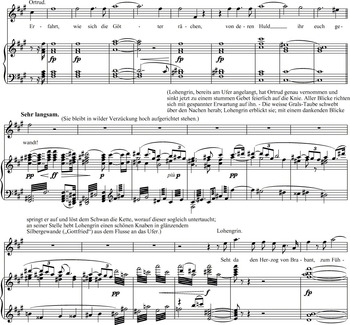
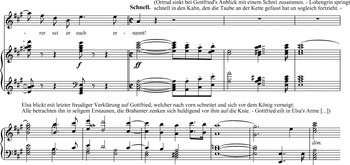
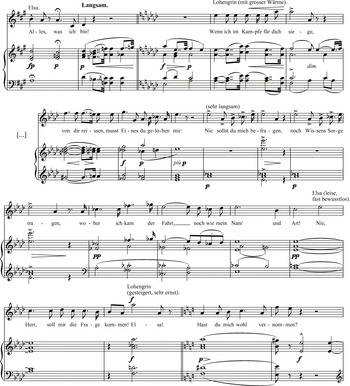
Although titled after its male hero, Lohengrin surprisingly revolves around a tragic bride. Elsa enters the stage wrongfully accused of a crime, spends half of Acts II and III torn by doubt, suffers public humiliation on her way to the altar, breaks her marital vow, and practically brings down the final curtain with her on-stage collapse. Her dramatic prominence issues directly from Wagner's engrossing vision of the ‘absolute artist’, which renders the faultless knight a passive respondent (even his Frageverbot is dictated from above) and burdens frail Elsa with the opera's two vital decisions: invoking the knight to defend her innocence and breaking her pledge to remain ignorant of his origins. Indeed, Wagner hinges the main sources of suspense fuelling the drama on her promise to keep clear of the forbidden question: the uncertainty about her guilt (Act I) and the growing speculation about Lohengrin's ‘Nam und Art’ (Acts II, III).
Elsa's enormous dramatic weight has generated a tradition of critical resistance ever since the completion of the opera. On the one hand, critics have protested Lohengrin's cruel treatment of an innocent girl. This cruelty results from Wagner's insistence on creating drama out of a philosophical notion already present in his first opera Die Feen (1834),Footnote 1 which he defined as the ‘contact between a metaphysical phenomenon and human nature, and the impossibility that such contact will last.’ Reacting, on 30 May 1846, to Hermann Franck's reservations about Lohengrin's depressing finale, the composer denied his heroine any mercy: ‘atonement for Elsa's failing must necessarily involve her punishment … only the punishment of separation – albeit the harshest of all penalties – appears as utterly inevitable, and it can never appear too harsh, precisely because it is the most just and most consequential’.Footnote 2 This view would never find popularity with commentators who have regarded Lohengrin's condition as so ‘impossible’ and ‘inhumane’, to quote Dahlhaus, that Elsa ‘would have to ask him his name, even without Ortrud's interference’.Footnote 3
On the other hand, Elsa's feminine nature has frequently been used as an exegetical frame for her mental deterioration. In his guide to the opera, Kurt Pahlen calls her confidence breach ‘typically female’.Footnote 4 Ernest Newman and Dieter Borchmeyer attribute her reaction to a psychological fear of loss and abandonment, with the latter arguing that her dread of the numinous ‘inspires … an insane and self-destructive desire to know her husband's true identity’.Footnote 5 For Nike Wagner, Elsa's decision affirms love as ‘sensual certainty’ and not as ‘abstract emotion’,Footnote 6 and Barry Emslie finds that she ‘asserts the importance of the sexual couple as a collective identity over that of the single male hero’.Footnote 7 In two alternative readings, finally, Slavoj Žižek proposes that Elsa ‘intentionally asks the fateful question and thereby delivers Lohengrin whose true desire, of course, is to remain the lone artist sublimating his suffering into his creativity’,Footnote 8 and Berthold Hoeckner, treating the opera as a Wagnerian allegory on music and poetry, explains Elsa's decision as constituting the birth of music drama.Footnote 9
Against this tradition of critical complaints, game theory analysis (the study of strategic reasoning in human behaviour) offers a novel approach directed at the heart of the drama that yields a psychologically deeper and dramatically more compelling reading of the opera. Conviction and doubt form the crux of Wagner's Lohengrin (‘Lohengrin suchte das Weib, das an ihn glaubte’ / Lohengrin sought the woman who believed in him)Footnote 10 and naturally call for an epistemological analysis of the characters' beliefs. What is certain and what remains conjectural? How much does each character know about the others? What do they know about what the others know about themselves? And in what way does each arrive at conclusions and translate them into actions? Such questions have already been asked by literary critics and game theorists exploring drama and fiction.Footnote 11 Steve Roth's analysis of the ‘Mousetrap’ in Hamlet – where the noun ‘belief’ appears twice as frequently as in any other of Shakespeare's plays – shows that, against common perception, Hamlet does not actually gain knowledge of his father's murder. Indeed, his decision to exact revenge, notwithstanding ‘that he can never truly know’ the murderer, is what renders Hamlet the first modern tragedy.Footnote 12 In his path-breaking monograph I Know That You Know That I Know, George Butte studies belief systems in (among others) Jane Austen's novels, pointing to the ‘deep intersubjectivity’ in beliefs about beliefs (commonly referred to as higher, or second-order, beliefs).Footnote 13 Lisa Zunshine explores Richardson's Clarissa and Nabokov's Lolita from the perspective of theories of mind or metarepresentation (thinking about other people's thoughts and distinguishing informational layers in fiction).Footnote 14 More recently, economists have applied game theory to drama and opera. Analysing episodes of the TV series CSI: Crime Scene Investigation, Benedikt Löwe, Eric Pacuit and Sanchit Saraf propose a formal algorithm to track the characters' belief systems and uncover building blocks of fictional narratives.Footnote 15 Closer to music, Ilias Chrissochoidis, Heike Harmgart, Steffen Huck and Wieland Müller use counterfactuals (evaluating an action by taking into account non-chosen alternatives) to explain Tannhäuser's disruptive behaviour at the singing contest in Wagner's eponymous opera, identifying the hero's dilemma once the contest is underway.Footnote 16
In an age such as ours, where reality and fiction complement and re-enforce each other, social science methodologies can enrich opera hermeneutics by focusing on beliefs that underpin staged action.Footnote 17 Game theory especially allows a probing of the state of knowledge and set of strategies for each character in a closed system of human interaction, thus leading to a deeper understanding of human conflict, the root of all drama.Footnote 18 Although not every opera is amenable to this type of analysis, those of Wagner are well known for their strong sense of drama and philosophical depth.Footnote 19Lohengrin, in particular, offers a good test case, as its waning post-war popularity rests considerably on dissatisfaction with its dramatic properties.Footnote 20 The knight's affirmation of love-at-first-sight for Elsa (Act III, scene 2) is contradicted by the mercenary quid pro quo of their marriage, and his declining the title of Duke (Act II, scene 3) casts doubt on his long-term commitment to Brabant. Moreover, Elsa's martyrdom is hardly tolerable in an era of female emancipation, and the knight's tender feelings for his ‘lieber Schwan!’ (Act I, scene 3), which Wagner underlines with an orchestral Generalpause, raise homoerotic suspicions among gay and straight listeners alike. Above all, the opera's bleak ending, with both heroes withdrawn and leaving the stage to first-timer Gottfried, is hardly attractive to audiences accustomed to spectacular or comforting finales in other dramatic genres. If anything, Wagner's creative struggle with this finale shows careful thinking about his characters,Footnote 21 whose actions might better be understood through rigorous epistemological analysis.
Elsa's (rational) choice
As Elsa constitutes the dramatic core of the opera, this essay concentrates on her beliefs and behaviour. We propose that she asks the forbidden question because her ignorance of her husband's identity raises doubts about his belief in her innocence. This second-order belief (Elsa thinking about her spouse's thinking about her) reveals that she has a theory of mind and that there is ample sophistication in her emotional turbulence. We draw support for this novel perspective from Wagner himself, whose prose draft of the libretto has Elsa explicitly conditioning Lohengrin's belief in her innocence by her own belief in his mission: ‘So wie du an meine Unschuld glaubst, glaub’ ich an deine hohe Sendung!' (Just as you believe in my innocence, so do I believe in your lofty mission).Footnote 22 At the time, just after Lohengrin's arrival and before the trial-by-combat that determines her fate, Elsa has no reason to doubt his origins: the knight has duly responded to her call and willingly risks his life for her innocence. She has faith and is certain. This is well understood by Ortrud, a master psychologist whose cognitive sophistication Wagner heightens with a progressive musical idiom,Footnote 23 without breaking the impression that she will never get rid of Elsa and her omnipotent knight. Indeed, her first attempt to shake Elsa's faith, by invoking the fear of loss and abandonment, fails resoundingly:
ORTRUD Wohl daß ich dich warne,
zu blind nicht deinem Glück zu trau'n;
daß nicht ein Unheil dich umgarne,
laß mich für dich zur Zukunft schau'n.
ELSA Welch' Unheil?
ORTRUD Könntest du erfassen,
wie dessen Art so wundersam,
der nie dich möge so verlassen,
wie er durch Zauber zu dir kam!
ELSA Du Ärmste kannst wohl nie ermessen,
wie zweifellos mein Herze liebt!
Du hast wohl nie das Glück besessen,
das sich uns nur durch Glauben gibt!
Kehr' bei mir ein, laß mich dich lehren
wie süß die Wonne reinster Treu'!
Laß zu dem Glauben dich bekehren:
es giebt ein Glück, das ohne Reu'.
[ll. 544–59]
[ORTRUD: It were well I should warn you / not to trust too blindly in your happiness; / lest some misfortune should befall you, / let me look into the future for you.
ELSA: What misfortune?
ORTRUD: Have you never reflected / that he of such mysterious lineage / might leave you in the same way / as by magic he came to you?
ELSA: Poor woman, you can never measure / how free of doubt is my heart! / You have indeed never known the happiness / that only faith can give. / Come in with me! Let me teach you / how sweet is the bliss of perfect trust! / Let yourself be converted to faith: / it brings happiness without alloy!]
Elsa resists the attack because her faith in the knight is grounded in their pact. He proved his belief in her innocence by winning the combat, and so she believes in his high mission and their happiness. In the following soliloquy, Ortrud swiftly updates her strategy. Her failure to instil doubt in Elsa's mind becomes a lever for a renewed and more powerful assault, as it has inflated Elsa's confidence. Which dreamy maid could possibly teach happiness and ‘perfect trust’ to an older and experienced woman?
ORTRUD Ha! Dieser Stolz, er soll mich lehren,
wie ich bekämpfe ihre Treu':
gen ihn will ich die Waffen kehren,
durch ihren Hochmuth werd' ihr Reu'!
[ll. 560–3]
[Ha! This pride of hers shall teach me / how to undermine her trust! / Against it I will turn her own weapon: / through her pride shall come her pain!]
To know something is one thing; to be able to teach it is to know that you know it. Until now Elsa was faithful and certain; from the moment she rejects Ortrud's ludicrous suggestion she also has proof, thus she knows of her own faithfulness. What she cannot realise is that her inflated self-assurance makes her more vulnerable to another attack. Indeed, Ortrud's assault in Act II, scene 4 is unexpected and shattering, as it combines private betrayal (Elsa: ‘I was misled by your deceit’), a breach of social protocol (the wife of an exiled man publicly challenges Brabant's heiress) and a public accusation that, if true, exposes a conspiracy (Brabant cannot be ruled by an impostor knight and a murderess Elsa):
ORTRUD Weil eine Stund' ich meines Werth's vergessen,
glaub'st du, ich müßte dir nur kriechend nah'n?
Mein Leid zu rächen will ich mich vermessen,
was mir gebührt, das will ich nun empfah'n.
ELSA Weh'! Ließ ich durch dein Heucheln mich verleiten,
die diese Nacht sich jammernd zu mir stahl?
Wie willst du nun in Hochmuth vor mir schreiten,
du, eines Gottgerichteten Gemahl?
ORTRUD Wenn falsch Gericht mir den Gemahl verbannte,
war doch sein Nam' im Lande hochgeehrt;
als aller Tugend Preis man ihn nur nannte,
gekannt, gefürchtet war sein tapf'res Schwert.
Der deine, sag', wer sollte hier ihn kennen,
vermagst du selbst den Namen nicht zu nennen?
…
Kannst du ihn nennen? Kannst du uns es sagen,
ob sein Geschlecht, sein Adel wohl bewährt?
Woher die Fluthen ihn zu dir getragen,
wann und wohin er wieder von dir fährt?
Ha, nein! Wohl brächte ihm es schlimme Noth;
der kluge Held die Frage drum verbot!
…
ELSA Du Lästerin! Ruchlose Frau!
Hör', ob ich Antwort mir getrau'!
So rein und edel ist sein Wesen,
so tugendreich der hehre Mann,
daß nie des Unheil's soll genesen,
wer seiner Sendung zweifeln kann!
Hat nicht durch Gott im Kampf geschlagen
mein theurer Held den Gatten dein?
Nun sollt nach Recht ihr alle sagen,
wer kann da nur der Reine sein?
…
ORTRUD Ha! Diese Reine deines Helden,
wie wäre sie so bald getrübt,
müßt' er des Zaubers Wesen melden,
durch den hier solche Macht er übt!
Wagst du ihn nicht darum zu fragen,
so glauben alle wir mit Recht,
du müßtest selbst in Sorge zagen,
um seine Reine steh' es schlecht!
[ll. 635–77]
[ORTRUD: Because for an hour I forgot my position / do you think that I must only cringe before you? / I intend to have revenge for my suffering; / I demand what is mine by right!
ELSA: Ah! I was misled by your deceit / when last night you crept lamenting to me. / How can you now arrogantly walk before me, / the wife of one condemned by God?
ORTRUD: Although false judgment has condemned my husband, / his name was highly honoured in the land; / he was called the crown of all virtue, / his valiant sword was known and feared. / But yours, who here can know him / if you yourself may not call him by his name? / … / Can you name him? Can you tell us / whether his lineage, his nobility, is well attested, / from whence the waters brought him to you, / when he will leave you again, and for where? / Ah no! It would bring disaster on him – / so the crafty hero forbade the question! /
…
ELSA: Slanderer! Wicked woman! / Hear, if I can trust myself to answer! / So pure and noble is his nature, / so virtuous this exalted being, / that none who can doubt his mission / shall ever be free from ill-fortune. / Did not my dear hero, with God's help, / strike down your husband in the combat? / Now let all say, in justice, / which alone can be innocent? /
…
ORTRUD: Ha, how soon would this innocence / of your hero be besmirched / if he had to reveal the magic craft / by which he wields such power here! / If you do not dare to question him / we shall all believe, with right / that you yourself falter in misgiving, / and have little confidence in his innocence!]
Launched as an unprovoked attack against Lohengrin's honesty, Ortrud's disruption (before the house of God, of all places) has cognitive effects. By introducing an alternative explanation for his victory she forces Elsa – indeed, everyone present – to confront two scenarios: either her saviour won by valour, thus proving her innocence, as it was generally accepted in trial-by-combat, or he cheated through magical means (‘Zaubers Wesen’), which makes it possible that, after all, he did not believe in her innocence. In the following scenes, Elsa gradually realises that without revealing his identity she cannot verify his ‘hohe Sendung’ upon which her belief in his belief in her innocence really depends.Footnote 24 What underlies her turbulence in the Act III duet is this concern for her innocence in the mind of her spouse. What once was a simple mindset of unshakeable faith in God and her saviour has turned, with Ortrud's cognitive manipulation, into a world of multiple and conflicting possibilities and uncertainties. The price of saving her marriage (not asking the forbidden question) is to live knowing of Ortrud's alternative explanation without ever being able to test it. The price of restoring her Act I certainty (asking the question) is to risk her marriage (note, however, that the knight never specified the consequences of breaching her vow, which leaves open the possibility that she might be forgiven). We can represent her dilemma as follows:
Elsa's strategy

By choosing the second, Elsa proves that she is both human and a thinker, and that her need to know outweighs her fear of losing the knight. If she is devastated in the finale, at least she does know her departing husband's identity, which confirms to all Brabant and to herself that he won the combat fairly, thus proving her innocence. Her objective being fulfilled, she, too, is free to depart the world, though in the way mortals do (collapsing entseelt).
Bayesian updating and the trial-by-combat
Elsa's martyrdom is first and foremost mental. Quite suddenly, she passes from a cognitive state of absolute knowledge to that of stochastic belief predicated on alternatives that inform her decision-making. To understand her condition, let us ponder the ultimate consequences of Ortrud's scenario: if the knight cheated, then Friedrich was presumably the real winner. If so, his charges against Elsa were just and she was guilty, which is, of course, impossible for her to accept, for she knows she is innocent. The only solution to this impasse would be to consider trial-by-combat as inherently flawed, which then would cast doubt on the existence of divine justice and, ultimately, of God. In short, Elsa's entire worldview would collapse. The judicial duel concluding Act 1 thus turns into a focal point in the minds of everyone except Lohengrin, and deserves to be examined as something more than a piece of spectacular action or a formal counterweight to the wedding procession in Act III.
In medieval times, trial-by-combat or judicial duel was reserved for cases where the truth of a matter could not be ascertained otherwise, such as unwitnessed murders. It was accepted that, because of the high stakes involved (losing one's own life), a man was submitting his case directly to God's hands to receive either victory or death regardless of his physical attributes.Footnote 25 As this ‘wager of battle’ involves a winning and a losing agent, it qualifies as a zero-sum bet and can be further illuminated through a class of celebrated results in game theory called agreement theorems. The basic logic of these theorems is grounded in the observation that, if somebody is willing to bet against us, he must have different information from ours, and that we need to take this into account when we update our beliefs.Footnote 26 As a result, agents will never trade in a zero-sum environment where one's gain is the other's loss, and they will never bet.Footnote 27 Agreement theorems and the Bayesian updating they rest on allow us to probe the degree of knowledge and strategies of both combatants even before they cross swords.
Thomas Bayes (1702–61) was a British mathematician and Presbyterian minister who showed, in a posthumously published Essay Towards Solving a Problem in the Doctrine of Chances (1763), how to compute conditional probabilities.Footnote 28 If a piece of news arrives, the probability of something being the case has to be recomputed conditional on the new information. This very process where a prior belief is transformed into a conditional or posterior belief is the process of Bayesian updating. Common examples include investors updating their beliefs about the economic potential of companies in response to the arrival of new technologies; voters adjusting their beliefs about a politician's integrity after hearing rumours about corruption; and lovers pondering how much they are loved back despite a phone that does not ring. New information can arrive as factual knowledge (for example, updating weather forecast on the basis of new data) or in the form of suppositions of other people's beliefs. The latter is the one we will apply to the two combatants in Lohengrin.
As mentioned above, the trial-by-combat is a zero-sum game: Lohengrin bets on (for he already knows of) Elsa's innocence and Friedrich on Elsa's guilt. Since only one is expected to survive, both contestants have to be fairly certain about their respective cause. This can happen only if they have uneven access to private information. Indeed, Lohengrin knows for a fact that Elsa did not kill her brother because, omniscience discounted, he was led to Brabant by the supposed murder victim transformed into a swan. Friedrich, on the other hand, believes in her guilt based on second-hand evidence, namely Ortrud's eyewitness account and his observing Elsa's behaviour during interrogation:
als ich mit Drohen nun in Elsa drang,
da ließ in bleichem Zagen und Erbeben
der gräßlichen Schuld Bekenntniß sie uns seh'n. [ll. 50–2]
[when I questioned Elsa threateningly / her pallor and her trembling revealed to us / her confession of her hideous crime.]
His indirect knowledge is compounded by a conflict of interest: the eyewitness happens to be Elsa's enemy and, by the time of the trial, also his wife; still worse, both benefit from Elsa's death. This is one reason why he avoids disclosing his source before the King and rushes to propose a duel:
Wess' ich sie zeih', dess' hab' ich sich'ren Grund:
glaubwürdig ward ihr Frevel mir bezeugt.
Doch eurem Zweifel durch ein Zeugniß wehren,
das stünde wahrlich übel mein Stolz! [ll. 131–4]
[Her offence is proved to me beyond doubt; / but to dispel your doubts by calling a witness / would truly wound my pride!]
In the absence of contradictory evidence and without Lohengrin's presence, Friedrich has every reason to expect victory. Indeed, no Brabantine volunteers to defend Elsa (‘Ohn’ Antwort ist der Ruf verhallt:' l. 172 / The challenge dies away unanswered), prompting Friedrich to boast ‘auf meiner Seite bleibt das Recht.’ l. 175/ (Right is on my side!).
The knight's arrival changes everything. He is a stranger, thus he cannot be evaluated, lands (or rather docks) in a miraculous way and looks pure beyond doubt:
welch' seltsam Wunder! …
…
Ein Wunder ist gekommen!
Ha, unerhörtes, nie geseh'nes Wunder! [ll. 187–94]
[What a strange and wondrous sight! … / A miracle has transpired, / A miracle such as we have not heard nor seen!]
Indeed, the Brabantines advise Friedrich ‘Steh’ ab vom Kampf! Wenn du ihn wagst, / zu siegen nummer du vermagst!' (ll. 256–7 / Call off the fight! If you challenge him, / you will never succeed in conquering him). Under Bayesian updating, he should reconsider his commitment to the duel because of Lohengrin's willingness to fight and everybody's updated belief that he may not win. Wagner himself describes Friedrich's deportment as one of inner struggle (‘mit leidenschaftlich schwankendem und endlich sich entscheidendem, innerem Kampfe’: ll. 261–2; in the verse draft, ‘nach heftigem inneren Kampfe’: l. 433). Why does he, then, continue the challenge and agree to fight?
Friedrich's beliefs
We propose that Friedrich's beliefs change in a subtle way, thus affecting the logic of agreement theorems. His belief ‘Elsa is guilty’, based on Ortrud's account, is displaced by a belief in his sincerity in believing ‘Elsa is guilty’. From this point forward his statements revolve exclusively around his honour and truthfulness (‘ich zu lügen nie vermeint.’ l. 266 / I have never stooped to tell a lie). The duel is no longer about Elsa's crime but about his integrity in espousing this belief (‘Herr Gott, verlass’ mein' Ehre nicht!' l. 299 / Lord God, let me not be dishonoured!). Moments before crossing swords with Lohengrin, Friedrich still has something to gain even if he dies: his personal integrity.
Friedrich's strategy

Agreement theorems predict that agents will only bet, and knights will only fight, if they have either perfect knowledge (such as Lohengrin) or if the zero-sum assumption does not quite hold, that is, if one agent stands to gain something from engaging in the bet regardless of its outcome (such as Friedrich who wants to maintain his sincerity). Friedrich is bound to lose not only because Lohengrin (his divine nature aside) fights for the right cause, but also because he himself replaced the strength of a first-order belief with a reflection upon it.Footnote 29 In warfare strategy, higher-order beliefs are crucial for winning a battle, but can be fatal for those in the line of fire, who are supposed to act instantly without any reflection.Footnote 30 Friedrich's ‘updating’ has consequences for his post-duel attitude, as we shall see below.
His life being spared by the knight, Friedrich is left to bemoan the loss of his honour (‘Mein’ Ehr' hab' ich verloren, / mein' Ehr', mein' Ehr' ist hin!' ll. 362–3). Still believing in God's will (‘Weh’! mich hat Gott geschlagen'), he has to accept that he was wrong and his witness, Ortrud, had lied to him:
War's nicht dein Zeugniß, deine Kunde,
die mich bestrickt, die Reine zu verklagen?
…
Und machtest mich, …
zu deiner Lüge schändlichem Genossen? (ll. 368–9, 383–5)
[Was it not your testimony, your story, / that inveigled me into accusing the innocent Elsa? / … / And made me, … /the base accomplice of your lies?]
Although she knows of Elsa's innocence, Ortrud does not believe in God and thus she is not obliged to accept the result as fair. At her lowest point in the opera, she finds recourse in her fertile mind and spins the alternative scenario that will drive Lohengrin from Brabant and will lead to Elsa's and (accidentally?) to her own husband's deaths: the knight cheated using magic, and thus Elsa is guilty and should be condemned, leaving Friedrich to rule Brabant and Ortrud to restore worship of her pagan gods.
The trial-by-combat and Lohengrin's victory beget the mental conflict that will dominate the following two acts. But why is Friedrich, who has been duped once by Ortrud with catastrophic results, willing to follow her for a second time? A ready explanation is that he has nothing to lose. His honour and lofty position in Brabant vanished, he finds Ortrud's comforting scenario preferable to the harsh reality of poverty and exile. On a deeper, cognitive level, however, we find in Act II, scene 1 that his belief in Elsa's guilt was actually linked to his own belief in Ortrud's honesty and accuracy.
Friedrich's mindset

Had Friedrich entered the duel with a first-order belief about Elsa, he would have had to accept its outcome as just. Instead, he confronted Lohengrin from a cognitively weak position (accepting a second-hand account and sliding into self-reflexivity), thus opening up his mind to multiple explanations. Of his pre-duel beliefs the one about his honesty cannot be revised because it is based on personal knowledge, but all the rest are open to question. This mental crack allows Ortrud to plant the seed of doubt in Act II, scene 1.
If anything, this interpretation upgrades the role of Ortrud, whom Wagner invented specifically as a reactionary figure (‘Sie ist eine Reaktionärin’).Footnote 31 Her addition to the Lohengrin story creates two couples, instead of a pair and a villain, thus increasing the opera's dramatic complexity. Among other advantages, our cognitive perspective reveals new couplings based on the characters' state of beliefs.Footnote 32 Lohengrin and Ortrud hold absolute beliefs, always know more than their partners, control the flow of information to them (a forbidden question and an alternative scenario), and do survive (though having failed to reach their goals). Elsa and Friedrich, on the other hand, have to adjust their beliefs throughout the opera, which leads to fluctuating behaviour. And both die. This symmetry between antithetical couples presumably informed Wagner's view of Elsa's sacrifice as the inevitable conclusion of the opera. That is, if Elsa is the cognitive counterpart of Friedrich and the latter is eliminated by Act III, then we may expect her to die as well.
Cognitive states and musical representation
Following Wagner's own creative process, we have based our analysis on a close reading of the libretto. Can this interpretation be grounded in the score? To rephrase an old question: are states of mind amenable to musical representation? Can certainty and doubt, honesty and duplicity, mental anguish, all receive specific and recognisable musical gestures? These issues certainly preoccupied Wagner, for in a letter to Liszt penned on 8 September 1850, just after the opera's premiere in Weimar, he explicitly designated music as
in large measure a means to an end, that end being in rational opera the drama, which is most emphatically placed in the hands of the representatives on the stage … Every bar of dramatic music is justified only by the fact that it explains something in the action or in the character of the actor.Footnote 33
In addition to being a discursive medium, music also reflects and explicates a character's choices and psychological condition, bringing to the foreground what is contemplated and left unsaid. Thus it allows us to perceive states of mind and enhances our experience of opera as drama. Working towards this goal, Wagner removes the partition between recitative and musical numbers, as he affirmed to Liszt in the same letter:
Nowhere in my score to Lohengrin have I written the word ‘Recitative’ above a vocal passage; the singers ought not to know that it contains any recitatives. On the contrary, I have been at pains to take account of the spoken emphasis of the words and to denote such emphases so unerringly and so precisely that it should be necessary for the singers simply to sing the notes exactly according to their written value at the given tempo in order to gain control of the correct spoken inflection.Footnote 34
Abolishing this time-honoured dichotomy in favour of a through-composed narrative has cognitive effects. The division that music imposed on drama in number opera eroded the theatrical illusion. Listeners could relax during recitatives, while waiting for the next course of proper singing. Lohengrin, by contrast, demands unwavering attention through to the end of an act. Herein lies the significance of developing an independent orchestral part and using recurring associative motifs. By acquiring melodic autonomy from the singer, the orchestra becomes a parallel track that can accentuate or undermine his statements.Footnote 35 Listeners thus are exposed to two informational sources of variable content. At the same time, the strategic reappearance in the opera of significant motivic gestures allows for the constitution of memory and the cognitive development of opera characters. Reminiscences and premonitions, subconscious fears, they all can be registered in the parallel orchestral track and help transform stage actors/singers into thinkers. In the already mentioned letter to Liszt, Wagner singled out the conclusion of Act II as an example of this dramatic enrichment:
When I conceived and wrote the second act, it had not escaped me how important it would be for the proper mood of the spectator to show that Elsa's contentment at the last words of Lohengrin is not really complete and genuine; the public should feel that Elsa violently forces herself to conquer her doubt, and we should in reality fear that, having once indulged in brooding over Lohengrin, she will finally succumb and ask the prohibited question. In the production of this general feeling of fear lies the only necessity for a third act in which that fear is realised; without it the opera should end here, for the chief problem would not only have been mooted, but satisfactorily solved. In order to produce this feeling very distinctly and tangibly, I invented the following dramatic point: Elsa is led by Lohengrin up the steps to the minster; on the topmost step she looks downwards with timid apprehension; her eye involuntarily seeks Frederick, of whom she is still thinking; at that moment her glance falls on Ortrud, who stands below, and raises her hand in a threatening manner. At this moment I introduce in the orchestra in F minor fortissimo the warning of Lohengrin, the significance of which has by this time been distinctly impressed upon us, and which, accompanied by Ortrud's impressive gesture, here indicates with absolute certainty, ‘Whatever happens, you will disobey the command in spite of all’. Elsa then turns away in terror, and only when the king, after this interruption, once more proceeds towards the entrance of the minster with the bridal pair, does the curtain drop.Footnote 36
Wagner's effort to create suspense here rests on two conflicting projections: (a) the marriage of the two heroes will take place because Lohengrin has successfully contained the verbal attacks of Ortrud and Friedrich, and the procession to the cathedral resumes amidst trumpet flourishes in triumphant C major; (b) the marriage may not happen, for Elsa has already absorbed the poisonous suggestion of asking Lohengrin's ‘Nam und Art’ and might break her oath. The orchestral injection of the Frageverbot motif combined with Ortrud's raised hand reveal to us the psychological tension within her just moments before she marries her saviour. Already in scene 2 of the act, Wagner had Ortrud appropriate this motif for her cognitive assault (see below) prompting Elsa to associate the Frageverbot with an urge to overcome it. We thus expect to witness in Act III her mental tight-roping between honouring her conjugal oath and securing knowledge of Lohengrin's belief in her innocence.
To Wagner's own example of musically revealing cognitive states our analysis adds other instances involving choice of key and tonal differentiation, recurring motifs and orchestral gestures. While it is true that Lohengrin does not exhibit the fully developed system of musical associations of the Ring, these instances are sufficient to lend credibility to our interpretation. Beginning with tonal space: the association of Lohengrin and Ortrud with the relative keys of A major and F-sharp minor, respectively, is strange given their moral polarity yet it makes sense in the context of their cognitive affinity as holders of absolute beliefs. One might even speculate on the symbolism of the tonic–submediant oscillation in the ‘Grail’ motif and its melodic equivalent in Lohengrin's statements, as if scale degree 6 introduces a human element in the moral perfection of the A-major triad (for instance, in his address to the swan).Footnote 37 Conscious of the nexus of harmonic and dramatic operations, Wagner even rewards Ortrud's short-lived victory at the end with the Grail theme in her key before Lohengrin's prayer breaks her magic spell once and for all and restores Brabant's ‘Führer’ with a triumphant perfect cadence in A major (Ex. 1). On the other cognitive side, that of doubt and Bayesian updating, the mental kinship of Elsa and Friedrich is mirrored by their tonal space, A-flat major for Elsa and flat keys for Friedrich in Act I.
Act III, end of scene 3.


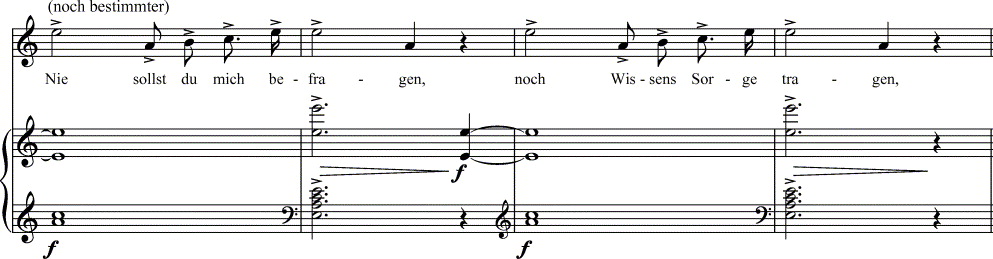
Choice of key also underscores the conjugal state of each couple, which rests on beliefs of trust and fidelity. Elsa's A-flat major is the closest possible to Lohengrin's A major yet stands the furthest away in the circle of fifths, the half-tone friction between the two tonal plateaus projecting Wagner's core idea of the impossibility of a human–divine union.Footnote 38 In their first encounter, Lohengrin briefly adopts Elsa's key up to the repeated Frageverbot, which brings him back to A (Ex. 2). Wagner frames this episode wonderfully with two choruses in A major, reflecting Lohengrin's power to project belief in his divine origin. In Act III, their brief spell of conjugal happiness finds expression in E major (bars 306ff.), but following the climax of their duet in unison singing (bars 355–61), the music reverts to Lohengrin's key (bar 363). He will return to a flat-key area only prior to his departure, when he addresses Elsa for the last time (bars 1298–368). On the side of the villains, Friedrich's vocal terrain of flat keys in Act I is reversed in the following one, a clear sign of his growing dependence on Ortrud. His full conversion to her key of F-sharp minor comes with their homophonic singing in the revenge duet (bars 391–418).
Act I, scene 3.

Stylistically, Wagner's invention of Ortrud was of the utmost significance for the score of Lohengrin. If the arcadian purity of triadic, folkish melodies corresponded with the hero's mindset of absolute belief, Ortrud's cognitive complexity and evil nature called for a contrasting, radical style. His letter to Liszt from January 1852 presents a frightening image of her mind:
Ortrud is a woman who – does not know love. This says it all – and a most terrible thing it is to say. Her nature is politics. A male politician disgusts us, a female politician appals us: it was this appalling character which I had to portray. There is one love which this woman feels, love of the past, of departed generations, the dreadfully insane love of ancestral pride which can express itself only as hatred towards all that lives, all that really exists … She is a reactionary, a woman concerned only for what is outdated and for that reason is hostile to all that is new – and hostile, moreover, in the most rabid sense of the word: she would like to eradicate the world and nature, simply in order to breathe new life into her decaying gods . . . For that reason, there must be nothing in the least trivial about her portrayal: she must never appear to be simply malicious or spiteful; every expression of her scorn, of her malice, must allow us to glimpse the full force of her terrible madness, which can be satisfied only with the destruction of others, or – of herself.Footnote 39
Wagner endows this regressive fiend with his most advanced techniques: harmonically open utterances, with emphasis on diminished-seventh chords, the use of the orchestra as an index of her seductive power, and specific motifs described evocatively by Thomas Grey as ‘a nexus of slithery, sinister, readily shifting figures’.Footnote 40 Far from contradicting himself, Wagner actually serves his drama by associating pagan primitivism with tonal instability. From the cognitive perspective that we have been describing, these devices correspond to a world of multiple possibilities and continuous updating of beliefs that Ortrud so masterfully projects on to others. Diminished-seventh chords, for example, can lead to multiple harmonic regions; the triadic melodies of Lohengrin belong only in a single key.
Ortud's Versuchungs-motiv, Act II, scene 1.

Act II, scene 2.

Act II, scene 5.

Act II, scene 5.

Act III, scene 2.

Act III, scene 2.

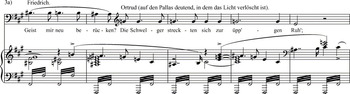
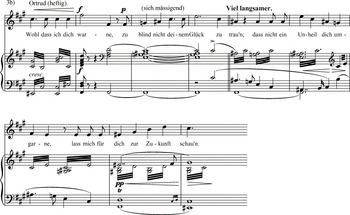
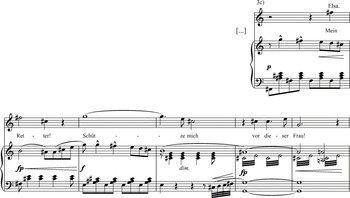
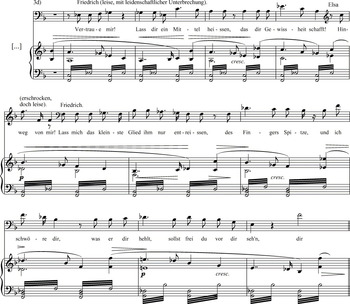
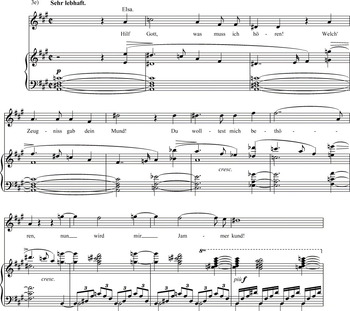
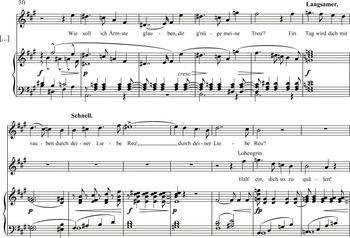
With reference to Wagner's most celebrated device, the leitmotif, we have already considered the deployment of the Frageverbot in the Act II finale. As contrast to its triadic framework and restricted ambitus of a fifth stands Ortrud's temptation motif (‘Versuchungs-motiv’), formed around a diminished-seventh chord. Its appearance in the last two acts of the opera signals her successful penetration into the minds of her victims. In Act II, scene 1, we hear it underscoring Friedrich's admission ‘wie willst du doch geheimnisvoll den Geist mir neu berücken!’ (would you once again 86mislead my spirit by your arcane arts? bars 260–1) (Ex. 3a); moments later, he is under Ortrud's full control, singing the revenge oath with her at the octave. More prominently later in the act, the motif signals the cognitive assaults against Elsa's absolute belief in Lohengrin. Her mental poisoning begins with Ortrud's warning ‘zu blind nicht deinem Glück zu trauen’ (not to trust too blindly in your happiness, bar 761) (Ex. 3b). As argued above, doubt begins its workings (with an excerpt of the motif in Elsa's signature instrument, the oboe) after her public confrontation with Ortrud, forcing her plea to Lohengrin ‘Mein Retter! Schütze mich vor dieser Frau!’ (My rescuer! Protect me from this woman! bars 1651–6) (Ex. 3c) and reaches its climax in Friedrich's final address to Elsa ‘Vertraue mir!’ (Trust me! bars 2001–13) (Ex. 3d). The motif reappears in her Act III scene with Lohengrin, occupying Elsa's mind in bar 634 and finally overtaking her vocal line in bars 654–8 (‘Wie soll ich Ärmsteglauben, dir g’nüge meine Treu?' (How can I believe that my poor trust is sufficient?) (Ex. 3e–f).
Aside from such motivic treatment, the intense chromaticism associated with Ortrud allows her to manipulate her victims harmonically. Consider, for example, Friedrich's final glimpse of suspicion in F minor (bars 364–72), following her insinuations against Lohengrin in Act II, scene 1. Ortrud confidently relaunches her effort by morphing an F-minor chord into a C-sharp-major harmony in first inversion for a return to her native F-sharp-minor key (bars 374–6). Chromaticism also captures Friedrich's mental struggle in Act I, after he is advised to withdraw from the duel, through irregular palpitations of clusters of seconds that gradually move upwards.
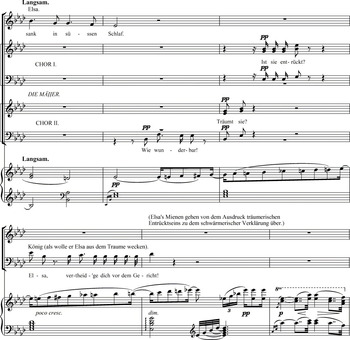
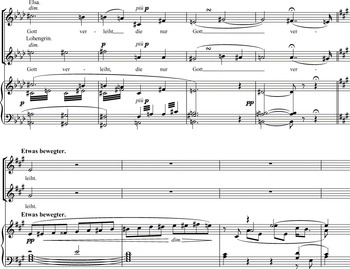
Two additional musical parallels are also relevant to our cognitive perspective. An ascending chromatic line on the flute in Act I prepares us for Elsa's vision of her saviour sung in her native A-flat major (Ex. 4a). The line, starting on E flat and covering two octaves, rises slowly amidst a whispering chorus as the King commands Elsa to defend herself. The registral shift to the Prelude's stratospheric plane together with Wagner's description of her attitude as confident (‘Elsas Mienen gehen von dem Ausdruck träumerischen Entrücktseins zu dem schwärmerischer Verklärung über’; bars 350–4) signal a state of absolute belief, one which Ortrud and Friedrich will later attack. The same gesture is repeated only once in the opera, in Act III, at the conclusion of Elsa's love duet with Lohengrin. This time the ascending line leads to A major, Lohengrin's key (Ex. 4b). The two instances frame Elsa's period of absolute belief, one where she has the resources to fight doubt. Indeed, after the second gesture the deterioration of her mindset is rapid and irreversible.
Elsa's rising chromatic line, Act I, scene 2.

Act III, scene 2.

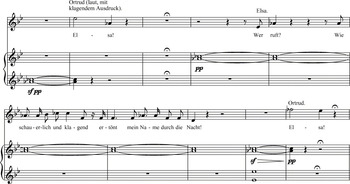
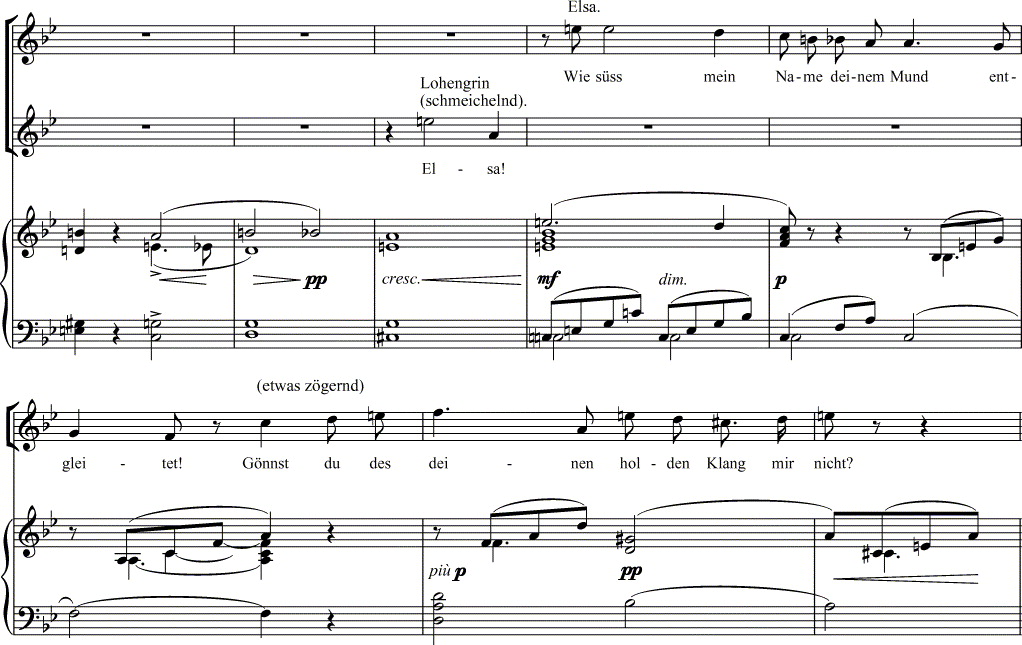
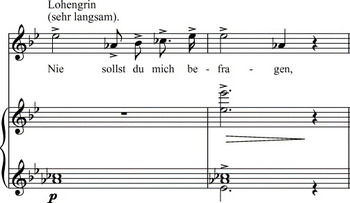
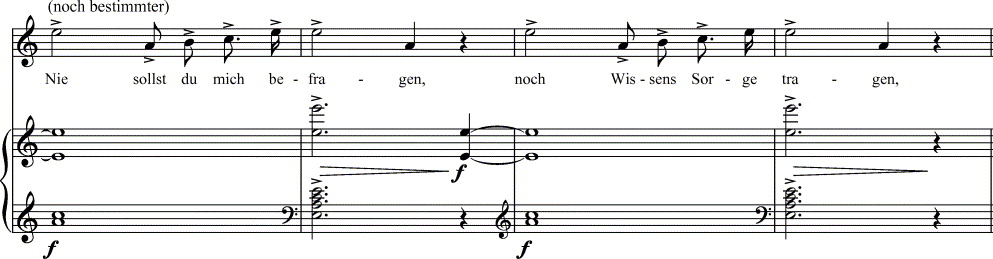
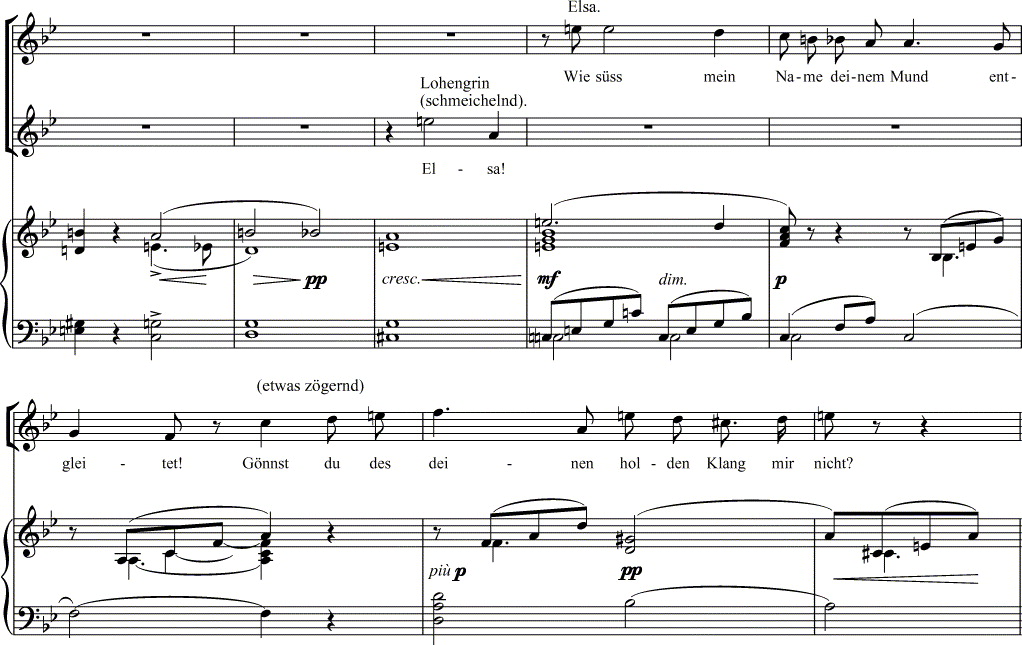
Another musical parallelism reflecting cognitive changes is the call ‘Elsa’. It is surely significant that Ortrud's first call to her in Act II is on the notes of the Frageverbot with practically identical accompaniment. As if intuiting the fatal consequences of her befriending Ortrud, Elsa responds ‘Wie schauerlich und klagend ertönt mein Name durch die Nacht!’ (How sinister and mournful is the sound of my name in the night!) (Ex. 5a). When Lohengrin calls her by name in Act III, he inadvertently evokes the moment, as the sudden harmonic change from a sharp to a flat key and Elsa's reply show: ‘Wie süss mein Name deinem Mund entgleitet!’ (How sweetly my name glides from your lips!). But because her encounter with Ortrud led her to doubt, she now picks up the association ‘Gönnst du des deinem holden Klang mir nicht?’ (Must you refuse to let your own be heard?) (Ex. 5b). In other words, Ortrud ingeniously appropriates the Frageverbot (Ex. 5c) in order to induce Elsa to breach it.
Elsa and the Frageverbot, Act II, scene 2.

Act III, scene 2.
Act I, scene 3.

The above examples help us to understand Elsa as a character whose dramatic weight lies in cognitive operations. It is the workings of her mind (rather than, say, a ‘female’ predisposition for indiscretion and betrayal) that compel her to ask the fateful questions in Act III. Using a series of innovative musical devices, Wagner creates a sophisticated score that lends insight into Elsa's psychological state and thus, arguably, makes her more real and human than any previous operatic heroine. This is so much so that her tragic predicament, namely to be united with her saviour without ever knowing whether she deserves it, gave rise to complaints about her brutal treatment in the opera's finale.
Concluding remarks
This essay proposes a critical re-engagement with Wagner's most neglected opera in post-war years. Introducing social science and game theoretic methodologies in opera hermeneutics, we subject Lohengrin's main characters to a rigorous epistemological analysis, studying their beliefs and decision-making strategies. In particular, we employ novel methodologies in opera criticism to trace the cognitive state of the opera's two dramatic variables, Elsa and Friedrich, as they move from one reversal of fortune to another. Their fluctuating behaviour involves complex higher-order or self-reflective beliefs and are a key to a deeper understanding of Elsa's choice, which stands at the core of the opera.
Elsa asks the forbidden question because she needs certainty about Lohengrin's belief in her innocence. Only by finding out his true ‘Nam und Art’ will his true reason for fighting for her be revealed. She may fear that asking the forbidden question may have terrible consequences, but not asking it will leave her in permanent agony, as she will live with someone whom she fears of suspecting her of murder. This is the most unsettling result of this epistemological study, as it suggests a radically different, psychologically convincing answer to the central question that drives two-thirds of the Lohengrin plot. At the same time it offers a modern view of an Elsa who does not passively accept the verdicts of others about her guilt or innocence but instead makes an active choice to prove her innocence. The analysis also highlights the dramatic role of the combat scene in Act I, the outcome of which becomes a fixed point of reference for the rest of the opera. Above all, we find this perspective reflects Wagner's own vision for an all-embracing music drama. Much as the artist has to ‘completely step outside himself to grasp the inner nature of an alien personality with that completeness which is needful before he can portray it’,Footnote 41 so can we better identify with a Wagnerian hero if we engage with his state of mind. Indeed, Wagner's understanding and use of the orchestra as a universal current out of which emerge individual utterances andleitmotifs practically invites a cognitive opera criticism, whether this appears in the form of Wolzogen's leitmotif guide or as a game theory analysis like the one undertaken here.