1. Introduction
Industry currently funds more than two-thirds of research and development in the United States (National Science Board 2016). Nevertheless, a number of factors have contributed to widespread concerns and skepticism about the quality of this research (Besley et al. Reference Besley, McCright, Zahry, Elliott, Kaminski and Martin2017). Historical scandals involving products like tobacco and lead have highlighted strategies used by industry in order to suppress scientific evidence and emphasize favored messages about their products (Markowitz and Rosner Reference Markowitz and Rosner2002; Proctor Reference Proctor2012). In recent years, similar strategies have been employed to manipulate scientific evidence about pharmaceuticals, climate change, and a variety of industrial chemicals (McGarity and Wagner Reference McGarity and Wagner2008; Michaels Reference Michaels2008; Oreskes and Conway Reference Oreskes and Conway2010; Elliott Reference Elliott and Angulo2016a). In addition to these specific instances of misconduct, there is evidence that results in multiple areas of science are systematically skewed in such a way that they favor the financial interests of the research funder (Lesser et al. Reference Lesser, Ebbeling, Goozner, Wypij and Ludwig2007; Lundh et al. Reference Lundh, Sismondo, Lexchin, Busuioc and Bero2012). While a number of factors can contribute to this correlation, it appears that biases of various sorts play an important role (Doucet and Sismondo Reference Doucet and Sismondo2008).
Given the prominent role that industry plays in research funding, it is important to develop effective responses to these concerns, but this has not turned out to be an easy task. Most solutions are either limited in effectiveness or difficult to implement. This article responds to this challenge by arguing that the philosophical literature on objectivity can be a promising source of insights for evaluating and improving industry-funded science. It examines analyses of objectivity by Heather Douglas (Reference Douglas2004, Reference Douglas2009), Sandra Harding (Reference Harding2015), Elisabeth Lloyd (Reference Lloyd1995; Lloyd and Schweizer Reference Lloyd and Schweizer2014), and Helen Longino (Reference Longino1990, Reference Longino2002). The article argues that their analyses can be boiled down to three particularly relevant criteria for scientific objectivity: transparency, reproducibility, and effective criticism. On closer examination, the criteria of transparency and reproducibility turn out to have significant limitations in this context, but the criterion of effective criticism suggests some important strategies for improving the objectivity of industry-funded science.
2. Background on Industry-Funded Research
In order to facilitate more careful analysis of industry-funded research, it is helpful to consider some background on the major issues at stake. This section provides a brief overview of major concerns about industry science, the conditions under which those concerns are particularly serious, and the major solutions that have been proposed previously.
Turning first to concerns about industry-funded research, it is important to recognize the breadth of the concerns that have been raised (Holman and Elliott Reference Holman and Elliott2018). For example, many scholars have worried that industry tends to pursue topics or approaches that are profitable in the short term but that may not be the most valuable to society in the long term (see, e.g., Brown Reference Brown, Elliott and Steel2017). Another concern is that industry might cut corners with the safety of human and animal research subjects. Others have worried that the private sector tends to encourage a proprietary culture in which research results are patented or kept secret, which threatens the traditional norms of science (Krimsky Reference Krimsky2003; Radder Reference Radder2010). Industry has also been accused of intimidating scientists who spread unfavorable messages about their products, while industry heavily disseminates its own preferred messages through powerful public-relations firms and front groups (Oreskes and Conway Reference Oreskes and Conway2008; Elliott Reference Elliott and Angulo2016a; Biddle, Kidd, and Leuschner Reference Biddle, Kidd and Leuschner2017).
All these worries are important, but this article focuses on a more narrow concern: the worry that industry-funded research can be consciously or subconsciously manipulated to generate questionable results that serve the interests of the funder. In some cases, this can involve the deliberate falsification or fabrication of results, but it is more likely to be caused by subtle factors such as design bias or publication bias (Doucet and Sismondo Reference Doucet and Sismondo2008). Design bias occurs when researchers create study designs that tend to produce desired results (Smith Reference Smith2005), and publication bias happens when some results (such as those favorable to the funder) tend to be published more often than other results (Goldacre Reference Goldacre2012). Industry has also been accused of rhetorically presenting study findings in ways that are either questionable or outright misleading (Doucet and Sismondo Reference Doucet and Sismondo2008). In addition, companies will sometimes heavily fund preferred lines of research, which can shift the balance of evidence in favor of their desired conclusions and away from those that they want to avoid (Elliott and McKaughan Reference Elliott and McKaughan2009; Holman and Bruner Reference Holman and Bruner2017).
In order to address these manipulative practices, however, it is important to develop a finer-grained approach than just dismissing all industry-funded science (Conrad and Becker Reference Conrad and Becker2011; Resnik and Elliott Reference Resnik and Elliott2013). The private sector funds a great deal of research, and not all of it is problematic. Moreover, some scholars have objected that it is intellectually lazy to question research solely based on its funding source rather than looking deeper at its quality (Conrad and Becker Reference Conrad and Becker2011). After all, industry is not the only actor with incentives to produce desired results. Government agencies such as the Department of Defense or the Department of Energy sometimes also have strong reasons for pursuing science that arrives at preferred conclusions (Shrader-Frechette Reference Shrader-Frechette1993, Reference Shrader-Frechette2007). Academic research has also come under fire for failing to be reproducible (Ioannidis Reference Ioannidis2005). In fact, some academics have actually used collaborations with industry to help generate better quality control and greater reproducibility (Edwards Reference Edwards2016).
In previous work, I have suggested three conditions that, when present in combination, provide significant cause for concern about the quality of scientific research, no matter how it is funded (Elliott Reference Elliott2014):
1. Scientific findings are ambiguous or require a good deal of interpretation or are difficult to establish in a straightforward manner.
2. Individuals or institutions have strong incentives to influence those scientific findings in ways that damage the credibility of the research.
3. Individuals or institutions that have incentives to influence those scientific findings also have adequate opportunities to influence them.
These conditions for concern are sometimes, but not always, met in cases in which industry funds science, and they are sometimes present in science funded by other sources. These conditions are especially likely to be met in situations in which companies are studying potential public- or environmental-health threats caused by their products.
Scholars have proposed a wide variety of strategies for addressing problems with industry-funded research, but they tend to be either limited in effectiveness or difficult to implement (Holman and Elliott Reference Holman and Elliott2018). A particularly common strategy is to require published studies to include an acknowledgment of the funder. Unfortunately, this approach appears to do little to prevent biases from influencing the studies, and it could possibly even have perverse psychological effects that make biases worse (Doucet and Sismondo Reference Doucet and Sismondo2008; Elliott Reference Elliott2008; de Melo-Martin and Intemann Reference de Melo-Martin and Intemann2009; Loewenstein, Sah, and Cain Reference Loewenstein, Sah and Cain2012). Another very common strategy is to require federal agencies such as the US Environmental Protection Agency (EPA) or the US Food and Drug Administration (FDA) to examine industry-funded studies submitted to them for regulatory purposes. Unfortunately, a number of scandals have still arisen with products approved by these agencies (McGarity and Wagner Reference McGarity and Wagner2008; Michaels Reference Michaels2008). In the pharmaceutical arena, trial registries have been created in an effort to prevent publication bias, but to be effective they need to achieve greater compliance and completeness (Goldacre Reference Goldacre2012). A variety of more aggressive steps have also been proposed: imposing .pnger penalties on the executives of companies when they manipulate evidence, making it easier to sue companies accused of misconduct, requiring more of the data from industry-funded safety studies to be made publicly available, and taking important safety studies out of the hands of industry and performing them in laboratories funded by regulatory agencies. Unfortunately, these solutions have been very difficult to implement (Krimsky Reference Krimsky2003; Shrader-Frechette Reference Shrader-Frechette2007; McGarity and Wagner Reference McGarity and Wagner2008; Elliott Reference Elliott2011).
3. Criteria for Objectivity
Given the difficulty of arriving at effective, practical strategies for preventing problems with industry-funded research, additional ideas are needed for evaluating and improving its quality. This article argues that efforts by philosophers of science to develop criteria for objective science can be a valuable source of insights. By better understanding the characteristics of objective science, we are in a better position to evaluate and improve the objectivity of industry-funded research.
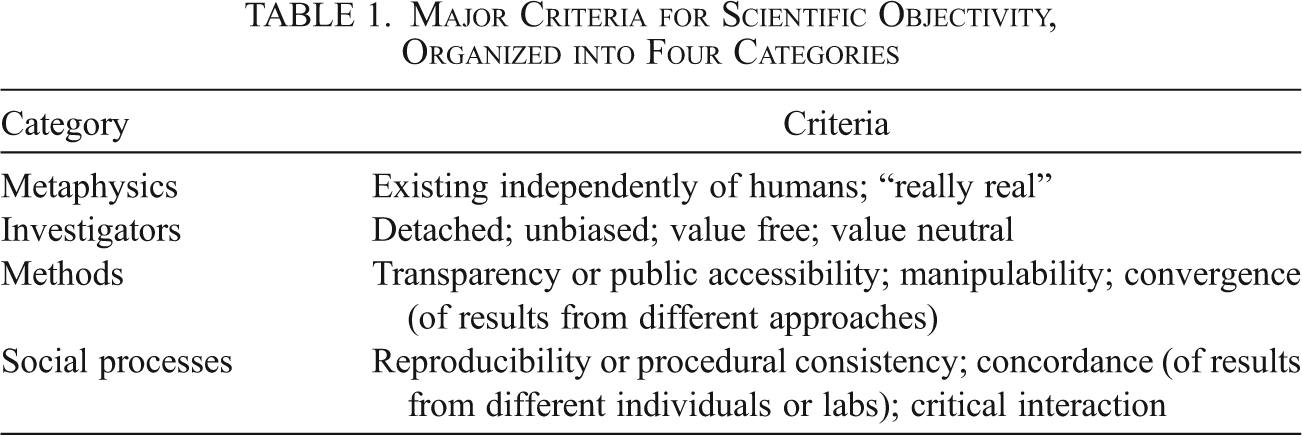
Recent studies by Heather Douglas (Reference Douglas2004, Reference Douglas2009), Sandra Harding (Reference Harding2015), Elisabeth Lloyd (Reference Lloyd1995; Lloyd and Schweizer Reference Lloyd and Schweizer2014), and Helen Longino (Reference Longino1990, Reference Longino2002) converge on a common set of criteria for evaluating scientific objectivity. Douglas divides these criteria into three general categories: (1) those associated with the relationship between investigators and the world, (2) those associated with investigators’ reasoning processes, and (3) those associated with social processes. Lloyd and Schweizer (Reference Lloyd and Schweizer2014) also propose three categories, focusing on (1) methods, (2) metaphysics, and (3) social processes. Longino’s and Harding’s suggestions fall into the category of social processes. All of the suggestions made by these authors can be combined under four general categories, as illustrated in table 1.
Major Criteria for Scientific Objectivity, Organized into Four Categories

| Category | Criteria |
|---|---|
| Metaphysics | Existing independently of humans; “really real” |
| Investigators | Detached; unbiased; value free; value neutral |
| Methods | Transparency or public accessibility; manipulability; convergence (of results from different approaches) |
| Social processes | Reproducibility or procedural consistency; concordance (of results from different individuals or labs); critical interaction |
Some of these criteria are less relevant to industry-funded research than others. For example, the criteria in the metaphysics category are relatively unhelpful, because they are not under the direct control of investigators and therefore do not provide practical guidance for promoting objectivity. In the methods category, the criterion of manipulability is similar, insofar as investigators typically do not have a great deal of control over whether the phenomena they study will be readily manipulable. The criteria in the investigators category initially appear to be more useful, but on further inspection they turn out to be somewhat problematic. They all focus on conscious efforts by investigators to exclude values and biases from their reasoning. Recent work in the philosophy of science suggests that despite scientists’ efforts, they are still likely to be influenced by values, and it is better to reflect carefully on which values should influence science than to try to exclude them (Longino Reference Longino2002; Douglas Reference Douglas2009; Elliott Reference Elliott2017).
Most of the criteria in the methods and social processes categories are more helpful for evaluating and improving industry-funded research. For example, some of the strategies that have already been widely discussed and implemented (such as trial registries) are designed to promote transparency or public accessibility of data and methods. Moreover, the criterion of reproducibility or procedural consistency is highly relevant for evaluating industry-funded science. Industry is typically engaged in research either so that it can be submitted for regulatory purposes or so that it can be used for developing commercial products, and in both cases it is typically important to generate robust, replicable results. The criteria of convergence (of different approaches), concordance (of results from different investigators or labs), and critical interaction all reflect the value of obtaining diverse perspectives from multiple investigators who can identify weaknesses in each other’s methods and highlight each other’s implicit assumptions. All these criteria are relevant to evaluating the quality of industry-funded research.
This brief analysis suggests that previous efforts to analyze scientific objectivity can be boiled down to three criteria that are likely to be particularly relevant for evaluating and improving the quality of industry-funded research: transparency, reproducibility, and effective criticism. The first criterion, transparency, comes from the methods category (see Lloyd and Schweizer Reference Lloyd and Schweizer2014). The second criterion, reproducibility, comes from the social processes category (see Douglas Reference Douglas2009; Lloyd and Schweizer Reference Lloyd and Schweizer2014). The third criterion, which I am labeling effective criticism, is a combination of three closely related criteria from the methods and social processes categories: convergence of results generated through different methods (Douglas Reference Douglas2009), concordance of results from multiple investigators (Douglas Reference Douglas2009), and critical interaction among different individuals who can challenge each other’s methods and assumptions (see Longino Reference Longino2002; Douglas Reference Douglas2009; Lloyd and Schweizer Reference Lloyd and Schweizer2014; Harding Reference Harding2015). Although Douglas (Reference Douglas2009) distinguishes convergence and concordance from critical interaction, all three criteria are very closely related. The goal of critical interaction is to uncover and evaluate scientists’ implicit assumptions, methodological choices, and interpretive judgments. One of the best means of doing this is to compare the conclusions of multiple investigators using a variety of different methods to see whether they converge and, if they do not, to reflect on the reasons for their differences.
4. Applying the Criteria to Industry-Funded Research
The central thesis of this article is that we can gain valuable insights into addressing industry-funded research by examining the three criteria of transparency, reproducibility, and effective criticism. Transparency and reproducibility turn out to have significant limitations in this context, but the criterion of effective criticism suggests important strategies for increasing objectivity. Let us consider each criterion in turn.
Transparency
The criterion of transparency has received a great deal of attention in recent years because of the rise of the “open science” movement (e.g., Royal Society Reference Society2012). Many strategies that have been proposed previously for improving industry-funded research are designed to generate greater transparency. As noted earlier, one of the major strategies for responding to publication bias in pharmaceutical research has been to create trial registries so that unfavorable study results are more difficult to hide. Scholars are pushing to increase the comprehensiveness of these registries so that they include not only summary results but also more of the data underlying the results (Goldacre Reference Goldacre2012; Chalmers, Glasziou, and Godlee Reference Chalmers, Glasziou and Godlee2013). Scholars looking at other areas of industry-funded science, such as chemical safety studies, have also been calling for the underlying data to be made publicly available, just as publicly funded academic scientists are increasingly being required to make their data publicly available (McGarity and Wagner Reference McGarity and Wagner2008; Michaels Reference Michaels2008).
Unfortunately, the norms of the marketplace make it very difficult to achieve significant transparency. Companies are very concerned about protecting their intellectual property, so they are resistant to making too much information about their products publicly available (Kesselheim and Mello Reference Kesselheim and Mello2007). Companies typically do not publish their findings, except in fields of science in which they can advertise their products by doing so (e.g., clinical trials of pharmaceuticals). Moreover, the regulations that require them to make their study data available to agencies such as the EPA and FDA typically allow them to designate much of it as “confidential business information” that cannot be made known publicly (Kesselheim and Mello Reference Kesselheim and Mello2007). Some legislation, such as the US Federal Insecticide, Fungicide, and Rodenticide Act (FIFRA), provides even more intense pressures to keep study data private. FIFRA allows companies who develop pesticides and perform safety studies on them to obtain “data compensation” from other companies that later register the same pesticides with regulatory agencies (sec. 3c1F). In other words, the original companies are paid for the use of the safety data that they have generated, so it is in their financial interests not to make the data publicly available.
The pressures that industry faces not to make their data and methods fully available reflect a crucial barrier to the objectivity of industry-funded research. To the extent that companies are forced or incentivized to keep the details of their research from public scrutiny, they sacrifice the objectivity of their work. Failures to make data and methods fully available for outside examination are not unique to industry; in fact, the entire scientific community is currently discussing the importance of “open science,” in part because of concerns that a great deal of research is lacking in reproducibility (Molloy Reference Molloy2011; Alberts et al. Reference Alberts2015). Nevertheless, industry faces particularly significant challenges because of the pressures it faces to protect intellectual property. If industry cannot fulfill the criterion of transparency or can do so only to a very limited extent, then its research should rightly be treated as less objective than science that is open to public scrutiny.
Reproducibility
In contrast to the criterion of transparency, the criterion of reproducibility has often been a significant strength of industry. This is especially the case in areas of science in which standardized study guidelines have been developed, which specify many of the details about how studies performed for specific regulatory purposes should be conducted (Elliott Reference Elliott2016b). For example, the Organization for Economic Cooperation and Development has developed test guidelines for assessing chemical safety, and many different countries all accept the results of these standardized studies for regulatory purposes (Elliott and Volz Reference Elliott and Volz2012). In addition, industry studies used for regulatory purposes are typically required to follow Good Laboratory Practices (GLP) requirements, which provide an extremely detailed record-keeping system for ensuring that investigators actually follow the protocols that they claim to be following (Myers et al. Reference Myers2009). The criterion of reproducibility has received so much emphasis in the regulatory context that academic studies are often dismissed because they are not performed according to standardized guidelines and GLP requirements (Beronius et al. Reference Beronius, Molander, Ruden and Hanberg2014). Academic scientists typically view GLP as unnecessary and far too costly, and they find it much more intellectually interesting to pursue novel methods rather than standardized approaches.
Unfortunately, standardized test guidelines still leave a great deal to be desired. For one thing, they do not guarantee reproducibility, because they still typically leave some room for judgment about choices like which dose levels, experimental animals, and statistical analyses to use (Elliott and Volz Reference Elliott and Volz2012). But even if one sets aside this concern, the reproducibility achieved through the use of standardized test guidelines turns out to be a double-edged sword. Because it takes a long time to change test guidelines once they have been put in place, they run the risk of locking outdated procedures in place (Elliott Reference Elliott2016b). For example, many scholars have alleged that our current standardized toxicity tests are inadequate for identifying the endocrine-disrupting effects of chemicals that scientists have learned about in recent years (Myers et al. Reference Myers2009; Birnbaum, Burke, and Jones Reference Birnbaum, Burke and Jones2016). This is one example of the more general problem that studies can be reproducible without being relevant (Beronius et al. Reference Beronius, Molander, Ruden and Hanberg2014; Birnbaum et al. Reference Birnbaum, Burke and Jones2016). In other words, one can perform a study in a manner that can be replicated over and over, but if it does not address the question one is trying to answer (e.g., if the study is not sensitive enough to uncover particular kinds of adverse health effects caused by a chemical), then it is likely to be misleading. Thus, meeting the criterion of reproducibility is typically not sufficient by itself for establishing the objectivity of industry-funded research in a meaningful way.
Effective Criticism
The limitations of transparency and reproducibility highlight the importance of effective criticism. Given that it is so difficult to prevent problems with industry-funded studies, one of the best approaches for promoting the objectivity of this research is to subject it to critical analysis so that any questionable aspects of it can be highlighted. It is important to emphasize that criticism in this sense need not always be negative. It simply means subjecting research to careful evaluation so that the strengths and weaknesses of its background assumptions, methods, data interpretation, and conclusions are as explicit as possible. Even exemplary science is made more objective when it is subjected to this sort of criticism. Longino (Reference Longino1990, Reference Longino2002) argues that effective criticism should have four characteristics: publicly recognized venues for criticism, uptake of criticism, shared standards, and tempered equality of intellectual authority. The first two characteristics (venues for criticism and uptake of criticism) are particularly relevant in this context, because there are a variety of ways in which they could be improved in order to generate more effective responses to industry-funded research.
Let us turn first to venues for criticism. In many cases, when the science produced by industry is done for regulatory purposes, agencies such as the EPA, FDA, and Occupational Safety and Health Administration have the opportunity to serve as venues for critically evaluating industry studies. Unfortunately, they often fail to take full advantage of this opportunity, because they are understaffed and underfunded or because they are under political pressure or because they are “captured” by those they are supposed to be regulating (Beder Reference Beder2002; Shrader-Frechette Reference Shrader-Frechette2007). A number of steps could be taken to improve the role of these agencies as venues for criticism of industry science. A relatively small step would be for the agencies to get more involved in designing the safety studies performed by industry in specific cases. Given that standardized test guidelines still leave room for judgment, the agencies could exert greater control over those decisions rather than leaving them up to industry.
Another step for improving venues for criticism would be to strengthen and extend the activities of the science advisory boards and committees that already provide guidance to many federal agencies about scientific issues. These boards are composed primarily of academic scientists who can play an important role in evaluating the quality of the scientific evidence available to the agency, especially when the board members do not have conflicts of interest that limit their critical perspective (Elliott Reference Elliott2011, 87). A more ambitious step would be to create something like a “science court” for examining particularly important or controversial bodies of research. For example, the court could hear conflicting perspectives on the safety or effectiveness of particular drugs or chemicals, thereby institutionalizing opportunities to scrutinize the science produced by industry (see, e.g., Elliott Reference Elliott2011, 104–5; Biddle Reference Biddle2013).
It is also important to promote more effective uptake of criticism directed at industry-funded research. One of the most obvious barriers to effective uptake of criticism is that academic studies are often given much less weight than industry studies in regulatory contexts. As a result, many opportunities to challenge the results and methods of industry research are lost. For example, the strengths and weaknesses of industry-funded research could ideally be evaluated by looking to see whether there is concordance and convergence of results coming from multiple investigators (with different funding sources) using a variety of methods. When academic studies are hastily dismissed, the potential uptake of criticism from these sources is lost.
Recent debates about bisphenol A (BPA) provide an excellent example of this problem. BPA is an endocrine-disrupting chemical used in food-can liners, receipts, and many plastic products. For years, the majority of academic studies have raised concerns that BPA may have harmful effects on humans at the levels to which they are already exposed (vom Saal and Hughes Reference vom Saal and Hughes2005; Resnik and Elliott Reference Resnik and Elliott2015). Regulatory agencies in both the European Union and the United States have been slow to regulate BPA, however, because they deferred to industry studies that indicated the chemical was not likely to cause harm (Myers et al. Reference Myers2009; Vandenburg and Prins Reference Vandenburg and Prins2016). This deference to industry studies is based on the assumption that research studies performed according to standardized guidelines and GLP procedures are better than those that are not (Myers et al. Reference Myers2009; Beronius Reference Beronius, Molander, Ruden and Hanberg2014; Vandenburg and Prins Reference Vandenburg and Prins2016). However, as discussed earlier, this assumption is sometimes problematic (Wickson and Wynne Reference Wickson and Wynne2012; Elliott Reference Elliott2016b), and academic studies could ideally be an effective source of insights for critically evaluating industry studies of BPA.
Several steps could be taken so that the critical perspectives offered by academic studies in this and many other cases would receive greater uptake. One important step would be to develop better criteria for assessing which studies are reliable and relevant for regulatory purposes. Academic studies that are not performed according to standardized guidelines often use cutting-edge methodologies that can be more informative and relevant than industry studies in some cases. Thus, rather than using the existing criteria that focus primarily on whether studies have been performed according to standardized guidelines, some scientists are proposing new criteria that are less likely to exclude high-quality academic studies from informing regulatory decisions (e.g., Beronius et al. Reference Beronius, Molander, Ruden and Hanberg2014). A closely related step is to provide guidance to help academics report their published findings in ways that make them as relevant as possible for regulatory agencies, thereby increasing their likelihood to be considered as evidence alongside industry studies (Moermond et al. Reference Moermond, Kase, Korkaric and Agerstrand2016). A final step to promote better uptake of criticism would be to create more efficient processes for revising standardized test guidelines so that regulatory decision making can be more responsive to new information that challenges older approaches (Birnbaum et al. Reference Birnbaum, Burke and Jones2016; Elliott Reference Elliott2016b).
5. Conclusion
This article has explored how efforts by philosophers of science to analyze the concept of objectivity can provide insights for evaluating and improving industry-funded research. This is an important contribution that philosophy can make, given that industry funds a large portion of contemporary scientific research and development and yet is plagued by concerns about the quality of its work. The article identified three criteria for objectivity that are particularly relevant: transparency, reproducibility, and effective criticism. It showed that the criteria of transparency and reproducibility have significant limitations in the context of contemporary industry-funded science, but the criterion of effective criticism suggests some important strategies for improving the objectivity of this research.
The problem with the criterion of transparency is that it stands in tension with pressures in the marketplace to protect intellectual property. Thus, while industry can take some steps to meet this criterion, it is more likely to stand as a challenge to the objectivity of industry-funded research. The criterion of reproducibility is frequently regarded as a strength of industry science, especially when standardized study guidelines are employed. However, as this article emphasized, efforts to promote reproducibility can stand in tension with the goal of performing cutting-edge research that is maximally relevant to contemporary public-policy questions. Therefore, the criterion of effective criticism is perhaps the most helpful for suggesting practical strategies to promote the objectivity of industry-funded research. This article has suggested some initial steps for promoting more effective venues and better uptake of criticism, and this criterion can serve as a source of guidance and inspiration for developing additional strategies.