INTRODUCTION
Toxoplasma gondii is an obligate intracellular parasite distributed worldwide. It infects many warm-blooded animal species, including sheep, with its definitive host being Felidae family members (Dubey, Reference Dubey2004). Toxoplasmosis transmission occurs by ingestion of sporulated oocysts released with the faeces of infected cats and other felids or of cysts present in the tissues of an infected animal. This infection can cause severe life-threatening disease in immunocompromised patients and in newborns with congenital toxoplasmosis (Montoya and Liesenfeld, Reference Montoya and Liesenfeld2004). Besides, T. gondii infection is important in veterinary medicine due to fetal absortion, abortions and neonatal losses of livestock, especially in sheep; thus, it was recognized as an economic problem a long time ago (Hartley and Marshall, Reference Hartley and Marshall1957; Dubey and Welcome, Reference Dubey and Welcome1988; Buxton, Reference Buxton1990). The most likely source of infection for sheep kept on pasture are the oocysts shed by cats in their faeces; thus, these animals can also be sentinels for transmission studies (Blewett and Watson, Reference Blewett and Watson1983).
The prevalence of T. gondii in sheep varies considerably in different parts of the world, from 15% to 85%, depending on raising conditions and weather (van der Puije et al. Reference van der Puije, Bosompem, Canacoo, Wastling and Akanmori2000; Figliuolo et al. Reference Figliuolo, Kasai, Ragozo, de Paula, Dias, Souza and Gennari2004; Hove et al. Reference Hove, Lind and Mukaratirwa2005; Sawadogo et al. Reference Sawadogo, Hafid, Bellete, Sung, Chakdi, Flori, Raberin, Hamouni, Chait and Dalal2005; Sevgili et al. Reference Sevgili, Babür, Nalbantoğlu, Karaş and Vatansever2005; Dumètre et al. Reference Dumètre, Ajzenberg, Rozette, Mercier and Darde2006; Gaffuri et al. Reference Gaffuri, Giacometti, Tranquillo, Magnino, Cordioli and Lanfranchi2006; Klun et al. Reference Klun, Djurkovic-Djakovic, Katic-Radivojevic and Nikolic2006; Sharif et al. Reference Sharif, Gholami, Ziaei, Daryani, Laktarashi, Ziapour, Rafiei and Vahedi2007; Clementino et al. Reference Clementino, Souza and Neto2007; Romanelli et al. Reference Romanelli, Freire, Vidotto, Marana, Ogawa, De Paula, Garcia and Navarro2007; Vesco et al. Reference Vesco, Buffolano, La Chiusa, Mancuso, Caracappa, Chianca, Villari, Curro, Liga and Petersen2007). In Mexico, two studies performed during the 1990's revealed a prevalence of 20% in Guanajuato, 39% in San Luis Potosí and from 38–55% in Morelos, as determined by the indirect fluorescent antibody test (IFAT) (García Vázquez et al. Reference García-Vázquez, Rosario-Cruz and Solorzano-Salgado1990; Cruz-Vazquez et al. Reference Cruz-Vazquez, Garcia-Vazquez, Rosario-Cruz and Solorzano-Salgado1992). These values were geographically related to the frequency of infection in humans around those years (Velasco-Castrejón et al. Reference Velasco-Castrejón, Salvatierra-Izaba, Valdespino, Sedano-Lara, Galindo-Virgen, Magos, Llausas, Tapia-Conyer, Gutiérrez and Sepúlveda1992). Besides these reports, nothing is known about the presence of T. gondii in other regions of Mexico. Each year, more than 40 000 tons of ovine meat are produced in the States of the central part of Mexico (De Lucas-Tron and Abiza Aguirre, Reference De Lucas-Tron and Arbiza-Aguirre2005; www.sagarpa.gob.mx); thus, ovine toxoplasmosis is probably causing economical losses of high impact, besides the risk for humans who eat this type of meat. Therefore, the aim of this study was (i) to determine the frequency of anti-T. gondii seroantibodies in sheep fed with pasture and living in a high risk zone of Central-Eastern Mexico, and (ii) to analyse changes occurring both in this frequency as well as in the response pattern and avidity after 10 months.
MATERIALS AND METHODS
Sheep
The experimental farm ‘Las Margaritas’ of the National Institute of Forest, Agriculture and Animal Research (INIFAP) is in the borderline between the States of Puebla and Veracruz (Fig. 1). In total, 103 sheep between 1 and 4 years of age were included in the study, from a total population of 180 present in the farm in November 2005. Fifty-six of these animals, still living in the ranch after 10 months were sampled again (September 2006). Five ml samples of peripheral blood were taken from the jugular vein. After clotting, the serum was separated by centrifugation at 2000 g for 10 min, aliquoted and stored at −20°C until use.
Map of Mexico showing the areas where Toxoplasma gondii antibodies have been searched for in sheep, including the present study. Numbers in brackets and parentheses represent frequency and prevalence values, respectively. Data from other studies were taken from García-Vázquez et al. (Reference García-Vázquez, Rosario-Cruz and Solorzano-Salgado1990) and Cruz-Vazquez et al. (Reference Cruz-Vazquez, Garcia-Vazquez, Rosario-Cruz and Solorzano-Salgado1992).

Immunoassays
In order to detect anti-T. gondii IgG antibodies in sheep, a home-made ELISA (hmELISA) and an immunoblot were developed and evaluated. A commercial ELISA kit (IP kit) was used as reference test (Institut Pourquier®, France, version P00710/03).
hmELISA
A crude extract antigen was prepared with tachyzoites of the RH strain as described by Figueroa-Castillo et al. (Reference Figueroa-Castillo, Duarte-Rosas, Juárez-Acevedo, Luna-Pastén and Correa2006). Polystyrene ELISA plates (Maxisorp, Nunc) were incubated with 2 μg/ml of antigen diluted in 15 mm carbonate buffer, pH 9·6, overnight at 4°C. Non-specific binding sites were blocked with 200 μl/well of 0·01 m phosphate-buffered 0·15 m NaCl, pH 7·2 (PBS) containing 0·05% Tween 20 (PBS-T) and 1% of bovine serum albumin (Euro-Clone, Italy). Plates were washed thrice with PBS-T, 5 min each time. Immediately, 100 μl/well of the serum samples (diluted 1:1000 in PBS-T) were incubated for 2 h at 37°C. The plates were washed as above, and incubated with 100 μl/well of a donkey anti-sheep IgG peroxidase conjugate (Sigma-Aldrich Corp., St Louis, MO, USA, product A3415) diluted 1:10 000 in PBS-T overnight at 4°C. After further washing, the reaction was revealed by addition of 100 μl/well of the substrate/chromogen solution (5 ml of 0·1 m citric acid plus 5 ml of 0·1 m sodium citrate, added with 5 mg O-phenylenediamine (Sigma-Aldrich) and 4·5 μl of 30% hydrogen peroxide). After 10–20 min incubation in the dark at room temperature, the reaction was stopped by addition of 50 μl/well of 1 n sulphuric acid. The absorbance values were read at 492 nm on a Wallac Victor 2 1420 micro-ELISA autoreader (Wallac Oy, Turku, Finland). The cut-off was set as the mean plus 3 times the standard deviation of the absorbance obtained with 11 negative samples, which were tested by the 3 methods. The absorbance average of each serum was divided by the cut-off to establish the reactivity index (RI). Serum samples with RI⩾1 were considered positive, including undetermined samples (RI from 1·0 to 1·1).
Immunoblot
Immunoblot (IB) was adapted for sheep, from a technique previously performed for human serum (Vela-Amieva et al. Reference Vela-Amieva, Cañedo-Solares, Gutiérrez-Castrellón, Pérez-Andrade, González-Contreras, Ortíz-Cortés, Ortega-Velázquez, Galván-Ramírez, Ruiz-García, Saltigeral-Simentel, Ordaz-Favila, Sánchez and Correa2005). Briefly, 1×10⁷ tachyzoites were electrophoresed in SDS-PAGE under reducing conditions and electroblotted onto nitrocellulose membranes (Hybond-C pure, Amersham Pharmacia Biotech), which were blocked with 2% skim milk in PBS for 1 h and washed 3 times with PBS-T. The nitrocellulose strips were incubated overnight at 4°C with serum samples diluted 1:1200 in PBS-T and, after washing, developed by incubation with the donkey anti-sheep IgG peroxidase conjugate diluted 1:2000 in PBS-T. The immunocomplexes were detected using 60 mg of 4-chloro-1-naphthol (Sigma-Aldrich) in 10 ml of methanol added to 10 ml of PBS plus 100 μl of 30% H2O2. Samples were considered positive when at least 3 bands were detected in the nitrocellulose strip.
IgG avidity
In order to distinguish recent (acute) from longstanding (chronic) infections an IgG avidity ELISA was employed. The detailed avidity ELISA procedure followed was described by Suárez-Aranda et al. (Reference Suaréz-Aranda, Galisteo, Hiramoto, Cardoso, Meireles, Miguel and Andrade2000). Briefly, polystyrene plates were sensitized and washed as described for the conventional ELISA. Sera were serially diluted 2-fold, starting at 1:400, and loaded into plate wells. After 1 h of incubation, plates were washed 3 times with PBS-T, and incubated for 30 min at 37°C with PBS-T alone or with PBS-T containing 6 m urea (Promega Corp., Madison, WI, USA). After 2 washes with PBS, the plates were incubated with 100 μl/well of a donkey anti-sheep IgG peroxidase conjugate (Sigma) diluted 1:10 000 in PBS-T overnight at 4°C. The reaction was revealed and stopped as described in the ELISA section. IgG avidity index was determined as the absorbance fraction (percent) resistant to urea. Avidity values ⩾0·5 (⩾50%) indicated chronic infection, whereas values <0·5 suggested a more recent infection.
Statistical analysis
All data were analysed using the SPSS 12.0 software (SPSS Inc., Chicago, IL, USA). The correlation between hmELISA and IP kit, as well as between values of the first versus the second sample, was determined by linear regression analysis, with 95% confidence limits. The frequency of T. gondii antibodies was calculated and positive serum samples were confirmed by IB. The diagnostic parameters (sensitivity, specificity and positive and negative predictive values) were calculated taking the IP kit as the reference test with the formula described by Conraths and Schares (Reference Conraths and Schares2006).
RESULTS
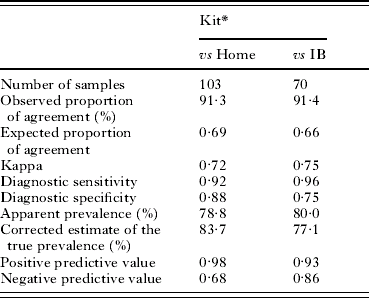
In order to use the hmELISA and IB in this and future studies, their diagnostic performances were compared with that of the IP kit (Table 1). More than 91% of the samples had the same result by the two methods compared with the IP kit. The concordance was similar for both immunoassays (kappa=0·72 and 0·75, respectively). The highest sensitivity was obtained with IB, while specificity was maximal using hmELISA (Table 1). The correlation between absorbance values of hmELISA and IP kit was 0·87, P<0·0001.
Diagnostic performance of the two tests used and concordance versus reference test

* Kit, Kit Institut Pourquier®; Home, home-made ELISA; IB, immunoblot.
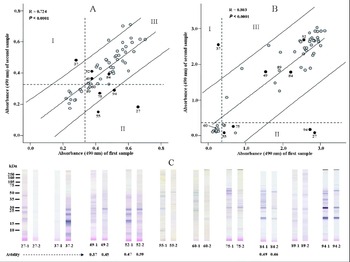
Fifty-six of the original sheep were sampled 10 months later and then tested again. The correlations between the absorbance values of the first and second tests for each animal are shown in Fig. 2. They were high (0·7 and 0·8), although there were some exceptions: using both hmELISA and IP kit 4 animals became negative in the second sample (Fig. 2A and B, regions II) and 1 case was negative the first time and strongly positive 10 months later (Fig. 2A and B, regions I). In order to further analyse these changes, comparisons by immunoblot were also performed (Fig. 2C). The first observation was a heterogeneous antigenic pattern among animals even in the first sample, with at least 8 antigen bands detected in positive serum samples ranging from 10 to 250 kDa. A seroconversion was confirmed for sample 37 in region I; also, the sera from regions II in Fig. 2A and B presented immuno-reactivity in IB.
Correlation of the ELISA absorbance values of anti-Toxoplasma gondii between first and second samples using home-made (A) and commercial (B) ELISAs and comparison of some cases in immunoblot (C). Dashed lines represent cut-off values for the first and second sample. Strips without avidity data presented high values (>0·5). R=Pearson correlation.

Thirty-six sera were positive on both occasions, so IgG avidity was tested in these pairs. Thirty-three sheep (91·7%) presented antibodies of high avidity in both samples, while slight increases in avidity were found in 2 (samples 49 and 52) and conservation of low avidity was observed in sheep 84 (Fig. 2C).
The frequency of anti-T. gondii antibodies ranged from 77 to 84% depending on the technique employed. In any case, the frequency found was much higher than the prevalence reported for other regions of the country, where sheep toxoplasmosis has been investigated (Fig. 1).
DISCUSSION
Herbivorous animals may be used as sentinels to determine the burden of soil- or water-transmitted infectious agents. Toxoplasma gondii oocysts may live for months in humid/warm weather conditions. In this study we had two main objectives, i.e. to standardize and evaluate an indirect ELISA and immunoblot for diagnosis of T. gondii infection in sheep, and to test them under field conditions, and by these means evaluate T. gondii infection frequency in a region of Mexico with presumed high transmission risk.
Previous studies have demonstrated that ELISA is a sensitive technique to diagnose this protozoan infection in sheep (van der Puije et al. Reference van der Puije, Bosompem, Canacoo, Wastling and Akanmori2000; Sawadogo et al. Reference Sawadogo, Hafid, Bellete, Sung, Chakdi, Flori, Raberin, Hamouni, Chait and Dalal2005). Although T. gondii is closely related to Sarcocystis species and other apicomplexans, cross-reactivity has not been considered a major issue (Ortega-Mora et al. Reference Ortega-Mora, Troncoso, Rojo-Vázquez and Gómez-Bautista1992; Paré et al. Reference Paré, Hietala and Thurmond1995; Dubey and Lindsay, Reference Dubey and Lindsay2006). The exception is Neospora sp. (Harkins et al. Reference Harkins, Clements, Maley, Marks, Wright, Esteban, Innes and Buxton1998), but this parasitosis is considerably less frequent than toxoplasmosis in sheep (Figliuolo et al. Reference Figliuolo, Kasai, Ragozo, de Paula, Dias, Souza and Gennari2004; Masala et al. Reference Masala, Porcu, Daga, Denti, Canu, Patta and Tola2007; Romanelli et al. Reference Romanelli, Freire, Vidotto, Marana, Ogawa, De Paula, Garcia and Navarro2007). Thus, the frequency of seropositivity in the present study is most probably due to T. gondii infection. Besides, the techniques standardized presented adequate concordance between them and with the IP kit, supporting true diagnosis in most animals.
Immunoblot has been applied to follow the immune response after experimental infection; a heterogeneous pattern with predominance of a ~30 kDa band has been shown (Wastling et al. Reference Wastling, Harkins and Buxton1994, Reference Wastling, Harkins, Maley, Innes, Panton, Thomson and Buxton1995; Harkins et al. Reference Harkins, Clements, Maley, Marks, Wright, Esteban, Innes and Buxton1998). To our knowledge there are no reports concerning T. gondii antibody searches in naturally infected sheep by immunoblot, and therefore our study was important since it gave interesting qualitative information. A quite heterogenic pattern was observed among animals, which can be explained by some phenomena, one of them being variability in infection time. In this regard, the animals studied were 1–4 years old and the results on avidity changes supported chronic infections in most of them. Only 3 sheep had evidence of recent infection by either antibody maturation (2) or seroconversion (1), and 4 seropositive sheep seemed to become negative 10 months later, both in hmELISA and IB. It is universally believed that an individual infected by T. gondii will harbour tissue cysts for several years or even life-long (Tenter et al. Reference Tenter, Heckeroth and Weiss2000). However, it is possible that these sheep were able to eliminate the T. gondii infection, depending on the type or number of parasites that infected them; the ultimate destiny of the tissue cyst is not completely known (Dubey, Reference Dubey2004). Another possible explanation could be an apparent disappearance of the antibody followed by later reappearance as occurs in Neospora caninum infection in pregnant cows (Cox et al. Reference Cox, Reichel and Griffiths1998). The heterogeneity of the IB patterns could also be due to variability in host immune responses or parasite genetic types. Since domestic and wild felines (margay – Leopardus wiedii-, ocelot – Leopardus pardalis-, bobcat – Lynx rufus- and probably also a melanistic jaguar – Phantera onca-) live in this zone, the later possibility would be interesting to analyse.
In the present study, a minimum 77% frequency of T. gondii infection in adult sheep was found. A broad range of prevalence values have been found in various countries, from 24·5% in Iran to 84·5% in Serbia (Hashemi-Fesharki, Reference Hashemi-Fesharki1996; Klun et al. Reference Klun, Djurkovic-Djakovic, Katic-Radivojevic and Nikolic2006). Higher rates of anti-T. gondii antibodies in warm/moist compared to cold/dry areas is attributed to the long viability of T. gondii oocysts in the former (Fleck, Reference Fleck1972; Fayer, Reference Fayer1981). This may explain why transmission of the parasite is occurring frequently in the region studied, because it presents favourable climatic conditions, and sheep are probably at high risk of exposure to T. gondii oocysts released by wild and domestic felines onto the pasture they are fed on. In one animal seroconversion was observed. Considering this a true case, a preliminary incidence of 2·1% (CI95% 0·6–4·8%) per year was calculated, supporting a high transmission rate in this zone. Sheep meat is considered an important source of T. gondii infection and is among the main risk factors during pregnancy in various European countries (Tenter et al. Reference Tenter, Heckeroth and Weiss2000; Dumètre et al. Reference Dumètre, Ajzenberg, Rozette, Mercier and Darde2006). Accordingly, the region of the present study is among those with the highest seroprevalence found for humans several years ago (Velasco-Castrejón et al. Reference Velasco-Castrejón, Salvatierra-Izaba, Valdespino, Sedano-Lara, Galindo-Virgen, Magos, Llausas, Tapia-Conyer, Gutiérrez and Sepúlveda1992).
In conclusion, at least 77% of the sheep from this region were seropositive against T. gondii. Due to economic losses and the risk for transmission to humans, these results represent valuable information to map the T. gondii burden in different parts of Mexico.
We are grateful to Dr Carlos René Calderón-Robles, dean of the Centro Experimental Pecuario del Estado de Puebla (CIPEP-INIFAP) for allowing execution of this project within the ranch. Thanks are due to Esther Calderón-Segura and Héctor Luna-Pastén (Laboratorio de Inmunología Experimental, INP) for their excellent technical assistance.