Rheumatic heart disease is a residual clinical manifestation of acute rheumatic fever involving inflammation of heart valves.Reference Bernstein1 Research conducted by Hasnul et al. showed that the most frequent valve abnormality in rheumatic heart disease patients treated at RSUP Dr M. Djamil Padang is mitral regurgitation (30.40%).Reference Hasnul and Najirman2 The aortic valve is involved in the second most frequent valvular abnormality in rheumatic heart disease. Research conducted by Laudari et al. in Nepal found that 46.80% of samples with rheumatic heart disease had single mitral valve problems, and 33.62% had mitral and aortic valve issues.Reference Laudari and Subramanyam3
Early detection is very important in the initiation of secondary prophylaxis. Early secondary prophylaxis can prevent complications of rheumatic heart disease. The current recommended diagnostic approach for rheumatic heart disease is echocardiography. However, echocardiography examination requires special expertise, so it is limited to facilities that have paediatric cardiology consultants.Reference Bernstein1
When a person has rheumatic heart disease with mitral regurgitation, blood leaks back into the left atrium from the left ventricle. As a result, the volume load and pressure in the ventricle increase resulting in stretching of the ventricle. Stretching of ventricular myocytes is the main stimulus for synthesizing and releasing the pre-prohormone brain natriuretic peptide.Reference Gardezi, Coffey, Prendergast and Myerson4 Brain natriuretic peptide pre-prohormone undergoes conversion to brain natriuretic peptide prohormone and is then broken down into the active form of brain natriuretic peptide and N-terminal pro-brain natriuretic peptide.Reference Fernandes, Maher and Deshpande5 N-terminal pro-brain natriuretic peptide secretion can directly indicate ventricular conditions and indirectly indicate the severity of valve abnormalities.Reference Chopra, Cherian, Verghese and Jacob6 Previous study conducted by Floriana et al., both at rest and after exercise, N-terminal pro-brain natriuretic peptide levels in adult patients with mitral or aortic regurgitation were considerably greater than those in healthy patients.Reference Petracca, Affuso and Pasquale7 The biomarker N-terminal pro-brain natriuretic peptide has the potential to be used as a supportive diagnostic tool to identify mitral valve damage in individuals with rheumatic heart disease. The purpose of this study was to demonstrate positive correlation between N-terminal pro-brain natriuretic peptide levels and the severity of single mitral regurgitation or accompanied by mild aortic valve dysfunction in rheumatic heart disease patients.
Material and methods
All children aged 1–18 years who were diagnosed with rheumatic heart disease at Sanglah General Hospital Denpasar and had a single mitral regurgitation or accompanied by mild aortic valve dysfunction were included in this cross-sectional study. Exclusion criteria were children with pneumonia, bronchiolitis, CHD, acute coronary syndrome, renal failure (glomerular filtration rate < 30 mL/min/1.73 m2), pulmonary embolism, atrial fibrillation, subclinical cardiac dysfunction, and subjects with incomplete data. Subjects were taken consecutively and stopped once the minimum number of subjects was reached.
Data were obtained from clinical examinations, laboratories, and medical records. Subjects were examined for echocardiography. Two paediatric cardiology consultants performed echocardiography examination (Philips EPIQ 5C brand), and the results were reviewed by the two paediatric cardiology consultants against each other. Subjects who showed ambiguous echocardiography results were excluded. Technical errors in blood sample collection and storage were minimized by conducting blood collection and storage according to partner laboratory procedures. Venous blood samples were taken as much as 3 ml, put into a tube containing ethylenediaminetetraacetic acid, and stored at 3°C. The samples were centrifuged at 2500rpm. The blood plasma formed was examined using the electrochemiluminescence immunoassay method. The severity of mitral regurgitation was determined using the parameters of vena contracta width, effective regurgitation orifice area, regurgitant jet area, and regurgitation volume. Left ventricle dimension characteristic was evaluated for ejection fraction, Left atrium/aorta ratio, tricuspid annular plane systolic excursion, left ventricle internal diameter at end-diastole, interventricular septum at end-diastole, and left ventricular posterior wall thickness at end-diastole.
Minimum samples were determined by correlation analytic formula with α 10% and β 10% resulting in 36 samples being the least. Normally distributed continuous data were presented in mean and standard deviations, whereas categorical data were presented in frequency distribution and percentages. Non-normally distributed continuous data were presented as median and interval. The Spearman correlation test was used to examine the correlation between N-terminal pro-brain natriuretic peptide levels and mitral regurgitation severity. Data analysis was performed with the SPSS 25 program. The study result was stated with a p value and confidence interval of 90%. The Ethics Committee of Sanglah Hospital Denpasar has approved this study (number 2427/UN142.2.VII.14/LT/2021).
Results
This study included 36 subjects with rheumatic heart disease who suffered from mitral valve regurgitation only or were accompanied by mild aortic valve dysfunction. There were no subjects who met the exclusion criteria or had incomplete data. This research was conducted from November 2021 to October 2022. A total of 6 subjects (16.7%) had undergone benzathine penicillin G injection treatment for > 5 years. The study’s flowchart is presented in Figure 1.
Study flow chart.

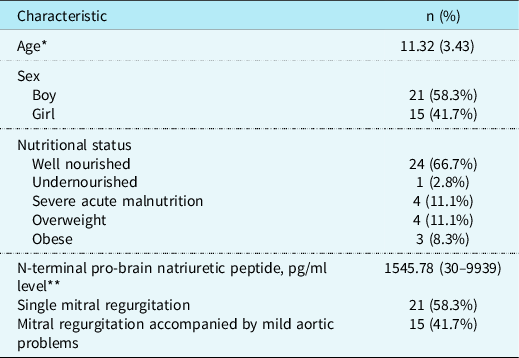
The results of the Kolmogorov–Smirnov distribution test showed that the N-terminal pro-brain natriuretic peptide values were not normally distributed and presented as median (interval). The median N-terminal pro-brain natriuretic peptide level of the subjects was 1545.78 (30 s.d. 9939). Low N-terminal pro-brain natriuretic peptide levels (30–45) were found in subjects with mild mitral regurgitation. The majority of cases (19 children, 52.8%) had severe mitral regurgitation. Table 1 lists the demographic characteristics of the study participants.
Subjects characteristic.

* normally distributed data presented as mean (SD).
** Non-normally distributed data presented as median (min-max).
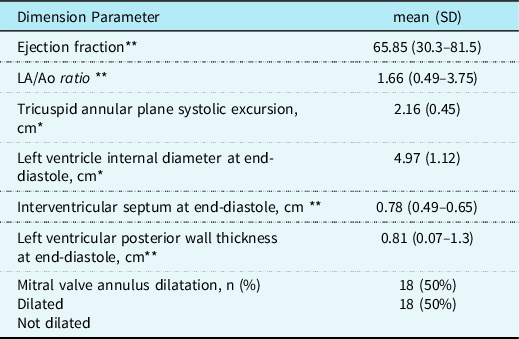
Most subjects showed a normal ejection fraction with a median of 66% (30.3–81.5%) and normal left ventricular dimension. The tricuspid annular plane systolic excursion value of the subjects was normal, 2.16 cm (0.45). The median left ventricular posterior wall thickness at end-diastole value of the subjects was also in the normal range (0.78 cm). Three subjects showed abnormal left ventricular posterior wall thickness at end-diastole values (>1.0 cm). The proportion of subjects who had mitral valve annulus dilatation problems and did not have mitral valve annulus dilatation problems was comparable 18 children each (50%). The left ventricle dimension of the subjects was presented in Table 2.
Left ventricle dimension characteristic.

* normally distributed data presented as mean (SD).
** Non-normally distributed data presented as median (min-max).
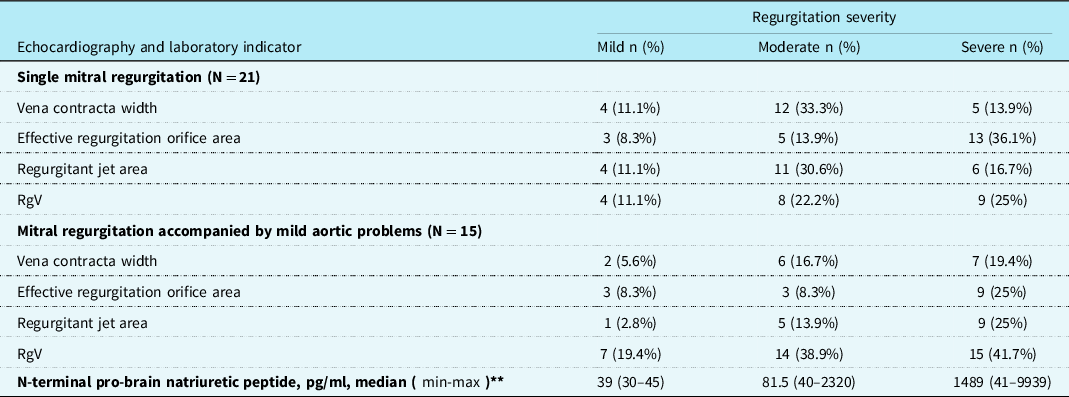
Echocardiography showed that most subjects suffered severe single mitral valve regurgitation in 11 children (30.6%). The least valve abnormalities were found in 2 children (5.6%) with mild mitral regurgitation and mild aortic valve problems. The haemodynamic and laboratory characteristics of the subjects based on mitral regurgitation severity are presented in Table 3.
Haemodynamic and laboratory characteristic based on mitral regurgitation severity.

* normally distributed data presented as mean (SD).
** Non-normally distributed data presented as median (min-max).
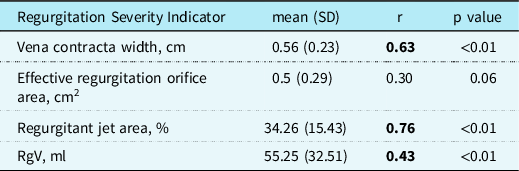
Subjects’ classification based on mitral regurgitation severity is presented in Table 4. The correlation between N-terminal pro-brain natriuretic peptide and echocardiographic parameters to assess the severity of mitral valve regurgitation was analysed using the Spearman correlation test, bivariate presented in Table 5. The bivariate analysis results showed a significant positive correlation between N-terminal pro-brain natriuretic peptide levels and vena contracta width, regurgitant jet area, and regurgitation volume. The highest r-coefficient value was obtained from the correlation analysis of N-terminal pro-brain natriuretic peptide values and regurgitant jet area, 0.76 (p value < 0.01).
Classification of subjects based on mitral regurgitation severity (vena contracta width, effective regurgitation orifice area, regurgitant jet area, rgV).

Correlation between N-terminal pro-brain natriuretic peptide level and mitral regurgitation severity.

Discussion
In response to cardiac stress, myocytes release N-terminal pro-brain natriuretic peptide, a physiologically inactive metabolite, along with biologically active brain natriuretic peptide.Reference Zhang, Wang and Xiao8 N-terminal pro-brain natriuretic peptide is a breakdown product of brain natriuretic peptide and has more stable properties in vivo and is often used as a biological marker of active hormones. Under normal circumstances, the atria are the main source of secretion of this peptide and the ventricles.Reference Hall9 The stimulus for brain natriuretic peptide release is mainly due to myocyte stretching. In severe chronic mitral regurgitation conditions, increased left ventricular volume causes compensatory dilatation and eccentric hypertrophy.Reference Steadman, Ray, L. and McCann10 Chronic stretching of myocytes, such as in heart failure conditions, leads to upregulation of peptide production, which predominantly occurs in the ventricular.Reference Hall11 In individuals with rheumatic heart disease, the N-terminal pro-brain natriuretic peptide biomarker has potential to help determine the severity of mitral regurgitation.
The subjects’ average age was 11.32 years, and 58.3% of them were male. This is by the study conducted at Harapan Kita Hospital Jakarta. The study found that the average age of children with rheumatic heart disease was 12 years old.Reference Lilyasari, Prakoso and Kurniawati12 The peak incidence of tonsillopharyngitis occurring at this age period may be the cause of the high prevalence of rheumatic heart disease in children and adolescents aged 5–15.Reference Tobing, Ontoseno, Rahayuningsih, Ganie and Siregar13 Most of the subjects in this study had severe mitral regurgitation (52.8%). Similar findings were attained by Sulaiman et al. in a study conducted in Uganda. Mitral valve dysfunction was the most common valve abnormality (98.9%), and most subjects had severe mitral regurgitation when first diagnosed (73.1%).Reference Lubega, Aliku and Lwabi14 This similar result may be because both studies were conducted in tertiary health facilities where most patients with rheumatic heart disease were referred with severe symptoms.
This study found a positive correlation between N-terminal pro-brain natriuretic peptide levels and the severity of mitral regurgitation only or accompanied by mild aortic valve dysfunction in patients with rheumatic heart disease based on the parameters of vena contracta width, regurgitant jet area, and regurgitation volume. We did not find any confounding factors that could affect N-terminal pro-brain natriuretic peptide levels in subjects such as pneumonia, bronchiolitis, CHD, acute coronary syndrome, renal failure, pulmonary embolism, atrial fibrillation, and subclinical cardiac dysfunction. The correlation result was not affected by confounding factors because the confounding factors were excluded.
N-terminal pro-brain natriuretic peptide levels had a moderately positive correlation with regurgitant jet area and vena contracta width. N-terminal pro-brain natriuretic peptide levels showed weakly positive correlation with regurgitation volume. This is the first study including regurgitant jet area for rheumatic heart disease severity evaluation. This result was also obtained by Elif et al. Elif et al. study showed a weak positive correlation between N-terminal pro-brain natriuretic peptide levels and vena contracta width/body surface area (r = 0.46; P value = 0.003) and a very weak positive correlation with regurgitation volume/body surface area (BSA) (r = 0.32; P value = 0.04). These different results may be due to differences in exclusion criteria. Elif et al.’s study excluded patients with acute rheumatic fever who recovered in the last 6 months. The sensitivity and specificity of N-terminal pro-brain natriuretic peptide for the presence of mitral regurgitation (MR) in Elif study were 89.2% and 59.5%, respectively.Reference Erolu and Akalin15
The levels of N-terminal pro-brain natriuretic peptide and effective regurgitation orifice area were not significantly correlated in our study. This result was consistent with Elif et al.’s results that N-terminal pro-brain natriuretic peptide levels did not correlate with effective regurgitation orifice area/BSA (r = 0.47; P value = 0.002). The prolapse factor in the mitral could affect the effective regurgitation orifice area to be lower when measured during the systolic phase. Mitral valve prolapse was found in 3 subjects with effective regurgitation orifice area values indicating moderate mitral regurgitation. As mitral regurgitation is influenced by its duration, particularly in situations when the mitral valve is prolapsed, effective regurgitation orifice area also could not accurately predict the volume of regurgitation in mitral regurgitation. Assessment of mitral regurgitation severity based on effective regurgitation orifice area could be greater in measurement during the late systolic phase despite a small regurgitation volume. The proximal isovelocity surface area measurement method used for effective regurgitation orifice area is based on a single frame. The effect of mitral regurgitation duration needs to be considered in the proximal iso velocity surface area method if there is a difference in regurgitation severity based on effective regurgitation orifice area and regurgitation volume. The calculation of regurgitation volume involves the components of effective regurgitation orifice area and velocity time integral, i.e. RgV = EROA x VT. Velocity time integral is mathematically identical to the square root of the systolic mean pressure gradient multiplied by the duration (T), i.e. √MPGxT. This equation shows that the time component can affect the regurgitation volume but not the effective regurgitation orifice area value.Reference Grayburn, Weissman and Zamorano16 Sample size can also affect the difference in the results of our study and Elif et al. Elif et al.’s study included more subjects (45 subjects).Reference Erolu and Akalin15
The non-normal distribution of N-terminal pro-brain natriuretic peptide levels in this study could be due to extreme differences in N-terminal pro-brain natriuretic peptide levels from the lowest levels of 30 pg/ml to the highest level of 9939 pg/ml. This result was different from the results of Elif et al. Elif et al. obtained a lower mean N-terminal pro-brain natriuretic peptide level of 140.4 (15.7) pg/ml. These considerable results might be due to differences in the subjects’ mitral regurgitation severity. Most of our study subjects had severe mitral regurgitation (52.8%), while 60% of the subjects in Elif et al.’s study showed mild mitral regurgitation. Elif et al. only included patients with chronic mitral regurgitation. Long-term secondary prophylaxis might lead to an improvement in mitral regurgitation severity.Reference Erolu and Akalin15
Most of our subjects showed normal left ventricular dimensions. Similar results were obtained in a study by Faris et al. that compared the profiles of children with heart disease accompanied by mitral regurgitation who received angiotensin-converting enzyme inhibitor treatment at Dr Saiful Anwar Hospital in Malang. In this study, both groups using captopril and not using captopril showed almost the same left ventricular dimensions.Reference Nugroho, Rohman, Rizal, Martini, Prasetya and Makhmud17
The median ejection fraction of our study subjects was within the normal range of 66 (30.381.5) %. This outcome is consistent with a 2016 study by Anurag et al. performed at the Cardiology Clinic of the All India Institute of Medical Sciences. The subjects’ mean left ventricular systolic function was 60.1 (5.1) %.Reference Mehta, Saxena, Juneja, Ramakrishnan, Gupta and Kothari18 The compensatory phase is indicated by normal left ventricular dimensions and ejection fraction. The ventricle has not yet undergone structural or functional changes during the compensatory phase of mitral regurgitation.Reference Gaasch and Meyer19
Mitral valve annulus dilatation was found in 50% of the subjects in this study. This may be because most subjects had severe mitral regurgitation (52.8%). The severity of mitral regurgitation is known to be correlated with the annulus area. Michael et al. found that the anterior and posterior leaflets were significantly larger in severe mitral regurgitation. The putative mechanisms underlying annulus dysfunction, including mitral valve annulus dilatation, are most likely associated with papillary muscle shift due to ventricular dilatation resulting from mitral regurgitation.Reference Yeong, Silbery, Finucane, Wilson and Gentles20
The limitation of our study was that this study only showed a positive correlation between N-terminal pro-brain natriuretic peptide levels and echocardiography parameters to assess the mitral regurgitation severity. The cut-off N-terminal pro-brain natriuretic peptide levels to determine the mitral regurgitation severity cannot be determined. This study also included rheumatic heart disease patients with mitral regurgitation and mild aortic valve problems. Future studies are expected to increase internal validity by involving patients with single mitral regurgitation and not receiving any therapy yet. The discrepancy between the mitral regurgitation severity based on effective regurgitation orifice area and regurgitation volume was found in this study. Future studies are expected to use three-dimensional echocardiography and zoom to overcome study limitation. This study is anticipated to encourage further investigation into the optimal cut-off value for N-terminal pro-brain natriuretic peptide levels.
In conclusion, our study found moderate positive correlation between N-terminal pro-brain natriuretic peptide levels and the regurgitation severity based on echocardiography parameters of regurgitant jet area, a moderate positive correlation with vena contracta width, and a weak positive correlation with regurgitation volume in patients with rheumatic heart disease. No correlation was found between N-terminal pro-brain natriuretic peptide levels and effective regurgitation orifice area. Most children with rheumatic heart disease with single mitral regurgitation or mild aortic regurgitation/stenosis showed severe mitral regurgitation with normal left ventricular function and left ventricular dimensions.
Acknowledgements
All authors contributed equally to the study from the conceptual framework, data collection, data analysis, and final publication of the findings.
Financial support
The authors received no specific grant from any funding agency in the public, commercial, or not-for-profit sectors.
Competing interests
None.