Introduction
People who are excluded from the labor market face large personal and economic costs (Brand, Reference Brand2015). They are more likely to experience psychological distress, social marginalisation, financial hardship, higher welfare support needs, and earlier mortality (Paul, & Moser, Reference Paul and Moser2009; Roelfs, Shor, Davidson, & Schwartz, Reference Roelfs, Shor, Davidson and Schwartz2011; Savolainen, Mason, Lyyra, Pulkkinen, & Kokko, Reference Savolainen, Mason, Lyyra, Pulkkinen and Kokko2017; Schmitz, Reference Schmitz2011). Although the causal antecedents of economic exclusion and long-term welfare receipt are complex, involving both individual characteristics and structural systemic factors, it has been repeatedly observed that children with behavioral problems are more likely to experience economic difficulties in adulthood, including unemployment, lower earnings, and less wealth (Fergusson, Boden, & Horwood, Reference Fergusson, Boden and Horwood2013; Healey, Knapp, & Farrington, Reference Healey, Knapp and Farrington2004; Knapp, King, Healey, & Thomas, Reference Knapp, King, Healey and Thomas2011; Rivenbark et al., Reference Rivenbark, Odgers, Caspi, Harrington, Hogan, Houts and Moffitt2018). This has led to growing interest in early behavioral problems as potential targets for economic policy interventions. So far, few studies have examined the association between behaviors in early childhood (e.g., kindergarten) and long-term trajectories of welfare receipt in population-based samples, which could help inform the development of screening tools and early prevention programs.
The individual characteristics that contribute to youth unemployment and subsequent welfare receipt have been extensively debated both inside and outside academia and the role of both proximal and distal factors are generally acknowledged. Proximal factors describe immediate precipitating events, such as accidents or illness, that lead to employment loss and subsequent welfare needs, while distal factors concern temporally distant events or personal characteristics that may stretch far back into childhood (Savolainen et al., Reference Savolainen, Mason, Lyyra, Pulkkinen and Kokko2017). According to one influential view, youth unemployment is the consequence of failed accumulation of capital – human, social, and personal capital – across the early life course (Caspi, Wright, Moffitt, & Silva, Reference Caspi, Wright, Moffitt and Silva1998; Converse, Piccone, & Tocci, Reference Converse, Piccone and Tocci2014). This idea is supported by a large body of empirical literature showing that many early life factors reliably predict adverse economic outcomes, such as low IQ, academic underperformance, failure to graduate high school, and limited parental socioeconomic resources (human capital), family conflict, growing up in a single-parent family and weak school ties (social capital), and childhood conduct problems, antisocial behavior, and substance use (personal capital) (Caspi et al., Reference Caspi, Wright, Moffitt and Silva1998; Serafino & Tonkin, Reference Serafino and Tonkin2014; Spengler, Damian, & Roberts, Reference Spengler, Damian and Roberts2018).
Childhood risks for unemployment are of particular interest to researchers and policy makers because early prevention and intervention efforts are more likely to succeed and are therefore more cost effective (Heckman, Reference Heckman2006). One challenge, however, is that some established risk factors – such as low IQ and family adversity – are hard to modify, making them dubious targets for intervention efforts (Heckman, Stixrud, & Urzua, Reference Heckman, Stixrud and Urzua2006). Attention has therefore increasingly focused on more modifiable traits, such as childhood behavior and social–emotional skills, which have been consistently linked with adverse economic outcomes in studies of clinical and population-based samples (Bowles, Gintis, & Osborne, Reference Bowles, Gintis and Osborne2001; Duckworth & Schoon, Reference Duckworth and Schoon2010; Watts, Reference Watts2020).
The existing literature shows that childhood inattention (Feinstein, Reference Feinstein2000; Vergunst et al., Reference Vergunst, Tremblay, Nagin, Algan, Beasley, Park and Côté2019a, Reference Vergunst, Tremblay, Nagin, Algan, Beasley, Park and Côté2019b), diagnosis of attention-deficit/hyperactivity disorder (Fletcher, Reference Fletcher2013), conduct problems (Knapp et al., Reference Knapp, King, Healey and Thomas2011), antisocial behavior (Healey et al., Reference Healey, Knapp and Farrington2004; Vergunst et al., Reference Vergunst, Tremblay, Nagin, Algan, Beasley, Park and Côté2019a), and low self-control (Fergusson et al., Reference Fergusson, Boden and Horwood2013) (between 3 and 15 years of age) are associated with lower earnings, unemployment, and less wealth in adulthood. Conversely, prosocial behaviors at age 5–6 years have been linked with higher earnings among males at age 33–35 years (Vergunst et al., Reference Vergunst, Tremblay, Nagin, Algan, Beasley, Park and Côté2019a) and have been shown to buffer the harmful effects of childhood aggression on unemployment (Kokko & Pulkkinen, Reference Kokko and Pulkkinen2000); kindergarten social–emotional skills are associated with employment tenure at age 25 years (Jones, Greenberg, & Crowley, Reference Jones, Greenberg and Crowley2015) and higher earnings at age 26 years (Feinstein, Reference Feinstein2000). To our knowledge, the association between early childhood behavior and long-term welfare receipt has been examined only in a study of males from low-income backgrounds, which found that kindergarten inattention was associated with chronic welfare receipt (Vergunst et al., Reference Vergunst, Tremblay, Nagin, Algan, Beasley, Park and Côté2020). These effects have not been examined in a large population-based sample of males and females, nor has the role of moderators been assessed, which the present study sought to address.
Limitations of existing research
Childhood behavioral problems are an important, though under studied, distal predictor of future economic difficulties. The limitations of previous studies have been summarized elsewhere (Vergunst et al., Reference Vergunst, Tremblay, Nagin, Algan, Beasley, Park and Côté2020) and here we address the limitations and literature gaps most pertinent to the present study.
First, previous studies that linked behavior to economic outcomes usually examined outcomes spanning only a few years – typically employment earnings (Feinstein, Reference Feinstein2000; Knapp et al., Reference Knapp, King, Healey and Thomas2011; Vergunst et al., Reference Vergunst, Tremblay, Nagin, Algan, Beasley, Park and Côté2019a, Reference Vergunst, Tremblay, Nagin, Algan, Beasley, Park and Côté2019b) – and therefore fail to capture the continuous and dynamic nature of individual economic circumstances over time. Participants who are temporarily absent from the workforce (e.g., due to childcare responsibilities) could therefore be missed.
Second, existing studies have generally used behavior assessments made in middle childhood, for example at age 10 years (Feinstein, Reference Feinstein2000; Knapp et al., Reference Knapp, King, Healey and Thomas2011), or combined them across multiple years, for example at age 3–11 years (Fergusson et al., Reference Fergusson, Boden and Horwood2013; Moffitt et al., Reference Moffitt, Arseneault, Belsky, Dickson, Hancox, Harrington and Ross2011). This is problematic for the development of early screening tools since it is impractical to wait several years before at-risk children can be identified. Ideally, assessments should be made as early as possible (Heckman, Reference Heckman2006), based on teacher assessments since teachers have a good sense of normative behavior and produce ratings with good reliability and predictive validity (DuPaul, Reference DuPaul1991; Staff et al., Reference Staff, Oosterlaan, van der Oord, Hoekstra, Vertessen, de Vries and Luman2020), at a single time point, and in a context that allows population-wide assessment (e.g., in kindergarten).
Third, several studies have combined multiple behaviors (e.g., inattention, aggression, conscientiousness) to form composite indices of broader concepts such as “self-control” (Converse et al., Reference Converse, Piccone and Tocci2014; Daly, Delaney, Egan, & Baumeister, Reference Daly, Delaney, Egan and Baumeister2015; Fergusson et al., Reference Fergusson, Boden and Horwood2013; Moffitt et al., Reference Moffitt, Arseneault, Belsky, Dickson, Hancox, Harrington and Ross2011). While this approach can increase statistical power to detect significant effects, it lacks specificity and does not allow the unique additive or interactive contribution of specific behaviors to be evaluated (Greenland, Reference Greenland1993) or the mechanisms underlying specific effects to be identified, which diminishes its utility for the development of prevention or intervention programs (Greenberg & Abenavoli, Reference Greenberg and Abenavoli2017; Vitaro & Tremblay, Reference Vitaro and Tremblay2016).
Finally, it is unclear whether behavioral problems in kindergarten operate interactively to increase (or decrease) future welfare receipt risk. For example, childhood anxiety symptoms have been linked with numerous adverse long-term social and educational outcomes (Woodward & Ferguson, Reference Woodward and Fergusson2001), and could plausibly increase the risk of welfare receipt above and beyond disruptive behaviors, possibly by interacting with aggression–opposition. For instance, aggressive–anxious children are more likely to be victimized by their peers (Monahan & Booth-LaForce, Reference Monahan and Booth-LaForce2016). In contrast, childhood prosocial traits, which have been associated with better peer relations and higher academic attainment (Caprara, Barbaranelli, Pastorelli, Bandura, & Zimbardo, Reference Caprara, Barbaranelli, Pastorelli, Bandura and Zimbardo2000; Hay, Payne, & Chadwick, Reference Hay, Payne and Chadwick2004), could buffer against the harmful effects of disruptive behaviors on welfare receipt (Kokko & Pulkkinen, Reference Kokko and Pulkkinen2000). Consequently, these behaviors were included in the analyses, and interactions between all behaviors were examined.
Given the well-documented sex differences in both childhood behavioral problems and adulthood economic outcomes (American Psychiatric Association, 2013; Blau & Kahn, Reference Blau and Kahn2000), it might be assumed that the association between childhood behavior and adult-life economic outcomes will differ for males and females. But the empirical evidence is somewhat mixed. Some studies have found effects for males only, with aggression–opposition and low prosocial behaviors at age 6 years linked to lower earnings (Vergunst et al., Reference Vergunst, Tremblay, Nagin, Algan, Beasley, Park and Côté2019a) and conduct problems at age 10 years linked to unemployment at age 26 years (Feinstein, Reference Feinstein2000). Other studies report no sex differences in the association between antisocial behaviors at age 10 years and unemployment at age 30 years (Knapp et al., Reference Knapp, King, Healey and Thomas2011). It is therefore important to better understand these sex differences because it might help explain the observed differences in welfare receipt among men and women, and sex was therefore examined as a moderator in this study. Further to this point, it is well documented that children from low-income backgrounds are more likely to receive welfare as adults (Pepper, Reference Pepper2000). It is therefore possible that family adversity moderates the effects of early behavioral problems on future welfare receipt (e.g., effects are larger for children coming from backgrounds of high adversity) and the moderating effects of family adversity were therefore tested in the analysis.
Aims
The aims of this study were twofold. First, to create trajectories of welfare receipt from age 18–35 years in a population-based sample of males and females. Second, to examine the association between kindergarten behaviors – inattention, hyperactivity, aggression–opposition, anxiety, and prosociality – and trajectories of welfare receipt, after adjustment for the child's IQ and family background. Since behaviors could operate interactively rather than additively, two-way interactions between all behaviors were tested. To test whether childhood behaviors were differentially associated with high welfare trajectories for males or females, or influenced by the child's socioeconomic background, sex and family adversity were examined as moderators. Based on the literature reviewed above, it was expected that inattention and aggression–opposition would be most strongly associated with welfare receipt, while prosocial behaviors would be negatively associated with welfare receipt. Previous studies of the association between childhood behavior and adult economic outcomes have yielded mixed results with respect to sex differences, the moderating effect of adversity, and interactions between behaviors, and consequently no directional hypotheses were made for these analyses.
Method
Participants
This study used data from the Quebec Longitudinal Study of Kindergarten Children, a population-based sample of children born in 1980/1981 (n = 3,020). The original study was designed to investigate the prevalence, risk factors, development, and consequences of behavioral and emotional problems during elementary school years using a developmental perspective; the study currently spans ages 6–35 years (Rouquette et al., Reference Rouquette, Côté, Pryor, Carbonneau, Vitaro and Tremblay2014). The sample comprised 2,000 randomly selected children (1,001 boys) and 1,017 children (593 boys) who scored at or above the 80th percentile for disruptive behaviors at the end of kindergarten (age 5–6 years) with gender-specific cutoffs. This was done to increase statistical power in the studies of disruptive behaviors. The participants were recruited from French-speaking public schools in Quebec, Canada, and were 96.2% Caucasian, 52.3% male. The study was approved by the University of Montreal Ethics Board and Statistics Canada. Written informed consent was obtained from the children's parents prior to participation.
Outcome variables
Outcome data were obtained from Statistics Canada through a data linkage of individual tax return records with the Quebec Longitudinal Study of Kindergarten Children birth cohort. Tax return records, obtained for each year of follow-up from age 18–35 years (1998–2015), included total personal and household pre-tax earnings, social assistance support, marital status, and the number of children in the household. In the Canadian province of Quebec, social assistance support (hereafter referred to as welfare) provides “last resort” financial support to people without income who are no longer eligible for unemployment insurance (excluding those with severely limited capacity for work) (Government of Quebec, 2018). Welfare receipt was coded dichotomously for each year of follow-up (1 = received, 0 = not received). Personal earnings were defined as all annual pre-tax wages, salaries, and commissions, not including income from capital gains; household income was defined as the total annual income of the household. For the earnings and income variables, the annual amount was averaged for the three most recent years (2013–2015), and then converted to US$ (CAN$1 = US$0.75). Data on high school graduation rates were obtained from the Québec Ministry of Education.
Behavioral predictors and control variables
Behavioral ratings were obtained from kindergarten teachers for each child using the Social Behavior Questionnaire when the children were 5–6 years old (Tremblay, Desmarais-Gervais, Gagnon, & Charlebois, Reference Tremblay, Desmarais-Gervais, Gagnon and Charlebois1987). This instrument is well validated and has good predictive validity for a range of outcomes (Tremblay et al., Reference Tremblay, Loeber, Gagnon, Charlebois, Larivée and LeBlanc1991). Behaviors were assessed as follows. Inattention (four items): poor concentration, distracted, head in the clouds, lack of persistence. Hyperactivity (two items): agitated or fidgety, moves constantly. Physical aggression (three items): fights with other children, bullies or intimidates other children, kicks or bites. Opposition (five items): disobeys, doesn't share materials, blames others, inconsiderate, irritable. Anxiety (three items): fearful or afraid of new things or new situations, worried/worries about many things, cries easily. Prosociality (10 items): tries to stop quarrels or disputes, will invite bystanders to join in a game, will try to help someone who has been hurt, shows sympathy, comforts a child who is crying or upset, and so on.
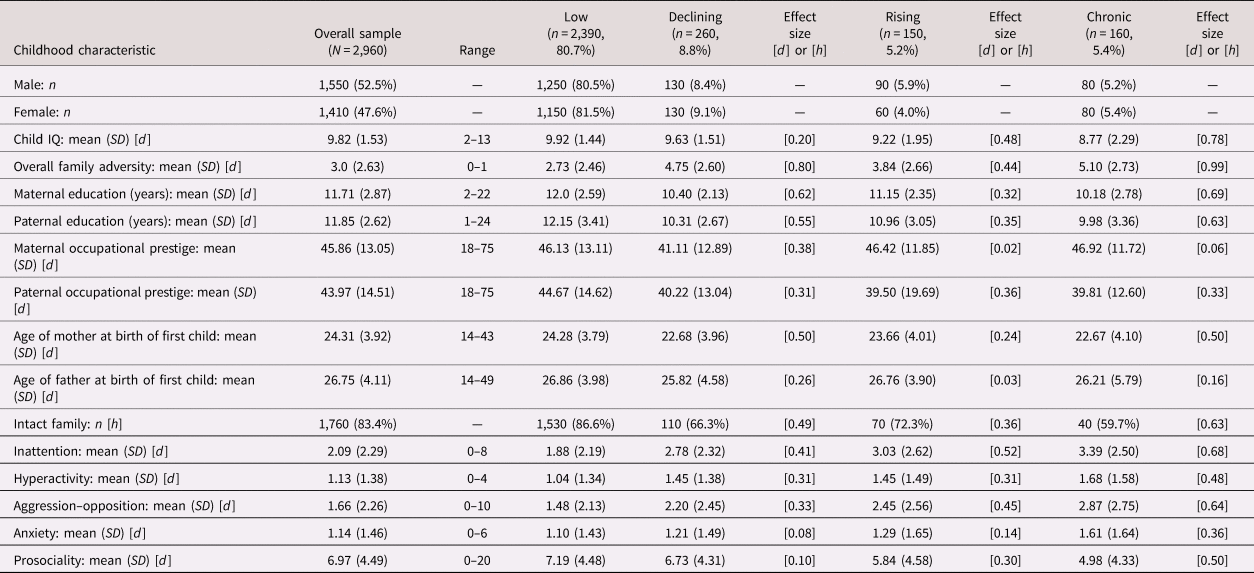
Aggression and opposition were highly correlated (r = .77, variance inflation factor test of collinearity > 5) and these items were consequently combined into a single variable with adjustment for differences in scoring. Behaviors were rated on a 3-point scale (0 = never/not true, 1 = sometimes/somewhat true, 2 = often/very true) and the item scores were summed for each behavior (the mean, standard deviation (SD), and range are shown in Table 1). Cronbach's alpha scores for inattention, hyperactivity, opposition, aggression, anxiety, and prosociality were .85, .89, .86, .86, .74, and .91, respectively.
Sample characteristics at baseline split by welfare receipt trajectory

a Up to 12.1% missing data, except for intact family, which had 29.8% missing data. In accordance with Statistics Canada's confidentiality (nondisclosure) rules, displayed counts are rounded to base 10 and percentages to one decimal point. Baseline characteristics assessed in kindergarten at age 5–6 years except for child IQ, which was assessed at age 13 years. [d] and [h] represent effect sizes based on Cohen's d for mean differences and Cohen's h for proportional differences (Cohen, Reference Cohen1988) relative to the low group (reference). Effect sizes of 0.2, 0.5, and 0.8 represent small, medium, and large effects, respectively.
Life course studies show that child IQ and family adversity are consistently associated with future economic outcomes, and we adjusted for both in the analyses (Caspi et al., Reference Caspi, Wright, Moffitt and Silva1998). The child's cognitive ability was measured using the Sentence Completion Task (SCT) at age 13 years (Lorge & Thorndike, Reference Lorge and Thorndike1950); this task correlates highly with other verbal and nonverbal measures of intelligence and educational attainment across respondents by sex, ethnic background, and socioeconomic status (Veroff, McClelland, & Marquis, Reference Veroff, McClelland and Marquis1971). IQ is relatively stable across development (Mackintosh, Reference Mackintosh2011) so the assessment at age 13 was considered to provide a good assessment of the child's cognitive abilities at age 6 years. The family adversity index was calculated by combining the following variables, assessed at age 6: parents’ education level (total years), parents’ age at birth of the first child, family structure (intact vs. not intact), and parents’ occupational status, based on the criteria of Blishen, Carroll, and Moore (Reference Blishen, Carroll and Moore1987). Families at or below the 30th percentile for each of these variables (or a not intact family) were allocated one adversity point for each indicator. Overall scores were standardized on a 0–10 scale.
Statistical analyses
Group-based trajectory modeling was used to estimate trajectories of the annual probability of receiving welfare (received vs. not received) from age 18–35 years. The purpose of this approach is to identify clusters of individuals following similar developmental trajectories (in this case welfare receipt) across time. The probability of welfare receipt was specified as following a quadratic function of age, which allows for nonlinear variations over time. Trajectory modeling is relatively robust to missing data patterns (Nagin, Reference Nagin2005). Participants with at least three tax returns from age 18–35 years were included in the study (n = 2,960, 98.0%). Included and excluded participants did not differ in any of the baseline characteristics. Of the 2,960 included participants, 66.9% had tax returns for all 18 years, 87.3% for at least 15 years, and 92.1% for at least 12 years. Model selection (e.g., three-, four-, or five-group solution) was based on model fit statistics, including the Bayesian information criterion (BIC) and Akaike information criterion (AIC), model parsimony, and the substantive aims of the study – that is, to identify clusters of individuals following similar trajectories of welfare receipt (see Table 1 of the Supplementary Material) (Nagin, Reference Nagin2005). The results of the modeling procedure were used to assign participants to their welfare receipt trajectory based on the posterior probability of group membership.
After identifying the best fitting model, multiple imputations were performed to account for missing covariate data, before incorporating all data into the final multivariable model. Missing data were managed using multiple imputations by chained equations (see Table 2 of the Supplementary Material). Compared with single imputations, multiple imputations provide more reliable standard errors for fitted models by accounting for the statistical uncertainty of the imputations (Azur, Stuart, Frangakis, & Leaf, Reference Azur, Stuart, Frangakis and Leaf2011). Models were estimated across 80 data sets and the results were pooled (Azur et al., Reference Azur, Stuart, Frangakis and Leaf2011). The association between kindergarten behavior (independent variables) and trajectories of welfare receipt (dependent variable) was examined using mixed effects multinomial logistic regression models with adjustment for clustering at the school (n = 305) and classroom (n = 554) levels with clustered standard errors. The sex of the child and family adversity were entered as main effects initially, and then examined as moderators, which were tested separately for each behavior. Two-way interactions between all behaviors were examined separately, after first centering each behavioral predictor by subtracting the variable mean from each score. For the interactions, significance thresholds were set at 0.01, to account for multiple testing. All other significance tests were set at .05 and all tests were two-tailed.
The results of the multivariable models are presented as relative risk ratios (RRRs), which represent the risk of being in the target group (e.g., chronic welfare receipt trajectory) relative to the reference group (i.e., low welfare receipt trajectory) for a unit increase in the predictor (e.g., inattention), holding all other variables constant. Based on the criteria of Olivier et al. (Reference Olivier, May and Bell2017), RRRs of 1.22, 1.86, and 3.00 are small, medium, and large effect sizes, respectively. Effect sizes for descriptive statistics were based on Cohen's d for mean differences and Cohen's h for proportional differences (i.e., categorical variables) with figures of 0.2, 0.5, and 0.8 representing small, medium, and large effects, respectively (Cohen, Reference Cohen1988). Analyses were conducted using Stata 15.
Results
Trajectories of welfare receipt
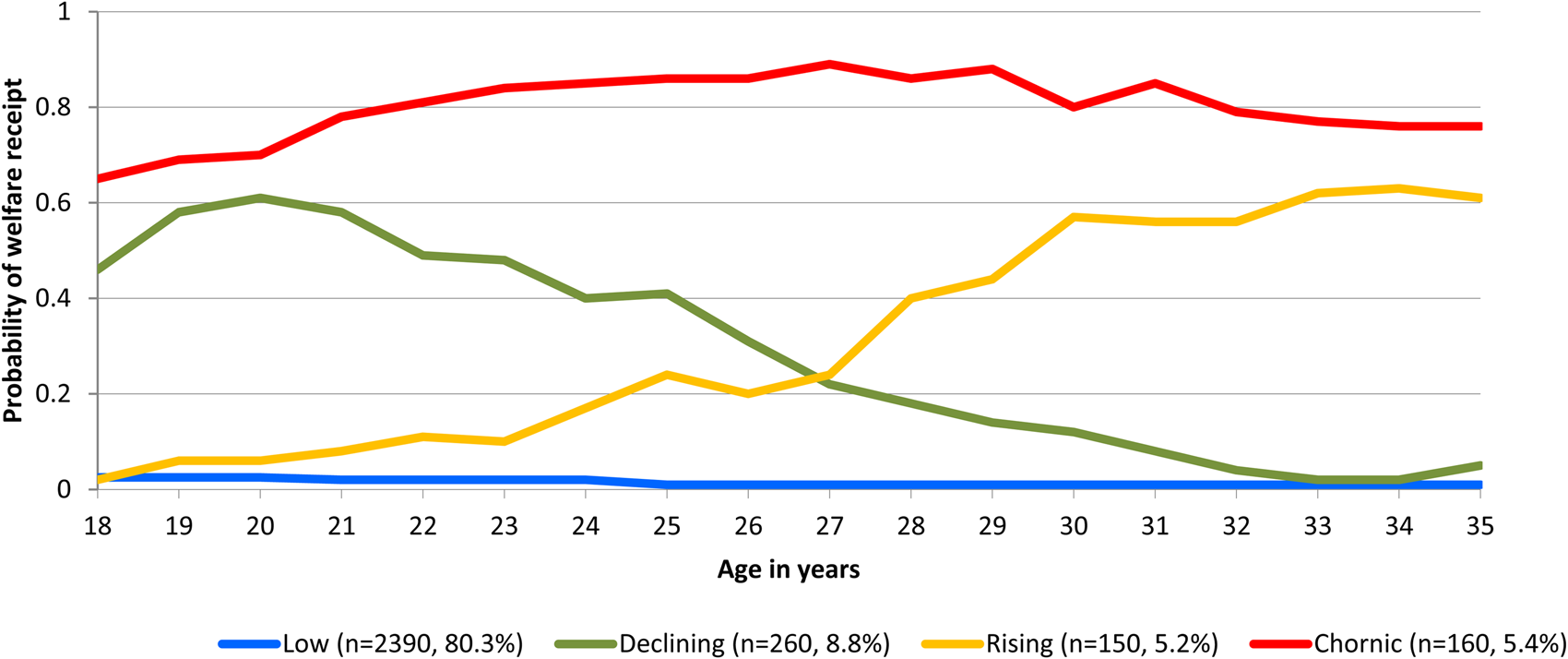
The trajectories of welfare receipt from age 18–35 years are shown in Figure 1. A four-group model was selected based on the model fit statistics, including BIC and AIC, model parsimony, and the substantive aims of the study. Details about model selection are provided in the caption for Figure 1; fit indices are presented in Table 1 of the Supplementary Material. The final model was composed of four groups of welfare receipt: low (n = 2,390, 80.7%), declining (n = 260, 8.8%), rising (n = 150, 5.2%), and chronic (n = 160, 5.4%).
Trajectories of welfare receipt from age 18 to 35 years drawn from a Canadian population-based sample (n=2960). Trajectories show the probability of welfare receipt for each year of follow-up. For participants in the rising group, for example, the probability of receiving welfare was roughly zero at age 18, rising to 40% by age 28 and 60% by age 35 years. A four-group model was selected based on the Bayesian information criterion (BIC) and Akaike information criterion (AIC) numbers, model adequacy tests, and the overall explanatory power of the model compared to the next best fitting models (three- and five-group models). For the four-group model, the average posterior probability of group membership for group assignments based on the maximum posterior probability rule exceeded the .7 threshold recommended by Nagin (Reference Nagin2005), passed the odds of the correct classification test, and Nagin's recommendation that the estimated probability of group membership for each group be close to the proportion assigned to the group (see Table 1 of the Supplementary Material).

Characteristics of the sample at baseline (i.e., at age 5–6 years) are shown for each trajectory group in Table 1. Compared with participants in the low group, participants in the chronic and rising trajectories were more likely, at age 5–6 years, to have had more behavioral problems, lower prosociality, and to have come from families with higher levels of adversity.
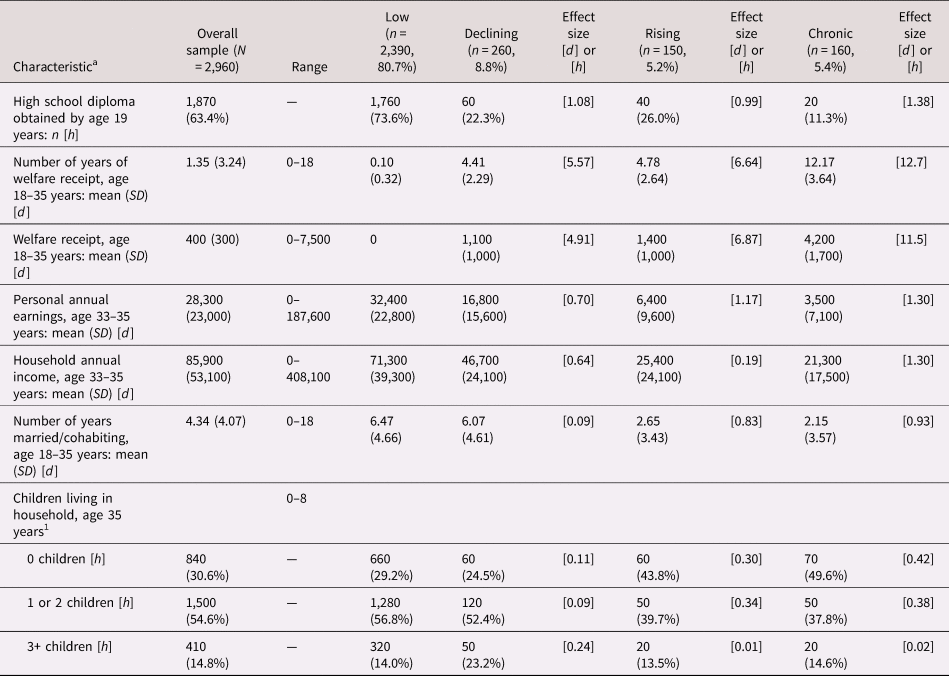
The participants’ social and economic circumstances at follow-up, split by trajectory group membership, are shown in Table 2. Again, participants following the declining, rising, and chronic trajectories were less likely to have obtained a high school diploma by age 19, had lower personal and household earnings at age 33-35 years, and spent fewer years partnered from age 18–35 years, when compared with the low group. Participants in the chronic group fared particularly poorly – compared with the low group, they had significantly lower annual personal earnings (US$3,500 vs. US$32,400) and household income (US$21,300 vs. US$71,300) at age 33–35 years and spent fewer years married or cohabiting across follow-up (2.2 vs. 6.5 years). The mean annual welfare receipt across all years from age 18–35 years for participants in the chronic group was US$4,200/year, compared with US$1,400/year in the rising group, US$1,100/year in the declining group and zero in the low group. Participants in the chronic group received roughly US$75,000 in welfare payments across the 18-year follow-up period.
Socioeconomic circumstances at follow-up split by welfare receipt trajectories
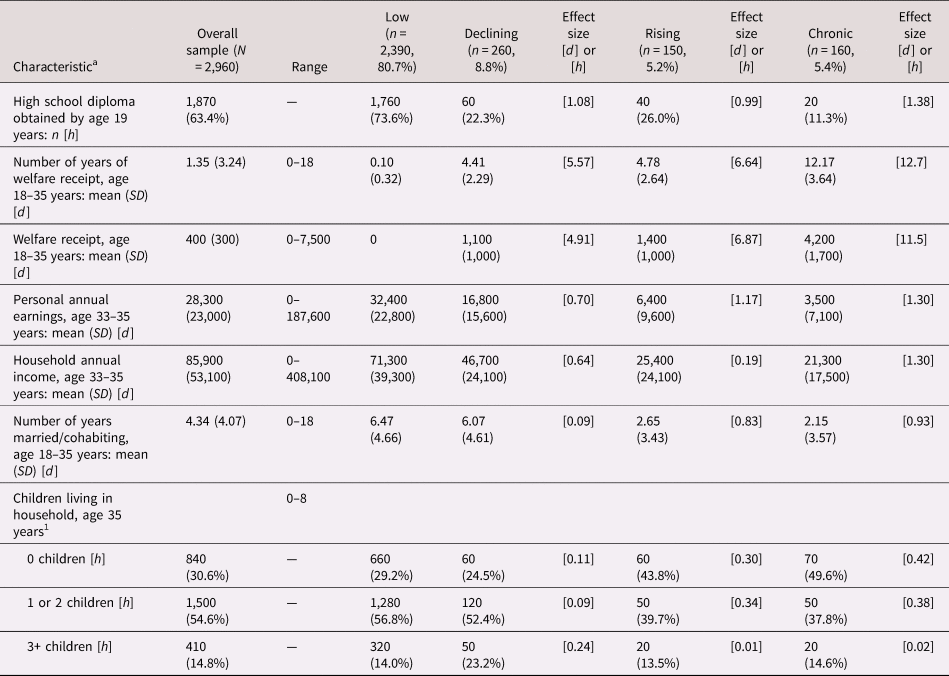
a Up to 3.1% missing data. In accordance with Statistics Canada's confidentiality (nondisclosure) rules, earnings are rounded to the nearest hundred, and ranges represent the mean of the five lowest and five highest scores respectively and are therefore a conservative estimate of the upper limit. Welfare receipt represents the mean annual value received from age 18-35 years in US$. Personal earnings and household income are for the 2013–2015 period in US$. [d] and [h] represent effect sizes based on Cohen's d for mean differences and Cohen's h for proportional differences (Cohen, Reference Cohen1988) relative to the low group (reference). Effect sizes of 0.2, 0.5, and 0.8 represent small, medium, and large effects, respectively.
Association of behavior with welfare trajectories
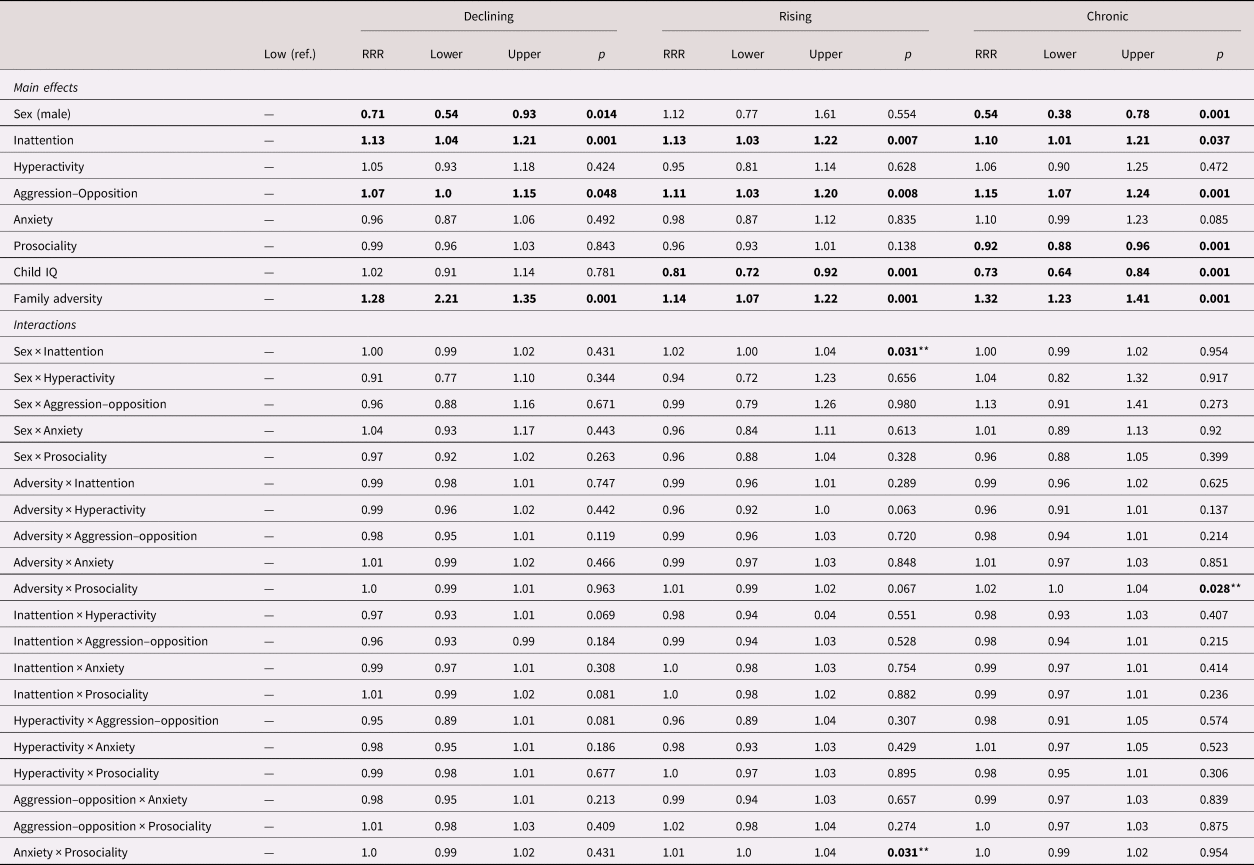
All the variables in the model were significantly associated with trajectory group membership in bivariate analyses (see Table 3 of the Supplementary Material). In multivariable analyses (see Table 3), inattention and aggression–opposition at age 5–6 years were associated with an increased risk of following declining, rising, and chronic trajectories of welfare receipt, independent of hyperactivity and anxiety, and after adjustment for children's IQ and family adversity. Prosociality was associated with reduced likelihood of following a trajectory of chronic welfare receipt. Neither hyperactivity nor anxiety were significantly associated with long-term welfare receipt. Compared with females, males were significantly less likely to follow trajectories of declining receipt or chronic receipt. Overall, family adversity was the strongest predictor of welfare receipt (judged by RRR), followed by child IQ and participant sex.
Tests of association between kindergarten behavior and trajectories of welfare receipt from age 18–35 years

Multinomial logistic regression model with adjustment with clustering of standard errors at the school and classroom levels. Relative risk ratios (RRR) represent the risk of being in the target group (e.g., chronic welfare receipt trajectory) relative to the reference group (i.e., low welfare receipt trajectory) for a unit increase in the predictor (e.g., inattention), holding all other variables constant. Based on the criteria of Olivier et al. (2016) criteria, RRRs of 1.22, 1.86, and 3.00 are small, medium, and large effect sizes, respectively. Significant associations are shown in bold.
** Indicates not significant after adjustment for multiple testing (threshold set at .01).
In more specific terms, for a unit increase in inattention at age 5–6 years, there was a 1.10 times increased risk of following a chronic welfare receipt trajectory from age 18–35 years, relative to the low receipt trajectory. Similarly, a unit change in aggression–opposition was associated with a 1.15 times increased risk of following a chronic receipt trajectory. Conversely, a unit increase in prosocial behavior was associated with a 0.92 (decreased) risk for following a chronic welfare receipt trajectory, compared with the reference group. Effect sizes for all behaviors were in the small range, based on the criteria of Olivier et al. (RRRs ranged from 1.07 to 1.22), with family adversity having a larger effect size than any behavior (RRR = 1.14–1.32). Associations between behaviors and welfare trajectory group were not moderated by sex. Similarly, after adjustment for multiple testing, there were no significant moderating effects of family adversity and no significant interactions between the behavioral predictors.
Discussion
To our knowledge, this is the first study to examine the association between behavior in kindergarten and long-term trajectories of welfare receipt in a large population-based birth cohort. From age 18 to 35 years, around 81% of the participants followed a trajectory or low receipt, 9% of declining receipt, 5% of rising receipt, and 5% of chronic receipt. Kindergarten inattention and aggression–opposition were independently associated with increased risk of following trajectories of declining, rising, and chronic welfare receipt, while prosociality was associated with a lower risk of following a chronic trajectory. This study suggests that it may be possible to identify children at risk of long-term economic aversity based on a single teacher-rated behavioral assessment made in kindergarten, which has important implications for early screening and prevention.
Although most participants in this study received no welfare from age 18–35 years, those who did generally fared poorly on a variety of social and economic indicators. Compared with the low welfare group, participants in the declining and rising groups were more likely to have left high school without a diploma, to have lower annual personal earnings and household income, spent fewer years partnered, had fewer children living in the household, and, overall, had a socioeconomic profile more similar to that of the chronic group, who fared worst of all.
To put these findings in context, official data show that the mean proportion of the population aged 16+ that was unemployed from 1998 to 2015 was 8.3% for the province of Quebec and 7.2% for all of Canada (Statistics Canada, 2020). During the same period, the mean proportion receiving welfare receipt was 6.1% for Quebec and 6.0% for Canada, which closely matches our figure of 5.4% in the chronic welfare trajectory. The slightly lower figure in our chronic receipt group may be explained by several factors including the youthfulness of our sample (young people are more likely to be in full-time education/training and therefore to be ineligible for welfare) and the fact that some welfare recipients were captured in the rising and declining welfare receipt groups rather than the chronic group.
There were marked differences in high school graduation rates across the welfare receipt groups. Although 73.6% of participants in the low group obtained a diploma by age 19, graduation rates were just 22.3% in the declining group, 26.0% in the rising group, and 11.3% in the chronic group. (Note that around 90% of Canadians will eventually obtain their diplomas by age 35 years, according to Statistics Canada.) The overall graduation rate for participants in this study was 63.4%, which is lower than the rates of 82.2% and 76.0% reported for Quebec and Canada, respectively, in 1997/1998 (Statistics Canada, 2005). The lower graduation rates in the present study may reflect sampling differences: the participants were recruited from French-speaking public schools (private and English-speaking schools were excluded), which typically have lower graduation rates compared with Canadian population averages. It should also be noted that reported graduation rates for Quebec were unusually high in 1997/1998 and declined thereafter, reaching 72.4% in 2002/2003, where they have remained since, well below the national average.
Effect sizes for individual behaviors were in the small range, possibly due to the long follow-up duration and use of behavioral assessment at a single time point in kindergarten, and likely reflect a conservative estimate of the actual effect. In concrete terms, however, the effects represent the difference between no welfare receipt and long-term support, which are radically different economic outcomes for both individuals and society. In monetary terms, if the mean annual welfare receipt is used as an approximation, a one-unit change in inattention at age 5–6 years was associated with a 1.10 increased risk of following chronic welfare receipt trajectory, relative to the low receipt trajectory. This represents a roughly US$4,200 annual increase in welfare receipt, or US$75,000 from age 18–35 years. Likewise, a one-unit change in aggression–opposition corresponded with a 1.15 increased risk of following a chronic receipt trajectory.
Male participants were less likely to follow declining or chronic trajectories of welfare receipt compared with females, although participant sex did not moderate the effects of behavior on welfare trajectory group membership. There were no significant interactions between behaviors after adjustment for multiple testing. This is consistent with several previous studies (Knapp et al., Reference Knapp, King, Healey and Thomas2011; Vergunst et al., Reference Vergunst, Tremblay, Nagin, Algan, Beasley, Park and Côté2019a, Reference Vergunst, Tremblay, Nagin, Algan, Beasley, Park and Côté2019b) and may have to do with the use of behavioral predictors obtained at a single time point (e.g., kindergarten), with the result that restricted variance deminished power to detect effects.
Our overall results broadly concur with the small number of studies that have linked kindergarten behavioral assessments with economic outcomes in adulthood. This work shows that inattention is consistently associated with lower earnings, while prosocial and social–emotional skills are associated with higher earnings and employment stability (Jones et al., Reference Jones, Greenberg and Crowley2015; Vergunst et al., Reference Vergunst, Tremblay, Nagin, Algan, Beasley, Park and Côté2019a, Reference Vergunst, Tremblay, Nagin, Algan, Beasley, Park and Côté2019b). The effects of kindergarten aggression–opposition on earnings are somewhat mixed, with one study reporting an association with lower earnings at age 33–35 years for males only (Vergunst et al., Reference Vergunst, Tremblay, Nagin, Algan, Beasley, Park and Côté2019a), while a study of males from low-income backgrounds found no association between aggression–opposition and earnings at age 35–36 years (Vergunst et al., Reference Vergunst, Tremblay, Nagin, Algan, Beasley, Park and Côté2019b).
The present study differed from previous work in two important ways: it focused on welfare receipt – available only as “last resort” financial assistance – and spanned a much longer period of economic activity (18 years). This approach provides a more continuous picture of individual economic circumstances over time and is therefore more likely to include participants who are economically marginalized, such as those working in the informal economy or performing unpaid work (e.g., childcare), who are frequently women. Taking this long-term economic perspective rather than snapshots spanning just a few years, we see that more behavioral difficulties in kindergarten are associated with increased risk of adverse economic outcomes for both males and females. To our knowledge, the only study to examine the association between kindergarten behavior and trajectories of welfare receipt was carried out on a sample of males who grew up in low-income urban neighbourhoods. That study found that inattention was associated with a higher likelihood of long-term welfare receipt, while prosocial behaviors were associated with a lower likelihood of receipt, though the latter behavior fell short of the traditional significance threshold (Vergunst et al., Reference Vergunst, Tremblay, Nagin, Algan, Beasley, Park and Côté2020). Why no association was found between kindergarten disruptive behaviors and long-term welfare receipt remains unclear, though one explanation is that the circumscribed demographic characteristics of the sample (i.e., males from low-income backgrounds) resulted in reduced variance in the disruptive behavioral measures and consequently diminished power to detect associations (Vergunst et al., Reference Vergunst, Tremblay, Nagin, Algan, Beasley, Park and Côté2020).
Explanatory pathways
Childhood behavioral problems, even at subclinical levels, may signal large future costs to individuals and society. This is because they can set in motion a cascade of adverse life events – which operate with additive, interactive, and cumulative effects – and set children on development trajectories that undermine the accumulation of social and economic capital across the life course (Caspi et al., Reference Caspi, Wright, Moffitt and Silva1998; Kokko & Pulkkinen, Reference Kokko and Pulkkinen2000). In the present study, several pathways and mechanisms linking kindergarten behavior to adult economic participation are worth highlighting. First, low academic attainment and failure to graduate high school are especially relevant (Rietveld & Patel, Reference Rietveld and Patel2019) because they represent important barriers to obtaining more complex and often better paid employment; it is notable that just 11% of participants in the chronic group had obtained a high school diploma by age 19, compared with 73% in the low welfare group. Second, both inattention and aggression–oppositional behaviors in childhood have been linked with lower educational attainment, poor peer relations (Mrug et al., Reference Mrug, Molina, Hoza, Gerdes, Hinshaw, Hechtman and Arnold2012), and increased risk of substance abuse (Jester et al., Reference Jester, Nigg, Buu, Puttler, Glass, Fitzgerald and Zucker2008), which could further harm educational attainment, graduation rates, and employment opportunities. Although disruptive behaviors broadly decline across development, for a sub-population, behaviors such as inattention can persist at high levels into adulthood (Vergunst et al., Reference Vergunst, Tremblay, Galera, Nagin, Vitaro, Boivin and Côté2018) and impact directly on occupational attainment and performance, which bear directly on unemployment tenure and therefore welfare support needs. Third, prosocial behaviors are likely to have protective or promotive effects on human and economic capital accumulation. Children who are prosocial – those described as being helpful, kind, and considerate – typically have higher self-esteem (Laible, Carlo, & Roesch, Reference Laible, Carlo and Roesch2004), better interpersonal relationships (Hay et al., Reference Hay, Payne and Chadwick2004), higher academic performance and educational attainment (Caprara et al., Reference Caprara, Barbaranelli, Pastorelli, Bandura and Zimbardo2000), and more stable employment and higher earnings (Jones et al., Reference Jones, Greenberg and Crowley2015), all of which support the accumulation of personal and economic capital and reduce the need for welfare receipt in the long run.
Study implications
The present study suggests that children exhibiting high inattention, aggression–opposition, and low prosocial traits – even at subclinical levels – may be at increased risk of long-term welfare receipt in early adulthood. Early screening could help to identify at-risk children so that they can be monitored and supported. Kindergarten is an ideal time to initiate such programs since it is the first time that population-wide assessment becomes feasible and it allows initiation of early prevention and support programs, well before age 10 years, when they are more likely to succeed (Heckman, Reference Heckman2006; Piquero, Jennings, Farrington, & Jennings, Reference Piquero, Jennings, Farrington and Jennings2010). Prevention programs that target inattention, aggression–opposition, and low prosociality (Castellanos-Ryan, Séguin, Vitaro, Parent, & Tremblay, Reference Castellanos-Ryan, Séguin, Vitaro, Parent and Tremblay2013; Diamond & Lee, Reference Diamond and Lee2011; Durlak, Weissberg, Dymnicki, Taylor, & Schellinger, Reference Durlak, Weissberg, Dymnicki, Taylor and Schellinger2011) in elementary school should improve social integration and education attainment, and thus help reduce welfare needs in the long run. These effects should be especially large for children from disadvantaged backgrounds (Heckman et al., Reference Heckman, Stixrud and Urzua2006). The finding that family adversity was the strongest predictor of welfare receipt highlights, once again, the pernicious effects of poverty across generations (Wagmiller & Adelman, Reference Wagmiller and Adelman2009) and underscores the vital importance of comprehensive policy initiatives that provide genuine opportunities for mobility and full social and economic participation in society.
Strengths and limitations
The strengths of this study are its prospective design, long follow-up duration, use of administrative outcome data, focus on teacher-rated behavioral assessments made at a single time point in kindergarten, and inclusion of males and females from a large population-based sample. The study nevertheless has several limitations.
First, it is based on observational data and causality should not be implied: numerous life events from age 6 years onwards could have influenced economic activity and the likelihood of welfare receipt. Future work should address this by examining the mediating pathways through which the observed associations occur (e.g., education attainment, peer relations, substance abuse, criminal convictions). Second, many children exhibit behavioral difficulties, yet most will grow into well-adjusted adults who require little or no welfare support. Why they “outgrow” these difficulties is unclear, but factors such as peer group changes (e.g., a shift away from socially deviant peers), improved school engagement and teacher support, or greater family and community psychosocial resources could all play a role (Sabol & Pianta, Reference Sabol and Pianta2012; Telzer, van Hoorn, Rogers, & Do, Reference Telzer, van Hoorn, Rogers and Do2018). These should be tested in future studies. Third, the study aim was to predict long-term welfare receipt based on a single teacher-rated behavioral assessment in kindergarten; however, the use of only one behavioral assessment may have reduced predictive validity when compared with using multiple repeated assessments. Fourth, the participants in this study were less likely to have obtained a high school diploma (compared with provincial and national averages), suggesting higher levels of socioeconomic adversity; these differences may reduce the generalizability of our findings within Canada (e.g., for First Nations populations) and internationally. Finally, the predominantly Caucasian composition of the sample from French-speaking public schools may further limit the generalizability of the findings to more ethnically diverse countries and jurisdictions.
Summary
Children exhibiting high inattention, aggression–opposition, and low prosocial behaviors in kindergarten may be at increased risk of welfare receipt in adulthood. Early screening could help to identify at-risk children so that they can be monitored and supported, and should yield social and economic returns for individuals and society.
Supplementary Material
The Supplementary Material for this article can be found at https://doi.org/10.1017/S095457942100047X
Acknowledgment
We thank all participating families for their continued commitment to the study.
Funding Statement
This study was conducted with support from Quebec's CQRS and FCAR funding agencies, Canada's NHRDP, CIHR, and SSHRC funding agencies, the Molson foundation, the U.S. National Consortium on Violence, and Statistics Canada. Dr. Vergunst is funded by Canadian Institute of Health Research (CIHR) and Fonds de Recherche du Québec Santé (FRQS) postdoctoral fellowships. Dr. Algan received funding from the European Research Council under the European Union's Horizon 2020 Research and Innovation Programme (grant agreement no. 647870). Dr. Côté received funding from the Initiative of Excellence (IdEx) University of Bordeaux via the Origin Chair.
Conflicts of Interest
None.