Over the past few decades, the spatial theory of elections has emerged as a major – perhaps the dominant – paradigm for scholars analysing parties’ policy programmes and election outcomes. Beginning with Anthony Downs’s An Economic Theory of Democracy in 1957, scholars have used spatial theory to generate an array of theoretical results about parties’ policy strategies, and, increasingly, they have used spatial concepts to analyse party positioning in real world elections.Footnote 1
The spatial model of elections generates two central predictions about the reciprocal relationships between parties’ policy programmes, the policies of rival parties and voters’ policy preferences. The first is that political parties will adjust their policy programmes in response to shifts in public opinion. This hypothesis, which flows from the simple logic that vote-seeking politicians tailor their policy promises to voters’ policy preferences,Footnote 2 receives empirical support in studies on American politics and in studies of European party systems.Footnote 3 The second hypothesis is that political parties will also adjust their policies in response to policy shifts by their competitors – i.e. parties’ policy strategies are shaped in part by the policy positions of the other parties in the party system. This hypothesis underlies a core spatial modelling concept – that of ‘Nash equilibrium’ – which is defined as a configuration of party strategies such that each party’s policies are optimal contingent on the strategies of its opponents. Most spatial models of elections revolve around the search for Nash equilibrium.
To date, we are unaware of any cross-national studies that evaluate whether real world political parties adjust their policy positions in response to rival parties’ policy strategies. That is what we do here. Specifically, we present a time-series, cross-sectional analysis of the relationship between parties’ policy programmes and the programmes of their competitors, in an effort to answer two questions. First, do political parties adjust their policies in response to rival parties’ policy shifts? Secondly, are parties particularly responsive to policy shifts by other members of their ‘ideological families’, so that for instance left-wing parties respond primarily to the policy shifts of other left-wing parties, while right-wing parties react to other right-wing parties?
Our analyses, which encompass 193 parties in twenty-five post-war democracies, produce two findings. First, we conclude that the political parties in these democracies did indeed adjust their policies in response to rival parties’ policy shifts. In particular we find that, in the current election, political parties tended to shift their policies in the same direction that the other parties in the system had shifted at the previous election. We label this finding the ‘party dynamics result’.
Secondly, we conclude that political parties were particularly responsive to policy shifts by fellow members of their ideological family, so that for instance Socialist parties tended to respond to Communist parties’ policy shifts, Conservative parties responded to Christian Democratic parties’ policy shifts, and so on. We label this finding – which relates to important work by Budge and by Laver (discussed below) – the ‘ideological families result’.
Our conclusions have important implications for spatial models of elections, and for understanding the ideological dynamics of party systems. With respect to spatial modelling, our party dynamics result supports a central tenet of formal theory, namely that political parties craft their policy strategies in response to their opponents’ strategies. This suggests that spatial modellers’ reliance on Nash equilibrium analysis is appropriate for understanding parties’ policy positioning, particularly among the growing group of spatial modellers who analyse party strategies in real world elections.Footnote 4
With respect to the evolution of party systems, our findings illuminate an empirical pattern first identified by Budge, namely that political parties’ ideologies rarely ‘leapfrog’ each other in the policy space.Footnote 5 For when parties respond to other parties’ policy shifts by shifting their own policies in the same direction – as our party dynamics and ideological families results confirm – this decreases the likelihood that parties will overstep the ideologies of their ideological neighbours, and thereby lessens the incidence of leapfrogging.
Finally, we note an additional point – one that we elaborate extensively below – about the findings summarized above: namely, that our conclusions on parties’ decision rules may actually understate the degree to which political parties respond to each others’ policy shifts. Indeed, one of our central themes is that the complex reciprocal relationships between rival parties’ policy positions pose serious obstacles to parsing out how political parties influence each other; and, for this reason, we employ a statistical specification that generates conservative estimates of these effects. However, we will also argue that the effects we identify are large enough: the reciprocal influences between parties’ policy programmes that we identify – even if we understate their true impact – have important implications for party system stability and for spatial modelling.
Hypotheses about party behaviour
Our aim here is to evaluate hypotheses about how political parties adjust their policy positions in response to the policies of other parties in the party system. Of course, many additional factors plausibly influence how parties position themselves in the policy space, including public opinion; parties’ linkages with important socio-economic groups including trade unions; the characteristics of the state welfare system; economic conditions; the policy preferences of party activists; the voting system; and past election results. We control for some of these factors in the empirical analyses we report below. However, here we focus primarily on how political parties respond to rival parties’ policy strategies.
Our first hypothesis is a general one, which is motivated by an extensive spatial modelling literature:
HYPOTHESIS 1 (The Party Dynamics Hypothesis). Political parties respond to rival parties’ policy shifts by shifting their own policies in the same direction.
The spatial modelling literature provides several arguments that support H1. First, the basic Downsian prediction for elections involving exactly two office-seeking parties is that the parties will converge to similar positions, so that if one party unilaterally shifts its position, the other party can be expected to shift its policies in the same direction in order to re-establish convergence.Footnote 6 Matters are less clear in multi-party elections, i.e. in elections involving three or more major parties, but Adams presents theoretical arguments that vote-seeking parties contesting such elections also have incentives to respond to rival parties’ policy shifts by shifting their own policies in the same direction.Footnote 7
The spatial modelling literature on policy-seeking parties – i.e. political parties that seek office in order to implement desired policies, rather than proposing policies in a single-minded pursuit of office – generates predictions that also support the Policy Dynamics Hypothesis. Roughly speaking, the intuition underlying the strategic dynamic for policy-seeking parties, as elaborated by spatial modellers, is as follows. In a two-party election, when a right-wing party, for instance, shifts farther to the right along the ideological continuum, this party’s increased policy radicalism makes the prospect of a right-wing government more repugnant to the rival left-wing party, and therefore this party has added incentives to moderate its own policy programme – i.e. to shift rightward, in the direction of the median voter’s position – in order to forestall an election victory by the right. Adams and Merrill have recently extended this argument to multi-party elections held under both proportional and plurality-based voting systems.Footnote 8
Our second hypothesis extends the Party Dynamics Hypothesis, by positing that parties’ responses to other parties’ policy shifts are mediated by the type of party:
HYPOTHESIS 2 (The Ideological Families Hypothesis). Parties are more responsive to policy shifts by members of their ideological family than to the policy shifts of other parties in the system.
Specifically, we hypothesize that left-wing parties are particularly responsive to the policy shifts of other left-wing parties, while right-wing parties respond disproportionately to other right-wing parties. There are two different spatial modelling perspectives that support this hypothesis. First, in spatial models where parties have full information, each party’s vote share depends primarily on the positions of the spatially-proximate parties in the policy space, so that vote-seeking parties can be expected to adjust their policies in response to these proximate parties’ policy shifts.Footnote 9 Secondly, in spatial models where parties lack full information, important work by Budge and Laver suggests reasons why parties may react to the policy positioning of spatially proximate parties.Footnote 10 Budge argues that parties, under conditions of severely limited information, may choose to calibrate their policies against those of an ideologically-proximate ‘marker party’ in order to maintain a distinctive ideology relative to this party, while Laver presents results that suggest that ‘aggregating’ parties – i.e. parties that seek to represent the policy views of their supporters – will be especially responsive to policy shifts by adjacent parties in the policy space. Roughly speaking, the logic underlying the Laver model is that policy shifts by adjacent parties change the composition of the aggregating party’s electoral constituency, which in turn changes the distribution of the policy views in this constituency. In the penultimate section we discuss the Budge and Laver arguments in more detail.
Finally, we note that the Ideological Families Hypothesis (H2) is only relevant to party systems that feature multiple parties from the same ideological family. Thus H2 is not relevant to the British and American party systems, because each system features only one major right-wing party (the British Conservatives and the US Republicans) and one major left-wing party (British Labour and the American Democratic party). However, roughly 70 per cent of the 193 political parties included in our analyses were coded as having family members in their party systems, and according to H2 these parties are hypothesized to respond disproportionately to these family members’ policy shifts.
Testing the party dynamics and the ideological families hypotheses: Data, measurement and model specification
Measuring the Dependent and Independent Variables
We require longitudinal, cross-nationally comparable measurements of party policy positions in order to evaluate the Party Dynamics and the Ideological Families hypotheses. The Comparative Manifesto Project (CMP) codes policy programmes of parties competing in the elections of more than twenty democracies in the post-war period. Apart from being the only available longitudinal and cross-national estimates of parties’ policies, these estimates are plausibly reliable because policy programmes provide comprehensive and authoritative statements about the parties’ policy priorities at the time of elections. Historically, the heated debates within parties over the content of these public statements testify to their importance.
The procedures used to map parties’ policy positions from their election programmes are described in detail in several of the CMP-related publications, so that we only briefly review the process here.Footnote 11 The coders match up quasi-sentences in the policy programme with a category of policy (e.g., welfare, defence, law and order, etc.), and take the percentages of each category as a measure of the party’s priorities. Based on the mixture of policy priorities, the authors develop an index that measures the overall ideology for the programme of each party in each election year. The ideological scores range from −100 to +100, with higher scores denoting a more right-wing emphasis. The importance of the CMP data is that it allows us to ‘map’ party positions over time in numerous post-war democracies. The CMP measures generally correspond with other measures of party positioning – such as those based upon expert placements, parliamentary voting analyses, election survey respondents’ party placements and ‘language-blind’ word-scoring techniques – which gives us additional confidence in the longitudinal and cross-national reliability of these estimates.Footnote 12
Previous empirical research has established that parties systematically adjust their ideological positions in response to public opinion,Footnote 13 and so we control for public opinion shifts in the empirical specifications reported below. Our longitudinal measure of public opinion is based on Kim and Fording’s measure of the median voter’s position.Footnote 14 The Kim–Fording median voter measure, which has been used by McDonald and Budge in their cross-national analyses of political representation in Western democracies, uses the parties’ vote shares in each election, in combination with their positions, to infer the median voter’s position in the election under review.Footnote 15 This measure is the only cross-national public opinion measure that is available over the entire post-war period for the twenty-five party systems in our study.Footnote 16 McDonald and Budge report analyses suggesting that the Kim–Fording measure closely tracks alternative cross-national measures of public opinion, such as those based on the Eurobarometer surveys.Footnote 17
Model Specification: Causal Inference Problems in Estimating Parties’ Reciprocal Policy Influences
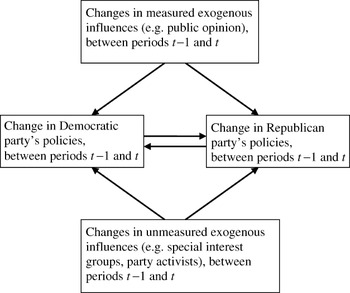
In evaluating the Party Dynamics Hypothesis (H1) and the Ideological Families Hypothesis (H2), we confront complicated problems in parsing out the reciprocal influences of parties’ policy shifts on each other; and, these problems are made worse by the fact that the parties in our study plausibly adjusted their positions in response to additional, exogenous, influences such as public opinion, social and economic conditions, and the policy preferences of party activists, some of which we cannot reliably measure. To understand why it is difficult to sort out these influences, consider the simplest possible democratic party system, one that features only two major parties, as in the United States. Figure 1 illustrates the reciprocal relationships between the policy positions of the Democratic party and those of the Republican party in a model that also incorporates exogenous influences, both those we can measure (such as public opinion) and those we cannot reliably measure (such as the policy preferences of party activists). Note that in this example we measure the changes in the variables over the period between time (t − 1) and time t. Now, suppose we observe that both political parties shifted their policies to the right between time (t − 1) and time t, and furthermore, that we cannot account for this shift based on the observed changes in our measured exogenous variables. The problem we confront is that we cannot reliably estimate the extent to which: (1) the Democrats shifted their policies in response to the Republicans’ policy shifts; (2) the Republicans shifted their policies in response to the Democrats’ policy shifts; (3) both parties exerted reciprocal influences on each other; or (4) both parties shifted their policies in response to changes in unmeasured, exogenous, influences such as shifts in the policy preferences of party activists, lobbying from special interest groups, political crises (such as the 9/11 attack on the World Trade Center), and so on. To estimate these reciprocal relationships, we would be forced to make very strong – and empirically dubious – assumptions about the causal processes in our model.Footnote 18 This is an approach we seek to avoid, since it is precisely these causal processes we are attempting to understand. It is this problem that leads Erikson, Mackuen and Stimson to lament the ‘statistical nightmare’ of causal feedback that arises in situations where the analyst attempts to parse out the reciprocal relationships between parties’ policy positions.Footnote 19 And note that our hypothetical example concerns the relatively simple American two-party system; these statistical estimation problems are far worse in the multi-party systems featured in the overwhelming majority of the countries in our study.
Hypothetical specification for the reciprocal influences of parties’ policy positions, as applied to the United States

Given the estimation problems discussed above we specify an alternative causal model. Specifically, we will estimate the extent to which political parties react, at time t, to the policy shifts of other parties in the system at the previous time period t − 1. Theoretically, our focus on parties’ responses to their opponents’ lagged policy shifts is justified by the time-consuming process of writing the party policy manifesto, which typically takes place over a two–three year period during which party-affiliated research departments and committees draft sections of this manuscript, which are then circulated for revisions and approval upward to party elites and downward to activists.Footnote 20 Given this lengthy policy-development process, it seems plausible that the programmes parties ultimately publish will to some extent engage with their competitors’ policy stances from earlier time periods, as opposed to engaging exclusively with their rivals’ current policies. At the same time, we emphasize that to the extent that parties also respond to each other during the current time period, our lagged approach will under-estimate political parties’ reciprocal influences on each other.Footnote 21 However, our specification ensures that we can parse out the causal inference problems discussed above. For if we observe, for instance, that a given party A shifted to the right during the previous election cycle and that party B shifts to the right during the current cycle, we know that any cause-and-effect relationship between these policy shifts is one where party B has responded to party A, rather than A responding to B or both parties responding to each other. And, to the extent we conclude that parties exert substantively significant policy influences on each other based on a specification that omits reciprocal policy influences during the current time period, this conclusion certainly extends to alternative models that incorporate such contemporaneous policy influences. On this basis we proceed.
Specification for the Party Dynamics Hypothesis
We specify a multivariate regression model in order to evaluate the Party Dynamics Hypothesis (H1), that political parties respond to rival parties’ policy shifts by shifting their own policies in the same direction. Because we are interested in how parties adjust their policy positions over time, our dependent variable is the change in the party’s left–right position in the current election compared to its position in the previous election, as measured by the CMP’s codings of the party’s manifestos (below we report alternative analyses where the dependent variable is the party’s position, not the change in its position). We label this variable party shift (t). The crucial independent variable captures the shift in other parties’ left–right positions at the previous election (i.e. election t − 1) compared to their positions in the election before that (i.e. election t − 2), again measured by the CMP’s codings of the parties’ manifestos. We define the variable [average shift − other parties (t − 1)] as the mean left–right shift of all political parties in the party system except for the focal party, between election t − 2 and election t − 1.Footnote 22
We also include variables that control for additional factors that plausibly influence parties’ policy shifts between elections. The first is the public opinion shift (t) variable, which we define as the change in the median voter position in the country between the year of the current election and the year of the previous election, based on the Kim–Fording median voter estimates. As discussed above, previous empirical research by Adams et al., McDonald and Budge, and Erikson, Stimson and Mackuen concludes that political parties systematically adjust their policies in response to public opinion shifts.Footnote 23 Another plausible influence on party leaders’ left–right strategies in the current election is the direction of the party’s policy shifts in the previous election, i.e. parties may account for their own previous policy shifts as well as the previous shifts of other parties. We control for this variable for both theoretical and practical reasons. Theoretically, previous work by Budge and by Adams presents arguments that party elites have electoral incentives to shift their party’s policies in the opposite direction from their shifts in previous election.Footnote 24 Practically, controlling for this variable eliminates autocorrelation which is otherwise present in the data. Thus, we include a lagged measure of a party’s policy shift, the shift from election (t − 2) to election (t − 1), which we label [policy shift (t − 1)]. Thus our initial specification, which we label the ‘Party Dynamics Model’, is:

where:
party shift (t) = the change in the focal party’s left–right position in the current election t compared with its position in the previous election t − 1.
average shift − other parties (t − 1) = the mean change in the left–right positions of all parties except for the focal party, between election t − 1 and election t − 2.
party shift (t − 1) = the change in the focal party’s left–right position between election t − 1 and election t − 2.
public opinion shift (t) = the change in the median voter position in the country between the current election t and the previous election t − 1.
If parties respond to rival parties’ policy shifts at the previous election, as the Party Dynamics Hypothesis (H1) posits, then the estimated coefficient b 2 on the [average shift − other parties (t − 1)] variable in Equation (1) should be positive and statistically significant. This would indicate that, in the current election, political parties tend to shift their policies in the same direction as the other parties in the system had shifted their policies in the previous election.
Specification for the Ideological Families Hypothesis
Our second model specification differentiates between the previous policy shifts of parties that are members of the focal party’s ideological family, and the shifts of parties from outside the focal party’s family. For these analyses we code parties as belonging to the ideological family of left-wing parties if the CMP classified the party as a member of the Ecology, Communist or Social Democratic party families; and we coded parties as belonging to the right-wing ideological family if they were classified by the CMP as belonging to the Conservative, Christian Democratic or Nationalist party families.Footnote 25 The following specification, which we label the ‘Fully-Specified Model’, is identical to the Party Dynamics Model in Equation (1) except that here we include an additional independent variable, labelled [average shift − family members (t − 1)], which captures the policy shifts of the other members of the focal party’s ideological family:

where:
average shift − family members (t − 1) = the mean change in the left–right positions of all members of the focal party’s ideological family (excluding the focal party) between election t − 1 and election t − 2.
Note that the [average shift − family members (t − 1)] variable is set to 0 if there are no other members of the focal party’s ideological family in the party system.
The Ideological Families Hypothesis (H2) is supported if the estimated coefficient b 5 on the [average shift − family members (t − 1)] variable in Equation (2) is positive and statistically significant. To see this, note that for a party that does not have another member of its ideological family in its party system – as is the case for the major American and British parties – the estimated response to other parties’ previous policy shifts is given by the coefficient b 2 on the [average shift − other parties (t − 1)] variable. By contrast, for parties that do have ideological family members in their system – such as, for instance, the French Communist and Socialist parties who are both members of the left-wing family – the estimated response to other parties’ previous policy shifts is given by the sum (b 2 + b 5) of the estimated coefficients on the [average shift − other parties (t − 1)] variable and the [average shift − family members (t − 1)] variable.Footnote 26 Thus in the context of our model, H2 predicts that (b 2 + b 5) > b 2, or in other words that b 5 > 0. Thus if our estimate of b 5 is positive and statistically significant this will indicate that, in the current election, political parties tend to be more responsive to the previous policy shifts of members of their ideological family, compared to the previous policy shifts of the other parties in the system.
Evaluating the party dynamics and the ideological families hypotheses
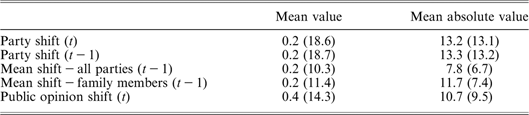
Our analysis encompassed 1,469 policy shifts by political parties in the twenty-five democratic party systems that are included in the CD-ROM that accompanies Budge et al.’s Mapping Policy Preferences, over the time period beginning with the first post-war election in each country and ending in 1998 (the last year for which the CMP data are available). The complete set of parties included in the analyses, along with their party family codings, is reported in the Appendix. Table 1 reports descriptive statistics of the variables used in the analyses. Note that pooling our data across countries entails the assumptions that the data are comparable cross-nationally and that the same causal processes operate in each country. The sensitivity analyses we report below support these assumptions.
Descriptive Statistics: Dependent and Independent Variables
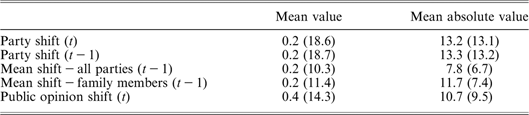
Notes: The numbers in parentheses are the standard deviations of the reported values. All of the variables are calibrated along a 200-point scale running from −100 (extreme left) to +100 (extreme right).
Our data analyses encompassed every party listed in the CMP dataset whose policy programme was coded in at least three consecutive elections.Footnote 27 In all, these analyses encompassed 305 elections involving 193 parties, each observed over an average of eight elections, and should thus be regarded as time-series cross-sectional data. Estimating a simple regression on the pooled data can lead to erroneous conclusions if there are unobserved differences between parties;Footnote 28 fortunately, tests for party-specific effects indicate that this is not a concern for the model we estimate. However, there are other methodological concerns to address. The ‘policy alternation’ findings that emerge from the work of Budge and Adams suggest that serially correlated errors may be a problem.Footnote 29 The lagged dependent variable included in our specification helps to address this concern,Footnote 30 and a Lagrange multiplier test fails to reject the null hypothesis of no serial correlation. Another concern is that there may be unobserved election-specific factors that influence all parties’ policy shifts in a particular election, leading to correlated errors among the parties competing in a particular election. We address this concern through the use of robust standard errors clustered by election.Footnote 31
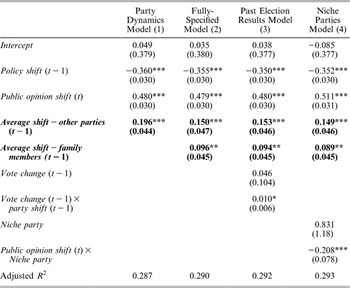
Table 2 reports the parameter estimates for our Party Dynamics Model (column 1) and for the Fully-Specified Model (column 2). Note that for both models, the coefficient estimate on the [average shift − other parties (t − 1)] variable is positive and statistically significant (p < 0.01, two-tailed test). These estimates provide strong evidence that political parties shift their policies in the current election in the same direction that other parties shifted their policies in the previous election, a result that supports the Party Dynamics Hypothesis. Furthermore, for the Fully-Specified Model the estimated coefficient for the [average shift − family members (t − 1)] variable is also positive and statistically significant (p < 0.05, two-tailed test), indicating that political parties tend to be more responsive to previous policy shifts by members of their ideological families than they are to the previous shifts of the other parties in the system. This estimate thereby supports the Ideological Families Hypothesis. We also find, as expected, that political parties appear highly responsive to public opinion shifts and that they tend to shift their policy positions in the opposite direction from their own policy shifts in the preceding election cycle, conclusions that are in line with the findings reported by Budge and by Adams et al.Footnote 32
Substantively, the parameter 0.196 on the [average shift − other parties (t − 1)] variable, as estimated for the Party Dynamics Model (column 1) implies that, ceterus paribus, political parties shift their policy positions by approximately 0.2 units along the CMP’s left–right scale in response to a one-unit shift in the mean position of the other parties in the system during the previous election cycle. The estimates for the fully-specified model break down parties’ reactions to policy shifts by different types of parties: Here the parameter estimate 0.15 on the [average shift − other parties (t − 1)] variable implies that parties shift their policy positions by approximately 0.15 units along the left–right scale in response to a one-unit shift in the mean position of the other parties in the system – including parties both within and without the focal party’s ideological family; and the estimate 0.096 on the [average shift − family members (t − 1)] variable implies that parties shift their policy positions by an additional 0.096 units along the left–right scale in response to a one unit shift in the mean position of the members of the focal party’s ideological family. Thus parties appear substantially more responsive to ideological family members’ policy shifts than they do to the policy shifts of the other parties in the system.
Sensitivity Analyses
We performed several tests in order to evaluate the cross-national comparability of our data and model and to consider alternative explanations for our findings.Footnote 33 First, we address the possibility that the reliability of the CMP’s left–right coding procedures may vary across countries. Pelizzo, for instance, argues that the CMP’s coding procedures do not accurately measure shifts in the Italian parties’ left–right positions.Footnote 34 If our results in Table 1 are driven by measurement errors from a single country, omission of this country’s data from our analysis should alter our substantive conclusions. Thus, we re-estimated the parameters of the Fully-Specified Model omitting one country at a time from the pooled data, i.e. we estimated twenty-five sets of parameters in all. These estimates continue to support our substantive conclusions, and convince us that our results are not driven by measurement error or other factors specific to a single country.Footnote 35
Secondly, we note that specifying our dependent variable as the difference in a party’s policy position between the previous and the current election assumes that the coefficient on a lagged dependent variable in a model using the party’s position in the current election as the dependent variable would be equal to 1. Re-estimating our model using actual party positions (rather than changes in parties’ positions) as the dependent variable, and including a lagged dependent variable as an independent variable, supported substantive conclusions identical to those using our original dependent variable.
Thirdly, we re-estimated our models while incorporating additional independent variables relating to the global economy and the voting system,Footnote 36 and we also re-estimated our models on the sub-set of cases for which an alternative, survey-based measure of public opinion was available: namely Eurobarometer respondents’ left–right self-placements. These analyses continued to support our substantive conclusions.
Fourthly, in order to address the concern that the policy spaces in the party systems in our study may be multi-dimensional – a possibility that is not addressed in our empirical analyses of party shifts along the uni-dimensional left–right continuum – we re-estimated our models on a sub-set of parties that plausibly compete primarily along the classic left–right economic continuum.Footnote 37 Again, these analyses supported our substantive conclusions.
Fifthly, we conducted sensitivity analyses that controlled for additional independent variables related to rival parties’ current policy shifts. These analyses continued to support our substantive conclusions on how parties respond to their competitors’ previous shifts.
Finally, columns 3–4 of Table 2 report parameters for alternative specifications that featured additional control variables, which are of particular interest because they relate to previous research on parties’ policy shifts. Column 3 reports results for a model that is identical to the Fully-Specified Model except that we control for parties’ reactions to past election results. Previous work by Budge concludes that some parties shift their policy positions in the same direction as their previous policy shift if they gained votes in the previous election, and in the opposite direction if they lost votes in the previous election.Footnote 38 Therefore, we include a measure of a party’s vote gain (or loss) at the previous election – specifically the difference between the party’s vote at the previous election and its vote at the election before that – which we label vote change (t − 1), and we interact this variable with the variable policy shift (t − 1). The resulting variable [policy shift (t − 1) × vote change (t − 1)], is constructed so that a positive coefficient estimate implies that parties respond to past election results by shifting their policies is the same direction as the last time provided they gained votes in the previous election, and in the opposite direction if their vote shares declined. We also include the variable [vote change (t − 1)] by itself, in order to capture effects of past election results that are independent of the parties’ previous policy shifts. Column 3 reports results for this specification, which we label the Past Election Results Model. Consistent with Budge’s arguments, the coefficient estimate on the [policy shift (t − 1) × vote change (t − 1)] variable is positive and statistically significant, which supports the hypothesis that parties did indeed adjust their policies in response to the vote gains (or losses) associated with their policy strategies in the last election. However, inclusion of this variable does not alter our central substantive conclusions: the parameter estimates continue to support the Party Dynamics Hypothesis and the Ideological Families Hypothesis.
Statistical Analyses of Parties’ Ideological Shifts

Notes: For these analyses the dependent variable was the party’s ideological shift between the previous election and the current election, based on the CMP codings of the parties’ left–right positions. See the text for definitions of the independent variables. The specifications used to estimate the parameters of the Party Dynamics Model and the Fully-Specified Model are given by Equations (1) and (2) in the text, respectively. N = 1,469. ***p ≤ 0.01; **p ≤ 0.05; *p ≤ 0.10, two-tailed tests.
Finally, we estimated the parameters for a model that was identical to the Fully-Specified Model except that we controlled for the possibility that ‘niche’ parties – such as Green, Communist and nationalist parties – respond differently to public opinion than do other types of parties. Adams et al. report empirical analyses that suggest that niche parties are much less responsive to public opinion shifts than are mainstream parties, an effect we control for by constructing a niche party dummy variable – equal to 1 if the CMP classified the party as belonging to the Ecological, Communist and Nationalist party families, and 0 otherwise – that we interact with the [public opinion shift (t)] variable.Footnote 39 To the extent that this new variable [public opinion shift (t) × niche party] has a negative and statistically significant coefficient, this will indicate that niche parties display weaker tendencies to shift their policies in the direction that public opinion has shifted, compared to other types of parties. We also include the niche party dummy variable by itself, to capture niche party tendencies that are independent of public opinion. Column 4 of Table 2 reports results for this ‘Niche Parties Model’. Consistent with the conclusion of Adams et al., we find strong evidence that niche parties are less responsive to public opinion shifts than are other types of parties.Footnote 40 Most important for our purposes, the parameter estimates for the Niche Parties Model continue to support the Party Dynamics Hypothesis and the Ideological Families Hypothesis.
Connections to previous research
Although we believe that our cross-national findings on parties’ reciprocal policy influences are new, we note that there are two, related, strands of theoretical research that anticipate key features of our results. With respect to our Ideological Families Hypothesis, Budge develops arguments that imply this dynamic. Specifically, Budge argues that in an uncertain political environment – one where politicians are unsure about the distribution of public opinion, about voters’ decision rules, and about the possible entry/exit of other members of the party system – party elites have incentives to calibrate their party’s policies against those of ‘marker’ parties, which share the focal party’s ideological orientations:
Parties could be concerned not so much about the absolute position or direction they take, as where they move relative to some other party(ies). This could be particularly relevant where two parties have been competing for leadership of a particular ideological tendence … At any rate the criterion of always choosing positions so that they could not possibly be confounded with those of a ‘marker’ party or parties seems also to be one that a party could pursue under uncertainty, and which fits well with strongly ideological motivations.Footnote 41
We view our Ideological Families Hypothesis (H2) as being in the same spirit as Budge’s ‘marker party’ model. For, to the extent that parties calibrate their policy positions against those of the parties that share their ideological tendencies, they will be especially responsive to these ‘ideological family’ members’ policy shifts – exactly what H2 posits. And, if Budge is correct that party elites seek positions that cannot be confounded with those of a ‘marker’ party, then the most reasonable strategy is to shift one’s positions in the same direction as the marker party has shifted its policies – thereby maintaining a consistent policy distance relative to this marker party. Again, this is precisely in line with our Ideological Families Hypothesis, and also with our empirical findings.
Our findings are also relevant to innovative recent research by Laver, Fowler, Kollman and others, who report dynamic agent-based analyses of spatial party competition in a political environment where parties are unsure about voters’ policy preferences (except for the preferences of their supporters).Footnote 42 Laver analyses how parties’ policy behaviour varies with the types of adaptive decision rules they employ, and one of these postulated decision rules, labelled ‘Aggregator’, implies our ideological families result. The Aggregator decision rule stipulates that parties present positions that reflect the mean policy preferences of their supporters, so that when a party’s electoral constituency becomes more right-wing (left-wing) in ideological orientation, then the party correspondingly shifts its policies to the right (left).Footnote 43 To understand how the aggregating decision rule motivates the ideological families dynamic we have uncovered, consider the situation where the left-most party in the party system, labelled Party A, shifts rightward along the left–right continuum, thereby converging towards the position of an adjacent, centre-left party, labelled Party B. In this case Party B should lose marginal support among the voters located between A and B on the left–right scale, who will defect to Party A. But since these voters were the most left-wing elements among B’s electoral constituency, their defection to Party A will shift the mean position of B’s remaining supporters to the right – in the same direction that Party A has shifted. By contrast, if A shifts farther to the left, then B will pick up additional supporters on its left flank. Thus when two ‘aggregating’ parties are adjacent to each other in the policy space, we can expect a reciprocal policy dynamic in which these parties shift their positions in the same direction – precisely in our line with our ideological families finding.
Finally, our party dynamics result is relevant to several interesting recent studies utilizing the CMP data to analyse the diversity of policy programmes on offer in party systems. Both Ezrow and Abney et al. conclude that the degree of ideological diversity displayed in post-war party systems has been surprisingly stable over time – specifically, that the variety of party ideologies on offer in most post-war systems (whether measured as the ideological range between the most extreme parties’ positions, or by the variance of the ideologies of all parties in the system) has not varied a great deal during the post-war period.Footnote 44 Our party dynamics result plausibly illuminates this empirical pattern, because it implies that if, for instance, the right-wing parties in a party system shift farther rightward during the current election cycle – thereby temporarily expanding the range of ideological choices presented to the electorate – then, at the next election, the centrist and left-wing parties in the system will respond by shifting their own positions to the right, which narrows the range of ideological choices in the party system. In this way, the party dynamics we uncover constitute an ‘equilibrating’ dynamic, one that helps ensure that the diversity of policy programmes on offer in the party system fluctuate around some baseline or equilibrium value.
Conclusion
We have reported a time-series, cross-sectional analysis of data from twenty-five post-war democracies, in an effort to estimate the degree to which political parties adjust their policy positions in response to other parties’ policy shifts. Basing our computations on the Comparative Manifesto Project codings of party ideologies, we find results that consistently support both the Party Dynamics Hypothesis, that political parties respond to rival parties’ policy shifts by shifting their own policies in the same direction, and the Ideological Families Hypothesis, that parties are more responsive to policy shifts by other members of their ideological family than to the policy shifts of other parties in the system. These findings are striking given that our empirical specifications estimate the degree to which political parties, in the current election, shift their policies in response to rival parties’ shifts at the previous election. To the extent that parties also react to rival parties’ current policy behaviour, our approach – which we employ in order to avoid causal inference problems arising in analyses of parties’ contemporaneous reciprocal policy influences – understates the degree to which political parties actually influence each other.
From a theoretical standpoint, our empirical findings in support of the Party Dynamics Hypothesis are relevant to spatial models of party competition, which typically posit that party elites craft their policy strategies in response to the policies of the other parties in the system – an assumption that underlies Nash equilibrium analyses of parties’ policy strategies. To date, however, we are unaware of cross-national studies that address the question of whether real world political parties in fact systematically adjust their policy positions in response to rival parties’ policy strategies. That is the issue we address here, and our party dynamics and ideological parties’ findings suggests that the answer to this question is ‘Yes’ – an answer that supports the central assumption used in spatial models of party competition.
Our findings raise several questions that we hope to address in future research. First, it would be interesting to analyse how our conclusions on parties’ overall left–right orientations play out in specific issue areas, such as social welfare policy, European integration, globalization and environmental policy.Footnote 45 Secondly, we hope to explore how parties adjust their ideologies in response to an alternative type of party behaviour that we have not considered here: namely, the entry of new parties into the party system and/or the exit of old parties.46 Thirdly, as discussed above we hope to parse out parties’ reciprocal policy influences during the current time period. It is possible that when we eventually derive reliable estimates of such contemporaneous policy influences, we will conclude that the magnitudes of these reciprocal policy effects equal or exceed the estimated effects that we report here, which calibrate parties’ reactions to other parties’ behaviour during the preceding election cycle. However, this is a topic for future research. In any event, we have shown that the effects of parties’ previous policy shifts we have uncovered – even if they understate the extent of parties’ actual reciprocal policy influences – nevertheless have important implications for spatial models of elections and for political representation. Finally, we emphasize that while we have presented evidence on how political parties adjust their ideologies in response to other parties’ ideological shifts, we have proposed only tentative explanations for our findings. In particular, at different points in this paper we have invoked alternative party motivations, including vote-seeking motivations, policy-seeking objectives, party elites’ concern with the policies of ‘marker’ parties, and elites’ desires faithfully to ‘aggregate’ the views of their electoral constituencies, as goals that can motivate the Party Dynamics and the Ideological Families hypotheses. In one sense this approach is an asset, for it highlights the fact that a wide range of party decision rules plausibly motivate similar policy strategies.47 However, we believe it would be an extremely interesting – and challenging – project to parse out precisely which motivation or combination of motivations actually drives the party elites in our study to pursue the policy strategies we have observed. We suspect that a satisfactory explanation for our findings may require ‘thick’ descriptions of parties’ organizational structures, and of the decision-making processes of party elites and of rank-and-file supporters. Such analyses lie outside the scope of the kinds of statistical analyses that we report here.
Nonetheless, we feel that our findings illuminate the reciprocal linkages between parties’ policy programmes. For while the question of why the political parties in our study reacted to each other remains open, we feel we have gone some ways towards answering the question of whether political parties respond to each others’ policies. We have shown that, in a wide range of post-war democracies, political parties systematically adjust their policy positions in response to the behaviour of the other parties in the system.
Appendix: Parties included in the empirical analyses

Notes: The initials in parentheses indicate the ‘party families’ to which parties belong – ECO = Ecology; COM = Communist; SOC = Social Democratic; LIB = Liberal; CHR = Christian Democratic; CON = Conservative; NAT = Nationalist; AGR = Agrarian; ETH = Ethnic and Regional; SIN = Special Interest. Party family designations are taken from the Comparative Manifesto Project, where the third digit of the party identification code represents a party’s family. We note that for the purposes of our empirical analyses, the parties that the CMP classified as members of the Communist, Social Democratic and Ecology families were classified as left-wing parties, while parties the CMP classified as belonging to the Conservative, Christian Democratic and Nationalist families were classified as right-wing parties.