Machaut's double balade, Quant Theseus/Ne quier (B34) is unique in his output both generically and in being the only known musical setting by Machaut of a poem by someone else. The identity of the ‘Thomas Paien’ to whom one of the upper-voice texts of this balade is ascribed in Machaut's Voir dit has occasioned much speculation. The present article reviews earlier proposals and collates new sources to argue that this Thomas can be identified with a figure who was, like Machaut, a canon of Reims and a court secretary. In the process it will be necessary to exclude other figures with similar names whose presence in the documentary evidence has confused earlier attempts at identification. Evidence not formerly considered now offers several roles, functions and relationships with historical individuals that are shared between the biographies of Machaut and Thomas, potentially offering them meeting points. Ultimately I propose an occasion for the composition of B34's texts, an occasion that fits their exemplification of homosocial poetic exchange, supporting recent analyses of so-called courtly love lyrics ostensibly directed at ladies as a pretext for male–male poetic competition. First of all, however, I offer a brief resumé of the traces of Thomas Paien in Machaut's poem, Voir dit.
Quant Theseus/Ne quier (B34) in the Voir dit
Quant Theseus/Ne quier (B34) is one of the few works of fourteenth-century music for which the composer's own discussion of its composition survives, albeit in a fictional context.Footnote 1 The composition of B34 occurs near the beginning of the second part of Machaut's long verisimilitudinous poem, Le livre dou Voir dit (The Book of the True Story). The first part of this poem – written mainly in Machaut's standard narrative verse format of octosyllabic rhyming couplets, but including prose letters and lyrics in the so-called formes fixes – is action-packed. At the outset of the story the protagonist (an aging poet called Guillaume) is revived from sickness by the letter of a young girl, whom he calls only Toute Belle. He undertakes to give her an epistolary education in poetry, which evolves into a love dialogue, and ends up with the two of them meeting naked in bed while they are supposedly on pilgrimage.
Guillaume first sees his beloved after just over 2,000 lines and last takes his leave of her only a couple of thousand lines later. Ten letters are exchanged before they meet and eight in the period of their three meetings. The entire poem is over 9,000 lines long, with forty-six letters, which means that just over half the lines and nearly two-thirds of the letters take place at a point when they will never meet again.Footnote 2 The narrative of the larger second part involves no further personal contact and becomes more densely filled with classical exempla and Guillaume's clerkly interpretations of them as pertaining to the situation between him and Toute Belle. Plans for further meetings continue, however, and it is the delaying of these that sparks Guillaume's most serious doubts about his lady's fidelity, culminating in his letter 31, the letter that initiates the sequence surrounding the composition of B34. Letter 31 and subsequent letters, together with other passages relevant to the current discussion, are summarised and excerpted in the Appendix on pages 109–112.
In letter 31 Guillaume recounts a dream in which the image of Toute Belle that she had sent him much earlier in the poem dresses in green and turns its head away from him.Footnote 3 Meanwhile, Toute Belle's brother (identified as ‘T.’) has arrived and is staying in Guillaume's house; Guillaume plans to send Toute Belle's book (that is, the Voir dit itself, at least as much as he has written up to this point in the narrative) with her brother's confessor, and also mentions having composed a rondeau encoding her name (Dix et sept (R17)). Meanwhile, Guillaume returns ‘the things of hers’ that he has used in writing her book, together with an older rondeau, now with new tenor and contratenor parts.Footnote 4
In letter 32, her reply to Guillaume's letter 31, dated 5 May (the year is, implicitly, 1363), Toute Belle recounts how she found in the packet from Guillaume a sealed letter that should have gone to him, which she is now returning. It is ‘a balade that you'd been sent’. This balade, as it will turn out, is that of T. Paien. Two letters follow that make no reference to this poem, but in his reply dated 17 October (letter 35) Guillaume not only repeats his promise (made on 9 October in letter 33) to send the Voir dit itself soon, but says that he is sending the balade by T. Paien and a ‘response’ that he has done for it, modelled on the same rhymes and versification. He stresses that because Paien went first, he had the advantage and ‘took all the fat from the pot’; Guillaume, however, plans to write music for both poems.
The texts of the double balade are not immediately interpolated. First follows Toute Belle's reply (letter 36, 28 October), in which she says that she has had a good look at what he wrote to her about Thomas, now using only the other poet's first name, even though this hasn't yet been given to the reader.Footnote 5 She promises to tell Guillaume her thoughts about it either when God pleases that she should see him again, or using as an intermediary, Guillaume's friend Henri (to whom Guillaume has sent a letter via her, which she cannot deliver because she does not currently know where Henri is).
A narrative passage follows, which initiates the promised ‘subtives fictions dont ie le pense a parfaire’ (subtle fictions with which I think to perfect it [the Voir dit])Footnote 6 with a string of summaries of the plights of lovers including Pyramus and Thisbé, Leander and Hero, Lancelot and Guinevere, the son of Peter Toussac and his sweet lady, Paris and Helen, and the chatelaine de Vergy.Footnote 7 The section ends with a general discussion of metamorphosis, which parallels that which the poem itself is undergoing at this point. Guillaume's reflection on these exemplars leaves him miserable, since they offer no proof that he might see his lady again. This desire to see her – felt acutely early in the poem before the lovers meet, expressed in the interpolated musical balade Nes com porroit (B33) and its long epistolary genesis, and partly assuaged by the gift of Toute Belle's image Footnote 8 – is expressed repeatedly in the absence that follows their meetings, and amply by the shared refrain of the two balades that comprise B34, which considers the sight of the lady more sufficient than a hyperbolical list of classical wonders.Footnote 9
Guillaume's narrative reiterates a point made in letter 35, noting again that T. took all the fat from the pot, explaining that this gave him the advantage of being able to make his soup better. By pointing out the other poet's advantage, Guillaume stresses his own poetic prowess in deploying the same rhymes and metres as the other poet, but he additionally emphasises his musical prowess in making the pair of poems into ‘les chans a .iiij.’ (melodies in four parts). It is at this point that both texts of the balade are presented in full. The manuscript copies introduce the first poem, Quant Theseus, with Balade . et ya chant / . Thomas, or Balade . Thomas, confirming that Thomas is indeed Paien's full first name, as was implied in Toute Belle's letter 36.Footnote 10 The second poem, Ne quier, is preceded by the rubric Response . G . de Machau, or Response par guill∼e de Machaut, which similarly notes the name of the narrator, usually called ‘lamant’ (the lover) in rubrics, and gives him his full toponym.Footnote 11
In his next letter, number 37 (3 November), Guillaume regrets that Toute Belle has not said anything about his book or judged the two balades, reiterating (for the third time!) that the other poet went first in writing his balade. Guillaume tells her what the audience already knows from the earlier narrative section: that he has had both balade texts put into writing and has set them to music in four parts. He comments further that he has heard these many times and they please him well. He asks her to learn them because he has written them for her. On 5 November (letter 38) Toute Belle replies that she has read his book twice and has ideas for its improvement that she will communicate with him when they next meet; the balades, however, were so good that no improvement could be imagined. What Guillaume makes, says Toute Belle, pleases her more than that which others do, and she is sure that others think the same.
Guillaume's constant restatement of how the pair of balade poems came about – stressing the priority of Thomas's text and thus the difficulty of his own task – together with his proud setting of them both in four voices and his repeated calls for Toute Belle's judgement (which is eventually given), all draw attention to the importance of this exercise and its status as a song competition. But who is the Thomas Paien with whom Guillaume is competing?
Thomas Paien, canon at Reims
The earliest editor of the Voir dit mistakenly called Guillaume's competitor–poet Thibaut Paien, despite the clear rubrication of the manuscripts.Footnote 12 The earliest and best editor of Machaut's musical work has a brief footnote identifying him as a famous Breton jurist at the Sorbonne from the third quarter of the fourteenth century, but without any indication of how Machaut might have been linked to such a man.Footnote 13 In a publication from the 1980s, by contrast, Jacqueline Cerquiglini glosses parenthetically that Thomas Paien is ‘perhaps Eustache Deschamps’, although she gives no reason for this tentative attribution.Footnote 14 I have to admit to having formerly doubted that Thomas Paien was a real person at all – his poem is full of pagan references and Thomas is a biblical twin, so I imagined Machaut was simply joking. In this I was dismissing James I. Wimsatt's observation that the two poems exhibit palpable stylistic differences, although he undercuts his own argument by wrongly ascribing the poems, giving Quant Theseus to Machaut and Ne quier to Thomas.Footnote 15 He then comments that Ne quier exhibits list-like anaphora and short phrases that are seldom found in Machaut's lyric works. However, it is Ne quier that is the Response . G . de Machau, so this analysis disproves the very point Wimsatt is trying to make (and, although uncommon in Machaut's lyrics, the use of anaphora in lists can readily be found in his narrative works).Footnote 16 Nevertheless, stylistic differences may still be present, and the identification of Thomas Paien with a real historical personage lends weight to Wimsatt's basic assertion.
It is tempting to seek for the identity of Thomas Paien among the denizens of the spheres of influence and employment that Machaut is known to have inhabited. However, not much is known about Machaut's employment history or his residential whereabouts (far less than is commonly thought, in fact).Footnote 17 But we do know about some of his benefices. Machaut held a canonry at Reims for nearly the last four decades of his life. He was collated (by proxy) to prebend no. 40 at Our Lady of Reims on 28 January 1338, having held the canonry in expectation since 1333.Footnote 18 He occupied this dignity until his death in 1377, although he is only known to have been resident in Reims for the single chapter year that started in August 1351, and in 1372, when he is listed as residing in a canonial house outside the cloister.Footnote 19 However, if the Voir dit is as verisimilitudinous as it seems, it is likely that he had lived there in semi-retirement from around 1360, often lodging royalty, noblemen, and their entourages with whom his former employment had made him familiar.Footnote 20
The Chapter of Reims cathedral, therefore, provides one possible meeting point for Machaut and Thomas, since Pierre Desportes lists one ‘Thomas Pagani (Payen)’ as no. 287 in his 1998 prosopography of medieval Reims, cross-referring this entry to a man of the same name in the series volume on Rouen, edited in the same year by Vincent Tabbagh.Footnote 21 On 5 March 1359, this Thomas Paien, a deacon, was received into the Chapter of Our Lady of Reims, collated to a canonry and (unlike Machaut, simultaneously) to a prebend (no. 22).Footnote 22 He disappears from the records in this capacity after 3 February 1364. (Desportes lists additional information for this person after this date, but for reasons given below, I do not think it pertains to the holder of the canonry between 1359 and 1364.) This Thomas Paien, occupier of prebend no. 22, was thus Machaut's contemporary and colleague in the period of, and immediately before, the time in which the Voir dit takes place. It seems highly likely, therefore, that this man was the poet who authored Quant Theseus. To argue this more fully, it is necessary in what follows to link him to, and differentiate him from, other men of the same name.
Thomas Paien, ducal secretary
The published historical record provides a few other traces of someone who can clearly be identified with the Thomas Paien who held canon prebend no. 22 from 1359 to 1364 (hereafter ‘Thomas A’), in a role that links him further with Guillaume de Machaut. Papal supplications made on behalf of a Thomas Paien survive from John, Duke of Berry, a known patron of Machaut.Footnote 23 In the first of these, addressed in French to the Roman Curia on 26 August 1361, the beneficiary is referred to as ‘our beloved secretary, Master Thomas Paien’ and seems destined for a benefice at Rouen.Footnote 24 A Latin petition appended to this letter asks that he also receive a canon prebend at Thérouanne, vacated by the death of Gilles Vaguel, notwithstanding any other benefices that might be issued to him.Footnote 25
Neither of these texts offers a link to the canon at Reims, but a third petition by John and his wife Joanna links this same ducal secretary Thomas firmly to the canon of Reims. On 28 December 1362 the Duke and Duchess petitioned the subsequent pope, Urban V, on behalf of Thomas, who is called a favourite and secretary of the Duke.Footnote 26 This document refers again to the benefice at Thérouanne and to one at Senlis also granted in expectation under the previous pope but not realised.Footnote 27 John and Joanna ask that Thomas be granted instead a canonry in expectation at Cambrai; a grant of one at the church of the Holy Cross is duly recorded.Footnote 28 The ‘non obstante’ clause, in which petitioners generally asked for exceptions to be made to the rules against excessive accumulation of benefices, lists a number of other benefices already held by Thomas. Significantly, the list is headed by the mention of a canonry and prebend in the cathedral church of Reims, thereby proving that the Duke of Berry's secretary is the same Thomas Paien who held prebend no. 22 at Reims between 1359 and 1364.Footnote 29 The man who was Machaut's fellow canon was thus also in the same line of business that Machaut himself had pursued in his most recently attested job – a court secretary. Of Thomas A, nothing more is known at present, although given the link with Machaut via both Reims and John, Duke of Berry, a hypothetical situation for the composition of poems set as Machaut's Balade 34 will be advanced at the end of the present article. For now, it is necessary to document other individuals of the same name who must be distinguished from Thomas A if the confusion surrounding his identity is to be cleared up decisively.
A later canon at Reims
Desportes includes under his listing for person no. 263 (that is, as if they pertained to the same individual) details of a Thomas Paien who was collated to a canonry and prebend no. 28 at Reims Cathedral on 15 April 1373. However, by connecting disparate aspects of the documentary record it can be shown decisively that this Thomas (hereafter Thomas B) cannot be the same person. Desportes's entry thus conflates Thomas A and Thomas B.
As mentioned above, Desportes cross-refers his entry to a man of the same name who was collated as a canon at Rouen Cathedral on 24 January 1369. It seems likely that the part of Desportes's entry that pertains to my Thomas B can be thus linked, since the death dates in both cases are similar: the listing for him at Rouen notes that their canon Thomas Paien died in December 1374 and at Reims he is absent from records after 17 December 1374.Footnote 30 The published prosopography for Reims assumes that the holder of both canon prebends at Reims (no. 22, between 1359 and 1364, and no. 28 from 1373 to 1374) is one man. However, Thomas A is a deacon at Reims in 1359, whereas Thomas B is only a subdeacon at Rouen in 1369. The extreme implausibility of regression from a higher order to a lower one makes it clear that the Reims canon prebend no. 22 and the canon at Rouen are not the same man. As, on the basis of their shared death date, Reims canon no. 28 and the canon at Rouen are the same man, this forces the conclusion that the Reims canon-prebends no. 22 and Reims no. 28 were held by two separate individuals of the same name, falsely conflated in Desportes's list.
Further evidence for the career of Thomas B confirms that he could not be the same person as Thomas A. Although this evidence has to be inferred, it is possible to do so with conviction given the post that Thomas B occupied at Reims and the fact that he was collated simultaneously to his canonry and his prebend. Most canons of Reims (including Machaut and his brother) were appointed to a nominal canonry in expectation of a prebend becoming available. They typically waited years. Thomas B, however, like his earlier namesake, stepped straight into a prebend, thereby receiving both a seat on the Chapter and the right to prebendal and other income. An indication of why this might have been the case – an index of Thomas B's importance and influence – can be gleaned from the fact that when Thomas B assumed his canon prebend he was already occupying the highly prestigious office of ‘vidame’ (a French contraction of the Latin ‘vice-dominus’), the principal lieutenant and deputy of the archbishop of Reims in the diocese.Footnote 31 As vidame, Thomas B would have had his office headquarters and residence in the Archbishop's palace, immediately adjacent to the cathedral. He resigned on 19 October 1374 and is absent from records after 17 December 1374, by which time he must have died (see above).
The office of vidame required very specific qualifications and experience, including a superior qualification in canon law, experience in its application, and knowledge of ecclesiastical administration. Despite its seeming proliferation here, the name ‘Thomas Paien’ is not common, which means that a single candidate for Thomas B can be advanced. Records of benefices for this individual are given in the entries for the conflated Thomas AB in the prosopographies of Rouen and Reims. And Friedrich Ludwig's complete edition of Machaut's musical works effectively puts Thomas B forward as the candidate for Machaut's Paien in the notes to Quant Theseus/Ne quier (B34), pointing to the presence of a man of this name in the published Charters of the University of Paris.Footnote 32 Although Ludwig was probably wrong to imagine that the author of Quant Theseus was this jurist, one of the documents to which he refers points to a man who is readily identifiable as Thomas B.
A text, published in the third volume of Chartularium universitatis parisiensis, documents a legal case between the decretalists of Paris and magister Amelius de Brolio (Aymé Dubrueil), which dates from 1386. One ‘Thomas Payan’ is cited twice in similar lists of ‘the most worthy men’ who in ‘times gone by’ read the morning lecture when they were bachelors and not when they proceeded to the doctorate (the qualification necessary for the reading of the morning lecture is the point at issue in the case).Footnote 33 The implication from the listing of Thomas's name is that he is now deceased, but still remembered well enough to provide a point of reference with legal and historical force. This Thomas Payan must therefore have been, within living memory, an eminent canon lawyer at Paris, who had proceeded to the degree of Doctor of Laws, and had remained so prominent in his field that his fame endured after his death.
It thus seems reasonable to identify this Thomas Payan with the vidame of Reims and canon of Rouen (that is, with Thomas B), who must have been a prominent lawyer to occupy such a post and who died in 1374. And given that the Rouen canonry petition gives his surname in the spelling of its Breton form (‘Pagani’), it seems also reasonable to identify him with the Thomas Pagani who is cited as doctor in utroque jure and lecturer in law at the University of Paris in a number of papal letters pertaining to further benefices.Footnote 34 In particular, a document of 24 January 1369 (italics mine) conferred upon
Thomas Pagani, doctor in both laws, who in the University of Paris read the morning lecture in canon law, on the recommendation of Guillermus [de la Jugié], cardinal-priest of San Clemente, whose officer and lieutenant in the district of Rouen he is, a canonry and a prebend of the [cathedral] church of Rouen, [both] vacant by the death, without the Roman Curia, of Hugo de Castenea, chaplain of the Holy See, notwithstanding that he holds [the rectory of] the parish church of Nort, in the diocese of Nantes, and – on the authority of letters apostolic – a canonry with expectation of a prebend in the [cathedral] church of Angers, and [notwithstanding] the fruitless letter apostolic by which he holds a canonry in the [cathedral] church of Nantes, and expects a prebend.Footnote 35
It seems likely that Thomas Payan, cited in 1386 as one who had read the morning lecture in law at the University of Paris, is the same man as this Thomas Pagani, who in 1369 is also listed as having ‘read the morning lecture in canon law’ there, but has now proceeded to the doctorate of both laws. And it has already been argued that because both this canon of Rouen and the canon of Reims with the same name died in December 1374, they are also the same. Therefore, in this plausibly reconstructed career, Thomas Pagani/Payan/Paien (my Thomas B) progressed from being a memorable lecturer in law at Paris, to being the district deputy for a high-ranking cleric and renowned jurisconsult Guillaume de le Jugié in Rouen, to then fulfilling a similar role for the Archbishop of Reims.Footnote 36
Various other instances of patronage may now be associated with Thomas B, the earliest of which by sheer chance adds a further proof that Thomas B and Thomas A are distinct. On 28 December 1362 there was conferred upon Thomas Pagani (that is, Thomas B), ‘canon of Nantes, licentiate in both laws and a lecturer in decretals at [the University of] Paris, a canonry of the [cathedral] church of Nantes, with reservation of a prebend, notwithstanding that he was known to hold [the rectory of] the parish church of Nort, in the diocese of Nantes’.Footnote 37 This prebend was duly conferred on 22 November 1368 and the canonry and prebend were resigned by 25 June 1370.Footnote 38 The date of the original petition, 28 December 1362, is also the exact day that another document records Thomas A as being the secretary of the Duke of Berry. The serendipitous coincidence of the dates makes it impossible that Thomas A and Thomas B are the same man, since one is secretary to the Duke of Berry while the other is lecturer in decretals at the University of Paris, jobs which could not realistically be discharged simultaneously by the same man.Footnote 39
Other Thomas Paiens
One other candidate who has been advanced as Machaut's Thomas Paien can also be differentiated from both Thomas A and Thomas B. In their edition of the Voir dit, Daniel Leech-Wilkinson and R. Barton Palmer report Ludwig's proposal that Paien is a teacher of law at the Sorbonne in the third quarter of the century (my Thomas B) and then add that:
since it is a relatively unusual name he may also be the Thomas Paien referred to in an order of Pope Urban V, dated 24 February 1364. That Paien enjoyed benefices from the Benedictine monastery of St Stephen at Fontenailles, north of Bayeux, and died on 30 December 1363.Footnote 40
Given that the jurist and later canon of Reims (Thomas B) died in December 1374 and the ducal secretary and earlier canon of Reims (Thomas A) is still alive and attested up to 3 February 1364, the Leech-Wilkinson and Palmer Thomas is clearly neither man, but a third figure about whom nothing else is known (Thomas X).
One further candidate can also be excluded, despite scholars' attempts to link him to Thomas B. In their notes to the 1386 reference to Thomas B's reading of the morning lecture at Paris, the editors of the Chartularium cross-refer the reader to one ‘Thomas Paganni’ in document no. 703 of the preceding volume (covering the earlier years 1286–1350).Footnote 41 This document lists ‘Thomas Paganni’ among a string of names of masters and scholars of the University of Paris who were appealing to the Holy See for more time to make tender of an extraordinary payment, equivalent to each individual's officially sworn full burse, that was required by the University within one week of its published appeal for funds on 1 May 1313.Footnote 42 Ludwig, perhaps deliberately, silently excluded this cross-reference from his footnote attempt at identifying Machaut's Thomas Paien with the lawyer in the document from 1386. It does indeed seem unlikely, despite the Chartularium's attestation, that the Paganni who is already at Paris in 1313 and the Payan who is recently dead in 1386 are the same person. If they were, it would imply that the archdiocese of Reims had appointed a vidame who was already in his seventies. As the discharge of such wide-ranging duties would require vigour, energy, and good health, this possibility seems remote. It seems likely, instead, that the 1313 reference is to another, older Thomas Paien/Paganni (‘Thomas C’), possibly an older relation of Thomas B, and, like him, a Breton lawyer.
If one further documentary trace may be associated with this Thomas C it would prove that he is distinct from the Thomas B who is cited in the 1386 document. On 18 April 1335 a benefice in the cathedral church of Dol in the custody of Jean, the Bishop, and of the Chapter was collated upon ‘Magister Thomas Pagani, doctor of laws and licentiate in decrees, born of persons most loyal and most noble, rector of the parish church of Pleine-Fougères in the diocese of Dol’.Footnote 43 As this individual already held a doctorate in 1335, he cannot be the same man as Thomas B, who was still only a Bachelor in 1363, but he might easily be the same person who is named in the list of masters and students at Paris in 1313. If this is so, Thomas B and Thomas C are even more clearly generationally distinguished from one another.
Whether Thomas C might also be the Thomas Paien who died in 1364 (Thomas X) is more difficult to assess. The geographical area is roughly right, and 1364 is a plausible death date for someone who must have been born at the end of the thirteenth century to have been at Paris in 1313, but there is no more concrete evidence than that. Regardless of whether Thomas X is Thomas C, it seems likely, however, that the lawyers Thomas B and Thomas C were related. Thomas C was a lawyer and nobleman; Thomas B's more illustrious legal-administrative career would certainly have been facilitated if he were also noble.
Of the two Thomas Paiens who overlapped with Machaut as canons at Reims, only Thomas B is known to have resided in Reims when Machaut was also resident (in the early 1370s – a period well after the composition of the Voir dit). However, Thomas A appears to be a far better candidate for the authorship of Quant Theseus because he and Machaut had another potential arena in which they might have met. Moreover, this was an arena in which poetry and music would have been positively nurtured: the court of John, Duke of Berry. John was to become one of the most artistically inclined members of the French royal house in this period, and Paien is cited as his secretary at dates close in time to the setting, and probably not long before the composition, of Machaut's Voir dit.Footnote 44
Machaut's employment history after the death of his only securely known employer, John, Duke of Luxembourg and King of Bohemia, in 1346 is sketchy.Footnote 45 Although a good case can be made for service with Charles of Navarre until around 1358, no firm evidence for Machaut's employment after this date has come to light. However, many of his patrons (as distinct from his employers) are known from references to them in his works. Although there is some scholarly dissatisfaction with the anagram that supposedly names the dedicatee, the patronage of the Duke of Berry in regard to Machaut's poem Le dit de la fonteinne amoureuse (The Book of the Fountain of Love) is widely accepted.Footnote 46 And the story the poem depicts mirrors a historical situation concerning John, Duke of Berry in 1360.
The Fonteinne depicts a noble lover whom the poet–narrator overhears sleeplessly complaining in an adjacent room. Ultimately the narrator forges an intimate relationship with this lover in order to comfort him in the face of his impending exile overseas away from his beloved. At the end of the poem, the narrator accompanies the lover to a seaport, reciting poetry and singing songs on the way. After distributing alms, the lover embarks for captivity, singing a final rondeau, leaving his land and jewels to the narrator, who has written everything down.Footnote 47
In June 1360, when the nineteen-year-old John, Duke of Berry married Jeanne d'Armagnac, he already knew that he would be required to travel to London as a hostage under the terms of the treaty of Brétigny. Accordingly, he travelled to Calais for the final conferences held there between 9 and 24 October, eventually signing the treaty and leaving for London, where he remained for over four years.Footnote 48 John's situation and that of the lover in the Fonteinne are clearly intended to be parallel, and Machaut's typically verisimilitudinous first-person narrator figure makes it tempting to speculate that Machaut was at least in John's entourage at this period, if not directly in his service.
Knowledge of the possible identity of Machaut's co-author Thomas Paien makes the homosocial poetic competition of B34 especially clear, since Machaut and Thomas are peers. Notwithstanding their different posthumous reception as poets, Machaut and Thomas were in many ways parallel figures: both were clerics, secretaries to the highest nobility, writers and sometimes poets in receipt of ecclesiastical benefices, specifically cathedral canonries. Machaut was employed by King John of Bohemia as successively an almoner, notary and secretary; he possibly served Charles of Navarre in a similar capacity after John's death in 1346 until some time in the 1350s. In fourteenth-century royal courts these ostensibly dryly administrative functions were in reality distinctly cultural. As almoner, Machaut would have been responsible for a wide range of duties, including gift-giving, counsel and perhaps also the organisation of religious services.Footnote 49 As Malcolm Vale has pointed out, court culture in this period seems paradoxically to cherish lavish display, cultural artefacts and pleasure, yet to revere austerity.Footnote 50 The court almoner – Machaut's initial job description – was responsible for the intersection of culture and religion at court in so far as cultural artefacts were frequently commissioned as part of charitable giving – whether to serve as purses for monetary gifts or as gifts of charity in their own right (such as silverware, vestments, or furniture).Footnote 51 Purposeful rejection of extravagant display in response to the rhythm of the liturgical year was connected to the frequent appointment of mendicants or austere religious as royal confessors and chaplains. Mendicancy's asceticism was given meaning by the presence of material affluence, because by rejecting it for specific periods at court the making of vows or the observance of penitential periods of the church year could be given extraordinary truth value.Footnote 52 Machaut is not the only almoner from this period known to have written vernacular poetry and nor is he the only rather literary secretary.Footnote 53 Given that both Thomas and Machaut were employed in highly literate roles within court circles, it seems plausible that their employer(s) (or they themselves) might have had the idea of making a noble entertainment out of a poetic competition.
A song competition of 1360?
Guillaume's constant emphasis on Thomas having gone first (which he says three times) and taken all the fat from the pot (twice) is a thinly veiled (and probably parodic) example of the male–male striving ordinarily inherent in the poetics of courtly love: ostensibly about the lady whom the poems praise, the poems and their setting are actually an all-male competition, addressed back and forth between two men.Footnote 54 Simon Gaunt has commented on the way that the assertion of masculinity in the context of courtly literature leads men to brandish poems like swords, and he notes that this kind of competition tends to focus specifically, as here, on lyric exchanges.Footnote 55
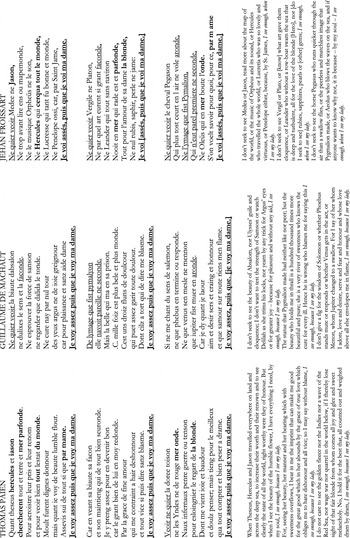
At the beginning of the Voir dit, Guillaume receives rondeaux by Toute Belle and instructs her in the art of poetry by producing rondeaux on the same rhymes and using the same verse structure. In B34 Machaut has done the same with the much more challenging form of the balade, showing his poetic superiority to a more accomplished versifier than Toute Belle, Thomas Paien (both poems are given in Fig. 1). Thomas's poem mentions Theseus, Hercules and Jason in its first line as a way of setting up the basic hyperbole: that to see the lady is better than the wide world seen by its most famed adventurers. In response, Guillaume adorns all three stanzas with evidence of his education, listing Absalom, Ulysses, Samson, Delilah, Argus, Pygmalion, Solomon, Phoebus, Venus, Menon and Jupiter. Guillaume's allusions are wider in terms of sources (biblical as well as classical), provide comparisons to things other than the world (Absalom's beauty, Samson's strength and so on), and are simply greater in number.
Shared text between the balades of Guillaume de Machaut, Jehan Froissart, and Thomas Paien on the refrain, ‘I see enough, because I see my lady’.

The musicalisation of the pair of poems, however, tops off their competitive ranking, not just in the fact of it alone (Paien's was only a spoken poem before), but in the way in which the counterpoint of the setting ranks the two texts. Machaut usually deployed the setting of different verbal texts simultaneously in a musical context – polytextuality – in motets, where the layering of secular and sacred references forms inter- and intra-textual dialogue.Footnote 56 His use of the technique in songs is much rarer (although still more frequent than in those of his contemporaries). In his earliest polytextual balade, Sans cuer/Dame/Amis (B17), the three parts sing the same melody, staggered as a chace, the polytextual nature staging a dialogue whose enactment is spatialised by the canon. Like B17, B34 is a dialogue, but more of a writerly than a performative one, with a hierarchy implied between the two poems that is nevertheless only evident in their musical setting.Footnote 57
Guillaume places Thomas's poem in the top voice, a voice which is highest in pitch but fourth (that is, last) in importance in the contrapuntal hierarchy.Footnote 58 So the voice carrying Guillaume's poetry might lie ‘humbly’ beneath that of Thomas's at major cadences, but Thomas's is a triplum-type voice in terms of its contrapuntal function, whereas Guillaume's is the true cantus: it carries the octave sonority at major cadence points and has a slightly larger overall range. A three-part performance that excluded Thomas's text would be theoretically possible; a three-part performance that excluded Machaut's wouldn't. Machaut's text could stand alone but Thomas's requires all three other vocal parts – Machaut's poem and his music – for it to be sung at all. All musical and textual phrases end together, and much of the syllabic declamation is aligned so that, almost syllable for syllable, Guillaume's text effaces and sonically obscures that of his rival. What can be heard in performance is very little of either man's verbal dexterity, but rather a consonant four-part musical structure by Guillaume de Machaut.Footnote 59
There is evidence that the poetry competition that Machaut musicalised as a way of winning it went beyond the two poems here, and might indeed have had a historical occasion at its inception. A balade by Jehan Froissart, Ne quier veoir Medee ne Jason, shares the same refrain as both texts in B34 and its incipit combines the opening of Guillaume's poem with the first rhyme word in Thomas's. Moreover, its entire text continues this fusion so that it seems that Froissart is almost certainly responding to both poems at once. (Fig. 1 shows text shared between Froissart and Thomas in bold and between Froissart and Guillaume underlined.) Of course, Froissart could have come across these texts together in their musical setting, but he might also have known them from an earlier occasion when he, Machaut, and Thomas might conceivably have been at court together. My suggestion for this occasion relies once more on the Berry connection between Machaut and Thomas, and the situation that might have prompted Machaut's composition of the Fonteinne for John. This connection forges a link to Froissart, who not only wrote a poem using the same refrain as the two set in B34, but also wrote a poem modelled jointly on Machaut's Fonteinne and Voir dit.
Jehan Froissart's poem Espinette amoureuse (The Hawthorn Bush of Love) is widely recognised to have two principal Machauldian models: the Voir dit, which also presents a verisimilitudinous love affair, and the Fonteinne.Footnote 60 Most of these similarities are based on the narrative events and overall conceit of the poem, but some are lexical. In particular, Froissart's Espinette, like Machaut's Fonteinne, uses the unusual word ‘avolés’ (foreigners, refugees) to describe the people populating the seaport from which the lover (in Machaut's poem) or lover–narrator (in Froissart's) departs. James I. Wimsatt has suggested that this conscious imitation of Machaut points to both Froissart and Machaut being at Calais with John, Duke of Berry in October 1360.Footnote 61 Although the evidence dates only from 1362–3, it is entirely possible that Thomas Paien might well already have been in John's service in 1360 and, if so, as secretary would have been in his immediate entourage.Footnote 62 If the situation in Fonteinne is factual as well as verisimilar, it would indicate that Machaut, too, accompanied John to Calais. The conferences at Calais prior to John's actual departure lasted three weeks, plenty of time for serious (morally efficacious as well as entertaining) recreational competition between those royal servants with verbal facility; the Fonteinne documents a fair amount of poetry, both said and sung, on the way to the lover's final embarkation point. Thomas's and Froissart's poems have references to journeying over the sea, which would have been of direct relevance to John and his court. Moreover, the lover in Fonteinne learns the quintessential Machauldian courtly love lesson: that one can ‘see’ the lady when one is absent from her by imprinting her image in memory – the ‘Souvenir’ – so as to produce ‘souffissance’ – loving (self-)sufficiency. This situation is neatly summarised by the refrain that all three balades share: ‘I see enough because I see my lady’ and would have been a potentially useful form of comfort to give to a young man about to go into exile without his wife.Footnote 63
In the Voir dit, written a short time after Fonteinne, Machaut's alter ego, the narrator–poet Guillaume, distinguishes between the verbal text of the two balade poems by himself and Thomas, which he says are old material, and his new four-voice musical setting of them together.Footnote 64 Perhaps the sealed and unopened copy that is misdirected to Toute Belle (letter 32) was sent in response to Machaut's own request for a written copy of Thomas's old poem during the period he was collecting materials for the Voir dit. It would then have been easy for Machaut to re-use its polyvalent theme of seeing the lady as part of his new poem, in the process capping his competitive poetic response with a musical one that – as far as we know – his rival could not match. That this betrays a mixture of adulation (treating Thomas's poem seriously, imitating its structure, and taking time to set it to music) and self-promotion (setting it inextricably with his own matching verse in a musical texture and notation of the utmost complexity and refinement), could not be more typical of Machaut's artistic persona.
Appendix
Passages surrounding the presentation of Quant Theseus/Ne quier (B34) in the Voir dit
Letter and line numbers relate to the edition of Leech-Wilkinson and Palmer (1998).
Letter 31 Guillaume 28 September [1363]
[Worrying that Toute Belle has forgotten him, Guillaume recounts a dream that her image dressed in green and turned its head from him. He says Toute Belle's brother has visited him after mass in the morning on St Michael's day, staying with his party in his house. He says he has composed the music for her name-rondeau and will send his book (three times as much as Morpheus [i.e. Fonteinne]) with her brother's chaplain. He sends back her chest with all the ‘things’ that he has now put in the proper place in her book: her brooch, beads, and balade – he will send its (the balade's) peer with the first person going her way and is sending a rondel composed some time ago with newly written tenor and contratenor parts.]
The lady's complaint follows.
Letter 32 Toute Belle 5 May [1363]
[Defends herself against charges of forgetting him. She knows the rondel with music well, having seen it before, and begs for others as well as virelays.]
Jay trouve en la laiette que vous mavies envoie unes lettres clauses qui aloient a vous . si les ouvri pour ce que ie ne savoie pour quoy vous les avies envoies . et trouvay que cestoit une balade que on vous envoioit . si la vous renvoie pour ce que ie pense que vous ne la veistes onques . car elle est encores toute sellee.
I found in the container you sent me a sealed letter that should have gone to you. If I have opened it, it is because I did not know why you had sent it and I found that it was a balade that you'd been sent. If I send it back, it is because I think that you never saw it because it was still sealed.
Letter 33 Guillaume 9 October
Guillaume is with the king's people and the Duke of Bar and has not been able to attend to other things. He won't send her name-rondeau because he hasn't yet heard the music. Says he will soon send her the manuscript of the book so far.
Letter 34 Toute Belle 28 October
Toute Belle pardons Guillaume.
Letter 35 Guillaume 17 October
[The Duke of Bar and several other lords have been staying in Guillaume's house, which has prevented him working on the book. He is now sending her the book, which he wants back soon. It will be called Le livre dou voir dit. Sends her the music of her name-rondeau, which the strangers staying with him in Reims have already heard. Guillaume will be in St Quentin from All Saints and from there on to the Duke of Normandy, Charles the Dauphin.]
Je vous envoie la balade .T. paien et la response que ie li fais . la quele ie fis en present. Mais il fist devant . et prist toute la graisse dou pot a son pooir . et ie fist apres . si en iugerez sil vous plaist . mais vraiement il avoit lavantage de trop . et toute voie ie y feray chant . si ne les bailliez a nelui ie vous en pri .
I am sending you the balade by T. Paien and the response that I did for it, which I did just now. But he did it earlier and took all the grease from the pot that he could and I did it afterwards so judge if you please, but really he had the total advantage and anyway I am going to make it into a song as long as you don't give them to anyone, I beg you.
[Passages on Pyramus and Thisbe, Leander, Lancelot, Peter Toussac, Paris and Helen, Chastellain de Vergy]
Letter 36 Toute Belle, 28 October
Et si tost comme ie y seray ie lescrirai a mon frere qui le vous fera savoir . Et aussi vous pri ie que vous li escrivez de vostre estat et li mandes quil le me face savoir . Jay bien veu ce que vous mavez escript de thommas . Et quant il plaira a dieu que ie vous voie . ie vous diray tout ce quil en fu . Et aussi le vous sara bien a dire .H. Jay receu . unes lettres . les queles vous envoiez au dit henri . Mais ie ne li envoierai mie pour ce que ie ne say ou il est .
And as soon as I'm there [at a new lodging], I will write it to my brother who will make it known to you. And also I pray you that you write to him of your state and ask him to make it known to me. I have had a good look at what you wrote me about Thomas. And when it pleases God that I see you, I will tell you all that there was in this. And also .H. will surely tell you about it. I have received a letter which you sent to the said Henri, but I cannot send it to him at all because I do not know where he is.
[She is not yet ready to send the book back to him.]

Letter 37 Guillaume 3 November
[Did not go to St Quentin or the duke because of enemies at Beauvais.]
Mon tresdous cuer ma tres chiere suer . et ma tresdouce amour . vous ne mavez mie escript de mon livre . ne mes .ij. balades jugie que ie vous ai envoie . dont ie fis lemprise pour vous . comment que ie ordenasse qui li autres feist premiers
My very sweet heart, my very dear sister and my very sweet love, you have not written anything to me about my book nor judged my two balades that I sent you, which I undertook for your sake even though I organised it that the other [poet] did his first.
[Mentions Pyramus and Thisbe, Leander, Lancelot, Peter Toussac, Paris and Helen, Chastellain de Vergy]
Mon tresdous cuer . Je vous envoie les .ij. balades que vous avez veues autre fois qui furent faites pour vous . par escript . Si vous suppli humblement que vous les weilliez savoir . car ie y ai fait les chans a .iiij. et les ay pluseurs fois ois . et me plaisent moult bien.
My very sweet heart, I send you the two balades that I promised you another time that I have had done for you in writing. Thus I beg you humbly that you would get to know them, for I have done the melodies there in four parts and have heard them many times and they please me well.
Letter 38 Toute Belle 5 November
[She has read his book twice and has ideas for improvement.]
Les .ij. balades que vous mavez envoies sont si bonnes que on ni saroit trouver que redire. Mais ce nest pas comparison . car ce que vous faites me plaist trop mieux a mon gre que ce que li autres font. Et aussi suis ie certeinne que einsi fait il aus autres.
The two balades that you sent me were so good that one cannot fault them. But this is not a comparison because that which you make pleases me more to my will than that which others make. And also I am certain that it strikes others thus.