INTRODUCTION
There is widespread agreement that good communication is a cornerstone of high-quality end-of-life care. However, talking about sensitive topics such as life-sustaining treatment and end-of-life decisions often proves challenging for healthcare professionals, patients, and relatives alike. Consequently, patients' wishes are often left to the side until it is too late, leaving both relatives and healthcare professionals in the dark as to providing the care that the patient would have wished for (Neergaard et al., Reference Neergaard, Jensen and Sondergaard2011).
The concept of advance care planning (ACP) has been emphasized as a way to encourage more and better communication between patients and healthcare professionals preparing and planning for a patient's end-of-life care and death (Romer & Hammes, Reference Romer and Hammes2004). The purpose of ACP is for a healthcare professional to discuss seriously ill patients' preferences regarding, for example, life-sustaining treatment, resuscitation, and choosing a proxy decision maker. At the patient's discretion, one or more relatives may participate in the discussion. The outcomes of an ACP discussion are typically documented in the patient's chart and may be regularly reviewed and communicated to other relevant healthcare professionals engaged in the disease course of the patient (Mullick et al., Reference Mullick, Martin and Sallnow2013).
So far, the empirically based research on ACP has focused mainly on the effects of the discussion; particularly on the long-term effects the discussion has had on patients and relatives. These studies usually build on focus groups, surveys, and interviews and show that participating in ACP discussions yields improved quality of life for both patients (Detering et al., Reference Detering, Hancock and Reade2010) and relatives (Wright et al., Reference Wright, Zhang and Ray2008). However, although extensive research has been done on traditional doctor–patient communication (Ainsworth-Vaughn, Reference Ainsworth-Vaughn1998; Heritage & Maynard, Reference Heritage and Maynard2006; Meeuwesen et al., Reference Meeuwesen, Schaap and van der Staak1991; Ong et al., Reference Ong, de Haes and Hoos1995; Pilnick & Dingwall, Reference Pilnick and Dingwall2011), examples of empirically based descriptions and analyses of what goes on during actual ACP discussions are practically nonexistent. This renders the ACP discussion a virtual black box in the sense that, while we know the “input” (an ACP discussion) and the “output” (improved quality of life for patients and relatives), we have no real knowledge of the discussion's inner workings, or how sensitive topics are approached and discussed in actual ACP discussions.
The lack of empirical research focusing on the content of actual ACP/end-of-life-care discussions needs to be remedied, not least because studies show that this type of discussion, with its focus on very sensitive topics, is particularly difficult for both healthcare professionals and patients (Ahluwalia et al., Reference Ahluwalia, Levin and Lorenz2012; Sorensen & Iedema, Reference Sorensen and Iedema2009; Wright et al., Reference Wright, Zhang and Ray2008). Furthermore, most guidelines and recommendations that have been presented for ACP are not evidence based. After a thorough literature search, we were able to find only a few studies that focused on content analysis of actual end-of-life discussions. These studies generally show that discussions about care at the end of life are infrequent and brief, that physicians tend to focus on medical issues while avoiding or spending very little time on emotional and end-of-life issues, that physicians dominate discussions by having the greatest amount of speaking time, and that discussions that include end-of-life topics take longer (Ahluwalia et al., Reference Ahluwalia, Levin and Lorenz2013; Barnes et al., Reference Barnes, Barlow and Harrington2011; Bradley et al., Reference Bradley, Hallemeier and Fried2001; Burchardi et al., Reference Burchardi, Rauprich and Hecht2005; Clarke & Seymour, Reference Clarke and Seymour2010; Roter et al., Reference Roter, Larson and Fischer2000; Siegler & Levin, Reference Siegler and Levin2000; Tulsky et al., Reference Tulsky, Fischer and Rose1998; Waldrop & Meeker, Reference Waldrop and Meeker2012). The findings of these studies will be discussed and compared to the findings of the present study in more detail later.
Although the mentioned studies are valuable in their own right, they are primarily descriptive, giving us important information about the topics that are discussed, but leaving us with an inadequate understanding of how they are discussed. In the following, we aim to explore how patients and healthcare professionals communicate about the sensitive topics that comprise an ACP discussion by focusing on the interactive dynamics of the verbal exchange.
METHODS
Setting
This article draws on transcriptions of 10 audiotaped ACP discussions carried out as part of a pilot study preceding a major randomized controlled trial in the municipality of Aarhus, Denmark, during the summer of 2013.
The Danish healthcare system follows the Nordic welfare model for healthcare in that it has tax-based funding, publicly owned and operated hospitals, universal access, and comprehensive coverage. However, ACP is a new concept in Denmark, and the Danish healthcare system has no tradition of employing systematic discussions about end-of-life issues. The ACP discussions that are analyzed in this study are therefore not part of “real-time” discussions between patients and doctors, but were rather discussions focusing exclusively on ACP issues.
Participant Selection
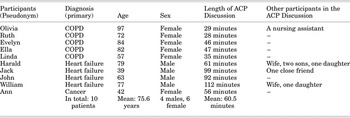
Participants were recruited by the physician who carried out the ACP discussions. The participants were patients diagnosed with cancer, COPD, or heart disease. They were recruited from the electronic patient records, based on the patient being either chronically or seriously ill. The patients were sent a letter with information about the purpose of the ACP discussion and were subsequently phoned by the physician and asked if they wished to participate. As such, the ACP discussion was not requested by the participants, but rather a proposal they accepted. A total of 18 patients were contacted: 10 agreed to participate in an ACP discussion, while 8 declined, mostly due to not wanting to talk about end-of-life issues. The mean age of patients was 75 years, ranging from 39 to 97 years. (See the patient and ACP discussion information in Table 1.)
Participants and ACP discussion information

The ACP Discussions
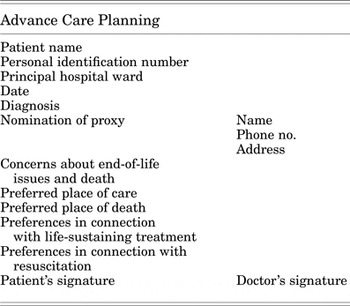
Discussions were carried out in patients' homes, except in one case where the discussion was carried out in a private room at the hospital. The discussions concluded with the filling out of a form (see Table 2), which was subsequently attached to the patient's electronic records. The form was inspired by the British Gold Standards Framework and the Australian Respecting Patients Choices (see http://www.goldstandardsframework.org.uk/ and http://advancecareplanning.org.au/). The discussions lasted between 28 and 112 minutes. In three cases, relatives participated, and in one case a nursing assistant participated.
Contents and layout of the ACP discussion document

The first author, an experienced anthropologist, observed and audiotaped all of the discussions. The patients and relatives were given both written and oral information about the ACP project as well as the present study, and they gave their oral and written consent to participate in both projects. Patients and relatives were informed that data would be handled confidentially, that they could withdraw their consent at any time, and were offered to be forwarded the findings of the study. All participants have been given pseudonyms in the text.
Data Analysis
The ACP discussions were transcribed and listened to numerous times by the first author, who was responsible for carrying out the analysis in collaboration with the rest of the authors. Once transcription of the discussions was completed, the entire body of material was subjected to a careful and close reading and open coding in order to identify general themes. This was followed by a focused coding and fine-grained, line-by-line analysis of analytically interesting themes and subthemes (Emerson et al., Reference Emerson, Fretz and Shaw2011).
The analysis takes as its theoretical starting point sociolinguist Marisa Cordella's concept of patient and doctor “voices” (Cordella, Reference Cordella2004), a theory developed on the basis of empirical research on hundreds of “regular” doctor–patient discussions. Cordella identifies the forms of talk—“voices”—that doctors and patients use during the course of follow-up consultations, which allows a study of the dynamic interaction as it unfolds. The theory is inspired by sociologist Erving Goffman's concept of “footing,” that is, that speakers use different forms of talk depending on their alignment in a given context (Cordella, Reference Cordella2004), and that a shift from one voice to another corresponds to a rebalancing of the interaction between doctor and patient, making the discussion dynamic. During the analysis, we were attentive to the possibility of identifying other voices than the one's identified by Cordella and how different voices were used in different ways.
Ethics
According to the Scientific Committee for the County of Aarhus, the Biomedical Research Ethics Committee System Act does not apply here. The study was approved by the Danish Data Protection Agency. Furthermore, we were especially sensitive to conducting research with such a vulnerable group and were always very aware of the impact that the ACP discussion had on them. The physician carried out the discussions in a sensitive manner and was ready to contact other healthcare professionals if patients had been negatively affected emotionally by the discussion. This was not deemed necessary in any instances, though.
RESULTS
Overall Themes in the ACP Discussions
All discussions started and ended with some form of small talk, ranging from the weather and family relations, to death being taboo in Western culture. All discussions were carried out in an amicable manner, except for one discussion where the patient seemed somewhat annoyed with the doctor's questions and answered only curtly.
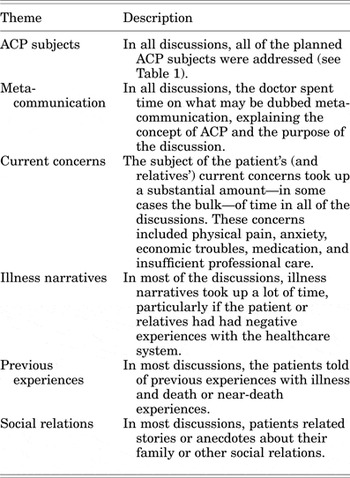
Different themes were touched upon during the discussions. The most prominent ones are described in Table 3 to give an overall impression of the discussions.
Description of the ACP discussion themes

Discussions were not carried out in a rigid manner, and the themes mentioned in Table 3 often intertwined and reemerged throughout. Patients and doctor in most cases held the floor for the same amount of time. In cases where close relatives were present, the patients tended to have less speaking time, while the relatives had more.
The Healthcare Professional's Voices
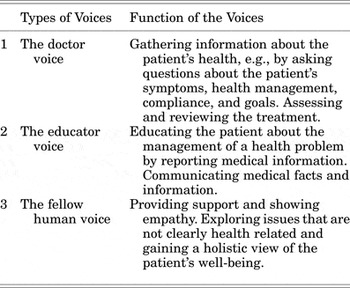
We follow Cordella in distinguishing between the different healthcare professional “voices” that she found to be particularly prominent in doctor–patient encounters (see Table 4). We found that these voices were also used in connection with the ACP discussions, but as we shall demonstrate, they were often used with a different purpose and in different proportions than the consultations surveyed by Cordella.
The healthcare professional's voices

1. The Doctor Voice
The doctor voice was used by the physician to ask specific ACP questions—for example, if the patient wanted to be resuscitated or receive life-sustaining treatment. These questions were generally posed in a quite straightforward manner. As such, they did not take up much time, though they were the central part of the conversation.
Although the ACP-related questions were posed in a straightforward manner, it is important to emphasize that the questions were embedded in other types of voices. These voices were used much more often than the doctor voice and partly softened the questions and partly sought to empower the patient, as will be described in the following.
2. The Educator Voice
Another voice used by the physician was the educator voice, which is traditionally used to share information with patients in order to help them better understand their health condition and appreciate the benefits of the recommended treatment. According to Cordella, the educator voice is traditionally used by doctors to reinforce the hierarchy between doctor and patient, keeping the patient in a more passive role by encouraging compliance (Cordella, Reference Cordella2004). In the ACP discussions, however, the educator voice was primarily used in two different ways, both of which sought to empower the patient.
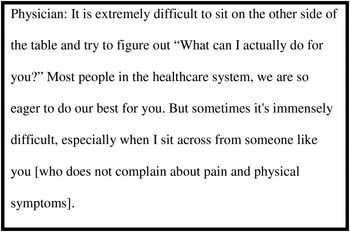
First of all, the educator voice was used as a way of making the patients more assertive and more aware of their options; a form of patient education. The doctor usually initiated the ACP discussion by presenting the ACP concept and explaining why it is a good idea to talk about these issues before they become pressing. The ACP discussion was presented as a tool to help patients and relatives, but especially healthcare professionals. In particular, the physician emphasized how important communication was in terms of both providing and receiving adequate care, as seen in example 1:
Example 1

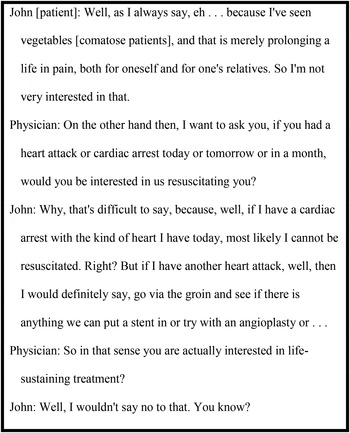
Second, the educator voice was used to play the devil's advocate in order to make the patients reflect on their choices and decisions. In example 2, the physician is talking about life-sustaining treatment and the male patient, John, has a strong response:
Example 2

Here the patient initially declined life-sustaining treatment, but the physician utilized a probing strategy to nuance the patient's answer. Where the educator voice is traditionally used to persuade patients to comply with a certain treatment, it was here used to make patients reflect on their answers and reach a nuanced and thought-through conclusion.
3. The fellow human voice
The fellow human voice was the one used most prominently by the physician during the discussions. The function of the fellow human voice is to show empathy and involvement in order to encourage patients to open up about their personal situations and stories (Cordella, Reference Cordella2004). By listening attentively and frequently making empathetic comments such as “I understand” and “That must be really tough,” the doctor encouraged patients to develop their stories further.
As will be expanded upon later, the physician taking an empathetic stance often led to valuable information that the physician could then include in the ACP document.
The Patients' Voices
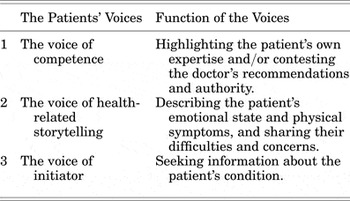
Cordella describes several different types of voices used by patients in the medical exchange, all of which were used to different extents in the ACP discussions. Here we will focus on the three most prominent voices used to interact with the physician (see Table 5).
The patients' voices

1. The Voice of Competence
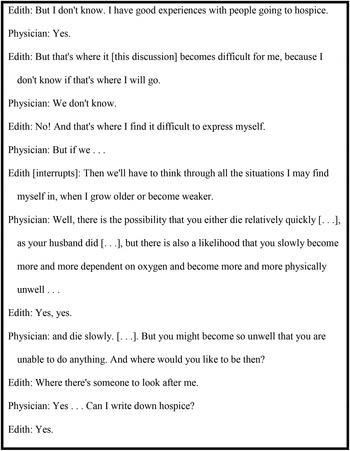
By using the voice of competence, patients show that they are knowledgeable about their own situation and familiar with medical procedures, which in turn may lead them to question the physician's authority if they disagree on procedures (Cordella, Reference Cordella2004). In connection with the ACP discussions, this voice was used to challenge the very concept of ACP. In one discussion, the physician asked a female pulmonary patient, Edith, where she would like to spend the last days of her life, which prompted the following exchange:
In example 3, the patient questioned whether the ACP discussion is helpful or even feasible, because it is impossible to take into account all possible scenarios in connection with end-of-life issues and dying. The physician, however, tried to boil down the options, making it easier for the patient to answer. However, as the example shows, patients are not reluctant in voicing a critique of the ACP concept, urging the physician to take on the educator voice to explain or even defend the concept.
Example 3

2. The Voice of Health-Related Storytelling
By using the fellow human voice, the physician encouraged health-related storytelling. By asking sympathetic questions such as “That must have been really awful; what happened then?” the doctor indicated that these were appropriate subjects to talk about. In some of the ACP discussions, this led to lengthy accounts of the patient's medical history, but in many cases the physician used these stories to infer meaning that was relevant in an ACP context. For instance, a male patient talked at length about the fact that he had been disappointed when only a few of his friends visited him at the hospital during a prolonged admission. The physician used this story to deduce that one of the friends who had in fact visited him in the hospital should be added as a contact person. The physician also suggested that it should be added to the ACP document that it was important that the patient have his friends and relatives around him toward the end of his life. The patient keenly agreed with both suggestions. Hence, even though the lengthy storytelling was not always directly related to ACP subjects, the physician was able to use the stories as a starting point for relevant issues by using deductive phrases such as “Have I understood this correctly?” and “Let me get this right. Can I write down that you would like to …?”
3. The Voice of Initiator
The initiator voice seeks information and advice and desires to know more about the possibilities. However, the patients and relatives often found themselves in difficult situations at the point of the ACP discussion. Once the physician, by use of the fellow human voice, opened up for the possibility of getting advice or help by answering and making suggestions, many patients and relatives seized the opportunity to get more knowledge and advice on their current situation, especially in terms of dissatisfaction with the healthcare system or specific healthcare professionals. A few of the discussions even ended up mainly focusing on the current situation of the patient. In this sense, the patients and their relatives introduced somewhat extraneous subjects that the doctor in most cases chose to respond to.
DISCUSSION
Having identified various “voices” in the ACP discussions enables us to explore the dynamic relationship between doctor's and patients' use of different “voices.” Doctors generally have a prominent position in the medical encounter because their status as interviewer makes them responsible for the introduction of new topics (Cordella, Reference Cordella2004). However, in connection with the ACP discussions analyzed here, patients were either given or took the opportunity to speak about what was on their mind. The doctor voice and educator voice, which traditionally reinforce the hierarchy between doctor and patient, with the patient in a more passive role, were here used to encourage the patients to reflect and make informed choices. Furthermore, the fellow human voice was used extensively by the doctor to demonstrate attentiveness and interest and to allow and encourage patients to participate in the discussion.
In line with Cordella's findings, we found that the physician's use of certain “voices” prompted the use of certain kinds of patient's voices. In particular, the physician's extensive use of the fellow human voice and the use of the doctor and educator voices in ways that sought to empower the patients allowed patients to use the voices of competence, of health-related storytelling, and of initiator. This, in turn, allowed the doctor to get vital information by deducing and assessing patients' sometimes lengthy answers; information the physician might not have otherwise acquired.
On the whole, patients' responses suggest that they did not feel constrained to conform to a strictly ACP-related discourse. Rather, they felt sufficiently at ease to not only explore other topics and ask questions about their current situation, but also to question the very concept of ACP and the assumption that all end-of-life issues can or should be discussed in advance.
This study is based on direct observation of the features of ACP discussions that were successful in terms of several ACP subjects being addressed during the discussion. The few previous studies that have directly studied discussions on end-of-life care and ACP subjects suggest that the quality of these conversations is not optimal, especially in terms of addressing the relevant issues. This is mainly blamed on time restrictions and the need for better communication skills in healthcare professionals (Barnes et al., Reference Barnes, Barlow and Harrington2011; Bradley et al., Reference Bradley, Hallemeier and Fried2001; Cherlin et al., Reference Cherlin, Fried and Prigerson2005; Tulsky et al., Reference Tulsky, Fischer and Rose1998).
Compared to these studies, our study suggests that ACP may include a discussion that may indeed call for a less restricted timeframe, but more importantly also calls for the use of certain voices. This indicates that, in order for patients to open up about the sensitive subjects of end-of-life care and dying, the healthcare professional should emphasize the fellow human voice. Although the ACP-related questions were posed in a quite straightforward manner, they were embedded in empathetic fellow human voice utterances, encouraging and allowing patients to respond unreservedly, including emotional responses and uncertainty.
Our study has several limitations, however. Our sample is small, and indeed it is quite possible that the participating patients were more positive about discussing ACP topics than patients are in general. Close to half of patients who were invited to participate in an ACP discussion refused on account of not wanting to talk about end-of-life care, death, and dying. This indicates that far from all patients may wish to actively consider end-of-life care. Furthermore, the discussions were all carried out by the same physician. Including other healthcare professionals would widen the scope of the study considerably by offering examples of different approaches to the discussion. Finally, the discussions included here were part of a pilot study and were not subject to time-limit constraints, which is unusual in modern healthcare systems. These factors all limit the generalizability of our results, and as such the discussions presented in this paper represent examples of how this discussion may happen in order to show the potential in the discussion by use of different voices, functioning as a stepping stone for further studies.
Further research with larger samples is needed in this complex area. Valuable insights could be gained by studying the frequency and content of ACP discussions with patients with different medical diagnoses and varied cultural and social backgrounds in order to identify possible variations. In addition, the role of participating relatives in the discussion should be explored.
With this study, we have sought to offer insight into how the sensitive and difficult subjects of the ACP discussion are carried out in concrete discussions. We have done this by identifying the prominent voices that doctor and patients used and exploring the dynamic relationship between doctors' and patients' use of different voices. The analysis shows that patients and relatives were encouraged to take the stage, to reflect, and to make informed choices. Patients very actively explored different topics and asked questions about their current situation, but some also challenged the concept of ACP, especially the thought of being able to take control of end-of-life issues in advance.
Furthermore, our analysis also shows that the doctor voice and educator voice, which traditionally build the healthcare professional's authority (by stressing the healthcare professional's role as initiator, introducing new topics and controlling the conversation) may be used instead to empower the patient, allowing and encouraging them to reflect on their answers and voicing their concerns. Our findings thus suggest there is new potential in the use of the doctor and educator voices.
Our aim has been to offer a peek into the black box of the ACP discussion. Analyzing actual ACP discussions will allow us to better recognize both the strengths and challenges in the ACP discussion and thus offer a complementary approach to understand communication about ACP. This, in turn, may aid healthcare professionals in their own communication about the often difficult and sensitive issues encompassed in ACP discussions and possibly increase the use of ACP. We also believe that greater transparency about actual ACP discussions may help nuance the debate surrounding the use of ACP.
ACKNOWLEDGMENTS
Profound gratitude is extended to participating patients and relatives. Our study was funded by the Danish Cancer Society and TrygFonden.