Introduction
After a long silence since the Chernobyl accident in 1986, the 11 March 2011 incident at Fukushima following the earthquake in the northeastern part of Japan caused not only the Japanese public, but the entire global community, to once again be reminded of the potential danger of nuclear power. This reawakening of public awareness as to the potential risks of nuclear power seems to have had a significant effect on individuals’ attitudes toward that energy source.
Public attitude toward nuclear energy has been one of the major academic interests. People's fundamental values and beliefs about society are possible factors that frame their nuclear attitude. Zetterberg (Reference Zetterberg1980) shows that post-materialist values are closely linked to anti-nuclear attitude (see also Ladd et al., Reference Ladd, Hood and Van Liere1983; Mitchell, Reference Mitchell, Freudeburg and Rosa1984; Scaminaci and Dunlap, Reference Scaminaci and Dunlap1986). The media also influences individual attitude toward nuclear energy, while it is not evident whether the exposure of information promotes pro-nuclear attitude (Firebaugh, Reference Firebaugh1981) or anti-nuclear attitude (Gofman and Tamplin, Reference Gofman and Tamplin1971; Manzur, Reference Manzur1975, Reference Manzur1981, Reference Manzur, Freudenburg and Rosa1984).
Fishbein (Reference Fishbein1963) and Fishbein and Hunter (Reference Fishbein and Hunter1964) argue that those individual attitudes are based on anticipated consequences of the introduction of nuclear technology. Other empirical studies also find that perceptions of potential costs and benefits of nuclear energy are associated with citizens’ nuclear attitudes (e.g., Otway and Fishbein, Reference Otway and Fishbein1976; Sundstrom et al., Reference Sundstrom, Lounsbury, DeVault, Peele, Baum and Singer1981; Sundstrom et al., Reference Sundstrom, Lounsbury, Schuller, Fowler and Mattingly1977). More importantly, proponents and opponents of nuclear energy attach values to different aspects of the energy source; the former group stresses the potential benefits, yet the latter group is concerned with safety issues (see Eiser and van der Pligt, Reference Eiser and derPligt1979; van der Pligt et al., Reference van der Pligt, Linden and Ester1982).
After the Fukushima incident, many international polls have been administered to examine public attitudes toward nuclear energy. As conducted by one of the leading newspapers in Japan, the Asahi Shimbun, a survey in seven major countries including Japan, the US, France, South Korea, Germany, Russia, and China, all of which possess nuclear power plants, found that the Fukushima incident has had a significant impact on the growth of negative attitudes toward nuclear power. The results show that public opinion in Japan and Germany has been swayed by the nuclear crisis; 42% of those queried in Japan oppose the use of nuclear energy, and only 19% of the respondents in Germany have a positive attitude toward nuclear energy. However, the survey result also found that the publics in both France and the US have been less influenced and, rather, continue to support the use of nuclear energy (51% in France and 55% in the US). The Chinese, as well, have been affected by the incident, although 51% of the respondents still favor the use of nuclear energy.
Why does such a difference in attitude toward nuclear power appear between these countries? From the perspective of the cost–benefit framework, the public concern for a future nuclear crisis may be a possible answer. In the Asahi Shimbun survey, the percentage of those concerned (including ‘very’ and ‘somewhat’) about a possible major accident at a nuclear plant in their own country is very high; in South Korea, 82% of the respondents are concerned about it, and in Russia, 80%. However, this explanation is checked by the finding that concern is high even in countries where the public tends to favor the use of nuclear energy; 61% of the respondents in the US are concerned about another nuclear accident, as are 83% in China.
Given the discrepancy in attitudes between countries, it is not entirely clear how the perceived risk of nuclear power affects public opinion. Using survey data that include samples collected from countries that have and countries that do not have nuclear power plants, this article examines how the variance in risk perception is related to attitudes toward nuclear power. A public's risk perception as to nuclear power derives not only from the prospect of a possible incident but also from individuals’ trust in the administrative control of nuclear power plants.
Acknowledging that apprehension about another nuclear crisis is indeed a major explanatory variable that determines public sentiment toward nuclear energy, this article argues that structural contexts also need to be taken into account in order to explain the observed gap in the relationship between risk perception and attitudes toward nuclear power across countries. The demand for electricity and degree of dependence on nuclear energy, in particular, both directly and indirectly influence individuals’ attitude toward nuclear power. Employing the multilevel modeling, an empirical analysis reveals that, by conditioning individuals’ risk perception, a demand for the massive consumption of electricity due to economic development reduces negativity to nuclear energy, and, in contrast, the degree of dependence on the energy source provokes negative attitudes toward its use for the production of electricity.
Dramatic events and public opinion
Dramatic events have a significant impact upon public attitudes, especially when the population is seriously affected by an experience involving a previously unknown risk, or when it needs to radically revise its estimate of the size of a risk due to new developments (Sjöberg and Engelberg, Reference Sjöberg and Engelberg2010; see also Sorrentino and Vidmar, Reference Sorrentino and Vidmar1974). Accidents that have occurred at nuclear power plants are examples of such extraordinary events that have caused concern for not only the affected countries, but the entire global population (e.g., de Boer and Catsburg, Reference de Boer and Catsburg1988; van der Brug, Reference van der Brug2001). The severity of the April 1986 Chernobyl nuclear power plant incident, for instance, brought attention to the risks that accompany the use of modern large-scale technologies (Verplanken, Reference Verplanken1991). Unlike with the accident that occurred at the Three Mile Island nuclear power plant in 1979, Soviet reactors were not equipped with containment buildings, and the public was shocked by the enormity of the damage left by the unanticipated disaster (Sjöberg and Engelberg, Reference Sjöberg and Engelberg2010).
Various studies reveal that people became more critical about the use of nuclear energy immediately after the Chernobyl accident. Employing public opinion polls in ten European countries and the US both before and after the Chernobyl accident, Hohenemser and Renn (Reference Hohenemser and Renn1988) and Renn (Reference Renn1990) give an overview of the levels of opposition to nuclear power and show that those countries experienced an increase in anti-nuclear attitudes after the accident.
Dramatic events such as in Chernobyl appear to have a certain impact on public attitudes toward nuclear energy. However, researchers still have to question whether the changes in public opinion are permanent or transitory. Sorrentino and Vidmar (Reference Sorrentino and Vidmar1974) note the possibility that such a change in public opinion in time reverts to its pre-event level; in other words, while nuclear opposition grows immediately after a crisis, it does in fact return to the pre-crisis level. The pattern by which public support for nuclear power declines immediately after a nuclear accident and eventually reverts back to the pre-incident level has long been observed and has often been addressed in literature. A shift in public attitude was evidenced not only in the aftermath of the Chernobyl accident but also in the months following the Three Mile Island incident. In their article that examines survey results showing the impact of these two incidents, de Boer and Catsburg (Reference de Boer and Catsburg1988) also conclude that, while significant shifts in attitude toward nuclear power do coincide with major nuclear accidents, such large changes in public opinion are likely to be temporary.Footnote 1
The impact from nuclear accidents is not confined to the occasional and temporary shifts in public attitude immediately after major publicized incidents, but extend beyond with the enduring use of nuclear power. The potential for nuclear accidents is in fact mirrored in the day-to-day management of nuclear power plants, although this goes largely unnoticed due to the fact that there is no publicity when reactors remain silent. The planned construction of a new nuclear power plant, however, gives rise to new concern among residents living within the proximity of a proposed site. Since the mid-1970s, surveys have examined public opinions about the local siting of nuclear power plants (e.g., Rosa and Dunlap, Reference Rosa and Dunlap1994; Bolsen and Cook, Reference Bolsen and Cook2008). Although a high degree of opposition to the proposed locations of nuclear power plants is generally observed (e.g., Rankin et al., Reference Rankin, Melber, Overcast and Nealey1981), local attitudes are typically based on thoughts that focus on the specific costs as well as potential benefits rather than on general beliefs about the risks that would accompany the construction of additional plants (Hughey et al., Reference Hughey, Sundstrom and Lounsbury1985; Woo and Castore, Reference Woo and Castore1980). Tanaka (Reference Tanaka2004) finds that factors that determine public acceptance of the local siting of nuclear power plants are different from those that determine public acceptance of nuclear energy in general.
Therefore, it is likely that even when generally agreeing on the use of nuclear power, people take issue with the construction of nuclear power plants near their place of residence. The acronym NIMBY (Not in My Backyard) is used to describe this ‘self-contradictory’ attitude (Portney, Reference Portney1991). That is, the local siting of a nuclear power plant is likely to garner a more negative response from individuals than the general use of nuclear power outside of their immediate vicinity.
The distinction between the concepts of NIMBY and NIABY (Not in Anybody's Backyard) may explain the discrepancy in attitudes toward nuclear power. Unlike the decidedly personal focus of NIMBY, NIABY corresponds to a negative attitude toward nuclear facilities in general. Although the public attitude reflective of NIABY may be vaguer than that of NIMBY, to contextualize NIABY with a possible change in public attitude after a nuclear crisis for the purpose of this study is not meaningless because that association reflects people's continued lack of confidence in the routine control of nuclear energy. While it is consensus that a nuclear accident has an enormous effect on rendering people's attitude toward nuclear power negative, its impact largely varies according to the contexts that frame individuals’ tolerance as to administrative attentiveness to nuclear control at individual facilities.
Theories of risk perception and anti-nuclear attitudes
The public perception of risk as related to a nuclear incident in one's home country is a key to determining post-incident attitude toward nuclear power. In terms of the public's evaluation of a crisis event, its attitude is largely influenced when characteristics of the incident include terms such as ‘newness, familiarity, voluntariness, controllability, catastrophic potential, and threat to future generations’ (Tanaka, Reference Tanaka2004). When dramatic events correlate with these factors, the risks associated with the event are likely to be overestimated. The public also places more weight on the broadcasting of vivid news than on information that is less graphic. That is, what they hear and see as presented by the media is likely to lead to biased judgments. The disaster at Chernobyl, for instance, would have raised subjective concern for the probability of accidents at other nuclear power facilities, given that the public tends to view the potential for catastrophic risks as more probable than for non-catastrophic risks (Verplanken, Reference Verplanken1991).Footnote 2
Previous studies have shown that there is a difference in the pattern of risk perception between countries. For instance, the surveys from the US and France conducted by Slovic et al. (Reference Slovic, Flynn, Mertz, Poumadere, Mays, Renn and Rohrmann2000) identify perceived risk as a significant predictor of attitudes toward nuclear power. After the Chernobyl accident, while the level of opposition almost doubled in Finland, Yugoslavia, and Greece and significantly increased in Austria, West Germany, and Italy, it was only modestly altered in the UK, France, the Netherlands, and Sweden (Hohenemser and Renn, Reference Hohenemser and Renn1988; Renn, Reference Renn1990).Footnote 3 As argued in other studies (e.g., Lindell and Perry, Reference Lindell and Perry1990), the US public was hardly affected. Similarly, reviewing literature on the effect of the Chernobyl accident on public attitudes in Europe and the US, Verplanken (Reference Verplanken1991) finds that European sentiment and risk perceptions of nuclear power were affected by the accident to a greater extent than in the US and that, in Europe, the accident resulted in the increase in unfavorable attitudes toward nuclear power, higher subjective concern for the probability of future nuclear incidents, and higher levels of concern for related health issues. These consequences are closely intertwined; Verplanken elsewhere points out that a negative change in public attitude toward nuclear power after the accident was accompanied by higher subjective risk-perceptions for large-scale nuclear disasters (Verplanken, Reference Verplanken1989). With regard to a negative change in public attitudes toward nuclear power after the accident, Eiser et al. (Reference Eiser, Spears and Webley1989) also notes that the change was greater among those who considered the accident as one that could possibly be repeated in their countries, but less among those who viewed the accident as peculiar to the Soviet Union. Furthermore, the degree of trust in experts and government possibly differentiates the levels of public acceptance of nuclear power between countries. Poortinga and Pidgeon (Reference Poortinga and Pidgeon2003) point out that Europeans’ public attitude toward nuclear energy is influenced by the widespread lack of trust in national and European governments and industry.
Therefore, risk perception of a possible nuclear accident, often coupled with the vulnerability of nuclear power facilities, should be closely related to public attitudes toward nuclear energy. It is important to note the distinction between identifying the public's risk perception and explaining the possibility that perceived risk increases public opposition to the energy source. Gerber and Neeley (Reference Gerber and Neeley2005) indeed point out that not much attention has been paid to examining whether perceived risk determines an individual's opinion of public policies regarding the management of possible hazards.Footnote 4 However, existing literature expects that people's reactions stem from their fears of physical threat and that the perceived risk of a possible nuclear incident is in direct proportion to an attitude toward nuclear power. In other words, public support for and opposition to nuclear power would be a result of the perceived risk of affiliated incidents: not only is the oppositional attitude based on the view that nuclear technology is risky but also support for nuclear power may be due to a perceived low risk and/or potential benefit.
The argument in this article is generally accordant with this assumption; a nuclear accident has a negative impact on public attitudes toward nuclear power not only in a country where the accident has taken place but also in other countries. However, it is still unanswered how differences in risk perception between countries can account for public attitude following a nuclear crisis. To assume that individuals’ risk perception per se linearly explains their attitudes is incorrect because hypotheses possibly drawn from the above relationship between risk perception and nuclear attitude do not entirely capture the cases whereby people support nuclear energy despite their perception of high risk, or oppose it despite the low risk of incidents. Examining the survey data used in this study, the next section evidences the point made here.
Global snap poll – tsunami in Japan and its impact on views on nuclear energy
After the 2011 Fukushima nuclear accident, WIN-Gallup International conducted surveys on public attitudes toward nuclear power in more than 40 countries, including those that have nuclear facilities for the generation of electricity. Among those polled were Belgium, Brazil, Bulgaria, Canada, China, Czech Republic, Finland, France, Germany, India, Japan, Netherlands, Pakistan, Romania, Russia, South Africa, South Korea, Switzerland, and the United States. The early surveys in Bosnia and Herzegovina, Brazil, China, Egypt, Kenya, Netherlands, Pakistan, and Spain took place about a week after the incident and were followed by polls collected in other countries until 10 April. Sample size in each country ranged from 200 to 2,716, and both telephone and face-to-face interviews were employed for the collection of samples.
Capturing the impact of unexpected events on public attitude by survey is not an easy task because such unforeseen events occur before researchers can prepare for the relevant documentation. For this reason, most studies that address a change in public attitude under crisis lack reliable ‘baseline data’ (Sorrentino and Vidmar, Reference Sorrentino and Vidmar1974). The data to be examined in this article do not have baseline data either, yet the surveys instead asked the respondents about their attitudes toward nuclear power both before and after the accident at Fukushima. The survey results seem to confirm the above discussion about the negative impact of nuclear crisis on public attitude toward the energy because the net favor (favorable minus unfavorable) for nuclear power dropped from 25% to 6% after the accident; while pre-incident attitudes showed 57% support (very favorable and favorable) and 32% opposition (very unfavorable and unfavorable), 49% of the respondents came to hold supportive views and 43% became opposed to nuclear energy after the accident.Footnote 5
To measure the effect of the nuclear accident on public attitudes, it is also important to grasp the extent to which the public had been informed of leakages from the power plants at Fukushima up to the point of the interviews. The polls show that 81% of the respondents heard about the nuclear leakages through TV, radio, newspapers, or internet as well as personal communication.Footnote 6
As observed in the literature on the Three Mile Island and Chernobyl accidents, polls revealed a difference between countries in the rate of decline in favorable attitude toward nuclear energy. The surveyed countries are categorized into four groups: (a) where the majority view in favor of nuclear energy turned into a minority view (e.g., Japan, Canada, Netherlands, and Romania); (b) where the majority view was severely reduced (e.g., China, India, and Russia); (c) where the majority view was moderately impacted (e.g., the US, France, Korea, Pakistan, Bulgaria, Czech, and Finland); and (d) where support for nuclear energy was already a minority and was further reduced (e.g., Belgium, Germany, Switzerland, and Brazil).Footnote 7
The survey's report summarizes that the resulting fears of nuclear leakage generally caused a decline in support for nuclear energy (WIN-Gallup International, 2011a).Footnote 8 This seems to imply that individuals’ risk perception and attitudes toward nuclear power are directly associated; that is, the higher the perceived risk is, the greater is the opposition to nuclear energy, and the lower the perceived risk is, the greater is the approval of the energy source.
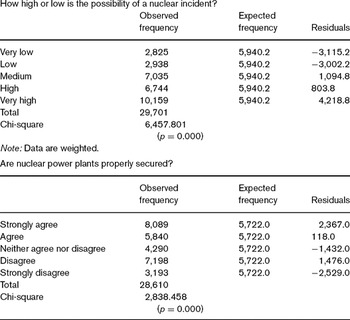
This poll includes two questions regarding individuals’ risk perception. First, the respondents were asked, ‘How high or low is your concern about the possibility of a nuclear incident in your country?’ The ordinal scale for this question ranged from very low to low, medium, high, and very high.Footnote 9 Second, they were asked, ‘To what extent do you agree or disagree that nuclear power plants in your country are properly secured against accidents?’ The answers were either strongly agree, agree, neither agree nor disagree, disagree, or strongly disagree.Footnote 10
Table 1 shows the results of the Chi-square test of these variables. It suggests that the frequency of the perceived possibility of a nuclear accident significantly differs between items. Also present is the evidence that there is a difference in the perception of the vulnerability of nuclear power plants between items.Footnote 11
Observed and expected frequency and chi-square test for risk perception (possibility of a nuclear incident/vulnerability of nuclear power plants)

Note: Data are weighted.
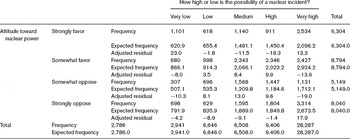
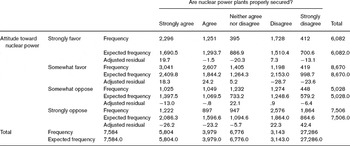
However, when looking at cross-tabulations between these variables and attitudes toward the use of nuclear energy for the world, a counterintuitive relationship is noticeable. Tables 2 and 3 show the frequency between the post-accident attitudes toward nuclear energy and the perceived potential for nuclear incident and the perceived vulnerability of nuclear power plants.
Cross-tabulations for risk perception (possibility of a nuclear incident) and attitudes toward nuclear power

Note: Data are weighted.
First, Table 2 largely confirms the finding that the lower an individual's perceived risk of a future nuclear accident is, the more he/she approves of the use of nuclear energy. For instance, the adjusted residual for ‘very low’ perceived risk is the highest in the row of ‘strongly favor’ and this perception is under-represented for negative attitudes (i.e., somewhat oppose and strongly oppose). ‘Low’, ‘medium’, and ‘high’ perceived risks largely fall into more neutral positions (i.e., somewhat favor and somewhat oppose). In a similar sense, ‘very high’ perceived risk is over-represented at strong opposition (the adjusted residual is 17.9). However, it is also important to note that a sizable number of those whose perceived risk is ‘very high’ belong to the category of strong approval of nuclear energy (the adjusted residual is 13.3).
Second, the relationship between perceived vulnerability of nuclear power plants and attitudes toward nuclear power is not fully straightforward, either (Table 3). In addition to the finding that agreement and strong agreement about the safety of nuclear power plants seems to be associated with an approval for the use of nuclear energy, strong disagreement is closely connected to a strong opposition to nuclear power. Disagreement is, however, not merely concentrated in oppositional attitudes but rather is dispersed to strong approval (the adjusted residual is 7.3).
Cross-tabulations for risk perception (vulnerability of nuclear power plants) and attitudes toward nuclear power

Note: Data are weighted.
Thus, the cross-tabulations reveal that there can be a gap between theories of risk perception and attitude toward nuclear power. This article addresses this point by taking into consideration a structural context in each country that influences these causal relationships. While risk perception itself is likely to vary across countries as stated in the preceding section, the demand for electricity and degree of dependence on nuclear energy in each country complicates the relationship between risk perception and attitude toward nuclear power. The need for more electric power due to economic development may blunt individuals’ perception of risk as well as contribute to positive attitudes toward nuclear power, and the excessive dependence on the energy source may provoke a sense of impending crisis. To explore the effects of individuals’ risk perception and country-level contexts upon their attitudes toward nuclear power, the following section lays out hypotheses to be tested.
Hypotheses
Individual-level independent variables
Perceptions of risk promote intolerance and a reliance on stereotypes (Doty et al., Reference Doty, Peterson and Winter1991; Bodenhausen et al., Reference Bodenhausen, Sheppard and Kramer1994).Footnote 12 As previously discussed, the literature on crisis and public opinion claim that the risk perception of accidents at nuclear power plants has an impact on public attitudes toward nuclear energy. This article does not reject but, to a certain extent, acknowledges that a higher level of risk perception leads to a higher level of opposition to the use of nuclear energy for the world.
Hypothesis 1: The higher the perceived risk of a future nuclear incident is, the more likely the public is to oppose the use of nuclear power.
This article uses a number of control variables. While most people surveyed did not directly experience the Fukushima nuclear accident, nor have they survived other dramatic events, information about the occurrences and aftermaths has been readily available to them through interpersonal communication and/or the media (Mutz, Reference Mutz1998). To accurately measure the impact of nuclear accidents on public attitudes, it is necessary to control for whether or not individuals were informed about the accident to be examined.
Despite attempts by previous works, findings related to the demographic effect on attitudes towards nuclear power are mixed (Ansolabehere and Konisky, Reference Ansolabehere and Konisky2009). However, among demographic variables, gender is considered a significant determinant that differentiates attitudes toward nuclear energy. According to Brody (Reference Brody1984), gender difference in the relationship with attitude is two-fold. First, given that men occupy more central positions in the economic, political, and technical fields, they tend to perceive a need for additional energy as a necessity for economic growth. In contrast, women, who are under-represented in those spheres, are less likely to identify a need for additional energy generated by nuclear power, as well as for the economic growth it promotes. Second, women are considered to have a greater concern for the safety of nuclear energy and the potential danger it poses to health and human life (Brody, Reference Brody1984). This may be endogenous to the previous point about gender differences because nuclear proponents and opponents focus on different aspects of the issue of nuclear energy. Proponents of nuclear power tend to stress the benefits of the energy (e.g. improvement in standard of living, promotion of economic growth, and solution to the energy crisis), but opponents attach importance rather to potential safety risks (DelSesto, Reference DelSesto1980; Otway et al., Reference Otway, Maurer and Thomas1978; Woo and Castore, Reference Woo and Castore1980).Footnote 13 In addition to gender, analytical models employ a demographic control variable such as age (using a four-point scale of under 30, 30–50, 51–65, and over 65), household income (measured in quintile), education (using a three-point scale of no/basic education, secondary school, and high level of education such as university), employment (working or not), and settlement type (rural versus urban).
Country-level independent variables
To examine the direct impact on anti-nuclear attitude with an intervening effect on the relationship between risk perception and public attitude, this article employs two independent variables at country-level. Considering that nuclear energy is more efficient than other means of electricity production, it is appealing for those who have a need for additional electricity. In countries with high levels of economic activity, the requirement for more electricity lends support to the use of nuclear energy because the industrial sector and ordinary citizens are likely to make the expanded demand for electricity. The variable dealing with a level of economic development is measured by GDP per capita, which represents the extent to which people (will) have a need for electricity. This country-level variable conditions individuals’ risk perception as well as influences their attitudes toward nuclear energy.
Hypothesis 2: The higher the level of economic development in a given country is, the more individuals in the country are likely to favor the use of nuclear power.
However, the increasing proportion of nuclear electricity production in itself elevates the probability that individuals will encounter nuclear accidents. This article considers that reliance on nuclear energy has an adverse effect on public attitudes. Citizens do not face the risk of radiation leakage unless they are within proximity of a nuclear power facility in which case a leaning toward the use of that energy source for the production of electricity will inevitably elevate individuals’ risk perceptions as to both nuclear power plants in general and the possibility of related accidents. Although a nuclear accident in a neighboring country, of course, seriously influences individuals, the dependence on domestic nuclear energy to provide electricity is a more direct way of measuring the variable. The data on the amount of electricity production are taken from the Power Reactor Information System (PRIS) of the International Atomic Energy Agency (IAEA). The dataset includes indexes of the annual amount of electricity production (GWh) for both nuclear power and total production. Using these data, the proportion of nuclear energy to total production of electricity is calculated.
Hypothesis 3: The higher a country's dependence on nuclear energy to provide electricity is, the more individuals in the country are likely to oppose the use of nuclear power.
Analysis
Models
To examine how both individual- and country-level variables are related to nuclear attitude drawn from cross-national survey data, the analysis employs multilevel modeling with HLM 6.08, in which individual-level independent variables (i.e., question items) are used for Level 1 and country-level variables for Level 2. Models include variables of perceived risk on nuclear energy and public attitude toward nuclear energy, along with other control variables at Level 1.Footnote 14 As for the purpose of this article, the multilevel modeling is an adequate method in that it partitions the variance into within-country and between-country components and computes the explanatory power of predictors at both levels simultaneously; that is, the modeling allows us to estimate a set of coefficients as outcomes to be simultaneously explained as a function of measured differences between countries (see Bryk and Raudenbush, Reference Bryk and Raudenbush1992).
Since the dependent variable (i.e., attitude toward the use of nuclear energy for the world) is an ordered category (1 = ‘strongly favor’, 2 = ‘somewhat favor’, 3 = ‘somewhat oppose’, and 4 = ‘strongly oppose’), an ordinal regression model is estimated. This article considers a model that allows us to vary both intercept and slope (Appendix A describes the full model). This model estimates random-intercept and random-slope effects since country-level variables are assumed to condition individual-level slope coefficients. In addition to the assumption that country-level variables account for variation in individual-level constants, which are left unexplained by individual-level explanatory variables, the overall structure of this model (i.e., GDP per capita and proportion of nuclear electricity production) influences individuals’ attitudes toward nuclear energy. This implies that the variation among countries in intercepts (the average level of individuals’ attitude toward nuclear power) and slopes (the association between their risk perception and attitude toward nuclear power) can be explained by country-level characteristics. Appendix B represents countries from which the samples in the multilevel models are drawn and the selection procedures.
Results
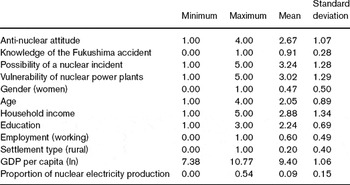
Table 4 presents descriptive statistics for all the variables. Knowledge of the Fukushima accident and gender, as well as employment and settlement type, are dummy variables. The question posed regarding knowledge of the accident is paired with that of the earthquake followed by a tsunami on 11 March 2011 in the northeastern region of Japan, and respondents were asked, ‘Have you heard or read about the leakage of radiation from a nuclear reactor in Japan as a result of the earthquake?’ The related variable is coded 0 = no and 1 = yes. The gender variable is recoded so that male is represented by 0 and female 1. The variables for possibility of nuclear incident and vulnerability of nuclear power plants are on a five-point scale. For the variables at Level 2, the proportion of nuclear electricity production is measured by percentage, and GDP per capita is the natural-log value.
Descriptive statistics

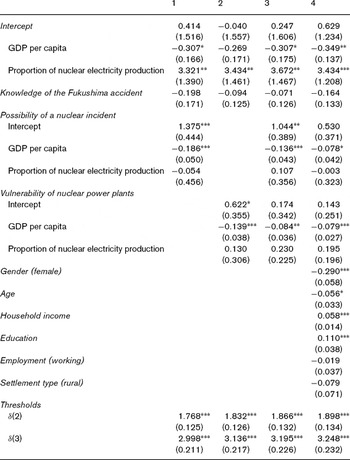
Table 5 presents the results of the analysis. For individuals’ risk perception, two variables are examined: (1) the possibility of a nuclear incident in a respondent's country and (2) the vulnerability of nuclear power plants in the designated country. Model 1 examines the former variable, and Model 2 includes the latter, both of which take into consideration the effect of the Fukushima accident by adding knowledge of the incident. Model 3 is distinctive from these models in that it considers both variables of risk perception. Model 4 includes control variables such as gender, age, income, education, employment, and place of residence.
Multilevel modeling for risk perception and anti-nuclear attitudes

Notes: * p < 0.10, ** p < 0.05, *** p < 0.01. Two-tailed test. Standard errors are in parentheses. The number of observations is 16,404 and the number of clusters is 33 in each model.
In Model 1, the individual-level independent variable dealing with the possibility of a nuclear incident is positive and statistically significant at the 0.01 level. The model excludes control variables, except for knowledge of the Fukushima accident, but suggests that a higher level of the perceived possibility of a nuclear incident leads to a negative opinion about the energy source. Both country-level independent variables as intercepts are statistically significant. GDP per capita has a negative effect on anti-nuclear attitudes and the proportion of nuclear electricity production has a positive effect; that is, people in wealthier countries are more supportive of nuclear energy, but they are oppositional in countries where dependence on the energy is greater. Once these country-level variables are taken into the slope of the individual-level variable, only the level of economic development is statistically significant and has an alleviative effect on the relationship between risk perception and anti-nuclear attitude. This suggests that the oppositional attitudes of those who perceive a high risk of nuclear incident are eased in economically developed countries.
Model 2 includes the variable of vulnerability of nuclear power plants instead of possibility of a nuclear incident. The effect of this variable is positive and statistically significant, implying that individuals’ risk perception on nuclear facilities increases their anti-nuclear attitudes. GDP per capita remains statistically significant and has a positive influence on pro-nuclear attitude. The variable also reduces the positive association between the perceived vulnerability of nuclear power plants and anti-nuclear attitude. Although a level of economic development is likely to render individuals’ view toward the energy source favorable, as in Model 1, the variable of proportion of nuclear electricity production is statistically significant and has a positive effect on anti-nuclear attitude only when it is considered as an intercept. Overall, the model indicates that, even if individuals were informed of the Fukushima nuclear accident, the perceived vulnerability of nuclear facilities had a lesser impact on negative attitudes toward nuclear energy in wealthier countries that consume a great amount of electricity. The dependence on nuclear energy functions in the opposite way and makes the public less tolerant to the use of the energy.
Model 3 takes into consideration both variables of risk perception and provides some distinctive findings. First, perceived possibility of a nuclear incident is statistically significant. Despite the finding that, as in Model 1, individuals’ perception on risk of the next nuclear incident increases their anti-nuclear attitudes, a level of economic development itself makes public attitudes more favorable to nuclear energy. This variable has the same effect on the association between people's risk perception and their attitude toward the energy. Second, however, perceived vulnerability of nuclear power plants turns insignificant, while GDP per capita shows an alleviative effect on the relationship between risk perception and anti-nuclear attitude. A country's dependence on nuclear energy for electricity production increases a negative view on that energy source, yet has no effect on the relationship between individuals’ risk perception and anti-nuclear attitudes.
The full model (Model 4) takes into consideration individual-level control variables such as gender, age, household income, education, employment, and settlement type. Among the individual-level control variables, gender, age, household income and education are statistically significant. One of the differences from Model 3 is that, in the full model, the possibility of a nuclear incident becomes insignificant. A result still confirms that the increasing dependency on nuclear electricity production leads to individuals’ opposition to the use of nuclear power. A level of economic development, as both an intercept and slope, maintains its effect on nuclear attitude; individuals in wealthier countries are more favorable to nuclear energy than those in less affluent countries, and whether or not individuals’ risk perceptions promote anti-nuclear attitudes, economic wealth does contribute to generating more pro-nuclear attitudes. In this model, individuals’ risk perception of nuclear facilities does not show statistical significance (the p-value is 0.572).
Model 4 also shows the counterintuitive effect of gender difference on the attitude toward nuclear power. Previous works have provided a finding that, unlike men, women in past surveys have had a negative attitude toward nuclear energy. However, this model suggests that women tend to support nuclear energy more than men do (the variable is statistically significant at the 0.01 level).Footnote 15
Looking at Models 1 through 4, it is possible to claim that economic development is a strong indicator that accounts for public attitudes toward nuclear energy. As an intercept, a level of economic development promotes a favorable attitude toward nuclear energy. This variable has significant effects on individuals’ risk perception and attitudes toward nuclear power as well throughout the models. The other country-level independent variable, the proportion of nuclear electricity production, is less salient than economic development, but it directly influences nuclear attitude; people tend to have stronger antipathy against the energy in countries where electricity production is largely dependent on nuclear power.
Discussion
The multilevel models show that the country-level variables have important effects on individuals’ attitudes toward nuclear energy. Those Level-2 variables used in the models vary across countries and, therefore, differently condition the public attitudes. To complement the findings from the multilevel models, this section discusses various associations between risk perception and anti-nuclear attitude.
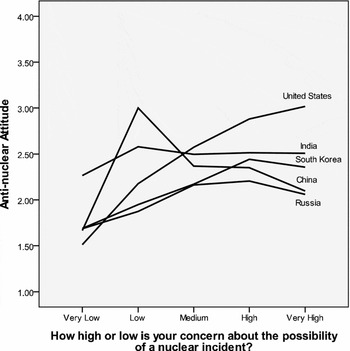
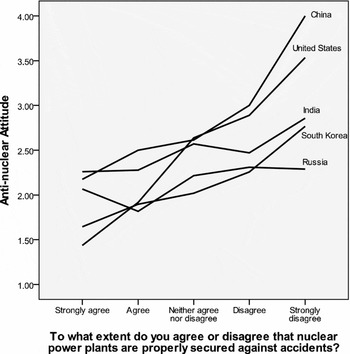
Figures 1 and 2 represent mean scores for anti-nuclear attitude and risk perception measured by the possibility of a nuclear accident and the vulnerability of nuclear facilities in selected sample countries of the survey. As theories of risk perception and attitudes toward nuclear power predict, a perceived high risk seems to be generally associated with negative attitudes toward the energy source. However, it is interesting that the relationship between risk perception and anti-nuclear attitude largely varies across countries. In Figure 1, countries such as the US, South Korea, and Russia more or less have a positive association between risk perception and anti-nuclear attitude; those who view the risk of another nuclear incident as minimal are likely to favor the use of nuclear energy for electricity production, yet those who view the risk as real to them tend to oppose it. The public opinion in India is, in contrast, less influenced by risk perception and the Chinese anti-nuclear attitude even decreases as individuals’ perception of the possibility of a nuclear incident increases, except for the sharp rise at mid-point. It should be noted that the level of anti-nuclear attitude also varies across countries. For instance, the US public overall shows stronger opposition to nuclear power than does that in Russia.
Risk perception (possibility of a nuclear incident) and attitude toward nuclear power

Risk perception (vulnerability of nuclear power plants) and attitude toward nuclear power

Figure 2 also indicates that the anti-nuclear attitude correlates positively with risk perception as scaled by the vulnerability of nuclear power plants. As in Figure 1, however, the strength of the relationship between these two variables is different from country to country; while the relationship is weak in India and Russia, the risk perception strongly reflects the increase in antinuclear attitude in countries such as the US and China. Moreover, the figure reveals that the level of opposition to the energy source is relatively low in Russia, yet it is high in China. China is indeed an interesting case in that, compared with other countries, the possibility of a future incident is in inverse proportion to anti-nuclear attitudes, although the vulnerability of nuclear facilities greatly intensifies the degree of public disapproval of the energy source. Therefore, both of these variables on risk perception have different paths through which they influence individuals’ attitude toward nuclear energy.
In the figures, the country-level variables (i.e., demand for electricity and dependence on nuclear energy) are not ignorable, either. India shows a lower level of anti-nuclear attitude than does the US, while per capita income in India is lower than that in the US. However, considering that a deep dependence on nuclear energy may foster concern about its accident, the US public is reasonably influenced by this negative view. In 2010, according to the data obtained from the PRIS, the percentages of nuclear energy in total production of electricity were 19.18% in the US and 1.77% in India.
Conclusion
The perception of risk associated with nuclear power plants is believed to lead to an anti-nuclear attitude. This article finds that the perceived risk of nuclear accidents has a significant impact on the expansion of negative attitudes toward the use of nuclear energy for the production of the world's electricity. When the risk is real to them, the public is more likely to become opposed to nuclear energy. However, the article does argue that a structural context conditions these individual-level variables. A level of economic development and consequential demand for the consumption of electricity largely alleviates a negative effect of risk perception on individuals’ support for the energy. In addition, the extent to which a country depends on nuclear energy for the production of electricity has been shown to encourage negative attitudes toward nuclear power.
These findings are significant as they help us to better understand the effects of the overarching structure that influences individuals’ opinions about the use of nuclear energy. This article has aimed to address the puzzle of why people may support nuclear energy despite their perception of a probable nuclear disaster. The multilevel modeling reveals that risk perception is not linearly associated with anti-nuclear attitude. It is still important to note that the results fit an untested assumption that a need for the efficient production of electricity (i.e., nuclear energy) may outstrip the potential danger of a nuclear incident. The demand in itself may, in fact, dictate the continued use of nuclear power, despite the likelihood of future dramatic events such as occurred at the Fukushima nuclear power plants.
Findings presented in this article may be partial in that the analysis does not address individuals’ attitudes toward nuclear energy in their own countries but rather deals with the use of the energy for the world. Public attitudes may differ between NIMBY and NIABY as many of the respondents have not had the occasion to be concerned about the construction of nuclear plants in their immediate surroundings and, secondly, many have not been as directly affected by the disastrous nuclear episodes of the world. Given the findings, however, examining likely conditions for the expansion of favorable opinion about nuclear energy under a situation of high risk of a nuclear incident suggests itself as a useful framework for arriving at an understanding of the contradictory relationship between risk perception and attitude toward nuclear power.
About the author
Yuichi Kubota is a Ph.D. candidate at State University of New York at Albany.