Introduction
In the UK, otolaryngology is under-represented in medical school, typically comprising less than 1 per cent of the curriculum.Reference Davies and Elhassan1 Many medical schools lack a mandatory placement in otolaryngology and most UK medical graduates feel they have not received sufficient otolaryngology undergraduate training.Reference Ferguson, Bacila and Swamy2 The lack of dedicated otolaryngology teaching appears to result in important omissions from the curriculum. A recent review of UK otolaryngology undergraduate curricula showed that only two-thirds of medical schools include otolaryngology history taking, and only 58 per cent include tonsillitis.Reference Steven, Mires, Lloyd and McAleer3
Demands on otolaryngology service provision are predicted to increase, with problems such as hearing loss, dizziness and epistaxis being prevalent in the growing ageing population. In the UK, there are concerns that future workforce demands in otolaryngology will outstrip supply.Reference Wilmot, Davis and Carrie4 In recent years, we have seen a concerning downward trend in application rates to otolaryngology specialty training.Reference Green, Steven and Haddow5 The reason for this decline is unclear; however, exposure to otolaryngology during undergraduate training appears to be an important positive influential factor in medical students’ and junior doctors’ decision to pursue a career in otolaryngology.Reference Nguyen, Liu and Church6,Reference McCaffrey7
For these reasons, it is imperative that teaching time is utilised effectively and that undergraduates are provided with the best possible experience of otolaryngology. At Newcastle University Medical School, otolaryngology teaching is delivered during a 2-day compulsory placement in the final year of medical school. This presents particular challenges in providing students with exposure to the diversity of otolaryngology as well as ‘showcasing’ the specialty as a possible career option. This study aimed to audit the impact of a change in the delivery of final year tuition and measure its impact on student satisfaction.
Materials and methods
Participants were final year medical students completing a 2-day compulsory otolaryngology placement. Groups of between six and eight students attended the placement each week. The first cohort of students received the baseline teaching programme. This was assessed over a 4-week period using an online anonymous questionnaire emailed to participants immediately following completion of their 2-day placement. The questionnaire consisted of statements that participants responded to on a 7-point Likert scale (1 = strongly disagree, 7 = strongly agree) and free-text responses (Appendix 1).
Using the feedback provided by those students who completed the questionnaires, the baseline teaching programme was revised in order to produce a novel teaching programme. This novel teaching programme was assessed over a 10-week period using an anonymous paper questionnaire given to participants at the end of their 2-day placement, again combining the use of the 7-point Likert scale and free-text responses (Appendix 2).
Raw data were entered using Microsoft™ Excel spreadsheet software. Data from Likert scale responses are presented as mean scores. A tally of common free-text responses was recorded to identify the most frequent responses.
For both the baseline and novel teaching programmes, lectures were attended by all the students at the same time. In order to prevent crowding in clinical environments, students were distributed evenly between clinics and operating theatres, with no more than one student in a single clinic or operating theatre at a time.
Results
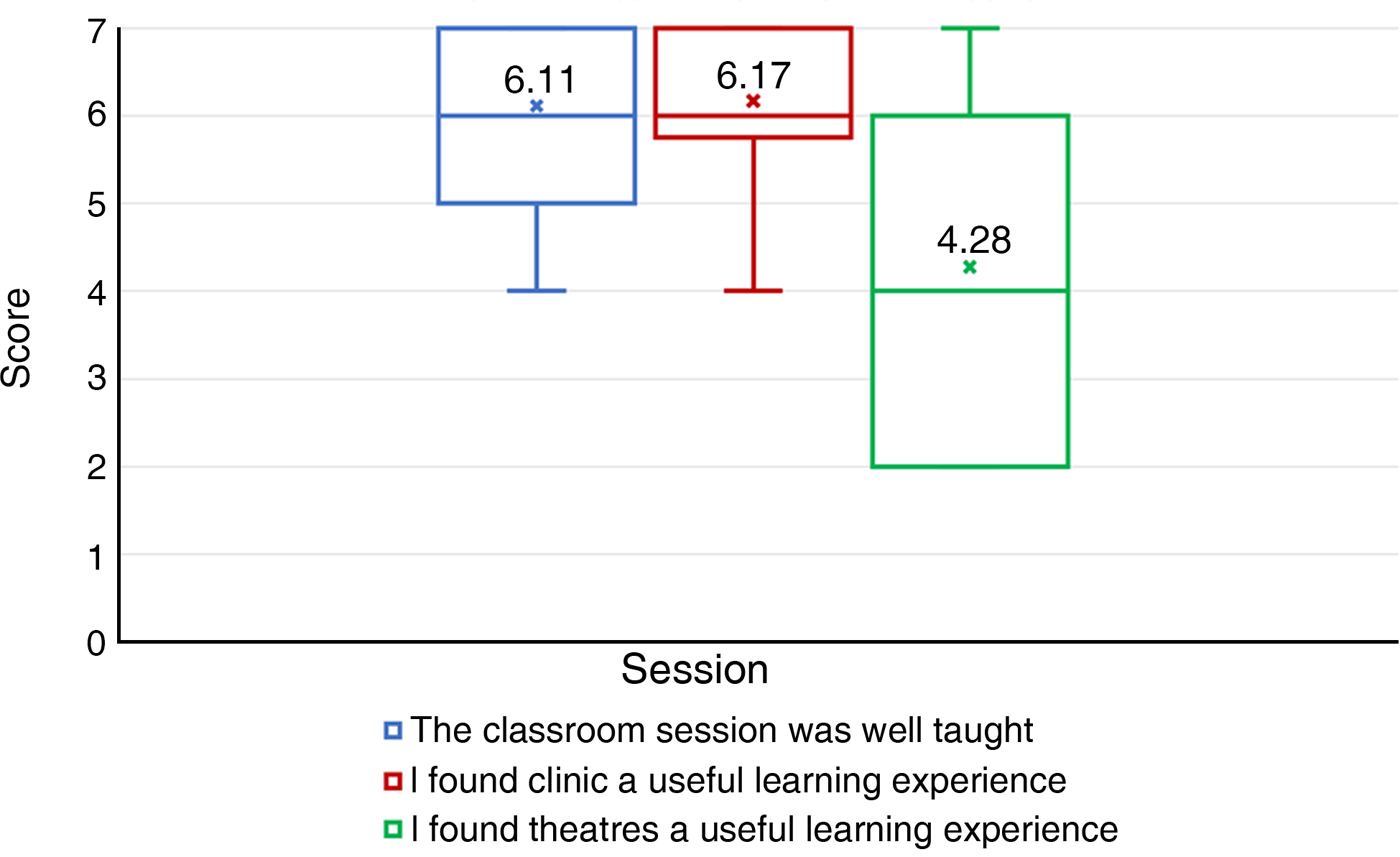
Twenty-eight participants completed the baseline teaching programme (Table 1). Nineteen participants completed the questionnaire, giving a response rate of 68 per cent. Overall, the baseline teaching session was positively reviewed, although some students did not find attending an operating theatre a useful learning experience (Figure 1). When asked how we could improve the placement, the most common suggestions were to reduce the duration of the classroom session (n = 6) and to include a clinical skills session (n = 6).
Overview of baseline teaching programme

H = hours
Box-and-whisker plot showing feedback results from the baseline teaching programme. Score of 1 = strongly disagree and 7 = strongly agree.

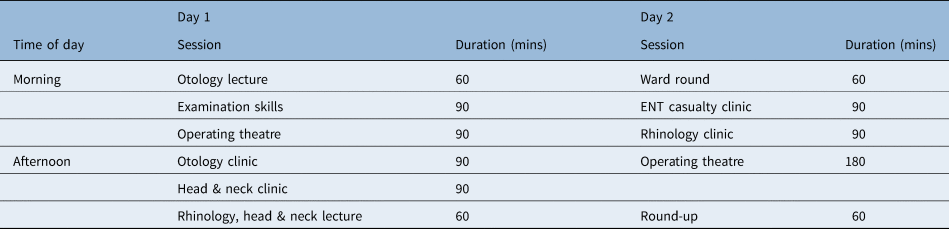
At this point, sufficient feedback had been gathered to develop our novel teaching programme (Table 2). Several changes were made in order to optimise the student experience. Firstly, we incorporated a 90-minute examination skills session. These sessions were taught by the clinical teaching fellow, and attended by two students at a time. The session covered ear, nose, neck and cranial nerve examinations, and students received formal feedback on their examination skills. Secondly, the content from the classroom session was split across the 2-day placement into an otology lecture, and a rhinology, head and neck lecture. Thirdly, a workbook of 20 multiple choice questions was developed that was relevant to the students’ learning outcomes. Students were provided with the answers during a round-up teaching session at the end of the placement. Fourthly, clinics were split into two 90-minute sessions in order to increase the breadth of clinical cases seen (e.g. 90 minutes in an otology clinic and then 90 minutes in a rhinology clinic).
Example timetable for a student completing the novel teaching programme

Mins = minutes
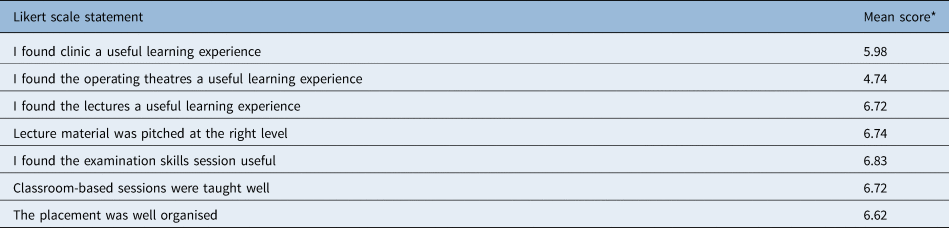
Seventy participants completed the novel teaching programme, 58 of whom completed the questionnaire, giving a response rate of 83 per cent. The lectures, examination skills session and placement organisation scored highly (Table 3). In comparison with classroom-based sessions, students found attending the clinics and operating theatre a less useful learning experience.
Novel teaching programme feedback results

Data based on 58 responses. *Score of 1 = strongly disagree and 7 = strongly agree.
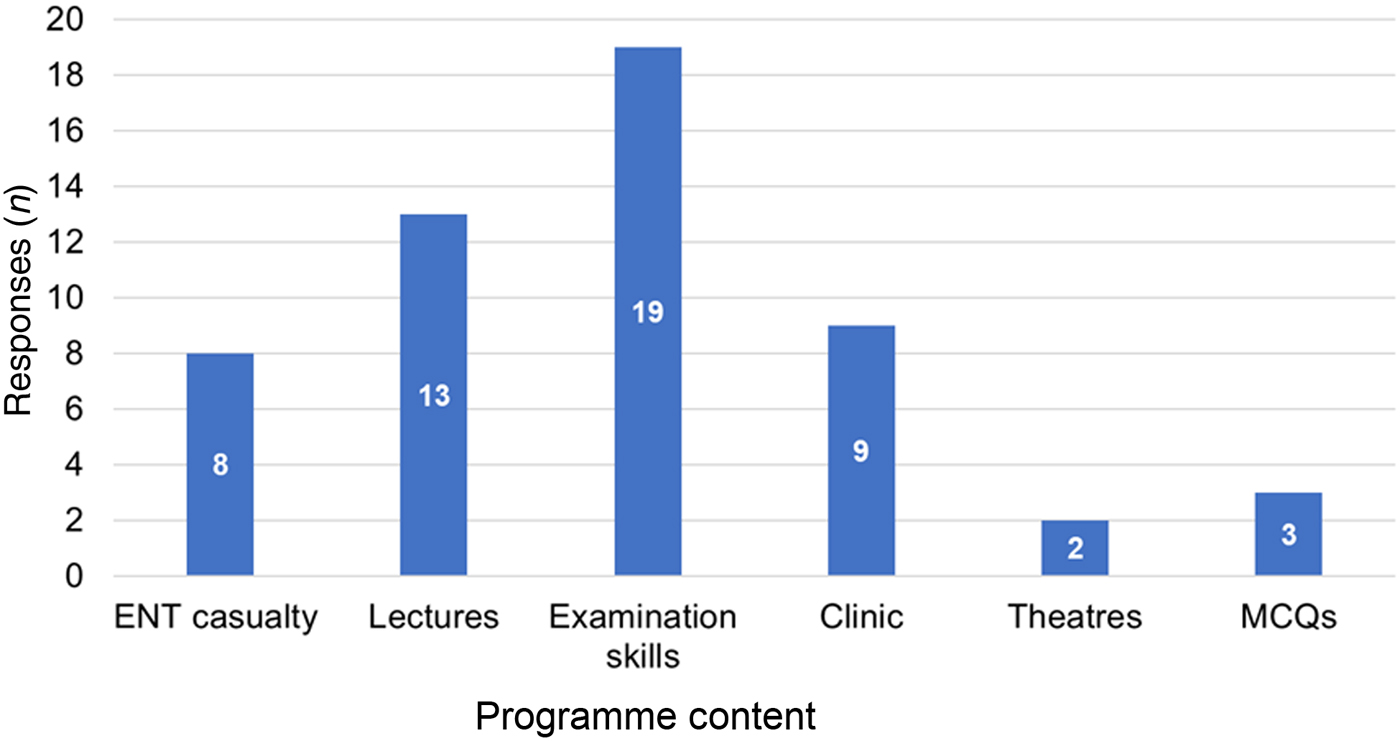
Participants most commonly found the examination skills session the most useful part of the placement (Figure 2). When students were asked how the placement could be improved, the most common response was that the placement needed to be longer (n = 8).
Free-text response feedback results for the novel teaching programme, showing responses to the question ‘What was the most useful part of the placement?’. MCQs = multiple choice questions

Discussion
Students found attending the clinics and operating theatre a less useful learning experience than they did the classroom-based sessions. One explanation for this may be the lack of exposure to otolaryngology as an undergraduate; with a poor level of baseline knowledge, students may struggle to follow a clinic consultation or the principles of a surgical procedure. Instead, the students found the examination skills session the most useful part of the placement, revising skills that were taught during the second and third years of medical school. Another potential explanation for this finding is that, within the classroom environment, the student is placed at the centre of the learning process, where the tutor's focus is on engaging the students. In contrast, during workplace-based learning, the primary focus is on the patient. Balancing the triadic relationship between clinician, patient and student in order to facilitate learning can be notoriously difficult.
Workplace-based learning is opportunistic and dependent on the clinical cases that present during a day. Therefore, the experience for the learners is inconsistent. In contrast, classroom sessions occur within a controlled learning environment, and consequently the learners’ experience is more reliable. Medical students’ focus is often on passing exams, rather than preparation for practice. Therefore, it may be expected that controlled learning experiences are more popular amongst students, as they usually have a higher educational yield in a given time period.
What the medical student may not recognise is the importance of workplace-based learning in their professional development. With clinical experience comes tactic knowledge; knowledge not easily transferred from one individual to another by means of didactic discourse. This encompasses areas such as non-technical skills, diagnostic reasoning and pattern recognition.Reference Heiberg Engel8 Furthermore, experiential learning in the workplace encourages reflective practice. Consider constructivist theorist David Kolb's learning cycle: the student's experience in the clinic or operating theatre provides a ‘concrete experience’ on which they can reflect, identify principles, form opinions and assimilate this into their existing knowledge. They are then ready to utilise this new knowledge in new experiences and the cycle continues. As such, this approach has another advantage in that learners gain applied rather than abstract knowledge.Reference Yardley, Teunissen and Dornan9 Additionally, spending time in the clinical environment allows students to appreciate the role of the otolaryngologist and provides an insight into what a career is like within the specialty.
Our teaching programme was organised and taught by an otolaryngology clinical teaching fellow. Clinical teaching fellows are junior doctors who are commonly undergoing a formal teaching qualification. They are relieved of some or all of their clinical commitments, allowing time for curriculum planning and placement organisation. Evidence suggests that students find teaching fellows more approachable, feel that content is pitched at the correct level and often prefer being taught by clinical teaching fellows rather than consultants.Reference Woodfield and O'Sullivan10 We noted a decrease in student satisfaction with lectures and placement organisation during the week in which consultants delivered the teaching programme rather than the otolaryngology clinical teaching fellow. Wider availability of clinical teaching fellow posts in otolaryngology could help ensure more consistent high-quality otolaryngology teaching for undergraduates.
• Otolaryngology is under-represented in UK medical school curricula
• Many medical graduates do not feel they have received sufficient otolaryngology undergraduate training
• Medical students find attending otolaryngology clinics and operating theatre less useful for learning than classroom-based sessions
• A practical otolaryngology examination skills session is a popular teaching modality amongst final year medical students
• Clinical teaching fellows are useful in the delivery of undergraduate otolaryngology education
• Medical students and otolaryngologists desire greater exposure to otolaryngology in the undergraduate curriculum
The most frequent suggestion of how to improve the programme was to increase the length of the placement. A desire for increased otolaryngology placement time is common amongst medical students and medical graduates.Reference Ferguson, Bacila and Swamy2 In addition, the duration of undergraduate placement is often considered insufficient for making an informed career choice with regard to otolaryngology. A study by Doshi and Carrie showed that within a cohort of 30 surgically inclined final year medical students, only 6 felt they had enough undergraduate otolaryngology exposure to consider the specialty as a career.Reference Doshi and Carrie11 Furthermore, a study by Powell et al., of 444 foundation year one doctors, showed that only 8.7 per cent of respondents would consider otolaryngology as a career. A significant proportion of respondents felt they had not received adequate experience and information to make an informed career choice regarding otolaryngology.Reference Powell, Cooles, Carrie and Paleri12
One aspect we found challenging was the number of students in our department each week. The number of students per week had increased from the previous year, from six to eight. Although a small increase, this posed a significant barrier toward certain teaching modalities such as bedside teaching. Moreover, with current efforts to increase the number of medical school places available, one may anticipate this becoming an increasing problem.Reference Rimmer13 This issue is compounded by the current working climate and the European Working Time Directive; junior doctors’ availability to teach medical students is limited.Reference Baker, Spence, Boohan, Dorman, Stevenson and Kirk14
E-learning may help to provide a solution. E-learning can help alleviate the demands of teaching on staff time, and learners can have control over the content, pace, time and place in which learning occurs. ENT UK has produced a number of e-learning resources for this purpose, including: e-LefENT (an e-learning platform),15 Student and Foundation Doctors in Otolaryngology (‘SFO UK’) examination videos,Reference SFO16 and the recently developed ENT UK medical student and junior doctor handbook.Reference SFO17 More widespread use of alternative effective teaching modalities, such as e-learning, should be considered in light of the increasing numbers of medical students in the clinical workplace.
Conclusion
Near-peer led lectures and clinical skills sessions are effective means of teaching undergraduates otolaryngology. Although workplace-based learning is less popular with medical students, it still plays an important role in their learning and as such should not be omitted. A mutual desire for greater exposure to otolaryngology in the undergraduate curriculum is held by medical students and otolaryngologists.
Competing interests
None declared
Appendix 1 Online anonymous questionnaire given to baseline teaching programme participants

Appendix 2 Paper anonymous questionnaire given to novel teaching programme participants
Hospital Based Practice ENT Feedback Form
Start date of placement:
Name of tutor(s):
Otology
Rhinology, head & neck
Examination skills teaching (Monday)
Examination skills teaching (Tuesday)
Round-up