Introduction
Cowpea (Vigna unguiculata (L.) Walp) (Fabaceae) is an important crop in the tropics, and due to its high-protein content, constitutes a major food staple for people in sub-Saharan Africa (Murdock et al., Reference Murdock, Coulibaly, Higgins, Huesing, Ishiyaku, Sithole-Niang, Kole and Hall2008). Burkina Faso, one of the main cowpea-producing countries in West Africa, produces an estimated 455,500 tons annually (FAOSTAT, 2007). However, the average yield (282 kg/ha) is considerably lower than the estimated potential of nearly 2900 kg/ha (Muleba and Ezumah, Reference Muleba, Ezumah, Singh and Rachie1985; Singh et al., Reference Singh, Chambliss, Sharma, Singh, Mohan-Raj, Dashiell and Jackai1997), due to a combination of abiotic (e.g. drought and soil quality) and biotic (e.g. pests and pathogens) factors. In the more northern areas, rainfall is the limiting factor, while in more southern regions, pest pressure is considered the most important constraint on cowpea production (Singh and Van Emden, Reference Singh and Van Emden1979; Singh et al., Reference Singh, Jackai, Dos Santos, Adalla and Singh1990).
The legume pod borer Maruca vitrata Fabricius (Lepidoptera: Crambidae) is one of the key cowpea pest species as the larvae feed on the tender parts of the stem, peduncles, flower buds, flowers and pods (Singh and Jackai, Reference Singh and Jackai1988), and infestations may reduce yield by 20–80% (Singh et al., Reference Singh, Jackai, Dos Santos, Adalla and Singh1990). Currently, insecticide sprays are the only viable control technology available, but this approach has been compromised with the appearance of resistance to multiple classes of insecticides (Ekesi, Reference Ekesi1999). Thus together with the environmental and health problems associated with pesticide use, it is necessary to provide farmers with more sustainable pest management options for the control of the legume pod borer.
To develop sustainable integrated pest management programmes, regardless of the management practices deployed, it is essential to have a better understanding of the seasonal biology of M. vitrata. In sub-Saharan Africa, there are three distinct rainfall-based ecological zones from south to north (Sudanian, Sudano-Sahelian and Sahelian), with annual rainfall declining as one moves north. Previous studies stated that M. vitrata is present throughout much of the year in more southerly regions of the cowpea grain shed of West Africa, where the rainfall is higher (the Sudanian zone; Bottenberg et al., Reference Bottenberg, Tamò, Arodokoun, Jackai, Singh, Youm, Singh, Mohan-Raj, Dashiell and Jackai1997). However, in drier more northerly regions (the Sahelian zone), it has been hypothesized that M. vitrata adults are migrants from the south (Bottenberg et al., Reference Bottenberg, Tamò, Arodokoun, Jackai, Singh, Youm, Singh, Mohan-Raj, Dashiell and Jackai1997; Arodokoun et al., Reference Arodokoun, Tamò, Cloutier and Adeoti2003) during the rainy season. It is still unknown whether M. vitrata persists at low densities on wild host plants during the dry season when cowpeas are not available.
In this study, we examined the seasonal abundance of M. vitrata adults in light traps in the three agro-ecological zones, and a subset of females was dissected to determine the incidence of mating and the pattern of ovarian development, as this could provide insight concerning the migratory status of this species (McNeil, Reference McNeil1987). In addition, other cultivated and wild plants were sampled for the presence of M. vitrata larvae. The current study tests the following two hypotheses. First, in the Sahelian and Sudano-Sahelian zones, M. vitrata occurs only during the rainy season when cowpea is cultivated. Second, in the Sudanian zone, M. vitrata occurs throughout the year surviving mainly on cowpea during the rainy season and on wild hosts during the non-cowpea growing season.
Materials and methods
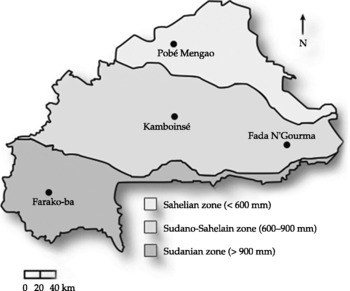
The study was carried out at three geographical locations during 2005 and 2006: Pobé Mengao in the north (Sahelian zone), Kamboinsé in the Sudano-Sahelian zone and Farako-ba in the south-west (Sudanian zone; Fig. 1). Each location differed considerably both in the length of the rainy season and the level of precipitation. In 2006, we also sampled in Fada N'Gourma (Sudano-Sahelian zone; Fig. 1).
Map of Burkina Faso showing the locations of each of the light traps is given within the context of the three ecological zones, along with data regarding regional rainfall.

The light traps utilized a 500 Watt mercury vapour white incandescent bulb positioned above a wire mesh cage (1.38 m width × 1.93 m height), which rested on a metal support set 2.43 m above ground level. At each location, the trap was emptied daily and all M. vitrata adults were collected and placed into plastic vials containing 70% ethanol. A subsample of females (n = 225), captured on different dates over the flight period, was dissected to evaluate the incidence of mating based on the presence or absence of a spermatophore.
The incidence of cowpea flowers and pods attacked by M. vitrata larvae was also monitored during the growing season. At each location, samples were collected from 50 different farms (n = 50), all within a 25 km radius of the light trap. Forty randomly chosen flowers were collected from each farm at the beginning and at the end of the cowpea flowering period, which lasted about 2 weeks. The flowers were examined for the presence or absence of M. vitrata larvae.
In 2005 and 2006, plant species reported as alternative hosts in Benin and Nigeria (Bottenberg et al., Reference Bottenberg, Tamò, Arodokoun, Jackai, Singh, Youm, Singh, Mohan-Raj, Dashiell and Jackai1997; Arodokoun et al., Reference Arodokoun, Tamò, Cloutier and Adeoti2003) were visually examined for the presence of M. vitrata larvae. Once a month, all flowering plants in the families Caesalpiniaceae, Mimosaceae, Fabaceae and Combretaceae were sampled along a randomly chosen 5-km transect from the research stations where the light traps were installed. The larvae that were collected were then reared until adult emergence to confirm their identity as M. vitrata.
Data analysis
SAS (2001) software version 8 was used for data analysis. ANOVA was performed for the percentage of flowers hosting M. vitrata larvae. For each year, comparison was made between the sites, and separation of the means was done using the Student–Newman–Keuls test at 5% significance level.
Results
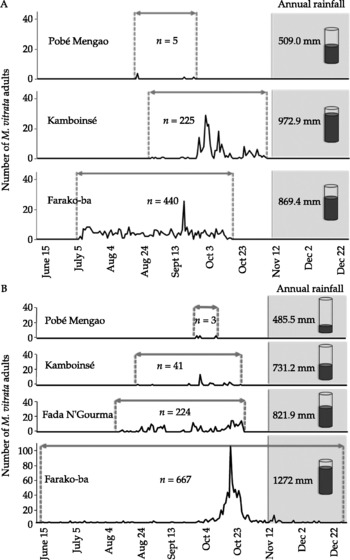
The number of M. vitratra adults captured, and the duration of the flight period, varied with latitude, with an evident decline in both parameters as one moves from regions at lower latitudes with high rainfall to higher latitude sites with lower rainfall, in both 2005 and 2006 (Fig. 2A, B).
Adult Maruca vitrata catches in the light trap (A) at three locations: (i) Farako-ba, (ii) Kamboinsé and (iii) Pobé Mengao from 15 June 2005 until 22 December 2005; (B) at four locations (i) Farako-ba, (ii) Fada N'Gourma, (iii) Kamboinsé, and (iv) Pobé Mengao from 15 June 2006 until 22 December 2006. Catch number (n) indicates the total number of adult M. vitrata caught during the year. Cumulative annual rainfall is indicated as rainfall on the figure at each location.

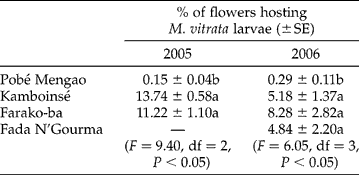
The levels of infestation of flowers showed inter-year variability at all three sites (Table 1); however, larvae were present in the cowpea fields at all the locations tested. Within either year, infestations were lowest in the Sahelian region, as would be expected given the short period of flight activity and the low numbers of moths captured. Nearly 70% of all individuals captured in light traps were males, suggesting that females are less attracted to light traps or that the sex ratio of the populations is not 1:1. The first mentioned possibility is supported by the fact that total light trap catches do not really provide a good predictor of the inter-year variability in the infestation of flowers (Table 1). For example, at Farako-ba, the proportion of flowers or pods with larval damage was higher in 2005 than in 2006 (Table 1), while the inverse was true for the number of moths captured (Fig. 2A, B).
Incidence of Maruca vitrata larvae on cultivated cowpea flowers at different geographical sites in Burkina Faso in 2005 and 2006
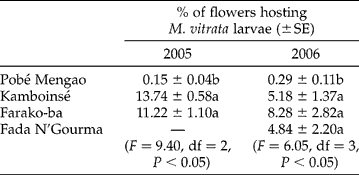
Means within a column followed by the same letter are not significantly different (P < 0.05; SNK-test).
There was no evident seasonal pattern in the incidence of mating at any of the sites. In fact, overall very few of the females dissected were mated ( < 20%) and these individuals were found at different times through the season. However, it is of interest to note that at Pobé Mengao, a site believed to have no permanent Maruca population, only three females were captured in 2 years but they were all mated.
During the cowpea growing season in Farako-ba, M. vitrata larvae were also found on young shoots, shoot-tips of Daniellia oliveri (Rolfe.) Hutch & Dalz (Fabaceae), on pods of Cassia sieberiana DC. (Caesalpiniaceae), as well as on flowers, pods and leaves of Cajanus cajan L. Millsp (Fabaceae). Outside the cowpea growing season, larvae were only found on the cultivated French bean Phaseolus vulgaris L. (Fabaceae) and the wild host D. oliveri. The latter is a common perennial plant in the Sudanian zone that flowers during the dry season in January, and forms pods from February to April. On D. oliveri, attacked organs were detected by the presence of webbing and excreta found in the damage holes of the stems. No larvae were found on alternate hosts in Kamboinsé, Fada N'Gourma or Pobé Mengao areas.
Discussion
The fact that M. vitrata adults were captured in light traps over most of the year in Farako-ba, and that larvae are found on alternate hosts when cowpeas were not present, supports the hypothesis that this pest maintains permanent populations in the Sudanian zone of Burkina Faso. However, in the more northerly zones, the shorter flight periods of the moth and the absence of larvae on alternate hosts when cowpeas were not present suggests that the infestations were the result of immigration from the permanent populations in the south. The prevailing winds at the onset of the rainy season (Pedgley et al., Reference Pedgley, Reynolds, Tatchell, Drake and Gatehouse1995) facilitate northward movement of adults. Such windborne migration of M. vitrata has already been documented, using searchlight traps, in northern China (Feng et al., Reference Feng, Wu, Cheng and Guo2003). However, we cannot rule out the possibility that M. vitrata may enter a prolonged diapause during the dry season in the more northerly sites, although Bottenberg et al. (Reference Bottenberg, Tamò, Arodokoun, Jackai, Singh, Youm, Singh, Mohan-Raj, Dashiell and Jackai1997) found no evidence of diapause in this species.
Differences in the incidence of mating of individuals captured in light traps over the season have been used as a possible indicator of seasonal migration in Lepidoptera (McNeil, Reference McNeil1987). However, no such patterns were observed for M. vitrata in this study. In part, this may be due to the low proportion of adults captured, which were female. Male-biased light trap catches are common in many Lepidoptera (Herbert, Reference Herbert1983; Acharya, Reference Acharya1995) and may reflect differences in behaviours associated with reproduction. It is also possible that M. vitrata transiently extends its geographical range temporarily during the time when cultivated cowpeas are available in normally unsuitable habitats, but these populations die out at the end of the season. This scenario, described as the ‘Pied Piper’ phenomenon by Rabb and Stinner (Reference Rabb and Stinner1978), may not be as readily detected using trapping data as for those species that immigrate to exploit available resources and then emigrate when the habitat quality declines (McNeil, Reference McNeil1987).
Further studies will be needed to refine these results, including alternate sampling techniques such as placing light traps close to the canopy of the host crop, and the use of black instead of white lights, and food-baited traps. Such approaches may allow us to gain a greater understanding of the life history of this pest insect.
Conclusion
This study has demonstrated that (i) M. vitrata is endemic in the Sudanian zone of Burkina Faso; (ii) the larvae survive on wild alternative host plants when cultivated cowpea is not in cultivation; (iii) M. vitrata was only observed in the Sudano-Sahelian and Sahelian regions during the cowpea growing season; and (iv) are, therefore, likely migrants from the southern endemic zone (Sudanian).
Acknowledgements
The project was supported through the Bean/Cowpea Collaborative Research Support Programme (CRSP) programme with funding from the United States Agency for International Development (USAID). This study was also made possible through support provided to the Dry Grains Pulses CRSP by the Bureau for Economic Growth, Agriculture and Trade, USAID, under the terms of grant no. EDH-A-00-07-00 005. The opinions expressed herein are those of the authors and do not necessarily reflect the views of the USAID or the US government. Funds were also provided by the USAID/IITA biodiversity and biosafety grant no. 551-0138-01. The authors are grateful to Susan Balfe for making the figures and to the technicians Herve, Idani, Theodore and Simon who collected the field data.