The term ‘gypsum’ derives from the Latin terms ‘gypsum’ and Greek ‘gypsos’, meaning ‘plaster’. It is a material of great economic potential that has been utilized since prehistoric times. Being abundant and widespread in the Earth's crust, gypsum has been used continuously since the times of Ancient Egypt, and its field of application has increased progressively (Olson, Reference Olson2002; Scott, Reference Scott2011). Today, plaster is used in medicine, pharmaceuticals, paper, civil construction and agriculture, among other areas (Velho & Campos, Reference Velho and Campos2006; Schaefer, Reference Schaefer2013; Moura et al., Reference Moura, Velho and Alves2015).
Gypsum is used in large volumes in Europe, the USA and Asia, with total production of 80 million tons per year (Olson, Reference Olson2002; Scott, Reference Scott2011). The construction sector consumes ~95% of total plaster production (Scott, Reference Scott2011).
In Portugal, the known gypsum deposits are of evaporitic origin and occur mainly in the Lusitanian and Algarve basins in the marls and grey clays in the forms of hyaline crystals or fibrous white masses that are silky to granular in appearance (Soure and Loulé) or having a saccharoid aspect (Óbidos). CIMPOR is the main Portuguese cement company; cement manufacture consumes most of the national production of gypsum (~550,000 tons per year) distributed in four centres: Soure, Óbidos, Souto de Carpalhosa and Loulé (Velho & Campos, Reference Velho and Campos2006).
The present work has as its main objective the preliminary analysis of the potential of Portuguese gypsum as a raw material for the future preparation of relevant dermocosmetic formulations. A comparative study was focused on three of the main Portuguese gypsum deposits in Loulé, Óbidos and Soure, through examination of chemical, mineralogical, physical and technological properties, with particular emphasis on those recommended for assessment of the degree of quality needed for dermocosmetic formulations (i.e. Olejnik, Reference Olejnik1999; Kanouni et al., Reference El Kanouni, Aazzab, Tricha, Samdi, Moussa, Hamel and Gomina2005; Aguzzi et al., Reference Aguzzi, Cerezo, Viseras and Caramella2007; López-Galindo et al., Reference Lopez-Galindo, Viseras and Cerezo2007; Viseras et al., Reference Viseras, Aguzzi, Cerezo and Lopez-Galindo2007; El Karakaya et al., Reference Karakaya, Karakaya and Aydin2017). For dermocosmetic applications, gypsum should be alkaline (pH ≈ 10), fine grained (>90% fine fraction) and containing a small amount of potentially hazardous elements such as As, Fe, Cl, F, Cr, Cd and Pb. Similarly to other minerals (e.g. clay minerals) used for dermocosmetics, specific surface area, sorption, cooling rate and textural (adhesiveness, firmness) properties should show medium to high values, whereas abrasiveness should be low (Olejnik, Reference Olejnik1999; Baltar et al., Reference Baltar, Bastos, Luz, da Luz and Lins2005; Rowe et al., Reference Rowe, Sheskey and Quinn2009; Thomas & Puleo, Reference Thomas and Puleo2009).
Materials and methods
Samples from the Loulé (GPS coordinates: 37.190222, –8.067639), Óbidos (GPS coordinates: 39.361293, –9.175657) and Soure (GPS coordinates: 40.059335, –8.627096) deposits were collected. These deposits correspond to outcrops on small areas of diapiric anticlines, associated with larger saline deposits. In general, the gypsum present is white and usually of sufficiently high quality to be adequate for its traditional applications (cements and mortars), whereas lower grades with greyish (sometimes dark) colourations also occur, which are considered to be of insufficient grade for these applications.
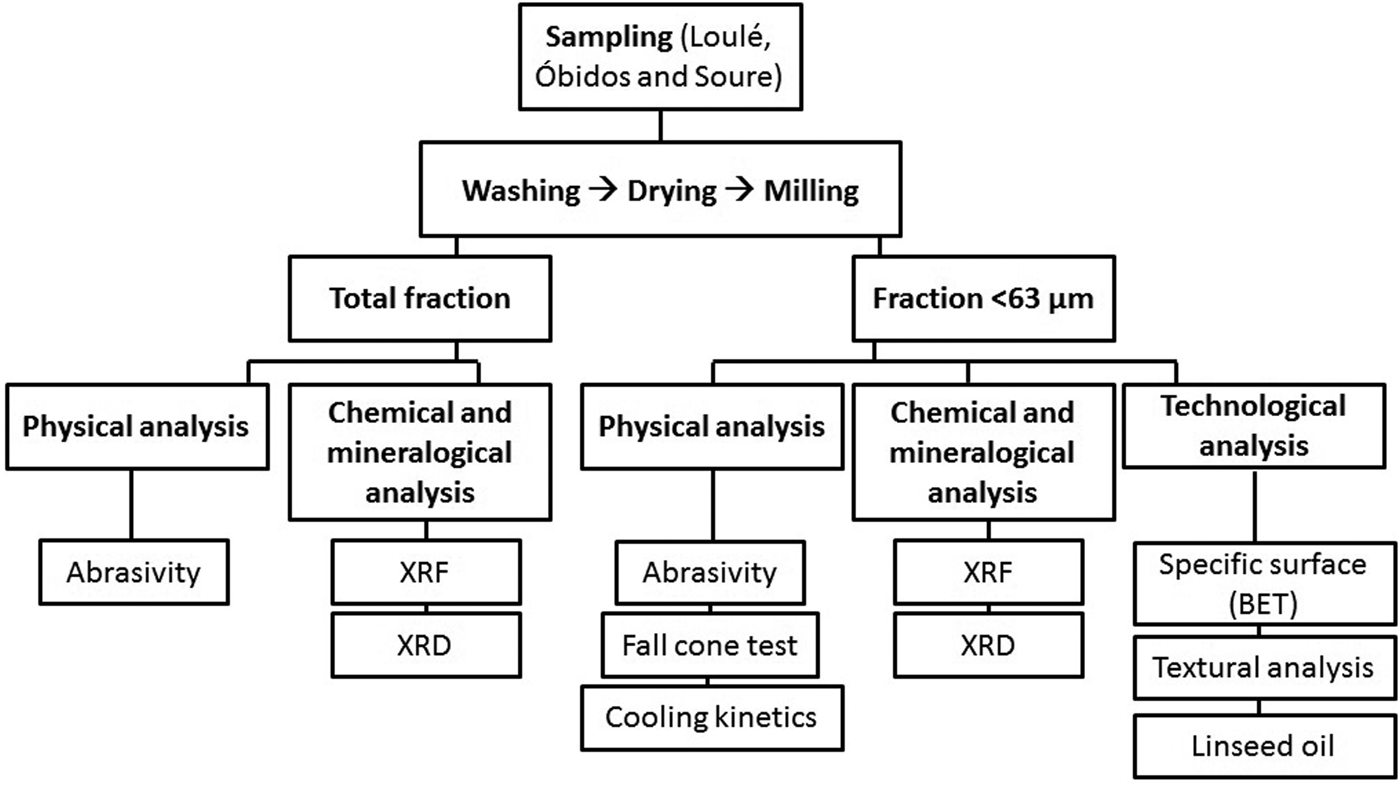
A flow chart detailing the analytical procedure used in this study is illustrated in Fig. 1. The samples were ground down to 110 μm and wet sieved at 63 μm. The grain-size distribution of the <63 μm fractions was assessed using an X-ray Grain Size Analyser (Micromeritics SediGraph).
Flow chart illustrating the analytical procedure used in the present study. BET = Brunauer–Emmett–Teller; XRD = X-ray diffraction; XRF = X-ray fluorescence.

The mineralogical composition was determined by X-ray diffraction (XRD) with a Panalytical X'Pert-Pro MPD diffractometer using Cu-Kα radiation (λ = 1.5405 Å) on randomly oriented powders. To assess the final presence of phyllosilicates, suspensions of the samples were heated at 70°C and the insoluble minerals were then analysed. The identification of the different mineral phases followed the criteria recommended by Brindley & Brown (Reference Brindley and Brown1980) and the Joint Committee for Powder Diffraction Standards. The mineralogical semi-quantification of the identified minerals was performed through peak-area determination of specific reflections and was calculated following the ‘reflective powers method’ (Galhano et al., Reference Galhano, Rocha and Gomes1999; Oliveira et al., Reference Oliveira, Rocha, Rodrigues, Jouanneau, Dias, Weber and Gomes2002).
The chemical composition of the samples was assessed using X-ray fluorescence (XRF) spectrometry with a Panalytical AXIOS PW4400/40 XRF spectrometer. Loss on ignition (LOI) was determined by heating 1 g of the sample at 1000°C for 1 h in a MF20 Cassel furnace (series 83215).
The technological properties, namely abrasiveness, plasticity, texturometrics (adhesivity and firmness), Brunauer–Emmett–Teller (BET) specific surface area, oil absorption and cooling rate, were determined in accordance with the protocols and norms followed in the Departments of Geosciences and of Material Engineering of the University of Aveiro and in the Faculty of Pharmacy of the University of Porto (Quintela et al., Reference Quintela, Terroso, Almeida, Reis, Moura, Correia, Ferreira, Forjaz and Rocha2010, Reference Quintela, Costa, Terroso and Rocha2014, Reference Quintela, Costa, Terroso, Sá, Nunes and Rocha2015; Rebelo et al., Reference Rebelo, Viseras, Galindo, Rocha and Silva2011a, Reference Rebelo, Viseras, Galindo, Rocha and Silva2011b; Pena-Ferreira et al., Reference Pena-Ferreira, Santos, Silva, Amaral, Sousa-Lobo, Gomes and Gomes2011).
Results and discussion
The samples studied originally had white (Óbidos) to greyish (Soure and Loulé) colours, which turned to white after grinding. The Óbidos sample is the finest, with 68% of the material at <63 μm, followed by Loulé (54%) and Soure (48%). Grain-size analysis of the fine fractions yielded a similar size classification, with the Óbidos material showing the lowest value of ϕ50 (24.8 μm), followed by Loulé (28.5 μm) and Soure (30.2 μm). The three samples showed similar pH values, namely 9.8 for Óbidos and 9.7 for Loulé and Soure.
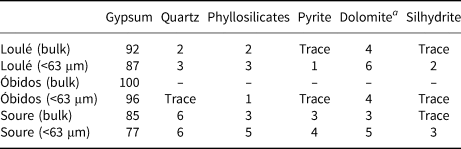
The mineralogical compositions of the bulk samples and the fine fractions are reported in Table 1.
Mineralogical compositions of the Portuguese gypsum.

aDolomite and Mg-calcite.
The mineralogical composition is dominated by gypsum, with the Óbidos material being almost monomineralic. Quartz and dolomite are the main accessory minerals; other accessory minerals are phyllosilicates, pyrite and silhydrite. All of the accessory minerals are slightly more abundant in the fine fractions of all samples studied. This quartz increase in fine fractions (<63 μm), indicative of the very fine grain size, may be adverse for common gypsum applications (Velho & Campos, Reference Velho and Campos2006), although for some dermocosmetic applications, the SiO2, if present in a reactive form (e.g. silhydrite), may have a positive contribution, being a skin regenerator and strengthener and having anti-inflammatory properties (Gomes & Silva, Reference Gomes and Silva2007; Schleier et al., Reference Schleier, Galitesi and Ferreira2014). The insoluble residue analysis after gypsum dissolution allowed for more accurate assessment of the phyllosilicates; illite and smectite are present in all of the samples, with illite being more abundant in the Soure material and smectite in the Loulé material.
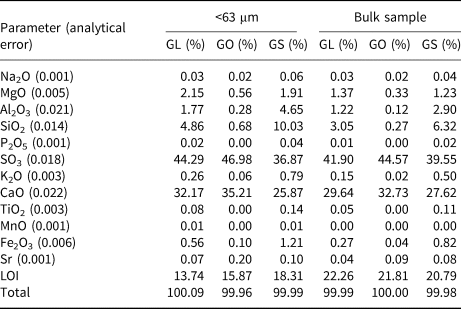
The chemical compositions (major elements) of the fine fractions and bulk samples are reported in Table 2.
Chemical compositions (major elements) of the Portuguese gypsum.

GL = Loulé; GO = Óbidos; GS = Soure.
The theoretical composition of gypsum is 32.5% CaO, 46.6% SO3 and 20.9% H2O. Thus, Óbidos (GO) and Loulé (GL) gypsums are sufficiently pure, whereas Soure (GS) gypsum contains significant amounts of Al2O3 and SiO2, related to the presence of quartz and, probably, phyllosilicates. The lack of peaks which are characteristic of phyllosilicates indicate that they may be poorly ordered. The fine-fraction Óbidos gypsum exhibits a greater CaO content and lower LOI than the bulk sample (and the gypsum theoretical composition), in accordance with the mineralogical composition (decrease in gypsum and increase in the Mg-calcite and dolomite contents). The LOI decrease in the fine fractions is due to the decrease in the gypsum contents compared to the bulk sample. In the Soure and Loulé samples, the SiO2 is present in significant amounts (~5%), which is important for dermocosmetic applications (Gomes & Silva, Reference Gomes and Silva2007; Schleier et al., Reference Schleier, Galitesi and Ferreira2014).
Taking into account both the mineralogical and chemical analysis, the samples from Loulé and Soure have lower gypsum contents and greater iron contents than is recommended for health applications (Olejnik, Reference Olejnik1999; Baltar et al., Reference Baltar, Bastos, Luz, da Luz and Lins2005; Rowe et al., Reference Rowe, Sheskey and Quinn2009; Thomas & Puleo, Reference Thomas and Puleo2009).
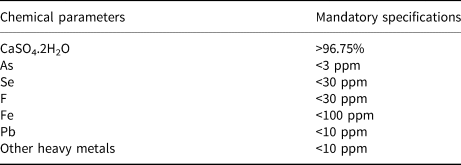
Table 3 shows some of the chemical specifications for health applications (according to Harben, Reference Harben and Taylor2002).
Chemical specifications for health applications (Harben, Reference Harben and Taylor2002).

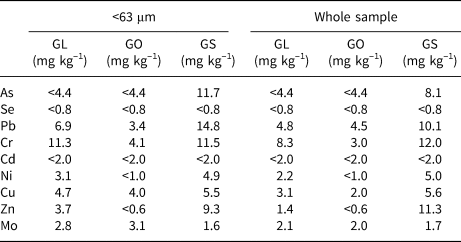
The concentrations of the minor elements considered important for health applications in the samples studied are listed in Table 4.
Chemical compositions (minor elements) of the samples studied.

GL = Loulé; GO = Óbidos; GS = Soure.
The Soure gypsum contains more As, Pb and Cr in both the <63 μm fractions and the bulk sample than the amount allowed for health applications. The Loulé and Óbidos samples show generally adequate values, with the Loulé sample having slightly greater Pb and Cr contents.
Thus, according to the mineralogical and chemical composition, only Óbidos gypsum is adequate for dermocosmetic applications, but only with a finer granulometry (i.e. after more extensive milling; Olejnik, Reference Olejnik1999; Baltar et al., Reference Baltar, Bastos, Luz, da Luz and Lins2005; Rowe et al., Reference Rowe, Sheskey and Quinn2009; Thomas & Puleo, Reference Thomas and Puleo2009).
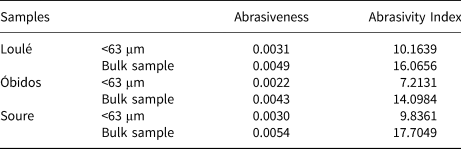
All studied samples show low values for abrasiveness and on the Abrasivity Index (AI) (Table 5). Abrasiveness is the net mass loss during testing. The AI is the loss in weight (in g m–2) of a standard bronze net when in contact with a suspension of the material after a certain number of rotations (Quintela et al., Reference Quintela, Costa, Terroso and Rocha2014). The Óbidos gypsum displays lower abrasiveness and AI values in both the bulk samples and the <63 μm fractions.
Abrasiveness and Abrasivity Index values of the samples studied.

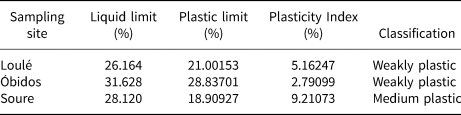
The low abrasiveness values allow classification of these samples as ‘not abrasive’ (Quintela et al., Reference Quintela, Costa, Terroso and Rocha2014). The AI is considerably lower than the recommended values for aesthetic and pharmaceutical formulations (Baltar et al., Reference Baltar, Bastos, Luz, da Luz and Lins2005; Rebelo et al., Reference Rebelo, Viseras, Galindo, Rocha and Silva2011a, Reference Rebelo, Viseras, Galindo, Rocha and Silva2011b; Quintela et al., Reference Quintela, Costa, Terroso and Rocha2014). The Atterberg limits and the Plasticity Index (PI) of the samples studied are indicative of materials with low plasticity (Table 6).
Atterberg limits and Plasticity Index values of the studied samples.

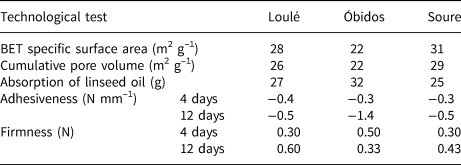
The results of technological tests to assess the potential use of the studied gypsums for dermocosmetics (BET specific surface area, cumulative pore volume, oil absorption, adhesiveness and firmness) are listed in Table 7.
Technological tests of the studied samples.

All of the samples studied show moderate BET specific surface area, cumulative pore volume and oil absorption, which are acceptable for the desired applications (Olejnik, Reference Olejnik1999; Baltar et al., Reference Baltar, Bastos, Luz, da Luz and Lins2005; Aguzzi et al., Reference Aguzzi, Cerezo, Viseras and Caramella2007; López-Galindo et al., Reference Lopez-Galindo, Viseras and Cerezo2007; Viseras et al., Reference Viseras, Aguzzi, Cerezo and Lopez-Galindo2007; Rowe et al., Reference Rowe, Sheskey and Quinn2009; Thomas & Puleo, Reference Thomas and Puleo2009; Karakaya et al., Reference Karakaya, Karakaya, Sarıoğlan and Koral2010). In addition, the adhesiveness and firmness values may be considered as adequate for dermocosmetic applications (Pena-Ferreira et al., Reference Pena-Ferreira, Santos, Silva, Amaral, Sousa-Lobo, Gomes and Gomes2011). All of the samples show an increase with time for both properties which is almost linear, and which is more pronounced in the Óbidos gypsum.
Finally, the cooling time from 55°C to 30°C) varied between 16.5 min (Óbidos) and 21 min (Soure). The application of peloids usually lasts for 30 min for a temperature ranging from 45°C to 40°C. According to Legido et al. (Reference Legido, Medina, Mourelle, Carretero and Pozo2007), the cooling time of peloids which are suitable for therapy should be between 20 and 25 min. Thus, the Óbidos gypsum would not be suitable for this application.
Table 8 shows a qualitative summary of all of the assessed technological properties for practical applications in geophagy and pelotherapy.
Summary of the technological properties of the gypsum samples.

X = unsatisfactory; √ = satisfactory; √√ = good; √√√ = very good.
SSA = specific surface area; CPV = cumulative pore volume; OA = oil absorption; A = adhesiveness; F = firmness; PI = Plasticity Index; AI = Abrasivity Index; CT = cooling time.
Conclusions
All of the samples studied are relatively pure, with the Óbidos gypsum having the greatest purity from both mineralogical and chemical perspectives, as well as it showing the greatest content of fine-grained particles.
The Óbidos gypsum fulfils the requirements for almost all properties relevant to dermocosmetics, being the only sample that may be considered to be adequate for dermocosmetic applications (Olejnik, Reference Olejnik1999; Baltar et al., Reference Baltar, Bastos, Luz, da Luz and Lins2005; Aguzzi et al., Reference Aguzzi, Cerezo, Viseras and Caramella2007; López-Galindo et al., Reference Lopez-Galindo, Viseras and Cerezo2007; Viseras et al., Reference Viseras, Aguzzi, Cerezo and Lopez-Galindo2007; Rowe et al., Reference Rowe, Sheskey and Quinn2009; Thomas & Puleo, Reference Thomas and Puleo2009; Karakaya et al., Reference Karakaya, Karakaya, Sarıoğlan and Koral2010), particularly for dental applications (Olejnik, Reference Olejnik1999; El Kanouni et al., Reference El Kanouni, Aazzab, Tricha, Samdi, Moussa, Hamel and Gomina2005). In contrast, the Soure and Loulé gypsums should be submitted to finer milling and reassessed.
Acknowledgements
Supported by GeoBioTec Research Centre (UID/GEO/04035/2013), funded by the Portuguese Foundation for Science and Technology (Fundação para a Ciência e Tecnologia; FCT) and FEDER funds through the Operational Program Competitiveness Factors COMPETE. FCT granted the first author a PhD scholarship (SFRH/BD/102837/2014).