Introduction
Pediatric palliative care is defined as an “active and total approach to care” for a child and their family throughout the child’s life (Knapp et al. Reference Knapp, Woodworth and Wright2011; Chambers Reference Chambers2018; WHO 2017). In UK, hospices play an important and valued role in its provision (Department of Health 2016; Keeble et al. Reference Keeble, Scobie and Hutchings2022; Taylor and Aldridge Reference Taylor and Aldridge2017). Between 2003 and 2017, 2,453 children died in hospices in England (Gibson-Smith et al. Reference Gibson-Smith, Jarvis and Fraser2021) and 8,159 children received active clinical care from a children’s hospice charity in England in 2018/2019 (Together for Short Lives 2019). The important role of the staff working in this specialty has been acknowledged (Hall et al. Reference Hall, Johnson and Watt2016; Han et al. Reference Han, Shanafelt and Sinsky2019; Sizmur and Raleigh Reference Sizmur and Raleigh2018), but there is little evidence about their psychological well-being (Papworth et al. Reference Papworth, Ziegler and Beresford2023b), despite the fact that this has been shown to have implications for staff sickness, absence rates, and staff retention (Hall et al. Reference Hall, Johnson and Watt2019, Reference Hall, Johnson and Watt2016; Koutsimani et al. Reference Koutsimani, Montgomery and Georganta2019; Sizmur and Raleigh Reference Sizmur and Raleigh2018; Vachon Reference Vachon1995) and have impacts on the quality, cost, and safety of patient care (Han et al. Reference Han, Shanafelt and Sinsky2019; National Academies of Sciences, Engineering, and Medicine 2019; Sizmur and Raleigh Reference Sizmur and Raleigh2018).
There is evidence that burnout and distress are lower among health professionals who work in palliative care than those who work in other specialities (McConnell et al. Reference McConnell, Scott and Porter2016; Meier and Beresford Reference Meier and Beresford2006; Parola et al. Reference Parola, Coelho and Cardoso2017; Vachon Reference Vachon1995), but staff who work with dying patients are exposed to specific potential demands, such as death anxiety due to recurrent exposure to death, patient suffering, and the requirement to break bad news to patients and their families (Ablett and Jones Reference Ablett and Jones2007; Nia et al. Reference Nia, Lehto and Ebadi2016; Vachon Reference Vachon1995). There has been little consideration paid to these specific demands, and there is little understanding of what works to modify them for staff working in this important setting (McConnell et al. Reference McConnell, Scott and Porter2016; Meier and Beresford Reference Meier and Beresford2006; Parola et al. Reference Parola, Coelho and Cardoso2017). Research has also highlighted the limited organizational and emotional support available for staff (Koutsimani et al. Reference Koutsimani, Montgomery and Georganta2019; Meier and Beresford Reference Meier and Beresford2006). The authors’ recent systematic review (Papworth et al. Reference Papworth, Ziegler and Beresford2023b) on psychological well-being in hospices (both adult and children’s) found that only two of the 23 eligible studies collected data from children’s hospice settings. Both were qualitative studies (McConnell and Porter Reference McConnell and Porter2017; Taylor and Aldridge Reference Taylor and Aldridge2017) set in a single hospice and did not collect systematic data on interventions to improve psychological well-being.
The UK children’s hospice sector has become increasingly concerned about levels of work-related stress and the need to review and develop staff support systems to enhance staff well-being and reduce burnout (Goodrich et al. Reference Goodrich, Harrison and Cornwell2015; Hospice UK 2017). Evidence on how to prevent these negative outcomes is weak (NHS Employers 2014) and limited to particular settings or sections of the workforce (Ahola et al. Reference Ahola, Toppinen-Tanner and Seppänen2017). A core set of work-related demands are found in most workplaces, but specific jobs have their unique resources and demands (Mukherjee et al. Reference Mukherjee, Beresford and Tennant2014). It is, therefore, essential to understand what factors affect staff well-being in UK children’s hospices and what impact existing interventions can have.
This study was underpinned by the Job Demands-Resource (JD-R) theory of occupational stress (Bakker and Demerouti Reference Bakker and Demerouti2017). This theory argues that job and personal “Resources” are positively related to motivation (e.g., work engagement) and that “Demands” are positively related to strain (e.g., exhaustion and burnout). Resources and Demands involve physical, psychological, social, or organizational aspects. Resources help in the achievement of work goals (e.g., organizational and social support, autonomy, performance feedback, and opportunities for growth). In contrast, Demands are related to physiological or psychological costs and require sustained physical, emotional, or cognitive effort (e.g., workload and working relationships, high work pressure, and emotionally demanding tasks/relationships) (Bakker and Demerouti Reference Bakker and Demerouti2007, Reference Bakker and Demerouti2017; Bakker et al. Reference Bakker, Demerouti and Sanz-Vergel2014; Demerouti et al. Reference Demerouti, Bakker and Nachreiner2001).
In JD-R theory, Resources are the most important predictor of work engagement and Demands are the most important predictor of burnout (Halbesleben Reference Halbesleben2010; Schaufeli and Bakker Reference Schaufeli and Bakker2004). The two constructs also interact with each other (Bakker and Demerouti Reference Bakker and Demerouti2017), with work-related well-being moderated by a balance between Demands and the Resources available to meet those Demands (Bakker and Demerouti Reference Bakker and Demerouti2007, Reference Bakker, Demerouti, Chen and Cooper2014). When an individual’s responses to Demands create obstacles that undermine their performance, this is termed self-undermining (Bakker and Costa Reference Bakker and Costa2014; Bakker and Demerouti Reference Bakker and Demerouti2017). When an individual makes changes to tasks or how tasks are completed, this is called job crafting (Bakker and Demerouti Reference Bakker and Demerouti2017; Van Wingerden et al. Reference Van Wingerden, Derks and Bakker2017). Despite evidence partly supporting the JD-R model among hospice workers, generalization to the UK context is limited (Stensland and Landsman Reference Stensland and Landsman2017).
In this study, we aimed to address the gap in the evidence on the well-being of children’s hospice staff in the UK by using JD-R theory to predict burnout levels and work engagement in this population. We also sought to identify what staff support systems and organizational practices were related to staff burnout and work engagement.
Methods
Study design
The study team developed two surveys with the content informed by a systematic review of the literature (Papworth et al. Reference Papworth, Ziegler and Beresford2023b) and focus groups in three different UK children’s hospices. The Children’s Hospice Organisation and Management survey (CHOM) was completed by the Heads of Care, or equivalent, in each hospice. This collected information about hospice organizational and staffing characteristics and included questions on the hospice size and services provided, staffing, staff support mechanisms, and funding. The Heads of Care (or equivalent) completed the survey in each hospice.
The Children’s Hospice Staff survey (CHSS) comprised a suite of questionnaires and was completed by UK children’s hospice staff. These included demographic, role, and employment information; staff well-being information from validated scales; and information about the rewards and stressors that hospice staff experience using the Work-related Rewards Scale–Children’s Hospices (WRS-CH) and Work-related Stressors Scale–Children’s Hospices (WSS-CH) scale (Papworth et al. Reference Papworth, Bedendo and Taylor2023a), which were developed for this study. The measures used in the surveys are detailed further below.
Measures
Outcomes
Burnout
This was measured using the Copenhagen Burnout Inventory (CBI), a 19-item scale with items rated on a 5-point scale, assessing three aspects of burnout: personal, work related, and client related (Kristensen et al. Reference Kristensen, Borritz and Villadsen2005). We calculated CBI total scores by summing the items.
Work engagement
This was measured by questions taken from the National NHS Staff Survey 2017 (NHS 2017). It asked how satisfied are you with each of the following aspects of your job? related to eight aspects of their work (e.g., The recognition I get for good work or their level of pay). Participants used a 5-item Likert scale from very dissatisfied to very satisfied.
Resources
Rewards
Work-related rewards were measured using the WRS-CH (Papworth et al. Reference Papworth, Bedendo and Taylor2023a). The measure consists of 27 items assessing the intensity of rewards experienced by an individual during the previous 6 months. Participants responded how rewarding they found each of the items (0 = not at all; 1 = a little; and 2 = a lot). A total score was then calculated summing all responses.
Management standards
We used the UK’s Health & Safety Executive (HSE) Management Standards indicator tool (Brookes et al. Reference Brookes, Limbert and Deacy2013; Cousins et al. Reference Cousins, MacKay and Clarke2004) as a measure of how staff believe that the organization they work for is managing the risks associated with work-related stress. The HSE tool is a 35-item measure with items rated on a 5-point scale varying from Never to Always or from Strongly Disagree to Strongly Agree. Scores were calculated for each of the seven sets of working conditions, which were (I) demands – includes issues such as workload, work patterns, and the work environment; (II) control – how much say the person has in the way they do their work; (III and IV) manager and peer support (calculated separately) – includes the encouragement, sponsorship, and resources provided by the organization, line management, and colleagues; (V) relationships – includes promoting positive working to avoid conflict and dealing with unacceptable behavior; (VI) role – whether people understand their role within the organization and whether the organization ensures that they do not have conflicting roles; and (VII) change – how organizational change (large or small) is managed and communicated in the organization.
Staff support interventions
Participants reported how often they have accessed 13 supporting interventions in the last 12 months, with the interventions included derived from the relevant literature (Papworth et al. Reference Papworth, Ziegler and Beresford2023b). For analysis, the interventions were grouped as clinical reflective practice (e.g., clinical supervision and reflective practice), peer support (e.g., peer support group, peer supervision, or mentoring), employee well-being (e.g., training or event focused on stress management, mindfulness or meditation, relaxation or exercise class, counseling or psychological therapy, complementary or other therapies, occupational health involvement, and employee assistance program), flexible working options (e.g., altered shift patterns and working times), and training and development (training or support for personal or professional development). First, responses were coded as No (never accessed the intervention) or Yes (accessed the intervention less than monthly, at least monthly, or at least weekly). Participants reporting not available were excluded from the analyses. Second, we created a total score summing participant responses and reflecting the number of staff supporting interventions accessed (ranging from 0 to 5).
Experience in LLC
Participants reported how long they have worked with children with life-limiting or life-threatening conditions and their families (0 = less than 1 year, 1 = 1–2 years, 2 = 3–5 years, 3 = 6–10 years, 4 = 11–15 years, and 5 = more than 15 years).
Employed clinician and employed specialist nurse
These questions were assessed via the CHOM survey and described whether the hospices had an employed clinician (0 = No and 1 = Yes) or specialist nurse (0 = No and 1 = Yes).
Demands
Stressors
Work-related stressors were measured using the WSS-CH, which mirrors the WRS-CH (Papworth et al. Reference Papworth, Bedendo and Taylor2023a). The WSS-CH has 42 items assessing the intensity of stressors experienced by an individual during the previous 6 months. Participants responded how stressful they found each of the items (0 = not at all; 1 = a little; and 2 = a lot). A total score for each of the three subscales (child, parent, and organization stressors) was created by summing the items.
Occupational group
Participants reported their occupational group. Responses were collapsed into clinical (i.e., medical and registered nurse) and other (i.e., allied health professionals, nursing or healthcare assistant, nursery nurses, psychologist, social work, other).
Managerial, community, or bereavement roles
Participants reported if they had any managerial responsibilities (Yes or No), work in the community (Yes or No), or work with bereaved families as part of their roles (Yes or No).
Number of child deaths
The total number of child deaths in the hospice in 2019 was assessed from the CHOM survey.
Inclusion criteria
All UK children’s hospices were invited to participate in the survey. All employed children’s hospice staff providing direct care to children or their families were invited to respond to the CHSS. For the CHOM, we sought to recruit the most appropriate person to answer the survey, which the hospices themselves nominated.
Recruitment
We used Qualtrics, a secure web-based survey platform, to administer the survey. Staff were invited to respond to the CHSS by a study champion in each participating hospice organization. We sent the participant information sheet and a link to the online survey to this individual, who then sent it on to eligible staff. The participant information sheet explained the voluntary nature of participation and the anonymity afforded to participants. We used a prize draw to incentivize responses. For the CHOM, the study team sent a separate email and participant information sheet directly to whomever was felt to be the most appropriate person to complete the survey. No data that can be linked to specific individuals from either of the surveys are presented here.
Data analysis
We assessed the linear relationships between variables using Spearman correlation followed by multivariate linear regression models to predict the outcomes. Structural equation models (SEM) evaluated whether Resources, Demands, and Resources*Demands interaction predicted work engagement and burnout levels. The theoretical model is presented in Fig. 1.
Theoretical model diagram. 1- Assessed as seven separate factors: Demands, Control, Manager’s Support, Peer’s Support, Relationships, Role, Change. 2- Assessed as three separate factors: child, parent and organizational.

Due to large variation on the ranges of the scales, burnout, rewards, and stressors scores were rescaled (divided by 10) for the SEM analysis. Missing data were treated using pairwise deletion. Interaction between Resources and Demands used residual centering (Schoemann and Jorgensen Reference Schoemann and Jorgensen2021). We tested the SEM using lavaan (Rosseel Reference Rosseel2012) with an unweighted least squares estimator (Li Reference Li2016), and model fits were examined using root mean square error of approximation (RMSEA) of ≤0.07 (Steiger Reference Steiger2007), standardized root mean square residual (SRMR) <0.10 (Kline Reference Kline2015), and values above 0.9 for comparative fit index (CFI) (Hu and Bentler Reference Hu and Bentler1999), Tucker–Lewis index (TLI) (Byrne Reference Byrne1994), and goodness-of-fit index (GFI) (Hair et al. Reference Hair, Black and Babin2019). Modification indices were assessed (Brown Reference Brown2015), and indices higher than 11 were checked (Ebesutani et al. Reference Ebesutani, Bernstein and Nakamura2010) for the plausibility of the relationship. Models were then updated and checked for fit improvements. All analyses were performed using R v4.2.1 and R Studio v2022.07.1+554 with statistical significance set at 5%.
Results
Sample characteristics
A total of 583 staff responses were obtained from 32 hospices from all four nations; sample characteristics are presented in Table 1. Missing data varied depending on variables, with 308 (53%) participants providing complete data and 414 (71%) providing data on the outcomes. Most participants were females (95.4%, N = 502), aged 51–65 years old (31.3%, N = 165), and had more than 15 years of experience working with life-limiting conditions (29.7%, N = 123).
Sample characteristics, outcomes, resource, and demands variables

The average score for burnout was 32.5 (SD: 13.1), for work engagement was 7.5 (SD: 1.5), and for rewards (WRS-CH) was 51.4 (SD: 10.3). The HSE Management Standard average scores ranged from 4.2 (SD: 0.6) for the “Role” domain to 3.2 (SD: 0.8) for the “Change” domain. When compared to the HSE benchmark (Health and Safety Executive, UNDATED), results showed that hospices performed well: above the 80th percentile for “Demands” and “Peer and manager support”; between the 50th and 80th percentiles for “Role,” “Relationships,” and “Change”; and between the 20th and 50th percentiles for “Control” (Bedendo et al. Reference Bedendo, Papworth and Taylor2023).
All hospices reported having a specialist nurse (N = 467), and 46.3% an employed clinician (N = 216). On average, participants reported that 3.6 (SD: 1.1) staff support interventions were available.
Most participants responded that they had a clinical role (medical and registered nurse). Within the three specific types of work surveyed, most respondents reported having a bereavement role (88.0%, N = 453), with half reporting they had a community role (49.9%, N = 258), and about a third reported having a managerial role (35.3%, N = 183).
The stressors intensity scores derived from the WSS-CH were highest on the child factor (M: 14.6, SD: 7.4) and lowest on the organizational factor (M: 9.7, SD: 5.7).
Correlation
Figure 2 shows the correlation between the variables of interest for building the SEM. Work Engagement was negatively correlated with burnout (r(412) = −0.46, p ≤ 0.001). All variables showed a significant correlation with the outcomes of the study (burnout and work engagement), except participants’ experience in life-limiting conditions, whether they were employed as a clinician, their occupational group, and the number of child deaths. Variables with non-significant correlations with the outcomes also showed few and overall weak correlations with other variables.
Correlogram showing correlations between variables. Crossed values were not significant at 5% level. Employed nurse not shown due to lack of variation as all hospices reported having this professional.

HSE variables and rewards showed the highest correlation coefficient with the outcomes (negative correlation with burnout and positive correlation with work engagement), followed by stressors factors (positive correlation with burnout and negative correlation with work engagement).
High correlation coefficients were also observed among stressors factors (Child and Parent: r(404) = 0.78, p ≤ 0.001; “Child” and “Organizational”: r(406) = 0.65, p ≤ 0.001; “Parent” and “Organizational”: r(404) = 0.76, p ≤ 0.001).
Regression
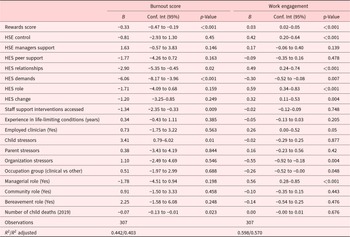
The regression models using all Resources and Demands variables predicting burnout score and work engagement are presented in Table 2. Rewards score, “HSE Relationships,” and “HSE Demands” were significant predictors of both outcomes.
Regression models predicting burnout score and work engagement

The strongest predictors of burnout score were HSE Demands (b = −6.06, p < 0.001), Child stressors (b = −3.41, p = 0.01), and HSE Relationships (b = −2.90, p = 0.02). “Rewards score,” “Staff support interventions accessed,” and “Number of child deaths (2019)” also significantly predicted burnout scores. The strongest predictors of work engagement were “HSE Role” (b = 0.59, p < 0.001), managerial role (b = −0.56, p < 0.001), and Organization stressors (b = −0.55, p = 0.005). Rewards score, three HSE dimensions (“Control,” “Relationships,” “Demands,” and “Change”),” Employed clinician”, and “Occupation group” were also significantly associated with work engagement.
An additional analysis examining specific staff support interventions showed that lower burnout scores were reported when the staff accessed “Reflective practice” (b = −3.81, p < 0.019) and “Training or support opportunities” (b = −4.63, p = 0.008). No specific intervention was associated with work engagement (Supplementary Table S1).
SEM
We first assessed the measurement model validity of our a priori model as stated in Fig. 1.
The model fit was not adequate (X 2 = 678.507, CFI = 0.792, TLI = 0.772, GFI = 0.970, RMSEA = 0.099, SRMR = 0.172), so the model was updated considering the correlation between variables, goodness-of-fit, model diagnostics, and theoretical framework. Respecifications removed the variables that were not correlated with the outcomes. Modification indices also suggested using “HSE Demands” in the demand latent factor, as opposed to Resources. This was also in line with the core aspects measured by those items. Finally, we included error covariance between stressors, as suggested by the correlations and the original scale study. The updated model showed an overall good fit (X 2 = 106.429, CFI = 0.975, TLI = 0.970, GFI = 0.962, RMSEA = 0.022, SRMR = 0.096).
We then assessed the structural model validity, which also showed a good fit (X 2 = 129.704, CFI = 0.994, TLI = 0.993, GFI = 0.982, RMSEA = 0.019, SRMR = 0.087). Demands significantly predicted burnout (b = 4.67, p ≤ 0.001) and Resources predicted work engagement (b = 3.06, p ≤ 0.001), but burnout did not predict work engagement (b = −0.10, p = 0.127). Since the original theoretical framework also suggests that Resources and Demands interact, we re-fitted the structural model adding an interaction term between those variables (Fig. 3). The results were similar to the model without the interaction, showing good fit (X 2 = 503.217, CFI = 1.00, TLI = 1.00, GFI = 0.995, RMSEA = 0.000, SRMR = 0.072), with Demands significantly predicting burnout (b = 4.65, p ≤ 0.001) and Resources predicting work engagement (b = 3.09, p ≤ 0.001). The interaction (Resources*Demands) only predicted work engagement (b = −0.31, p = 0.115) but not burnout (b = 0.31, p = 0.115). Burnout again did not predict work engagement (b = −0.09, p = 0.194).
Model diagram for SEM (Structural Equation Modelling) showing standardised effects (N=393).

Discussion
Our model partly supported the JD-R model, with clear relationships between Resources and the Resources and Demands interaction on work engagement and between Demands and burnout. However, there was no clear support that Resources had a buffering effect on Demands effects on burnout. Also, the effects of Demands did not amplify the impact of job resources on work engagement.
In our study, Resources and its interaction with Demands predicted work engagement, and in previous research, Resources have been found to be generally the most important predictors of work engagement (Bakker et al. Reference Bakker, Hakanen and Demerouti2007, Reference Bakker, Veldhoven and Xanthopoulou2010). The effects of the interaction were smaller than the isolated effects of Resources. It has been suggested that when confronted with challenging Demands, Resources become valuable to individuals and help them to foster dedication to the tasks at hand (Bakker and Demerouti Reference Bakker, Demerouti, Chen and Cooper2014). For example, Demands amplify the impact of Resources on motivation/engagement in some contexts (e.g., dentistry and education) (Bakker et al. Reference Bakker, Hakanen and Demerouti2007; Hakanen et al. Reference Hakanen, Bakker and Demerouti2005), but our study did not corroborate these findings. However, our results are in line with evidence suggesting that burnout undermines Resources and that a fine balance between Resources and Demands is needed to foster work engagement and cope with Demands (Bakker and Costa Reference Bakker and Costa2014; Crawford et al. Reference Crawford, Lepine and Rich2010).
Only Demands predicted burnout in our model, in line with previous research showing that Demands have been found to be widely associated with burnout (Bakker et al. Reference Bakker, Demerouti and Sanz-Vergel2014), but Demands interaction with Resources did not significantly predict burnout. It would be expected that having greater Resources would help staff to cope with Demands, as Resources can mitigate the negative impact of the Demands on burnout (Bakker and Demerouti Reference Bakker and Demerouti2017; Bakker et al. Reference Bakker, Demerouti and Euwema2005, Reference Bakker, Veldhoven and Xanthopoulou2010), and this was partly confirmed in our data. The interaction between Resources and Demands effects on burnout were not statistically significant, but the addition of Resources changed the direction of the relationship between Demands and burnout (i.e., they were associated with lower levels of burnout once Resources were included in the model). This indicates that although the Resources in our study population reduced the effects of Demands on burnout, those effects were not strong enough to significantly moderate the relationship.
Factor loadings for the three job role variables (managerial, community, and bereavement) were small but were kept in the final model due to their relevance to the topic. Compared to other variables, organizational stressors were the most relevant aspect of Demands, followed by the HSE Demands dimension. Both were significantly associated with work engagement (regression models). The results also suggest a higher relevance of the organizational aspects compared to more individual aspects (e.g., occupational group, experience, or stressors related to patient caring or dealing with patient’s families). Additionally, the analysis showed that lower burnout scores were associated with those accessing Reflective practice or those accessing Training or support for personal or professional development. This result is particularly relevant to hospices aiming to provide their staff with such support strategies.
Overall, HSE Management Standards presented the highest loadings on Resources, with manager support and change showing the highest values. In the multivariate regressions, HSE Demands was one of the few variables predicting both burnout and work engagement. Our final SEM analysis showed that this variable fitted better as a Demand rather than a Resource, in contrast to the other HSE Management Standard variables. This variable also had the second highest factor loading in the SEM model, suggesting that this is a potential point of attention for future work and clinical practice. Providing employees with appropriate Demands that consider their hours of work, skills, capabilities, and concerns is likely to be particularly helpful to reduce overall Demands pressure and burnout levels.
Our model partly supported the JD-R model, with clear relationships between Resources and the Resources and Demands interaction on work engagement and between Demands and burnout. However, there was no clear support that Resources had a buffering effect on Demands effects on burnout. Also, the effects of Demands did not amplify the impact of job resources on work engagement. We also did not find support that burnout was associated with work engagement, whereas the JD-R model clearly states a negative relationship between exhaustion (e.g., burnout) and work engagement (Bakker and Demerouti Reference Bakker, Demerouti, Chen and Cooper2014); however, this evidence is limited and temporality seems to play an important role. Directionality suggests that despite the association between burnout and work engagement occurring in both directions, some evidence suggests that it is stronger from burnout to work engagement than in the opposite direction. However, this is time-specific (i.e., only observed on a 12-month time lag) (Maricuțoiu et al. Reference Maricuțoiu, Sulea and Iancu2017) and remains an unresolved issue (Bakker and Demerouti Reference Bakker and Demerouti2017).
Overall, the evidence from this study provides important contributions as to how JD-R theory possibly operates in children’s hospice working environments. This is the first study examining organizational and personal aspects in a large sample of hospice staff and testing for multiple relationships within a single model. The model takes into account the intricate connections between Resources and Demands and their effects on burnout and work engagement and provides a better representation of how the relationships may occur within a hospice setting. Our results partly supported the JD-R model. Resources did not show a significant buffer effect on burnout, but Demands were significantly associated with burnout (even controlling for its interaction with Resources). In conjunction with a previous study that showed no support for “perceived respect” (a Resource associated with higher work engagement) as having buffer effects on role conflict or deep acting (Demands) among hospice workers (Stensland and Landsman Reference Stensland and Landsman2017), our findings suggest that a buffer effect of Resources may not clearly operate in hospice-related settings, although further research is still needed to confirm this. Future studies may also examine whether changes in how Resources or Demands variables were composed may affect their effects on the outcomes.
Strengths and limitations
The study collected information from a large sample across multiple UK hospices and assessed both organizational and personal Resources and Demands, and so the tested model is likely to be a good depiction of how Resources and Demands interact and affect burnout and work engagement.
Despite the large sample and efforts to recruit all children’s hospices, we were not able to retrieve responses from every hospice. This was partly related to COVID limitations at the time of data collection. The methods used do not allow to infer any causal relationships. Our final model showed a good fit, but this does not mean it is the only true relationship between the variables.
Conclusion
The interaction between Resources and Demands predicted work engagement only. Our findings also present a set of variables that can represent Resources and Demands and may help identify aspects that can be used to improve staff well-being in children’s hospices. Our model partly supported the JD-R model, showing that Resources were positively related to work engagement and Demands were related to burnout. Overall, knowledge generated from this study provides an important evidence base from which to identify staff support systems and organizational practices that offer the greatest potential to improve staff well-being in children’s hospices and its associated outcomes.
Supplementary material
The supplementary material for this article can be found at https://doi.org/10.1017/S147895152300161X.
Acknowledgments
We would like to thank all the participants who made this study possible during a particularly difficult time for them and the organizations that they worked for.
Author contributions
Conception and design of study were done by J.T., A.P., B.B., L.K.F., and S.M. Acquisition and assessment of data were done by A.B., A.P and J.T. Analysis and/or interpretation of data were done by A.B., A.P., and L.Z. Drafting of the manuscript was done by A.B., A.P., and L.Z. All authors have approved this version of the manuscript to be published.
Funding
This study was funded by the Martin House Research Centre: a partnership between the University of York and Martin House Hospice Care for Children and Young People.
Competing interests
The authors declare that there are no competing interests.
Ethical approval
Ethical approval was obtained from the Department of Health Sciences Research Governance Committee at the University of York (HSRGC/2019/336/D).