In 1923, William Somerset Maugham arrived in the Vietnamese city of Hai Phong on the last leg of a journey that had begun almost half a year earlier in Rangoon. As he recorded in the short story ‘Mirage’, he was strolling round the city when he was approached by an expatriate Englishman named Grosely, who subsequently told him his life story.Footnote 1 Although – or precisely because – he has not been back home for over two decades, England has become a fantasy for Grosely:
There was always before him the mirage of London, the Criterion Bar … the promenade at the Empire and the Pavilion, the picked-up harlot, the serio-comic at the music-hall, and the musical comedy at the Gaiety. This was life and love and adventure. This was romance. This was what he yearned for with all his heart.Footnote 2
What Grosely misses, then, are not family and friends but the pleasures of London's West End: the fashionable Criterion Bar in the basement of the Criterion Theatre on Piccadilly Circus, the infamous Empire Theatre of Varieties on Leicester Square, whose promenade was a well-known abode of prostitutes, and, most importantly, the Gaiety Theatre on the Strand, the ‘birthplace and home of musical comedy’, the most popular theatrical form from the Edwardian Age to the Second World War.Footnote 3
Unlike most expatriate Britons, Grosely – living with a Chinese woman amongst Vietnamese people in a French colonial city – had severed all connections with his home country as well as with his fellow countrymen. But the longing for home and the amenities of the big city was something that he shared with them. For him, as for many others, homesickness was not only about social relations, soft beds and hot water, but also about popular culture. The only way for Grosely to stay in touch with it was through the London illustrated journals, which he avidly read and collected.
Most colonial Britons, however, whether soldiers, administrators, or businessmen, lived in close-knit diasporic communities – and they did not have to go without theatrical entertainment either. In Calcutta, for example, the first British theatre was built in 1775.Footnote 4 Like Calcutta, most larger colonial cities had at least one, and often more than one. These were mainly played by touring companies from Europe, who travelled round from one city to another. Visits by professional companies were supplemented by performances by amateur dramatic societies. In smaller towns and stations, they provided one of the most important sources of entertainment, as is evident not least from E. M. Forster's novel A passage to India, which characteristically begins with an amateur performance at the local club.Footnote 5
Despite frequent mentions of touring companies and amateur dramatics in both historical sources and fiction, the colonial theatre has hardly been studied. So far as theatre history has engaged with it, it has focused either on indigenous performance as a site of resistance or – in the majority of cases – on the representation of the colonial ‘Other’ on the metropolitan stage.Footnote 6 As Josephine Harrop points out, ‘travelling theatres have never received their due share of recognition in nineteenth-century theatre history’.Footnote 7 But Harrop herself mentions only the provincial tours and ignores the many companies bound for the colonies. The little research that exists on colonial theatre has focused mainly on highbrow forms like Shakespeare.Footnote 8 Amateur theatricals, too, whether at home or abroad, have attracted little scholarly attention.Footnote 9 Historians of the British empire mention the theatre in passing at best.
As I will show in this article, this silence does not do justice to the importance of theatre for colonial societies. Theatrical entertainment – whether by professional companies or by local amateurs – provided much more than mere entertainment. First, theatre was an important institution of the colonial public sphere. Whether it took place in a makeshift arena or a built playhouse, it provided a space where the British diaspora came together to socialize. Secondly, like newspapers and letters it served as a lifeline to the home country. By watching theatrical performances either brought to them straight from London or which they staged themselves, colonial Britons felt in touch with the homeland. Watching or performing in a play allowed them to strip away their colonial identity and feel part of ‘civilization’ – if only for the duration of a performance. While the practice of theatregoing in and of itself was seen as ‘civilized’ and ‘cultivated’, the theatrical fare presented brought ‘civilization’ to them as well. This is particularly true of musical comedy, the favourite genre of both touring companies and amateurs. As Peter Bailey and Len Platt have shown, musical comedy embraced and celebrated the contemporary world, especially the fast, fashionable life of London, with its department stores, restaurants, and nightclubs – exactly what expatriates were missing out on.Footnote 10
Finally, by performing the hits of the West End at the imperial periphery, touring companies not only allowed colonial audiences to participate in the metropolitan culture, but also inadvertently helped to unify the British empire; whether they lived in London, the provinces, or a colonial city, all British subjects were able to consume the same popular culture, forming in effect one big taste community. Amateur dramatics were likewise ‘just another link of kinship’, as the Bulletin of the National Operatic and Dramatic Association succinctly declared in the 1930s when reviewing the ‘operatic work in the Empire overseas’.Footnote 11 Although this article is primarily concerned with British colonial society in India, it also asks whether these performances reached the indigenous population as well.
In many ways, theatre fulfilled similar functions to that of two better-researched imperial institutions: the club and sports. George Orwell was one of the first to highlight the ambiguous position – inclusive as well as exclusive – of the club, characterizing it as ‘the spiritual citadel, the real seat of the British power, the Nirvana for which native officials and millionaires pine in vain’.Footnote 12 Most historians have echoed this description. According to Mrinalini Sinha, the club reproduced ‘the comforts and familiarity of “home” for Europeans living in an alien land’ and, at the same time, worked as a ‘symbol of racial exclusivity’.Footnote 13 Tim Harper describes the clubs as ‘sacred ground for the Europeans, bastions of racial prestige, and symbols of a politics of exclusion’.Footnote 14 Similarly, sports were not only a leisure pursuit. According to J. A. Mangan, they embodied a ‘persistent and significant cluster of cultural traits’ and propagated ‘imperial sentiments’ through bodily practices and rules.Footnote 15 Theatre encompassed the functions of both the club and sports, but it also went beyond them. Like the club, it was a social space that defined whether someone was part of society or not. Like sports, it drew on distinctive social and bodily practices, namely European conventions of acting and watching a play. But in addition to all that, theatre was also a medium. As such, it generated stereotypes, presented narratives, and conveyed messages, and thereby expressed as well as shaped the mindset of its audience.
Theatre therefore lends itself to a discussion of central issues of imperial history, for example the relationship between the metropolitan centre and the imperial periphery, the colonial public sphere, social and racial hierarchies, the perception of the ‘Other’, and, finally, processes of cross-cultural exchange and appropriation. If we need ‘to know more about the range of associations that defined the European diaspora and their relationship to non-European subjects', as Tim Harper writes, theatre is indeed an ideal object to study.Footnote 16 The first section of the article, then, explores the commercial touring companies that travelled all over the British empire, while the second studies British amateur dramatic associations. Both sections ask how performances were organized, who acted in them, how audiences were composed, and what plays were performed, before the last section takes a closer look at the repertoire. While most London theatres often did not care to preserve their papers, the question of sources becomes even more problematic in the case of travelling theatre companies. Therefore this article largely relies on chance findings in London archives, on newspaper articles and memoirs and on the original play scripts in the Lord Chamberlain's Plays Collection in the British Library. Due to the scarcity of sources, it concentrates on India. Touring companies and amateur dramatic societies did, however, exist in most British colonies and dominions, so that at least some of the conclusions might apply to the empire in general.
I
Theatrical touring companies have a long history in Britain. During the nineteenth century, many cities and towns completely relied on them for their theatrical entertainment. As Josephine Harrop has shown, they brought ‘drama to the furthest corners of Britain’.Footnote 17 Almost all West End actor-managers went on tours to the provinces, and often to the United States as well. Henry Irving, the foremost actor of the Victorian age, was able to sustain his prestigious but largely unprofitable West End theatre only thanks to the travelling circuit (he crossed the Atlantic eight times between 1882 and 1903, and died during his farewell tour).Footnote 18 Like Irving, most actor-managers confined themselves to the provinces and America, although some also visited the continent. But hardly any of them – once they had made it in London – ventured further afield. For stars, a long, winding tour through the empire was simply not profitable. For a less-well-paid troupe of actors, however, there was money to be made. As one author explained, the ‘exiled European positively gasps to be entertained’ and ‘saves up his money … with the idea of spending it the moment the entertainment comes along’.Footnote 19
The first popular musical plays to travel almost the entire globe were the comic operas of Gilbert and Sullivan. Richard D'Oyly Carte, the owner of the Savoy Hotel and Theatre, where all their later works were first performed, sent between three and six touring companies to the provinces, America, South Africa, and, occasionally, the continent.Footnote 20 For regions like Australia and New Zealand, he rented out the rights to other entrepreneurs.Footnote 21 After 1900, comic opera lost out in popularity to musical comedy, a combination of Gilbert and Sullivan, burlesque, music hall, and continental operetta. Musical comedy achieved unprecedented long runs, surpassing even Gilbert and Sullivan's most popular plays. The success of musical comedy in the West End prompted its inventor, George Edwardes, to follow the example of D'Oyly Carte, organizing not only provincial but also overseas tours. In 1894, one of the first musical comedies, A gaiety girl, was sent on a long, intercontinental journey – chronicled by composer Granville Bantock and travel writer Frederick George Aflalo – which lasted for 431 days and went from London to New York, Boston, Washington, Pittsburgh, St. Louis, Chicago, Milwaukee, San Francisco, and Australia.Footnote 22
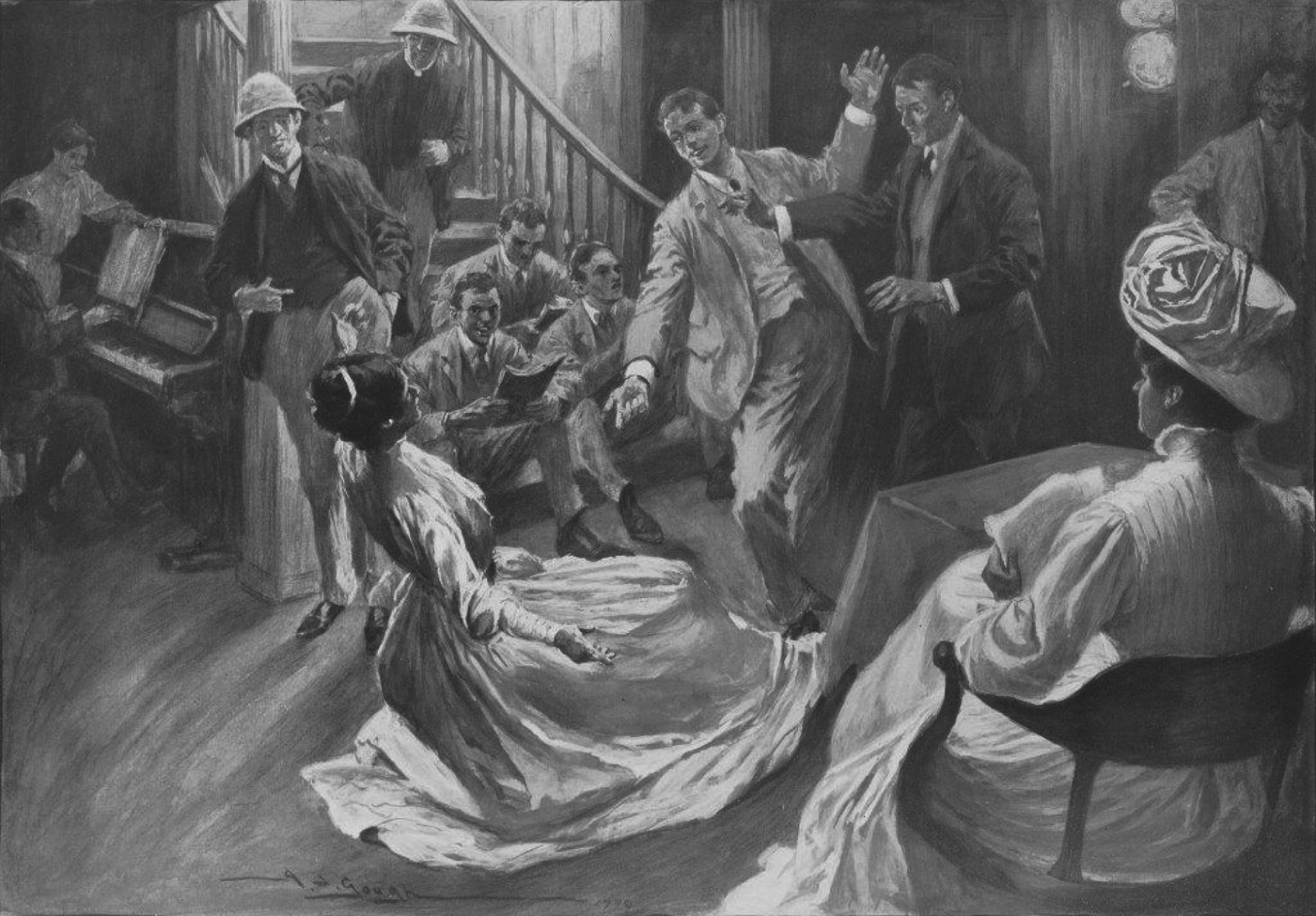
In the following years, West End managers gradually ceased to organize such ventures themselves. Instead, they concentrated on marketing the performing rights to managers who specialized in touring companies. A unique source for reconstructing the outreach of musical comedy is the Gaiety royalties book in the theatre collection of the Victoria & Albert Museum. It gives the royalties for all the plays for which the Gaiety Theatre Company held the performing rights from 1910 until well into the 1920s. One of the hits of this era was Our Miss Gibbs. It opened at the Gaiety Theatre in 1909 and ran for 632 performances. As documented in the Gaiety royalties book, it was performed in more than 150 British cities in 1910 and 1911 alone, from Bournemouth to Glasgow and from Llandudno to Scarborough. Simultaneously, it was played by touring companies in many cities of the British empire, in 1910 in Cape Town, Bloemfontein, Kimberley, Johannesburg, Pretoria, Bulawayo, Lucknow, and Allahabad, in 1911 in Cairo, Alexandria, Calcutta, Rangoon, Bombay, Manila, Hong Kong, Shanghai, Tientsin, and Yokohama, and in 1912 in Sydney, Melbourne, Brisbane, and all over New Zealand.Footnote 23 Such extended tours spanning several continents seem impressive even by today's standards and mark an important stage of cultural globalization before the age of mass cinema-going. And Our Miss Gibbs was far from the only musical comedy to experience such a tour; The sunshine girl, A runaway girl, A gaiety girl, The girls of Gottenberg, and many other plays travelled the same distances.Footnote 24 As touring companies had ‘to play to almost the same audience every night during their stay at a place’, their repertoire usually consisted of several musical comedies. Consequently, most of the actors' daytime while on tour was taken up by rehearsing, a process that began immediately after boarding the ship on the voyage out (see Figure 1).Footnote 25
Musical comedy rehearsal aboard ship. ‘The subject of this picture is a rehearsal of a musical comedy on board a P. and O. boat bound for China. Although the passengers regard the scene as a form of amusement for them, the artists find it hard work, and are often glad when the weather is too rough for rehearsals to be held.’

The cities where Our Miss Gibbs was performed were not chosen accidentally. Rather, touring companies followed a route that had become well established by the 1890s.Footnote 26 The German-American actor-manager Daniel E. Bandmann, for example, had visited almost the same towns (apart from South Africa) during an extended Shakespeare tour he had undertaken from 1879 to 1882.Footnote 27 And again, the same cities are mentioned in an article on touring in the Far East.Footnote 28 Instead of travelling from town to town, as touring companies did in Britain, their colonial equivalents only stopped in places where a large English-speaking community promised takings substantial enough to make a profit after all expenses had been settled. Such places were primarily the larger colonial cities. In an article on ‘Touring the Orient’, Campbell Henderson stated in 1920 that ‘no good entertainment ever leaves Bombay, Calcutta, Colombo, Rangoon, Singapore, Hong Kong, Shanghai, Tientsin, etc., with the management dissatisfied with the financial results of the visit’.Footnote 29 Henderson recommended that managers open their tours in Bombay, where a company could succeed for three or four weeks and from where numerous smaller towns could be reached conveniently by train. According to Henderson, Calcutta could be played for six weeks and Rangoon, Madras, and Colombo for a fortnight each. ‘It is after leaving India that there is a set-back to the steady income of the players', he noted, because voyages from one place to the next took a long time, and travel costs ate up the profits.Footnote 30
Touring began in London with entrepreneurs like D'Oyly Carte and Edwardes, but as early as the 1900s local actors came to the forefront, like Ben and Frank Wheeler in South Africa and W. J. Holloway in Australia.Footnote 31 The most important of them all, however, was Maurice E. Bandman. The son of Daniel Bandmann (the son dropped an ‘n’ so his name was more English-sounding), he followed in his father's footsteps and became an actor, but it was as a manager that he made a name for himself. He had ‘the monopoly of the show business in Calcutta’, where he had built the Empire Theatre – his headquarters (see Figure 2) – and part-owned the Theatre Royal.Footnote 32 He also built and controlled theatres in other cities like the Royal Opera House and Bandman's Theatre in Bombay.Footnote 33 Perhaps even more importantly, Bandman owned the companies that performed at these theatres and at many others throughout India, the Mediterranean, the Middle and Far East, South America, and Canada.Footnote 34 Japan, for example, was an annual stop for the Bandman Opera Company.Footnote 35 According to one obituary, he oversaw between forty and fifty companies in his twenty-five-year career.Footnote 36 All of them mainly played ‘the comic operas which contemporaneously are running in London’.Footnote 37 The Times of India called Bandman the ‘pioneer of musical comedy in this part of the world’.Footnote 38 The letterhead of his correspondence in the Gaiety royalties book designated him as the holder of the ‘Executive Eastern Rights of Mr. George Edwardes, The Gaiety Theatre Company, Mr. Robert Courtneidge & Mr. Frank Curzon's Plays and all other Leading London Productions Including the Gilbert & Sullivan Operas'.Footnote 39 Indeed, it was Bandman who was responsible for the organization of the touring companies that brought Our Miss Gibbs and many other musical comedies to Asia.
Title page of a programme of the Empire Theatre Calcutta, the headquarters of Maurice Bandman's theatrical company and his touring circuit. It was modelled on the Gaiety Theatre in London.

The First World War seems to have had little influence on the touring business. Bandman continued to organize tours until his death in 1922. The interwar period even resulted in an expansion of touring activity, as Allister Macmillan observed in the case of Shanghai: ‘Before the war, if a couple of musical comedy touring companies visited the port from India during the course of the year, the community considered itself fairly fortunate. Nowadays, scarcely a month passes but some American, Australian, or British companies arrive at Shanghai.’Footnote 40
Notwithstanding his success, little information about Bandman survives. Even less is known about the actors he and other touring managers employed. While South African theatres at least occasionally featured ‘the best English actors and actresses’, British audiences in India seldom had the chance to see a star.Footnote 41 Marie Tempest, who played the title roles in many hit musical comedies, performed in Calcutta, and the equally popular Ada Reeve toured several times through South Africa and Australia, and once through India.Footnote 42 But they were exceptions rather than the rule. As the American manager Michael Leavitt knew, ‘it does not usually pay for any really expensive company to visit India’.Footnote 43 And the actors, for their part – once they had become well known – concentrated on the West End stage, where the highest salaries were paid. The metropolis was never far from the beginning actor's thoughts: ‘London is his goal, and every month spent in foreign countries is a month wasted so far as the building of a London reputation is concerned.’Footnote 44 An engagement in London, however, was hard to come by, and even future stars often had to go through the gruelling experience of a prolonged spell of touring through provinces and colonies before they were discovered by a West End manager. In the meantime, they had to find some form of paid work. ‘Money therefore, is the inducement which probably influences his final decision … since salaries for the most part rule high.’Footnote 45 Most touring companies, therefore, were ‘composed of amateurs just entering on the profession – “dames-errant” and second or third-rate professionals’ who had never succeeded in getting roles in Britain.Footnote 46 In addition to British actors, Maurice Bandman also employed some Indian or Anglo-Indian actors, like Patience Cooper, who performed as a dancer in one of his musical comedy productions and later became one of the first Indian movie stars.Footnote 47
Little is known about the audiences for which the touring companies performed, but the tours were obviously geared primarily at the local British population. In larger colonial cities, this population was big enough to sustain at least one, in Calcutta and Madras even three, European-style theatres.Footnote 48 As Alfred Claude Brown observed, Europeans had ‘these places practically to themselves’, a view echoed by an article in Theatre, according to which the ‘Native does not patronise the English theatre’.Footnote 49 Other, mainly Indian sources, however, tell a different story. In his history of the Indian stage, published in the 1930s, Hemendra Nath Das Gupta emphasized that the ‘English Stage in Calcutta used to be patronised by our countrymen’.Footnote 50 To prove his point, he quoted an article from the India Gazette in which the presence of ‘a number of respectable natives among the audience every play-night’ is seen as a sign for ‘a growing taste for the English Drama’.Footnote 51 Prabhucharan Guha-Thakurta went even further in stating that ‘the enthusiasm for English plays and interest in Western methods of performance became a kind of obsession’, but he added that this only applied to the ‘small educated Bengali community of Calcutta’, while ‘the large section of the Bengali public ignorant of the English language’ had no interest in British plays.Footnote 52 As these sources suggest, performances by touring companies in India reached not only the European diaspora but at least the elite of the indigenous society as well. Because touring was costly, commercial managers for their part would hardly have rejected native theatregoers, as long as their presence did not deter the Europeans from attending the theatre.
II
Even in larger cities like Calcutta, performances by travelling companies were supplemented with amateur theatricals organized either by specialized dramatic societies or the local club. Though composed of amateurs, these societies took their theatrical passions very seriously and made the job of touring companies even more difficult. As Michael Leavitt had to learn painfully, the ‘only theatrical show in Calcutta that pays, and always draws a packed house, is the amateur dramatic club performance of some well-known operette’.Footnote 53 In J. G. Farrell's novel The Singapore grip, a local businessman recalls with delight when ‘the great Russian dancer, Pavlova, had come to Singapore expecting to find herself dancing at the Town Hall theatre, only to find that it had already been booked by the Amateur Dramatic Society’.Footnote 54 This – true – anecdote illustrates very well the mindset of the members of these clubs. Common in larger cities like Calcutta or Singapore, such associations were even more important in towns where the European population was modest. Smaller towns were not connected to the touring circuit, as ‘very few professional companies can afford the expense of journeying through India, only to find small stations and therefore small audiences to play to’.Footnote 55 Anglo-Indian society in particular was to ‘a great extent dependent upon its own resources for any form of popular entertainment’.Footnote 56
It was in the smaller towns, therefore, that amateur theatricals really thrived and became an important feature of social life, drawing in people who never would have dreamt of taking part in such amusements at home. Apart from South Africa, where amateur dramatics never did take hold, such societies could be found all over the British empire, but nowhere were they more numerous and important than in India.Footnote 57 In his Indian memories, Robert Baden-Powell relates that one of the first questions asked of him upon joining his regiment was ‘Can you act, or sing, or scene paint?’ and he continues to narrate how he later became an ardent amateur himself.Footnote 58 If India was ‘the home of the amateur’, then Simla, the summer capital of the Raj, was ‘the Mecca of amateur actors’, a true ‘amateur dramatic paradise’.Footnote 59 There is hardly any book on Simla that does not mention the Amateur Dramatic Club (ADC) and its importance for the social life of the station.Footnote 60 While most amateurs performed in makeshift venues like clubs and ballrooms, the ADC had its own purpose-built playhouse in the basement of the neo-Gothic town hall designed by Henry Irwin and completed in 1887. It was certainly not by coincidence that it was called Gaiety Theatre.Footnote 61 With a seating capacity of only 280, it looked like a downsized copy of a West End theatre. Its stage was ‘about the size of one of those of the smaller Strand theatres’, and its auditorium featured ‘a dress circle, with boxes at either side, and a gallery stretching far back behind it’.Footnote 62 In contrast to most theatres from the colonial era, the Gaiety exists to this day, and still gives a good impression of what theatregoing must have been like in the heyday of the empire (see Figure 3).Footnote 63
The auditorium of the Gaiety Theatre in Simla as it is today after two decades of restoration.
At a time when the theatrical profession was still often treated with suspicion, to act in an amateur production at the Gaiety Theatre was more than respectable – it was fashionable. Not only was ‘the supply of actors and actresses … greater than the demand’, the club's membership was made up of ‘most of the leading Princes and Gentlemen and ladies who form the society of the summer capital’.Footnote 64 Indeed, ‘its list of members reads like a Who's Who of Anglo-Indian society’.Footnote 65 Among them were Lord Robert Bulwer-Lytton, the viceroy of India, Robert Baden-Powell, Rudyard Kipling and his sister, and many more.Footnote 66 The socially exclusive nature of the ADC is underlined by the fact that it initially had only 20 members, a number that rose to 350 at the turn of the twentieth century and probably beyond that in the following decades.Footnote 67 Rather elitist and socially exclusive at the beginning, by 1937 its members ‘ranged democratically throughout the social scale from band masters to field marshals, from assistant secretaries to viceroys, clerks, authors, lawyers and governesses'.Footnote 68 Because of the city's nature as a summer residence, Simla's British population fluctuated even more than that of other Indian cities. Though many came here every summer, its population differed markedly from year to year. The ADC therefore fulfilled an important social function, bringing large sections of the Anglo-Indian population together – whether as actors or as spectators – and turning them into a community. Lieutenant-General Gerald De Courcy Morton summed up his experiences thus:
I can confidently say that my best friends have been made on the cricket field and on the stage. There is in both, but especially in the latter, a spirit of true and a strong feeling of mutual sympathy which bind more closely than is usual in the ordinary avocations of life, and I know of no better place or condition for enabling a judgement to be formed of the character and qualities of an individual than associations with him or her during rehearsals or performances.Footnote 69
As this quote illustrates, acting was a profoundly social occupation that brought people together and made friends of strangers. In contrast to sports – especially polo and hunting – acting was less competitive and much less concerned with masculinity, since women were also included as active participators. This being Anglo-India, however, socializing in itself had political overtones: gossip was exchanged, marriages made, promotions secured, social hierarchies established.
Absent from the stage, as well as from the audience, was the Indian population. In the case of the Gaiety Theatre there was no need to bar the windows ‘lest the servants should see their mem-sahibs acting’, as the theatre ‘was taboo to Indians’ anyway.Footnote 70 Only high dignitaries were excepted from this rule, as, for example, the Maharajah of Cooch Behar, who – in an example of class over-riding race – was even allowed to rent a box in the theatre.Footnote 71 Because they were not accepted as members of the ADC, Indians started to form their own amateur dramatic clubs. One of the first was the ‘Babus of Government House’, founded in 1893, followed by a Bengali and a Hindustani society in 1897. In the beginning, these associations were permitted to rent the Gaiety Theatre once a year, but this practice was abolished with the transparent excuse that they used too many stage props.Footnote 72
In reality, this decision must be understood in the context of the growing movement for independence in India and the deterioration of the Anglo-Indian relationship. The earliest Western theatres established in India performed exclusively for British audiences to such an extent that even the ushers and doorkeepers were British, but they opened their doors to aristocratic Indians in the first half of the nineteenth century.Footnote 73 While commercial theatres in big cities catered to a heterogeneous audience, the Simla ADC continued such practices of exclusion well into the twentieth century. Being forbidden to rent the theatre predictably enraged the Indian population of Simla. Indeed, ‘the denial of use of the Gaiety Theatre was often discussed as an example of racial discrimination’.Footnote 74 That the theatre represented imperial rule and racial segregation can also be discerned from the fact that it was high up on the anti-imperial agenda – at least in Simla. The journalist Durga Das, for example, who was elected to Simla's Municipal Committee in 1927, prided himself on ‘getting the municipal-owned Gaiety Theatre on the Mall thrown open to Indian amateur dramatic clubs’.Footnote 75 From the late 1930s onwards, Indians were finally allowed to become members of the ADC, which in 1946 saw its first all-Indian production. Soon after independence, it passed from British to Indian control.Footnote 76 In the context of the larger history of decolonization, such quarrels might seem trivial, but they testify to the highly symbolic quality of the theatre; equal use of the playhouse was seen as an important step towards social equality and the end of racial discrimination. As this telling example shows, theatre, and especially amateur dramatic clubs, fulfilled a central social function. By including as well as excluding parts of the population, they constructed a society according to the hierarchical and racialized ideas of those ruling it. The theatre served as an arena in which these hierarchies and ideas were not only enforced, but contested as well.
III
Although touring companies and amateur dramatic societies differed in many respects, they shared one important feature: they both performed by and large the same repertoire, with comic opera and musical comedies at the top of the list. This choice might seem surprising, as these genres were not only ‘the most expensive’, but were also more difficult to stage, requiring, to begin with, performers able to sing, as well as an orchestra.Footnote 77 This raises the question why these genres and plays were selected for performance, and what they meant for colonial audiences. This question is especially hard to answer, as the sources, apart from simple generalizations, are almost completely silent on how the performances were received by the audience. Without the play scripts used in touring and amateur productions, it is also impossible to say how faithful these productions were to the originals, or if plots, characters, or songs were changed.Footnote 78 It is, however, unlikely that a play that had been approved by the lord chamberlain (responsible for censorship of stage plays) and had been successful in London would be altered fundamentally for the touring production. In any case, the selection of plays and their content alone reveal a lot about the tastes and the mindset of colonial audiences.
Since many recent studies have focused on imperialism, colonialism, and racism on the metropolitan stage, the obvious question is whether the repertoire displayed a predilection for imperial themes, which might have resonated particularly with colonial audiences.Footnote 79 Unsurprisingly, a number of plays featured such themes. One well-known example is Gilbert and Sullivan's The Mikado, whose imperial undertones and general condescension towards Asia have been noted so often that there is no need to repeat the argument here.Footnote 80 A favourite with amateur dramatic societies at home, it was also very popular with the Simla ADC, which staged The Mikado in 1900 and 1910, one of the few plays to be performed twice.Footnote 81
The Japanese theme established by The Mikado was taken up a decade later by The Geisha, with music by Sidney Jones and a libretto by Owen Hall. After a hugely successful run of 760 performances in London in 1896, it soon became equally popular with American and continental audiences.Footnote 82 While The Mikado had used only Japanese characters, The Geisha featured both Asians and Europeans, thereby dramatizing the encounter between East and West. The Geisha tells the story of Lieutenant Reggie Fairfax of the Royal Navy, who amuses himself with O Mimosa San, the geisha of the title, whom he teaches the art of kissing. When his fiancée Molly learns about this, she decides to follow him to Japan. Disguised as a geisha, she attracts the love of a Japanese marquis and thereby Reggie's jealousy.
In the two pairings, The Geisha played with the possibility of inter-racial sexual relations. This topic could easily have offended audiences in the colonies, where such relations – though never openly acknowledged – were not uncommon.Footnote 83 On the stage, however, they were innocuous, as all characters were played by Europeans and the existing order was affirmed in the end. In The Geisha, Reggie and Molly are, of course, reunited in the final act. By teasing Reggie ‘You thought I'd marry a Japanese Marquis, when I can get an English sailor?’, Molly not only dismissed the idea of inter-racial sexual relations as preposterous, but acknowledged the superiority of the British male and, thus, British culture in general.Footnote 84 As Len Platt has pointed out, musical comedy narratives often utilized ‘romantic love and sexual attraction between races as metaphors for representing the winning position of white authority in the modern world’.Footnote 85 In these narratives, the man was usually of European, the woman of Asian, background. When this model was reversed – as in the case of Molly and the marquis – the woman was cast as the strong character, thereby exposing the Oriental man as effeminate, lethargic, and harmless. Regardless of the specific gender constellation, in the end these shows always underscored the weakness and dependency of the East and thereby the cultural superiority of the West.Footnote 86
If these attitudes resonated with audiences in London, they did even more so with Britons in the colonies, where the failure to maintain control and authority presented not only a much more real threat to social order, but possibly to life and limb as well. The plays selected for performance addressed these fears indirectly and soothed them with their harmonizing happy endings. They also expressed exactly those notions of cultural superiority that Europeans in the colonies so carefully maintained towards non-Europeans. This attitude was also apparent in the comic character of the pig-tailed, pidgin-English-speaking Chinaman Wun-Hi, a classic racist stereotype. In a 1897 production of The Geisha by the Simla ADC, this character was played by Robert Baden-Powell – not yet of Mafeking and boy scouting fame – to the tune of ‘Chin, Chin, Chinaman,/Muchee, muchee sad,/Me aflaid, alle tlade/Welle, welle bad’ (see Figure 4).Footnote 87 Similar characters featured in many musical comedies with an exotic setting, like the ‘Baboo lawyer’ Chambhuddy Ram in The Cingalee by James T. Tanner with music by Lionel Monckton.Footnote 88 Although The Cingalee was heavily based on a play set in Kashmir written by Frederick Fraser, a captain in the Indian army and a visitor to Simla, it was never performed by the ADC.Footnote 89 For obvious reasons, the Indian character Chambhuddy Ram, who is ridiculed for his attempts to adopt English dress and mannerisms – as were many Indians in real life – could not feature on the Simla stage.Footnote 90 In Wun Hi, however, Britons could express their ‘contempt for all things Indian’ and mock Indians who tried to speak English and live as Englishmen without openly provoking them.Footnote 91
Robert Baden-Powell as Wun Hi in an 1897 performance of the musical comedy The Geisha by the Amateur Dramatic Club of Simla.
Most of the plays performed by touring companies and amateur dramatic societies did not, however, deal overtly with imperialist themes, but were instead set in England, like A gaiety girl or Our Miss Gibbs. A gaiety girl ran for 413 performances in London in 1893 before going on the world tour chronicled by Bantock and Aflalo and becoming a stock play for Bandman's companies, as well as the Simla amateurs. With its mixture of catchy songs and a plot combining romantic entanglements with topical humour, A gaiety girl – written by Owen Hall, with music by Sidney Jones – served as the model for many later musical comedies. Partly set at a garden party in Windsor and partly at a seaside resort in the French Riviera, the story provided ample opportunity to show the pleasures of metropolitan life (and its chorus girls in bathing costumes).Footnote 92 Though it premiered sixteen years later at the Gaiety Theatre, Our Miss Gibbs – written by James T. Tanner, with music by Ivan Caryll and Lionel Monckton – was constructed along the same lines. Like its predecessor, it consisted of two acts set in two distinctive settings: a department store named ‘Garrods’ – replicating the splendours of Harrods Knightsbridge – and the Franco-British Exhibition of 1908.Footnote 93
Despite their metropolitan settings, however, these plays also celebrated Britain's imperial splendour and military prowess. Not only is the garden party in A gaiety girl organized by the Royal Life Guards, the scene also included the song Private Tommy Atkins written by Henry Hamilton. In it, a collective ‘we’ (the nation) glorifies the British soldier, who through his heroic death secures for himself the eternal gratitude and love of his compatriots. Its last stanza explicitly referred to the British empire:
India and the Sudan were not simply two theatres of operation among many for British troops; they stood for two of the most humiliating defeats of the British army. The Indian Rebellion of 1857 and the Mahdi Revolt of the 1880s had threatened imperialist authority and inscribed themselves as haunting moments into the collective memory of the nation – but especially into that of the Anglo-Indians.Footnote 95 The song, however, recast defeat as triumph by stressing soldierly courage and selflessness. Private Tommy Atkins became an immediate success. As the actor singing the song himself noted in his memoirs, theatre audiences received it ‘with great enthusiasm’.Footnote 96 It went on to become ‘one of the most popular songs of the decade’, sung all over Britain and the empire, and became a music hall favourite.Footnote 97 Although ‘Tommy Atkins’ had been in use as a generic name for the British common soldier for a while, A gaiety girl contributed much to its popularization.Footnote 98
The imperialist message was comparatively subdued in Our Miss Gibbs. But by setting the second act at the Franco-British exhibition, this play too embraced imperialism. For one thing, the Franco-British exhibition commemorated the Entente cordiale of 1904, the treaty that had ended over a hundred years of colonial rivalry between Britain and France, consequently allowing both nations to consolidate their power in Africa. What is more, the bi-nationally organized Franco-British exhibition was one of a series of imperial exhibitions showcasing Western superiority and imperial expansion. More than eight million visitors passed through an area displaying Western arts, crafts, and industry before coming to a section devoted to the British and French colonies. In Ceylonese, Algerian, and Senegalese villages, people from the colonies were put on display in a pseudo-ethnographic way to provide entertainment for Western spectators. The underlying idea was to show the primitive state of cultures colonized by European powers, thereby emphasizing European superiority.Footnote 99 By choosing the Franco-British exhibition as a setting, Our Miss Gibbs not only demonstrated its topicality, but also embraced and promoted this specific ideology. While colonial settings and imperial propaganda unquestionably resonated with metropolitan audiences, they, again, had an even more acute meaning for colonial Britons, who carefully maintained an air of superiority towards the non-European cultures amongst which they were living. The cultural snobbery and patriotic fervour of musical comedy was close to their hearts, while Reggie and Molly Fairfax were characters they could playfully identify with.
Most of all, however, A gaiety girl and Our Miss Gibbs – as well as a host of other shows like Three little maids, The Arcadians, The belle of New York or The Dollar princess – were about life in the modern metropolis. Set at garden parties, breezy beach resorts, modern department stores, or the theatre, they featured exactly those things and places that many colonial Britons – whether in mountain resorts like Simla or in colonial cities like Calcutta or Bombay – were pining for. With their urban settings and their topical political, social, and cultural allusions, their promotion of modern fashions and fads, they vividly and tangibly recreated the urban experience on the stage.Footnote 100 They were a potent reminder of the home country, its manners, its fashion, its language, and the most material dimensions of its modernizing, progressivist, metropolitan culture. While London audiences enjoyed seeing their own environment and pastimes reproduced on the stage, they took on a slightly different and even more powerful meaning for colonial audiences. Attending a performance of A gaiety girl or Our Miss Gibbs, theatregoers could imagine themselves transported back to England for the duration of a play. This was even more true for amateur theatricals, which allowed colonial Britons to assert their Englishness and their class affiliation by acting them out onstage. No one knew this better then E. M. Forster, who wrote about amateur actors in A passage to India: ‘They had tried to reproduce their own attitudes to life upon the stage, and to dress up as the middle-class English people they actually were.’Footnote 101 In the novel, the amateur performance becomes a potent symbol for the unwillingness of expatriates ‘to see the real India’.Footnote 102 The memoirs of the ADC members testify to this mentality, when they recall how its performances ‘took us for a time out of India’.Footnote 103
Even more important than the content of a play was the level of its success back home. A play that flopped in the West End seldom got a second chance outside London. If it did become a success, however, managers everywhere were eager to produce it. In the provinces, ‘the attribute “London”, and a “London success” was always especially announced’.Footnote 104 The same is true for the colonial scene. All the plays in the repertoire of Bandman's companies and the amateur dramatic clubs had previously been received favourably in the metropolis. While the amateurs sometimes also performed evergreens like The Mikado or HMS Pinafore, the professional companies relied mainly on current shows, some of which were still running in the West End when they arrived in India. They thus allowed colonial Britons to keep up to date with developments back home. Commentators sometimes suggested that the tastes of colonial audiences were inferior, as they preferred ‘a musical comedy to a melodrama to a farce’, often citing the climate as responsible (‘We don't want the legitimate drama out here, with a thermometer at a century.’).Footnote 105 In truth, however, the tastes of colonial Britons closely resembled those of metropolitan audiences. This is hardly surprising given that the officers, civil servants, administrators, and businessmen in India were mostly members of the middle classes, that is, the same social milieu as most West End playgoers.Footnote 106
IV
Theatre performances by touring companies and amateur dramatic societies fulfilled – separately and jointly – important social, cultural, and political functions in the British empire. They provided, first and foremost, a meeting place where the British (and sometimes European) diaspora came together to constitute itself as a community. As with all communities, the composition of audiences was based on strategies of inclusion and exclusion, and therefore reveals larger social processes and hierarchies. The composition of audiences differed markedly according to the context of a performance, and also changed over time. The first British theatres in India catered to an exclusively European audience, ‘determined to insulate themselves from the natives’.Footnote 107 Gradually, however, this policy changed during the nineteenth century, when theatres opened their doors to aristocratic Indians, and English literature – particularly Shakespeare – was actively promoted, until by the mid-Victorian period the Indian middle class was regularly frequenting British playhouses.Footnote 108 Clearly, managers of commercial theatres and touring companies catered to a heterogeneous audience, since their livelihood depended on the box office. Maurice Bandman even employed Indian actors. The Simla amateurs, on the other hand, played to a much more homogeneous audience that consisted almost exclusively of the local British diaspora. But even their policy changed after the First World War, when they had to give in to demands to let Indian amateur dramatic societies use the Gaiety Theatre, before finally allowing Indians to join the ADC. Thus, while both commercial theatres and amateur dramatic societies started out by enforcing British enclaves and deliberately isolating Britons from Indians, in the end they had to accommodate them. Consequently, theatre history paralleled imperial history and the changing Anglo-Indian relationship.
Theatre, however, did not only foster connections within colonial society, but also between the colonial periphery and the metropolitan centre. The dominance of the West End over all things theatrical extended far beyond Britain. As early as 1866 John Morley foresaw the increasing centralization of the British theatre: ‘In our provinces and colonies the form of entertainment will be, as it now is, mainly determined by the example of the eight or nine theatres in or near the West-end of London.’Footnote 109 This prophecy had become a reality by the end of the nineteenth century. The names of the theatres already displayed the pre-eminence of the West End. John Hollingshead, the founder of the Gaiety Theatre, prided himself that its name ‘soon became popular … in England, Ireland and Scotland, and even in India and China’.Footnote 110 Indeed, a Gaiety Theatre was not only to be found in Simla but also in Bombay, Yokohama, Johannesburg, Sydney, Brisbane, and other colonial cities.Footnote 111 Maurice Bandman named his headquarters in Calcutta after the Empire Theatre of Varieties on Leicester Square, which already celebrated the empire in its name.Footnote 112 It was not just the names, but the architecture as well, that emulated metropolitan forms. The Calcutta Empire Theatre, with its triangular ground plan and its cupola (Figure 2), was almost an exact replica of the London Gaiety Theatre, while the interior of the Simla Gaiety Theatre, with its boxes, stalls, and gallery, resembled a miniature West End theatre (Figure 3).
As has been shown, the repertoire performed by the professional companies as well as by the amateurs was West End to the core. There was hardly any play that had not originated in London. Anglo-Indian writers for their part generally concentrated – like Kipling – on short stories, novels, and travelogues and avoided the drama. As Tracy Davis has argued, ‘London served as the centre where the imaginative work of theatre-making was undertaken – and proven – while worldwide outposts of empire became partners in arbitrage … With headquarters in London, the Gaiety and the Savoy operated as multinationals.’Footnote 113 Research into colonial theatre confirms this assessment. While the binary of metropolitan centre and colonial periphery has justifiably been questioned by post-colonial studies, in the case of the theatre it still holds true. Even after London managers had ceased to organize tours themselves and had handed over the touring business to specialized managers based in the colonies like Maurice Bandman, the West End still retained its position as sole producer of plays for the British world.
Based on all that has been said so far, the political importance of theatre is clear. Theatre was a social space, and as such it conveyed rules, norms, and conventions. By including and excluding parts of the population it represented the society as those ruling over it saw it. But theatre was also a medium. As has been shown, many plays displayed the imperial ideas of the time. Far from undermining or subverting imperialism, popular theatre made – as Len Platt has argued – ‘a serious contribution to its authorization’.Footnote 114 This judgement is born out by all we know about the West End stage at the time. George Edwardes, for example, ‘believed in the virtues of the Empire, and worked hard for it’.Footnote 115 The actor-manager Sir George Alexander delivered a rousing speech at a school on Empire Day in 1912, in which he instilled in the pupils that they had ‘a share in the maintenance of this same great Empire of ours, whose name is your heritage and possession, and belongs to you, by what I may call your birthright privilege’.Footnote 116 As mainstream popular culture, theatre expressed the values of Victorian and Edwardian society, especially those of the middle classes. By constantly representing and generating imperial and colonial settings, characters, and stereotypes on the stage, it also shaped popular sentiments and opinions.Footnote 117
Plays, however, did not even have to feature imperial themes to fulfil a political function. Touring companies as well as amateur dramatic societies provided ways to engage in metropolitan activities and to stay in touch with metropolitan culture. By ‘taking them out of India’ for the duration of a performance, theatre reminded expatriate Britons of their metropolitan identity and aroused as well as soothed their homesickness. Moreover, the plays communicated to colonial audiences what was fashionable back home, what London society wore, what it talked about, what leisure activities it engaged in, and so on, and thereby fostered a strong cultural bond that united metropolitan and colonial Britons and, thus, the whole British empire. Theatre was, as the Bulletin of the National Operatic and Dramatic Association phrased it, ‘just another link of kinship’ that turned Britons living all around the world into one imperial nation.
But there is another aspect to colonial theatre that should not be overlooked. Although touring companies and amateur dramatic clubs catered primarily to Europeans, they also reached at least parts of the indigenous society, thereby starting a process which would have unplanned and often unwanted consequences. Many Indian theatre critics, for example, observed – and frequently condemned – the European influence on the Indian theatre. Prabhucharan Guha-Thakurta, for instance, criticized the Bengali community of Calcutta for a ‘tendency to blind imitation of Western models’, especially when they ‘carried to ridiculous extremes whatever was particularly bad in Western habits and ways of thinking’.Footnote 118 Ramanalala Ke Yajnika complained that ‘elements of the musical comedy … have taken a firm root in the soil of the Indian theatre’.Footnote 119 Rather than imitating blindly, however, Indian managers and actors borrowed creatively from European traditions. Starting in the middle of the nineteenth century, touring companies modelled on the European example appeared all over India, while the Parsis in Bombay built their own theatres, where they performed in Gujaratti.Footnote 120 The Indian theatre that emerged at the end of the nineteenth century was, in effect, neither traditional nor European but a combination of various forms and sources and therefore something entirely new and hybrid.Footnote 121
Also, as Poonam Trivedi points out, imitation ‘should not be seen as a capitulation or genuflection towards the imperial masters' but rather ‘a mode of resistance’.Footnote 122 As Trivedi, Rakesh H. Solomon, Nandi Bhatia, Lata Singh, and others have shown, the theatre was a potent site of resistance and contestation in colonial India.Footnote 123 Like any medium, it could convey all kinds of messages, and even an Indian theatre modelled on European lines could still pursue an anti-imperial agenda. One example of this was chronicled by the civil servant Henry Craik (later governor of the Punjab), who in the early twentieth century went to a ‘performance of a musical comedy by a native travelling company’ in Delhi where the ‘faces of every actor and of all the chorus were painted to represent European complexions’.Footnote 124 The Indian actors had obviously copied European forms like musical comedy and racialized make-up (‘whiting up’), but had turned it against their imperial overlords.
If Indian theatre critics did not like the cultural appropriation of European theatre by Indians – especially when it came to popular genres like musical comedies – this was even more true for the Europeans operating such theatres. The Simla ADC enviously defended its dominance over the Gaiety Theatre against Indian amateur dramatic societies, which for their part hastened to take control of the playhouse during independence. Similarly, Bandman was happy to perform before Indian audiences when it was profitable, but increasingly suffered from competition with Indian rivals. Like the Gaiety in Simla, his theatres were taken over by Indian managers and companies after independence and often turned into cinemas.Footnote 125 Theatre, then, united the empire, but it also triggered cultural transfers that became crucial in its breakup. Rather than bridging the divides between cultures, it was a way to express and to perform them.