Suicide continues to be a public health crisis within the USA and is the second leading cause of death among youth and young adults (CDC, 2021). A recent epidemiological study found that around 19% of adolescents reported serious suicide ideation in the past year, 15.7% made a suicide plan, and 8.9% attempted suicide in the past year (Ivey-Stephenson et al., Reference Ivey-Stephenson, Demissie, Crosby, Stone, Gaylor, Wilkins and Brown2020). Females consistently report higher rates of suicide ideation, plans, and attempts relative to males, although adolescent males have a higher suicide mortality rate (CDC, 2021; Glenn et al., Reference Glenn, Kleiman, Kellerman, Pollak, Cha, Esposito and Boatman2020). Data from recent national college student surveys show that around 1–3% of college students reported attempting suicide in the past year, 5% made a suicide plan, and 13–28% seriously considered suicide in the past year (ACHA, 2022; Healthy Minds Network, 2022). An analysis of trends from these national surveys shows that suicidal thoughts, plans, and attempts substantially increased (range 47–157% increase) between 2011 and 2018, especially among females (Duffy, Twenge, & Joiner, Reference Duffy, Twenge and Joiner2019). This increasing trend in suicide thoughts and behaviors, particularly among females, has been observed among adolescents as well (Miron, Yu, Wilf-Miron, & Kohane, Reference Miron, Yu, Wilf-Miron and Kohane2019). Understanding the factors and circumstances associated with changing risk is essential to reducing the burden of suicide.
Nonsuicidal self-injury (NSSI; intentional self-injury without suicidal intent) is also a notable concern among adolescents and young adults, with 18–20% endorsing engagement in self-injury (Kiekens et al., Reference Kiekens, Hasking, Bruffaerts, Alonso, Auerbach, Bantjes and Kessler2021; Swannell, Martin, Page, Hasking, & St John, Reference Swannell, Martin, Page, Hasking and St John2014). A meta-analysis of gender differences in NSSI found a small effect for higher rates among females, but emphasized males are more likely to engage in burning, self-battery, and banging (Bresin & Schoenleber, Reference Bresin and Schoenleber2015). NSSI behaviors tend to emerge in early adolescence, escalate during mid-adolescence/young adulthood, and then decline in early adulthood mirroring developmental patterns of suicidal thoughts and behaviors (Glenn et al., Reference Glenn, Lanzillo, Esposito, Santee, Nock and Auerbach2017a, Reference Glenn, Werntz, Slama, Steinman, Teachman and Nock2017b; Plener, Schumacher, Munz, & Groschwitz, Reference Plener, Schumacher, Munz and Groschwitz2015). While NSSI is distinct from suicide in a variety of ways and many who self-injure do not become suicidal (Zareian & Klonsky, Reference Zareian, Klonsky and Washburn2019), NSSI is emerging as a robust risk factor for suicide. A meta-analysis of prospective studies examining the relationship between self-injurious thoughts and behaviors to suicide attempts found that NSSI conferred the greatest risk for future attempts (OR 4.27); more so than suicide ideation (OR 1.88) and past suicide attempts (OR 3.61; Ribeiro et al., Reference Ribeiro, Franklin, Fox, Bentley, Kleiman, Chang and Nock2016). Studies also find that in addition to being a strong predictor of future suicidal behavior, NSSI often begins before the emergence of suicide thoughts and attempts (Kiekens et al., Reference Kiekens, Hasking, Boyes, Claes, Mortier, Auerbach and Bruffaerts2018; Whitlock et al., Reference Whitlock, Muehlenkamp, Eckenrode, Purington, Abrams, Barreira and Kress2013).
Current models of suicidal behavior acknowledge the role of NSSI as a potential risk factor for suicide over time and propose that NSSI may concurrently impact suicidal thoughts and behaviors (Joiner, Ribeiro, & Silva, Reference Joiner, Ribeiro and Silva2012; O'Connor & Kirtley, Reference O'Connor and Kirtley2018). Cross-sectional studies have evaluated how different features of NSSI relate to suicidal thoughts and behaviors finding that high frequency, severity, use of a variety of methods, earlier age of onset, and anti-suicide or anti-dissociation motives have strong associations with both ideation and attempts (Brausch & Muehlenkamp, Reference Brausch and Muehlenkamp2018; Kiekens et al., Reference Kiekens, Hasking, Boyes, Claes, Mortier, Auerbach and Bruffaerts2018; Muehlenkamp, Xhunga, & Brausch, Reference Muehlenkamp, Xhunga and Brausch2019; Robinson, Garisch, & Wilson, Reference Robinson, Garisch and Wilson2021).While longitudinal and ecological momentary assessment studies also document significant associations between NSSI features and future suicidal thoughts or behaviors (e.g. Czyz, Glenn, Busby, & King, Reference Czyz, Glenn, Busby and King2019, Reference Czyz, Glenn, Arango, Koo and King2021; O'Loughlin, Burke, & Ammerman, Reference O'Loughlin, Burke and Ammerman2021), no known studies have explicitly evaluated whether changes in NSSI engagement are related to concurrent rates of change in suicidal thoughts or behaviors. It is well established that greater frequencies of NSSI acts are positively associated with increased risk for suicidal thoughts and behavior (Castellvi et al., Reference Castellvi, Lucas-Romero, Miranda-Mendizabal, Pares-Badell, Almenara, Alonso and Alonso2017; Victor & Klonsky, Reference Victor and Klonsky2014), but it is unclear whether risk for suicidal thoughts and behaviors weakens after someone has ceased NSSI.
Prior studies have suggested that NSSI-conferred risk for suicidal thoughts and behaviors is static, noting that any lifetime history of NSSI is associated with higher suicidality (Ribeiro et al., Reference Ribeiro, Franklin, Fox, Bentley, Kleiman, Chang and Nock2016). Other studies examining potential mechanisms of the NSSI and suicide risk relationship (e.g. implicit identification with self-injury) find these features change as NSSI offsets (Glenn et al., Reference Glenn, Lanzillo, Esposito, Santee, Nock and Auerbach2017a, Reference Glenn, Werntz, Slama, Steinman, Teachman and Nock2017b), suggesting that the impact of NSSI on suicide risk may also change based upon whether a person is consistently engaging in NSSI or not. Unfortunately, all the known longitudinal studies have examined static risk, looking at how any lifetime or past-year engagement in NSSI predicted future suicidal thoughts or behaviors, often months or years later (e.g. Kiekens et al., Reference Kiekens, Hasking, Boyes, Claes, Mortier, Auerbach and Bruffaerts2018). The existing EMA studies also fail to examine whether changes in NSSI engagement relate to concurrent changes in suicidal outcomes across the days or weeks studied. The field lacks research evaluating whether changes in NSSI engagement impact concurrent change in suicidal thoughts or behaviors over time. Establishing whether suicide risk fluctuates alongside variations in NSSI behavior is important to advancing our understanding of suicide risk and for guiding clinical practice.
The purpose of the current study was to evaluate whether changes in NSSI engagement were associated with concurrent changes of suicidal thoughts and behaviors over 12 months. We hypothesized that individuals who decreased or stopped engaging in NSSI would have concurrent decreases in suicide ideation, planning, and attempts across waves, whereas those who continued to engage in NSSI (or increased frequency) would report increases across the suicide outcomes.
Method
Participants
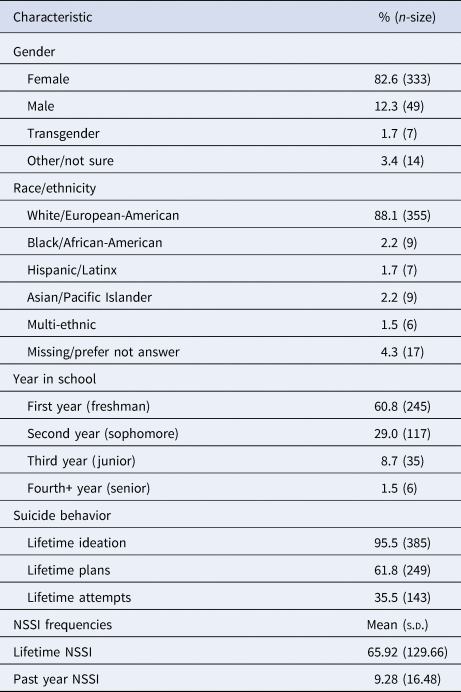
Participants were drawn from a longitudinal study of young adults who endorsed engaging in NSSI within the past year. At baseline, the sample included 403 participants (M age = 18.91 years, s.d. = 1.40); age range 18–30 with 98.3% between ages 18 and 22. Most of the sample were first-year students (60.8%), identified as female (82.6%), and consistent with the population from which the sample was drawn, endorsed being White (88.1%; see Table 1 for full demographic information). The majority (63.4%) of the sample reported being diagnosed with a psychological disorder, with co-occurring major depression/anxiety disorders being the most prevalent (53%), followed by major depressive disorder (9.6%), attention deficit and hyperactivity disorder (7.5%), post-traumatic stress disorder (6.9%), anxiety disorders (5.5%), and other diagnoses (e.g. eating disorders, body dysmorphic disorder, bipolar, borderline personality disorder; PMDD; 17.5%). Over a third (36.6%, n = 153) of the sample reported currently seeing a counselor, and almost half (46.3%) reported having a current prescription for ‘any medication to treat an emotional disorder’. At 6-month follow-up, 290 completed all measures (69% retention), and 236 (81% retention of the 6-month sample and 56% of the baseline sample) completed all measures used in the current analyses at the 12-month follow-up.
Sample demographics at baseline

Note. Full sample n = 403.
Procedure
Participants were recruited from an online eligibility screening survey administered at two universities in the USA (one south-central and one midwestern) for enrollment into a longitudinal study of NSSI. Individuals who reported NSSI within the past year on the screener were contacted and invited to participate. Those consenting to participate completed a self-harm pre-risk assessment (UWRAP; Linehan, Comtois, & Ward-Ciesielski, Reference Linehan, Comtois and Ward-Ciesielski2012), followed by a protocol of self-report and behavioral tasks on a lab computer, and ended their session with a post-risk assessment. Five participants at baseline, two at the 6-month, and one at the 12-month research visits required an imminent risk assessment. All participants were referred to the on-campus counseling center; the majority reported already being in therapy and three out of the five referred at baseline returned for follow-up assessments. Participants completed the research protocol within 30–45 min and returned to the research lab at 6 and 12 months for follow-up assessments. They received $20 in compensation at baseline and 6 months, and $25 at 12 months.
As noted, there was adequate retention (69%) at 6 months, and moderate retention (81% of the 6-month sample) at 12 months. Most attrition was due to participants no longer being enrolled at their respective university the following year. Comparisons between participants who did and did not complete all three time points showed no differences in age (t = 1.56, p = 0.12), ethnicity [χ2(4) = 4.47, p = 0.34], sexual orientation [χ2(2) = 1.3, p = 0.50], or current involvement in therapy [χ2(1) = 2.00, p = 0.16]. There were no differences on mean frequency for past-year NSSI at baseline (t = −1.11, p = 0.270), lifetime NSSI frequency (t = −0.25, p = 0.80), lifetime suicide ideation [χ2(1) = 1.11, p = 0.29], lifetime suicide plans [χ2(1) = 3.36, p = 0.07], or lifetime suicide attempts [χ2(1) = 0.87, p = 0.35]. Females were slightly less likely to complete timepoints than males [χ2(1) = 4.5, p = 0.03]. The study and all its procedures received approval from the Institutional Review Boards at both universities.
Measures
Demographics
Open-ended questions asked about participants' age, gender, sexual orientation, ethnicity, current treatment status, any diagnosed disorders, and whether they were currently prescribed any psychiatric medications.
Self-injurious thoughts and behaviors interview: short form
The Self-Injurious Thoughts and Behaviors Interview (SITBI)-short, self-report form was used and contains 72 items evaluating characteristics of suicidal thoughts, behaviors, and NSSI (Nock, Holmberg, Photos, & Michel, Reference Nock, Holmberg, Photos and Michel2007). The SITBI items evaluate the presence [i.e. Have you ever actually engaged in nonsuicidal self-injury (NSSI)? Coded Yes = 1, No = 0] and frequency (e.g. How many times have you….?) of NSSI behavior, suicide ideation, suicide planning, and suicide attempts were administered at baseline, 6-, and 12-month follow-ups. Follow-up administrations of the SITBI assessed for NSSI and suicide thoughts and behavior for the past 6 months using the prompt of: From the past 6 months through today, have you… […had thoughts of killing yourself; …made a plan to kill yourself; …made an actual attempt to kill yourself in which you had at least some intent to die; …actually engaged in NSSI]? Follow up questions asked about the frequency of NSSI (From the past 6 months through today, how many times have you engaged in NSSI?) and participants responded by entering a whole number. The same pattern was used for follow-up items assessing ideation (From the past 6 months through today, how many separate times have you had thoughts of killing yourself?), suicide plans (From the past 6 months through today, how many separate times have you made a plan?), and suicide attempts (From the past 6 months through today, how many suicide attempts have you made?).The SITBI has strong reliability and concurrent validity (Nock et al., Reference Nock, Holmberg, Photos and Michel2007).
Analytic approach
To determine the extent to which changes in NSSI behavior related to suicide ideation and suicide planning, bivariate latent growth modeling (Bollen & Curran, Reference Bollen and Curran2006; see Littlefield, Sher, & Wood, Reference Littlefield, Sher and Wood2009, for an applied example) was used. Occurrences of NSSI, suicide ideation, and suicide planning frequency were modeled as count variables based on frequencies at each of the three waves (see online Supplemental materials for more details). After determining the number of growth factors to retain for each construct, two bivariate latent growth models (i.e. NSSI with suicide ideation, NSSI with suicide planning) were estimated. The focus of these models involved the correlations between the growth factors across constructs (e.g. NSSI slope with suicide ideation slope). Sensitivity analyses examined the impact of adjusting for a binary history of counseling variable and lifetime NSSI frequency (based on a reviewer request) on model estimates.
Results
Univariate latent growth models with count indicators
Empirical comparisons across models supported retaining negative binomial models involving a random intercept and random slope for NSSI and suicide ideation and a random-intercept only model for suicidal planning (see online Supplemental materials for details). Importantly, the random intercept for suicidal planning reflects interindividual variance in planning frequency across the three waves (given a random slope was not retained). For NSSI and ideation, the random intercept reflects interindividual variance in the respective frequencies of these constructs when the loading on the latent slope is coded 0, which was set at the baseline assessment in these models.
Bivariate latent growth models with count indicators
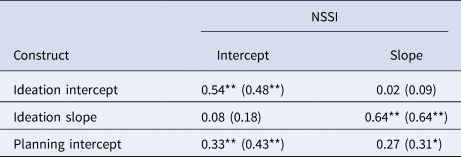
Correlations between the growth parameters are shown in Table 2. For NSSI with ideation, the random intercepts correlated across constructs, suggesting those higher in NSSI frequency tended to have higher ideation frequency at baseline. The random slopes were also significantly correlated between NSSI and suicide ideation, suggesting individuals that made sharper declines in NSSI across the three waves of assessment also made steeper declines in suicide ideation (and vice versa). The random intercepts between NSSI and suicide planning were also significantly correlated (see Table 2), suggesting those with higher NSSI frequencies at baseline tended to be higher in overall suicide planning frequencies across the three waves of assessment. When adjusting for the covariates of counseling history and NSSI lifetime frequency, the pattern of significance was largely the same, as was the magnitude of the correlations between growth parameters (see Table 2). Notably, when removing variance in the growth parameters accounted by counseling history and lifetime NSSI, the intercept of suicide planning marginally (p = 0.08) correlated with the slope of NSSI (see Table 2), tentatively suggesting those that made less pronounced reductions in NSSI tended to have higher overall frequencies of suicide planning when holding counseling history and lifetime NSSI constant. All significant relations reflected medium to large effect sizes (Cohen, Reference Cohen1988).
Correlations between growth parameters of NSSI with ideation and planning

NSSI, nonsuicidal self-injury; ideation, suicide ideation; planning, suicide planning.
Note. Correlations adjusted for the covariates of binary treatment history and lifetime frequency of NSSI are shown in parentheticals; maximum likelihood n = 403. **p < 0.0001; *p < 0.08.
Discussion
These data provide new insight into concurrent changes between NSSI and suicidal thoughts and behaviors over a 12-month timeframe. Overall, the pattern of results suggests that when engagement in NSSI changes, a similar pattern of change in suicidal thoughts and planning occurs. Consistent with prior literature (Castellvi et al., Reference Castellvi, Lucas-Romero, Miranda-Mendizabal, Pares-Badell, Almenara, Alonso and Alonso2017; Czyz, Glenn, Arango, Koo, & King, Reference Czyz, Glenn, Arango, Koo and King2021), higher rates of baseline NSSI were strongly related to elevated suicide ideation and suicide planning across all time points demonstrating a persistent risk relationship. This finding provides further evidence that while not all NSSI behavior increases risk for suicide, it does remain a salient risk factor. These results are an important step in understanding how NSSI contributes to suicide risk, offering additional evidence that there is likely some persistent, static risk for suicidal thoughts and behaviors among those with a history of NSSI (e.g. Joiner et al., Reference Joiner, Ribeiro and Silva2012; O'Connor & Kirtley, Reference O'Connor and Kirtley2018; Ribeiro et al., Reference Ribeiro, Franklin, Fox, Bentley, Kleiman, Chang and Nock2016).
Advancing existing knowledge, the current data provide evidence that when engagement in NSSI decreases over time, the frequency of suicidal thinking also decreases during the same period (and vice versa; when NSSI increases, ideation increases). Specifically, the observed correlations between the NSSI slope and ideation slope infer within-person changes in these constructs tracked across time, such that those who had a steeper decrease (increase) in NSSI frequency tended to make steeper decreases (increases) in suicide ideation as well. This suggests that reducing NSSI engagement may lead to reductions in suicidal thoughts, thereby decreasing suicide risk. The longitudinal effect of decreasing NSSI on decreasing suicide ideation remained after controlling for the effects of treatment and lifetime NSSI frequency, suggesting this is a robust relationship. Underscoring the importance of prevention and early treatment efforts, these data provide some of the first longitudinal evidence that changes in NSSI engagement may affect changes in suicide-related outcomes. At the same time, given the strength of the association and data suggesting suicide ideation occurs prior to NSSI for many (e.g. Glenn et al., Reference Glenn, Lanzillo, Esposito, Santee, Nock and Auerbach2017a, Reference Glenn, Werntz, Slama, Steinman, Teachman and Nock2017b), it may be useful for future longitudinal research to also examine whether decreases in suicide ideation coincide with subsequent reductions in NSSI.
The effects of changes in NSSI frequency on suicide planning were not as clear, likely due to the lower base rates of planning within the sample across waves, making it harder to model. Overall, levels of suicide planning were related to NSSI across time, with those who had higher baseline NSSI exhibiting elevated planning across all three waves. However, it was only after controlling for the effects of lifetime NSSI frequency and treatment status that a marginally significant effect between the planning intercept and NSSI slope was observed. This result tentatively suggests that individuals who experienced smaller declines in NSSI frequency across waves tended to engage in more planning behavior over time, possibly indicating that persistent or continued NSSI engagement is linked to more frequent planning. Such a conclusion is consistent with studies showing a positive correlation between NSSI and suicide planning (Castellvi et al., Reference Castellvi, Lucas-Romero, Miranda-Mendizabal, Pares-Badell, Almenara, Alonso and Alonso2017). Like with suicide ideation, variability in NSSI engagement may concurrently relate to and potentially affect suicide planning but the current data need replication to build confidence in that conclusion.
Although it was not possible to examine suicide attempts within this analytic framework given the sparseness of these data (e.g. only 10 participants had a nonzero response at the 12-month follow-up), additional analyses (available upon request) indicated individuals that consistently engaged in NSSI had up to a threefold higher risk for attempts compared to those that stopped engaging in NSSI (though these differences were not statistically significant). Taken together with the current findings, it appears that changes in NSSI engagement likely impact risk for suicide, strengthening the importance of monitoring for suicide risk when working with those who self-injure. Targeting NSSI directly in treatment and helping a person decrease and ultimately cease self-injury may contribute to concurrent decreases in suicide risk. Given studies have found NSSI often precedes suicidal behaviors by one year or more (Bryan, Bryan, May, & Klonsky, Reference Bryan, Bryan, May and Klonsky2015; Kiekens et al., Reference Kiekens, Hasking, Boyes, Claes, Mortier, Auerbach and Bruffaerts2018), identifying and treating NSSI early may help prevent suicide among this high-risk group.
There are numerous strengths to this study including the multi-wave longitudinal design, assessment of multiple suicide outcomes, and drawing from a sample of individuals with active NSSI. However, limitations include the homogenous nature of the sample and use of self-report without interview cross-validation of behaviors. Additionally, the self-report measure used has since been updated and revised (see Fox et al., Reference Fox, Harris, Wang, Millner, Deming and Nock2020). The sample was drawn from university students so the findings may not generalize to clinical samples, although most participants reported having a clinical diagnosis and many were currently in therapy. The high attrition at 12 months is another notable limitation, though the use of data estimation techniques reduces this concern to some degree. Although there were no significant differences on baseline assessments among those lost to attrition from those retained, it is possible participants who did not return at 12 months experienced meaningful changes in the behaviors studied that we were unable to capture. Future studies could consider examining how changes in NSSI relate to changes in suicide outcomes across shorter timeframes. Furthermore, some studies have found that up to 10% of individuals who cease NSSI for one year do re-engage in the behavior (Hamza & Willoughby, Reference Hamza and Willoughby2014), and it is unknown whether this re-engagement would subsequently affect suicide thoughts and behaviors. A 12-month window of assessment cannot completely capture the possible patterns of NSSI engagement across the lifespan nor its relationship to suicidal behaviors. Continued study of the concurrent course of NSSI and suicidal thoughts and behaviors across different timeframes using micro longitudinal (e.g. EMA) and traditional longitudinal methods would enhance current understanding of the developmental and dependent patterns of these behaviors. It is also important to examine longitudinal changes in NSSI and suicide outcomes in diverse participants, as the current results are limited to young adults who are predominantly white and female; although both NSSI and suicide attempts are more prevalent among young women (Bresin & Schoenleber, Reference Bresin and Schoenleber2015; Glenn et al., Reference Glenn, Kleiman, Kellerman, Pollak, Cha, Esposito and Boatman2020). Still, our predominantly female sample prohibited meaningful comparisons of prospective relations across genders, which remains important to examine. Continued exploration of the relationship between NSSI and suicide risk, including examination of the mechanisms facilitating risk, is needed to prevent both behaviors.
Despite these limitations, this study provides new and valuable information documenting the concurrent influence of NSSI on suicidal thoughts and behaviors. Consistent with prior work suggesting that NSSI prospectively confers risk for later suicide behavior (e.g. Glenn et al., Reference Glenn, Lanzillo, Esposito, Santee, Nock and Auerbach2017a, Reference Glenn, Werntz, Slama, Steinman, Teachman and Nock2017b; Ribeiro et al., Reference Ribeiro, Franklin, Fox, Bentley, Kleiman, Chang and Nock2016), the current results suggest that changes in NSSI engagement may also change suicide risk within the same time frame. It remains imperative to address early instances of NSSI and prioritize NSSI cessation in treatment as doing so may be an additional pathway to preventing suicide given that the current data show that decreases in NSSI align with decreases in markers of suicide risk.
Supplementary material
The supplementary material for this article can be found at https://doi.org/10.1017/S0033291722001763
Financial support
This work was supported by the National Institute of Mental Health (grant number 1R15MH110960).
Conflict of interest
None.
Ethical standards
The authors assert that all procedures contributing to this work comply with the ethical standards of the relevant national and institutional committees on human experimentation and with the Helsinki Declaration of 1975, as revised in 2008.