INTRODUCTION
Epidemiological studies have identified traumatic brain injury (TBI) as a risk factor for dementia (Perry et al., Reference Perry, Sturm, Peterson, Pieper, Bullock, Boeve and Kramer2015; Plassman & Grafman, Reference Plassman and Grafman2015). Not only are individuals who sustain TBI in older adulthood at high risk for dementia (Gardner et al., Reference Gardner, Burke, Nettiksimmons, Kaup, Barnes and Yaffe2014), but there is evidence of long-term associations such that individuals who experienced TBI earlier in life are at increased risk of developing mild cognitive impairment (MCI) (Guskiewicz et al., Reference Guskiewicz, Marshall, Bailes, McCrea, Cantu, Randolph and Jordan2005) and dementia (Barnes et al., Reference Barnes, Kaup, Kirby, Byers, Diaz-Arrastia and Yaffe2014; Plassman et al., Reference Plassman, Havlik, Steffens, Helms, Newman, Drosdick and Burke2000) in late life. Despite this evidence, the profile of cognitive deficits that may be present among older adults with a lifetime history of TBI remains unclear. Investigation of whether lifetime TBI is associated with deficits in specific cognitive abilities in aging may clarify what type of dementia process is most likely to occur among older adults with TBI, and perhaps elucidate potential targets for intervention or prevention efforts.
Most research examining the effect of TBI on specific cognitive abilities has been conducted among younger to middle-aged adults. From such studies, it is clear that individuals with recent TBI may exhibit deficits in a variety of cognitive domains, including problems with executive functioning (McDonald, Flashman, & Saykin, Reference McDonald, Flashman and Saykin2002; Rochat, Ammann, Mayer, Annoni, & Linden, Reference Rochat, Ammann, Mayer, Annoni and Linden2009), attention (Chan, Reference Chan2005), working memory (McAllister, Flashman, McDonald, & Saykin, Reference McAllister, Flashman, McDonald and Saykin2006), processing speed (Mathias, Beall, & Bigler, Reference Mathias, Beall and Bigler2004), and memory (Curtiss, Vanderploeg, Spencer, & Salazar, Reference Curtiss, Vanderploeg, Spencer and Salazar2001). In the months to initial years following a TBI, individuals tend to experience at least some cognitive improvement over time (Finnanger et al., Reference Finnanger, Skandsen, Andersson, Lydersen, Vik and Indredavik2013; Schretlen & Shapiro, Reference Schretlen and Shapiro2003), and some, particularly those with mild TBI, may experience complete cognitive recovery (Karr, Areshenkoff, & Garcia-Barrera, Reference Karr, Areshenkoff and Garcia-Barrera2014; Schretlen & Shapiro, Reference Schretlen and Shapiro2003). These patterns of cognitive stability or improvement following recent TBI contrast with findings of long-term associations between lifetime TBI and the development of dementia in late life.
The few studies (Ashman et al., Reference Ashman, Cantor, Gordon, Sacks, Spielman, Egan and Hibbard2008; Dams-O’Connor et al., Reference Dams-O’Connor, Spielman, Hammond, Sayed, Culver and Diaz-Arrastia2013; Himanen et al., Reference Himanen, Portin, Isoniemi, Helenius, Kurki and Tenovuo2006) that have addressed the effect of lifetime and/or remote TBI on specific cognitive abilities in older adulthood have produced mixed findings and have had important methodological limitations. For example, a study by Dams-O’Connor et al. (Reference Dams-O’Connor, Spielman, Hammond, Sayed, Culver and Diaz-Arrastia2013) compared dementia patients with and without a history of TBI to evaluate differences in the clinical features of dementia between these groups; although this study compared cognitive performance between groups, cognitive results are difficult to interpret as specific to TBI when both groups, by definition, already had cognitive impairment rising to the level of dementia. Other studies have not accounted for medical or psychiatric comorbidities when examining the association between TBI and late-life cognition. This is an important limitation because comorbidities are relatively common in individuals with TBI (Scholten et al., Reference Scholten, Haagsma, Cnossen, Olff, Van Beeck and Polinder2016) and are known to have important effects on cognition in aging (Byers & Yaffe, Reference Byers and Yaffe2011; Qiu & Fratiglioni, Reference Qiu and Fratiglioni2015; Yaffe et al., Reference Yaffe, Vittinghoff, Lindquist, Barnes, Covinsky, Neylan and Marmar2010).
Our group is conducting the Brain Aging in Veterans (BRAVE) study to investigate the long-term effects of TBI in aging, by comparing groups of older Veterans with and without a lifetime history of TBI (Peltz et al., Reference Peltz, Gardner, Kenney, Diaz-Arrastia, Kramer and Yaffe2016). TBI is a particularly common injury among military personnel (Okie, Reference Okie2005; Ommaya, Ommaya, Dannenberg, & Salazar, Reference Ommaya, Ommaya, Dannenberg and Salazar1996; Raymont, Salazar, Krueger, & Grafman, Reference Raymont, Salazar, Krueger and Grafman2011; Sayer, Reference Sayer2012); thus older Veterans are an important population among which to investigate this question. For the present study, we aimed to characterize the neuropsychological profile of lifetime TBI in aging, by comparing neuropsychological functioning between older Veterans with and without TBI in the BRAVE study. Because they share many similarities with older Veterans with TBI, older Veterans without TBI serve as an important comparison group for the BRAVE study.
However, it should be noted that this comparison group is not representative of a typical “healthy control” group. Other risk factors for cognitive impairment, such as cardiovascular risk factors and prior psychiatric and substance abuse conditions, are relatively common among older Veterans without TBI (Peltz et al., Reference Peltz, Gardner, Kenney, Diaz-Arrastia, Kramer and Yaffe2016). Therefore, in the present study, we aimed to first evaluate the extent to which each participant group in the BRAVE study exhibited neuropsychological deficits compared to healthy older adult norms. Then, we examined whether and how neuropsychological profiles differed between groups. Given that cognitive risk factors were present in both groups, we hypothesized that older Veterans with and without TBI would show cognitive deficits compared to normative data, but that older Veterans with TBI would show a different profile of deficits. We also hypothesized that cognitive deficits would be more extensive among older Veterans with greater TBI history burden (i.e., among those with multiple mild TBIs or any moderate or severe TBI).
METHODS
Population
Participants were older Veterans (≥50 years old) with and without a lifetime history of TBI from the Brain Aging in Veterans (BRAVE) study. For the BRAVE study, Veterans were recruited from one of two Veteran’s retirement homes: the Armed Forces Retirement Home in Washington, DC and the Veterans Home of California-Yountville in Yountville, California. Recruitment and eligibility criteria for the BRAVE study have been described previously (Peltz et al., Reference Peltz, Gardner, Kenney, Diaz-Arrastia, Kramer and Yaffe2016). In brief, to be included in the BRAVE study, individuals were required to score ≥20 on the Mini-Mental State Examination (Folstein, Folstein, & McHugh, Reference Folstein, Folstein and McHugh1975) to help ensure they were cognitively capable of providing informed consent. Individuals were also required to be residents of the independent-living sections of their retirement home; to reside in independent-living, the facilities required individuals to be functionally independent and free of active substance abuse.
To be included in the TBI group, participants were required to self-report ≥1 head injury over their lifetime that required medical care, and TBI history was further assessed as detailed below. To be included in the non-TBI group, participants were required to self-report no significant head injury history. Individuals with penetrating TBI, disabling medical or psychiatric conditions, or significant sensory limitations were excluded from the study. The BRAVE study was approved by institutional review boards at each site, all participants provided written informed consent, and all data were obtained in compliance with institutional regulations. All participants were informed during the informed consent process that there would be no direct benefit to them from study participation, other than their contribution to the gain of research knowledge.
Measures
TBI History
Detailed TBI history was ascertained using the Ohio State University TBI Identification Method (OSU TBI-ID) (Bogner & Corrigan, Reference Bogner and Corrigan2009; Corrigan & Bogner, Reference Corrigan and Bogner2007), a structured interview recommended by the National Institute of Neurological Disorders and Stroke (NINDS) as a Common Data Element (CDE) for the retrospective assessment of lifetime TBI in clinical research [National Institute of Neurological Disorders and Stroke (NINDS), 2012]. During the OSU TBI-ID, participants were asked to self-report the TBI(s) they had experienced over their lifetime, including age of injury, injury cause, presence and length of loss of consciousness (LOC), and yes/no response to “were you dazed or did you have a gap in your memory from the injury?” indicating alteration in consciousness or post-traumatic amnesia (PTA).
Each injury was classified as a (1) Mild TBI if an individual experienced an alteration in consciousness or PTA without LOC or LOC <30 min, (2) Moderate TBI if LOC≥30 min but<24 hr, or (3) Severe TBI if LOC≥24 hr (Department of Veterans Affairs & Department of Defense, 2009). Medical charts available at participants’ retirement home were reviewed to corroborate history of TBI to the extent possible. Of individuals in the present study, 41% in the TBI group had TBI documented in their retirement home charts, while none of the individuals in the non-TBI group had TBI in their charts.
Cognitive functioning
Participants completed a comprehensive neuropsychology battery, an expanded version of the Alzheimer’s Disease Centers’ Uniform Data Set battery (Weintraub et al., Reference Weintraub, Salmon, Mercaldo, Ferris, Graff-Radford, Chui and Galasko2009). This battery was comprised of measures assessing cognitive functioning in five domains: (1) attention/working memory, (2) learning/memory, (3) language, (4) processing speed, and (5) executive functioning. Specifically, measures of attention/working memory included the Wechsler Memory Scale-Revised (WMS-R) Digit Span Forward and Backwards (Wechsler, Reference Wechsler1987) and the Working Memory Factor score from the National Institutes of Health - Executive Abilities: Measures and Instruments for Neurobehavioral Evaluation and Research (NIH-EXAMINER) battery (Kramer et al., Reference Kramer, Mungas, Possin, Rankin, Boxer, Rosen and Widmeyer2014b). The Auditory Verbal Learning Task (AVLT) (Rey, Reference Rey1941; Taylor, Reference Taylor1959) was used to assess learning/memory, including AVLT Learning Trials (total trials 1–5), AVLT Delayed Recall, and AVLT Recognition total. Language was assessed using the Boston Naming Test—30 item version (Kaplan, Goodglass, & Weintraub, Reference Kaplan, Goodglass and Weintraub1983) and Animal Fluency (Morris et al., Reference Morris, Heyman, Mohs, Hughes, van, Fillenbaum and Clark1989). Measures of processing speed included Trail Making Test Part A (Reitan & Wolfson, Reference Reitan and Wolfson1985) and Wechsler Adult Intelligence Scale-Revised (WAIS-R) Digit Symbol (Wechsler, Reference Wechsler1981). Executive functioning was assessed with the Trail Making Test Part B (Reitan & Wolfson, Reference Reitan and Wolfson1985), and the NIH-EXAMINER battery Fluency Factor and Cognitive Control Factor scores (Kramer et al., Reference Kramer, Mungas, Possin, Rankin, Boxer, Rosen and Widmeyer2014b).
Other variables
Participants self-reported their age, race, sex, education, military service history, and cigarette smoking status. Comorbidities, including hypertension, myocardial infarction, stroke, diabetes, and history of mental health conditions and substance abuse were determined via a combination of participant self-report and chart review. Current psychiatric symptoms were assessed via self-report inventories. Namely, depressive symptoms were assessed with the Geriatric Depression Scale—Short Form (GDS) (Yesavage et al., Reference Yesavage, Brink, Rose, Lum, Huang, Adey and Leirer1983), a 15-item inventory of yes/no questions with a score>5 being suggestive of clinical depression. Current symptoms of post-traumatic stress disorder (PTSD) were assessed with the PTSD Checklist—Civilian version (PCL-C) (Blanchard, Jones-Alexander, Buckley, & Forneris, Reference Blanchard, Jones-Alexander, Buckley and Forneris1996), for which a score≥36 may be suggestive of significant PTSD among Veterans in general settings (U.S. Department of Veterans Affairs & National Center for PTSD, 2014).
Statistical Analysis
We compared participant characteristics between individuals in the TBI group versus the non-TBI group using t tests for continuous variables and chi-square tests or Fisher’s exact tests for categorical variables, as well as Cohen’s d and Phi coefficients as effect size measures in correspondence with these tests. To evaluate whether the TBI and non-TBI groups differed in terms of their neuropsychological profile, we first compared each participant’s raw cognitive test scores to age-corrected normative data for each measure [Mayo’s Older Americans Normative Studies (MOANS) age-corrected norms for AVLT Learning Trials (Ivnik et al., Reference Ivnik, Malec, Tangalos, Petersen, Kokmen and Kurland1990) and Delayed Recall and Recognition (Ivnik et al., Reference Ivnik, Malec, Smith, Tangalos, Petersen, Kokmen and Kurland1992); age-corrected norms for the NIH EXAMINER battery (Kramer et al., Reference Kramer, Mungas, Possin, Rankin, Boxer, Rosen and Widmeyer2014a); and Alzheimer’s Disease Centers’ Uniform Data Set age-corrected norms (Shirk et al., Reference Shirk, Mitchell, Shaughnessy, Sherman, Locascio, Weintraub and Atri2011) for the remaining measures], similar to standard practice in clinical neuropsychological evaluations.
Using these normative data, we converted each individual’s raw test scores into age-corrected Z-scores, reflecting the extent to which an individual’s test performance diverges from that of healthy, age-matched peers. To minimize multiple comparisons, individuals’ Z-scores for individual tests within a cognitive domain were averaged to create five cognitive domain composite scores: attention/working memory, learning/memory, language, processing speed, and executive functioning composites. Thus, these composites reflect the extent to which an individual’s overall performance within a cognitive domain diverges from that of healthy, age-matched peers.
We conducted linear mixed effects model analyses, using SAS PROC MIXED, to investigate the association between TBI and performance on the cognitive domain composite scores. These models accounted for study site (participants nested within site) as a random effect. We conducted these models with and without addition of covariates. We first adjusted for demographics (age, gender, race, education) and a binary variable indicating whether or not participants had any of the following medical comorbidities/health factors (hypertension, myocardial infarction, stroke, diabetes, or current smoking). Then, we additionally adjusted for a binary variable indicating whether or not participants had a history of any of the following psychiatric or substance use conditions (depression, anxiety, PTSD, bipolar disorder, or substance abuse), as well as their current level of psychiatric symptoms (i.e., GDS and PCL-C scores for depressive and PTSD symptoms, respectively). For each of these models, we calculated Cohen’s f 2 values from SAS PROC MIXED using procedures outlined in Selya, Rose, Dierker, Hedeker, and Mermelstein (Reference Selya, Rose, Dierker, Hedeker and Mermelstein2012), reflecting the effect size for the association between TBI and each cognitive domain composite score, unadjusted or adjusted for covariates.
To explore whether the association between TBI and neuropsychological functioning differs depending on details of an individual’s injury history, we created a four-level categorical variable to classify participants based on whether they had a single mild TBI, multiple mild TBIs (i.e., individuals who self-reported multiple head injuries that each met criteria for mild TBI as detailed in the “TBI History” section above), or at least one TBI that was moderate-to-severe in severity, compared to individuals without TBI. Using linear trend tests, we investigated the effect of TBI history category (no TBI, single mild TBI, multiple mild TBI, or any moderate-to-severe TBI) on the cognitive domain composite scores. These analyses were conducted by using the ESTIMATE statement in PROC MIXED to specify a test of linear trend across the four-level TBI variable (coefficients: −3 −1 1 3). All analyses were conducted in SAS version 9.4, and p-values<.05 were considered statistically significant.
RESULTS
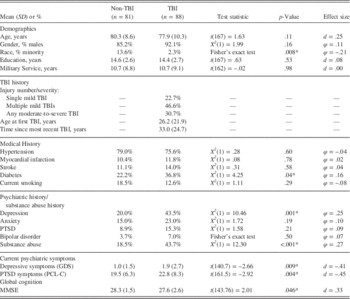
As previously reported in the BRAVE study (Peltz et al., Reference Peltz, Gardner, Kenney, Diaz-Arrastia, Kramer and Yaffe2016), Veteran participants with and without lifetime TBI were generally similar in terms of demographics and most medical comorbidities, although Veterans with TBI were more likely to be Caucasian and to have diabetes (see Table 1). Veterans with TBI were also more likely to have a history of depression and substance abuse and endorsed greater current depressive symptoms and current PTSD symptoms compared to those without TBI (see Table 1). Nevertheless, few individuals in either group endorsed current psychiatric symptoms that exceeded clinical cut-offs on the symptom inventory measures [% individuals with GDS>5: TBI=9.1% (n=8), non-TBI=2.5% (n=2); % individuals with PCL-C≥36: TBI=6.8% (n=6), non-TBI=1.2% (n=1)]. Regarding details of Veterans’ lifetime exposure to TBI, individuals’ TBI histories were quite heterogeneous.
Demographics and other participant characteristics

Note. Effect sizes reported are Cohen’s d and phi coefficient (φ) values.
* p<.05.
As shown in Table 1, experience of multiple mild TBIs was the most common lifetime injury pattern. The vast majority of Veterans had experienced their TBI(s) many years ago, although some had experienced TBI in more recent years. Namely, 18 TBI participants had sustained TBI within the past 5 years, although 14 of these individuals had had multiple lifetime TBIs with at least one of their injuries occurring >5 years ago. No participant had experienced TBI<1 year ago.
Figure 1 depicts the neuropsychological profile exhibited by older Veterans with and without lifetime TBI compared to age-corrected normative data. On average, older Veterans without TBI performed nearly .7 SD below the mean compared to normative data in the processing speed domain, and approximately .5 SD below the normative mean in the domains of attention/working memory and learning/memory, but performed more similarly to normative data in the executive functioning and language domains. On average, older Veterans with TBI performed nearly 1.2 SD below the normative mean in the processing speed domain, approximately .7 SD below the normative mean in the attention/working memory and executive functioning domains, and nearly .5 SD below the normative mean in the learning/memory domain, but performed more similarly to normative data in the language domain.
Neuropsychological profile among older veterans with and without TBI Graph shows mean cognitive domain composite scores with standard error bars by group. *p<.05 in unadjusted and adjusted models (see Table 2).

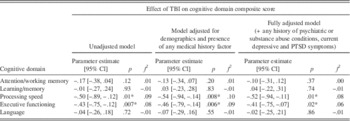
Results of linear mixed effects models examining the association between TBI and cognitive domain composite scores, with and without adjustment for covariates (demographics, presence of any medical history factor, any psychiatric or substance abuse condition, and current depressive and PTSD symptoms), are detailed in Table 2. There were no significant associations between TBI and performance on the attention/working memory, learning/memory, or language domain scores in any model. Individuals with TBI evidenced greater deficits in processing speed and executive functioning compared to those without TBI, associations which remained statistically significant in the fully adjusted model. Per standard guidelines for interpretation of Cohen’s f 2 values (“small”: f 2 ≥.02, “medium”: f 2 ≥.15, “large”: f 2 ≥.35) (Cohen, Reference Cohen1988), these associations (both unadjusted and adjusted for covariates) were in the range of “small” effect sizes.
Association between TBI and cognitive domain composite scores in older veterans

Effect sizes reported are Cohen’s f 2 values.
* p<.05.
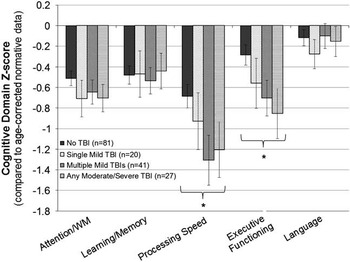
As shown in Figure 2, tests of trend for the four-level TBI variable (no TBI, single mild TBI, multiple mild TBIs, or any moderate-to-severe TBI) indicated that deficits in processing speed and executive functioning were most prominent among individuals with multiple mild TBIs or any moderate-to-severe TBI, while such deficits were not clearly present among those with single mild TBI. Specifically, in the fully adjusted model for processing speed, there was a significant linear trend effect across levels of the four-level TBI variable {parameter estimate for linear trend=−2.21, SE=.99, p=.03; parameter estimate [95% confidence interval (CI)]: no TBI=ref, single mild TBI=−.20 (−.83, .44), multiple mild TBI=−.70 (−1.22, −.18), any moderate-to-severe TBI=−.57 (−1.16, .02)}. Likewise, in the fully adjusted model for executive functioning, there was a significant linear trend effect across levels of the four-level TBI variable [parameter estimate for linear trend=−1.80, SE=.81, p=.03; parameter estimate (95% CI): no TBI=ref, single mild TBI=−.23 (−.75, .29), multiple mild TBI=−.44 (−.87, −.02), any moderate-to-severe TBI=−.53 [−1.02, −.04)]. There were no significant linear trend effects for the remaining cognitive domain composite scores (all p>.05).
Neuropsychological profile by TBI history category. Graph shows mean cognitive domain composite scores with standard error bars by group. *p-trend<.05 in unadjusted and adjusted models.

In sensitivity analyses, we re-ran the above models excluding the 18 individuals who had had a TBI within the past 5 years to explore whether findings differed among those whose injuries were exclusively remote TBI(s) rather than most recent injuries. Results remained similar to the above findings.
DISCUSSION
By evaluating the neuropsychological profiles of older Veterans with and without lifetime TBI, we found that both groups evidenced diminished cognitive performance compared to normative data from healthy older adults, but that the two groups had different neuropsychological profiles. On average, older Veterans with TBI (whose injuries were largely remote TBIs) had even greater deficits in processing speed than those without TBI. Older Veterans with TBI also showed evidence of executive dysfunction, whereas executive difficulties were not clearly present among those without TBI. The groups did not differ on measures of attention/working memory, learning and memory, and language.
When examining neuropsychological profiles of Veterans who differed in the number or severity of TBI(s) they had experienced, we found that deficits in speed and executive functioning were most prominent among individuals with more significant TBI injury histories (i.e., those with multiple mild TBIs, or any moderate-to-severe TBI), whereas history of single mild TBI was not clearly associated with greater deficits in these domains. Importantly, the neuropsychological profile differences we observed between groups did not appear to be explained by other factors present in individuals’ medical or psychiatric history, and results were unchanged when excluding the few individuals who sustained a TBI in more recent years. Overall, these results suggest that a lifetime history of multiple mild TBIs or any moderate-to-severe TBI, even when remote, is associated with a unique profile of cognitive deficits in older adulthood, characterized by slowed processing speed and executive dysfunction.
Despite epidemiological evidence that TBI is a risk factor for dementia (Plassman & Grafman, Reference Plassman and Grafman2015), much remains to be understood regarding how a lifetime history of TBI might influence cognitive aging to ultimately lead to cognitive decline and increase risk for dementia. Our study results provide some clarity among several possibilities that have been raised in the literature. First, it has been suggested that the association between TBI and risk of dementia may simply be contributed to by normal aging processes, such that older adults with a lifetime history of TBI may have long-standing neural and cognitive vulnerabilities that further worsen in aging, eventually resulting in cognitive decline significant enough to meet the clinical threshold for a dementia diagnosis (Moretti et al., Reference Moretti, Cristofori, Weaver, Chau, Portelli and Grafman2012).
Our results would be compatible with this hypothesis. Indeed, a common neural sequelae of TBI is diffuse axonal injury (Hayes, Bigler, & Verfaellie, Reference Hayes, Bigler and Verfaellie2016), which is known to be associated with deficits in processing speed and executive functioning (Spitz, Maller, O’Sullivan, & Ponsford, Reference Spitz, Maller, O’Sullivan and Ponsford2013) similar to the neuropsychological profile observed in the present study. It is possible that the processing speed and executive deficits we found among older Veterans with lifetime TBI, particularly among those with greater injury burden, may reflect long-standing deficits these individuals have had since their TBI(s) or deficits in these domains that have been further exacerbated by aging. The latter possibility is supported by a longitudinal study that found that older adults with TBI evidenced significant decline in processing speed over an 8-year follow-up period (executive functioning was not assessed) (Eramudugolla et al., Reference Eramudugolla, Bielak, Bunce, Easteal, Cherbuin and Anstey2014).
Alternatively, it is possible TBI may give rise to neuropathologic changes that initiate a neurodegenerative disease process (Johnson, Stewart, & Smith, Reference Johnson, Stewart and Smith2010; Shively, Scher, Perl, & Diaz-Arrastia, Reference Shively, Scher, Perl and Diaz-Arrastia2012; Smith, Johnson, & Stewart, Reference Smith, Johnson and Stewart2013), leading to a particular type of dementia. For example, some studies have identified TBI as a risk factor for Alzheimer’s dementia (AD), particularly among those with moderate or severe TBI (Plassman et al., Reference Plassman, Havlik, Steffens, Helms, Newman, Drosdick and Burke2000). Other research suggests repetitive mild TBI in particular may lead to a distinct neuropathology referred to as chronic traumatic encephalopathy (CTE) (Smith et al., Reference Smith, Johnson and Stewart2013; Stern et al., Reference Stern, Daneshvar, Baugh, Seichepine, Montenigro, Riley and McHale2013). Our results argue against a specific association between TBI and AD since we did not find prominent memory or language deficits in older Veterans with TBI, as is typical in prodromal AD and mild AD (Bondi et al., Reference Bondi, Jak, Delano-Wood, Jacobson, Delis and Salmon2008; Verma & Howard, Reference Verma and Howard2012). It is possible that our findings are capturing cognitive manifestations of another neurodegenerative process, such as CTE, although much remains to be investigated regarding the prevalence and cognitive profile of CTE. Moreover, it is unclear how likely it is for CTE neuropathology to be present among older Veterans whose TBI exposure may be qualitatively and quantitatively different from populations among whom CTE has been identified to date, namely football players and other athletes with extensive histories of repeated concussive and subconcussive head injuries (Bieniek et al., Reference Bieniek, Ross, Cormier, Walton, Soto-Ortolaza, Johnston and Wszolek2015; Gavett, Stern, & McKee, Reference Gavett, Stern and McKee2011).
That we found an association between the number/severity of TBIs and the extent to which individuals had cognitive deficits may also inform potential mechanism(s) linking lifetime TBI to cognitive impairment in aging. Namely, it is interesting that older Veterans who differed in the number and/or severity of TBI(s) they had experienced did not differ from each other in which cognitive domains they had deficits. Instead, they differed in the degree to which they had deficits within the same domains of processing speed and executive functioning. This pattern of findings suggests the same mechanism may underlie the association between lifetime TBI and cognition in aging among individuals with diverse TBI histories, but that the effects are more deleterious among those exposed to greater injury burden over their lifetime. Perhaps individuals with a history of multiple mild TBIs or any moderate-to-severe TBI have accumulated more extensive diffuse axonal injury or other neural damage than those with single mild TBI, increasing their vulnerability to cognitive impairment in aging. It is also possible that differences in TBI number and severity may influence whether or what type of neuropathologic cascade may develop to lead to cognitive decline and dementia in aging (Smith et al., Reference Smith, Johnson and Stewart2013).
Strengths of the present study include our ability to investigate functioning in specific cognitive domains among older Veterans with diverse TBI histories, as well as our characterization of neuropsychological profiles among these individuals compared to normative data. Our study also benefits from assessment of participants’ medical comorbidities, psychiatric and substance abuse history, and current psychiatric symptoms, enabling our results to reveal that cognitive profile differences between Veterans with and without TBI remain above and beyond the influence of these other factors. While accounting for these factors as covariates strengthens our conclusions regarding the independent impact of TBI on neuropsychological performance, it is also possible that factors such as psychiatric symptoms may themselves be features of a TBI-related decline process, a possibility that is further discussed in Peltz et al. (Reference Peltz, Gardner, Kenney, Diaz-Arrastia, Kramer and Yaffe2016).
A key limitation of our study is its cross-sectional design, such that we cannot determine whether the deficits we observed may be longstanding or incident in aging. We plan to investigate this in future work as we continue to follow these Veterans over time. We also cannot rule out the potential for reverse causality in this cross-sectional study, for example, perhaps individuals with lower pre-morbid cognitive functioning may be at greater risk for TBI in general, or at greater risk for sustaining repetitive or more severe TBIs. As accuracy of participants’ self-report of their TBI history could not be verified for many individuals, it is unclear how this may have influenced our results, or whether participants’ self-report may have tended to under- versus over-estimate the number or severity of TBI(s) they had experienced.
In defining our TBI group, we required individuals to self-report ≥1 head injury that required medical care, which may have influenced our TBI group to have more significant injury histories than the general population of older Veterans, particularly as a substantial proportion of individuals with TBI do not seek medical attention (Setnik & Bazarian, Reference Setnik and Bazarian2007). Additionally, normative corrections for our neuropsychological test battery necessitated comparisons to different sources of normative data (no one source was available that encompassed all of the tests), which may have introduced an unclear pattern of bias to our results. As this study focused on older, primarily male and caucasian Veterans, a unique population among whom medical and psychiatric comorbidities are common (Kramarow & Pastor, Reference Kramarow and Pastor2012), we cannot be certain how well our results may generalize to non-Veteran populations or to Veterans living in different settings who may differ from our participants in important ways.
Moreover, we cannot be certain of how findings from this research study may diverge from what is seen among patients presenting for neuropsychological evaluations as part of their clinical care, particularly in clinical situations where secondary gain factors may be present. As the associations we observed between TBI and cognitive functioning were in the range suggestive of “small” effect sizes, the extent to which such associations have clear clinical impacts remains unclear, including whether and how these TBI-associated cognitive deficits impact individuals’ daily functioning.
In summary, our findings suggest that the neuropsychological profile of older Veterans with lifetime TBI, even when remote, is characterized by slowed processing speed and executive dysfunction. This pattern of deficits was most prominent among individuals with a history of multiple mild TBIs or any moderate-to-severe TBI, but were not clearly present among those with single mild TBI. Older Veterans with lifetime TBI are appear to be a cognitively vulnerable population, for whom clinical care should include close monitoring and routine assessment to evaluate whether patients need additional resources and care. Future research is needed to understand whether it might be possible to intervene to improve cognitive functioning among older adults with TBI, and whether such interventions might also help to prevent, or at least delay, the development of dementia in this high-risk population. Our results suggest that intervention and prevention research efforts should focus on older Veterans who have had multiple mild TBI or any moderate-to-severe TBI in particular, and that research investigating potential cognitive interventions should emphasize processing speed and executive functioning skills as intervention targets.
ACKNOWLEDGMENTS
The authors thank our research participants, the Armed Forces Retirement Home in Washington, DC, the Veterans Home of California in Yountville, CA, and our dedicated study staff including Kim Kelley, Ross Passo, Leah Harburg, Daniel Freimer, and Margaret Gross. This research was supported by Department of Defense grants W81XWH-12-1-0581 and W81XWH-14-2-0132 (awarded to K.Y.); and in part by NIA grant K24AG031155 (awarded to K.Y.). This research was also supported by Career Development Award 1IK2RX001629 (awarded to A.R.K.) from the U.S. Department of Veterans Affairs, Rehabilitation Research and Development Service. The contents of this manuscript do not represent the views of the U.S. Department of Veterans Affairs or the United States Government. Disclosures: Dr. Kaup has been given access to cognitive assessment/cognitive training software and tablet devices by Akili Interactive Labs for usage in a related research study. Dr. Yaffe is a consultant for Novartis and Pfizer, serves on DSMBs for Takeda, Inc and an NIA sponsored study, and serves on the Beeson Scientific Advisory Board and the Alzheimer’s Association Medical & Scientific Advisory Council. The remaining authors have no disclosures to report.