

Introduction
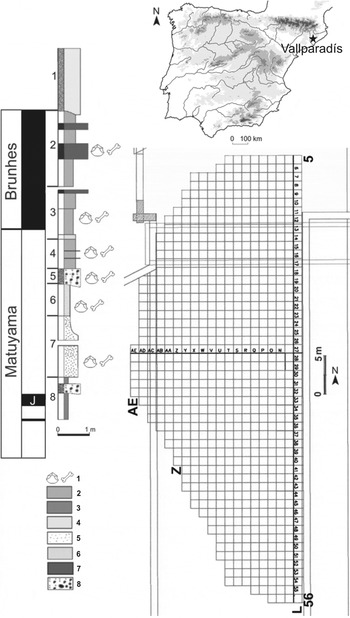
The Vallparadís archaeological site (Barcelona, northeastern Spain) is of particular relevance to the debate regarding the first hominin settlement of Europe. The site has made it possible to close the classic ‘young Europe’ debate (Roebroeks & van Kolfschoten, Reference Roebroeks and van Kolfschoten1995; Carbonell et al., Reference Carbonell, Mosquera, Rodríguez and Sala1996) and to demonstrate that the first Europeans arrived on the continent before the Jaramillo subchron (Garcia et al., Reference Garcia, Martínez, Cuenca-Bescós and Carbonell2014; contra Muttoni et al., Reference Muttoni, Scardia and Kent2013). Vallparadís has enriched the scant archaeological record of the continental Early Pleistocene and has filled the chronological gap that existed previously between the late Early Pleistocene and the Matuyama-Brunhes boundary (0.78 million years ago, Myr hereafter), which probably suggest a continuity of the hominin occupation during this time period (Garcia et al., Reference Garcia, Martínez and Carbonell2011). The site comprises a 14 m-thick succession of alluvial fan and plain deposits (Martínez et al., Reference Martínez, Garcia, Carbonell, Agustí, Bahain, Blain, Burjachs, Cáceres, Duval, Falguères, Gómez and Huguet2010, Reference Martínez, Garcia and Carbonell2013, Reference Martínez, Garcia, Burjachs, Yll and Carbonell2014; Madurell-Malapeira et al., Reference Madurell-Malapeira, Minwer-Barakat, Alba, Garcés, Gómez, Aurell-Garrido, Ros-Montoya, Moyà-Solà and Berástegui2010; Minwer-Barakat et al., Reference Minwer-Barakat, Madurell-Malapeira, Alba, Aurell-Garrido and Moyà-Solà2011) (Figure 1). Levels 10 and 10c (unit EVT7) are the richest archaeological deposits, dated to 0.83 ± 0.13 Myr and 0.849 ± 0.048 Myr by ESR/U–series and OSL for the archaeological level 10 (Garcia et al., Reference Garcia, Martínez and Carbonell2011, Reference Garcia, Martínez, Cuenca-Bescós and Carbonell2014; Duval et al., Reference Duval, Moreno, Shao, Voinchet, Falguères, Bahain, Garcia, Garcia and Martínez2011, Reference Duval, Bahain, Falguères, Garcia, Guilarte, Grün, Martínez, Moreno, Shao and Voinchet2015). Magnetostratigraphic and biostratigraphic analysis have suggested an age within the upper limit of the Jaramillo (0.98 Myr) for unit EVT7 (Martínez et al., Reference Martínez, Garcia, Carbonell, Agustí, Bahain, Blain, Burjachs, Cáceres, Duval, Falguères, Gómez and Huguet2010, Reference Garcia, Martínez, Cuenca-Bescós and Carbonell2014). This unit contains a rich Mode 1 lithic assemblage associated with a record of large and medium-sized mammals, including several bones cut-marked and fractured by hominin action (Martínez et al., Reference Martínez, Garcia, Carbonell, Agustí, Bahain, Blain, Burjachs, Cáceres, Duval, Falguères, Gómez and Huguet2010; Garcia et al., Reference Garcia, Martínez, Carbonell, Agustí and Burjachs2012, Reference Garcia, Martínez and Carbonell2013a, Reference Garcia, Landeck, Martínez and Carbonellb).
Location of the site (top right), general plan with excavation grids (right) and the chronostratigraphic section (left). 1: lithic industry and faunal remains; 2: clays and muds with gastropods; 3: red clays and muds; 4: Upper Pleistocene terrace; 5: unit 7 (levels 10 and 10c); 6: brown clays and muds; 7: palaeo-floor and 8: conglomerates. (Re-drawn with new data, based on illustrations and information in Madurell-Malapeira et al., Reference Madurell-Malapeira, Minwer-Barakat, Alba, Garcés, Gómez, Aurell-Garrido, Ros-Montoya, Moyà-Solà and Berástegui2010; Martínez et al., Reference Martínez, Garcia, Carbonell, Agustí, Bahain, Blain, Burjachs, Cáceres, Duval, Falguères, Gómez and Huguet2010; Duval et al., Reference Duval, Bahain, Falguères, Garcia, Guilarte, Grün, Martínez, Moreno, Shao and Voinchet2015).

The lithic assemblage of unit EVT7, ascribed to the Mode 1 technology (Garcia et al., Reference Garcia, Martínez and Carbonell2013a), is strongly conditioned by the small size of the raw materials quarried (>70 per cent quartz). Systematic use of bipolar knapping for stone tool production at the site has been interpreted as a cultural choice rather than determined by lithological constraints, as in the stream at Vallparadís there were deposits of raw material that could have been sourced for knapping larger sized pebbles (Garcia et al., Reference Garcia, Martínez and Carbonell2013a). Many scholars have referred to the difficulties in identifying and analysing these bipolar objects because the bipolar knapping process generates great quantities of non-diagnostic pieces (e.g. Kobayashi, Reference Kobayashi and Swanson1975; Shott, Reference Shott1989, Reference Shott1999; Prous & Lima, Reference Prous and Lima1990; Andrefsky, Reference Andrefsky1998; Díez-Martín et al., Reference Díez-Martín, Sánchez-Yustos, Domínguez, Mabulla and Barba2009; Sánchez-Yustos et al., Reference Sánchez-Yustos, Díez-Martín, Domínguez-Rodrigo and Tarriño Vinagre2012; Garcia et al., Reference Garcia, Martínez and Carbonell2013a; de la Peña & Wadley, Reference de la Peña and Wadley2014; de la Peña, Reference de la Peña2015a, Reference de la Peñab; Lombera et al., Reference Lombera, Rodríguez-Álvarez, Peña, Sala-Ramos, Despriée, Moncel, Gourcimault, Voinchet and Falguères2016). Such difficulties have been experienced in distinguishing between artefacts and ‘ecofacts’, cores and detached objects, or bipolar technique and free-hand technique. These drawbacks are emphasized when quartz is the raw material employed for bipolar knapping, since the less predictable fracture of quartz makes the identification of quartz objects difficult relative to other raw materials (Tallavaara et al., Reference Tallavaara, Manninen, Hertell and Rankama2010; Díez-Martín et al., Reference Díez-Martín, Sánchez-Yustos, Domínguez and Prendergast2011; Driscoll, Reference Driscoll2011; Proffitt & de la Torre, Reference Proffitt and de la Torre2014; Li, Reference Li2016). Different research experiments conducted on quartz have demonstrated that it is worthless applying conventional methods of lithic analysis to bipolar objects (Díez-Martín et al., Reference Díez-Martín, Sánchez-Yustos, Domínguez and Prendergast2011; Byrne et al., Reference Byrne, Proffitt, Arroyo and de la Torre2015; Li, Reference Li2016; Lombera et al., Reference Lombera, Rodríguez-Álvarez, Peña, Sala-Ramos, Despriée, Moncel, Gourcimault, Voinchet and Falguères2016).
The major classification difficulties experienced during the study of the EVT7 lithic assemblage from Vallparadís have been centred on differentiating between cores and detached objects. Further, during the technological analysis we faced difficulties related to the orientation of the objects, for instance when trying to distinguish between striking and resting platforms, butt and counter-butt, or dorsal and ventral surfaces. These orientation attributes are of very low diagnostic value for identifying bipolar objects in blind analysis (Proffitt & de la Torre, Reference Proffitt and de la Torre2014; Byrne et al., Reference Byrne, Proffitt, Arroyo and de la Torre2015). The identification between knapped objects (either cores or flakes) produced by using a bipolar technique or free-hand technique has not presented any complication in the analysis of the EVT7 assemblage, essentially because the bipolar technique is recurrently applied to small blanks (98.4 per cent of the bipolar cores are about 25 mm long) and the free-hand technique is under-represented (1.75 per cent of the cores) and always focused on larger blanks. Preliminary experimental work was undertaken to justify the presence of the bipolar technique in the EVT7 assemblage and its convenience for reducing small blanks (Garcia et al., Reference Garcia, Martínez and Carbonell2013a). The present experimental protocol is aimed at identifying the major constraints and parameters that could be employed to increase the level of accuracy in the identification and analysis of the bipolar objects from Vallparadís.
The Bipolar Core Technology in the European Mode 1
The Early and early Middle Pleistocene lithic assemblages characterized by a simple core and flake technology are known in the European literature of the Palaeolithic as the Mode 1 industry, and share the following technological traits: 1) local sourcing of raw materials; 2) presence of worked pebbles (choppers) and absence of handaxes and other large cutting tools; 3) short operative sequences; 4) poorly structured and adapted method of flaking with respect to the size, shape, and breakage response of selected blanks and raw materials; and 5) scarcity of retouched tools, often characterized by slight retouching and non-standardized morphotypes (e.g. Carbonell et al., Reference Carbonell, García-Antón, Mallol, Mosquera, Ollé, Rodríguez, Sahnouni, Sala and Vergès1999; Barsky et al., Reference Barsky, Celiberti, Cauche, Grégoire, Lebègue, de Lumley and Toro-Moyano2010; Parfitt et al., Reference Parfitt, Ashton, Lewis, Abel, Coope, Field, Gale, Hoare, Larkin, Lewis, Karloukovski, Maher, Peglar, Preece, Whittaker and Stringer2010; Despriée et al. Reference Despriée, Voinchet, Tissoux, Bahain, Falguères, Courcimault, Dépontc, Moncel, Robin, Arzarello, Sala, Marquer, Messagera, Puaud and Abdessadok2011; Toro-Moyano et al., Reference Toro-Moyano, Barsky, Cauche, Celiberti, Grégoire, Lebègue, Moncel and de Lumley2011; Arzarello et al., Reference Arzarello, Pavia, Peretto, Petronio and Sardella2012, Reference Arzarello, Peretto and Moncel2015; Garcia et al., Reference Garcia, Martínez and Carbonell2013a, Reference Garcia, Landeck, Martínez and Carbonellb; Mosquera et al., Reference Mosquera, Ollé and Rodríguez2013; Gallotti & Peretto Reference Gallotti and Peretto2015; Aureli et al., Reference Aureli, Rocca, Lemorini, Modesti, Scaramucci, Milli, Giaccio, Marano, Palombo and Contardi2016; Lombera et al., Reference Lombera, Rodríguez-Álvarez, Peña, Sala-Ramos, Despriée, Moncel, Gourcimault, Voinchet and Falguères2016).
Bipolar core technology (BCT) is a widespread technological behaviour in the European Mode 1, both chronologically and geographically. The earliest evidence is documented in Pirro North (Italy, 1.6–1.3 Myr) when BCT was exclusively employed to open small/medium-sized flint pebbles (Arzarello et al., Reference Arzarello, Pavia, Peretto, Petronio and Sardella2012, Reference Arzarello, Peretto and Moncel2015). At Barranco León y Fuente Nueva (Spain, 1.4–1.2 Myr) the BCT is applied towards the end of an exhaustive reduction sequences or to reduce small cube-shaped flint and limestone blanks (Barsky et al., Reference Barsky, Celiberti, Cauche, Grégoire, Lebègue, de Lumley and Toro-Moyano2010; Toro-Moyano et al., Reference Toro-Moyano, Barsky, Cauche, Celiberti, Grégoire, Lebègue, Moncel and de Lumley2011). At Pont-de-Lavaud (France, c. 1.1 Myr) the raw material exploited by hominids was exclusively quartz blanks and, depending on their shape and size, either the bipolar or hand-held technique was used; in particular the bipolar technique was mainly applied to reduce small/medium-sized pebbles (Despriée et al., Reference Despriée, Gageonnet, Voinchet, Bahain, Falguères, Varache, Courcimault and Dolo2006, Reference Despriée, Voinchet, Tissoux, Moncel, Arzarello, Robin, Bahain, Falguères, Courcimault, Dépont, Gageonnet, Marquer, Messager, Adbessadok and Puaud2010, Reference Despriée, Voinchet, Tissoux, Bahain, Falguères, Courcimault, Dépontc, Moncel, Robin, Arzarello, Sala, Marquer, Messagera, Puaud and Abdessadok2011; Lombera et al., Reference Lombera, Rodríguez-Álvarez, Peña, Sala-Ramos, Despriée, Moncel, Gourcimault, Voinchet and Falguères2016). At Untermassfeld (Germany, c. 1.05 Myr) the BCT was systematically applied to reduce small/medium-sized pebbles and clasts (85 per cent of the cores) (Garcia et al., Reference Garcia, Landeck, Martínez and Carbonell2013b). The scarce evidence of BCT in Gran Dolina TD6 (Spain, 0.9–0.78 Myr) is associated to the exploitation of quartz river-cobbles (Ollé et al., Reference Ollé, Mosquera, Rodríguez, de Lombera, García-Antón, García-Medrano, Peña, Menéndez, Navazo, Terradillos, Bargalló, Márquez, Sala and Carbonell2013). The BCT was systematically employed in Ca'Belvedere di Monte Poggiolo (Italy, 0.99–0.78 Myr) to split spherical flint pebbles and afterwards the core reduction was conducted by the hand-held technique (Peretto et al., Reference Peretto, Amore, Antoniazzi, Bahain, Cattani, Cavallini, Esposito, Falguères, Gagnepain, Hedley, Laurent, Lebreton, Longo, Milliken, Monegatti, Ollé, Pugliese, Renault-Miskovsky, Sozzi, Ungaro, Vannucci, Vergès, Wagner and Yokoyama1998). The latter kind of BCT in the European Mode 1 has been documented in Isernia la Pineta (Italy, c. 0.6 Myr), where the BCT was recurrently employed to exploit small to medium flint nodules (Peretto et al., Reference Peretto, Amore, Antoniazzi, Bahain, Cattani, Cavallini, Esposito, Falguères, Gagnepain, Hedley, Laurent, Lebreton, Longo, Milliken, Monegatti, Ollé, Pugliese, Renault-Miskovsky, Sozzi, Ungaro, Vannucci, Vergès, Wagner and Yokoyama1998, Reference Peretto, Arnaud, Moggi-Cecchi, Manzi, Nomade, Pereira, Falguères, Bahain, Grimaud-Hervé, Berto, Sala, Lembo, Muttillo, Gallotti, Thun Hohenstein, Vaccaro, Coltorti and Arzarello2015). However, in a recent reanalysis of the lithic assemblage from the lowermost archaeo-stratigraphic unit (t.3c) bipolar evidence has not been detected (Gallotti & Peretto, Reference Gallotti and Peretto2015).
Alongside the European Mode 1, bipolar technique is often combined with a hand-held technique, but just on a few sites (e.g. Vallaparadís and Utermassfeld) the former technique shows a remarkable preference over the latter. The BCT was employed for different purposes: splitting blanks with non-serviceable flaking angles (>90°) or to reduce blanks which were difficult to keep a firm hold of, either because it was difficult to grip, or because of the blank's lack of mass or the excessive tenacity of the rock. As a result, the European Mode 1 knappers employed this technique to reduce blanks of different sizes, shapes, breakage responses, and raw materials, which implies a selective management of lithological resources and an accurate knowledge of their mechanical properties. The presence of BCT in the European Mode 1 has been interpreted either as an adaptive behaviour to raw materials constraints (Despriée et al., Reference Despriée, Voinchet, Tissoux, Moncel, Arzarello, Robin, Bahain, Falguères, Courcimault, Dépont, Gageonnet, Marquer, Messager, Adbessadok and Puaud2010) or as a cultural choice (Garcia et al., Reference Garcia, Martínez and Carbonell2013a). Be that as it may, BCT cannot be considered as an oddity within the Mode 1 industry; conversely it reveals the variability and flexibility of the technological behaviour of the earliest European populations.
Materials and Methods
Bipolar reduction can be defined as a percussion technique in which a stone core is placed on an anvil and struck with a stone hammer on the top of the core to detach flakes. Flake creation depends on the forces created by the hammer's impact point (strike) and the resting point on the anvil (counter-strike). The core surface that received the hammer's strike is referred to here as the striking platform and the core surface that rests on the anvil as the resting platform, while these platforms are named butt and counter-butt in flakes. The eighty-five bipolar cores considered in this article were knapped in two bipolar axial methods (bearing in mind that hammer strike and anvil counter-strike are oriented on the same axis): horizontal axial (the flaking axis coincides with the axial width of the core) and vertical axial (the flaking axis coincides with the axial length of the core) (see supplementary material for film of experimental knapping). The aim was to produce as many detached elements with sharp edges per nodule as possible (but not necessarily complete flakes); whatever fragment could be considered a ‘usable object’ (Driscoll, Reference Driscoll2011). A usable object was defined according to two attributes: a minimum dimension of 20 mm and an edge segment with an angle of no more than 75° (Díez-Martín et al., Reference Díez-Martín, Sánchez-Yustos, Domínguez and Prendergast2011) (Supplementary material: Table 1).
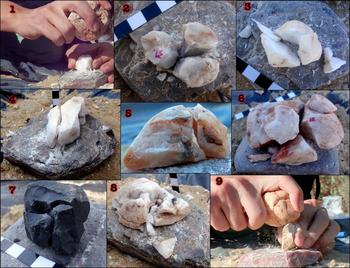
The small- to medium-sized nodules employed in the experiments were quarried in the conglomerate deposits located downstream from the Vallparadís site (Supplementary material: Table 2), where it is currently possible to find varieties of raw material and blanks similar to those documented in the archaeological record (Figure 2). The quality of the raw material is measured according to its fracture consistency, the most influential physical property in stone tool manufacture (Braun et al., Reference Braun, Plummer, Ferraro, Ditchfield and Bishop2009). Fracture consistency or response to fracture refers to how the fracture follows the direction of the applied force as opposed to the internal structure of the rock. We have analysed it according to the following variables: crystalline structure or grain size (grained texture), toughness or tenacity, and presence/absence of rock defects such as impurities, natural cleavages, or crystalline flaws (Crabtree, Reference Crabtree1967; Callahan, Reference Callahan1979; Domanski et al., Reference Domanski, Webb and Boland1994; Stout et al., Reference Stout, Quade, Semaw, Rogers and Levin2005; Díez-Martín et al., Reference Díez-Martín, Cuartero, Sánchez-Yustos, Baena, Domínguez-Rodrigo, Rubio and Domínguez-Rodrigo2012). The macroscopic criteria employed here to measure the fracture consistency of the knapped nodules are texture (fine, medium, and coarse grained), toughness (high, medium, and low) and density of rock defects (high: >5 defects per core; medium: 3–5 defects; and low: <2 defects).
Overview of bipolar core technology experiments: production process (1 and 9), core broken into several detached elements (2, 3, 6 and 8), and bipolar detachments (4, 5 and 7).

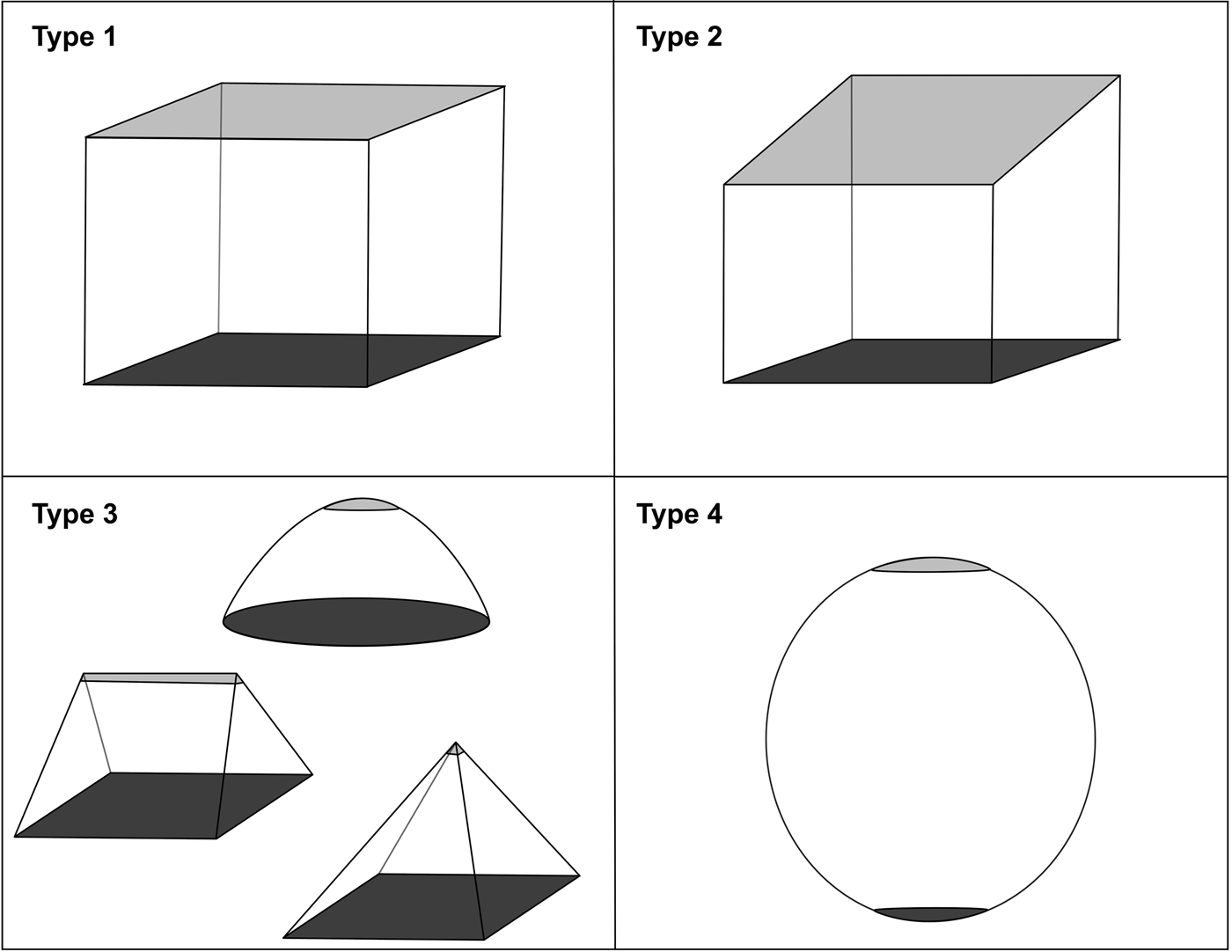
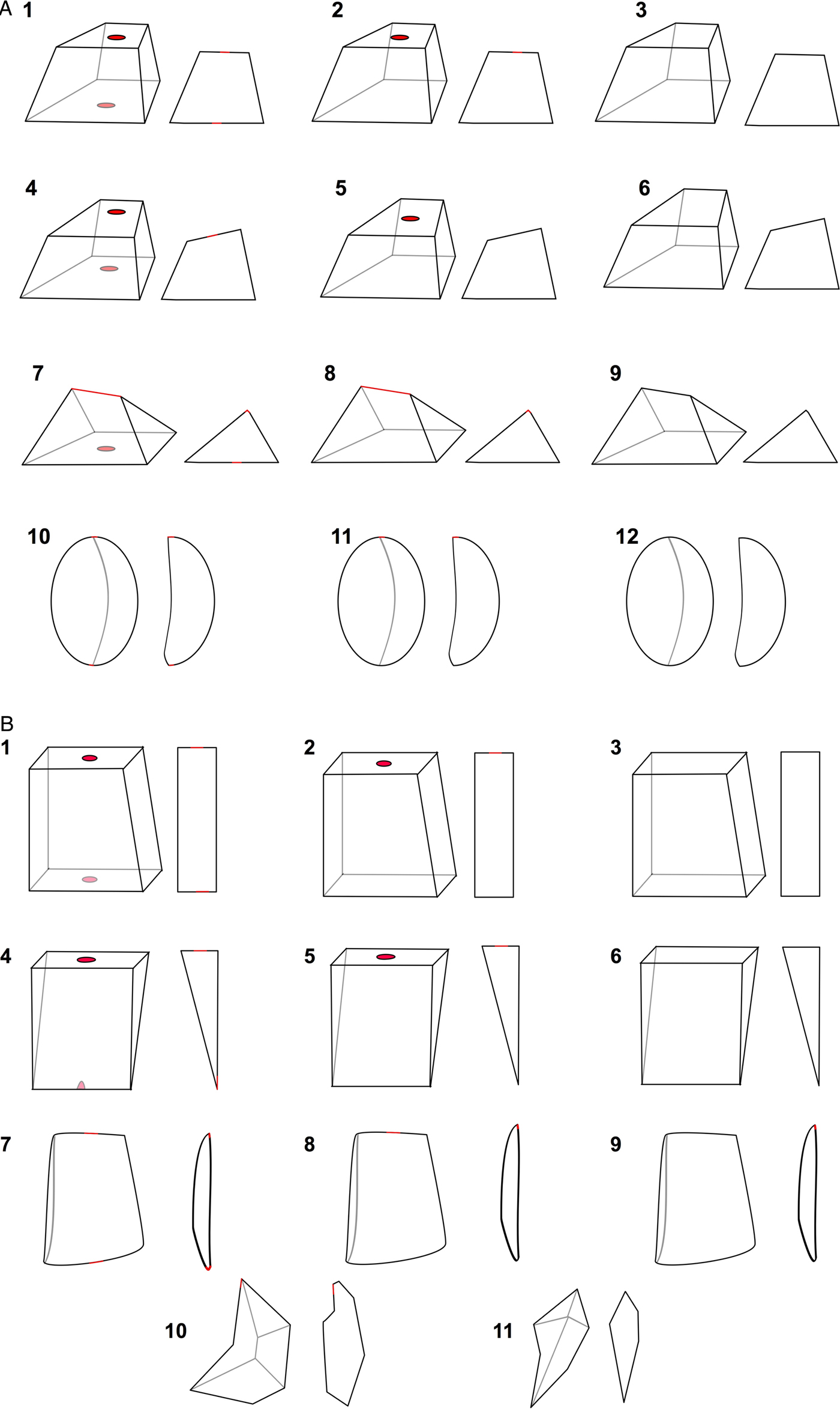
Research around bipolar knapping is in agreement that the morphology and presence/absence of battering areas are the most useful attributes to identify bipolar objects. Specifically, the most diagnostic parameters recurrently cited in bipolar-related literature are double striking platforms and opposite battering damage (e.g. Magne, Reference Magne1985; Jeske, Reference Jeske1992; Bradbury & Carr, Reference Bradbury and Philip2004; Díez-Martín et al., Reference Díez-Martín, Sánchez-Yustos, Domínguez and Prendergast2011; Vergès & Ollé, Reference Vergès and Ollé2011; Sánchez-Yustos et al., Reference Sánchez-Yustos, Diez-Martín, Díaz, Fraile, Duque and Domínguez-Rodrigo2015; de la Peña, Reference de la Peña2015b; Lombera et al., Reference Lombera, Rodríguez-Álvarez, Peña, Sala-Ramos, Despriée, Moncel, Gourcimault, Voinchet and Falguères2016). Likewise, some of these works have noted how blank or core morphology, particularly the delineation of both platform striking and resting, affect flake creation and thus flake morphology (Díez-Martín et al., Reference Díez-Martín, Sánchez-Yustos, Domínguez and Prendergast2011; Vergès & Ollé, Reference Vergès and Ollé2011; Lombera et al., Reference Lombera, Rodríguez-Álvarez, Peña, Sala-Ramos, Despriée, Moncel, Gourcimault, Voinchet and Falguères2016). The methodological framework applied here is largely based on the presence/absence of striking platforms and opposite battering damage. We have encoded this information by grouping blanks (Figure 3), cores, and detached elements in morphotechnical types (Figure 4). It has allowed us to measure the impact of these attributes in the experimental sample, and control to what extent the morphology of the cores and flakes was conditioned by blank morphology or how morphologies varied during the reduction process. The morphotechnical types of blanks, cores, and detached elements have been defined according to the following variables: 1) delineation of both platform striking and resting (flat, linear, and punctiform); 2) arrangement of platforms if both are flat (parallel and diagonal); and 3) presence/absence of battering areas on both surfaces (applied only for cores and detached elements).
Blank morphotypes. Type 1: double platform type with parallel arrangement; Type 2: double platform type with diagonal arrangement; Type 3: platform type and linear or punctiform type with parallel or diagonal arrangement; Type 4: double punctiform type with parallel arrangement.

Morphotechnical types of bipolar cores and detached elements. Note that the red colour indicates the presence of battering damage. Cores (A): Types 1–3, opposite flat platforms with parallel arrangement; Types 4–6, opposite flat platforms with diagonal arrangement; Types 7–9, linear or punctiform striking platform opposite a flat resting platform; Types 10–12, opposite linear or punctiform striking platforms. Detached elements (B): Types 1–3, opposite flat butt and counter-butt with parallel arrangement (double platform flakes); Type 4–6, linear or punctiform butt opposite to a flat counter-butt; Types 7–9, opposite linear or punctiform butt and counter-butt; Type 10–11, irregular detached element with non-diagnostic morphotechnical structure.

Other variables have been recorded in order to detect further diagnostic attributes that could help in the identification of bipolar cores and detached elements. The core attributes recorded are: 1) number of flaked planes, a fair indicator of the perimeter length flaked (Díez-Martín et al., Reference Díez-Martín, Sánchez-Yustos, Domínguez and Prendergast2011); 2) number of flaking axes which depends on core rotation; and 3) location of battering within the striking and resting platforms (platform plane, cortical plane ridge, and flaked plane ridge). The analysis of bipolar detached objects is based on the following variables: 1) presence/absence of bulb regarding hammer strike and/or anvil counter-strike; 2) location of battering within the striking (butt); 3) resting platforms (counter-butt) (platform plane, dorsal ridge, and ventral ridge); 4) type of detached element (whole flake, fragmented flake, fragment of flake, and by-product); and 5) total amount of sharp edges per detached element, sequence and mass, and angle of sharp edges.
Experimental Results
Limestone
The six limestone pebbles used as the production matrix provide the best fracture consistency recorded due to their fine-grained texture, low degree of toughness, and very low presence of cleavages or impurities (Supplementary material: Table 3). The six blanks, all of Type 4, were reduced by vertical technique, using a single flaking axis and single flaked plane, except in one case that shows two opposed flaked planes (Supplementary material: Table 4). The six experimental reduction series produced four cores, while in two series the reduction process ended up with the core being broken into several detached products (Supplementary material: Table 1). All cores are included in Type 10 according to their morphotechnical classification (Figure 5 A.2–4 and Supplementary material: Table 5). Battering is always located on the flaked plane ridge of both platforms (Supplementary material: Table 4).
Bipolar cores. The striking platform is represented by a dot and the striking counter-platform by a cross. A) Types 10–12 made of different raw materials: quartzite (1), limestone (2–4), quartz (5), and lydite (6); B); Types 1–3 made of different raw materials: quartzite (1), flint (2), quartz (3), and lydite (4). The striking platform is represented by a dot and the striking counter-platform by a cross; C) Types 4–6 made of different raw materials: quartzite (1), quartz (2), flint (4), and lydite (5). The core no. 3 made of quartz has rotated twice generating three flaking axes; D) Types 7–9 made of different raw materials: flint (1), lydite (2), quartzite (3), and quartz (4).

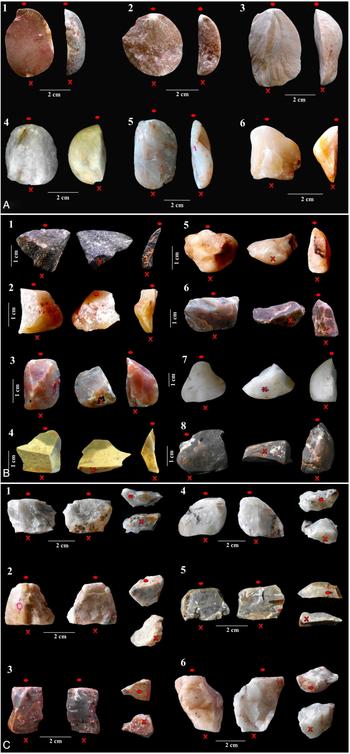
The reduction sequences produced fifteen detached elements, 3.7 detached products per sequence, and twelve detached elements showing sharp edges (Supplementary material: Table 6). The detached elements show the highest length mean value of sharp edges per object and per reduction series and one of the highest per mass. All sharp edges show acute angles (15–55°) and their mean is 41.6° (Supplementary material: Table 7). All detached elements are flakes and no by-products (Types 10–11) are recorded (Supplementary material: Table 8). The morphotechnical types represented only include the ones with double linear or punctiform type butt (Types 7–9) (Figure 6 A.1–2). The bulb is absent in all flakes, excluding one flake showing a double bulb. Battering is recurrently located on the ventral ridge of both butt and counter-butt (Supplementary material: Table 7).
Bipolar flakes. The striking platform is represented by a dot and the striking counter-platform by a cross. A) Types 7–9 made of different raw materials: limestone (1 and 3), quartzite (2), and quartz (4, 5, and 6). The striking platform is represented by a dot and the striking counter-platform by a cross; B) Types 4–6 made of different raw materials: quartzite (1), quartz (2, 5, and 7), flint (3, 4, and 6), and lydite (8); C) Types 1–3 made of different raw materials: quartz (1, 2, 4, and 6) and flint (3 and 5).

Quartzite
The six knapped quartzite nodules are characterized by a medium-grained texture, medium to high toughness, and low density of natural cleavages (Supplementary material: Table 3). There are seven experimental reduction sequences in total, because one nodule was split into two fragments and both were used as cores (Supplementary material: Table 1). The horizontal technique was restricted to Type 1 and Type 3 blanks, while the vertical technique was employed in a Type 4 blank. The seven experimental reduction sequences produced five cores; therefore, in two series the reduction process ends up with the core broken into several detached elements. A single flaking axis was employed in five sequences, while in the other two the core was rotated once generating two flaking axes. Knapping was conducted mostly on one or two flaked planes. The morphotechnical variability documented among the five cores may correspond to the different types of blank employed (Figure 5 A.1, B.1, C.1 and D.4). Battering is mostly located on the flaked plane ridge of both platforms striking and resting (Supplementary material: Table 4).
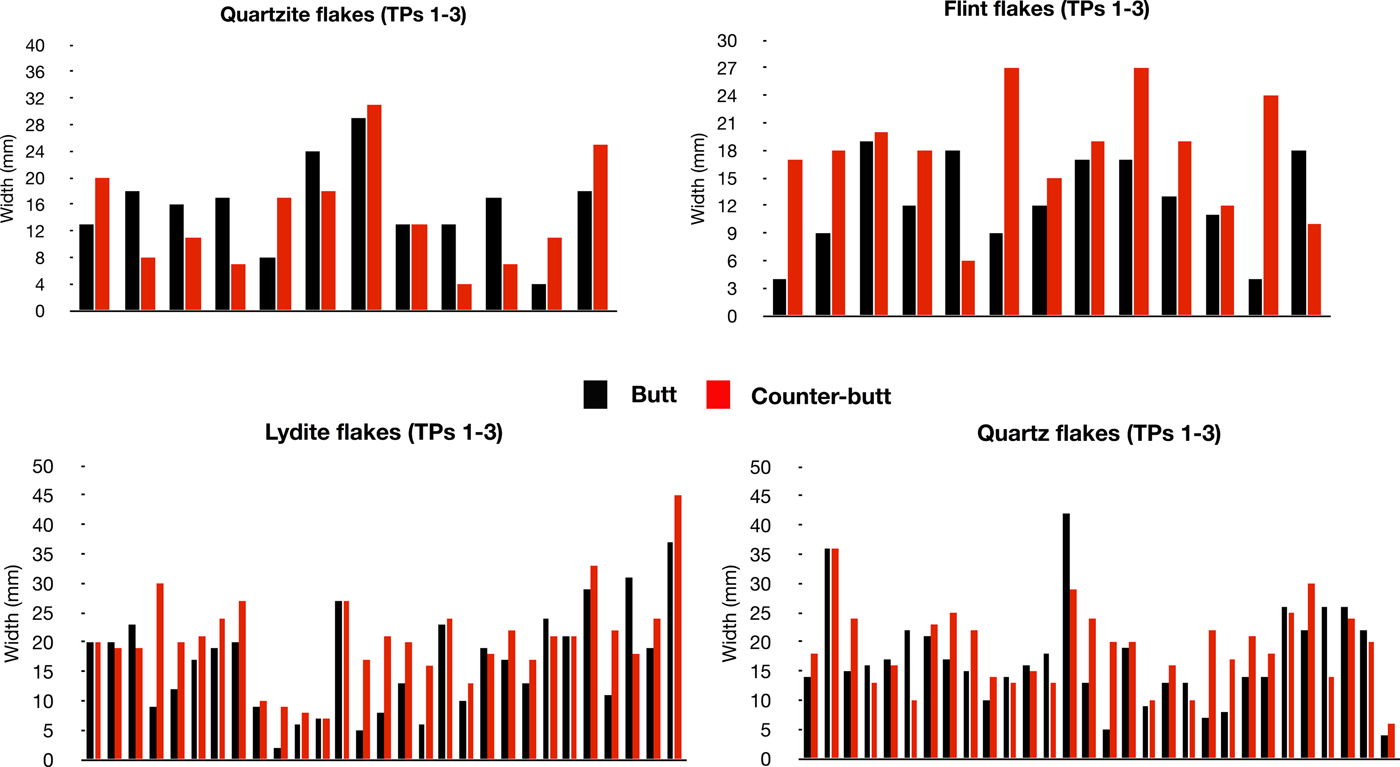
The seven experimental knapping sequences have produced thirty-six detached elements (5.1 detached elements per nodule), of which thirty items (83.3 per cent) show sharp edges (Supplementary material: Table 4). The detached elements show a high length mean value of sharp edges per object, per reduction series and per mass. The majority of the sharp edges show acute angles with a mean of 40.6° (Supplementary material: Table 7). The morphotechnical diversification of the detached elements (Supplementary material: Table 8) is likely to be related to the morphotechnical diversification documented among the respective cores (Figure 6 B.1 and Supplementary material: Table 5). The location of the battering shows a different pattern between the butt (very abundant on the ventral ridge) and the counter-butt (dominant on the dorsal ridge). There are no significant variations between the width of the butt and the counter-butt in the double platform flakes (Types 1–3) (Figure 7). In those flakes with a single platform (Types 4–6) battering is predominately associated to the anvil counter-strike. The few bulbs documented are mostly associated with the anvil counter-strike (Supplementary material: Table 7).
Width of the butt and counter-butt of the detached elements of Types 1–3.

Flint
The seven flint nodules knapped show a fine-grained texture, low degree of toughness and medium to high density of natural cleavages (Supplementary material: Table 3). More precisely, the abundance of natural cleavages has generated a high rate of accidental fractures in bipolar flakes. There are ten experimental reduction sequences in total, since two nodules were split into two and three fragments respectively, all of them later used as cores. The horizontal technique was employed in all the knapped blanks, following Type 1 and Type 2 morphologies (Supplementary material: Table 4). The ten reduction sequences have produced seven cores, because in three series the reduction process ended up with the core being broken into several detached elements (Supplementary material: Table 1). A single flaking axis was employed in six knapping sequences and in four sequences the core was rotated once, generating two flaking axes. Most of the cores were reduced from more than one flaked plane. The morphotechnical core classification reveals the absolute dominance of types with opposite percussion marks, Type 1 and Type 4 being the types most frequently documented (Figure 5 B.2, C.4 and D.1 and Supplementary material: Table 5). Battering is mainly located on the flaked ridges of both platforms (Supplementary material: Table 4).
The ten experimental knapping sequences created sixty-one detached elements (6.1 detached elements per sequence), of which forty-nine items have sharp edges. The detached elements show the highest mean value of sharp edge length per mass, although the mean values of sharp edges per object and reduction series are more moderate. Most sharp edges show acute angles, with a mean of 47° (Supplementary material: Table 6). According to themorphotechnical classification of detached elements, non-diagnostic morphotechnical structured objects dominate the collection (Types 10–11) due to the abundance of natural cleavage fractures in flint nodules. Flakes with single or double platform type butt (Types 1–6) are well represented (Figure 6 A.3, A.4, A.6, C.3 and C.5), while the flakes with double linear or punctiform butts are far less common (Types 7–9) (Supplementary material: Table 8). Regardless of its precise location, battering is more often located on counter-butts than butts. In almost all flakes with double platform type butt (Types 1–3) counter-butt dimensions are wider than the dimensions of the butts (Figure 7), whereas in flakes with a single platform type butt, it is predominately associated to the anvil counter-strike. The few bulbs documented correspond to hammer strikes (Supplementary material: Table 7).
Lydite
The seventeen lydite nodules used as the production matrix are of medium quality and have a medium to fine-grained texture, varied toughness, and abundance of natural cleavages which has generated a high rate of accidental fractures (Supplementary material: Table 3). There are twenty-two experimental reduction sequences in total, since four nodules were split into smaller fragments which were later knapped (Supplementary material: Table 1). Three types of blanks are present in the sample and the horizontal technique was employed in all reduction sequences. A single flaking axis was employed in fifteen sequences, while in another six the core was rotated once, generating two flaking axes, and in three sequences the core was rotated twice, giving rise to three flaking axes. The reduction process is focused on one or two flaked planes. In morphotechnical terms, the core classification is dominated by Type 1, while the other types are poorly represented (Figure 5 A.1, B.4, C.5 and D.2 and Supplementary material: Table 5). There are fourteen cores (77.7 per cent) with opposite battering damage preferably located on the flaked plane ridge (Supplementary material: Table 4).
The twenty-two reduction sequences have produced 153 detached elements (6.9 detached elements per sequence), of which 105 objects (68.6 per cent) have yielded sharp edges (Supplementary material: Table 6). The detached elements show the low mean values of sharp edge length per object, per reduction series and per mass. The majority of sharp edges show acute angles with a mean of 42.8° (Supplementary material: Table 7). Detached elements with non-diagnostic morphotechnical structure (Types 10–11) are quite abundant (n = 75, or 49 per cent) due to the number of natural fracture planes of lydite nodules. One of the blanks, corresponding to Type 1, produced many flakes with double platform butt types (Types 1–3). Conversely, in those of Type 2, single platform butt type flakes (Types 4–6) are more common (Figure 6 B.8 and Supplementary material: Table 8). Although battering is documented in whatever location on both striking platforms, battering is often located on the ventral ridge of the butts, whereas on the counter-butts the battering is more frequent on the dorsal ridge. As in the case of flint flakes, in many of the flakes with double platform type butt (Types 1–3) the counter-butt is wider than the butt (Figure 7). Many of the bulbs recorded are associated with an anvil strike (Supplementary material: Table 7).
Quartz
Quartz is the raw material with the worst response to breakage as its crystallographic and petrographic nature generates a very heterogeneous fracture consistency. The thirty-nine quartz nodules used as a production matrix are characterized by a medium to high-grained texture, medium to high toughness and a very high density of natural cleavages and flaws (some nodules had countless cleavages). There are forty experimental reduction sequences in total, because one nodule was split into two fragments which were later used as cores (Supplementary material: Table 1). Quartz is the only raw material in which all types of blanks are represented (Supplementary material: Table 4). The horizontal technique was employed in all reduction sequences but one, where the vertical technique was used. The abundance of natural cleavages and flaws explains that just twenty-five cores were produced in forty reduction series, and in the rest of series the cores were broken into multiple fragments (Supplementary material: Table 1). Core rotation is not a common reduction procedure and a single flaking axis is thus the most recurrent treatment. Almost half of the sequences were reduced through one flaked plane and the other half is further divided between two and four flaked planes. The morphotechnical core classification shows the absolute dominance of cores with opposite battering damage due to the high representation of Type 1 and the much more modest representation of Type 4 (Figure 5 A.4, B.3, C.2, C.3 and D.3). Battering is preferably found on the flaked ridges of striking platforms (Supplementary material: Table 4).
The forty reduction sequences have produced 256 detached elements with a result of 6.4 elements detached per sequence (Supplementary material: Table 2). The experiments on quartz created the lowest mean values of sharp edge length per object, per reduction series, and per mass (Supplementary material: Table 7). Detached products with non-diagnostic morphotechnical structure (Types 10–11) are very abundant (n = 113, or 44.1 per cent) due to the abundance of natural cleavages in quartz nodules. As documented in the other raw materials tested, Type 1 blanks produce many flakes with double platform type butt (Types 1–3) (Figure 7), whereas Type 2–3 blanks generate mostly single platform type butt flakes (Types 4–6) (Figure 6 B.2 and B.7). Flakes with double linear or punctiform type butt (Types 7–9) can be produced from all types of blank, while Type 4 only ends up in these types of flakes (Figure 6 A.4–6). Battering damage is more recurrently located on the butt rather than on the counter-butt, while on both striking platforms they are mostly distinguished on the ventral ridge. There are no significant differences between the width of the butts and the counter-butts in flakes with double platform type butt (Types 1–3) (Figure 7). However, in the case of flakes with a single platform type butt (Types 4–6) it is predominately associated to the anvil counter-strike. There is not documented bulb on either striking platform (Supplementary material: Table 7).
Constraints and Parameters to Identify and Analyse Bipolar Pieces
Constraints of the raw material
In the sample from Vallparadís EVT7 studied here, the fracture consistency of the raw material is greatly limited by the presence of defects in the rock (mostly natural cleavages) that interfere with the direction of the applied force. The raw materials with a high density of natural cleavages (e.g. quartz, lydite, and flint) also present the highest values of by-products (detached elements Types 10–11) per sequence and lowest values of sharp edges per reduction series and per detached element (Supplementary material: Tables 3 and 7). The extreme abundance of natural cleavages and flaws present in quartz nodules explains why, in many of their reduction sequences (37.5 per cent), the core ends up being broken into fragments. The toughness and texture may also determine the capacity of the raw materials to produce sharp edges. Although both flint and lydite nodules present a medium to high density of natural cleavages (Supplementary material: Table 3), the former have a finer grain texture and lower toughness than the latter, which may influence the production of more sharp edge length per reduction series and per mass (Supplementary material: Table 7).
Constraints of the blank morphology
Blank morphology (technically, the type and arrangement of the striking platforms) first determines the modality of the bipolar method to be applied. The few nodules with spherical shape (Type 4) were reduced through the horizontal axial method, and nodules with other morphologies (Type 1–3 blanks), which are present in large numbers since the knappers chose by preference the blanks providing broad and flat striking platforms, were reduced through the vertical axial method (Supplementary material: Table 4). Blank morphology also affects the number of flaking axes and flaked planes. The reduction of Type 3–4 blanks is carried out through one flaking axis, removing the flakes from the volume rather than the perimeter and generating one or two flaked planes. The reduction of Type 1–2 blanks is less rigid, their natural planes facilitating core rotation and exploitation following the perimeter or the volume, generating up to four flaked planes from a single axis (Figure 5 B-C). Core rotation aims to allow the reduction from a new flaking axis, providing suitable opposed striking platforms and extending core exploitation (Díez-Martín et al., Reference Díez-Martín, Sánchez-Yustos, Domínguez and Prendergast2011; de la Peña, Reference de la Peña2015a).
The number of flaked planes is also connected with the dimensions of the blanks: the bigger the core, the larger the number of flaked planes it could present. In the case of flakes, blank morphology does not categorically determine final morphology, although it is possible to draw interesting correlations: Type 1 blanks most frequently produce Type 1–3 flakes, whereas blanks morphologically included in Types 2–3 produce larger numbers of Type 4–6 flakes, and blanks corresponding to Type 4 exclusively produce Type 7–9 flakes. In sum, blank morphology could determine the reduction method, as well as the number of flaking axes and flaked planes. However, it does not categorically determine core and flake morphology. Although certain kinds of blank morphology tend to generate specific core and flake morphologies, the same blank morphology can also generate different core and flake morphologies (Supplementary material: Table 8). The reason is that there are other variables that affect the morphology of the bipolar objects, such as the blowing angle, irregularities in the striking platforms, and rock defects (Vergès & Ollé, Reference Vergès and Ollé2011).
Opposite parallel platforms and opposite battering damage
Opposite parallel platforms and battering damage are often the most diagnostic parameters employed to identify bipolar technology. In the sample studied, despite variations depending on the raw materials, opposite battering damage is overall more frequent than opposite parallel platforms in both cores and flakes, whereas both parameters show a higher representation in cores than in flakes. Almost all studied cores (94.9 per cent) show opposite battering damage, while the presence of opposite parallel platforms is much less restricted. About half of both complete and fragmented flakes show opposite battering damage and less than half present double platform type butts (Supplementary material: Table 9). Consequently, these identification parameters are not diagnostic in at least half of the complete and fragmented flakes.
Artefact orientation
As mentioned, the difficulties experienced with artefact orientation are related to distinguishing between striking and resting platforms, butts and counter-butts, or dorsal and ventral surfaces. The parameters traditionally applied to distinguish between dorsal and ventral surfaces, such as the presence of a bulb (Andrefsky, Reference Andrefsky1998; Inizan et al., Reference Inizan, Reduron-Ballinger, Roche and Tixier1999), are not useful in this case, since they are so little represented in the experimental sequences (Supplementary material: Table 7). The checks that we have applied to address this issue are the location of the battering damage, typometrical values, and the presence/absence of a bulb. With respect to cores, there is no significant difference between the striking and resting platforms when we look at the location of the battering damage (Supplementary material: Table 4). However, the typometrical values of both platforms are remarkably different: out of twenty-two cores with parallel flat platforms (Types 1–3), in twenty cases (90.9 per cent) the resting platform is wider and thicker than the striking platform. Likewise, in 63.9 per cent of the whole flakes with double platform butt type (Types 1–3) the counter-butt tends to be wider than the butt (Figure 7).
The same observation has been made in other experimental works in which distal width has contributed to differentiate between free-hand and bipolar flakes (Díez-Martín et al., Reference Díez-Martín, Sánchez-Yustos, Domínguez and Prendergast2011; Byrne et al., Reference Byrne, Proffitt, Arroyo and de la Torre2015). In 69.2 per cent of the flakes with a single platform type butt (Types 4–6) the platforms are associated with an anvil counter-strike (Supplementary material: Table 7). The location of battering damage is the only attribute with a relative statistical significance, allowing us to differentiate between dorsal and ventral surfaces in flakes without cortex on their dorsal surface, since around 50 per cent of the flakes show such damage in the ventral ridge of both butts and counter-butts. Therefore, there is a significant quantity of flakes with non-diagnostic attributes which prevent a correct flake orientation.
Underrepresentation of cores
The bipolar cores tend to be underrepresented in any given lithic sample because many cores are often broken into various fragments at the end of the process (Kobayashi, Reference Kobayashi and Swanson1975; Prous & Lima, Reference Prous and Lima1990; Andrefsky, Reference Andrefsky1998; de la Peña, Reference de la Peña2015b). This is what Driscoll (Reference Driscoll2010) termed a ‘chilled-core’. Paradoxically, bipolar cores are easier to recognize than bipolar flakes (Binford & Quimby, Reference Binford and Quimby1963; Flenniken, Reference Flenniken1981; Ahler, Reference Ahler, Amick and Mauldin1989; Jeske & Lurie, Reference Jeske and Lurie1993; Berman et al., Reference Berman, April and Whyte1999; Díez-Martín et al., Reference Díez-Martín, Sánchez-Yustos, Domínguez, Mabulla and Barba2009, Reference Díez-Martín, Sánchez-Yustos, Domínguez and Prendergast2011; Byrne et al., Reference Byrne, Proffitt, Arroyo and de la Torre2015; de la Peña, Reference de la Peña2015b). The identification and classification of chilled cores (e.g. core fragments) may lead to ambiguities and this is why several authors propose the generic category of ‘nucleiforms’, or ‘splintered pieces’ which include the thicker bipolar pieces (Prous & Lima, Reference Prous and Lima1990; Shott, Reference Shott1999; Díez-Martín et al., Reference Díez-Martín, Sánchez-Yustos, Domínguez, Mabulla and Barba2009).
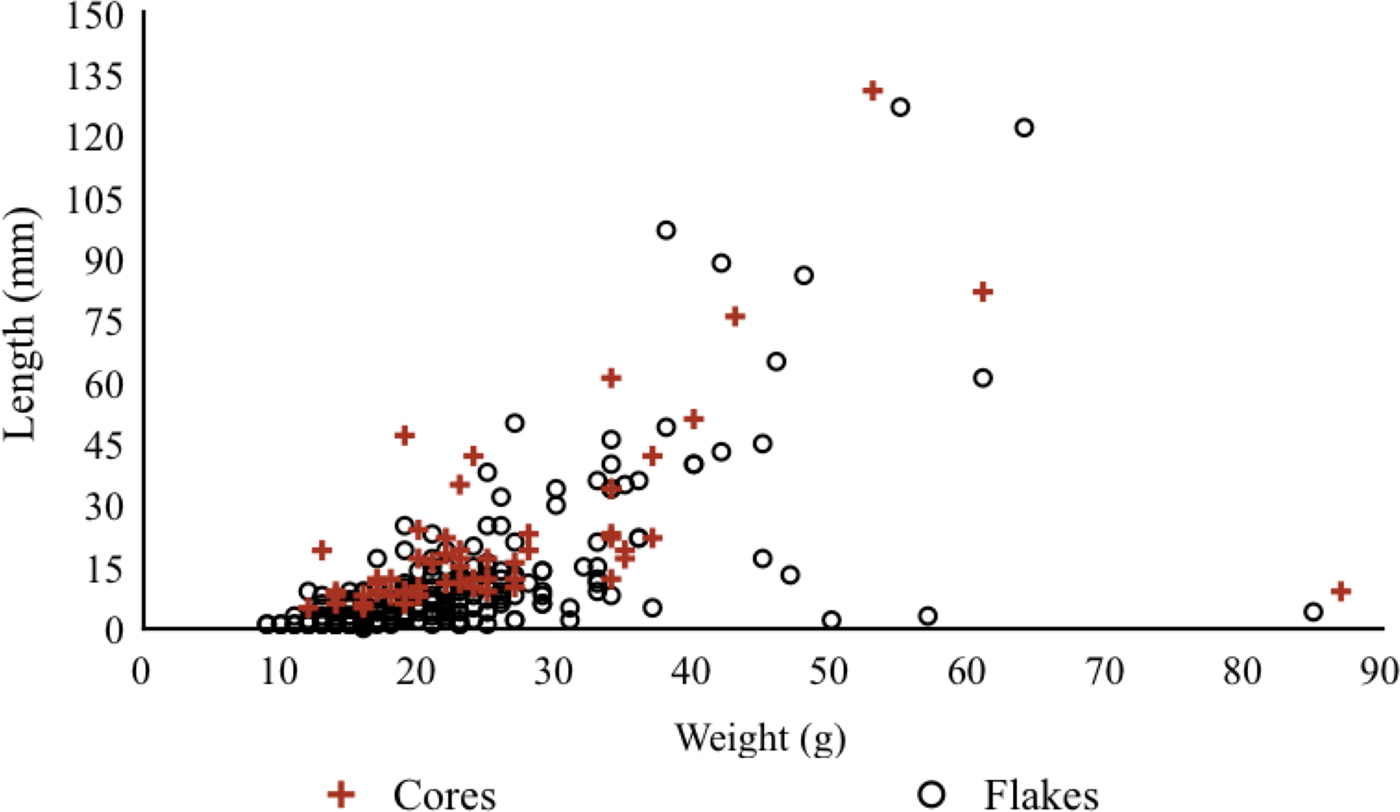
In the experiments carried out, more than a quarter (30 per cent) of the bipolar sequences ends up with the core broken into several pieces. Other important issues noted in core recognition is that those cores reduced through one flaking axis and one or two flaked planes are not particularly diagnostic because of the difficulty of recognizing different reduction series of detachments and the organization of core reduction. As a consequence, they can easily be confused with bipolar flakes. Furthermore, there are no significant differences in size between cores and flakes (Figure 8). The main parameter to differentiate between cores and flakes would be the presence of more than one flaking axis and/or more than two flaked planes. Accordingly, about 75 per cent of the bipolar cores in our experiment would potentially be difficult to identify and could thus easily be classified as flakes.
Length and weight of cores and whole flakes.

Conclusions
The present work is the largest and most exhaustive experimental programme applied to the study of the bipolar core technology in the Early Pleistocene lithic record of Europe. The results presented here are particularly relevant to understanding and defining the scant stone tool record from the Early Pleistocene in Europe. Apart from Vallparadís, lithic material roughly corresponding to the Jaramillo subchron had only been found at Gran Dolina TD3-TD4 and TD5 in the Sierra de Atapuerca in northern Spain, Ca'Belvedere di Monte Poggiolo in central Italy, Pont-de-Lavaud, Lunery-Rosières, or Le Vallonnet in central and southern France (Carbonell & Rodríguez, Reference Carbonell and Rodríguez1994; Peretto et al., Reference Peretto, Amore, Antoniazzi, Bahain, Cattani, Cavallini, Esposito, Falguères, Gagnepain, Hedley, Laurent, Lebreton, Longo, Milliken, Monegatti, Ollé, Pugliese, Renault-Miskovsky, Sozzi, Ungaro, Vannucci, Vergès, Wagner and Yokoyama1998; Despriée et al., Reference Despriée, Gageonnet, Voinchet, Bahain, Falguères, Varache, Courcimault and Dolo2006, Reference Despriée, Gageonnet, Voinchet, Bahain, Falguères, Varache, Courcimault and Dolo2010, Reference Despriée, Voinchet, Tissoux, Moncel, Arzarello, Robin, Bahain, Falguères, Courcimault, Dépont, Gageonnet, Marquer, Messager, Adbessadok and Puaud2011; de Lumley et al., Reference de Lumley, Barsky and Cauche2009; Ollé et al., Reference Ollé, Mosquera, Rodríguez, de Lombera, García-Antón, García-Medrano, Peña, Menéndez, Navazo, Terradillos, Bargalló, Márquez, Sala and Carbonell2013). This lithic assemblage enabled hominins to compete successfully with large carnivores to exploit the meat sources that large herbivores offered (Martínez et al., Reference Martínez, Garcia, Carbonell, Agustí, Bahain, Blain, Burjachs, Cáceres, Duval, Falguères, Gómez and Huguet2010; Garcia et al., Reference Garcia, Martínez, Carbonell, Agustí and Burjachs2012). The experimental programme presented in this article may help research at these sites to differentiate stone tools, which were usually knapped in a short chaîne opératoire using the bipolar technique, from ‘geofacts’. Moreover, this research can contribute to the potential discovery at coeval paleontological sites of a hominin presence, by presenting technological criteria for the detection of simply made lithic tools.
Although the bipolar technique has become the focus of an intense debate regarding its recognition and purpose within the early African industries on quartz, nearly all experimental work developed with respect to this issue is centred on the effect of the bipolar technique on just one type of raw material rather than multiple materials (Díez-Martín et al., Reference Díez-Martín, Sánchez-Yustos, Domínguez and Prendergast2011; de la Torre et al., Reference de la Torre, Benito-Calvo, Arroyo, Zupancich and Proffitt2013; Proffitt & de la Torre, Reference Proffitt and de la Torre2014; Sánchez-Yustos et al., Reference Sánchez-Yustos, Díez-Martín, Domínguez-Rodrigo and Tarriño Vinagre2012, Reference Sánchez-Yustos, Diez-Martín, Díaz, Fraile, Duque and Domínguez-Rodrigo2015; Byrne et al., Reference Byrne, Proffitt, Arroyo and de la Torre2015; Gurtov & Eren, Reference Gurtov and Eren2014 are an exception). The results of our experimental work constitute an empirical framework to increase the accuracy of identification and analysis of the bipolar component of Vallparadís, but it could also be a valuable experimental work of reference for the study of the bipolar phenomenon within early industries.
The main conclusion drawn from this experiment is that the bipolar core production process is conditioned by the morphology and fracture consistency of the nodules knapped. The size and shape of the blank determine the reduction method, as well as the number of flaking axes and flaked planes. Although the morphology of the blank does not categorically determine core and flake morphology, there is a clear correlation between them. The fracture consistency of the blanks may affect their productive capacity in terms of sharp edge production and representation of artefact categories: materials with poor fracture consistency (e.g. quartz) produce a smaller amount of sharp edge lengths and numerous by-products (e.g. detached elements Types 10–11).
For identifying bipolar objects, on the other hand, the most important parameter in statistical terms is the presence of opposite battering damage being more diagnostic in cores than among flakes. However, the presence of opposite parallel platforms is not very representative numerically in either cores or flakes, probably because blanks with opposite parallel platforms (Type 1) are only moderately represented (Supplementary material: Table 9). The fragmentation of cores supposes that three out of four bipolar cores would potentially be difficult to identify and could thus be classified as detached elements. The attributes employed for flake orientation are non-diagnostic in at least half of the complete and fragmented flakes. In sum, owing to the great quantity of non-diagnostic pieces generated throughout the bipolar knapping process, it seems pertinent to (re)analyse the Vallparadís archaeological assemblages according to alternative methodological approaches (e.g. morphotechnical types) in which the classic methods of classifying artefacts (e.g. cores, flakes, and fragments) and artefact orientation (distal/proximal and dorsal/ventral) could be dispensed with entirely.
Supplementary Material
To view supplementary material for this article, please visit https://doi.org/10.1017/eaa.2016.9.
Acknowledgements
We would like to thank the Deputy Editor (Catherine Frieman) and the anonymous reviewers for their comments and help in improving this paper. We also thank Madeleine Hummler of the European Journal of Archaeology for editing the manuscript and improving the English writing.