




No CrossRef data available.
Article contents
Is it impolite to discuss cognitive differences between liberals and conservatives?
Published online by Cambridge University Press: 27 June 2014
Abstract
Hibbing and colleagues argue convincingly that liberals and conservatives differ in reactivity to (negative) stimuli. Yet their analysis sidesteps evidence that cognitive ability differs as a function of ideology. Cognitive abilities, like cognitive preferences (e.g., structure needs), shape whether stimuli are psychologically threatening (prompting avoidance) or offer opportunity (prompting approach). Incorporation of these findings is critical despite any socially “delicate” implications.
Information
- Type
- Open Peer Commentary
- Information
- Copyright
- Copyright © Cambridge University Press 2014
References
Block, J. & Block, J. H. (2006) Nursery school personality and political orientation two decades later. Journal of Research in Personality
40:734–49.CrossRefGoogle Scholar
Castelli, L. & Carraro, L. (2011) Ideology is related to basic cognitive processes involved in attitude formation. Journal of Experimental Social Psychology
47:1013–16.Google Scholar
Deary, I. J., Batty, G. D. & Gale, C. R. (2008) Bright children become enlightened adults. Psychological Science
19:1–6.Google Scholar
Dollinger, S. J. (2007) Creativity and conservatism. Personality and Individual Differences
43:1025–35.Google Scholar
Duckitt, J. (2006) Differential effects of right wing authoritarianism and social dominance orientation on outgroup attitudes and their mediation by threat from and competitiveness to outgroups. Personality and Social Psychology Bulletin
32:684–96.Google Scholar
Eidelman, S., Crandall, C. S., Goodman, J. A. & Blanchar, J. C. (2012) Low-effort thought promotes political conservatism. Personality and Social Psychology Bulletin
38:808–20.Google Scholar
Fraley, R. C., Griffin, B. N., Belsky, J. & Roisman, G. I. (2012) Developmental antecedents of political ideology: A longitudinal investigation from birth to age 18 years. Psychological Science
23:1425–31.Google Scholar
Gervais, W. M. & Norenzayan, A. (2012) Analytic thinking promotes religious disbelief. Science
336:493–96.Google Scholar
Hetherington, M. J. & Suhay, E. (2011) Authoritarianism, threat, and Americans' support for the war on terror. American Journal of Political Science
55:546–60.Google Scholar
Hodson, G. & Busseri, M. A. (2012) Bright minds and dark attitudes: Lower cognitive ability predicts greater prejudice through right-wing ideology and low intergroup contact. Psychological Science
23:187–95.Google Scholar
Janoff-Bulman, R. (2009) To provide or protect: Motivational bases of political liberalism and conservatism. Psychological Inquiry
20:120–28.CrossRefGoogle Scholar
Jost, J. T., Glaser, J., Kruglanski, A. W. & Sulloway, F. J. (2003) Political conservatism as motivated social cognition. Psychological Bulletin
129(3):339–75.Google Scholar
Kanazawa, S. (2010) Why liberals and atheists are more intelligent. Social Psychology Quarterly
73:33–57.CrossRefGoogle Scholar
Keiller, S. W. (2010) Abstract reasoning as a predictor of attitudes toward gay men. Journal of Homosexuality
57:914–27.Google Scholar
Kemmelmeier, M. (2008) Is there a relationship between political orientation and cognitive ability? A test of three hypotheses in two studies. Personality and Individual Differences
45(8):767–72.Google Scholar
Luguri, J. B., Napier, J. L. & Dovidio, J. F. (2012) Reconstructing intolerance: Abstract thinking reduces conservatives' prejudice against nonnormative groups. Psychological Science
23:756–63.CrossRefGoogle Scholar
McCourt, K., Bouchard, T. J., Lykken, D. T., Tellegen, A. & Keyes, M. (1999) Authoritarianism revisited: Genetic and environmental influences examined in twins reared apart and together. Personality and Individual Differences
27:985–1014.Google Scholar
Nail, P. R., McGregor, I., Drinkwater, A. E., Steele, G. M. & Thompson, A. W. (2009) Threat causes liberals to think like conservatives. Journal of Experimental Social Psychology
45:901–907.Google Scholar
Sidanius, J. (1985) Cognitive functioning and sociopolitical ideology revisited. Political Psychology
6:637–61.CrossRefGoogle Scholar
Sturgis, P., Read, S. & Allum, N. (2010) Does intelligence foster generalized trust? An empirical test using the UK birth cohort studies. Intelligence
38:45–54.Google Scholar
Van Hiel, A., Onraet, E. & De Pauw, S. (2010) The relationship between social-cultural attitudes and behavioral measures of cognitive style: A meta-analytic integration of studies. Journal of Personality
78(6):1765–99. Available at:
http://dx.doi.org/10.1111/j.1467-6494.2010.00669.x.Google Scholar
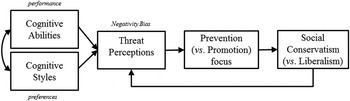
Figure 1. A conceptual model of cognition, threat, and ideology.
Hibbing et al. contribute greatly to our understanding of the fundamental differences between liberals and conservatives, covering an impressive array of research. However, their analysis focuses almost exclusively on emotional reactivity to negative environments. Absent from their synthesis is a consideration of cognitive factors, most notably cognitive or mental abilities, a factor associated with both ideology and orientations toward social environments.
Admittedly, Hibbing et al. acknowledge that liberals and conservatives differ in cognitive styles, most notably (a) need for closure, with conservatives exhibiting stronger need for simpler, more predictable, more clear, and more structured lives; and (b) need for cognition, with conservatives demonstrating less favorable attitudes or orientations toward cognitive exertion and complexity. These constructs involve preferences for dealing with information, including toleration of ambiguity, need for structure and routine, and pleasure derived from approaching (or avoiding) intellectual puzzles, factors long associated with conservatism. These theoretical constructs are interesting and informative but are clearly distinct from cognitive (or mental) abilities relevant to solving problems and mastering challenging tasks.
Yet empirical evidence reveals negative associations between cognitive ability and conservatism (e.g., Kanazawa Reference Kanazawa2010, Studies 1–2; Kemmelmeier Reference Kemmelmeier2008; Sidanius Reference Sidanius1985; Stankov Reference Stankov2009) or right-wing authoritarianism (Keiller Reference Keiller2010; McCourt et al. Reference McCourt, Bouchard, Lykken, Tellegen and Keyes1999). Particularly compelling are discoveries that poorer cognitive abilities in childhood predict stronger endorsement of social conservative values or conservative self-identification in adulthood (e.g., Block & Block Reference Block and Block2006; Deary et al. Reference Deary, Batty and Gale2008; Fraley et al. Reference Fraley, Griffin, Belsky and Roisman2012). When complex relationships are uncovered, such as curvilinear trends (e.g., Sidanius Reference Sidanius1985), linear relations persist (Kemmelmeier Reference Kemmelmeier2008), with liberals (vs. conservatives) scoring higher in mental abilities.
My colleagues and I have found this relation of particular value in explaining why lower cognitive ability predicts greater out-group prejudice (even after controlling for socioeconomic status and education). Specifically, lower cognitive ability predicts prejudice through heightened social conservatism, often fully explaining the relation (Hodson & Busseri Reference Hodson and Busseri2012). The first mediation path (i.e., between lower cognitive ability and right-wing ideologies) drew considerable media attention and public ire, yet was hypothesized given the reliable negative meta-analytic relation previously established between cognitive ability and political or authoritarian conservatism (Van Hiel et al. Reference Van Hiel, Onraet and De Pauw2010). Strong public backlash against such findings presumably explains its near-absence from theoretical and empirical discussions of ideology in psychology (e.g., Hibbing and colleagues). Instead such findings lie largely “off the radar,” with authors carefully crafting their language or de-emphasizing their importance or relevance (see Block & Block Reference Block and Block2006; Fraley et al. Reference Fraley, Griffin, Belsky and Roisman2012).
Yet these patterns converge on related findings, including: low-effort thinking promoting political conservatism (Eidelman et al. Reference Eidelman, Crandall, Goodman and Blanchar2012), analytical thinking generating religious disbelief (Gervais & Norenzayan Reference Gervais and Norenzayan2012), abstract thinking (measured or manipulated) reducing conservative prejudices (Luguri et al. Reference Luguri, Napier and Dovidio2012), lower creativity among conservatives (Dollinger Reference Dollinger2007), and stronger illusory correlations among conservatives (exaggerating the perceived association between minorities and negative outcomes; Castelli & Carraro Reference Castelli and Carraro2011). Using distinct methodologies, these studies converge on a central point: ideology and cognitive functioning/processing are meaningfully related.
Speaking to the present discussion, cognitive abilities can influence why particular events, groups, or contexts are perceived as threatening. That is, “when considering social, moral, and political situations, those with greater cognitive skill are able to form more individualistic and open-minded (i.e., antiauthoritarian) attitudes than those of lesser cognitive ability.” (McCourt et al. Reference McCourt, Bouchard, Lykken, Tellegen and Keyes1999, p. 987, emphasis added). With greater cognitive resources at hand, life is more manageable and navigable, lowering threat perceptions and social-motivational needs for change-resistant ideologies. In discussing Janoff-Bulman's (Reference Janoff-Bulman2009) work on prevention versus promotion focus, the target article informs this basic point, emphasizing that prevention focus leads to protective strategies that are conservative in nature, whereas a promotion focus encourages openness to alternative (including out-group) lifestyles. As Hibbing et al. note, with greater “psychological and physiological” resources available, individuals gravitate toward promotion-based, liberal orientations. Cognitive abilities undoubtedly play a central role in managing available psychological resources. Consistent with this interpretation, lower cognitive ability predicts decreased trust in others (Sturgis et al. Reference Sturgis, Read and Allum2010), with distrust in the social world (seeing others as “bad”) a reliable predictor of right-wing ideologies (Altemeyer Reference Altemeyer1996; Duckitt Reference Duckitt2006).
The field arguably needs greater integration between the cognitive, emotional, and motivational factors underpinning the fundamental ways that people differ ideologically. Although Hibbing et al. describe associations between threat negativity bias and conservatism, the authors do not articulate a vision for structural relations between the constructs. At this early stage this is understandable given the complexity of the variables involved and difficulties isolating causal directions. To this discussion I offer a model specifying that cognitive factors impact threat perceptions (i.e., reactivity bias) that cue avoidance (vs. approach), which enhance conservative ideology (see Figure 1).
A conceptual model of cognition, threat, and ideology.
Conceptually, both cognitive abilities (e.g., reasoning; thinking skills) and preferences (e.g., for structure and order) impact whether the social or physical world is psychologically considered threatening and in need of prevention-based strategies. Once threatened, people generally shift to the ideological right (Hetherington & Suhay Reference Hetherington and Suhay2011; Nail et al. Reference Nail, McGregor, Drinkwater, Steele and Thompson2009). In this manner, conservatism (characterized by resistance to change and acceptance of inequality) is the product of social-cognitive motives enlisted to navigate threating aspects of social life (Jost et al. Reference Jost, Glaser, Kruglanski and Sulloway2003). This model conceptually emphasizes that threat reactivity induces the prevention focus that drives conservatism, while explicitly recognizing a feedback loop. That is, change-resistant ideologies valuing tradition and convention heighten threat salience given that social systems are perpetually in flux or “risk” becoming so.
At this exciting juncture the field is embracing the notion of meaningful, psychological differences correlating with ideology. In doing so we must recognize the proverbial elephant in the room: cognitive differences between liberals and conservatives. It is unclear whether its omission by Hibbing et al. reflects their belief that cognitive abilities do not inform this discussion, or whether it is simply impolite (or too controversial) to contemplate these findings. The psychological community needs to debate the scientific evidence, regardless of its palatability, if it speaks to a deeper understanding of political ideology and human nature.