Introduction
Referral of patients with dysphonia is a common occurrence in otolaryngology practice and any patient over the age of 40 with persistent symptoms must have an examination of the larynx to exclude sinister lesions. The aetiology of dysphonia is usually secondary to disease in the larynx affecting voice production. However, quality of voice is also affected by the status of the nasal airway. Excessive nasal air escape, as sometimes occurs in patients with cleft palate (rhinolalia aperta), or significant nasal obstruction, for example in patients with nasal polyps (rhinolalia clausa), can change the quality of sound on phonation.Reference Mathieson1
We present an unusual case of dysphonia secondary to nasopharyngeal obstruction, as a result of C1/C2 vertebral subluxation/dislocation in a patient with ankylosing spondylitis.
Case report
A 69-year-old male was referred to the department of otolaryngology with an altered voice. The patient, a keen singer, was concerned that his voice had become increasingly ‘plummy’ and nasal over the last year. More recently he had developed mild dysphagia to solids, but was still able to eat everything he desired. He complained of no otalgia, odynophagia, hearing loss, reflux, rhinorrhoea or nasal symptoms. There was no report of recent trauma to the head or neck. The patient's past medical history was unremarkable except for a long history of ankylosing spondylitis.
On examination the patient had an obvious hyponasal quality to the voice. Examination of the oropharynx revealed a diffuse mass in the midline of the oropharynx, extending up to the nasopharynx. This was firm, but was not fluctuant, tender or pulsatile. The overlying pharyngeal mucosa was healthy. The patient displayed signs of quite advanced ankylosing spondylitis including loss of normal cervical lordosis. There were no palpable lumps in the neck. The cranial nerves were intact and there were no signs of any cervical neuropathy.
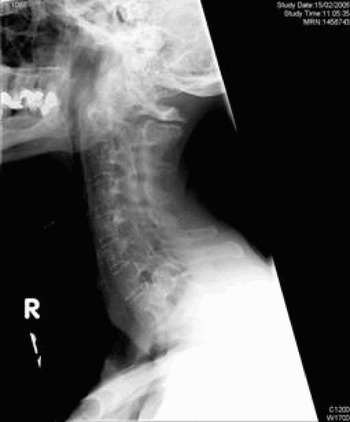
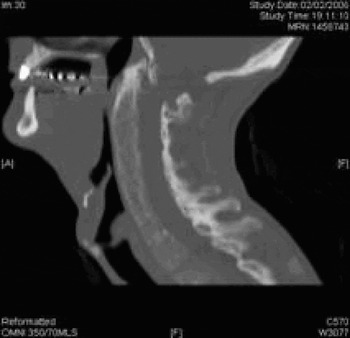
A plain lateral neck X-ray and neck computed tomography (CT) scan were organised and these revealed extensive fusion of cervical and upper thoracic vertebral bodies and posterior elements below the level of C2, in keeping with ankylosing spondylitis. C2 was displaced 11 mm forward in comparison to C1 and the odontoid peg had migrated through the anterior arch of C1 to lie anteriorly (Figure 1). It was this fracture dislocation of the odontoid peg at the atlanto-axial junction that caused the significant indentation into the oropharynx (Figure 2). There was also some forward slip of C1 with respect to the occiput and likely fusion at the atlanto-occipital joint. New bone growth superiorly encroached upon the spinal canal, but there was no evidence of cord compression. Overall the radiological findings were consistent with the chronic spinal changes of ankylosing spondylitis including an apparently old fracture dislocation of the base of the peg which was indenting the oropharynx. In view of these findings the patient was referred to orthopaedic spinal surgeons.
Plain cervical spine X-ray showing odontoid peg anterior to the body of C1 protruding beneath the pharyngeal mucosa.

Sagittal CT showing ankylosis of the cervical vertebrae and fractured odontoid peg beneath pharyngeal mucosa.

Discussion
The production of normal speech requires controlled expiration through vibrating vocal folds. The sound waves produced are altered by movement of the tongue, lips and mouth. The quality of the sound is affected by resonation through various air filled spaces. The thoracic cavity resonates sound in the subglottic region. The supraglottic resonators include the vestibule of the larynx, the oro- and nasopharynx, the mouth and the nose. Nasal resonance adds a beauty, richness and projection to the voice, which is especially relevant to singers. When the nose is blocked, as in a common cold, these qualities are lost and the voice becomes ‘plummy’.
Nasal resonance is also important for normal speech. The character of the consonants ‘m’, ‘n’ and ‘ng’, which appear frequently in English, rely upon nasal resonance, for example in the words ‘man’ and ‘hum’. Sound waves that are caught in the oro- and nasopharynx by closed lips when the soft palate is slightly raised or lowered, allow for the formation of the prolonged nasal hum common to ‘m’, ‘n’ and ‘ng’. Videofluoroscopy can be used to demonstrate this palatal movement and the approximation of the soft palate with the posterior nasal wall. However, as the cause of hyponasality was obvious in our case patient and his swallow was safe this was not performed.
If the nose is blocked ‘m’, ‘n’ and ‘ng’ consonants often become short and clipped, more like the plosives ‘b’, ‘d’ and ‘g’.Reference Dworkin, Marunich and Krouse2 This phenomenon results in the words ‘man’ and ‘hum’ sounding like ‘ban’ and ‘hub’. Thus a patient with rhinolalia clausa, especially one who enjoys public speaking or singing, may be much handicapped by their dysphonia.
Nasal blockage is very common. Causes include adenoidal hyperplasia in children, rhinitis, polypoidosis, deviated nasal septum and, very rarely, neoplasia. Reference Morrison and Rammage3 Anatomically the bodies of C1 and C2 sit just posteriorly to the oropharynx and inferior nasopharynx. In fact the oropharynx is a popular route for odontoid peg surgeryReference Shaha, Johnson, Miller and Milhorat4 and vertebral injury is recorded as a cause of ruptured pharyngeal mucosal membrane.Reference Pollock, Purvis, Apple and Murray5 Pathology of the upper cervical vertebrae can present as a mass causing pharyngeal intrusion. The literature reports several cases of spinal osteophytes presenting as dysphonia or dysphagiaReference Kissel and Youmans6 due to the compression of laryngopharyngeal structures. One Italian paper records the association of dysphonia with an osteophyte secondary to ankylosing hyperostosis.Reference Salvinelli, Marte, Firrisi, D'Ascanio, Casale and Lamanna7 There is not, however, a recorded link between ankylosing spondylitis and hyponasal speech.
Ankylosing spondylitis is an autoimmune condition typified by chronic inflammatory disease of the tendinous insertions of skeletal muscle into bone. This results in fibrosis and ossification of the axial skeleton known as enthesopathy. There is also associated synovitis and cartilage destruction that can lead to severe arthritis. Eventually the patient's spine may become rigid with loss of normal curvatures and movement.
The disease belongs to a family of seronegative arthropathies including Reiter's disease, psoriatic arthropathy, arthropathy of chronic bowel disease and possibly Behcet's disease. Human leukocyte antigen-B27 is common to 90 per cent of patients and there is therefore a strong familial tendency to the disease. It is most common in western European males.
• This paper describes an unusual case of dysphonia secondary to nasopharyngeal obstruction, as a result of C1/C2 vertebral subluxation/dislocation in a patient with ankylosing spondylitis
• There is an important anatomical proximity of the nasopharynx to the upper cervical spine
• Cervical pathology must be considered in patients with nasal symptoms
The abnormal fusion of originally separate bones causes atypical loading and osteoporosis.Reference Tait, Barlow and Iveson8 Therefore even mild trauma may result in serious bony injuries such as spinal fractures. Thoracolumbar or cervicothoracic junction fractures are common. Higher cervical spine fractures and atlanto-axial subluxation occur, but less frequently. There is often a delayed diagnosis of these fractures.Reference Peretti, Sane, Dran and Razafindratisiva9 An unstable fracture or dislocation of the odontoid peg can result in forward displacement of the body of C1 on C2. Considering the previously discussed anatomy it is possible that the body of C1 could therefore present as an oropharyngeal mass.
Conclusion
Although high cervical fractures are rare they do occur with increased frequency in patients with ankylosing spondylitis in comparison to the general population. This case illustrates that any patient presenting to the ENT clinic with denasal speech or oropharyngeal mass with obvious signs of ankylosing spondylitis or other cervical spinal disorder should receive lateral cervical spine radiology to exclude spinal pathology, including fracture dislocation, as a cause for their otorhinolaryngeal disorder.