Individuals differ remarkably in their ability to master a second language (L2). A number of variables have been studied in view of determining whether they play a role in L2 learning ability. Such variables include age, personality, aptitude, motivation, attitude, cognitive, and learning style. Of these, language-learning aptitude has been cited as playing a particularly important role (e.g., Gardner & MacIntyre, Reference Gardner and MacIntyre1992; Skehan, Reference Skehan1989) and has been described as “one of the most promising areas of SLA [second language acquisition] research” (Dornyei, Reference Dornyei2005, p. 63). The traditional concept of aptitude allowed for its global measurement by means of a battery of tests, but it is likely that additional cognitive abilities not specifically measured by such tests also differentiate talented language learners. An aspect of working memory (WM) known as phonological memory (PM) can be considered as one such distinct aspect of cognitive functioning that may play a role in L2 proficiency. The objective of this study was to examine traditional aptitude test components and PM and the relationship these variables might have with L2 proficiency in nonnovice learners.
APTITUDE
In L2 learning, aptitude has been defined as “language learning ability” (Dornyei, Reference Dornyei2005, p. 32) or as a characteristic controlling the rate of progress that an individual will make in learning a foreign language (Carroll, Reference Carroll1974). A traditional viewpoint is therefore that the notion of aptitude refers to the rate at which an individual is able to learn a language rather than whether a given individual can succeed at the learning task.
It has long been recognized that multiple cognitively based factors make up this ability. Carroll and Sapon, who developed the most widely known aptitude test battery, the Modern Language Aptitude Test (MLAT), describe aptitude as consisting of “basic abilities that are essential to facilitate foreign language learning” (Reference Carroll and Sapon1959, p. 14). Carroll (Reference Carroll and Diller1981) suggests that four abilities make up aptitude: phonetic coding ability, grammatical sensitivity, rote learning ability, and inductive learning ability. The MLAT comprises tests designed to measure these components, although Carroll admits that inductive learning ability was not directly measured by the tests. Recent conceptions of aptitude have proposed other, although similar, specific cognitive abilities that appear linked to high rates of language learning. For instance, Skehan (Reference Skehan1989, Reference Skehan1998) has proposed that aptitude is essentially composed of three main abilities: phonetic coding ability, language analytic ability, and memory ability.
There is a fairly abundant literature indicating the close relationship between performance on traditional aptitude tests, such as the MLAT and its subtests, and L2 classroom learning. Correlation coefficients with criterion variables in such studies have generally ranged from .4 to .6 (see reviews by Carroll, Reference Carroll and Diller1981; Dornyei & Skehan, Reference Dornyei, Skehan, Doughty and Long2003; Sawyer & Ranta, Reference Sawyer, Ranta and Robinson2001).
Researchers studying aptitude have emphasized the need to examine the interaction between specific abilities and context of language learning. Although some suggest that formal test batteries such as the MLAT only predict learning rate in formal classroom situations, others disagree. In their review of the literature, Sawyer and Ranta (Reference Sawyer, Ranta and Robinson2001) point out that the MLAT and its subtests have been found to correlate highly with L2 success both in and outside of traditional classroom settings. For instance, a clear relationship was found between aptitude and oral language performance acquired in a communicative setting (Horwitz, Reference Horwitz, VanPatten, Dvorak and Lee1987).
In contrast, there is increasing acknowledgment that different learning situations may require different aptitude components. It has been pointed out (e.g., Robinson, Reference Robinson and Robinson2002) that predictive validity for the MLAT was originally reached through correlations between the MLAT and results in classrooms characterized by an audiolingual approach to L2 learning. Robinson (Reference Robinson and Robinson2002) states that modern-day classrooms with their emphasis on a communicative approach call for the following:
. . . reconfiguration of the basic cognitive abilities partially measured by tests such as MLAT. For these classrooms and learning conditions, a measure of aptitude that reflects the processing demands of simultaneous attention to form and meaning, with its attendant demands on working memory, would seem to be necessary. (p. 215)
In one study, Robinson (Reference Robinson1996, Reference Robinson1997) looked at the correlation between aptitude measures and performance for rules of two levels of difficulty in four learning conditions: implicit (learners provided with material consistent with rules), incidental (learners given a meaning-related task, with the same rules characterizing material), rule-search (learners told to search for a rule), and instructed (learners given explicit instruction about rules). Results revealed a particularly strong link for implicit learners between the words in sentences MLAT subtest and posttest L2 learning success and awareness. In addition, his study revealed significant correlations between aptitude and L2 learning in all conditions except the incidental one. Robinson argues (Reference Robinson2005) that results from these studies as well as others (e.g., Robinson, Reference Robinson and Robinson2002) indicate that although conventional measures of aptitude (such as the MLAT subtests) are suitable for predicting successful learning in some exposure conditions, they need to be supplemented by other measures, such as WM, especially in learning situations where there is no specific focus on form (as characterized in the “incidental” condition in his study).
Other issues needing additional research include the role that aptitude might play at different learning stages. Robinson (Reference Robinson2005) points out that traditional aptitude tests were largely aimed at evaluating an individual's potential in classroom settings for beginning learners but not to predict very high attainment levels. Carroll (Reference Carroll, Parry and Stansfield1990) similarly expresses the view that different aptitude components might play a role at more advanced L2 developmental stages than those engaged at earlier stages. In this regard, Winke (Reference Winke2005) found that components of aptitude as measured by the MLAT were associated with learning at beginning levels but not at advanced levels in English native speakers learning Mandarin. In contrast, in another study, Harley and Hart (Reference Harley and Hart1997) found that aptitude played a role in L2 performance for both Grade 11 immersion students with long-term (Grade 1 onset and more advanced) and shorter-term (Grade 7 onset, less advanced) language training. The stage of language learning and aptitude is therefore an issue needing further research.
As pointed out previously in this section, a potentially fruitful aspect of aptitude that is not directly assessed in traditional aptitude test batteries is WM and more specifically PM. In terms of memory and aptitude testing, the MLAT includes one subtest of associative, or rote, memory, but even Carroll (Reference Carroll, Parry and Stansfield1990) articulates his doubts about the validity of that subtest. Other subtests draw on memory indirectly (phonetic coding, spelling clues). The next section discusses PM, the relationship it has been found to have with first language (L1) and L2 proficiency, and reasons justifying its examination to supplement present views of aptitude.
PM
WM is considered to be an active system for temporarily storing and manipulating information needed in the execution of complex cognitive tasks, such as the comprehension of verbal material (Baddeley, Reference Baddeley2003). As measured by reading-span tasks that require both storage and processing functions, WM has been suggested as a possible aptitude component (Dornyei, Reference Dornyei2005; Miyake & Friedman, Reference Miyake, Friedman, Healy and Bourne1998; Sawyer & Ranta, Reference Sawyer, Ranta and Robinson2001). PM is one particular aspect of WM that has also been pointed out as a possible aptitude component (Dornyei & Skehan, Reference Dornyei, Skehan, Doughty and Long2003; Ellis, Reference Ellis1996; Gathercole & Thorn, Reference Gathercole, Thorn, Healy and Bourne1998; Robinson, Reference Robinson2005).
Phonological short-term memory (PSTM) has been considered to play a prominent role within the highly influential multicomponent WM framework developed by Baddeley and colleagues (e.g., Baddeley, Reference Baddeley1986; Baddeley & Hitch, Reference Baddeley, Hitch and Bower1974), which views WM as consisting of several components: (a) a central executive, considered to be an attention control system responsible for integrating information from different WM subsystems and long-term memory, allocating resources and overseeing basic WM operations; and several independent subsystems including (b) the phonological loop, responsible for the temporary maintenance of acoustic- or speech-based material; (c) the visuospatial sketchpad that handles visual and spatial images; and (d) a subsystem for episodic memories (Baddeley, Reference Baddeley2000).
The phonological loop has been the most examined subsystem and is thought to be largely responsible for PSTM, that is, temporary maintenance of acoustic or speech-based information. PSTM, or what we will refer to by using the more general term PM,Footnote 1 has been highlighted as a potentially important source of individual differences in information processing in L1 acquisition (for reviews, see, e.g., Baddeley, Reference Baddeley1986; Gathercole & Baddeley, Reference Gathercole and Baddeley1993) and in L2 learning (Baddeley, Gathercole, & Papagno, Reference Baddeley, Gathercole and Papagno1998; Gathercole & Thorn, Reference Gathercole, Thorn, Healy and Bourne1998; Harrington & Sawyer, Reference Harrington and Sawyer1992; Papagno, Valentine, & Baddeley, Reference Papagno, Valentine and Baddeley1991). Neuropsychological studies (e.g., Baddeley, Papagno, & Vallar, Reference Baddeley, Papagno and Vallar1988) examining individuals with memory impairments also provide compelling evidence for the importance of PM in learning unfamiliar verbal material.
Typical tasks used in early studies to measure PM included digit and word span tasks, requiring repetition of sequences of digits or words. It was pointed out, however, that such tasks reflect knowledge of already familiar items and therefore include input from long-term memory (Gathercole & Baddeley, Reference Gathercole and Baddeley1993, p. 48). To lessen the contribution of long-term memory, a task that is now more commonly used is a nonword repetition (NWR) task, in which participants are asked to repeat nonwords of various syllable lengths. The nonwords generally consist of semantically empty items that follow the phonotactic structure of real words (e.g., “bannifer,” “thickery,” “stopograttic”). A number of studies indicate a correlation between such tasks and L1 vocabulary development in young children (Adams & Gathercole, Reference Adams and Gathercole1996; Avons, Wragg, Cupples, & Lovegrove, Reference Avons, Wragg, Cupples and Lovegrove1998; Gathercole & Baddeley, Reference Gathercole and Baddeley1989; Gathercole, Willis, Emslie, & Baddeley, Reference Gathercole, Willis, Emslie and Baddeley1992). Findings in these studies suggest the phonological loop supports the long-term learning of new sound patterns.
Some studies employing NWR tasks appear to indicate that PM may play a declining role in vocabulary development from as early as 5 years on (Gathercole & Baddeley, Reference Gathercole and Baddeley1989; Gathercole et al., Reference Gathercole, Willis, Emslie and Baddeley1992). Gathercole and Baddeley (Reference Gathercole and Baddeley1989) reported that PM predicted vocabulary development between 4 and 5 years old, and the reverse relationship was reported in the 5- to 6-year period. This decreasing effect of phonological loop involvement in older children has been attributed to the increasing role played by long-term phonological and lexical knowledge as a child's vocabulary grows. However, other studies (Gathercole, Service, Hitch, Adams, & Martin, Reference Gathercole, Service, Hitch, Adams and Martin1999; Henry & MacLean, Reference Henry and MacLean2003) have reported correlations between tests of PM and vocabulary knowledge in children as old as 13 years, suggesting the phonological loop may remain critical in the L1 even beyond an early lexical acquisition period.Footnote 2
A number of studies (e.g., Gathercole, Reference Gathercole1995; Gathercole, Willis, Emslie, & Baddeley, Reference Gathercole, Willis, Emslie and Baddeley1991) have revealed that the extent to which a made-up nonword resembles the phonological and morphological structure of real words in a given language, referred to as the item's “wordlikeness,” plays an important role in a person's ability to repeat items in a NWR task. Thorn and Gathercole (Reference Thorn and Gathercole1999) found that children's performance on NWR tasks reflected their familiarity with a given language, that is, nonwords that followed the phonological structure of known languages were better recalled than those resembling words in unknown languages. It appears therefore that long-term lexical knowledge, including knowledge about phonotactic structure, as in the case of nonwords with high wordlikeness, also plays a role in nonword tasks and results in a lesser need to depend on the phonological loop. This result suggests that the greater the familiarity with a given language, the better the performance on the nonword task. Contributions from lexical knowledge of a familiar language appear to outweigh the contribution from PM. Degree of familiarity of nonword task stimuli as a possible study confound will be discussed later in this article.
Paralleling the focus on the phonological loop found in the L1 literature, a relation between PM and L2 learning, in particular vocabulary acquisition, has been found in a few studies involving children and adolescents (Cheung, Reference Cheung1996; Dufva & Voeten, Reference Dufva and Voeten1999; French, Reference French2004; Hu, Reference Hu2003; Service, Reference Service1992; Service & Kohonen, Reference Service and Kohonen1995) and in some testing conditions for adults (e.g., Atkins & Baddeley, Reference Atkins and Baddeley1998; Papagno, Valentine & Baddeley, Reference Papagno, Valentine and Baddeley1991; Papagno & Vallar, Reference Papagno and Vallar1992, Reference Papagno and Vallar1995), but other studies suggest it may also play a role in the acquisition of L2 syntax (Baddeley et al., Reference Baddeley, Gathercole and Papagno1998; Ellis & Sinclair, Reference Ellis and Sinclair1996) and L2 oral fluency (O'Brien, Segalowitz, Freed, & Collentine, Reference O'Brien, Segalowitz, Freed and Collentine2007).
With regard to children, Service's (Reference Service1992) study indicated that PM, as measured by a NWR task, predicted aspects of Finnish-speaking children's acquisition of English over 2 years later. Dufva and Voeten's (Reference Dufva and Voeten1999) study applying structural equation modeling indicated that both native language literacy and PM had positive effects on foreign language learning when first graders were later examined on foreign language skills at the end of the third grade. French (Reference French2004) found PM predicted vocabulary gains but not grammatical gains in preadolescents enrolled in an intensive English as an L2 program in Quebec. The effect was particularly significant for the subgroup of low proficiency learners.
In contrast, significant relationships between L2 vocabulary and PM in young populations are not consistently found in the L2 literature. For example, Cheung's Reference Cheung1996 study using a fixed-length nonword span task did not find general correlations between PM and L2 vocabulary size in adolescent students, although a relationship between PM and L2 word learning was detectable in the subgroup of students whose English vocabulary size was below the group median. In a similar vein, Masoura and Gathercole (Reference Masoura and Gathercole2005) reported that Greek L1 children with 3 years of English instruction showed associations between learning new English words and existing English vocabulary but not with PM scores (measured by Greek-based and English-based NWR tests).
A few studies have examined the role of PM in adult L2 acquisition. These studies have not consistently used the same testing materials or procedures. For instance, O'Brien, Segalowitz, Collentine, and Freed (Reference O'Brien, Segalowitz, Collentine and Freed2006) used a serial recognition testFootnote 3 of PM, a test that does not require verbal articulation on the part of participants (unlike the NWR measure used in most other PM studies). In their study, PM was found to be linked to L2 vocabulary use and to L2 oral narrative production skill in less proficient young adult learners and to gains in function word use in more proficient learners in a mixed group enrolled in intensive L2 Spanish study (study-abroad setting) or in nonintensive study (non-study-abroad setting). Additional analyses conducted with the same population (O'Brien et al., Reference O'Brien, Segalowitz, Freed and Collentine2007) revealed that PM was linked to L2 oral fluency development when learning context variance was partialed out. Papagno and Vallar (Reference Papagno and Vallar1995) interpreted their results in which multilinguals received higher results than monolinguals on a NWR task and in a paired-associate language learning test as evidence that PM plays an important role in foreign language learning. Atkins and Baddeley (Reference Atkins and Baddeley1998) used digit-span and letter-span tasks to measure PM in their study of vocabulary learning of English–Finnish word pairs over a 1-week period. Their results revealed that span measures were reliable predictors of vocabulary learning success.
In contrast, other studies examining adult performance on PM tasks have failed to find significant correlations between PM and L2 measures. Harrington and Sawyer (Reference Harrington and Sawyer1992) reported no significant correlations between L2 proficiency as measured by the Test of English as a Foreign Language (TOEFL) and performance on PM measures of L2-based digit and word span tasks in their Japanese L1 speakers (significant correlations were only found on the reading span measure reflecting general WM storage and processing functions). In a small-scale study (N = 26), Hummel (Reference Hummel and Fabbro2002) did not find a significant correlation between L2 proficiency in young adult native French speakers and performance on an Arabic-based NWR task. In a similar vein, Mizera (Reference Mizera2006) failed to find any significant associations between PM as measured by an Arabic-based NWR task and L2 (Spanish) translation tasks or oral production measures in low or high L2 proficiency adults.
The small number of published studies to have reported results on a measure of PM and any aspect of L2 proficiency in adults is a strong argument for the need for further research to clarify the relationship between these variables.
To summarize, research suggests that performance on tasks that draw on PM is related to L1 vocabulary development in children (e.g., Adams & Gathercole, Reference Adams and Gathercole1996; Gathercole et al., Reference Gathercole, Willis, Emslie and Baddeley1992), to L2 vocabulary acquisition in children (Dufva & Voeten, Reference Dufva and Voeten1999; French, Reference French2004; Service, Reference Service1992; Service & Kohonen, Reference Service and Kohonen1995), to L2 word learning in adolescents with vocabulary levels below the group median (Cheung, Reference Cheung1996), to L2 vocabulary acquisition in adult novice learners (e.g., Atkins & Baddeley, Reference Atkins and Baddeley1998; Papagno & Vallar, Reference Papagno and Vallar1992), to L2 oral narrative production skill in less proficient adult learners, and to gains in function word use in more proficient learners (O'Brien et al., Reference O'Brien, Segalowitz, Collentine and Freed2006), and to L2 oral fluency gains in adults (O'Brien et al., Reference O'Brien, Segalowitz, Freed and Collentine2007). Other studies have failed to find correlations between L2 word learning and NWR in preadolescent nonnovice learners (Masoura & Gathercole, Reference Masoura and Gathercole2005) or between aspects of L2 proficiency and digit or word span tasks (Harrington & Sawyer, Reference Harrington and Sawyer1992) or NWR tasks (Hummel, Reference Hummel and Fabbro2002; Mizera, Reference Mizera2006) in nonnovice adult learners.
An important differentiating methodological aspect in the various studies that may have contributed to the seeming contradiction in results is with regard to the testing instruments, in particular the word span task or the NWR task that are used as measures of PM. One difference is that a word span task generally uses actual words, but a NWR task employs nonwords that may or may not resemble the phonological structure of real words. For the nonword task, an additional issue concerns the base language of the nonword stimuli. Most L1 as well as L2 nonword studies have used nonwords that are based on the phonotactic structure of the same language that is measured as the dependent variable, usually in terms of vocabulary measures. As discussed previously in this article, degree of wordlikeness has been found to affect NWR performance (e.g., Gathercole, Reference Gathercole1995; Gathercole et al., Reference Gathercole, Willis, Emslie and Baddeley1991; Thorn & Gathercole, Reference Thorn and Gathercole1999), with greater wordlikeness leading to better performance. Thus, it can be argued that when subjects have had previous exposure to the target language (e.g., English), performance on target language-based nonwords may constitute a disguised measure of familiarity with that language. Wordlikeness effects are likely to play a larger role in L2 studies than in L1 studies, because it can be argued that even at very young ages, children are likely to have attained similar L1 language skill levels, and even small amounts of L2 exposure are likely to lead to important familiarity effect differences in that language when compared to children with no exposure at all.
By contrast, a few L2 studies have used nontarget-language based stimuli in the NWR task in order to eliminate language familiarity as a possible confound. Hummel (Reference Hummel and Fabbro2002) used an Arabic-based NWR task in her study that did not reveal significant correlations between PM and L2 proficiency in university students with intermediate proficiency skills. Mizera's (Reference Mizera2006) dissertation examining oral proficiency similarly failed to reveal significant correlations between PM as measured by an Arabic-based NWR task and target language measures. French's (Reference French2004) study with preadolescents in an intensive L2 school program also used an Arabic-based NWR task; in contrast to the two preceding studies, his results revealed significant correlations between the NWR task and L2 development in preadolescents across a 5-month period.
Given the varying results with regard to the role of PM in L2 learning, it can be argued that further studies are amply warranted and, in particular, studies that avoid the possible confounding effects of language familiarity in the PM measurement instrument. In addition, a focus on PM and proficiency at specific stages in L2 development should help to pinpoint any specific relationships that might or might not exist. Given the research suggestive of an important role on the part of PM in L1 and L2 learning in children, there are strong grounds for considering that PM constitutes a component of language learning aptitude.
The second focus of interest in this study concerns whether traditional aptitude variables are associated with L2 proficiency at an advanced learning stage. As pointed out previously, there are varying perspectives on this issue. Robinson (Reference Robinson2005) and Carroll (Reference Carroll, Parry and Stansfield1990) suggest traditional aptitude batteries may not predict learning at advanced stages. Indeed, Winke (Reference Winke2005) found that components of aptitude as measured by the MLAT were associated with learning at beginning levels but not at advanced levels in English speakers learning Mandarin. In contrast, Harley and Hart (Reference Harley and Hart1997) found that aptitude played a role in L2 performance for both long-term and shorter-term language training.
Therefore, our study sought to determine whether PM and traditional aptitude variables remain linked to L2 proficiency in native French-speaking nonnovice learners of English. An exploratory principal component analysis was first chosen to establish whether L2 proficiency, PM, and the aptitude subtests constituted independent factors. A linear multiple regression analysis was also used to examine the predictive relationship among variables. PM was measured by an Arabic-based NWR task, and three traditional aptitude subtests from the Test d'Aptitude aux Langues Vivantes (TALV, the French version of the MLAT; Institute of Psychological Research, 1980) constituted the aptitude components: spelling clues, words in sentences, and paired associates. The Michigan Test of English Language Proficiency (MTELP; English Language Institute, 1977) was the L2 proficiency (grammar, vocabulary, and reading comprehension) measure.
METHOD
Participants
Volunteers (N = 77, 11 males, 66 females; aged = 18–30, median age = 21, mean age = 21.5) were recruited from a first-year Teaching English as a Second Language (TESL) degree program for training teachers offered at a French-language university in Quebec. These participants were a highly homogeneous group: all participants were native French speakers who had completed at least 7 years of English study at the secondary and junior college levels, a length of study that was required for admission to the TESL program. The mean (75) and median (77) raw scores on the L2 proficiency test (100 points possible) indicated that students could be considered as generally having attained a relatively advanced level. These are scores that MTELP proficiency recommendations consider sufficient to carry out substantial academic work in English. Indeed, students enrolled in this program carry out virtually all of their academic course work in their L2, English. (Note that one participant was subsequently omitted due to scores far below the mean, as explained later.)
Materials
Materials consisted of the validated short form of the MLAT aptitude test, consisting of three of the five original MLAT subtests (spelling clues, words in sentences, and paired associates) in the TALV (see Appendix A for sample items). Validity coefficients of the TALV are reported as comparable in stability and magnitude to those of the MLAT. Spelling clues required participants to identify words that most resembled the meaning represented by items containing some but not all letters in target words. It has been suggested that spelling clues draws on a phonetic coding ability as well as L1 vocabulary knowledge. Words in sentences required participants to choose items in test sentences whose grammatical function (verb, noun, prepositional object, etc.) was the same as items underlined in a test sentence. It has been suggested that this section measures grammatical sensitivity, or linguistic analytic ability. It likely also reflects familiarity with metalinguistic analysis of grammatical structures. The paired associates task required participants to memorize words in an unknown language (Kurdish) along with their meanings and, after a short, timed practice period, to recognize those words in a multiple-choice task. This subtest is thought to measure rote learning of foreign language material.
The PM task consisted of strings of nonwords based on Arabic (these were real Arabic words or short phrases), ranging from strings consisting of three- to nine-syllable long strings (see Appendix B). The background questionnaire revealed that none of the participants had any familiarity with Arabic. There were 4 items at each syllable length for a total of 28 items.
The L2 proficiency task consisted of a version of the MTELP that included three sections: 40 vocabulary items, 40 grammatical items, and 20 reading comprehension items (see Appendix C for sample items). The MTELP has been found to correlate highly with the better known TOEFL (r = .80). The vocabulary subtest required participants to choose the one best vocabulary equivalent to a target item in a multiple-choice format. The grammar subtest required participants to choose the proper grammatical form for a target item in a sentence context from a multiple-choice set of responses. The reading comprehension subtest required participants to read short passages and choose the best answer to questions on each passage from a multiple-choice format.
Procedure
During their first month in their TESL program participants were offered supplementary course credit in exchange for their participation in the research study. Participants first completed a background questionnaire in order to obtain information about their age, native language, previous language exposure, and so forth.
The first task they were asked to complete was the language proficiency measure, the 75-min MTELP. At a second testing period, participants sat for the aptitude and PM sections of the study. Both the aptitude tasks and the PM NWR task were carried out in a language laboratory. The PM task was first introduced and was carried out following a brief explanation as well as a trial task in which sample nonwords were presented. All PM material was prerecorded on a master tape, and participants' repetitions were recorded on tape for evaluation at a later time. Following the PM task, participants completed the three sections of the TALV. Due to malfunctioning tape recorders, the results of seven participants had to be discarded. One participant was unable to sit for the L2 competency test. The results of one additional participant were excluded from final statistical analyses as an outlier when preliminary analyses revealed her performances to be substantially below those of other participants on all tasks.
RESULTS
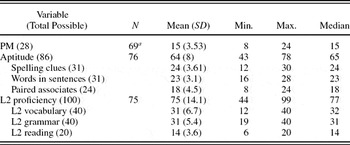
Descriptive statistics for all measures are indicated in Table 1. For the PM test, the mean score was 15 (SD = 3.53) out of 28 possible. For the aptitude subtests, the mean was 64 (SD = 8) out of 86 possible. The L2 proficiency test mean result was 75 (SD = 14.1) out of 100.
Descriptive statistics for all tests

Note: PM, phonological memory; L2, second language.
aMeans and standard deviations for the PM subgroup of 69 participants: aptitude (M = 64, SD = 8), spelling clues (M = 24, SD = 3.7), words in sentences (M = 23, SD = 3), paired associates (M = 17, SD = 4.5); L2 proficiency (M = 75, SD = 14), L2 vocabulary (M = 30, SD = 6.6), L2 grammar (M = 31, SD = 5.4), L2 reading (M =14, SD = 3.7).
Cronbach alpha tests, based on scores on subtests for each test, revealed generally strong internal coherence on the L2 proficiency test (r = .87) and the PM test (r = .86).Footnote 4 The aptitude test revealed weak internal coherence (r = .55), but this result is not unexpected, given that distinct aptitude components are considered to make up the aptitude test battery. This result will be examined further in view of the principal components analysis.
Two Arabic native speakers separately evaluated all of the taped PM NWRs for accuracy. As in previous studies (Dufva & Voeten, Reference Dufva and Voeten1999; French, Reference French2004; Service & Kohonen, Reference Service and Kohonen1995), an accurate repetition was considered to be one in which there were no obvious phoneme replacements, omissions, or additions. Minor variations were allowed if phoneme boundaries were not crossed. Interrater test–retest reliability calculations carried out on all 28 NWR items revealed a consistency of r = .95 (Shrout–Fleiss reliability). In addition, evaluators were asked to rigorously review all of the taped repetitions in which there had not been complete agreement. In this way, a consensus was obtained, as the evaluators were able to come to an agreement on all items.
Pearson product moment correlations
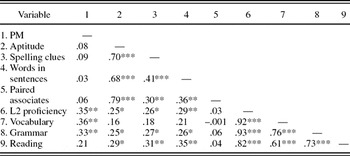
Pearson product moment correlational analyses revealed that PM and L2 proficiency were significantly, although modestly, related (r = .35, p < .01), as were aptitude test scores and L2 proficiency (r = .25, p < .05; see Table 2 for all correlation results). An α level of .05 was used for all statistical tests. PM was particularly linked to the vocabulary subtest of the L2 proficiency measure (r = .36, p < .01) and to the grammar subtest (r = .33, p < .01). Aptitude was particularly linked to the L2 reading (r = .29, p < .05) and grammar (r = .25, p < .05) subtests of L2 proficiency. The paired associates (rote memory) subtest of the aptitude test failed to correlate with L2 proficiency or PM. All subtests were strongly linked to each other as well as to the test they were part of (e.g., vocabulary and grammar subtests, r = .76, p < .001). There was no significant correlation between PM and aptitude (r = .08, p > .05).
Pearson product moment correlations between observed variables
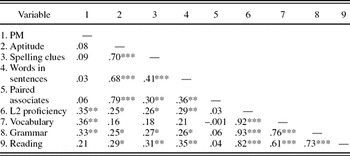
Note: PM, phonological memory; L2, second language.
*p < .05. **p < .01. ***p < .001.
Exploratory principal component analysis
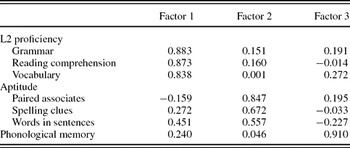
An exploratory principal component analysis was applied in order to establish independent factors on the basis of factor loadings. The analysis revealed that three clear factors emerged from the data, based on the Jolliffe (Reference Jolliffe1972) criterion (eigenvalues ≤ .7): L2 proficiency, aptitude, and PM. Factor 1 consisted of the three L2 proficiency subtests (vocabulary, grammar, and reading comprehension), each of which received a factor loading of .83 or above; Factor 2 consisted of the three aptitude subtests (paired associates, spelling clues, and words in sentences), each of which received loadings between .55 and .84; and Factor 3 consisted of the PM score at .91. Overall, the three factors accounted for 74.1% of the total variance (eigenvalues = 2.9, 1.3, and 0.9, respectively, for the three factors; variance = .42, .19, and .13, respectively, for the three factors).
The factor analysis revealed that despite the low Cronbach alpha score (.55) for the aptitude subtests, these tests appear to load on a similar factor (Factor 2). A varimax rotation method was next applied, confirming the previous factor loadings (see Table 3).
Loadings for exploratory principal component analysis (varimax rotation pattern)
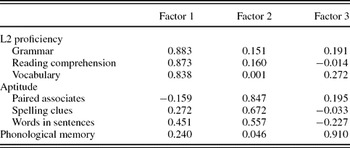
Note: L2, second language.
Multiple regression analyses
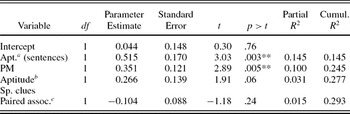
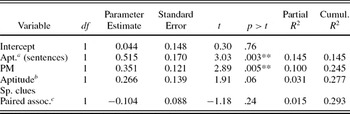
A linear multiple regression analysis was next applied, using the score on the L2 proficiency subtests as the criterion variable and with aptitude subtests and PM as predictors for L2 proficiency. The multiple regression analysis was statistically significant (p < .0002) and revealed that 29% of the variability in L2 proficiency was predicted by both aptitude and PM, F (2, 67) = 6.54, r 2 = .29. To understand the proportion of L2 proficiency explained by the predictors, partial r 2 statistics were computed. When looking at the contribution of each individual predictor in this analysis, the words in sentences subtest, considered to indicate grammatical sensitivity, contributed 14.5%, and PM contributed an additional 10% of the variance (see Table 4).
Intact group: Multiple regression of scores on L2 proficiency mean score by aptitude subtests and PM (N = 76)
Note: L2, second language; PM, phonological memory.
aMLAT words in sentences subtest.
bMLAT spelling clues subtest.
cMLAT paired associates subtest.
**p < .01.
Additional regression analyses were carried out with the individual L2 proficiency subtests (grammar, vocabulary, and reading comprehension) as criterion variables. The L2 proficiency subtests revealed the following results, indicating similar values for the three subtests: L2 grammar, F (2, 67) = 5.70, r 2 = .27; L2 vocabulary, F (2, 67) = 4.35, r 2 = .22; L2 reading comprehension, F (2, 67) = 5.58, r 2 = .26.
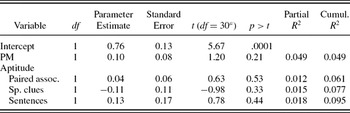
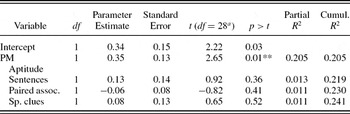
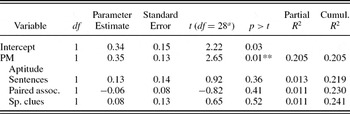
In order to examine whether the variables played different roles depending on the learner's degree of L2 proficiency, similar to what has been done in other studies (Cheung, Reference Cheung1996; French, Reference French2004; O'Brien et al., Reference O'Brien, Segalowitz, Collentine and Freed2006), the decision was made to divide the group into higher and lower proficiency subgroups based on a median split on the overall L2 proficiency score. Scores of individuals at and above the median (77) constituted the higher proficiency group (n = 39), and those of individuals below the median constituted the lower proficiency group (n = 36). It is important to keep in mind that all students were considered to have attained a fairly advanced proficiency level on the basis of years of English study and their having met university admission standards for the professional TESL teaching program; nevertheless, some variation in L2 proficiency is apparent from the standard deviation revealed on the L2 proficiency test (see Table 1; M = 75, SD = 14). The separate regression analyses revealed that variables among the higher proficiency subgroup did not attain a level of significance (see Table 5). In contrast, among the lower proficiency group, one variable, PM, reached a level of significance (p = .01; see Table 6). Therefore, for the lower proficiency subgroup, PM significantly predicted L2 performance.
Higher proficiency subgroup (n = 39): Multiple regression of scores on L2 proficiency mean score by aptitude subtests and PM

Note: L2, second language; PM, phonological memory.
aFour missing values on explanatory variables.
Lower proficiency subgroup (n = 36): Multiple regression of scores on L2 proficiency mean score by aptitude subtests and PM
Note: L2, second language; PM, phonological memory.
aThree missing values on explanatory variables.
**p = .01.
DISCUSSION
This study sought to examine the relationship between PM, language learning aptitude components, and L2 proficiency in nonnovice L2 learners. An exploratory principal component factor analysis revealed three distinct factors (L2 proficiency, aptitude, and PM) accounting for 74.1% of the total variance.
The multiple regression analysis revealed that both PM and aptitude subtests were significantly, although modestly, related to L2 proficiency. These two sets of variables together predicted 29% of the variance in English proficiency. These findings therefore confirm previous results that indicated the close link between aptitude tests and L2 performance. They also indicate that the relation found in previous studies between PM and L2 vocabulary skill, as well as aspects of oral production in early and intermediate stages of L2 learning, can be extended to one between PM and L2 proficiency at later L2 developmental stages. Aptitude on its own explained approximately 19% of the variance, and PM explained approximately 13% of the variance. It is interesting to note that no significant correlations were found between PM and aptitude or between PM and any of the aptitude subtests.
Correlations among variables revealed that PM was significantly correlated with L2 proficiency and in particular with vocabulary (r = .36) and grammar (r = .33). This result is similar to the one found between PM, measured by serial recognition, and L2 oral production measures by O'Brien et al. (Reference O'Brien, Segalowitz, Collentine and Freed2006). For instance, in their study, productive vocabulary and PM (r = .35, p < .05) and narrative abilities and PM (r = .35, p < .05) were significantly correlated at two distinct time periods, although PM did not predict change in vocabulary production over the semester-long period.
The finding in the present study that PM and the L2 vocabulary subtest were significantly but weakly correlated in this study corroborates findings in previous studies with regard to early L2 vocabulary acquisition in children (e.g., French, Reference French2004; Service & Kohonen, Reference Service and Kohonen1995) and suggests that even beyond early learning stages PM remains linked to L2 vocabulary skill, although this relationship is diminished compared to beginning stages. The still significant relationship between PM and L2 grammar skill in this study, although weak, confirms other research (e.g., French & O'Brien, Reference French and O'Brien2008; Williams & Lovatt, Reference Williams and Lovatt2003) that has indicated links between PM and aspects of grammatical rule learning. The finding that PM and the L2 reading comprehension subtest failed to correlate significantly suggests PM is less critical for a skill as complex as reading, which draws on multiple cognitive resources, and may be more strongly dependent on L1 literacy skills.
An additional finding in this study is that there is an intriguing inverse relationship in terms of correlations between aptitude, PM, and the L2 proficiency subtests. In the intact group, the strongest relationships between aptitude and L2 proficiency were with respect to the reading comprehension and grammar subtests, but a significant association was not found with the vocabulary subtest. In contrast, PM was significantly associated with L2 vocabulary and grammar subtests, and the reading comprehension subtest failed to reach a significant level. These findings suggest that aptitude components that include variables such as a grammatical analytical ability or sensitivity may be particularly useful when reading skills are required. L1 analytic skills are most likely tapped by the aptitude subtests (especially spelling clues and words in sentences), suggesting that L2 reading comprehension is particularly dependent on such skills. Because the aptitude subtests were carried out in the L1 of participants, this result may indicate the role that general L1 reading skill combined with linguistic analytic skill plays in L2 reading comprehension. This is corroborated by a number of studies (e.g., Dufva & Voeten, Reference Dufva and Voeten1999; Sparks & Ganschow, Reference Sparks and Ganschow1991, Reference Sparks and Ganschow1993; Sparks, Patton, Ganschow, Humbach, & Javorsky, Reference Sparks, Patton, Ganschow, Humbach and Javorsky2006) whose findings have indicated that L1 literacy skill is closely linked with L2 learning as well as with aptitude. The role played by L1 skill is also supported by the result that despite the fact that the three aptitude subtests are considered to measure separate aptitude components, they nevertheless loaded on a similar factor, which may in fact be L1-related skill.
Results from the present study thus indicate that PM appears to continue to contribute to aspects of L2 proficiency in nonnovice adult learners, albeit with a weaker association than that reported in studies among children L2 learners. However, a different portrait emerged when the additional separate regression analyses were carried out on lower and higher proficiency subgroups determined by a median split on proficiency scores. It was revealed that neither PM nor any of the aptitude subtests attained a level of significance within the higher proficiency subgroup. In contrast, among the lower proficiency subgroup, only one variable, PM, did reach a level of significance (r 2 = .20, p = .01). These results are consistent with those of other studies that appear to indicate that the role of PM as a predictor variable is particularly important at earlier stages of L2 development. Although the participants in our study were judged to be at a fairly advanced level of L2 proficiency, all having studied the L2 for at least 7 years in formal classrooms and having been accepted entry into a professional L2 teaching program on the basis of L2 scores, the results reveal that for the most advanced learners in this group, none of the aptitude or PM variables was found to be a significant predictor. As has been suggested in the L1 literature in particular, it is likely that at later stages of learning, existing lexical knowledge comes to outweigh any contributions from PM. In addition, a number of other factors are likely to play a more important role for advanced L2 learners than PM, such as amount or type of L2 exposure or motivation. However, it is important to keep in mind that in the smaller sample sizes associated with the subgroups (n = 36, n = 39), it is more difficult to detect statistical tendencies that might otherwise be found in a larger sample size.
Sawyer and Ranta (Reference Sawyer, Ranta and Robinson2001) suggest that the relation between WM and L2 competence may be explained by the fact that a more efficient WM allows learners to notice important aspects of the language input by freeing up necessary attentional resources that would otherwise be tied up in processing incoming material. We can similarly suggest that PM plays this specific role with regard to processing auditory and acoustic material associated with a given language. The better the ability to rapidly process, retain, and repeat new phonetic material, as required in the NWR task, the better able the learner is to process and deal with the new sound patterns in a language being learned. Results in this study indicate that this relationship remains modestly significant beyond very early learning stages, because PM predicted L2 proficiency in the nonnovice learners in this study although the most advanced learners no longer revealed evidence of that relationship.
Another important finding from our study is that traditional components of language learning aptitude continue to play a role in nonnovice learners, although the effect was not apparent when smaller proficiency subgroups were formed. Our study found significant although modest correlations between aptitude and L2 proficiency, r (75) = .25, p < .05, in the overall learner group. Findings revealed that the type of skills measured by the spelling clues and words in sentences subtests were linked to L2 proficiency, but those used in the paired associates memory task were not. These results corroborate those of other studies that reveal close associations between traditional aptitude tests and aspects of L2 performance. For instance, Erhman and Oxford (Reference Ehrman and Oxford1995) found significant correlations (r = .4) between the words in sentences MLAT subtest and L2 speaking and reading proficiency measures in a cohort of US government employees. Robinson (Reference Robinson1997) found that ESL learners who scored higher on the words in sentences and paired associates MLAT subtests outperformed other learners on tasks requiring higher levels of grammatical rule awareness and the ability to verbalize rules. In contrast, one study (Winke, Reference Winke2005) found a significant relationship between the MLAT and L2 performance (reading, writing, and listening skills) in beginning learners but not advanced L2 learners of Mandarin.
It is interesting to note that the paired associates aptitude subtest, which largely required rote memory for new lexical items, failed to correlate with overall L2 proficiency or with any of the proficiency subtests in any of the analyses. This finding suggests that rote memory may not be a particularly useful aspect of memory skill for L2 proficiency in nonnovice learners. In contrast, the short-term retention and articulation of new sounds required by the NWR task considered to reflect PM is an aspect of memory skill that was found in this study to be related to L2 proficiency.
It is important to point out that the short form of the MLAT (in its French version) that was used in this study did not include two additional MLAT subtests: number learning and phonetic script. The phonetic script subtest, requiring the learning of novel sound–symbol pairings that are then matched with their written representations, is thought to reflect phonetic coding (also tapped by the spelling clues subtest) and may, to some extent, also draw on PM. Future studies may shed further light on this possible relationship.
A particularly intriguing finding in this study is that although both PM and traditional aptitude components were found to be significant predictors of L2 performance in the intact group, they were not significantly related to each other, which underscores the distinct nature of skills underlying these measures. This finding suggests that individuals can have different ability profiles, each of which can lead to successful L2 performance. The skills that constitute PM are very different from those involved in the various aptitude tasks tested in this study. Individuals who have a high ability to hold in memory and accurately repeat new linguistic sounds were found to perform well on the L2 proficiency test. In a similar vein, individuals who performed well on L1-based aptitude subtests, thought to reflect a high degree of grammatical sensitivity and high levels of L1 vocabulary mastery, received high scores on the L2 proficiency test. This suggests that individuals can build on their own idiosyncratic patterns of abilities in L2 learning. Some individuals may be particularly strong in auditory-based memory and articulation skills (PM), and others are skilled in detecting linguistic patterns and relationships (aptitude subtests).
Skehan (Reference Skehan and Cook1986) reported results that point toward a similar differentiation in ability profiles. His use of cluster analysis revealed learners differed in terms of their skill profiles. Atlhough some learners were characterized by a strong memory ability, others demonstrated an analytic ability, and others appeared to have equal strengths in both areas. Wesche (Reference Wesche and Diller1981) reported similar findings from her study indicating that different aptitude profiles could lead to similar levels of success, especially when aptitude profiles were matched with appropriate instructional methodologies (e.g., analytic, audiolingual).
Furthermore, the lack of relationship between aptitude and PM suggests that the various tests were not merely hidden measures of task motivation or general test taking ability, because otherwise an overall pattern of high performance on both aptitude tests and PM would have occurred on the part of some participants, yet no relationship was found between these two measures.
Another important point to make is that L2 proficiency was measured by tests of literacy-based skills. Oral performance was not measured in this study, and a different pattern of results might occur for oral fluency in nonnovice learners. Still, PM was found to be significantly correlated with L2 proficiency in this study's intact group, a result that is similar to the one found between PM, measured by serial recognition, and L2 oral production measures at two distinct time periods in O'Brien et al.'s (Reference O'Brien, Segalowitz, Collentine and Freed2006) study of beginner and intermediate learners, although PM did not predict gains in vocabulary production in that study. However, as discussed previously, in a study that used a NWR task to measure PM, Mizera (Reference Mizera2006) failed to find any relationship between PM and oral production measures in low or high proficiency L2 adult learners, although one possible explanation for this result is that PM was not fully tapped by the relatively short spans (maximum of five syllables) used in the testing instrument.
The results in the present study provide evidence that PM constitutes an aspect of cognition that continues to manifest a relationship with L2 proficiency, albeit modest, in nonnovice adult learners. Findings from subgroups suggest that this effect disappears in the most advanced learners but remains significant in the less advanced learners. In this regard, it can be suggested that PM merits consideration as an individual difference variable contributing to L2 proficiency in adults, at least until relatively advanced learning stages.
Furthermore, these results indicate that previously identified aptitude components, in particular, grammatical sensitivity (words in sentences), and phonetic coding ability (spelling clues) remain perceptibly linked with L2 proficiency in nonnovice learners, although no effect was apparent when smaller subgroups were formed. The results from those subtests may also reflect a relationship between L1 literacy, metalinguistic skill, and L2 proficiency.
However, the methodology in this study does not allow us to make any statements as to whether PM or performance on aptitude subtests contribute to new learning. As this study only sought to measure performance at one given time period, no definitive conclusions can be drawn about effects on performance gains. The results do not allow firm statements about causal effects of any of the described variables on each other.
It may be that the small relationships found in this study are remnants from earlier learning stages, variables that increasingly play a smaller role in outcomes as other factors take on a larger role. Indeed, the fact that 29% of the variance in L2 proficiency was explained by both aptitude and PM in the intact group leaves approximately 70% of the variance due to other factors not tested in this study. The large proportion of variance due to unidentified factors suggests that L2 achievement at later stages remains highly subject to multiple variables. Individuals who are not particularly advantaged in terms of PM or the aptitude components examined in this study may have reached high proficiency levels due to sociopsychological variables, such as motivation, orientations, and attitude, as well as additional aptitude components not examined here. Although the participants in this study were fairly homogeneous in terms of language learning histories, variables such as amount and type of previous language exposure may also have played a role.
Taking into account the present results, in addition to results from L1 and L2 studies discussed previously in this article that specifically measured aspects of language development, we can suggest that a threshold effect may be in effect for PM in language learning. At earlier learning stages, whether for children learning their native language or in children or adults learning an L2, efficient functioning of the phonological loop appears to provide a distinct advantage. To the extent that an efficient PM provides an advantage in early L2 learning, it may be useful to consider it as a potential aptitude component predicting early language attainment. However, once a threshold of a relatively solid grasp of the sound patterns and basic vocabulary in the target language has been established, the phonological loop appears to no longer significantly contribute to further learning, and other factors, including already acquired L2 knowledge, are likely to take on a larger role. The fact that PM remained significantly linked with L2 proficiency in the nonnovice learners in this study suggests PM continues to leave evidence of an effect well beyond a beginner's level.
A similar, although slightly different, portrait may characterize the role of traditional aptitude components in nonnovice L2 learners. Although grammatical sensitivity and phonetic coding were modestly linked with L2 proficiency in the intact group, no effect appeared in the smaller subgroups. As suggested elsewhere (Carroll, Reference Carroll, Parry and Stansfield1990; Robinson, Reference Robinson2005), beyond early L2 learning stages, other factors are likely to outweigh the role played by aptitude components found in traditional aptitude tests.
It is easier to detect learning gains at early L2 developmental stages, as in beginning and intermediate learners, but equivalent gains are more difficult to detect and measure once learners are at a relatively advanced proficiency level. It is therefore more difficult to verify the role that factors such as PM and traditional aptitude components might play in any of the subtle increases that are likely to take place in more advanced learners. Further increases in proficiency may involve more subtle characteristics such as greater control over rhetorical and pragmatic aspects of written or oral discourse, acquisition of more complex grammatical structures and structures conveying subtle meaning distinctions, and greater knowledge of formal vocabulary. Future studies would gain from targeting such additional, specific aspects of L2 performance in order to more clearly delineate the patterns of relationships among PM and aptitude components in L2 proficiency.
CONCLUSION
To conclude, the exploratory principal components analysis revealed that the three variables examined in this study (L2 proficiency, PM, and aptitude components from a traditional test battery) constituted separate distinct factors. Furthermore, an additional important finding is that results appear to extend previous evidence that revealed that PM predicts proficiency in early L2 learning stages in children and adolescents to nonnovice adult learners as well. However, similar to what has been found for younger populations (e.g., Cheung, Reference Cheung1996), that relationship appears to disappear at more advanced stages of L2 proficiency. A slightly different pattern appears to characterize the relationship between L2 proficiency and the aptitude components examined in this study because no significant relationship emerged to differentiate lower or higher proficiency subgroups.
APPENDIX A
SAMPLE TALV ITEMS
Note that the instructions have been translated from the original French.
Spelling clues
Indicate which of the five words is most similar in meaning to the sample word that has been written according to how it sounds:
1. PLAS
a. pied
b. géographie
c. lieu
d. vitrine
e. siècle
Words in sentences
Which word in the second sentence has the same function as the underlined word in the first sentence?
1. OTTAWA est la capitale du Canada.
Il aime aller pêcher en Gaspésie.


Paired associates
Choose the item that corresponds to the Kurdish word (following a short period of study and practice) hij:
1. ver
2. chute
3. froid
4. tracer
5. livre
APPENDIX B
ARABIC-BASED WORDS USED IN NWR TASK
Three-syllable words:
1. Samaka
2. Sayara
3. Tawila
4. Infisal
Four-syllable words:
1. Rafahiya
2. Muhejira
3. Mudiratun
4. Kelimetun
Five-syllable words:
1. Imbraturiya
2. Almudawalat
3. Almutarjimun
4. Makatibuhum
Six-syllable words:
1. Intisaratuhum
2. Istijwabatuhum
3. Ajsamuhuna
4. Mutamasikina
Seven-syllable words:
1. Bunyatu al muhandas
2. Alzuhur al jamila
3. Itisalen la zimen
4. Jaziratun kabira
Eight-syllable words:
1. Alhayatu jamilatun
2. Alfatetuwesimetun
3. Malebisu al rajuli
4. Tarbiyatu al kiba:ri
Nine-syllable words:
1. Althikrayat al hazinatu
2. Huru:bu al mutasawilna
3. Sitata wa situna rajul
4. Milafatu al mujrimina
APPENDIX C
SAMPLE MTELP ITEMS
Grammar
1. “What is that thing?”
“That ________ a spider.”
a. to call
b. for calling
c. be called
d. is called
Vocabulary
Find a word or phrase that is closest in meaning to the underlined word.
1. It's too windy to go for a stroll.
a. swim
b. sail
c. drive
d. walk
Reading comprehension
Read each passage carefully and then try to answer the questions following the passage.
Example:
While I was getting ready to go to town one morning last week, my wife handed me a little piece of red cloth and asked if I would have time during the day to buy her two yards of cloth like that. I told her I would be glad to do it. And putting the piece of cloth into my pocket, I took the train for town.
1. The person telling the story is . . .
a. a married lady
b. an unmarried lady
c. a married man
d. an unmarried man
ACKNOWLEDGMENTS
I gratefully acknowledge Faten Abdallah and Sondes Hamdi for their assistance with data collection and data evaluation for this study, as well as the Laval University students who participated in this study. Sincere thanks go as well to Gaetan Daigle, Service de Consultation Statistique at Laval University, for his expertise in assisting with statistical analyses. I am also very grateful for the constructive comments from three anonymous reviewers for Applied Psycholinguistics. My appreciation also goes to Theodoros Marinis for his careful reading of the manuscript and to the editorial staff at Applied Psycholinguistics.