The manner in which courts perform their duties of conflict resolution and judicial review depends on their composition (Gill Reference Gill2014). In the United States, the membership of federal courts is an especially important outcome of executive-legislative bargaining, as the president appoints judges who must also be confirmed by the Senate (Corley Reference Corley2006). This is not, however, the sole instrument of interinstitutional control wielded by the elected branches over US federal courts. The very existence of federal judgeships is also a function of legislative design, as Congress has the power to create or eliminate seats on the federal bench. This responsibility over federal courts, then, offers Congress the opportunity to consider when and where to expand the judiciary.
Although Congress is afforded the constitutional tools to control the size of the federal courts, actions to alter the number of federal judgeships do not occur uniformly over time. Instead, there are long periods with no expansions to the federal judiciary, punctuated by single terms with a pronounced increase in federal judgeships. Moreover, the geographic distribution of such increases coincides imperfectly with the recommendations of the Judicial Conference (de Figueiredo et al. Reference de Figueiredo, Gryski, Tiller and Zuk2000, 111). This suggests the calculus underlying decisions whether to expand the size of federal district or circuit courts involves more than merely keeping pace with demand, that is, increasing rates of district or circuit litigation. Given these uneven patterns of expansions to the federal judiciary, we seek to answer the following questions: What explains legislative choices to increase the number of federal judgeships? More specifically, how do the ideological preferences of relevant actors involved in the expansion process affect congressional decisions to increase the size of federal courts?
We argue that the proximity of ideological preferences between key actors in the expansion process drives legislative choices whether to expand the federal judiciary. The legislative branch acts to increase the size of federal courts when those courts are deciding cases contrary to the preferences of Congress.
Whereas most existing research regarding congressional influence over the courts posits that expansions to the federal judiciary are more likely during unified government—when one party controls the House, the Senate, and the presidency—we approach the question of when Congress chooses to add new federal courts somewhat differently. While we agree that decisions to increase the size of the federal courts imply interinstitutional accord, we argue that the appropriate theoretical concept for predicting expansions to the federal judiciary is the ideological distance between relevant players in the expansion game—and not simply partisan congruence. Unified party government may influence court expansions, but the preferences of pivotal actors across branches are central to the legislative branch’s decision to expand the courts. Our theory and empirical findings alike suggest that expansions to the federal judiciary are driven by the proximity of ideological preferences across the House, the Senate, and individual federal courts.
We test our argument’s claims by examining whether Congress chose to add seats to a federal court for each district and circuit court during each year from 1937 to 2012. Ours is the first article to employ spatial measures of ideology to gauge the relative proximity of ideological preferences across federal institutions involved in the expansion process. This measure of interinstitutional preference congruence, novel in the context of judicial expansions, represents an empirical contribution. This article is also the first to empirically analyze the judicial expansion process at the level of the individual court, by considering whether Congress chose to expand each district or circuit court in each year of our study. Prior studies of judicial expansions have only considered whether Congress enacted legislation increasing the number of federal judgeships nationally, in the aggregate. Our unit of analysis permits us to account for the possibility that legislative choices regarding the expansion of the federal judiciary are made with great precision. This study seeks to contribute broadly to considerations of how courts function as political and legal institutions and how courts fit within a system of separated institutions sharing powers. Our argument and findings suggest that the organization of the judiciary is by no means a function of neutral, administrative decision making but rather itself a political choice by Congress given a legislative coalition’s desire and capacity to influence the judicial construction of public policy by populating the federal courts with ideologically proximate judges.
We find that expansions to the federal judiciary are more likely when (1) the ideological distance between the two chambers of Congress is smaller and (2) the ideological distance between pivotal senators and the individual courts targeted for expansions is greater. These results suggest that the choice to increase the number of federal judgeships is driven by the congruence of ideological preferences between relevant officials in the expansion process and imply that the legislative branch’s organizational choices for the federal judiciary are associated at least as much with the advancement of its policy agenda as with standard managerial practices.
The Politics of Federal Judgeships
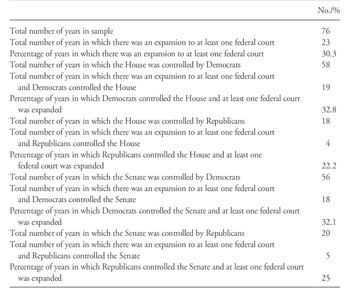
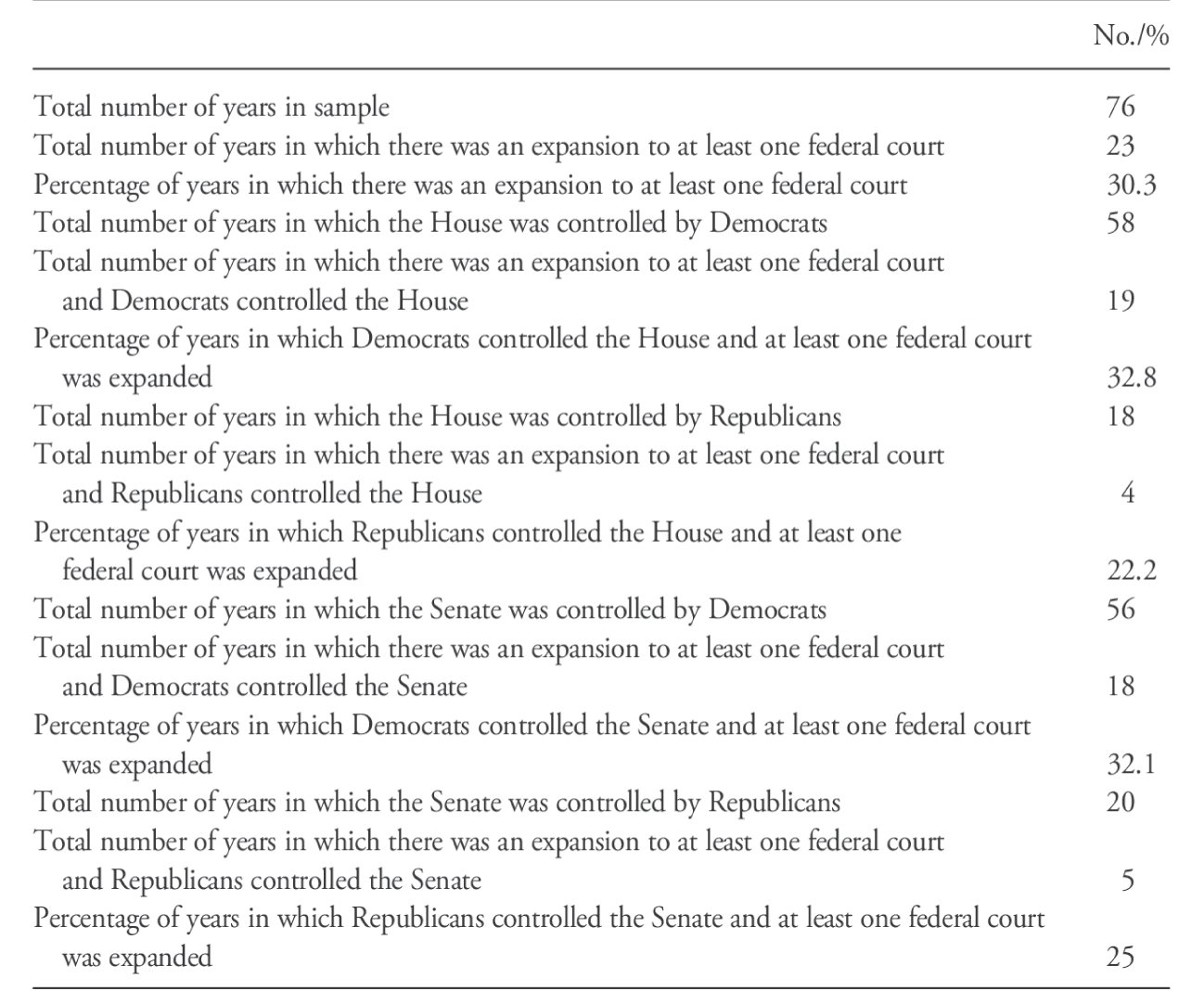
The number of authorized Article III federal judgeships increased from 149 in 1921 to 860 in 2012.Footnote 1 This represents approximately a sixfold expansion. Rather than a steady increase, however, the number of federal judgeships has risen in intermittent waves, with long periods in which no increase occurred interrupted by periods of less than 5 years in which over 100 new judgeships were created. This uneven pattern of expansions to the federal judiciary has been explained by de Figueiredo et al. (Reference de Figueiredo, Gryski, Tiller and Zuk2000) and others as a function of partisan alignment, based on their observation that judicial expansions occur more frequently during eras of unified versus divided government (see Bond Reference Bond1980; Barrow, Zuk, and Gryski Reference Barrow, Zuk and Gerard1996; de Figueiredo and Tiller Reference de Figueiredo and Tiller1996). Scholars have frequently posited that partisan control across branches of the federal government is important for predicting expansions to the judiciary because both chambers of Congress must enact expansion legislation in order to increase the size of even a single federal district or circuit court. In table 1, we present some descriptive statistics regarding the partisan control of each chamber of Congress and when expansions to the federal judiciary have occurred over the 76 years in our sample.
Parties in Congress and Expansions to the Federal Judiciary, 1937–2012
The theory that expansions to the federal judiciary are more likely under unified government is based on the premise that the elected branches struggle collectively to organize and populate the courts, so there is a greater likelihood of cooperation to increase the number of federal judgeships when there is no partisan conflict between the president and either chamber of Congress. Epstein and Segal (Reference Epstein and Jeffrey2005, 2) affirm this interinstitutional cooperative difficulty by asserting that “the appointment of justices is now and has always been a contentious process—one driven largely by partisan and ideological concerns.” According to this theory, the legislative and executive branches of government make choices in shaping the judiciary that advance their policy goals (Giles, Hettinger, and Peppers Reference Giles, Hettinger and Todd2001).
Because judges on federal courts have long been recognized as profoundly influential in shaping the administration and implementation of public policy (Spiller and Spitzer Reference Spiller and Matthew1992; McNollgast Reference McNollgast1994), it stands to reason that federal elected officials prioritize the membership and operation of the federal judiciary to the extent they care about the fulfillment of their policy preferences. At first blush, theories of representation might suggest that legislators in particular are unlikely to make ideologically driven decisions about judicial administration but rather should consider how such choices affect their own constituency. Political polarization and the nationalization of US legislative elections, however, dictate that individual legislators are apt to be held accountable by voters for even those policy developments at the federal level that do not preponderantly affect their own districts (Claggett, Flanigan, and Zingale Reference Claggett, Flanigan and Nancy1984; Theriault Reference Theriault2008; Abramowitz and Webster Reference Abramowitz and Steven2016). This national party effect on individual legislators’ likelihood for reelection propels them to engage in two distinct activities: credit claiming and what party theorists call “exchange relationships.” Legislators tend to create the belief among voters that they are responsible for desirable actions the government has taken (Mayhew Reference Mayhew1974), in addition to regularly supporting legislation that does not directly affect their districts in exchange for future support from colleagues toward legislation of personal importance to them or other institutional benefits, such as better committee assignments (Cox and McCubbins Reference Cox and Mathew2005).
In other words, both the aspiration to see their preferred policies enacted and the reelection incentive motivate legislators to care about the ideological composition of federal courts within and without their districts. Such concerns could be readily observed in 2013 when Republican Senator Chuck Grassley of Iowa—supported by 20 other senators, all Republican, from states ranging from coast to coast—introduced the Court Efficiency Act, which would have reduced the number of seats on the District of Columbia Circuit Court of Appeals from 11 to eight rather than allow President Barack Obama to nominate judges to the three vacancies on the court (S.699, 113th Cong. [2013]). These types of considerations likely factor into congressional choices about judicial administration, including expansions of federal courts, as well as the process of nominating and confirming judges to the federal bench (Binder and Maltzman Reference Binder2009).
In order to increase the size of federal courts, both chambers of Congress as well as the president must agree to pass expansion legislation. Both the House and Senate must enact legislation expanding the judiciary, and such legislation must be signed by the president. Thereafter, in order to fill the newly created seat, the president must nominate a candidate who is then confirmed by the Senate. The president can substantially delay the process of filling the new seat if he or she nominates someone who does not appeal to a sufficient proportion of the Senate, a possibility that may increase in likelihood under divided government (Law Reference Law2005). Senators can also delay or prevent the addition of judges by using dilatory tactics or refusing to vote on the nomination altogether (Binder and Maltzman Reference Binder and Forrest2002). Unified government potentially solves the problem of interbranch discord because common partisanship between the presidency and both chambers of Congress allows the institutions to more easily coordinate in filling a new seat on the federal bench (Zuk, Gryski, and Barrow Reference Zuk, Gryski and Deborah1993). With studies showing increased polarization between Democrats and Republicans, the differences between the interests of the two parties have become even more pronounced over time (Abramowitz and Saunders Reference Abramowitz and Kyle1998). This suggests that partisan alignment is indeed a necessary feature of an institutional landscape conducive to increasing the size of federal courts. However, while unified government may sufficiently explain the success or failure of the nomination and confirmation process, our primary concern is predicting the success or failure of enacting expansion legislation, and unified government alone does not explain the variation in expansions to the federal judiciary over time. Here, we seek instead to demonstrate that ideological proximity between relevant actors involved in the expansion process can explain the addition of seats to the federal bench.
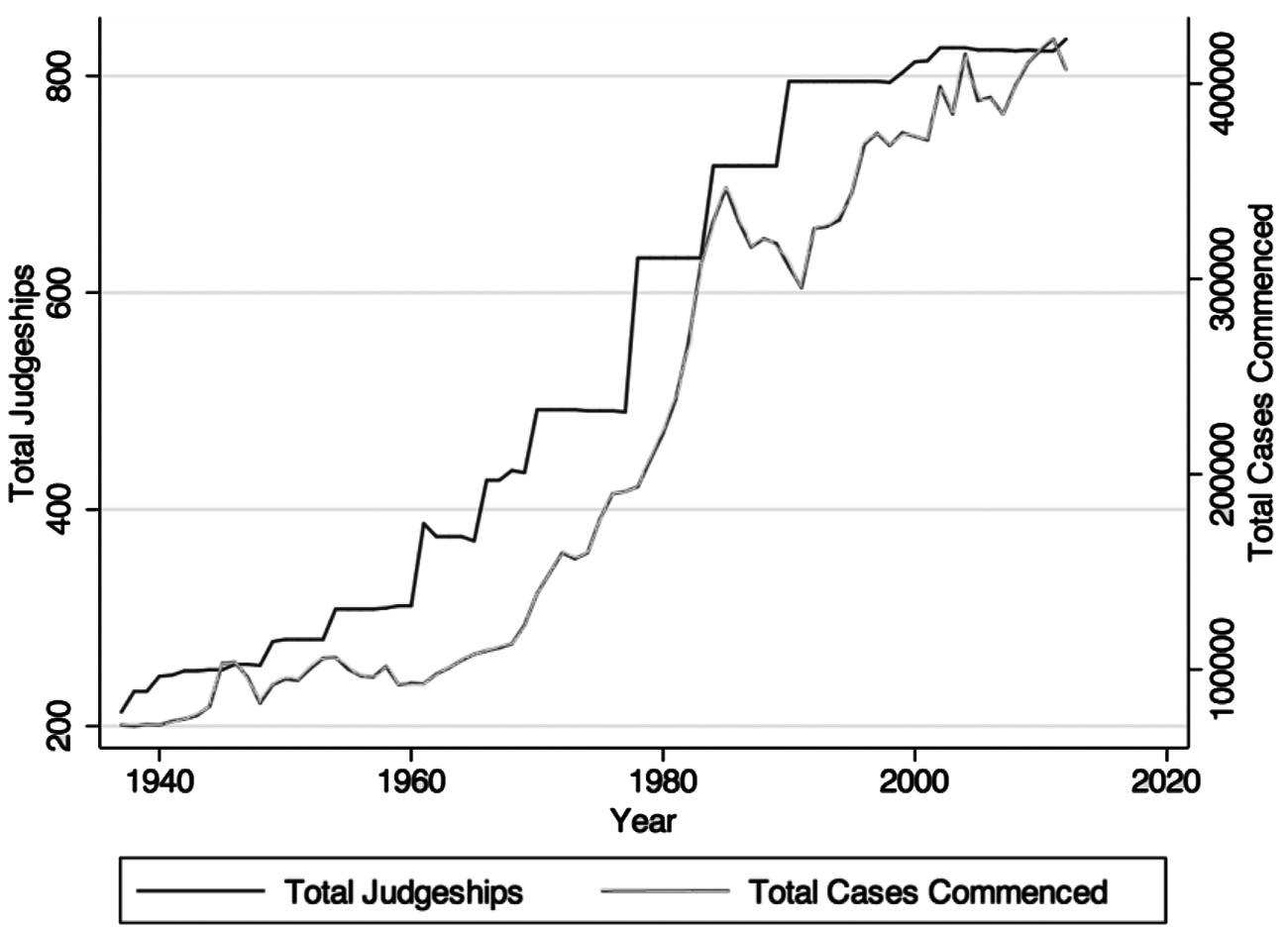
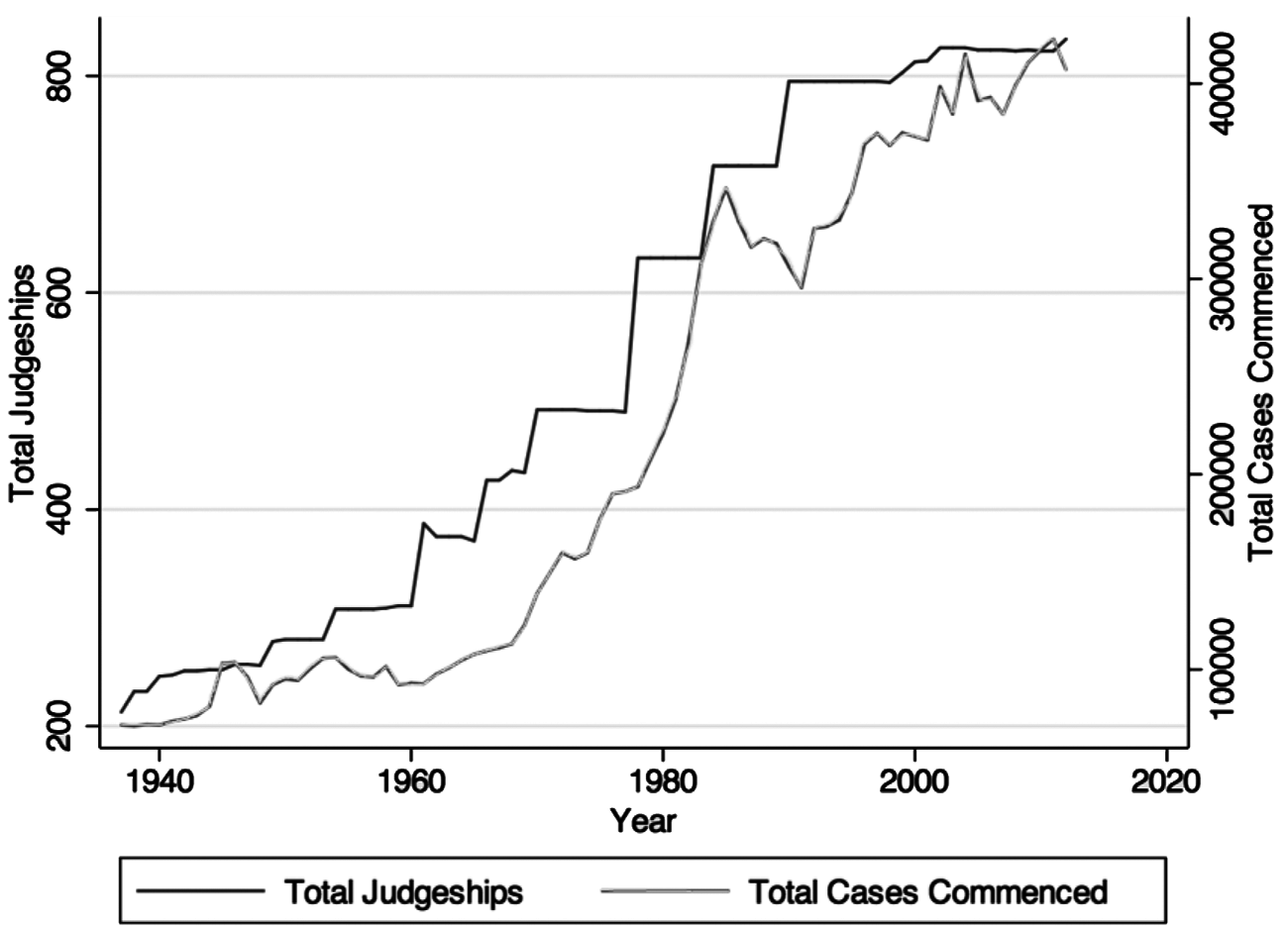
Increased demand for additional federal judgeships may credibly be seen as responsible management of the federal docket. An efficient system of justice requires a sufficient number of judges to dispose of cases in a timely manner. Some prior research suggests that newly authorized federal judgeships have been a response to increased caseloads (e.g., Marcus Reference Marcus1978; Phillips Reference Phillips1978; McCree Reference McCree1981). Such scholarship, however, tends to concentrate prescriptively on the need for an expanded judiciary rather than offering empirical evidence that judicial expansions occur to meet amplified demand in the courts. As reflected in figure 1, there have been many instances in which an increase in the federal caseload went unaccompanied by an expansion to the federal judiciary, and likewise, there have been increases in the number of federal judgeships in years when the number of total cases commenced in federal court actually declined.
Judgeships and caseload in federal district and circuit courts, 1937–2012
Neither fluctuations in the federal caseload nor the recommendations for judicial expansions from the Judicial Conference fully explain the success or failure of expansion legislation. With some frequency, legislative choices regarding expansions to the federal judiciary do not match the Judicial Conference recommendations for whether and where additional judgeships should be created (de Figueiredo and Tiller Reference de Figueiredo and Tiller1996; de Figueiredo et al. Reference de Figueiredo, Gryski, Tiller and Zuk2000). This follows from mixed evidence whether the elected branches even use the conference as a resource when deciding to increase (or not) the number of federal judgeships (Bond Reference Bond1980; Wheeler Reference Wheeler1988).Footnote 2
Unlike the argument we present, past scholarship on when Congress chooses to increase the size of the federal courts does not include an explanation based on the ideological congruence of relevant political actors in the expansion process (see Krehbiel Reference Krehbiel1998). According to both the strategic and attitudinal approaches, federal judges are guided by their policy preferences (Epstein and Knight Reference Epstein and Jack1998). This underscores the political ramifications of judicial appointments and judicial expansions alike. To the extent that elected officials are rational political actors, they will seek to place individuals with policy views similar to their own in influential posts.
Shared partisan control of the House, the Senate, and the presidency does not guarantee common ideological preferences across those institutions. By focusing on unified government by one party as an explanatory factor in predicting judicial expansions, de Figueiredo et al. (Reference de Figueiredo, Gryski, Tiller and Zuk2000) leave open the possibility of intrapartisan ideological heterogeneity. Ideological preferences represent a more precise measure of legislators’ and judges’ policy goals than a binary measure of their partisanship (e.g., Poole and Daniels Reference Poole and Steven1985; Scully and Patterson Reference Scully and Samuel2001), and it is this increased precision that makes interinstitutional congruence and divergence of ideological preferences the appropriate theoretical concept for predicting whether Congress chooses to expand the federal judiciary. If the creation of new federal judgeships is an attempt by Congress to control the courts, our theory suggests this attempt is influenced by ideological factors more than partisan ones. As a result, expansions to the federal bench are more likely given certain ideological configurations, regardless of whether there is unified or divided government.
Judicial Expansions and Interinstitutional Ideological Proximity
While absolute measures of ideology are useful in gauging the policy preferences of individual legislators or judges, we employ distance measures between relevant institutions in order to test our argument that ideological proximity between actors in the expansion process, rather than unified government, prevails in explaining the enactment of successful expansion legislation. Ideology and preference distance measures help to explain decision making and voting behavior in institutions (Sullivan and Minns Reference Sullivan and Daniel1976; Cameron, Cover, and Segal Reference Cameron, Cover and Jeffrey1990; Frymer, Kim, and Bimes Reference Frymer, Kim and Terri1997; Grossback, Nicholson-Crotty, and Peterson Reference Grossback, Nicholson-Crotty and David2004). For the empirical test of our theory, the two chambers of Congress are the legislative players whose ideological preferences matter. Either the House or the Senate can introduce legislation expanding the number of seats on any given federal court, after which the other chamber must approve the expansion as well. Existing scholarship confirms that legislators in Congress are incentivized to support administrative changes to the federal judiciary when judges’ preferences are out of line with their own (McNollgast Reference McNollgast1995).
We do not directly control for the preferences of the president in our analysis because the likelihood of the president affecting the expansion process is minimal for several reasons. There are two distinct processes by which the president could affect the expansion process: (1) by vetoing expansion legislation or (2) by encouraging the passage of expansion legislation. There has never been an instance in which the president vetoed legislation increasing the number of federal judgeships.Footnote 3 Indeed, the probability of the president vetoing an entire expansion bill owing to his or her objection to expanding an individual district or circuit court is low because typically such bills include the creation of new judgeships across a large number of federal judicial districts and circuits. At the same time, the president can much more easily affect the composition of federal courts through a less costly process than passing new legislation, that is, by filling one or more of the numerous, already existing judicial vacancies. Indeed, since the persistently high number of judicial vacancies through the years is perceived negatively by the public, the president would avoid adding to and perhaps even ameliorate what appears to be a crisis in federal judicial administration. Consequently, our theory suggests ideological proximity between the president on the one hand and the House and Senate on the other is not a necessary condition for successful expansion legislation.
We assume that the players involved understand the preferences of the other players and that they make decisions based on this knowledge; we also assume that the veto players (Tsebelis Reference Tsebelis2002; Saeki Reference Saeki2009) from the House and the Senate are the individuals whose preferences are directly relevant in determining whether seats are added to the federal bench. The relevant veto players in our model are the House median and the Senate filibuster pivot. Because legislation can pass the House with a simple majority, the House median is the veto player in that chamber. In the Senate, as a functional matter, legislation must be able to achieve a supermajority in order to pass because of the filibuster rule, since it takes three-fifths of the Senate to invoke cloture and force a final passage vote. As a result, the veto player in the Senate is the sixtieth senator in a given direction.Footnote 4
Because both the House and Senate must enact expansion legislation in order to increase the number of federal judgeships and because legislators with more proximate ideological preferences are more likely to share common policy goals, we believe that a smaller ideological distance between pivotal legislators in the House and Senate will increase the likelihood of successful expansion legislation. For our theory, the relevant measure of intercameral preference congruence is the distance between the House median and the Senate filibuster pivot most distant from the House median’s preference. These two pivotal actors have the power to prevent expansion legislation from being enacted, and as such, we expect that their ideological proximity is a critical component for predicting expansions to the federal judiciary. This logic motivates our first hypothesis:
Hypothesis 1: As the ideological distance between the House median and the Senate filibuster pivot most distant from the House median decreases, the likelihood of enacting judicial expansion legislation increases.
Further, we theorize that the House and Senate will use the expansion process to exert influence over the courts and move the judiciary closer to themselves ideologically. More specifically, we argue that legislative choices whether to add seats to the federal bench will take into account the ideological distribution of judges on each federal district and circuit court and that when designing expansion legislation, pivotal legislators in the House and Senate are likely to target those courts for expansion that are more ideologically distant from themselves. This leads to the second and third hypotheses:
Hypothesis 2: As the ideological distance between the pivotal Senator and a district court median or circuit court median increases, the likelihood of adding judgeships to that court increases.
Hypothesis 3: As the ideological distance between the pivotal House member and a district court median or circuit court median increases, the likelihood of adding judgeships to that court increases.
Consistent with our theory, we anticipate that increases in ideological incongruence between either chamber of Congress and an individual district or circuit court will be associated with a greater likelihood of legislation expanding that individual court. For the purposes of our subsequent empirical analysis, when gauging the respective ideological distances between each chamber of Congress and individual federal courts, the pivotal legislator can be construed one of two ways: either (a) as the median member of the House or relevant Senate filibuster pivot or, alternatively, (b) the pivotal member of the chamber judiciary committee, owing to these particular committees’ outsized importance in influencing matters of federal judicial administration (Perkins Reference Perkins1980).
Our theory implies that interinstitutional ideological incongruence should predict expansions to individual courts regardless of whether that court is at the district or circuit level. Despite occasional intercameral differences in behavioral tendencies, members of the House and Senate in large part share a common set of generalized incentives and goals. Existing scholarship suggests, however, that if one chamber or the other is less likely to make decisions regarding the enactment of expansion legislation based on its ideological distance from the court’s median ideology, that chamber is the House. Some prior work suggests that members of the House are inclined to support expansions to the judiciary not as an exercise in political control over the courts but in order to claim credit with their constituents for providing solutions to burdensome caseloads in their own districts (Binder and Maltzman Reference Binder and Forrest2002). As such, there is a local basis for House members’ incentive to enact expansion legislation related to the administration of their own district’s courts that may interfere with their ability to make choices about expansion legislation based on ideological proximity to individual courts. We anticipate, based both on our theory and on existing scholarship in legislative politics, that this sort of motivation is amplified in the House as compared with the Senate because of the comparatively small size of House members’ constituencies. There is a greater likelihood, then, that members of the House might be rewarded for expanding a given local court since the per capita impact of creating a new judgeship is greater in House versus Senate constituencies.
Data, Method, and Measurements
To test our expectations regarding how proximity of ideological preferences across federal institutions is critical to the process of expanding the judiciary, we estimate two specifications of a logistic regression model examining the association between ideological divergence or congruence and expansions to the federal judiciary. The unit of analysis is the court-year for every federal district court or federal circuit court in the United States from 1937 to 2012. To our knowledge, no prior scholar has examined judicial expansions by considering the court-year as the unit of analysis, as past work that considered this question did so only in the aggregate by analyzing whether Congress enacted legislation adding seats to any federal court nationwide during a given biennial Congress (Barrow et al. Reference Barrow, Zuk and Gerard1996; de Figueiredo et al. Reference de Figueiredo, Gryski, Tiller and Zuk2000). Using the court-year as the unit of analysis permits us to assess our expectation that legislators make calculated choices regarding not only whether to expand the federal judiciary in general but which federal courts to expand based on ideological divergence between the legislative chamber and the individual court. The dependent variable, Expansion, is a binary variable indicating whether there was an expansion of a given federal district or circuit court in a given year (coded 1 if Congress enacted legislation adding judgeships to a court in a given year and 0 otherwise).Footnote 5 As might be expected, most district and circuit courts are not expanded in most years—in other words, judicial expansions are relatively rare occurrences. Our dependent variable, then, collapses together all judicial expansions irrespective of their magnitude; this is not, however, expected to bias our results one way or the other because a clear majority (over 70%) of the 401 expansions observed in our sample only involved expansions of one seat, regardless.Footnote 6
The independent variables of interest are intended to measure the ideological distance between the relevant political players in the expansion process. In addition, several of our independent variables of interest change on a yearly basis as well. The first independent variable of interest is House-Senate Distance, measured as the absolute value of the difference between the House median ideal point and the Senate filibuster pivot ideologically farthest from the House median. To measure ideal points, we use Common Space scores developed by Poole and Rosenthal (Reference Poole and Howard1991) that bridge ideal points across members of the House, members of the Senate, and the president. Common Space scores cover all senators and House members since 1789 and measure ideology on a continuous unidimensional scale from −1 (most liberal) to 1 (most conservative).
The next two independent variables of interest take into account the existing ideological preferences of federal judges whose courts are potentially subject to gaining additional seats through expansion legislation.Footnote 7 Likewise, and importantly, these two variables are measured in slightly different ways across models 1 and 2. The second independent variable is House-Court Distance. In model 1, House-Court Distance is measured as the absolute value of the difference between the House median ideology and each district court median or circuit court median ideology from the previous year; in model 2, it is measured as the absolute value of the difference between the median member’s ideology on the House Judiciary Committee and each district or circuit court median from the prior year. The third independent variable is Senate-Court Distance. In model 1, Senate-Court Distance is measured as the absolute value of the difference between the relevant Senate filibuster pivot and each district court median or circuit court median ideology from the previous year; in model 2, it is measured as the absolute value of the difference between the median member’s ideology on the Senate Judiciary Committee and each district or circuit court median from the prior year. In other words, these two independent variables measure either (1) the distance between the House median (or House Judiciary Committee median) and a given district or circuit court or (2) the distance between the Senate filibuster pivot (or Senate Judiciary Committee median) and a given district or circuit court, respectively.
Based on our understanding of the literature on the operation of congressional committees, the committee median’s preference is the most theoretically appropriate measure of committee preferences when attempting to construct a variable that reflects the ideological space between the chambers of Congress and individual district or circuit courts. This does not mean, however, that we believe committee chairs to be inconsequential. Although the relative power of committee chairpersons has declined over the last century, chairs nevertheless wield institutional tools that are important for the legislative process (Deering and Smith Reference Deering and Steven1997). As a general rule, however, when considering legislation expanding the size of the federal judiciary or otherwise, the chair is unable to fully override the preferences of a committee majority (Groseclose Reference Groseclose1994). Instead, the probability of expansion legislation moving from the judiciary committees to the floor of each respective chamber—as with the movement of any such legislation from committee to a floor vote—is likely determined by the median ideological preference on the committee itself (Shepsle Reference Shepsle1979; Denzau and Mackay Reference Denzau and Robert1983). In other words, if the majority of a given committee opposes legislation, the committee itself has the capacity to prevent floor consideration by refusing to report it out of committee, but the committee’s collective preference would be that of its ideological median (Krehbiel, Shepsle, and Weingast Reference Krehbiel, Shepsle and Barry1987).Footnote 8
Additionally, because our unit of analysis is the court-year, for some observations we use district court ideology and for others we employ circuit court ideology to calculate these independent variables. To measure court ideal points, we use Judicial Common Space scores (Epstein et al. Reference Epstein, Martin, Jeffrey and Chad2007) for federal circuit courts and Boyd’s (Reference Boyd2015) ideology scores for federal district courts.Footnote 9 We chose to use a variable lagged by 1 year for the distance measures involving courts for two reasons. First, when Congress decides to add judgeships to a court, pivotal legislators are likely considering a slightly earlier ideological composition of the court. Second, if the expansion, nomination, and confirmation process moves sufficiently fast, the judge occupying a newly added seat will be included in the year-end composition of the court, thus affecting the court’s median ideal point during the same year the expansion happened and thus be inappropriately included in what is intended to be a preexpansion measure of central tendency.
To account for the prevailing, party-centered argument in existing research against which we are judging our alternative explanation for judicial expansions, we include a binary variable named Unified Government. The variable is coded 1 if both chambers of Congress and the presidency are controlled by the same party and 0 otherwise.
We also include several control variables in our analysis. The first is Caseload per Judgeship, which is a continuous measure that divides the total annual caseload for each district and circuit court by the total number of judgeships (measured in tens of thousands of cases).Footnote 10 This variable is also lagged by a year, following the same logic described above, based on the possibility that judicial expansions occur as a response to the prior year’s caseload.
To measure the effect that annual retirements have on the likelihood of expansions, we include a variable measuring the Vacancies occurring on a court. The Vacancies variable also encompasses all other rationales for leaving the bench, including deaths. This internal turnover is a sort of endogenous counterpart to the exogenous expansions, as both institutional changes ultimately result in the addition of a new judge to a court. The number of vacancies on a court is expected to affect whether Congress chooses to add seats to that court, as Congress is less likely to enact expansion legislation for a court on which there is already a vacancy. If Congress’s preferences are similar to the president’s, legislators would not need to target that court for expansion in order to affect its median ideology since they know the vacancy is likely to be filled by someone whose preferences are congruous with theirs. There is little need for legislators to expend political capital on adding a new seat since the appointment process provides a less costly way to affect the court’s median preference. Alternatively, if Congress’s preferences are not similar to the president’s and there is a vacancy on a given court, legislators remain unlikely to target the court for expansion since a new seat on that court would only serve to give the president another opportunity to appoint someone whose ideal point is closer to his or her own.
We also control for previous explanations regarding the impact of administrative and economic factors on court expansion. The Judgeships variable measures total judgeships per court per year and is included to control for any effects the size of a court has on its likelihood to be selected for expansion.Footnote 11 In addition, the variable Debt per GDP measures the annual US national public debt as a percentage of the gross domestic product and is used to assess whether the relative condition of the national economy affects the likelihood of expanding the judiciary owing to the practical constraints on increased outlays during economic downturns. Based on existing scholarship that suggests that Federal Judicial Conference recommendations for judicial expansions are routinely disregarded by Congress, we do not control for the conference’s recommendations.
Results: Interinstitutional Ideological Proximity Drives Judicial Expansions
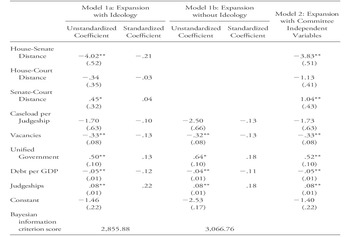
The results of our logistic regression models, designated models 1a, 1b, and 2, appear in table 2. In these models, we examine whether the House and Senate consider (1) intercameral differences in ideological preferences and (2) the distance between the ideology of the chambers’ pivotal members and the ideology of individual district and circuit courts when deciding whether to enact expansion legislation.Footnote 12 As described above, in models 1a and 1b, the court-oriented independent variables of interest are calculated using the ideology scores of the pivotal legislators from each chamber, whereas in model 2, such variables are calculated using the ideology scores of the pivotal legislators from each chamber’s judiciary committee.
Ideological Proximity and Court Expansions, 1937–2012
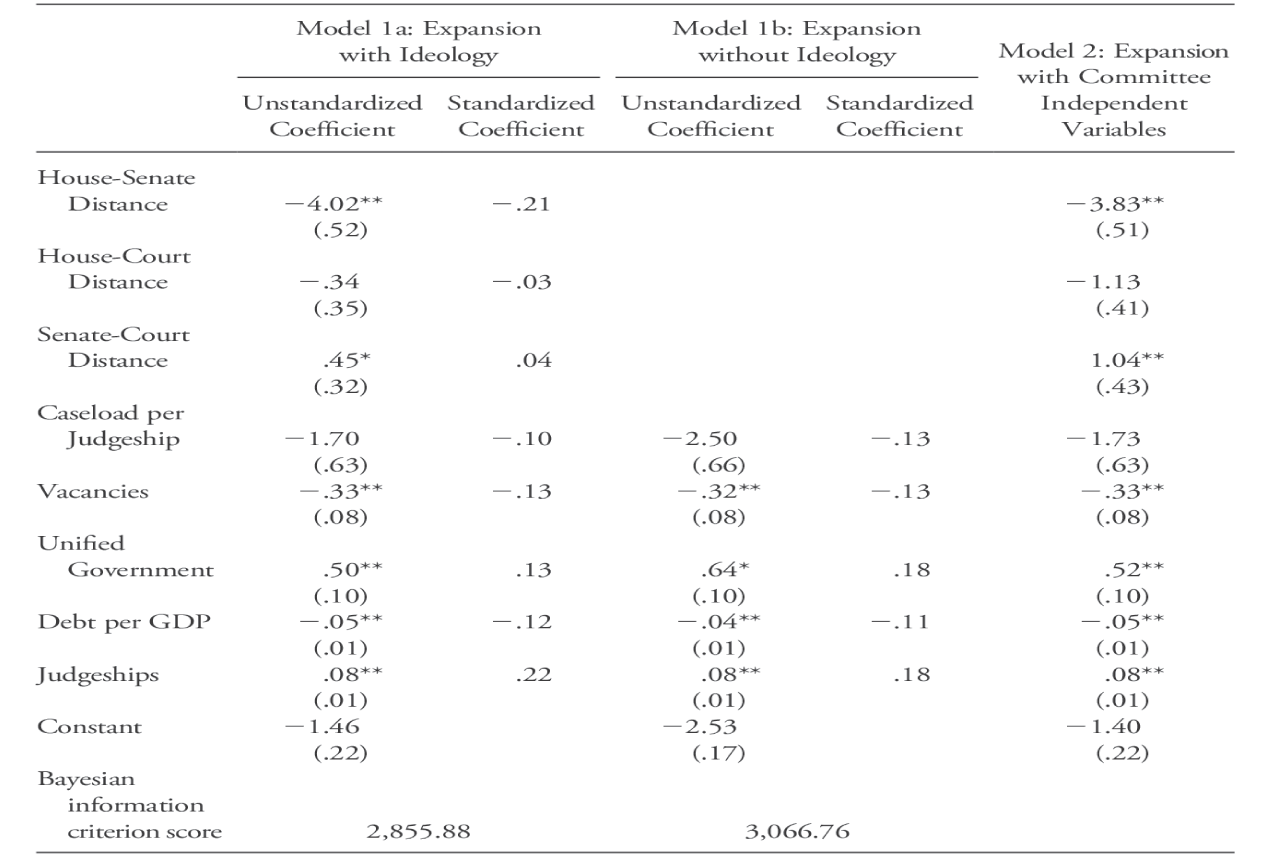
Note. The difference of 210.88 in the Bayesian information criterion scores between models 1a and 1b provides very strong support for the model incorporating ideological distances between key players in the expansion process over the model that does not incorporate ideological distance as an explanatory factor. Robust standard errors in parentheses. All one-tailed tests except Judgeships.
 .
* p ≤ .10.
** p ≤ .01.
Across all models, the House-Senate Distance variable is significant at the .01 p-level. The coefficient is moving in the expected negative direction, which follows from our theory that as the ideological distance between pivotal legislators in the House and Senate increases, the likelihood of an expansion will decrease. In other words, legislative veto players will most likely expand the federal judiciary when there is minimal intercameral ideological distance. If the distance between pivotal legislators in the House and Senate is large, there is little incentive for the House to enact expansion legislation because any nominee eventually confirmed by the Senate will likely be ideologically distant from the House median.
Furthermore, the Senate-Court Distance variable is statistically significant in both models 1a and 2, and its coefficient is moving in the anticipated positive direction, which indicates that as the ideological distance between pivotal senators and relevant courts increases, the likelihood of an expansion also increases. This finding confirms our expectation from hypothesis 2 that key players in the Senate take into consideration the ideological composition of a court when deciding whether to expand it and that they choose to do so when that court becomes less ideologically proximate. However, the corresponding hypothesis regarding ideological proximity between pivotal House members and federal courts is not confirmed, since the House-Court Distance variable is not statistically significant. It may be that Binder and Maltzman’s (Reference Binder and Forrest2002) observation regarding the tendency of legislators in the House to support expansion legislation for the purposes of credit claiming with their own constituents overrides their interest in drawing other federal courts closer to themselves ideologically.
Our control variables are also in general statistically significant and move in the expected directions. If the elected branches have an opportunity to place new judges on a court when there is a vacancy created through retirement or death, the likelihood of an expansion happening in the same court decreases, probably because the court’s median ideology can be changed at a lower political cost to all players involved. Courts that already have more total judgeships are also more likely to be expanded than smaller ones. Furthermore, the statistical significance of the Debt per GDP variable suggests the national economic environment plays some role in the judicial expansion process, since better economic conditions lead to a greater likelihood of expansions. The magnitude of this effect, however, is comparatively small, suggesting that national economic conditions are not the primary constraint on expanding the federal judiciary. Increased caseload, however, is not associated with any increased likelihood of expanding a given court. Finally, and as past literature posits, expansions are indeed more likely to occur under unified versus divided government.
We conduct supplementary analyses in order to more thoroughly evaluate our claim that ideological proximity between key players is the predominating explanation for expansions to the federal judiciary. These analyses include an additional specification of model 1a with standardized coefficients and a comparison of model fit between model 1a and one that excludes ideological explanatory variables (designated model 1b in table 2). Although both models suggest that expansions are more likely to occur under unified government, the standardized coefficient for our variable House-Senate Distance is nearly triple that for unified government in the model including both ideological and party-based explanatory variables, suggesting that the party-based explanation for judicial expansions errs in neglecting to consider ideological nuance. Moreover, a comparison of the Bayesian information criterion scores for model selection between our model versus a model that omits variables regarding intercameral and interinstitutional ideological proximity indicates strong support for the inclusion of ideological variables to explain the occurrence of judicial expansions.
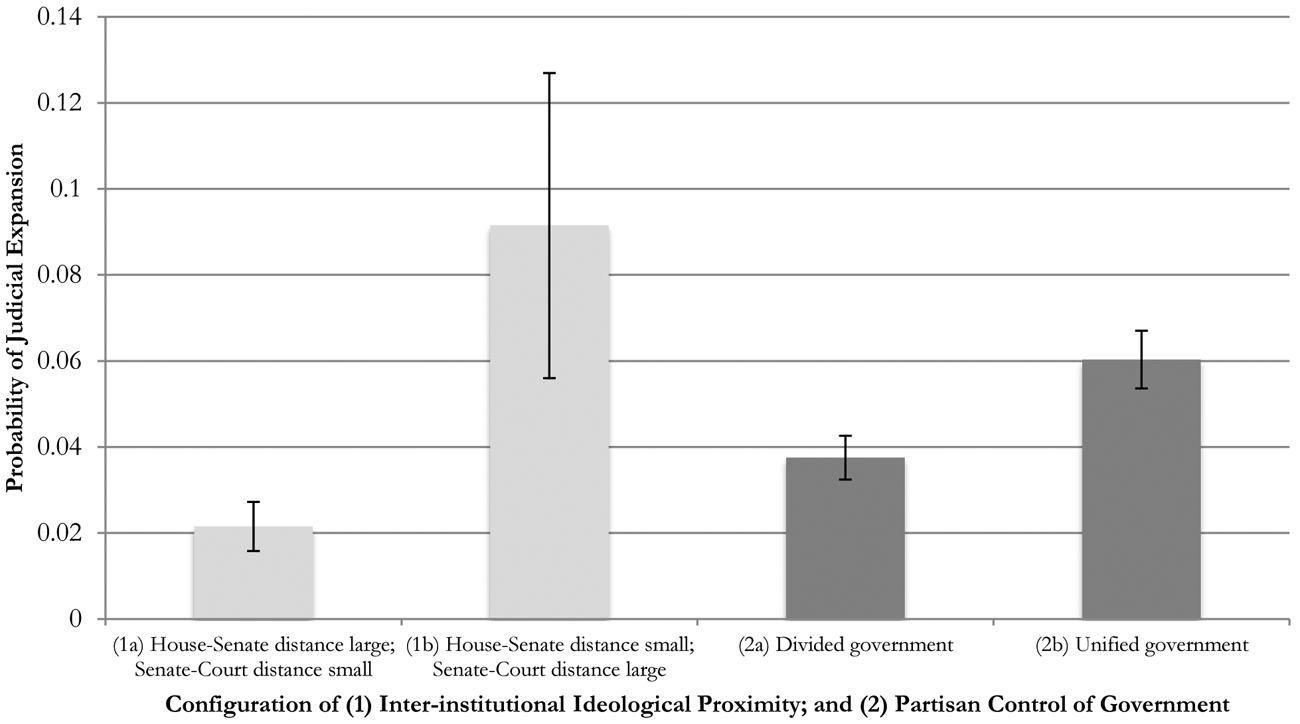
The impact of variation in both (1) ideological proximity between relevant actors in the expansion process and (2) partisan control of government is illustrated in figure 2. Here, in bars 1a and 1b, we present predicted probabilities based on model 1a for the dependent variable Expansion given variation in our statistically significant ideological proximity independent variables House-Senate Distance and Senate-Court Distance and, in bars 2a and 2b, given either divided or unified government. The estimated probability of an expansion to a federal court in a given year rises from 2.15% to 9.15% when House-Senate Distance moves from a relatively large to a relatively small value and when Senate-Court Distance moves from a relatively small value to a relatively large one.Footnote 13 This represents a seven-percentage-point increase in the estimated probability of a judicial expansion based on changes in ideological proximity. The change from divided to unified government, however, results in a change in the estimated probability of expansion from 3.75% to 6.03%, a 2.18-percentage-point increase. While both changes in Expansion are statistically discernible, the results indicate that the effect of a unified federal government is comparatively less influential than the effect of ideological proximity between certain key players in the expansion game.
Ideological versus party-based explanations for judicial expansions
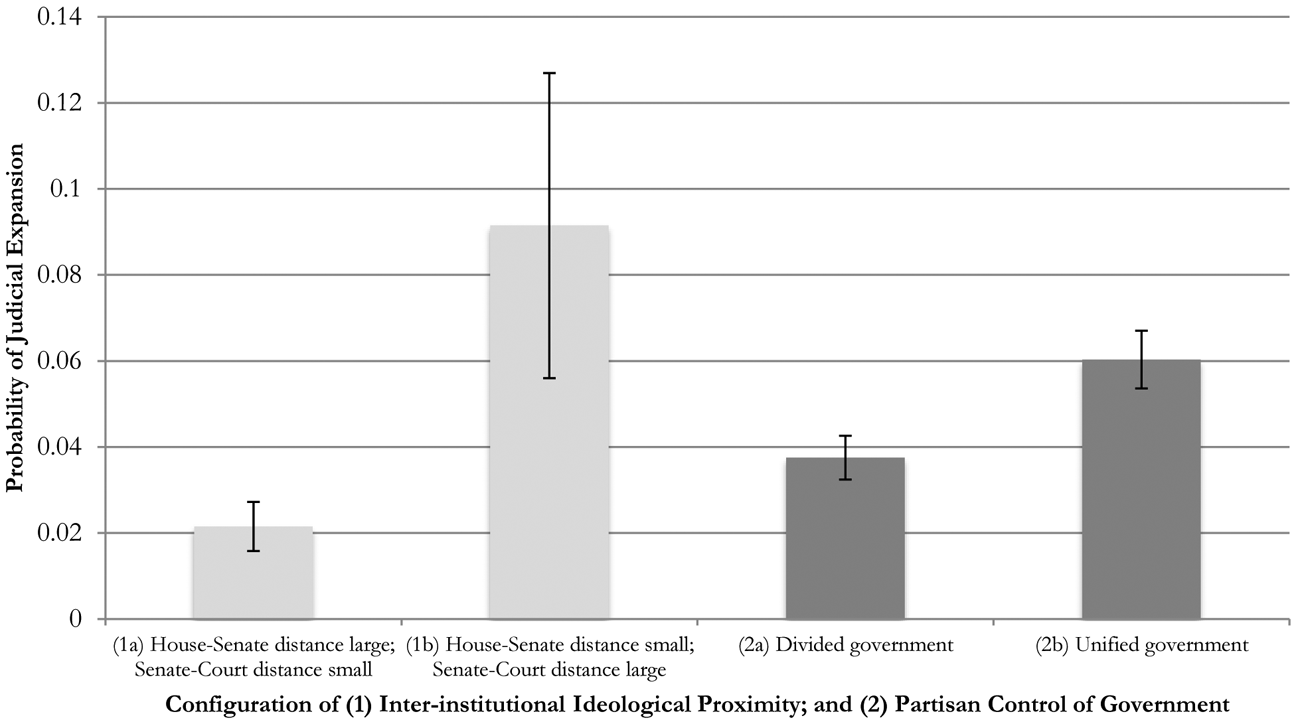
To summarize our main findings, both intercameral and interinstitutional ideological distance are highly predictive of whether Congress will enact legislation increasing the number of federal judgeships. While we do not argue that ideological distance is the only factor involved in explaining judicial expansions, our results persuasively suggest that ideological distance plays a significant role even when controlling for other political, economic, and administrative explanations, including the existence of unified government.Footnote 14
Conclusion
Mechanisms of interinstitutional political control by some branches of the federal government over others raise important questions about the separation of powers in operation. Because most studies of the federal judiciary focus on the Supreme Court, the appointment process for justices—which includes nomination by the president and confirmation by the Senate—has been the mechanism of political control most heavily concentrated on by scholars of judicial politics. In this article, by contrast, we examine the factors bearing on a different instrument of political influence, namely, the enactment by Congress of legislation expanding the federal judiciary. As a result, and because of our novel implementation of a court-year unit of analysis in examining the expansion process for each district and circuit court from 1937 to 2012, this article contributes to our understanding of interinstitutional relations between the legislative and judicial branches more broadly.
Our findings indicate that Congress elects to expand the federal judiciary given conditions of (1) ideological congruence between pivotal legislators in each chamber and (2) ideological divergence between pivotal senators and individual district or circuit courts. If legislators’ decisions to expand certain federal courts over others are predicated on their ideological proximity to the court in question, the theoretical ideal of an independent judiciary becomes fundamentally more complicated. Congress is granted a constitutional prerogative to make organizational decisions about the federal courts, but our findings suggest that legislators making such organizational choices nevertheless do not lose sight of advancing their ideological preferences or policy goals.
Previous attempts to explain when judicial expansions occur connect them to the elected branches’ efforts to influence the judiciary, but the justification they offer tends to center on partisanship and a narrative of unified versus divided government. This justification, however, does not account for expansions that occurred in times of divided government or the absence of expansions when unified government exists. Our results, alternatively, imply that legislators, specifically in the Senate, use the expansion process to control the supposedly independent judiciary by adding judgeships to courts that are ideologically less proximate from themselves. The possibility for political control by other branches of government through ostensibly administrative decisions suggests serious consequences and limitations for the existing conception of the judiciary as an independent actor in the policy-making process.
Appendix. Packing the Courts
Models A1.1 and A1.2: Replication of Primary Analysis with Nonbinary Dependent Variable
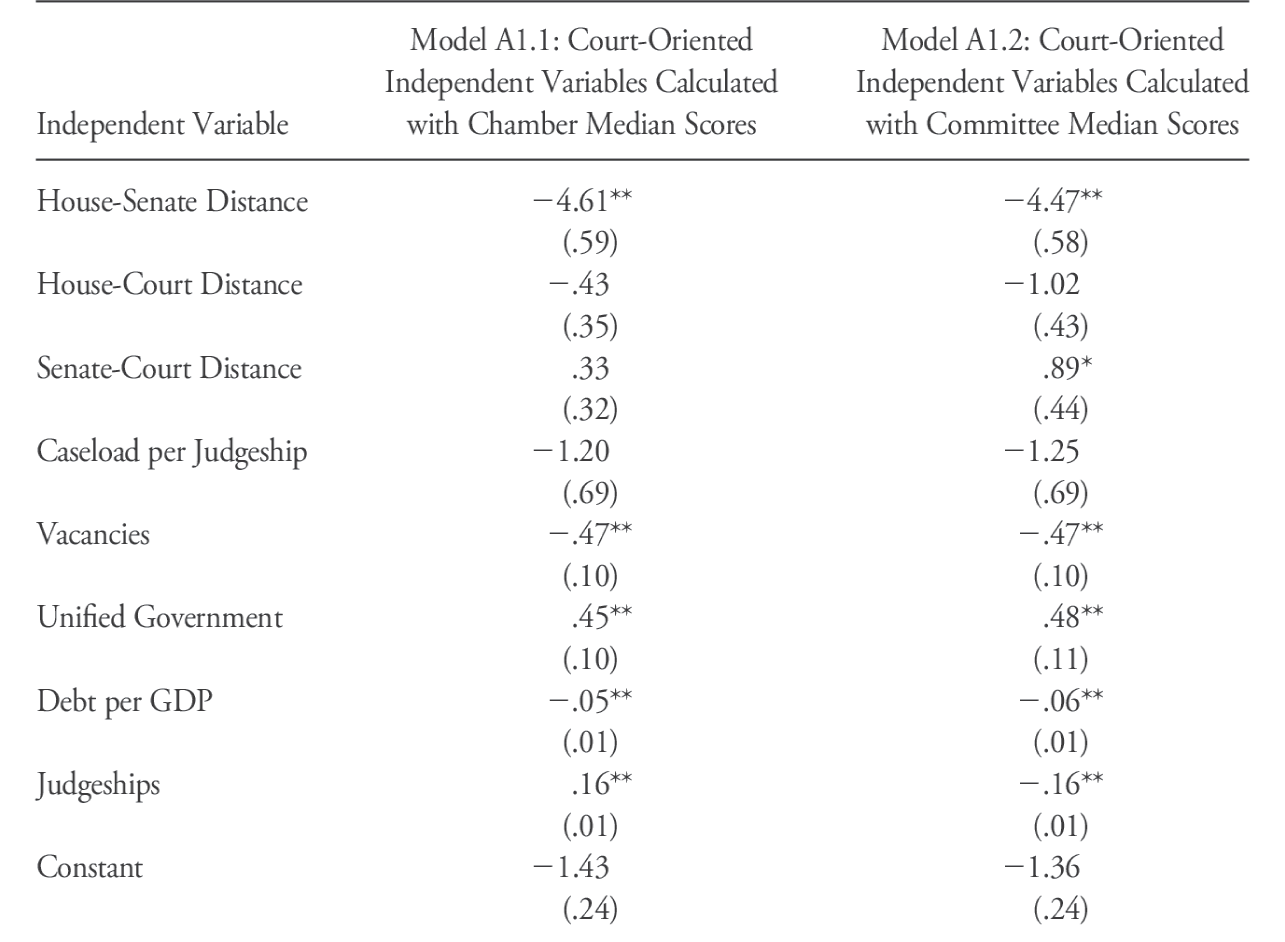
In footnote 6, we report that we estimated additional iterations of models 1a and 2 from the text in which the dependent variable is a count measure of the number of judgeships added to each district or circuit court in each year rather than a binary measure of whether an expansion occurred at all. In model A1.1, the court-oriented independent variables of interest are calculated using the chamber medians as in model 1a in the text; in model A1.2, those variables are calculated using the median from each chamber’s respective judiciary committee. Table A1 contains the results from models A1.1 and A1.2, which are both negative binomial regression models (appropriate for zero-inflated count data) in which the dependent variable is the Number of Expansions at the court-year level, the independent variables are the same as those presented in model 1a from the text, and the unit of analysis is the court-year. Negative binomial regression is appropriate for our analysis because of the distribution of Number of Expansions, whose value is 0 for 94.7% of court-years. As in models 1a and 2 from the text, we uniformly find statistically significant associations between House-Senate Distance and the alternative dependent variable employed here, Number of Expansions, and also find a statistically significant association between Senate-Court Distance and Number of Expansions in model A1.2. The direction and magnitude of the effects are comparable as well.
Ideological Distance and Court Expansions, 1937–2012, Using Nonbinary Dependent Variable Number of Expansions
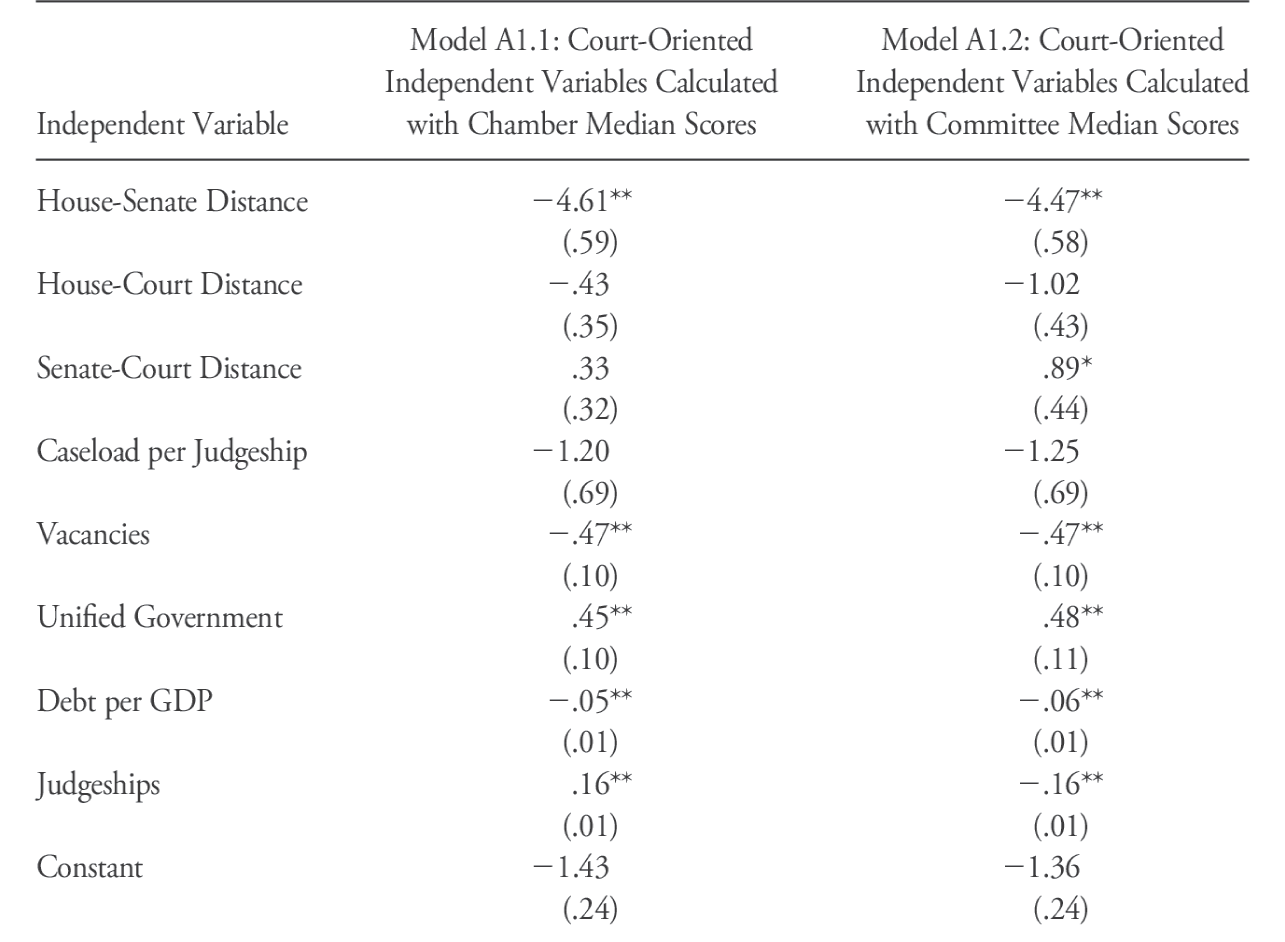
Note. Robust standard errors in parentheses. All one-tailed tests except Judgeships.
 .
* p ≤ .05.
** p ≤ .01.
Models A2.1, A2.2, A3.1, and A3.2: Replication of Primary Analysis with Caseload per Judgeship Variable Omitted
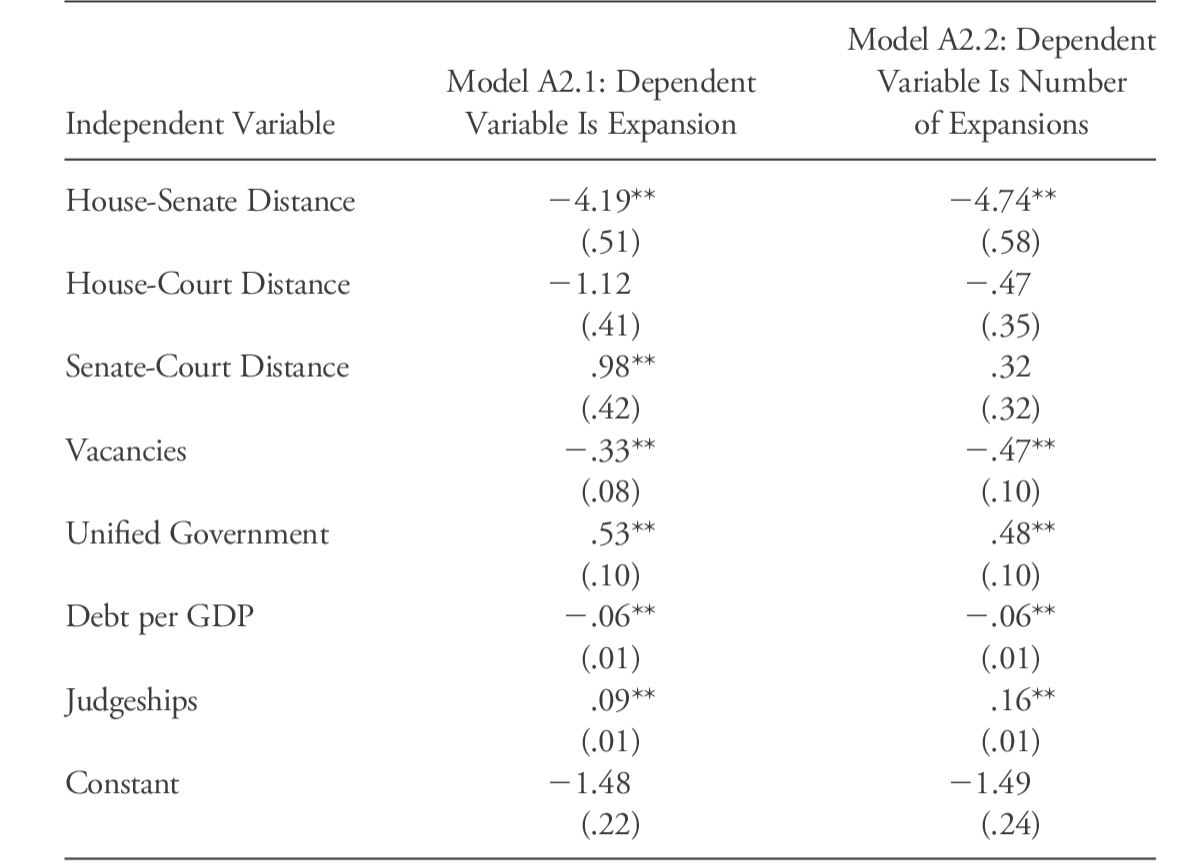
In footnote 10, we report that we estimated several additional iterations of the primary model included in the text in which we omit the independent variable Caseload per
Ideological Distance and Court Expansions, 1937–2012, Caseload per Judgeship Independent Variable Omitted
Note. Robust standard errors in parentheses. All one-tailed tests except Judgeships.
 .
* p ≤ .10.
* p ≤ .01.
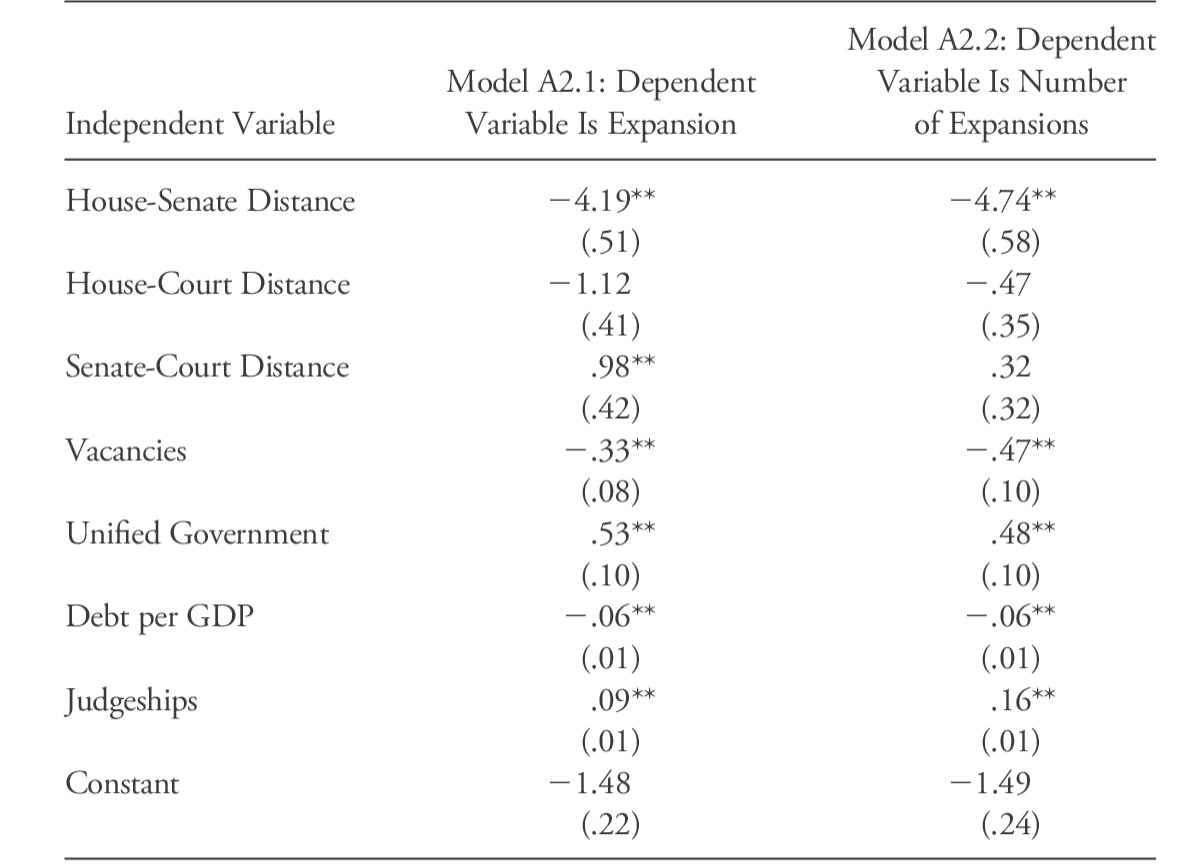
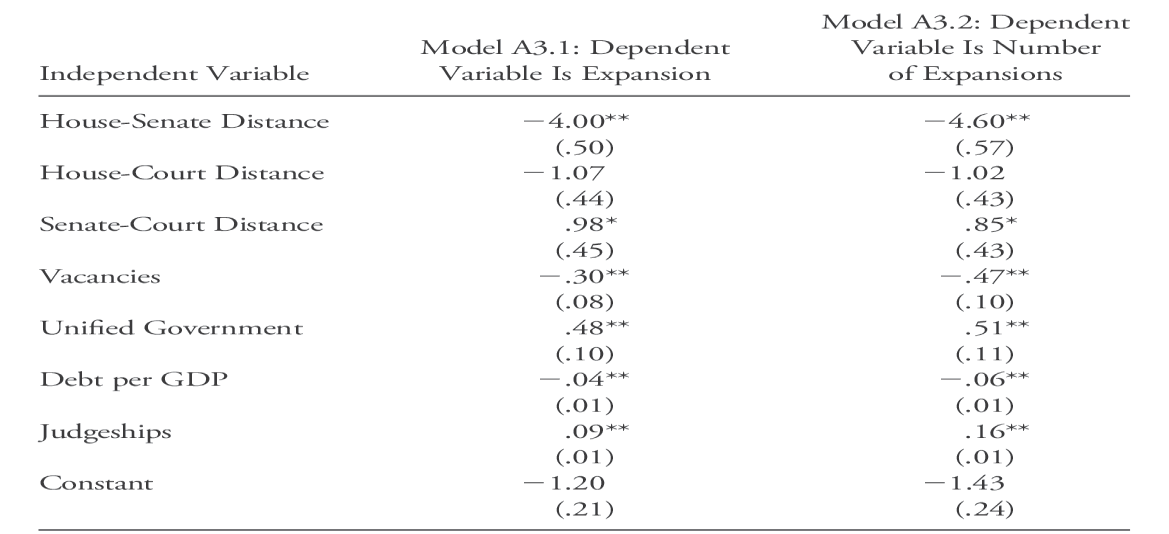
Judgeship, based on prior scholarship that suggests a magnified per capita caseload is not a sufficiently serious administrative burden to convince Congress to expand the federal judiciary. Tables A2 and A3 contain models in which the Caseload per Judgeship variable is omitted. The unit of analysis in all four models is the court-year.
In table A2, the independent variables of interest are those from models 1a and A1.1. In model A2.1, the dependent variable is the binary variable Expansion, while in model A2.2 the dependent variable is Number of Expansions, which takes on nonnegative integer values and is a measure of the number of seats added to each federal district or circuit court in each year.
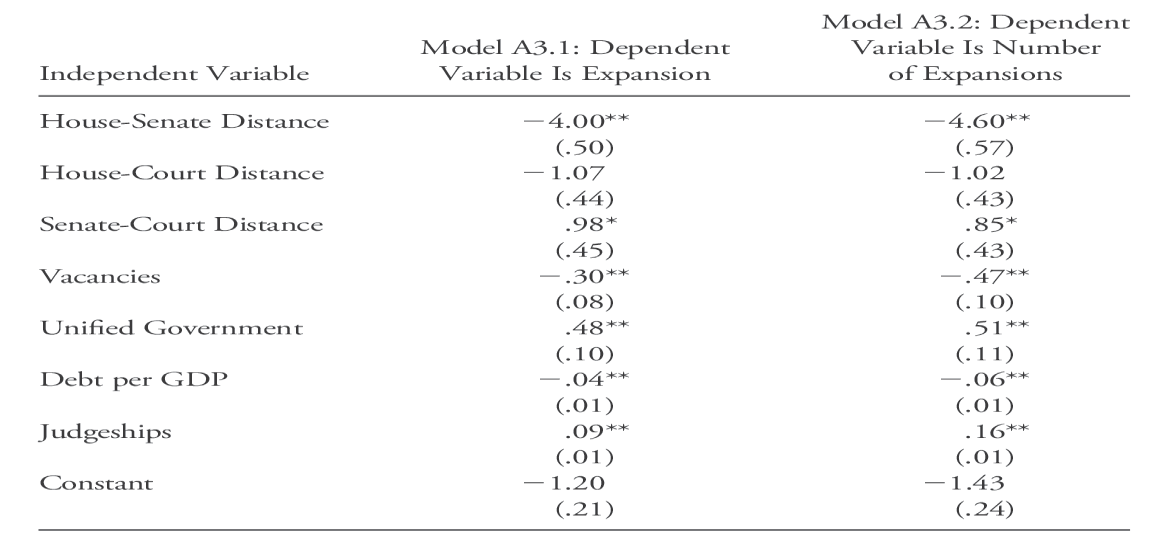
In table A3, the independent variables of interest are those presented in models 2 and A1.2 (in which the court-based independent variables are measured as ideological distance between individual district or circuit courts and relevant congressional committees). In model A3.1, the dependent variable is the binary variable Expansion, while in model A3.2 the dependent variable is Number of Expansions. In models A2.1 and A3.1, we estimate logistic regression models, while in models A2.2 and A3.2 we estimate negative binomial regression models.
Ideological Distance and Court Expansions, 1937–2012, Caseload per Judgeship Independent Variable Omitted, Committee-Calculated Independent Variables of Interest
Note. Robust standard errors in parentheses. All one-tailed tests except Judgeships.
 .
* p ≤ .05.
** p ≤ .01.
Generally, across tables A2 and A3, the results indicate statistically significant associations between House-Senate Distance and Senate-Court Distance and each version of the dependent variable. Both the direction and magnitude of the coefficients are similar to those presented elsewhere in the article.
Models A4.1, A4.2, A5.1, and A5.2: Replication of Primary Analysis with Restricted Samples to Consider Expansion of Federal District Courts and Federal Circuit Courts Separately
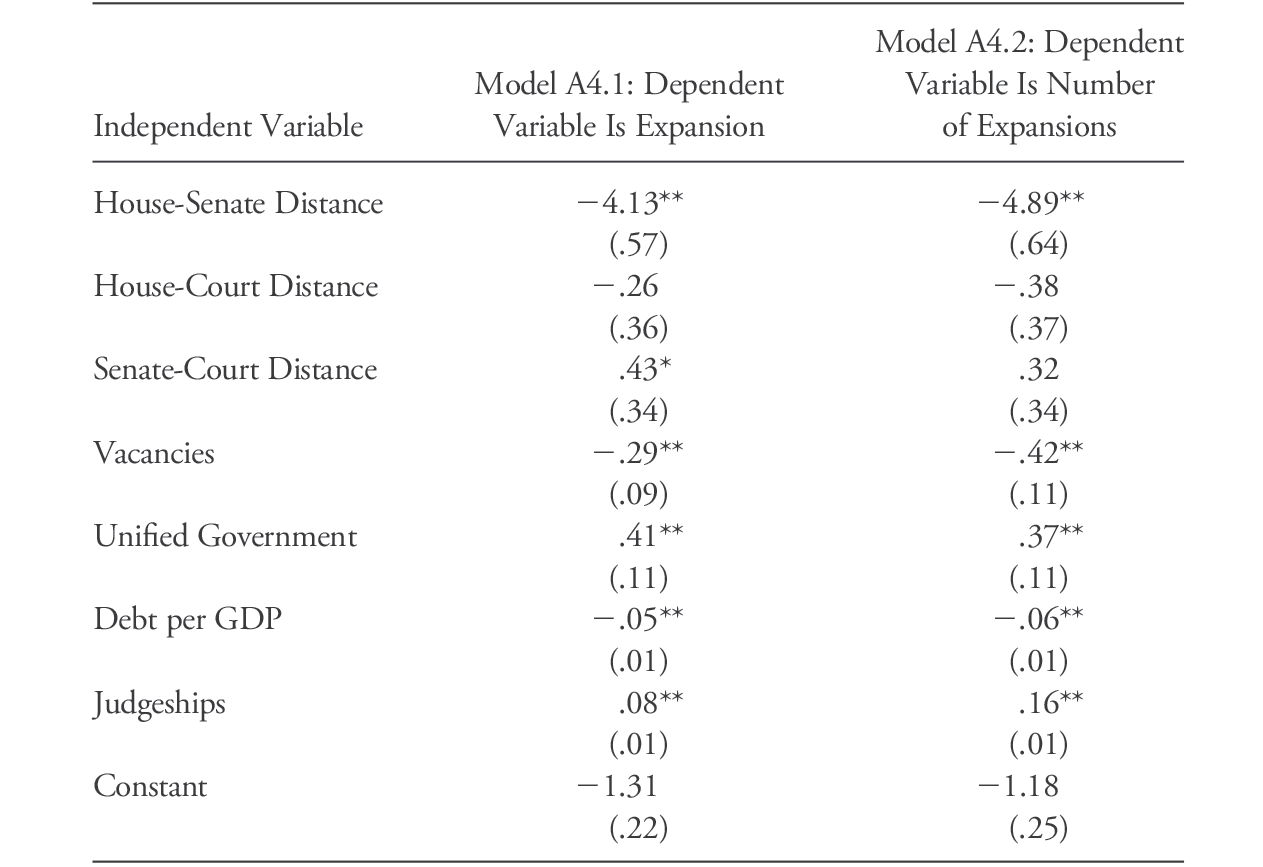
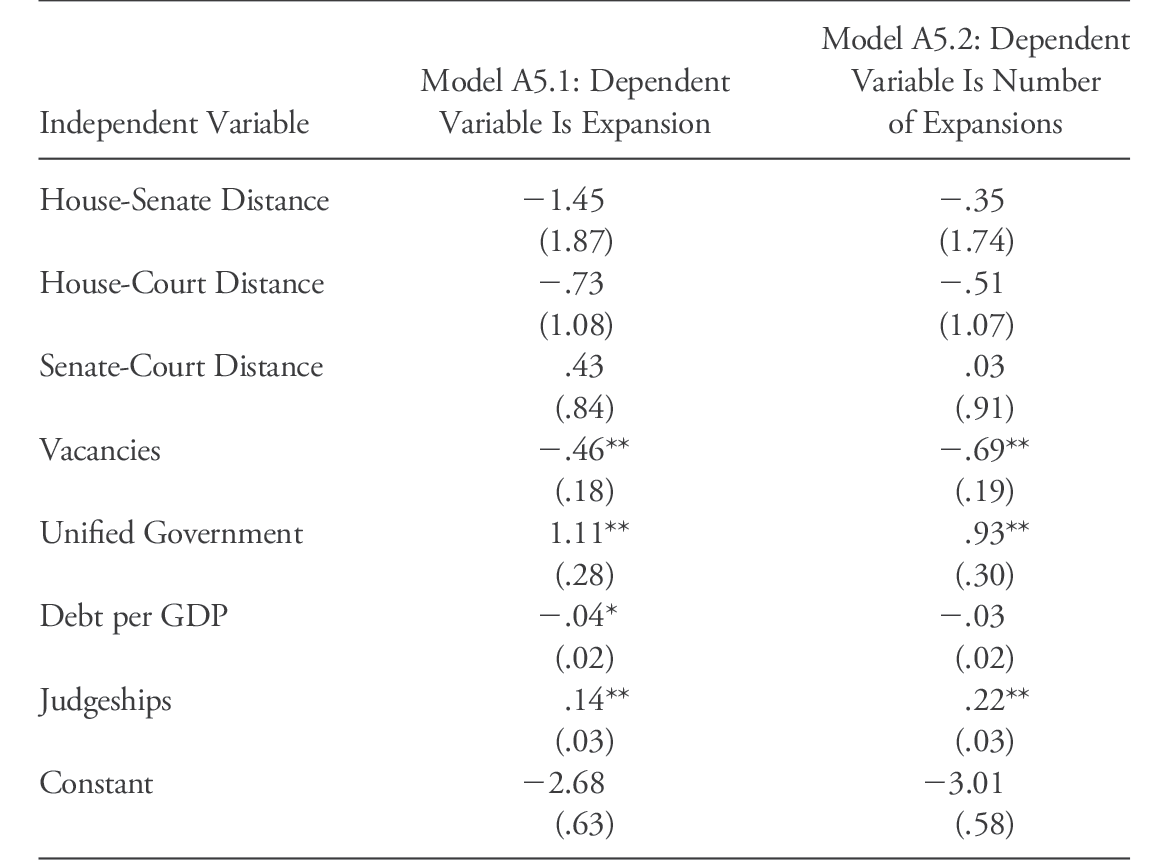
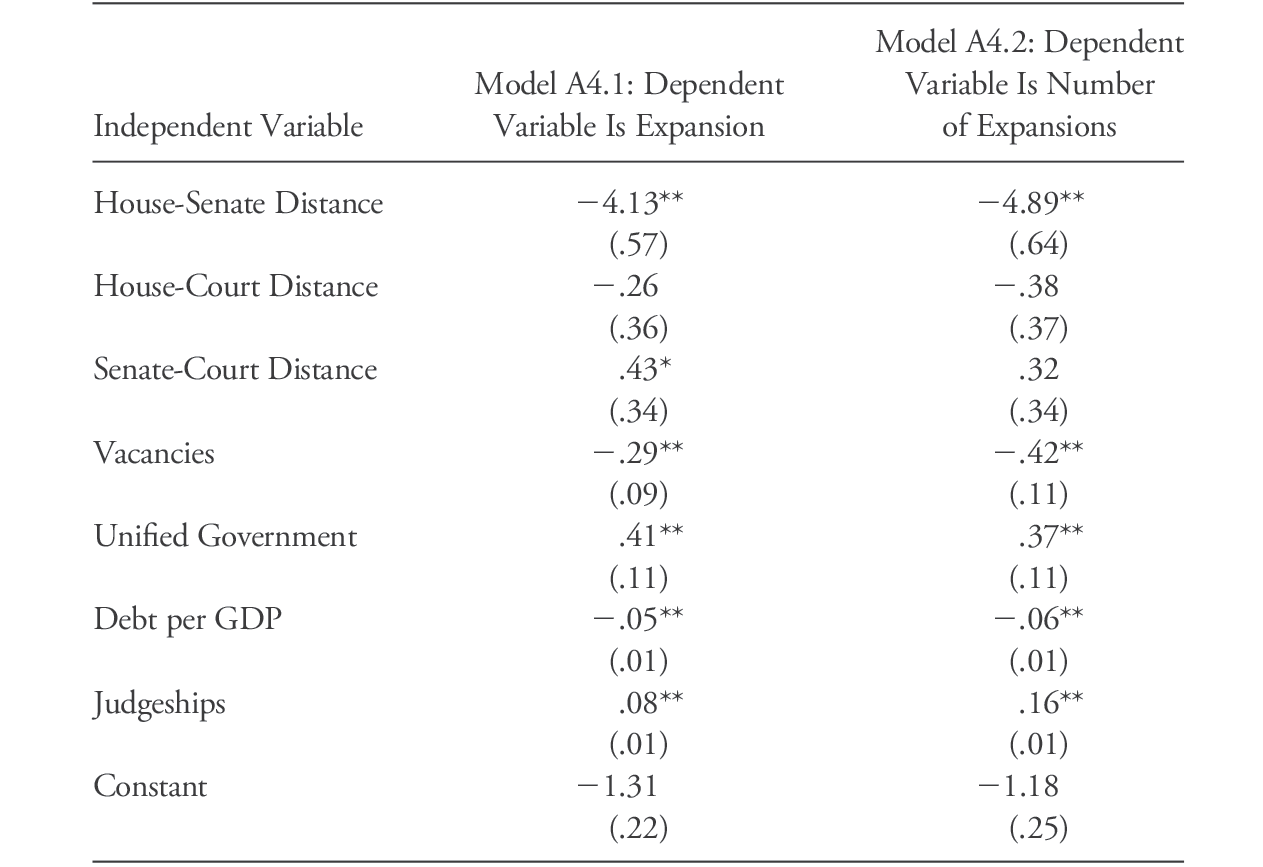
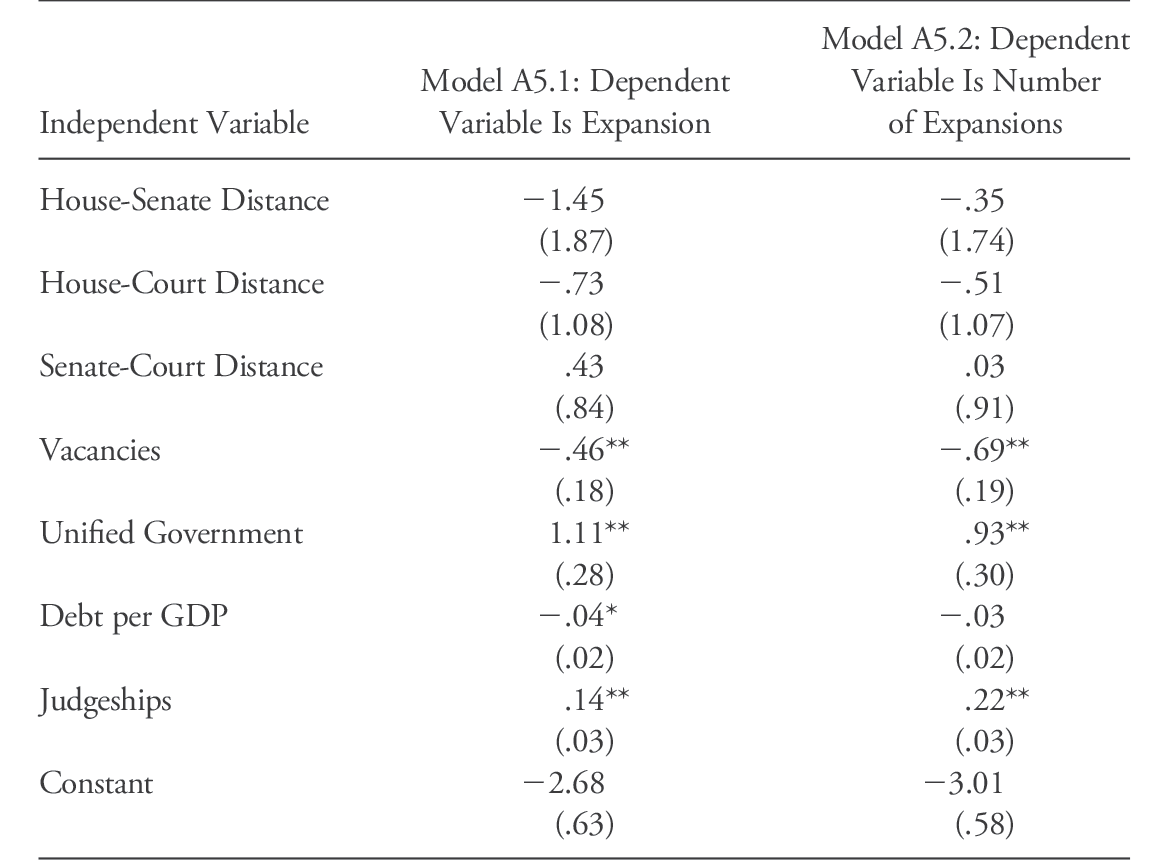
In footnote 12, we report that we include several additional versions of model 1a from the article’s main text in which we estimate the likelihood of judicial expansions for district and circuit courts separately, motivated by the possibility that the determinants of legislative choices to expand individual district or circuit courts differ across those two levels of the federal judicial hierarchy. Tables A4 and A5 contain models in which our sample is split into only district courts (A4) and only circuit courts (A5). The unit of analysis in all models is the court-year.
Ideological Distance and Court Expansions, 1937–2012, District Courts Only
Note. Robust standard errors in parentheses. All one-tailed tests except Judgeships.
 .
* p ≤ .10.
** p ≤ .01.
Ideological Distance and Court Expansions, 1937–2012, Circuit Courts Only
Note. Robust standard errors in parentheses. All one-tailed tests except Judgeships.
 .
* p ≤ .10.
** p ≤ .01.
In table A4, there are two models, in both of which the sample is restricted to only federal district courts: (1) model A4.1, a logistic regression model in which the dependent variable is the binary variable Expansion, and (2) model A4.2, a negative binomial regression model in which the dependent variable is the count measure Number of Expansions. In both models, the independent variables are those from model 1a in the text.
In table A5, there are also two models, in both of which the sample is restricted to only federal circuit courts: (1) model A5.1, a logistic regression model in which the dependent variable is the binary variable Expansion, and (2) model A5.2, a negative binomial regression model in which the dependent variable is the count measure Number of Expansions. In both models, the independent variables are those from model 1a in the text.
In the ancillary models presented in table A4, the direction and magnitude of the coefficients on the independent variables of interest are broadly comparable to those presented elsewhere in the article. We do not report comparable results in table A5, likely due to the reduced statistical power involved in limiting the sample to circuit courts.
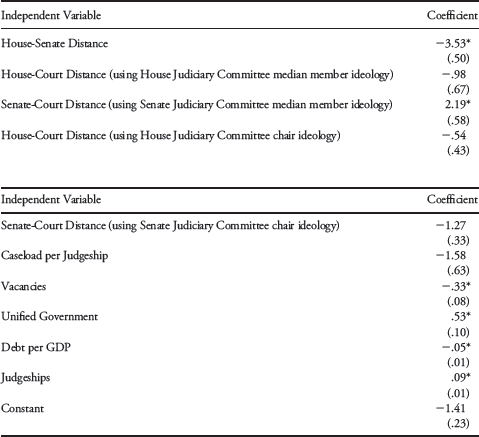
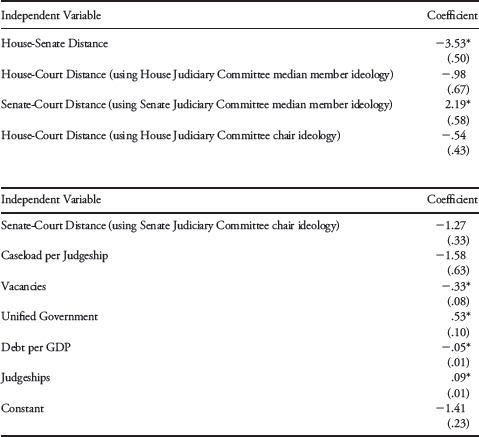
Model A6: Replication of Primary Analysis with Committee Chair Ideology and Committee Median Member Ideology as Independent Variables of Interest
In footnote 8, we report that we estimated the primary model with additional independent variables calculated by taking the absolute value of the difference between the ideology of the House and Senate judiciary committee chairs, respectively, and those of each district or circuit court included in our analysis.
In model A6, the coefficients on our three original independent variables, for which court-chamber distance is calculated using the committee median member’s preference, remain of a comparable magnitude to the models presented in the main text, and the two variables that were statistically significant in our primary results, House-Senate Distance and Senate-Court Distance, using the Senate judiciary committee median member’s ideology, are statistically significant in this model as well. The two chamber-court distance measures calculated using the ideology of the respective judiciary committee chairs, however, fail to attain statistical significance.
Ideological Distance and Number of Court Expansions, 1937–2012, Using Committee Chair Ideology to Compute Additional Court-Oriented Independent Variables
Note. Robust standard errors in parentheses. All one-tailed tests except Judgeships.
 .
* p ≤ .01.