INTRODUCTION
Heterosis breeding is an important method for plant breeders to improve desirable quantitative and qualitative traits (Srivastava Reference Srivastava2000). The modern concept of heterosis (hybrid vigour) in crops was defined by Shull in 1908 (Randhawa & Singh Reference Randhawa, Singh, Constable and Forester1994). Since then, many plant breeders have documented intraspecific and interspecific heterosis in cotton (Wang et al. Reference Wang, Dutt, Ni, Zhao, Nirania, Khadi, Katageri, Patil, Vamadevaiah, Udikeri and Eshanna2004; Wu et al. Reference Wu, Yin, Guo, Zhu and Zhang2004; Dong et al. Reference Dong, Wu, Jin and Huang2006, Reference Dong, Li, Tang, Li and Zhang2007; Zhu et al. Reference Zhu, Liu and Wang2008; Kantartzi & Roupakias Reference Kantartzi and Roupakias2010; Geddam et al. Reference Geddam, Khadi, Mogali, Patil, Katageri, Nadaf and Patil2011) and found that interspecific crosses displayed more heterosis than intraspecific heterosis, thus having more commercial potential (Baloch et al. Reference Baloch, Lakho and Soomro1993; Zhang et al. Reference Zhang, Wang, Jiang, Hua, Zhang and Dutt2007). The availability of cytoplasmic male sterility (CMS) and fertility restorer parents has facilitated high-yield hybrid seed production throughout the world (Wang et al. Reference Wang, Dutt, Ni, Zhao, Nirania, Khadi, Katageri, Patil, Vamadevaiah, Udikeri and Eshanna2004; Zhang et al. Reference Zhang, Wang, Jiang, Hua, Zhang and Dutt2007; Zhu et al. Reference Zhu, Liu and Wang2008). Heterosis in white-fibred cotton has been extensively studied, both physiologically and genetically (Hao et al. Reference Hao, Yu, Dong, Fan, Ma, Song and Yu2008; Tokatlidis et al. Reference Tokatlidis, Tsikrikoni, Tsialtas, Lithourgidis and Bebeli2008, Reference Tokatlidis, Tsikrikoni, Lithourgidis, Tsialtas and Tzantarmas2011; Gerardeaux et al. Reference Gerardeaux, Jordan-Meille and Pellerin2009); however, naturally coloured cotton has not been so well studied. Today, the demand for textiles manufactured from naturally pigmented cotton is increasing, since a decrease in the use of chemicals for dyeing can be helpful in reducing environmental pollution (Vreeland Reference Vreeland1987; Elesini et al. Reference Elesini, Cuden and Richards2002). However, cultivation of coloured cotton has not accelerated accordingly (Dutt et al. Reference Dutt, Wang, Zhu and Li2004). The fibre quality and yield of coloured cotton are inherently inferior to white cotton fibre (Murthy Reference Murthy2001; Wang & Li Reference Wang and Li2002a; Li et al. Reference Li, Wang, Zhao and Dutt2004; Hua et al. Reference Hua, Yuan, Shamsi, Zhao, Zhang, Liu, Wen, Wang and Zhang2009; Yuan et al. Reference Yuan, Hua, Ni, Li, Wen, Shao, Zhang, Zhu and Wang2010), so cotton breeders continue to be engaged in producing coloured cotton genotypes with high yield and good fibre quality using heterosis breeding (Basu Reference Basu1996). Previously, interspecific as well as intraspecific heterosis has been reported in coloured cotton with an average increase of 18% in agronomic- and yield-related traits (Meredith & Bridge Reference Meredith and Bridge1972; Dutt et al. Reference Dutt, Wang, Zhu and Li2004). But the amount of heterosis for fibre quality traits was very low, ranging from 0 to 0·02 (Wu et al. Reference Wu, Yin, Guo, Zhu and Zhang2004), indicating that fibre quality is probably attributed to the modulation of different metabolic pathways involved in cellulose synthesis during the course of fibre development.
Cotton fibre contains >0·9 cellulose with similar basic mechanisms of cellulose synthesis in different types and species of cotton (Haigler et al. Reference Haigler, Ivanova-Datcheva, Hogan, Salnikov, Hwang, Martin and Delmer2001). Cellulose biosynthesis is complex and controlled on many levels, such as genetics, biophysics, cell biology, biochemistry and environmental interaction (Haigler et al. Reference Haigler, Singh, Wang, Zhang and Paterson2009). Many researchers have documented the relationships of cellulose, carbohydrates, flavonoids and mineral elements with fibre yield and its quality (Dutt et al. Reference Dutt, Wang, Zhu and Li2004; Hua et al. Reference Hua, Wang, Yuan, Shao, Zhao, Zhu and Jiang2007, Reference Hua, Yuan, Shamsi, Zhao, Zhang, Liu, Wen, Wang and Zhang2009; Yuan et al. Reference Yuan, Hua, Ni, Li, Wen, Shao, Zhang, Zhu and Wang2010). Among these organic compounds, carbohydrates are considered as key sources of energy that act as important osmotic regulators (Martin & Haigler Reference Martin and Haigler2004). The quantity of carbohydrates varies not only among different types of cotton fibres but also at different fibre developmental stages, thus controlling the cotton fibre quality (Gipson Reference Gipson, Mauney and Stewart1986; Hua et al. Reference Hua, Wang, Yuan, Shao, Zhao, Zhu and Jiang2007, Reference Hua, Yuan, Shamsi, Zhao, Zhang, Liu, Wen, Wang and Zhang2009). Flavonoids are another important class of organic compounds involved in the pigmentation of tissues, pollen fertility and regulation of the hormones (Li et al. Reference Li, Ou-Lee, Raba, Amundson and Last1993; Stapleton & Walbot Reference Stapleton and Walbot1994; Shirley Reference Shirley1996). In coloured cotton fibre, this metabolite has negative associations with cellulose and fibre quality because both cellulose and flavonoids share the same substrates and energy during their synthesis (Wang & Li Reference Wang and Li2002b, Reference Wang and Lic; Dutt et al. Reference Dutt, Wang, Zhu and Li2004; Li et al. Reference Li, Wang, Zhao and Dutt2004; Zhao & Wang Reference Zhao and Wang2005). Beside carbohydrates and flavonoids, the pH of the developing fibre also plays a key role in determining the fibre colour and quality. Low pH in the developing fibre favours fibre elongation and secondary wall thickness (Hondo et al. Reference Hondo, Yoshida, Nakagawa, Kawai, Tamura and Goto1992; Dutt et al. Reference Dutt, Wang, Zhu and Li2004), and vice versa.
The objective of the current study was to explore the extent of heterosis for fibre quality, yield and yield components, and to characterize the relationship between different biochemical and fibre quality attributes at different fibre developmental stages in interspecific, intraspecific coloured cotton hybrids and their parents.
MATERIALS AND METHODS
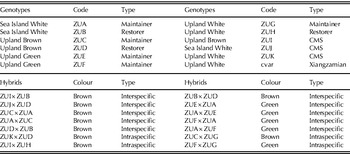
The dynamics of heterosis for fibre yield, yield components and quality was investigated using a set of 10 interspecific and 4 intraspecific hybrids, and 11 parental lines (Table 1), together with a commercial white cotton hybrid (Xiangzamian) used as a control (CK). The study was conducted at the College of Agriculture and Biotechnology, Zhejiang University, Hangzhou China during 2008/9 (30°15′N, 120°10′E; 18 m a.s.l.). The hybrid seeds were produced in 2007 and grown in 2008 and 2009 along with their parents to compare the extent of heterosis. Then, based on their performance during 2008, two interspecific (ZUC × ZUA and ZUF × ZUA), two intraspecific hybrids (ZUC × ZUG and ZUF × ZUG) and their parents (ZUC, ZUA, ZUF and ZUG) were selected in 2009, to evaluate the role of different biochemical properties (pH value, cellulose, flavonoid, total sugar, sucrose, fructose and glucose) during the course of fibre development.
Plant genotypes used in present study

Experimental design
The seeds of all interspecific and intraspecific coloured cotton hybrids and their parents were sown in April 2008 and 2009 in polythene bags (40 mm diameter × 100 mm high) filled with nutrient-rich soil and placed on an already watered seed bed. The soil was taken directly from the field and placed in the polyethylene bags one week before manual sowing. Each polythene bag contained 2–3 seeds at a depth of 15 mm and covered by a thin layer of fine soil. After sowing, the bags were covered with transparent plastic film to keep the soil moist. After germination (3–5 days), the bags were uncovered during the day but re-covered at night to protect the young seedlings from low temperatures. The surface of the soil was kept moist by watering the seed bed every 2 days. Only one seedling was allowed to grow in each polythene bag to ensure healthy seedlings before transplanting into the field at 15 days old. Seedlings were transplanted into field having clay-loam soil, pH 6·5 and organic matter content of 25·4 g/kg in May. Nitrogen fertilizer (0·12 t/ha) was applied to the experimental plots before transplanting. The experiment was laid out in a randomized complete block design with three replications. Each plot (10·5 m2) consisted of four rows, which were 5 m long with row to row and plant to plant distances of 700 and 400 mm, respectively. The crop density was c. 30 000 plants/ha.
Sampling for yield, yield components and quality attributes
At maturity, 30 healthy plants of each F1 hybrid were selected from each plot on which to record the data on agronomic, yield, yield components and quality attributes. These attributes were the number of sympodial branches, plant height (mm), aborted seed proportion, dry weight per plant (g), number of bolls per plant, boll weight (g), lint proportion, seed cotton yield (t/ha) and lint yield (t/ha). Fibre quality traits were measured using a high volume instrument (HVI). The tensile strength of fibres is determined as the force required to break a bundle of cotton fibres, expressed as (cN/tex). The Tex is a measure of the linear mass density of fibres and is defined as the mass in grams per 1000 m. Fibre fineness is a measure of the maturity and diameter of cotton fibres. A constant mass (2·34 g) of cotton fibres is compressed into a space of known volume and air permeability measurements of this compressed sample are taken. These are termed Micronaire values (mic). The fibre uniformity index provides a relative measure of the uniformity of the length of cotton fibres. It is calculated as the ratio of the average length of all fibres to the average length of the longest 0·50 of the fibres in the sample. Fibre length uniformity affects yarn strength and the efficiency of the spinning process. High-quality cotton has a score of 0·83–0·85. Cotton with a low uniformity index (below 0·79) is likely to have a high proportion of short fibres, will be difficult to process and is likely to produce low-quality yarn. Fibre elongation is measured as the proportional extension of the fibres before a break occurs.
Sampling and analysis for biochemical attributes
The flowers of two interspecific hybrids (ZUC × ZUA (brown) and ZUF × ZUA (green)) two intraspecific hybrids (ZUC × ZUG (brown) and ZUF × ZUG (green)) and their parents were tagged at the day of anthesis. Developing bolls were harvested from 0 to 50 days post-anthesis (DPA) with an interval of 5 days. Then fibre was separated from the seeds, kept in liquid nitrogen and stored at −80 °C for further analysis.
Total flavonoids were extracted following the method described by Dutt et al. (Reference Dutt, Wang, Zhu and Li2004) and quantified using rutin (quercetin-3-O-rutinoside; Sigma Aldrich, Cat No. 5143) as a standard curve (Wang et al. Reference Wang, Xu and Wei1999). For quantification of cellulose in developing cotton fibre, samples were collected from 15 to 50 DPA at 5-day intervals, digested in an acetic–nitric reagent (acetic acid: nitric acid: water = 8: 1: 2 v/v) and measured by following the procedure of Updegraff (Reference Updegraff1969). The pH value of harvested samples was determined according to Dutt et al. (Reference Dutt, Wang, Zhu and Li2004), while the amount of soluble sugars and glucose were calculated using the methodology of Dubois et al. (Reference Dubois, Gilles, Hamilton, Rebers and Smith1956). However, concentration of fructose and sucrose was measured using the method developed by Hendrix (Reference Hendrix1993).
Data analysis
The data were processed using SAS 9·1 and the graphs were generated using Microsoft Excel. Useful heterosis was worked out as the proportional difference in performance of hybrids from the control (cvar Xiangzamian):
 $${\rm Useful}\,{\rm heterosis} = \left[ {{\rm F}_{\rm 1} -{\rm CK}} \right]/{\rm CK}$$
The significance of the heterosis was determined using a t test. Negative values for useful heterosis imply that the value of the trait being analysed is lower than that of the control variety.
RESULTS
Mean performance and heterosis
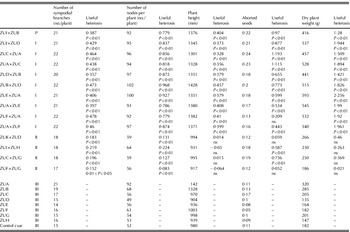
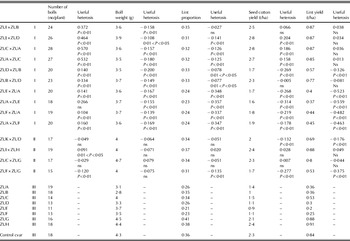
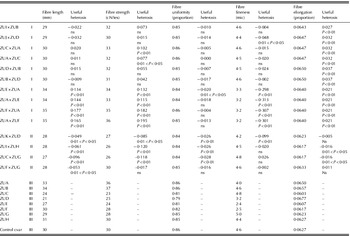
The interspecific F1 hybrids were significantly better than intraspecific hybrids for agronomic traits, boll numbers and fibre quality attributes. Maximum mean performance with highest magnitude of useful heterosis for number of sympodial branches (0·473), number of nodes per plant (0·968) and plant height (0·457) was observed in interspecific brown cotton hybrids ZUB × ZUD (Table 2). Among the intraspecific crosses, the brown cotton hybrids (ZUI × ZUH) showed the best performance, with positive and highly significant useful heterosis for the same parameters but still much lower than for interspecific hybrids (Table 2). Similarly for yield components, the brown interspecific hybrids ZUC × ZUA and ZUJ × ZUD exhibited positive and highly significant amount of useful heterosis for number of bolls (0·57) and seed cotton yield (0·204) (Table 3). However, useful heterosis for boll weight was negative in both inter- and intraspecific hybrids (Table 3). For quality attributes, interspecific green hybrids ZUF × ZUA and ZUA × ZUF showed positive, highly significant amounts of useful heterosis for fibre length (0·177) and fibre strength (0·195), whereas intraspecific hybrids exhibited negative and significant amount of useful heterosis for the same parameters, except ZUF × ZUG (Table 4).
Performance of cotton lines and heterosis for agronomic attributes in 2008 and 2009 in Hangzhou, China

* I = Interspecific crosses, II = Intraspecific crosses, III = Parents.
ns = not significant.
Performance of cotton lines and heterosis for yield and yield components in 2008 and 2009 in Hangzhou, China

ns: not significant.
Performance of cotton lines and heterosis for fibre quality traits in 2008 and 2009 in Hangzhou, China

ns: not significant.
Synthesis of flavonoids, cellulose and pH of fibre
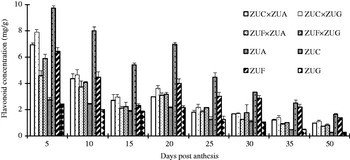
Synthesis of flavonoids, cellulose and fibre pH at different fibre developmental stages, i.e. 5–50 DPA, was measured in interspecific (ZUC × ZUA and ZUF × ZUA) and intraspecific hybrids (ZUC × ZUG and ZUF × ZUG) and their parents (ZUA, ZUC, ZUF and ZUG), as shown in Table 5. There were significant differences in flavonoid concentration among the parents and hybrids: the maximum amount of flavonoids was found at 5 DPA decreased continuously during the course of fibre development in both hybrids and their parents.
Correlation coefficient (r) between cotton fibre quality and physiological attributes

ns: not significant.
Among parents, the amount of flavonoids was highest in upland brown cotton (ZUC), followed by upland green (ZUF) cotton. Similarly, the greatest increase in flavonoid content in comparison with the mean performance of their parents at all fibre developmental stages was observed in the intraspecific green hybrid (ZUF × ZUG), while the lowest was found in the interspecific green hybrid (ZUF × ZUA) (Fig. 1).
Dynamics of flavonoid concentration at different cotton fibre developmental stages (5, 10, 15, 20, 25, 30, 35 and 50) in interspecific hybrids (ZUC × ZUA and ZUF × ZUA), intraspecific hybrids (ZUC × ZUG and ZUF × ZUG) and their parents (ZUC, ZUA, ZUF and ZUG). Bars in the histogram are standard errors.

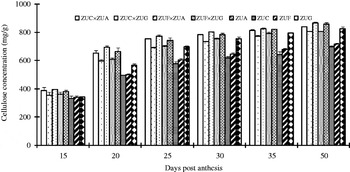
The synthesis and accumulation of cellulose were accelerated along with the fibre developmental stages (15–50 DPA) with a large increase from 15 to 20 DPA in hybrids and their parents. However, no significant differences were observed between hybrids and their respective parents at 15 DPA. Among the parents, Sea Island white cotton (ZUA) exhibited the maximum cellulose content during the entire course of fibre maturation, followed by upland white cotton (ZUG). The amount of cellulose was similar in hybrids derived from same species but significant differences were observed between interspecific (ZUC × ZUA and ZUF × ZUA) and intraspecific (ZUC × ZUG and ZUF × ZUG) hybrids, with distinct gains in interspecific hybrids from 20 to 50 DPA (Fig. 2).
Dynamics of cellulose concentration at different cotton fibre developmental stages (15, 20, 25, 30, 35 and 50) in interspecific hybrids (ZUC × ZUA and ZUF × ZUA), intraspecific hybrids (ZUC × ZUG and ZUF × ZUG) and their parents (ZUC, ZUA, ZUF and ZUG). Bars in the histogram are standard errors.

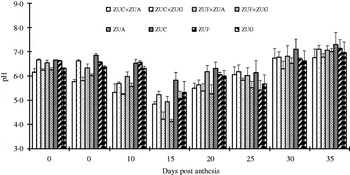
The results of fibre pH revealed a continuous decline from 0 to 15 DPA, followed by a gradual increase at later stages. However, the cellular environment was acidic during the whole process of fibre development. At 15 DPA, significant differences were observed not only between parents and hybrids but also within parents and hybrids (Fig. 3).
Dynamics of pH value at different cotton fibre developmental stages (0, 5, 10, 15, 20, 25, 30 and 35) in interspecific hybrids (ZUC × ZUA and ZUF × ZUA), intraspecific hybrids (ZUC × ZUG and ZUF × ZUG) and their parents (ZUC, ZUA, ZUF and ZUG). Bars in the histogram are standard errors.

Synthesis of carbohydrates
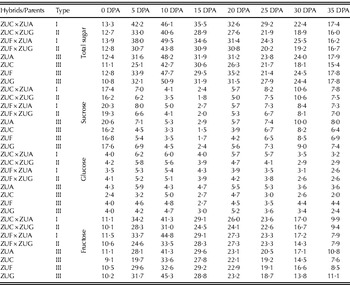
Significant variation in carbohydrates (total sugar, sucrose, glucose and fructose) was observed in hybrids and their parents (Table 6). The concentration of total sugars increased from 0 to 10 DPA, followed by a decrease up to 35 DPA, irrespective of the parents and hybrids. Interspecific hybrids (ZUC × ZUA and ZUF × ZUA) were superior to intraspecific hybrids (ZUC × ZUG and ZUF × ZUG) for total sugars with respect to their mean values. Among parents white cotton (ZUA and ZUG) had higher sugar content in comparison with brown (ZUC) and green (ZUF) cotton.
Dynamic change of cotton fibre carbohydrate contents at different developmental stages of materials in 2009 Hangzhou, China

For sucrose contents, a cyclical pattern of alternating increases and decreases was observed. The peak value was seen at 0 DPA, followed by a decline to a minimum concentration at 15 DPA, then another increase up to 30 DPA (although the peak value here was less than that found on the day of anthesis) and another decline to 35 DPA. However, the mean values for sucrose contents varied significantly between hybrids, being highest in interspecific crosses (Table 5). When parents were compared, white cotton (ZUA and ZUG) fibre was found to contain more sucrose compared to coloured cotton (ZUC and ZUF).
A significant increase in glucose concentration was observed from 0 to 5 DPA, with a sharp decline up to 15 DPA and then another increase up to 30 DPA in parents as well as their hybrids. However, the mean performance of the hybrids was significantly higher than their respective parents, interspecific hybrids being superior for glucose concentration.
The quantity of fructose increased significantly with the advancement of fibre development. Both hybrids and their parents had attained a peak value at 10 DPA, followed by a sharp decline up to 35 DPA, a stage when fibre elongation ceased. However, marked variations were observed between white cotton and coloured cotton, with the former having higher fructose concentrations (Table 6). Among hybrids and their parents, interspecific hybrids (ZUC × ZUA and ZUF × ZUG) were found to contain more fructose than intraspecific hybrids and their respective parents.
Correlation coefficient among different biochemical and fibre quality attributes
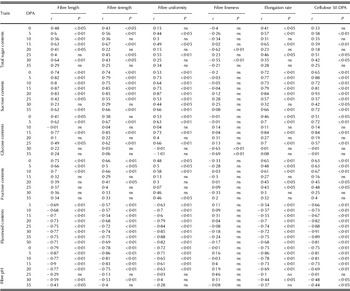
There was a close association among cellulose (50 DPA), fibre quality and biochemical traits during different fibre developmental stages in interspecific, intraspecific hybrids and their parents. During the earlier fibre developmental stages (0–20 DPA), carbohydrate levels were positively correlated with fibre quality attributes (fibre length, fibre strength, fibre uniformity and elongation). However, a highly significant positive correlation was observed between total sugars and sucrose with cellulose contents during the whole course of fibre development, with high amounts found in the fibre elongation phase compared to the fibre maturation phase (Table 5). Similarly, the pH and flavonoid contents were negatively correlated with both cellulose and fibre quality attributes during the whole course of fibre development (0–35 DPA).
DISCUSSION
Heterosis breeding is an effective tool to enhance the yield and enrich quality parameters (Srivastava Reference Srivastava2000; Dutt et al. Reference Dutt, Wang, Zhu and Li2004; Li Reference Li2005) and availability of CMS and restorer factors facilitated the production of cotton hybrids at commercial scale (Wang et al. Reference Wang, Dutt, Ni, Zhao, Nirania, Khadi, Katageri, Patil, Vamadevaiah, Udikeri and Eshanna2004; Zhang et al. Reference Zhang, Wang, Jiang, Hua, Zhang and Dutt2007). Useful heterosis has more practical implications as it conveys a more straightforward message to plant breeders and farmers, compared to mid-parent and best parent heterosis (Hua et al. Reference Hua, Zhou, Huang, Zhu, Yu, Zhang and Liu1963; Dong et al. Reference Dong, Li, Tang, Li and Zhang2007; Zhu et al. Reference Zhu, Liu and Wang2008; Geddam et al. Reference Geddam, Khadi, Mogali, Patil, Katageri, Nadaf and Patil2011). In the present study, the performance of interspecific coloured cotton hybrids regarding yield was significantly higher than intraspecific hybrids, thus demonstrating the commercial potential of interspecific hybrids (Dutt et al. Reference Dutt, Wang, Zhu and Li2004; Zhao & Wang Reference Zhao and Wang2005; Kantartzi & Roupakias Reference Kantartzi and Roupakias2010).
A useful significant and positive heterosis was observed for a number of bolls, seed cotton yield and lint yield, indicating the importance of hybrid vigour for these traits; this supports the findings of many other studies (Galanopoulou-Sendouca & Roupakias Reference Galanopoulou-Sendouca and Roupakias1999; Dutt et al. Reference Dutt, Wang, Zhu and Li2004; Khan et al. Reference Khan, Hassan, Kumbhar, Marwat, Khan, Parveen, Aimen and Saeed2009; Abd-El-Haleem et al. Reference Abd-El-haleem, Metwali and Al-Felaly2010). However, high heterosis for number of bolls in the case of interspecific hybrids did not always corresponded to high heterosis for lint yield. This revealed the fact that lint yield did not necessarily depend on high heterotic expression of all yield components (Galanopoulou-Sendouca & Roupakias Reference Galanopoulou-Sendouca and Roupakias1999; Kapoor et al. Reference Kapoor, Singh and Maheshwari2002; Dong et al. Reference Dong, Li, Tang, Li and Zhang2007). Except for interspecific green cotton hybrids, all combinations that were found to be heterotic for yield and yield components failed to exhibit good performance for fibre quality attributes, thus indicating that yield and quality traits cannot be exploited simultaneously (Preetha & Raveendran et al. Reference Preetha and Raveendran2008). However, the superiority of interspecific green hybrids for fibre length and strength indicated that this might be due to the phenomenon of over-dominance (Soomro et al. Reference Soomro, Kumbhar and Larik2009) or due to the presence of some dominant allele (Kowsalya et al. Reference Kowsalya, Raveendran and Puspalatha1999).
Cellulose is the major component of cotton fibre and high amounts of cellulose always guaranteed a better quality of cotton fibre (Martin & Haigler Reference Martin and Haigler2004). In the present study, the amount of cellulose was lower in coloured cotton fibres compared to white cotton fibre, and might be due to flavonoid synthesis (Dutt et al. Reference Dutt, Wang, Zhu and Li2004; Hua et al. Reference Hua, Wang, Yuan, Shao, Zhao, Zhu and Jiang2007, Reference Hua, Yuan, Shamsi, Zhao, Zhang, Liu, Wen, Wang and Zhang2009). However, a significantly higher amount of cellulose after 15 DPA in the interspecific coloured cotton hybrid as compared to their parental lines suggested the accumulation of dominant alleles at different loci for cellulose synthesis. This favoured the phenomenon of heterosis breeding to modulate the cellulose synthesis in coloured cotton hybrids (Kowsalya et al. Reference Kowsalya, Raveendran and Puspalatha1999; Dutt et al. Reference Dutt, Wang, Zhu and Li2004). Analysis of flavonoid biosynthesis revealed maximum accumulation in parents and their respective hybrids at 5 DPA with a continuous decrease during the remainder of the fibre development phase (Dutt et al. Reference Dutt, Wang, Zhu and Li2004; Hua et al. Reference Hua, Wang, Yuan, Shao, Zhao, Zhu and Jiang2007; Reference Hua, Yuan, Shamsi, Zhao, Zhang, Liu, Wen, Wang and Zhang2009). It is suspected that this continuous decrease might be due either to the synthesis of lignin or an increase in the amount of cellulose present (Dutt et al. Reference Dutt, Wang, Zhu and Li2004; Hua et al. Reference Hua, Wang, Yuan, Shao, Zhao, Zhu and Jiang2007). Moreover, at maturity (50 DPA) Sea Island white (ZUA), upland white (ZUG) and the interspecific green cotton (ZUF × ZUA) hybrid have lower amounts of flavonoids corresponding to high amounts of cellulose at the same stage.
Many other researchers have documented a close relationship between pigmentation (flavonoids) and the pH of specific plant tissues (Mol et al. Reference Mol, Grotewold and Koes1998; Wang et al. Reference Wang and Li2002b, Reference Wang and Lic; Yoshida et al. Reference Yoshida, Kitahara, Ito and Kondo2006). The observed differences in the fibre pH and flavonoid contents of parents, i.e. brown, green and white, and their hybrids revealed that pH value might have some effect on the synthesis of the flavonoid contents of developing fibres (Dutt et al. Reference Dutt, Wang, Zhu and Li2004; Hua et al. Reference Hua, Wang, Yuan, Shao, Zhao, Zhu and Jiang2007). Rapid and massive accumulation of cellulose and a sharp decline in the fibre pH during 15–20 DPA has also suggested a close relationship between cellulose synthesis and pH of developing fibres (Basra & Malik Reference Basra and Malik1984; Dutt et al. Reference Dutt, Wang, Zhu and Li2004). In agreement with this, the present study found that white Sea Island cotton (ZUA) and interspecific green hybrid (ZUF × ZUA) exhibited low fibre pH values during 15–20 DPA, in contrast to maximum amount of cellulose and good fibre quality. The lower pH value is helpful in maintaining the constant turgor state of developing cotton-fibre cells (Basra & Malik Reference Basra and Malik1983), offering resistance to radial expansion (Martin et al. Reference Martin, Bhatt and Baumann2001) and finally allowing unidirectional rapid growth of the developing cotton fibre (Seagull Reference Seagull1992; Wilkins & Jernstedt Reference Wilkins, Jernstedt and Basra1999; Martin et al. Reference Haigler, Ivanova-Datcheva, Hogan, Salnikov, Hwang, Martin and Delmer2001). In the present study, the increase in total sugar contents up to 10 DPA may be due to import of sugar from other parts of plant to the developing cotton boll (a carbohydrate sink), which might be consumed for cellulose synthesis during later stages of fibre development (Thaker et al. Reference Thaker, Rabadia and Singh1999). Among the parents, the green cotton fibre (ZUF) showed the highest sugar contents but did not have high cellulose contents or good fibre quality. This might be due to the fact that synthesis of green pigment consumed more amount of energy, which otherwise could be used for the synthesis of cellulose (Dutt et al. Reference Dutt, Wang, Zhu and Li2004; Hua et al. Reference Hua, Wang, Yuan, Shao, Zhao, Zhu and Jiang2007). But in the case of the interspecific green hybrid, the maximum amount of sugar corresponded to high cellulose contents, fibre length and fibre strength. This may be due to regulation or accumulation of genes controlling carbohydrate flow and efficiency of carbohydrate utilization during the course of fibre development (Hua et al. Reference Hua, Wang, Yuan, Shao, Zhao, Zhu and Jiang2007) hence indicating the significance of heterosis breeding. The reduction in the amount of sucrose contents might be due to its degradation into glucose and fructose, which in turn was exploited to maintain the turgor pressure of the fibre cell, especially during the rapid elongation phase (15 DPA). The increase in the amount of glucose and fructose in all hybrids and parents up to 10 DPA indicated that sucrose was inverted and glucose and fructose were stored during primary wall synthesis. However, at later stages of fibre development the glucose and fructose contents decreased, suggesting their involvement in secondary cell wall development (Jaquet et al. Reference Jaquet, Buchala and Meier1982). Similarly, low sucrose contents corresponded to low cellulose contents and poor fibre quality in parental-coloured cotton. In contrast to this, high cellulose contents with good fibre quality in both brown and green interspecific hybrids might be due to high levels of sucrose at 15 DPA (Zhang et al. Reference Zhang, Shu, Hu, Cheng, Wang and Zhou2009).
Highly significant positive correlation between carbohydrates, cellulose contents and fibre quality traits (except micronair) suggested that various metabolic activities required high amounts of carbohydrates as a source of energy to synthesize cellulose during the cotton fibre development particularly at 15 DPA (Jaquet et al. Reference Jaquet, Buchala and Meier1982; Thaker et al. Reference Thaker, Rabadia and Singh1999). Higher amounts of cellulose assured good fibre quality because cotton fibre maturity, strength and extensibility are directly dependent on the amount of cellulose (Hsieh Reference Hsieh and Basra1999; Ruan et al. Reference Ruan, Llewellyn and Furbank2001; Ruan Reference Ruan2005; Haigler Reference Haigler, Brown and Saxena2007; Wang et al. Reference Wang, Shu, Cheng, Mcgiffen, Zhang, Xu and Zhou2009; Zhang et al. Reference Zhang, Shu, Hu, Cheng, Wang and Zhou2009). The negative correlation between high amounts of flavonoids with cellulose and fibre quality during cotton fibre development showed that flavonoid biosynthesis consumed a large amount of carbohydrates, sharing the same energy for cellulose synthesis during cotton fibre development (Hua et al. Reference Hua, Wang, Yuan, Shao, Zhao, Zhu and Jiang2007). Genes involved in the synthesis of flavonoids also inhibit the development of cotton fibres (Richmond Reference Richmond1943). The significant negative correlation of fibre pH with cellulose and fibre quality traits, especially at the rapid elongation stage (15 DPA) of the developing fibre, revealed that a low pH value was favourable for fibre cell elongation by maintaining the cell turgor pressure and secondary wall development (Seagull Reference Seagull1992; Wilkins & Jernstedt Reference Wilkins, Jernstedt and Basra1999; Martin et al. Reference Martin, Bhatt and Baumann2001).
The exploitation of heterosis by the introgression of useful novel alleles from elite genotypes belonging to upland and Sea Island cotton could be an effective tool for improving the fibre quality of coloured cotton. Coloured cotton genotypes in the present study always revealed inferior fibre quality, associated with lowered contents of carbohydrates and cellulose. Similarly, the negative correlation of flavonoids and fibre pH with cellulose and fibre quality suggested that flavonoid biosynthesis consumed a large amount of carbohydrates, shared the same energy as cellulose synthesis and ultimately affected fibre development. However, interspecific hybrids exhibited high contents of carbohydrate and cellulose and hence high contents of the desired fibre quality as compared to their parents. In conclusion, there is no doubt that heterosis breeding has valuable applied prospective to modulate the synthesis of different biochemicals associated with fibre quality in coloured cotton.
This work was supported by the National Basic Research Program of China (the 973 Program: 2004CB11730502) and the Natural Science Foundation of Zhejiang (Y306093) and Zhejiang Technology Program (2008C22087).