Introduction
This paper attempts to develop some theoretical perspectives in the understanding and analysis of African popular music using the West African Highlife as a paradigm. The need for a theoretical framework arose because, in my research on Highlife music in the West African sub-region (between 2005 and 2009), issues of compartmentalisation, generic limitations and historical relativity continuously posed problems to me. This is because I did not see any theoretical basis for the inclusion and exclusion of musical types from genre categories. However, because Highlife music exists within a wider context and concept of African popular music, it stimulated my interest in the possibility of cross-cultural and trans-national theoretical perspectives on African popular music, which is the main preoccupation of this paper.
The need for a theory of African popular music is justified because popular music cannot be analysed effectively using ‘traditional tools’ of musicology, as Tagg (Reference Tagg1982, p. 4) has rightly asserted. By traditional tools I mean such analysis as focuses exclusively on aesthetic elements such as melody, scale, harmony and rhythm which are idiomatic of European musicology. Hawkins (Reference Hawkins2002, pp. ix–xi) has also stressed the need for new critical and theoretical models in the study of popular music. The need for an African theory of popular music is further justified by Omojola's (2006, pp. 1–5) submission that a dichotomy exists between Western and African perspectives on popular music. The above submissions informed my concern with the development of new theoretical models in understanding African popular music, using the West African Highlife as a paradigm.
My choice of Highlife music is based on a close scholastic and artistic association with the development and transformations of this genre of music over several decades in West Africa. Although my phenomenological analysis is drawn from this seemingly narrow confine of specificity, there is a general sensitivity to the wider spectrum of African popular music in other regions of Africa. Thus, references have been made in this paper to the development of such popular musical genres as the Tanzanian Taarab, Zimbabwean Chimurenga, Zouglou and Mapouka in Côte d' Ivoire, the Senegalese Mbalax and the Cameroonian Makossa, among others. This is done essentially to foreground the fact that the theoretical perspectives put forward in this paper have both cross-cultural and inter-regional applications in Africa.
Basically, two original theoretical perspectives have been put forward in this paper: ‘Indigenisation and Syncretisation’ and ‘Social Reconstructionism’. Although these theoretical perspectives do have their distinctive analytical approaches, they are also mutually complementary. While ‘Indigenisation and Syncretisation’ explain the processes in the creation of African popular music styles, ‘Social Reconstructionism’ theorises on the creation and sustenance of African popular music as a social phenomenon.
Background to the African continent
In this section, I hope to provide a concise background of the African continent in somewhat simplistic terms, without necessarily undermining theories and discourses on ethnicity and identity formation. My main focus is to present a graphic picture of the African continent, its geographical delineation, cultural/ethnic diversity, significant socio-historical influences on African culture and some issues in identity formation. I intend to use all of these to acquaint the reader with the background of the study area and to foreground the basis for theorisation on African popular music as a genre of music that seems diverse, but shares elements of commonality in musical language and the processes of its creation and sustenance.
Based on such criteria as colour, language groups, musical patterns and cultural similarities, most scholars in the humanities divide Africa into two broad regions: North Africa and sub-Saharan Africa, with the southern edge of the Sahara as the dividing line. North Africa is referred to colloquially as ‘white Africa’ or Saharan Africa, while Africa south of the Sahara is referred to as ‘Black Africa’, sub-Saharan Africa or the home of the ‘Negroes’. However, this North–South dichotomisation raises a number of questions as regards ‘who is an African?’ or, in more specific terms, ‘who is a true African?’ Coincidentally, the first question above formed the thematic focus of the opening sessions at the ‘Repositioning Africa’ conference which took place at Fourways, near Johannesburg in September 1998 (see Makgoba Reference Makgoba1999). Some scholars argued that ‘being African is everything but colour’ (Makgoba Reference Makgoba1998) and ‘not all blacks are Africans and not all Africans are blacks’ (Prah Reference Prah and Makgoba1999). Some others contended that being African requires more than citizenship and that the African intelligentsia is the key to the process of identity formation in Africa (Mamdani Reference Mamdani and Makgoba1999; Prah Reference Prah and Makgoba1999).
Palmberg (Reference Palmberg, Palmberg and Kirkegaard2002, p. 117) provides us three definitions of identity: ‘unique individuality of each person’, ‘a sense of sameness and belonging to a community’, and thirdly as ‘phenomena that are identified in order to classify them’. While the author agrees that the first two definitions are contradictory and mutually exclusive since they talk about uniqueness and sameness at the same time, the concept of ‘cultural identity’, he argues, provides a bridge between these two polarities. Stuart Hall identifies two ways of talking about cultural identity: as shared culture which provides us with a stable, unchanging and continuous frame of reference and meaning, and secondly as ‘what we really are’, ‘what history has done’, ‘what we have become’ and ‘the way we position ourselves within the narratives of the past’ (Hall Reference Hall and Rutherford1990, p. 223). To my mind, it is in this later sense that we can talk of an African culture based on our shared history as a continent and the way we have positioned ourselves within the narratives of the African past.
Responding to the question: ‘Where is Africa?’ Tomaselli (Reference Tomaselli2003, p. 25) strongly affirmed that ‘there is no single Africa … thousands of culturally different and interacting societies live on and through the African continent’. Mazrui (Reference Mazrui1986) also gave four general definitions of Africa based on racial, continental and power considerations. The racial criterion excludes non-blacks; the continental is basically geographical while power considerations excluded those parts of Africa under ‘white’ control (like apartheid South Africa). It is not my intention or focus in this paper to further deepen the issues of African identity, ethnicity and citizenship since such could lead to endless debates, contradictions and ambiguities. I will, however, appropriate the continental perspective above since Africa is basically a Colonial geopolitical creation whose rich and diverse cultural resources have been its greatest pride and the focus of various scholarly researches on Africa. It is my intention to attempt to resolve this paradox of cultural homogeneity and heterogeneity and create, in the process, a sense of unity, particularly as it relates to the diversity of popular music expressions on the African continent.
Although there are over 700 language groups in Africa, as Nketia (Reference Nketia1975, p. 4) has rightly observed, African music, like its language, is ethnic bound. However, it is my thesis that this cultural/ethnic diversity does not detract from the fact that there are similarities and centrally binding phenomena which circumscribe the musical expressions of the African people on both sides of the Sahara. Collins (Reference Collins, Sutherland-Addy and Takyiwaa-Manuh2004b, p. 1) has also noted that artistic syncretism was going on in Africa before European contact. This was mainly through trade, wars, migrations and other agents of acculturation and cultural diffusion between Saharan and sub-Saharan Africa. Syncretism is one of the key axioms of the theoretical perspectives in this paper.
Two main external influences have also made significant impact on African culture and, by extension, its music and musical practices. These are Islam and Arabic culture from the East and Christianity and European culture from the West. According to Oliver (Reference Oliver1991, p. 84), Islam was present in Africa from 639 A.D. when Arab Armies defeated the Byzantine Garrison in North Africa. Through the trans-Saharan trade route, Islam and Arabic culture spread to the Sudanese states, the savannah belt, as well as the coastal states of Africa. In a similar vein, European culture was introduced to Africa in the 19th century through trade, Colonialism, Western education and Christianity. These external influences made and continue to make a significant impact on the music of Africa. For example, Islamic and Arabic musical resources have been creatively integrated into traditional African music to create such hybrid popular forms as the Nigerian Fuji, the Algerian Rai and the East African Taraab, to mention but a few. Islamic/Arabic musical resources can also be heard in the music of Youssou N'Dour of Senegal, Umm Kulthum of Egypt and the Malian Blues singer, Alli Farka Toure (see Discography).
The European legacy in Africa gave birth to Western-influenced popular music such as the West African Highlife, Congo Jazz, Kwela and Mbaganga of South Africa, Mapouka of Cote d'Ivoire, Kriolu music for the mixed population (the Mesticos) in Cape Verde, and many others.
For ease of reference, geographers divide the African continent into five main regions, namely: North Africa which includes countries like Mauritania, Morocco, Tunisia, Algeria, Egypt, Libya, Ethiopia and Eritrea; Southern Africa which is home to the Republic of South Africa, Zimbabwe, Namibia, Mozambique, Malawi, Lesotho, Swaziland, Botswana and Angola; East Africa which consists of Kenya, Uganda, Tanzania, Somalia, Rwanda and Burundi, among others; Central Africa which includes countries like the Central African Republic, Gabon, the Democratic Republic of Congo and Cameroon; and West Africa, which includes Nigeria, Ghana, Sierra Leone, Liberia, Togo, Benin, Cote d' Ivoire, Guinea and Burkina Faso. The African continent also includes the adjoining islands of Malagasy, Cape Verde, Comoros, Mauritius, Seychelles, Sao Tome and Principe.
Important to the focus of this paper is the correlation between the delineation of Africa into geopolitical regions and Herskovit's 1920 delineation of culture areas in Africa (see Merriam Reference Merriam1955). This correlation provides a regional and continental basis for studying African popular music both as an art form and as a cultural and multicultural expression. The broad landscape of the African continent brings to fore the diversities of ethnic-bound indigenous music from where, to my mind, the various African popular music expressions derive. This backdrop of what I term ‘unity in diversity’ foregrounds the basis for theorisation on African popular music in this paper.
Towards a theory of ‘African pop’
Given the broad and diverse cultural landscape of the African continent, one concern that readily comes to mind is whether African popular music can be perceived as a unitary socio-musical phenomenon. However, from my over three decades of involvement in African popular music, first as a musician and music producer and later as an academic scholar and researcher, I have come to the conclusion that African popular music is a macrocosm of musical expressions which seem to have distinctive strands, but yet have some centrally binding musical and extra-musical concepts. This justifies the use of the term ‘African pop’ as a generic label. My proposition hinges on the following premises:
1 Because of the significance and dominant position that traditional music occupies in community life in Africa, all forms of popular music in Africa are rooted in the traditional music of the people. These traditional forms constitute the cultural foundation of the superstructure on which the various popular music styles stand.
2 A common Colonial heritage. Apart from Ethiopia and the ex-slave settlements of Sierra Leone and Liberia, other parts of Africa were colonised by such European powers as Portugal, Britain, France, Belgium and Spain. At the famous Berlin Conference of 1884–1885, Africa was partitioned among the European powers mentioned above. By 1900, Africa came under effective colonisation.Footnote 1 Colonialism as an instrument of domination and African resistance to it had its attendant social, cultural, economic and political consequences. These consequences are well documented in Walter Rodney's How Europe Underdeveloped Africa (Reference Rodney1972) and Frantz Fanon's The Wretched of the Earth (Reference Fanon1982). Themes and styles of African popular music reflect the realities of slavery, Colonialism and European contact.
3 Two main external cultural influences have affected African music, namely Western and Islamic/Arabic influences. All forms of African popular music oscillate between these two cultural polarities.
4 African popular music is driven by Western technology, in terms of musical and sound reinforcement equipment, as well as by other mass media representations such as recording studios, broadcast media, print media, the internet and other forms of contemporary audiovisual technologies.
5 African popular music is an economic product, a product of Western capitalism. The creation and sustenance of African popular music styles is therefore conditioned by economic forces such as the law of supply and demand, the concept of ‘the market’, theories of consumer behaviour and other economic indicators developed in the West.
From the foregoing, we can establish that African popular music is circumscribed by central concepts and phenomena which are cross-cultural and trans-national. Thus, the proposition of the use of the term ‘African pop’ for the various forms of popular music in Africa irrespective of their countries of origin is justified. The word ‘pop’ is used here as a generic name and not in reference to any specific style of music. Consequently, the term ‘African pop’ is used interchangeable with the term African popular music all through this paper deliberately. Again, one is not oblivious of some inherent problems of genre labelling and categorisation which are based on the one hand on the twin issues of historical relativity and historical specificity, and on the other hand on artistic autonomy and generational contextualisation. It is my thesis therefore that the use of the term ‘African pop’ will put to rest the problem of generational conflict between old- and new-breed musicians. This generational conflict is basically ideological, as each generation grapples with the question of what is ‘original’ or ‘authentic’ and what is ‘fake’ or ‘bastardisation’ of the ‘original’; what is the ‘core’ and what represents the ‘periphery’. The various Highlife revival projects in Nigeria and Ghana since the early 1980s, as well as the coinage of the labels ‘Burger Highlife’, ‘Hip life’, ‘Old School Highlife’ and ‘Gospel Highlife’ to demarcate generational tastes and preferences are cases in point.
The issues of generational interpretation and artistic recreation along a historical continuum are key axioms of my social reconstructionism theory which I will discuss later in this paper. From a marketing perspective also, the labelling of popular music from Africa as ‘African pop’ is a more appealing brand name than the longer name of ‘African popular music’. It is my thesis also that the term ‘African pop’ resonates more as a continental brand than being subsumed under an amorphous label of ‘world music’.
The concept of African music
The term ‘African music’ has a long pedigree and is capable of various interpretations, both from historical and contemporary perspectives. From the account of early European travellers, sailors and explorers, the term African music represented the music of ‘barbaric’ tribes; it was devoid of any form of aesthetic consideration and existed outside the theoretical framework and aesthetic benchmarks of European musicology. The idea of primitiveness, however, is a relative one: a group of African musicians listening to European jazz with its repetitive rhythm may term the whole process as primitive compared to their own complex rhythms, as Akpabot (Reference Akpabot1986, p.1) has rightly asserted.
To early ethnomusicologists who worked on African music, the concept of African music was limited to traditional African music in its ‘undiluted’ form, devoid of foreign influences in religious, social and political arenas. This may be why Chernoff (Reference Chernoff1979, p. 28) submitted that ethnomusicological research in Africa was targeted at gathering data from Africa to augment European music theory in comparative terms. This assertion is given further credence by the fact that early ethnomusicologists like Klaus Waschman, Alan Lomax, Alan P. Merriam, John Blackings and others who worked on African traditional music were Western scholars whose perspectives were necessarily and understandably nested in European musicology.
Some scholars of African music sometimes refer to African music as music of sub-Saharan Africa only. Notable among these scholars is Ghanaian Professor Emeritus, J.H.K. Nketia. He holds the view that only African music south of the Sahara qualifies to be called African music. He excludes the music of North Africa and of white settlers in Southern Africa and parts of East Africa from the African music category on stylistic grounds (Nketia Reference Nketia1975). This is, however, a contentious issue. While one may agree that some cultural differences exist between North Africa and sub-Saharan Africa as I stressed earlier, there have also been increasing interactions and unending streams of cross-cultural and trans-national influences from both sides of the divide. Some of these influences have come through migrations, the trans-Saharan trade, migrant labour, education, evangelical activities and other regional and trans-border collaborations. The direct impact of this is that the demarcation of Africa into two main cultural blocs, seeming to exist in isolation of each other, become all the more blurred in contemporary times.
In a similar vein, scholars like Coplan (Reference Coplan1985), Collins (Reference Collins1992) and Emielu (Reference Emielu2006) have extended the concept of African music geographically and stylistically beyond the African continent to accommodate music making in the African Diaspora. This view is given further credence by the fact that during the Second Black Festival of Arts and Culture (FESTAC) held in Nigeria in 1977, for example, hundreds of musicians and dance troupes were invited from the African Diaspora. In the same vein, the annual Pan-African Festival (PANAFEST) in Ghana features visiting African Diaspora musicians. In contemporary times, there have been increasing collaborations between African musicians in the homeland and those in the Diaspora both in live performances and studio recordings. These developments, and many others not specifically mentioned here, justify the assertion that music making in the African Diaspora has an essentially African core and therefore should be considered as an extension of African music (Emielu Reference Emielu2006, p. 106).
Beyond geographical contextualisation, it is important to stress here that African music is not restricted to its traditional forms only. As Coplan (Reference Coplan1985), Collins (Reference Collins1992), Aning and Mensah (in Obidike Reference Obidike1992), Obidike (Reference Obidike1992) and Omojola (Reference Omojola2006) have stressed, the concept of African music should not only include traditional African music, but also contemporary forms like art and popular music. In contemporary categorisation of African music, therefore, three generic groups are identifiable: ‘African traditional music’ which is ethnic bound; ‘African popular music’ which is Western derived; and the more elitist ‘African art music’ which is modelled on European ‘classical music’. This paper is focused on African popular music, which is a middle urbanised segment and an integral part of the broad landscape of what is today known as African music.
I will now proceed to propose some theoretical perspectives on the creation and sustenance of African popular music styles irrespective of the country or geographical region of origin. I will however, use the West African Highlife as a principle example to demonstrate that African popular music is a cross-cultural and trans-national product, while still making reference to other African popular genres.
The West African Highlife
Highlife music emerged as the culmination of social and historical processes which began in the mid-20th century in West Africa. The term Highlife with its disyllabic division into ‘High’ and ‘Life’ attests to the creation, accentuation and reinforcement of the politics of selfhood and social stratification of the West African society in the late Colonial period.
Highlife music grew first as a sub-regional music in British West Africa, with its roots situated in the diversities of traditional social dance music of the West African people. In Nigeria, some of these traditional social dance music were: Kokoma, Agidigbo, Dundun, Apala and Sekere dance music in Western Nigeria; Swange among the Tiv; Itembe dance music in Calabar; Ekpiri music in Eastern Nigeria; Akwete and Ekassa dance music in Midwestern Nigeria; and Kalangu dance music in Northern Nigeria. In Ghana, we had such forms as the Fanti Osibisaaba, Odonson, Kpanlogo and Borbobor of the Ewe-speaking people. These traditional social music forms were fused with foreign musical types like Maringa, Swing, Jazz, Cha-cha-cha, Foxtrot, Rhumba and Calypso.Footnote 2 These forms were brought to West Africa most significantly by freed African slaves from the West Indies, the Caribbean Islands and Britain, as well as American soldiers stationed in West Africa during the World wars.
These foreign forms and many others which usually combined traditional musical instruments with Western instruments like the acoustic guitar, banjo, accordion and harmonica, were subsumed under an amorphous label of ‘palm wine’ music. This was because of their predominance in palm wine or tombo bars during their early days. These various palm wine styles went into the tapestry of what later became known by the generic name of Highlife in West Africa.
Early prototypes of Highlife began to emerge in the 1920s from the indigenisation of the military and regimental brass band music of foreign armed forces and European colonists in West Africa. The West African sub-region hosted many military formations during the two World Wars (1914–1945), as well as during the Colonial period. For example, West Indian troops and their regimental bands were stationed by the British in Freetown in 1819, Cape Coast in 1870 and Lagos in the late 19th century (Collins Reference Collins, Sutherland-Addy and Takyiwaa-Manuh2004b, p. 2). One of the hallmarks of military presence in West Africa was the introduction of brass band music which was played on assorted brass instruments and percussion by military and regimental bands. Brass band music usually accompanied daily parades, as well as other special military occasions like the British Empire Day (24 May) and receptions for visiting top government officials. These brass bands derived their tunes mainly from the Western repertoire.
In all, two major stages can be identified in the creation of Highlife music. These are the indigenisation and syncretisation stages. The first stage could be said to have begun with the indigenisation of military and regimental brass band music. As Africans became increasingly exposed to military and regimental brass band music, local popular tunes infiltrated into their repertory. This indigenisation process gave birth to African brass bands outside the military. These emerging brass bands orchestrated local and popular folk tunes of the day. Some of these brass bands in Nigeria were the Niger Coast Constabulary Band from Calabar, the Hausa Constabulary Band based in Kaduna (Ogisi Reference Ogisi2004) and Bakana Brass Band from Rivers State, among others (Akpabot Reference Akpabot1986). Waterman (Reference Waterman1990) also noted that West Indian troops in Lagos had a great influence on the emergence of local Nigerian brass band music beginning in the 1920s.
The formation of what may be described as African brass bands marked the climax of the indigenisation process and prepared the ground for the eventual syncretisation of Western and African musical resources to produce the Highlife format as recognised today. It is interesting to note that the name ‘Highlife’ was coined at the indigenisation stage. This was done as an attempt to demarcate local tunes played by local folks on local instruments in local venues, from local tunes orchestrated and played on Western instruments in exclusively non-traditional contexts.
From its indigenised state as a form of African brass band music, Highlife developed further by absorbing several cross-cultural and trans-national musical influences. Among these were church hymns, American Swing and Jazz music, Latin American and Caribbean music like Rhumba, Foxtrot, Salsa and Meringue, which later became integral elements of Highlife's definitive framework. These musical resources were built on an African traditional base, which is the traditional social recreational music of the societies where Highlife developed. In Ghana, Western regimental brass band Highlife was syncretised with traditional social music styles such as Adenkum, Osibi and Adowa/Ashewa which resulted in the birth of local Adaha brass band style during the late 19th century (Collins Reference Collins2004a). Adaha, in turn, was one of the forerunners of Highlife music. The name Highlife was coined in about 1925 in the Cape Coast area of Ghana and this subsequently became the generic or umbrella name for a wide variety of early Ghanaian music such as Adaha, Kokoma, Osibisaaba, palm wine guitar music and local dance band music. In Nigeria, Highlife was syncretised with Kwokrikwo in Eastern Nigeria (Obidike Reference Obidike1994), Egwu Ekpiri, Egwu Ogene in Eastern Nigeria,Footnote 3Dundun, Sekere and Apala music in Western Nigeria (Euba Reference Euba1975), Kalangu music in Northern Nigeria (Ajirere Reference Ajirere1992), and Itembe music in Calabar (Martins Reference Martins and Bender2005), just to mention a few.
From the above, it can be correctly argued that the root of Highlife music is essentially African, while its branches reflect its diverse cross-cultural and trans-national ‘musical parents’. This assertion is given further credence by Rhodes' (Reference Rhodes1998, p. 6) submission that the musicians who took up Highlife in Nigeria (and by extension in Ghana) structured it from their traditional roots. This traditional attachment can be heard in the music of various Highlife artistes both in Nigeria and in Ghana. The creation and development of Highlife music in the West African sub-region lends empirical credence to the two theoretical perspectives which I have put forward in this paper.
Social reconstructionism
The term ‘Highlife’, with its disyllabic division into ‘High’ and ‘Life’, attests to the fact that Highlife developed most significantly as a social concept, before its appropriation as a musical concept. With its emphasis on ballroom venues, gate fees and audiences in English suits and hats, patrons of Highlife music belonged to a high social class of urban wage workers and professionals of various fields, a tiny and emerging class of the African elite who derived a certain amount of prestige, privilege and power from its consumption. On the other hand, it is interesting to note that a lower social class coined the name ‘Highlife’ because they felt socially inferior to those who patronised Highlife in ballrooms and exquisite venues (Collins Reference Collins1992).
Because African music is both a musical and social phenomenon (Nketia Reference Nketia1975), my new theoretical paradigm of ‘social reconstructionism’ is based on my perception of African popular music as a social concept which is constructed or created through prevailing socio-historical processes. Social reconstructionism as a theory posits that ‘a socially constructed phenomenon can be socially deconstructed and socially reconstructed contingent upon prevailing socio-historical processes’. When deployed in the analysis of popular music, the theory may be reframed to read that ‘a socially constructed musical phenomenon can be socially deconstructed and socially reconstructed contingent upon prevailing socio-musical and socio-historical processes’.
My theory of social reconstructionism takes its roots from the theory of social construction which Berger and Luckman (Reference Berger and Luckman1966), Johnson et al. (1984), Searle (Reference Searle1995), Hacking (Reference Hacking1999), as well as Boghossian (2001) have theorised on. Social constructionism is a sociological theory that examines how social phenomena develop in particular social contexts. The French social theorist Emile Durkheim (1858–1917) first theorised about social construction in his anthropological works on collective behaviour. Durkheim believes that individuals in a society are products of complex social forces which condition social actions, interactions and social mediations. Durkheim also believes that the individual cannot be considered outside the society where he lives. He theorised, among other things, on ‘collective conscience’ which stands for the shared values which act as cohesive bonds that bind social order in society.
However, social constructionism as a sociological theory was popularised by the work of Peter L. Berger and Thomas Luckman (1966) in America. Berger and Luckman theorised that persons and groups, interacting in a social system over time, form concepts or mental representations of each other's actions, which eventually become habitualised into reciprocal roles played by the actors in relation to each other. When these roles become routinised, the typified reciprocal interactions become institutionalised. In the process of institutionalisation, meaning is embedded into individuals and the social structure of society, including knowledge, conceptions and beliefs (http://en.wikipedia.org/wiki/Social_construction). This becomes accepted as social reality. In this sense, social reality is said to be socially constructed. Socially constructed reality is also an ongoing and dynamic process, where reality is reproduced by people, based on their varying interpretations and perceptions along a historical and generational continuum. Searle (Reference Searle1995), in his work on the construction of social reality, submitted that social reality can be produced by assigning functions or roles to physical objects; by sharing a collective intention to treat those objects that way and by conforming to rules for relating to those objects. Social constructionism therefore aims to uncover the ways in which social phenomena are created, institutionalised and made into living traditions by society.
Generally, social constructionism is opposed to essentialism. In philosophy, essentialism posits that, for any specific kind of entity, there is a set of characteristics or properties which constitute the essence of that entity. This essence is held to be permanent and unalterable. The essentialist position on various societal issues like ethnicity, gender, race, sexuality and other similar issues is that these categories have fixed traits which are unalterable by social forces. Essentialism, therefore, seems to espouse conservatism which militates against social change. To my mind, social constructionists' opposition to essentialism is both a weakness and strength. For a popular musical style like Highlife to be branded and regarded as such, it should have an essence with recognisable properties and aesthetic qualities; otherwise, no such thing as Highlife exists. Because of the aural and oral nature of popular music, its defining characteristics are more mental than physical. Despite the collective intentions of its creators and the social acceptance by its audience, such mental templates that define a music style may be epistemically subjective and historically relative.
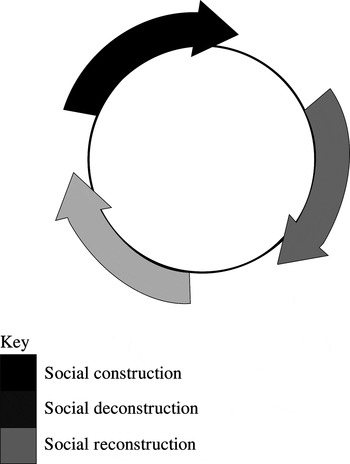
The Social Reconstructionism model is a cyclical and progressive one. Three peculiar stages can be identified in the model (see Figure 1).
Social reconstructionism model.

The stage of social construction
The first stage is focused on the social processes in the construction of a musical style. First of all, for a musical style to emerge there must be certain preconditions, as D'Anjou (Reference D'Anjou2003) has rightly observed. These include the availability of musical resources such as prevailing musical sounds, musical instruments and appropriate technology that supports musical creativity. This is coupled with the availability of skilled musicians to create the new sound, industries that market and promote the music, and the audience or social group for which the music is intended. Finally, there must be an enabling socio-cultural and economic environment that supports the development of the music in question.
Given the above conditions, the main features that can be identified in the social construction stage are, first of all, the creative combination of available musical resources into a coherent and recognisable musical core. This imputes a musical essence into the product. The ideologies and intentions of its creators are also imprinted on the style to give it meaning and socio-musical symbolism. This primary feature is complemented by social action, interaction and mediation between such social groups as artistes, listeners, critics, producers, marketers, promoters and other social groups not directly involved in the musical stream. The social action emanating from this social chain will add new meanings to the music, most times beyond the original intentions of its creators. The nature and content of the music is therefore shaped through this social process. The social significance, iconography and signification of the music are derived from this social process and define the music in specific terms socially. These processes will, over time, impute a core recognisable musical essence into the new product. This core, as opposed to its periphery, will then form the crust of the definitive framework of the new musical genre.
The stage of social deconstruction
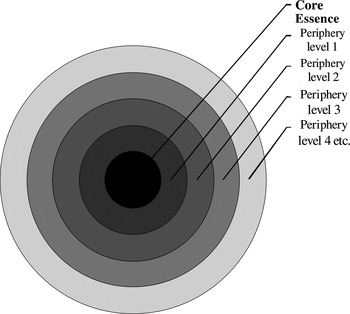
The term deconstruction is not used in this study in the sense of Jacques Derrida's usage to denote a process whereby the text and languages of Western philosophy complicate meaning when read in the light of the assumptions and absences they reveal within themselves. Rather, I have adopted the interpretation of Hansen et al. (Reference Hansen, Cottle, Megrine and Newbold1998, p. 177) of deconstruction as it relates to stages in genre development. According to these theorists, a genre passes through four stages of existence: the experimental stage which is characterised by an assemblage of principal elements that define its essence and symbolism; the classical stage which represents the point of maximum output and the clearest identification of the principal elements; the stage of parody; and finally, the stage of deconstruction. At this final stage of deconstruction, the generic elements and conventions that characterise the genre call attention to themselves by being placed outside their original contexts. This writer has thus coined the term ‘social deconstruction’ to denote the disruption of principal elements, encrypted meanings, conventions and iconography imbued in a social construct. These are shown by peripheral levels (see Figure 2) which represent differences in style that constitute artistic creativity, authorial autonomy and generational modifications reflective of the social processes of musical change. These peripheral levels also represent stages in the deconstruction process.
Levels of deconstruction and reconstruction.

Social deconstruction therefore represents a process where the engrafted meaning, conventions, musical features, symbolism and iconography in a social construct begin to lose their absolute advantages as emergent social and historical forces act upon them. In my developmental schema of social reconstructionism, the stage of social deconstruction is characterised by some remarkable features. Most significantly, the musical style begins to deviate more and more from its core musical essence and definitive framework. This phenomenon arises based on peripheral levels of artistic re-creation and re-interpretation that are brought to bear on the original style. This again, is a reflection of individual, group, generational or new socio-technological and economic demands. The musical style also begins to lose the original meaning of its creators. It gradually takes on added meaning and a new social identity as can be detected in the changing conventions, iconography and significations. It could possibly also acquire a new audience gradually, while losing some old ones along the way. A deconstructed musical form may contain some elements of the old style which are combined with new stylistic innovations reflective of the prevailing socio-musical environment.
Stage of social reconstruction
In my proposed model, a socially constructed musical style should have a recognisable core essence which gives it meaning. There should also be peripheral aspects which are in levels of intensity (see Figure 2). These peripheral levels represent steps towards deconstruction and, inevitably, reconstruction. The reconstruction stage represents significant attempts towards a re-definition of the social construct in new stylistic and social terms. It is a stage of assemblage of the ‘old’ and the ‘new’ in proportions that impute new musical and social meanings into the product. The reconstruction stage is also an ongoing process, a direct response to the changing social world of the art and the society at large. The main features of this stage include: multiple modes of expressions which may or may not directly derive from the original core essence; attempts at fashioning out a new direction and a new core essence for the product; and attempts at locating the musical stream within a new socio-economic, artistic and cultural space. The search for new meanings through some forms of ideological mutation reflective of the changing socio-musical environment, interactions and social mediations in the society are also integral aspects of this stage.
However, how long each process in the social reconstructionism model takes is dependent on the degree of musical saturation in the society. This will also depend on the level of social interactions between the various actors in the social chain, as well as their degree of social responsiveness and willingness to change.
The social construction, deconstruction and reconstruction of Highlife music
Although the name Highlife was not coined until the 1920s, the socio-musical processes in the construction of Highlife music could be said to have begun since the 1920s both from endogenous and exogenous influences. These influences include but are not limited to the presence of military and regimental brass bands in West Africa, the introduction of hymnal melodies by Christian missionaries, the impact of visiting sailors, the availability of Western musical instruments and other mass media representations. The social process was accentuated by the influx of returning African ex-slaves from the West Indies, Caribbean Islands, America and Europe, an emerging class of African elite and the rapid processes of urbanisation. These factors created new social structures and musical organisations in the West African sub-region. These social processes culminated in the entrenchment and acceptance of Highlife music as a social reality in the 1950s. It had a recognisable format, iconography, performance conventions, symbolism and encrypted meaning which were entrenched in the social fabric of the society at that time.
As Highlife moved progressively inland from its first location in coastal and port cities in West Africa, the genre took on ethnic and regional identities. Coupled with foreign musical influences like Congo jazz, Makossa, Soukous, and American and European popular music, the process of ‘deconstruction’ was set in motion as musicians deviated more and more from Highlife's core socio-musical essence. This deconstruction process is what practitioners and their patrons allude to in contemporary times as representing the decline and subsequent calls for the revival of Highlife in Ghana and in Nigeria since the 1990s.
My study observed among other things that the growth and development of Highlife, especially in Ghana and in Nigeria, has been fuelled by endless streams of cross-cultural musical influences. This is a social response to contemporary musical and generational tastes. In Ghana, Highlife was integrated into the Concert Party theatre genre to enhance its social appeal in the pre- and post-independence periods (Barber et al. Reference Barber, Collins and Ricard1997). In the late 1970s and 1980s, when Ghana was going through serious political and economic crises, there was a dislocation of civil society. Consequently, Ghanaian musicians moved en masse into the church as a social response to what Collins (Reference Collins1997) termed ‘urban anxiety’, creating in the process the development of Gospel Highlife. Other Ghanaian musicians who fled to Germany championed the development of ‘Burger Highlife’ in the 1990s. This new stylistic format of Highlife fused predominantly digital techno-rhythms with traditional Ghanaian Highlife. In the same vein, the fusion of American hip-hop music with Highlife has given birth to yet another brand, tagged ‘Hip Life’.
In the post-civil war period in Nigeria, Makossa and Soukous music from East and Central Africa were incorporated into Igbo Highlife as a social response to the influx of new music in the civil and post-civil war period in Nigeria (Emielu Reference Emielu2009). The influence of resident Ghanaian guitar bands like Okukuseku, Amachie Dede, Opambo and T.O. Jazz in Eastern Nigeria in the 1970s gave rise to the formation of guitar band Highlife like that of Ikenga Superstars, Oriental Brothers, Prince Nico Mbarga, and many othersFootnote 4. In contemporary Nigeria, Highlife is increasingly being fused with other new forms by younger generations of Nigeria musicians. Legendary Nigerian Highlife musician, Sir Victor Uwaifo, also supports the opinion that contemporary Nigerian pop music derives much of its stylistic resources from the Highlife genre.Footnote 5
The deconstruction process is contingent upon developments in the mainstream popular music scene as well as extraneous socio-musical influences. Since no society is static or lives in isolation at any point in time, deconstruction becomes inevitable. That is to say, Highlife cannot remain static while the social environment keeps changing. One can then say that rather than the revival of the old format in West Africa as it is been clamoured for in recent times, what is required is a social reconstruction of Highlife to reflect current social realities and contemporary tastes and preferences. Social reconstruction of Highlife will free the style from its socio-musical, ideological, economic and technological limitations. Accommodating innovations and transformations will lead ineluctably to sustainability. This lends credence to my thesis in this paper that African popular music is a socially responsive phenomenon: a music that never dies.
While Highlife is believed by its creators and patrons to have a material essence, we cannot also deny the fact that Highlife, like other African popular music forms, is a socially constructed phenomenon created from prevailing socio-historical processes. That Highlife has taken on new definitive frameworks over the years points to a deconstruction of the core essence of Highlife music, which again is oppositional to sustenance from an essentialist view point. Yet those clamouring for the sustenance of Highlife music in West Africa insist on sustaining the ‘original’ Highlife, which can be taken to mean the core musical and social essence of Highlife when it emerged in the 1950s. This, of course, may not be realisable considering the social transformation of West African society over the years.
The creation of African popular music
It is important at this juncture to observe that the development of urban popular music in Africa outlines a model in which musical resources mainly from Western Europe, America and the Islamic world are incorporated into traditional African music to produce new syncretic forms (Emielu Reference Emielu2009). African popular music is, therefore, a product of the intermingling of African and foreign socio-musical resources as the West African Highlife has exemplified. The processes of its creation are idiomatic of the various styles of popular music on the African continent. A few other examples of the socio-musical processes in the development of popular music in other parts of Africa will suffice here. Commenting on the development of urban popular music in Senegal in the late Colonial period, Adrien Benga writes: ‘The young musicians did not identify themselves as mouthpieces for an indigenous African culture nor a triumphant Colonial one … they demonstrated their ability to take advantage of the opportunities in the cities and they created a Creole urban identity’ (Benga Reference Benga, Palmberg and Kirkegaard2002, p. 75); ‘Mbalax music developed through a combination of the praise music tradition … and opening up to styles from abroad’ (Benga Reference Benga, Palmberg and Kirkegaard2002, p. 80). In a similar vein, Mai Palmberg writes: ‘The past few decades have seen interesting cross-currents redefine the national music treasure in Cape Verde and with it the musical expression of national identities’ (Palmberg Reference Palmberg, Palmberg and Kirkegaard2002, p. 117).
In furtherance of my theoretical perspectives on African popular music, I theorise here that the creation of African popular music is characterised by two significant social and cultural processes: indigenisation and syncretisation. By indigenisation, I mean the reworking and adaptation of otherwise foreign musical forms to reflect cultural and aesthetic benchmarks that are essentially African. For example, although Jazz is a musical form developed in Europe and America, it has been articulated in various cultures in Africa to reflect the socio-cultural and musical sensibilities of its new environment. One can thus speak of South African jazz as can be heard in the music of Hugh Masekela or Nigerian jazz as played by Tee Mac, Tunde Kuboye, Peter King and Bobby Benson. We can also talk of Congo jazz as popularised by Franco Luambo Makiadi and the O.K. Jazz Band. The vocal music of the South African top-rated group, Ladysmith Black Mambamzo, represents the indigenisation of the Western Accapella style, while the music of Malian Blues singer, Alli Farka Toure, and to some extent the music of Victor Deme from Burkina Faso, could be said to represent the African version of the Afro-American Blues. Commenting on the indigenisation of Reggae music in Côte d' Ivoire, Akindes opined that ‘when in 1982 Alpha Blondy released Jah Glory his first album, he immediately became a national star and gave reggae both a “new” home and a new life’ (Akindes Reference Akindes, Palmberg and Kirkegaard2002, p. 95)
Syncretisation, on the other hand, refers to the creative admixture of foreign and traditional African musical resources to create new forms of ‘syncretic music’ – a phenomenon which Omojola (Reference Omojola2006) describes as an intersection of local and global socio-musical perspectives. For example, Tanzanian popular music combines elements of Congolese, Arabic and Indian music, which is rooted in a tradition of praise singing in Tanzania. Again, the Zimbabwean popular music Chimurenga was created from traditional Zimbabwean folk music, contemporary pop music as well as pan-African influences such as reggae and Highlife (Encarta 2005). Syncretisation as a theoretical concept is based on Merriam's (1955, p. 28) submission that when structures within two musical systems are similar, the potential for blending is greater than when the structures are dissimilar. Merriam's postulation is given further credence by Akindes' (2002, p. 97) assessment of the popularity of Afro-American and South American music in Africa, which he sees as a direct result of the similarities that exist in their cultural patterns.
The process of indigenisation and syncretisation described above may either be linear or exclusive. In the linear format, a musical form is first of all ‘imported’ into a receiving society through cultural diffusion, complete with all the aesthetic, cultural and technological facets of the home environment. I will refer to the country of origin here as the primary home of that musical product. At the next stage, the imported product begins the process of indigenisation through creative reworking by African musicians, to bring the music within the ambience of cultural practices and principles of musical organisation that are acceptable in the receiving society. I will refer to the receiving society here as the secondary home of the imported musical product. Finally, the indigenised product is given a cultural base in the secondary home through a process of syncretisation. At this stage, more local elements are incorporated to produce a new syncretic form which has a definitive framework, nomenclature and identifiable principal cultural elements that are essentially African or community specific. This process of ‘decolonisation’ establishes the authenticity of the form as an African cultural product.
In what I may describe as mutually exclusive instances, an imported musical product may just go through the process of indigenisation only, while still retaining the definitive elements of the parent or primary form, as we alluded to earlier in our discussions about jazz and reggae in this paper.
Sustenance of African popular music
African popular music is a socially responsive phenomenon which absorbs cross-cultural and trans-national socio-musical influences as essential aspects of its growth, development and sustenance. An African popular music style is in a constant process of re-creation, contingent upon prevailing social-cultural and historical dynamics. These ‘re-creation’ processes act as bridges between generational groups and historical periods. African popular music, like the African man, never dies but passes through ‘cycles of life’ which guarantee its sustenance through a negotiated relationship between continuity and change. It is on these premises that my social reconstructionism theoretical model is anchored.
Conclusion and suggestions
Since music is a part of an overall cultural identity, as Kirkegaard (Reference Kirkegaard, Palmberg and Kirkegaard2002, p. 47) has rightly observed, we can conclude that African popular music is a cross-cultural and trans-national product which reflects, among other things, our common Colonial heritage, European contact, the legacy of Islamic and Arabic culture, as well as cross-cultural and trans-national influences within the African continent and the African Diaspora. African popular music also articulates contemporary African culture and the realities of African urbanisation. African popular music is, therefore, both a musical and a social phenomenon. Because African popular music is a cross-cultural and socially responsive phenomenon, it cannot be compartmentalised or restricted within genre or national boundaries. This is why the term ‘African pop’ is been proposed in this paper, as a generic name for all forms of popular music in Africa irrespective of their countries of origin.
Again, because African popular music is in a constant state of recreation or reconstruction through the social processes of change, I suggest that African popular music styles should be studied from both historical and contemporary perspectives. This approach will free the musical style under study from the constraints of genre boundaries and definitive frameworks, allowing greater room for studying developmental trends and accommodating artistic creativity and authorial autonomy.
Finally, having established that the process of the creation and sustenance of African music is a common one across cultural and national boundaries in Africa, it is my hope that a theoretical basis has been established for popular music scholars and others in the humanities in analysing African popular music from socio-cultural and socio-musical perspectives.