The gram-negative coccobacillus Acinetobacter baumannnii (AB) is a major nosocomial pathogen, notorious for its development of extensive antimicrobial resistance. The Center for Disease Control and Prevention (CDC) designates carbapenem-resistant A. baumannii (CRAB) as an “urgent threat,” responsible for at least 700 deaths and $281 million in healthcare costs in 2017. 1 The Infectious Diseases Society of America (IDSA) describes AB as a “red-alert” pathogen that threatens the utility of all presently available antibiotics. Reference Antunes, Visca and Towner2
Both pathogen and host factors drive this state of affairs. AB carries a broad array of resistance mechanisms and easily acquires resistance genes via horizontal transfer, enabling rapid adaptation to selective pressures. Reference Antunes, Visca and Towner2–Reference Peleg, Seifert and Paterson4 Furthermore, its inherent hardiness to desiccation, disinfectants, and high temperatures confers prolonged survival in hospital environments. Meanwhile, increasing antibiotic consumption, intensive care unit (ICU) utilization, and use of indwelling lines and catheters have fueled the rise of AB in hospitalized patients. In the 1970s, A. baumannii infection was comparatively rare in the United States and was nearly always susceptible to commonly used antibiotics. Over subsequent decades, multidrug-resistant (MDR) strains proliferated globally, and MDR AB now comprises 2%–10% of all hospital-acquired gram-negative infections. Reference Antunes, Visca and Towner2,Reference Maragakis, Perl and Logan3
Given this background, the recent CDC report of decreasing carbapenem-resistant A. baumannii incidence in the United States is surprising: 8,500 CRAB cases occurred in 2017, down from 11,700 in 2012. A similar decline in incidence has been identified for both children and adults. 1,Reference Logan, Gandra, Trett, Weinstein and Laxminarayan5 Although antibiotic stewardship programs are generally credited, the specific reasons for this trend are unknown. A more detailed understanding is needed both to inform future infection-control practices and to avoid a resurgence of this feared pathogen.
In this retrospective study, we describe the epidemiology of AB pneumonia over the past decade at a large US academic hospital, where we also observe declining incidence of this infection. We performed a case–control analysis to identify individual-level antibiotic exposures and other patient factors associated with CRAB compared with carbapenem-sensitive A. baumannii (CSAB) pneumonia. Separately, in an ecological analysis, we sought to ascertain whether hospital-wide antibiotic consumption patterns are associated with trends in overall AB incidence, regardless of carbapenem sensitivity.
Methods
This single-center retrospective study was performed at Northwestern Memorial Hospital (NMH), an urban teaching hospital with 894 beds, including 115 ICU beds. Records kept by our multidisciplinary epidemiological surveillance group were electronically queried to identify positive A. baumannii cultures at any site from our microbiology laboratory between 2008 and 2019. During part of this period, our laboratory also processed specimens from associated rehabilitation and pediatric hospitals; these cultures were excluded from the analysis.
Respiratory cultures were defined as cultures from bronchoalveolar lavage (BAL), non-bronchoscopic BAL (NBBAL), endotracheal aspirate (ETA), or sputum. During the study period, 638 unique patients had positive A. baumannii nonrespiratory cultures and 232 had positive respiratory cultures. For the latter, medical records were accessed to evaluate for inclusion and exclusion criteria. If multiple positive specimens were collected from the same patient, only the earliest specimen meeting inclusion and exclusion criteria was included for analysis. We applied the following inclusion criteria: (1) aged ≥18 years; (2) hospitalized at NMH at time of culture collection; (3) clinical diagnosis of pneumonia (per clinician documentation) and microbiologic evidence of A. baumannii pneumonia, defined as a positive culture. Further, we included patients with any of the following 3 criteria: (1) >10,000 colony-forming units/mL on quantitative BAL, NBBAL, or ETA culture; (2) >50% neutrophils in BAL or NBBAL specimens; and (3) <10 epithelial cells and at least 10 white blood cells per low-power field in sputum or ETA specimens. Exclusion criteria were documented history of A. baumannii pneumonia prior to the first positive culture result in our laboratory, history of cystic fibrosis, chronic bronchiectasis, and/or lung transplant.
For the patients with pneumonia, the following data were collected from the medical record: age and sex; major comorbidities; presence of shock and an artificial airway; duration of mechanical ventilation if present; location of care prior to hospital admission [ie, home, skilled nursing facility (SNF), acute inpatient rehabilitation (AIR), long-term acute care (LTAC), or outside hospital (OSH)]; dates of admission to the ICU, to our hospital, and to any healthcare facility where the patient continuously resided prior to hospital transfer; history of colonization or infection with methicillin-resistant Staphylococcus aureus (MRSA), vancomycin-resistant Enterococci (VRE), and/or extended-spectrum β-lactamase–producing (ESBL) organism; full-culture results including A. baumannii carbapenem resistance status, antibiotic exposure in the preceding 30 days (recorded as name of each medication and the nearest whole number of days of administration for each), and in-hospital death.
Hospital-wide antibiotic use data from 2015 (the earliest that comprehensive data was available) through 2019 were obtained from NMH data submitted to the National Healthcare Safety Network Antibiotic Use and Resistance module. Due to the low monthly incidence of AB pneumonia (some months had zero cases), cumulative quarterly cases and antibiotic DOT were calculated for each 3-month quarter of from 2015 to 2019 (January–March, April–June, July–September, and October–December). Each quarter was regarded as a single observation for statistical purposes.
Descriptive statistics were calculated for all quantitative findings. Pearson’s correlation coefficient was calculated for comparing continuous variables, and a 2-tailed t test was used to determine significance. For categorical variables, odds ratios were calculated, and 95% confidence intervals and P values were calculated based on a z-distribution.
Results
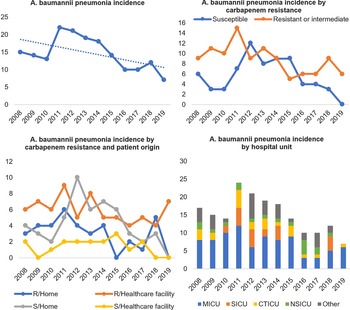
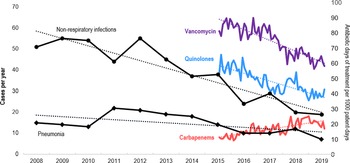
From 2008 to 2019, 175 cases of AB pneumonia occurred. Of these, 94 (53.7%) were diagnosed by NBBAL, 41 (23.4%) by BAL, 21 (12.0%) by endotracheal aspirate, and 19 (10.9%) by sputum culture. As illustrated in Figure 1, the incidence of both pneumonia and nonrespiratory AB infections declined over time. These 2 trends were highly correlated (r = 0.64; P = .024).
Acinetobacter baumannii pneumonia cases from 2008 to 2019 at our center, subdivided by carbapenem resistance, patient origin, and hospital unit. Note. R, resistant or intermediate; S, sensitive; MICU, medical intensive care unit; SICU, surgical intensive care unit; CTICU, cardiothoracic surgery intensive care unit; NSICU, neurologic-neurosurgical intensive care unit.

Descriptive characteristics of AB pneumonia cases
Patients with AB pneumonia were more commonly male (109 of 175, 62.3%), and the median age was 62 (interquartile range [IQR], 49–72). The most common location of care was the medical ICU with 87 cases, followed by the surgical and cardiothoracic surgery ICUs with 22 cases each, and the neurologic-neurosurgical ICU with 17 cases. The remaining 27 cases were a mix of ICU and floor patients. The median length of stay prior to pneumonia onset was 6 days (IQR, 1–16) from ICU admission (excluding non-ICU patients), 8 days (IQR, 2–19) since admission to NMH, and 24 days (IQR, 8.5–66) from admission to any healthcare facility. Only 15 patients (8.6%) lacked an artificial airway at the time of diagnosis; 60 (34.3%) had had a tracheostomy, and 100 (57.1%) were endotracheally intubated. Of 175, 147 (84.0%) were mechanically ventilated at the time of diagnosis; 112 (64.0%) had been on mechanical ventilation for >48 hours (thus meeting criteria for ventilator-associated pneumonia), and 66 (37.7%) had been on mechanical ventilation for >10 days. More than half of these patients (88 of 175, 50.3%) had been transferred from another healthcare facility. Shock was present in 70 patients (40.0%) at the time of diagnosis. The in-hospital mortality rate was 32.0% (56 of 175). Baseline characteristics of the patient population are displayed in Table 1.
Characteristics of Patients With A. baumannii Pneumonia and Associated Odds of Carbapenem-Resistant Compared With Carbapenem-Sensitive Infection

Note. CRAB, carbapenem-resistant Acinetobacter baumannii (includes isolates reported as either “intermediate” and “resistant” by the laboratory). CSAB, carbapenem-sensitive Acinetobacter baumannii; OR, odds ratio; CI, confidence interval; HIV, human immunodeficiency virus; COPD, chronic obstructive pulmonary disease; MRSA, methicillin-resistant Staphylococcus aureus; VRE, vancomycin-resistant Enterococci, ESBL, extended-spectrum β-lactamase.
a Odds ratios listed are for CRAB compared to CSAB.
*P < .05; **P < .01; ***P < .001.
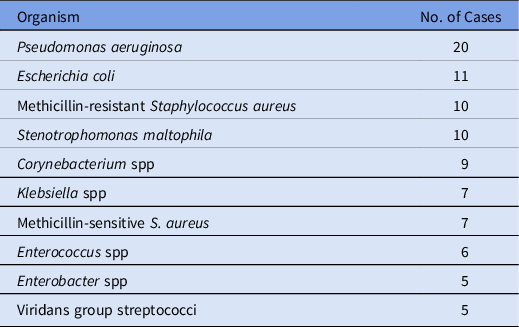
Among pneumonia cases, 107 (61.1%) were carbapenem-resistant (CR), while the remaining 68 (38.9%) were carbapenem-sensitive (CS). Numbers of both CR and CS cases declined over the study period, but the relative share of carbapenem-resistant cases increased. Polymicrobial pneumonia was common (Table 2); the organisms most frequently isolated during the same pneumonia episode were Pseudomonas aeruginosa (20 cases), Escherichia coli (11 cases), and MRSA (10 cases).
Organisms Most Frequently Isolated on Respiratory Culture Concurrently With A. baumannii at the Time of Pneumonia Diagnosis

Note. Other organisms isolated were Proteus and Serratia spp, 3 cases each; Burkholderia, Chryseobacterium, and Providentia spp, 2 cases each. There was 1 case each of Alcaligenes, Citrobacter, coagulase-negative staphylococci, group B streptococci, group G streptococci, H. influenzae, Morganella, Neisseria, human metapneumovirus, Influenza A, rhinovirus, and respiratory syncytial virus.
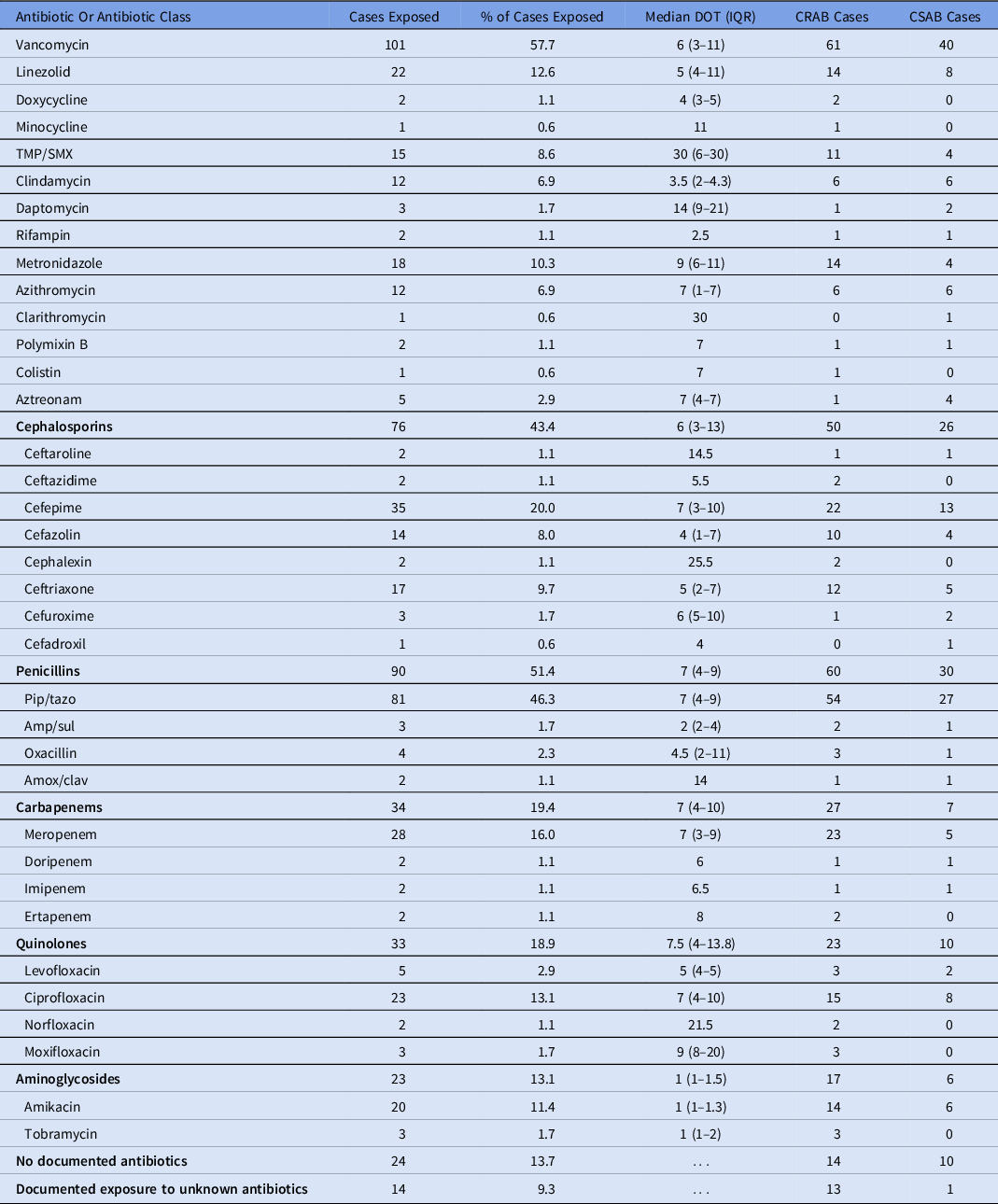
Table 3 lists all antibiotics to which AB pneumonia cases were exposed in the preceding 30 days. Vancomycin was the most frequently used antibiotic, with 101 cases and a median of 6 days of therapy (DOT) (IQR, 3–11) followed by piperacillin-tazobactam (81 cases; median, 7 DOT; IQR, 4–9) and cefepime (35 cases; median, 7 DOT; IQR, 3–10). Only 24 patients had no documented recent exposure to antibiotics, whereas 14 had some antibiotic exposure with details unavailable (eg, a note documenting only that the patient “received a course of antibiotics prior to transfer from outside hospital”).
Antibiotic Exposure of Individual A. baumannii Pneumonia Cases Within the 30 Days Preceding Pneumonia Diagnosis

Note. DOT, days of therapy. IQR, interquartile range (not calculated for categories with only 1 or 2 cases). CRAB, carbapenem-resistant Acinetobacter baumannii (includes isolates reported as either “intermediate” and “resistant” by the laboratory). CSAB, carbapenem-sensitive Acinetobacter baumannii. TMP/SMX, trimethoprim-sulfamethoxazole. Pip/tazo, piperacillin-tazobactam. Amp/sul, ampicillin-sulbactam. Amox/clav, amoxicillin-clavulanic acid.
Case–control analysis of CRAB and CSAB pneumonia
Table 1 displays the odds of CRAB as compared to CSAB pneumonia associated with various patient characteristics. Admission via transfer from another healthcare facility was strongly associated with carbapenem resistance (odds ratio [OR], 5.92; 95% confidence interval [CI], 3.00–11.7), as was presence of tracheostomy (OR, 2.27; 95% CI, 1.15–4.48) and mechanical ventilation ≥10 days (OR, 2.26; 95% CI, 1.17–4.48). If patients who received a carbapenem in the preceding 30 days were excluded, significant associations with healthcare facility transfer (OR, 6.27; 95% CI, 2.97–13.2) and tracheostomy (OR, 2.55; 95% CI, 1.22–5.35) remained, but not prolonged mechanical ventilation duration.
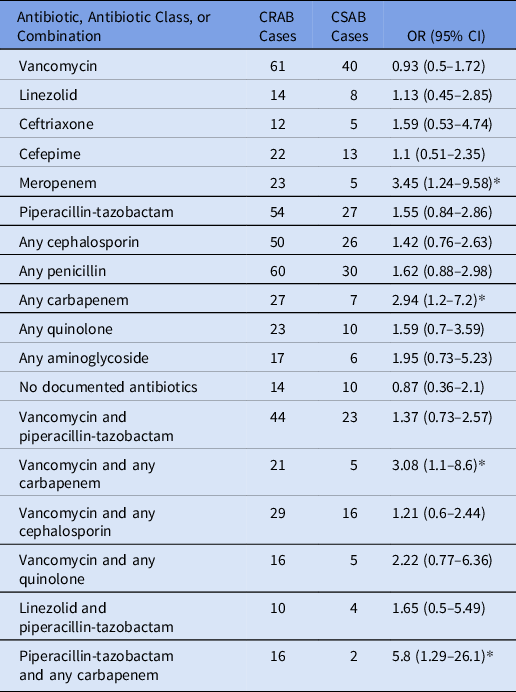
As displayed in Table 4, antibiotic exposures significantly associated with CRAB were meropenem (OR, 3.45; 95% CI, 1.24–9.58), carbapenems as a class (OR, 2.94; 95% CI, 1.2–7.2), and carbapenem-containing combinations. Days of antibiotic therapy were not significantly different between CRAB and CSAB patients.
Odds of Carbapenem-Resistant A. baumannii Pneumonia Compared With Carbapenem-Sensitive A. baumannii Pneumonia After Exposure to Selected Antibiotics

Antibiotic “combinations” refers to receiving both antibiotics within the prior thirty days, not necessarily on the same day. Odds ratios for all antibiotics omitted from this table were non-significant.
*P < .05.
Ecological analysis of antibiotic consumption and AB incidence
Our analysis of hospital-wide antibiotic use from 2015 through 2019 (Fig. 2) revealed a substantial decline in the use of vancomycin, from a mean 85.2 DOT per 1,000 patient days in 2015 to 62.1 in 2019. Quinolones use decreased from 58.0 DOT per 1,000 patient days in 2015 to 39.66 in 2019. Conversely, the use of carbapenems, cefepime, and piperacillin-tazobactam increased over the same period.
Incidence of Acinetobacter baumannii pneumonia and infection at other sites from 2008 to 2019 (left vertical axis), superimposed with hospital-wide consumption of selected antibiotics from 2015 to 2019 (right vertical axis).

A moderate negative correlation between AB pneumonia incidence and hospital-wide carbapenem use (r = −0.48; P = .031) was detected; correlations with other antibiotics were not significant. Analysis of AB infection at any site reproduced the negative correlation with carbapenem use (r = −0.63; P = .003) and revealed a significant positive correlation with hospital-wide use of vancomycin (r = 0.55; P = .012) and quinolones (r = 0.51; P = .022). A negative correlation with piperacillin-tazobactam was of borderline significance (r = −0.45; P = .045).
Discussion
Our center experienced a marked decline in A. baumannii incidence from 2008 to 2019. A review of the literature revealed that other centers with similar trends reported infection-control measures targeted specifically toward AB. For example, academic centers in Spain and Korea suffered AB outbreaks, rolled out specific interventions, and then reported reductions in hospital-wide AB incidence as a result; crucially, both programs included new restrictions on carbapenem use. Reference Cho, Bak, Baek, Park, Kim and Bae9,Reference Corbella, Montero and Pujol10 In contrast, the striking feature of our findings is that the incidence of AB pneumonia is decreased at our center despite a concurrent increase in hospital-wide carbapenem use. Importantly, the same trends are reflected on a national level: CRAB incidence in the United States decreased from 2012 to 2017, 1 whereas per-capita carbapenem consumption steadily increased after 2000. 11,Reference Klein, Van Boeckel and Martinez12
Our study population, comprising 175 patients over 12 years, appears to be representative of AB pneumonia cases in the United States. Most patients were mechanically ventilated, had prolonged stays in healthcare facilities, and/or were exposed to broad-spectrum antibiotics. Additionally, the main identified risk factors for CRAB as compared to CSAB pneumonia in our study population, namely carbapenem use, tracheostomy, and transfer from another healthcare facility, have been well described in previous literature. Reference Antunes, Visca and Towner2–Reference Peleg, Seifert and Paterson4,Reference Falagas, Kopterides and Perez6–Reference Perez, Endimiani and Ray8
Implications for antibiotic stewardship
In the ecological portion of this study, we identify a potential association between total AB incidence and both quinolone and vancomycin consumption. This association did not achieve significance for AB pneumonia cases alone, likely due to the low total number of observations in this group from 2015 to 2019, the only period when antibiotic consumption data were available. The total prevalence of vancomycin use among AB pneumonia cases was high (57.7%), and 18.9% were exposed to quinolones.
At our center, antibiotic-stewardship efforts to limit the use of anti-MRSA agents have been underway for some years. In 2016, we pilot tested the use of a rapid MRSA PCR for BAL specimens, enabling rapid de-escalation of anti-MRSA therapy for ICU patients with suspected pneumonia, which subsequently led to widespread clinical use. Reference Paonessa, Shah and Pickens13,Reference Pickens, Qi and Postelnick14 Others utilized a rapid nasal MRSA PCR in non-intubated patients to avoid MRSA antibiotic coverage. Reference Markoski, Wang and Bertram15 These efforts have led to a decline in both ICU and hospital-wide vancomycin consumption since 2015. Quinolone use decreased as well in response to concerns about resistance and adverse effects.
In a previous meta-analysis, glycopeptide antibiotic use has been associated with increased risk of MDR A. baumanniii and P. aeruginosa infection, both when compared to antibiotic-sensitive infections and when compared to uninfected controls. Reference Lim, Chua, Teo, Cai, Lee and Kwa16 Quinolones have also emerged as a risk factor for MDR cases compared to antibiotic-sensitive controls, but interestingly, not when compared to uninfected controls. Separately, in preliminary data from the Northwestern SCRIPT project, a specific shared cluster of microorganisms was found in BAL fluid collected from patients with A. baumannii and P. aeruginosa pneumonia, which crucially differed from the microbiome of both patients with pneumonia due to other pathogens and from that of uninfected patients. 17 These reports, taken together with our current findings, lead to a hypothesis that vancomycin exposure could play a part in A. baumannii and P. aeruginosa pneumonia pathogenesis by selecting for a distinctive lung microbiome favorable to those pathogens.
This study has several limitations. We were unable to account for environmental and other nonpharmacologic influences on A. baumannii transmission. Upon review of hospital infection-prevention interventions, we identified several pertinent changes during or near the study period. In 2007, a policy was implemented to discard unused gloves and other open supplies from rooms of patients with CRAB at the time of discharge; in 2013, “Contact Plus” isolation precautions (bleach cleaning daily and upon discharge, in addition to gown-and-gloves contact precautions already in place) were added for such rooms. Additionally, adenosine triphosphate sampling (a measure of total bioburden) was implemented starting in 2014 for a subset of all inpatient rooms, with abnormal results triggering repeat cleaning prior to new patient admission. These interventions per se should not influence the association between antibiotic consumption and AB incidence because they pre-date the period over which it was analyzed (2015–2019). However, if cleaning quality and/or adherence to disinfection policies improved in a delayed manner over time, this would confound the findings.
Water management systems have also undergone continual monitoring and improvement at our hospital throughout the study period. Pertinent events include updated plumbing mapping and completion of a new water hazard analysis in 2018, efforts to eliminate dead-end sections of piping from 2018 to present, and upgrading of boilers in one hospital building to “hyperheat” water before distribution. To our knowledge, no water-management interventions have targeted AB specifically, but the changes described above could plausibly decrease AB burden.
Finally, transfers of care between hospitals and long-term care facilities are known to play a key role in AB dissemination. Reference Perez, Endimiani and Ray8 Although we have identified such transfers as an individual-level risk factor for CRAB pneumonia in the case-control portion of the study, additional investigation is needed to determine whether changes in the pattern of such transfers could explain some of the variation in AB incidence.
Due to these shortcomings, the potential association between decreased vancomycin/quinolone consumption and declining AB incidence should certainly be interpreted with caution. Nonetheless, the observed trends are novel and can provide valuable hypothesis-generating directions for future research. Although selection for carbapenem resistance does correlate with carbapenem use, an antibiotic-stewardship focus on glycopeptides and quinolones might play a greater role in decreasing all Acinetobacter infections.
Acknowledgments
Financial support
This work was supported by the National Institutes of Health (institutional training grant no. 3T32HL76139-13S2 to C.I.P.) and by the National Institute of Allergy and Infectious Diseases at the National Institutes of Health (grant no. U19AI135964 to R.G.W. and C.Q.).
Conflicts of interest
All authors report no conflicts of interest pertinent to this work.