The best model for delivery of optimal surgical care to children with cardiac disease is unknown. There are hundreds of institutions listed in numerous registries performing congenital cardiac surgery in the United States, with the annual volume of cases ranging from 10 to 1800 per year. In the Society of Thoracic Surgeons’ Congenital Database, the 30-day post-operative or in-hospital mortality for all cases and for Risk Adjustment for Congenital Heart Surgery-1 category – henceforth called “risk category” – 6 typically ranges from 0% to 8% and 3% to 60%, respectively.
Such a range of volume and outcomes implies that cardiac care is not being delivered optimally. Numerous studies have examined the possible link between case volume and outcomes, leading to the suggestion that paediatric cardiac care should be regionalised to a smaller number of higher volume programmes.Reference Halm, Lee and Chassin1–Reference Welke, O'Brien, Peterson, Ungerleider, Jacobs and Jacobs8 A model consisting of 50 programmes, each performing 400 cases per year, would meet the national volume requirements. The problem with this model is in meeting the requirements of accessibility and patient satisfaction. A high proportion (25–50%) of patients are indigent and/or do not have the resources to access programmes that are far away. Even perceived access to care affects patient satisfaction, or the “social efficiency” of health-care delivery, factors now used to evaluate health-care quality.Reference Bernet, Moises and Valdmanis9–Reference Lorch, Silber, Even-Shoshan and Millman13 Some studies have shown, for example, that patients are willing to accept a 50% increase in mortality for certain surgical procedures in order to have local access to care – that is, less than 40 miles. Given this current expectation, an alternative to conventional regionalisation must be sought.
We hypothesise an alternative to conventional regionalisation, namely the formation of “joint programmes” – two or more highly cooperative and interactive programmes at different campuses – for paediatric cardiac surgery. In this model, programmes seek to improve outcomes, accessibility, cost, and efficiency for the combined region covered. By sharing data and resources, and by jointly conferencing most or all clinical cases, such joint programmes would have the “look and feel” of a higher volume programme, which could translate to actual better outcomes. In this paper, we report results of a survey in which we queried the prevalence, structure, and perceived success of joint programmes in paediatric cardiothoracic surgery among institutions in the United States. On the basis of our experience with two such programmes, we then discuss factors that may contribute to the success of such programmes.
Materials and methods
Survey design
We designed a survey consisting of “multiple-choice” questions addressed to 125 paediatric cardiac surgeons in the United States who were randomly chosen from the registry of surgeons in CTSnet.org that stated that they performed paediatric cardiac surgery. Surveys were sent and received between November, 2009 and January, 2010. The first 29 questions addressed the characteristics of the surgeon's primary institution. If the surgeon indicated that he/she is affiliated with a joint programme – either in the past or the present – he/she completed an additional 35 questions for each institution with whom the primary institution held a joint programme. The surgeon was asked to define the “primary” institution as that which housed the busier and generally the longer existing cardiac surgery programme. Other members of the joint programme were defined as “partner” institutions. Finally, if a joint programme had existed but then ceased to exist, an additional 12 questions were asked about that defunct joint programme.
We formulated the questions to determine the basic features of the institutions, such as number of beds, annual surgical volume, case mix, demographics of the population, and the number of surgeons, as well as the hospital and physician relationships between the institutions. In addition, we queried the model for the clinical service at the partner institution, such as physician staffing and inter-institutional communication. Finally, we asked the surgeon to evaluate his/her perceived strengths and weaknesses of the programme. We did not query quantitative mortality data.
We excluded surveys returned with greater than three required questions left unanswered, as well as surveys returned by nursing, administrative, visiting and research staff, residents and fellows, and surgeons not clinically active. If a survey was returned by more than one surgeon from the same institution or from the same joint programme, we used only the survey most completely filled out and/or filled out by the more senior surgeon.
Statistical analysis
For each question, we calculated the percentage of each choice selected. We determined the significance of differences among the percentages using the chi square test with p-values less than 0.05 significant. Correlations were calculated using the Spearman rank correlation coefficient.
Results
We received 111 responses, of which 100 were from clinically active attending surgeons. A total of 83 responses completed all the questions. We excluded 19 of these because the surgeon was from the same primary institution or joint programme as another responding surgeon. Thus, we analysed 65 responses, representing 65 surgeons and 65 institutions.
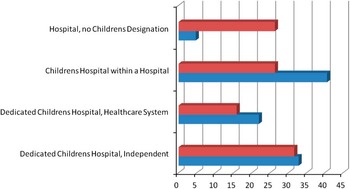
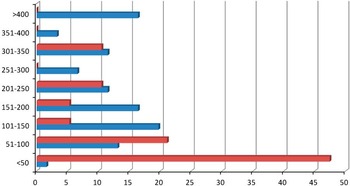
Of the 65 hospitals, 22 (35%) either had or have a joint programme with one or more other institutions, of which 15 currently exist and seven are defunct. Of the current joint programmes, 11 involve one partner hospital, one involves two partner hospitals, and three involve three partner hospitals. Approximately 26% of joint programmes have existed for 10 or more years, and 53% are 5 or fewer years old. The distributions of types of hospitals are shown in Figure 1 for the primary and partner hospitals. The difference between the distributions is significant (p = 0.0004) mainly because of the fact that only 75% of partner hospitals are actually children's hospitals, as opposed to 97% for primary hospitals. Partner hospitals had significantly fewer paediatric beds than the primary hospitals (p = 0.005). Approximately 50% of partner hospitals had 100 or fewer paediatric beds, as opposed to 11% in primary hospitals, whereas 30% of primary hospitals had 250 or more paediatric beds, as opposed to only 12% in the partner hospitals. The annual volumes of cases performed with cardiopulmonary bypass are shown in Figure 2 for primary and partner hospitals. These distributions are significantly different (p = 0.03). It is particularly noteworthy that 47% of partner hospitals perform fewer than 50 cardiopulmonary cases per year.
Distribution of the type of hospital – as percentage of all joint programmes. Red = Partner Hospital; Blue = Primary Hospital.

Distribution of the annual volume of cardiopulmonary bypass cases – as percentage of all joint programmes. Red = Partner Hospital; Blue = Primary Hospital.

The distance between the primary and partner hospitals varied greatly. The percentages were as follows: less than 5 miles (21%), 6–10 miles (5%), 11–40 miles (16%), 41–60 miles (16%), 61–80 miles (0%), 81–100 miles (16%), 101–150 miles (0%), 151–200 miles (11%), greater than 200 miles (16%). Surgical coverage in joint programmes varied. Approximately 54% of the joint programmes had no dedicated surgeon – one who lived near and predominantly worked – at the partner hospital, whereas 15% had an independent surgeon dedicated to the partner hospital, and 27% had a member of the surgical group of the primary hospital dedicated to the partner hospital. This implies that, in 54% of the programmes, a surgeon travelled from the primary to the partner hospital to perform operations. The surgical arrangement did not significantly depend on the distance between the primary and partner hospitals.
Not surprisingly, the cardiology arrangements were different from those of the surgeons. All but two partner hospitals had either an independent cardiology group dedicated to the partner hospital (51%), or had members of the primary hospital's cardiology group dedicated to the partner hospital (36%). The intensivist and anaesthesiologist arrangements were similar to those of the cardiologists, whereas 75% of partner hospitals used a separate, dedicated perfusion group for the conduct of cardiopulmonary support.
The catheterisation/pre-operative conferences were handled in a number of ways. In 37% of the joint programmes, cases from the partner hospital were reviewed at the partner hospital by partner hospital physicians only, with no involvement of primary hospital physicians. In 26% of the programmes, cases from the partner hospital were reviewed at the primary hospital. In 34% of cases, all cases from both hospitals were reviewed at a joint conference, either in person or by teleconference. In 71% of the joint programmes, morbidity and mortality conferences were held separately at the respective hospitals, and in 29% they were held jointly.
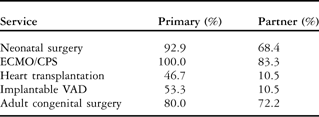
Approximately 67% of the joint programmes limited the complexity of cases performed at the partner hospital. Only 39% of partner hospitals performed risk category 6 cases, whereas 28% of partner hospitals performed only risk category 1 and 2 cases. Of the nine programmes in which there was no dedicated surgeon at the partner hospital, only one performed risk category 6 cases. The services offered at the primary and partner hospitals are shown in Table 1.
Percentages of primary and partner hospitals that provide listed services
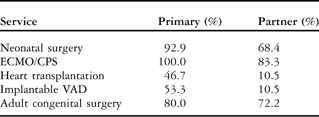
ECMO/CPS = extracorporeal membrane oxygenation/cardiopulmonary support; VAD = ventricular assist device
The administrative structure of joint programmes varied. In 67% of joint programmes, each hospital maintained its own administrator for cardiac services. Approximately 11% of the joint programmes had a common administrator and 22% of the programmes did not engage the hospitals in administrating the programme. Approximately 78% of the joint programmes had formal contracts between the hospitals. Six primary institutions charged the partner hospital no administrative fee, three institutions charged less than $100,000, two institutions charged $100,000–$500,000, and one institution charged $1,200,000 per year. In 28% of the joint programmes, responding surgeons did not know whether an administrative fee was charged.
Surgeons were asked to select a single most significant main objective of their joint programme. Approximately 46% selected, “to improve regional quality of care”, 31% selected “to increase referral of cases to the primary hospital”, 15% selected “to increase the surgical group's exposure to cases”, and one selected “to increase professional revenues”. Approximately 75% of the surgeons felt that their joint programme had succeeded in fulfilling its main objective, 15% did not know, and 10% felt their programme had not fulfilled its main objective. Of the six programmes whose stated main objective was to increase referrals to the primary hospital, only three were felt to be successful. On the other hand, of the nine programmes whose main objective was to increase regional quality, eight were felt to be successful.
Among all 15 joint programmes, 42% of surgeons felt their programme had improved the regional quality of care, combining all mission objectives; 16% felt that quality of care had not improved; 26% did not know; and 16% felt they were unlikely to formally evaluate this factor. Only 21% of surgeons in the joint programmes felt that their programme had lowered the regional cost of cardiac care. Among surgeons performing risk category 4 or greater cases at the partner hospital, 62% of surgeons felt the outcomes were “not significantly different” from those at the primary hospital and 38% did not know how the results compared.
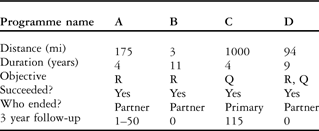
We obtained detailed characteristics of four of the seven defunct joint programmes, as shown in Table 2. In programme “A”, the period was 2000–2004. The distance between the hospitals was 150–200 miles. The primary hospital logged greater than 200 and the partner hospital less than 50 cardiopulmonary bypass cases per year. The surgeons travelled from the primary to the partner hospital to perform cases. The stated objective was to increase referrals to the primary hospital. The programme ended in its fourth year. The primary hospital felt the mission was successful, but the partner hospital was dissatisfied with the mission. A year after termination, the partner hospital had logged zero cases, but by 3 years later was logging 1–50 cases per year on its own.
Characteristics of defunct joint programmes.Footnote *
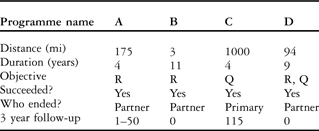
* Distance = distance between primary and partner programmes; Objective: R = increase referrals to the primary hospital, Q = increase quality of care to the region; Succeeded? = whether surgeon felt the primary objective succeeded while the programme was active; Who ended? = which hospital initiated termination of the programme; 3-year follow-up = number of cardiopulmonary bypass cases performed at the partner hospital at 3-year follow-up
In programme “B”, the period was 1985–1995. The inter-hospital distance was less than 5 miles. The primary hospital logged greater than 200 and the partner hospital less than 50 cardiopulmonary bypass cases per year. The surgeons travelled to the partner hospital. The objective was to increase referral to the primary hospital. The programme terminated in its eleventh year. The partner hospital was dissatisfied with the programme development. The primary hospital felt it had succeeded in its stated objective. At 3-year follow-up, which was the maximum follow-up requested in the survey, the partner hospital had logged zero cases.
In programme “C”, the period was 2000–2003. The inter-hospital distance was 1000 miles. The primary hospital logged greater than 200 and the partner hospital 150–200 cardiopulmonary bypass cases per year. Selected surgeons who were a part of the primary hospital's surgical group were dedicated to the partner hospital. The objective was to increase quality of care at the partner hospital. The programme ended in its fourth year. It was terminated by the primary hospital because of dissatisfaction maintaining fulfillment of the objective. At 3-year follow-up, the partner hospital partnered with another primary hospital and logged 115 cases.
For programme “D”, the period was 1996–2004. The inter-hospital distance was 94 miles. The primary hospital logged greater than 500 and the partner hospital 70–100 cardiopulmonary bypass cases per year. Surgeons from the primary hospital selected one member to be dedicated to the partner hospital. The stated objective was to increase quality of care in the partner hospital's region and to increase referrals to the primary hospital. The programme ended in its ninth year. Discontinuation was driven by the partner hospital, as it wanted to have a programme of its own. The primary hospital felt the mission was successful. At 3-year follow-up, the partner hospital logged 35–65 cases per year, 5 years later zero cases per year, and at 6 years’ follow-up re-partnered with another primary hospital and is starting to log cases.
Discussion
Results of this survey indicate that the incidence of joint programme formation in paediatric cardiac surgery is relatively common. Of the 65 institutions surveyed, 22 either have or have had a joint programme with another institution. In most such programmes, the complexity of cases was intentionally limited at the secondary institution. Overall, most surgeons perceived that their joint programmes were successful in increasing the quality of care to their regions. When the stated primary mission was simply to increase the referral to the primary hospital, about half such programmes were felt to have failed.
The optimal model for delivery of paediatric cardiac surgical care has not been determined. The challenge is formidable, partly because the volume of care is relatively small yet the intensity of care is high. Proposed models have included conventional regionalisation.Reference Chang and Klitzner2, Reference Chang and Klitzner14 This model was motivated by initial studies purporting to show a volume–mortality relationship. Alternatively, “selective-” or “evidence-based” referral, in which certain high-risk cases are referred to speciality centres for that case, have been proposed.Reference Allen, Gauvreau, Bloom and Jenkins15 Neither of these models solves the dilemma of access to care, nor do they sit well with the generally free market structure of health care in the United States. In yet another model implemented in one city, two hospitals alternated level one trauma care annually, a model that probably would not be palatable in paediatric cardiac care.Reference Schiller and Anderson16
It is appealing to propose that joint programmes are the practical solution to achieving better quality and accessibility of cardiac care. The present survey analysis indicates that joint programmes are relatively prevalent and that, on average, most surgeons felt that the model had improved quality of care in the extended region served. As opposed to conventional regionalisation, joint programmes preserve or even increase access to cardiac care.
However, the devil is in the details. First, the survey indicates that a joint programme may have an increased chance of failure if the primary mission is to increase referrals to the primary hospital. This failure is a result of “mission dissonance”, in which a member of a partnership adheres to a mission that cannot, by its nature, be shared. In this author's view, a common mission – to improve the quality of care in the combined region – is critical to the joint programme's success and relies on establishing and maintaining close professional bonds among as many practitioners, at both institutions, as possible.Reference Wagner and Muller17
Second, the joint programme must have the structure and processes that actually enable improvement in quality of care. For example, the regular use of medical imaging-quality teleconferencing for case presentation and quality improvement permits all practitioners to be exposed to the combined experience of both institutions on a regular basis. Another example is “tight” cross-coverage by physicians, assuring in-person cross-coverage between institutions and among all subspecialists, putting patients at less risk, and thus improving quality. A third example is the open sharing of all clinical data through mutually accessible databases, allowing studies to be performed that would not have been possible at each separate institution because of volume limitations.
A final factor determining the success and sustainability of the joint programme is the cooperation between the hospitals housing the programmes. The hospital administrations must adhere to the mission of the joint programme and make all decisions in line with that mission, keeping the mission in synchrony with their strategies of business. When this synchrony is lost, the ability of the physicians to sustain the programme is jeopardised.
Importantly, partners in joint programmes do not need to have a “mother/daughter” relationship to achieve the mission of improvement of quality of care. Partnering institutions can learn from each other. Indeed, the partner hospital in 39% of the joint programmes in the present survey performed risk category 6 cases. The decision of what level complexity the partner hospital will handle must be determined on the basis of available resources, fulfillment of the mission, and assurance of accessibility of care, and not on the dominance of the primary hospital.
The current study – a survey analysis – has obvious limitations in that it provided only clues but not proof of the nature of an optimal joint programme model in paediatric cardiac surgery, as well as its actual ability to increase quality of care. It is evident that current and past joint programmes show a high degree of heterogeneity in mission, structure, process, and success. Delineation of the optimal model may depend upon a concerted effort by leaders of such programmes to exchange ideas and develop a consensus model that could be implemented at multiple sites and then rigourously studied. If successful in paediatric cardiac surgery, it is possible that the joint programme model can be a practical alternative to conventional regionalisation in many other medical and surgical specialties.
Acknowledgements
The author thanks the Orlando Health Foundation, Orlando, Florida for providing financial support for this work.