Introduction
Availability of residential long-term care homes for older people with cognitive and physical disabilities varies from country to country, and within countries. In areas of the world where there are few or no residential care facilities, long-term care (LTC) for people with advanced dementia or disabling psychiatric illnesses or severe physical disabilities is usually provided by families or carers within people's own homes.
The type, organization, funding and policies of LTC homes vary among countries that do have them, and (together with facility design and attitude) are factors that affect the prevalence of mental disorders and the likelihood of being able to relieve mental distress. Much of the literature about mental health service delivery in LTC homes has emanated from countries where over 3% of persons aged over 65 years live in nursing homes, and comments and conclusions about mental health service provision are not necessarily pertinent in regions where few people live in LTC homes. Even among countries with high institutionalization rates, differences in size of facilities and other factors may determine the differential appropriateness of particular models of mental health service delivery.
This review considers various models of mental health service delivery in nursing homes, as observed in diverse countries, and extends its discussion to consider provision of services in assisted living and comparable residential homes. Relatively recently, Moak and Borson (Reference Moak and Borson2000) bemoaned the “unmet need” for mental health services in U.S. LTC homes and a lack of consensus regarding the kinds of expertise that should be deployed to deliver such services. There is good reason to study the literature about mental disorders in LTC facilities and how best to deal with them, and then to distil some recommendations that may be variably applicable and relevant in countries where LTC homes are available.
Methods
The Residential Care Task Force of the International Psychogeriatric Association (IPA) invited the author to present views concerning provision of mental health services in LTC homes. The aim was to provoke discussion and draw up recommendations that would be made available for comment by those working in LTC.
In order to inform the discussion, the author re-read or examined literature concerning mental health problems in LTC homes, and how best to deal with them. Opinions and evidence about the most effective ways of providing mental health services in LTC were considered. Attention was given to factors affecting persistence of mental health problems in LTC settings. This literature exploration was not systematic. Rather, it could be described as a narrative review, to give a critical overview of models of mental health care and mental health service delivery. Analyses of the strength of evidence (e.g. Draper and Low, Reference Draper, Low, Draper, Melding and Brodaty2005) were noted. Much of the relevant literature is known to the author, though some relevant and key references may have escaped his attention. Nevertheless, he intended to provide an overview of important issues in order to draw out observations and expressions of opinion from members of the Task Force, who represented health disciplines and countries that have considerable and varied experience in LTC. Discussion of the presented literature, opinions and experience-based observations allowed refinement of the author's proposed recommendations for optimal mental health service delivery. It was recognized that preferred models will differ between jurisdictions, depending on circumstances and needs.
Results: a review of relevant literature and research studies
Introductory questions
Studies around the world have shown a high prevalence and incidence of various mental disorders in LTC homes. To what extent do LTC homes provide optimal assessment and intervention services in relation to these disorders? How good are they at preventing development of mental disorders? Do facilities have access to the varying combinations of resources and personnel that are most likely to help relieve or cure the different disorders?
The following questions should be answered. (1) What can and should LTC facilities do to prevent, screen for, assess, treat and/or provide ongoing management of mental disorders among their residents? (2) What are the roles of LTC staff and of primary care doctors? (3) What is the role of mental health professionals who visit those LTC homes either regularly or in response to requests? (4) In what ways do visiting mental health professionals or teams link with LTC home staff to ensure optimal improvement? (5) Are there ways by which consultant experts or advisers can contribute to relief of mental disorders other than by visiting the homes? (6) Who pays? Is more money the answer to everything?
Is there adequate provision of mental health care and services in LTC homes?
Much of the literature on provision of mental health services in nursing homes has come from the U.S.A. In 1985–6, a nationwide survey in LTC homes showed that 2.3% of residents had contact with a mental health professional and another 2.2% received some mental health care from a general physician (Burns et al., Reference Burns, Wagner, Taube, Magaziner, Permutt and Landerman1993). At that time, 51% of residents were diagnosed as having dementia, 4% schizophrenia or other psychosis and 11% other mental disorders. The physician's role tended to be in managing aggression (ordering restraints or psychotropic medication as needed) while the mental health specialist tended to focus on mood disturbance.
Criticisms of care arrangements and medication use led to the U.S. Omnibus Budget Reconciliation Act, proclaimed in 1987 (OBRA ’87). A summary of OBRA regulations was provided by Ouslander et al. (Reference Ouslander, Osterweil and Morley1991). PASARR (Pre-Admission Screening and Annual Resident review) was mandated with the intention of restricting access of persons with mental disorders to Medicaid-funded nursing home care, but ensuring that they reached settings where appropriate treatment was available (and funded by the state). Borson et al. (Reference Borson, Loebel, Kitchell, Domoto and Hyde1997) commented that the PASARR process identified most cases of schizophrenia but failed to identify most of those with significant depression, or those with treatable non-cognitive symptoms of dementia. Such residents could be admitted to nursing homes because of physical problems and were funded to have those problems treated, but the new policies did not allow for assessment and treatment of their mental disorders. Snowden et al. (Reference Snowden, Piacitelli and Koepsell1998) found that compliance with PASARR recommendations for the use of specialty mental health services (consultation, therapy, day treatment) was generally low.
In 1990, Medicare coverage of mental health services had been expanded to include direct billing by clinical psychologists and certified social workers (Streim et al., Reference Streim, Beckwith, Arapakos, Banta, Dunn and Hoyer2002). There was a subsequent tripling of Medicare payments for nursing home mental health services, though an Inspector-General's review showed 32% of such services to be medically unnecessary and another 15% questionably so. Psychological testing was criticized for excessive length or frequency of testing. A 1997 law altered reimbursement methods for nursing homes, yielding large budget savings for Medicare, but resulting in the withdrawal of substantial resources from LTC (Streim et al., Reference Streim, Beckwith, Arapakos, Banta, Dunn and Hoyer2002).
Harrington (Reference Harrington2001) added to the criticisms. Referring to the continuing poor quality of U.S. nursing homes over three decades, she declared that the nursing home industry was increasingly being controlled by large and politically powerful multinational corporations, and that there was little financial accountability. Fraud and financial mismanagement were widespread throughout the industry, but (she said) the government was reluctant to impose higher standards for staffing because of concerns over cost.
Bartels et al. (Reference Bartels, Moak and Dums2002), writing about U.S. nursing homes nearly 15 years after the OBRA ’87 regulations were introduced, stated that: “Most of those residents who need mental health services do not receive them . . . Nursing home administrators have estimated that two-fifths of nursing home residents need psychiatric services yet half of nursing homes do not have access to adequate psychiatric consultation, and three-quarters are unable to obtain consultation and educational services for behavioural interventions”. In 2003, the American Geriatrics Society (AGS) and American Association for Geriatric Psychiatry (AAGP) called for reforms that would provide incentives for appropriate mental health care in LTC facilities.
It has been said that assisted living (AL) facilities were developed in the U.S.A. as a response to what was seen as the dismal life nursing homes offered (Calkins, Reference Calkins2007). However, levels of undetected depression in AL are reportedly also high (Gruber-Baldini et al., Reference Gruber-Baldini, Zimmerman, Boustani, Watson, Williams and Reed2005).
In other countries also, mental health services have been reported as insufficiently available in LTC facilities. A nursing home study in Ontario (Conn et al., Reference Conn, Lee, Steingart and Silberfeld1992) found that 81% of the directors of nursing of the 601 facilities responding to the survey believed their homes needed increased psychiatric services. Some 37% of the nursing homes had no visits at all from psychiatrists. Physical aggression, wandering and agitation were the problems for which they considered there was the greatest need of specialist input.
More recent findings from a study of British care homes were similar (Purandere et al., Reference Purandere, Burns, Challis and Morris2004). Only 50% of managers reported that the frequency of psychiatrist visits was adequate, 38% said their homes received no visits from psychiatrists, and 80% wanted more input for staff education and training.
Models of mental health service delivery in LTC facilities
Consultations and liaison
Psychiatric services in U.S. nursing homes, when available, are reportedly most commonly provided by a consultant psychiatrist who works alone, comes only when called to see a specific patient, and does not provide subsequent care unless called back to review the case (Bartels et al., Reference Bartels, Moak and Dums2002). When asked about psychiatrist input at their facilities, staff of U.S. nursing homes in six states declared they were satisfied in relation to diagnostic assessments and recommendations about medication. However, a majority considered that psychiatrist recommendations concerning non-drug treatments, resolution of resident family problems, education of staff and help in dealing with staff stress were inadequate (Reichman et al., Reference Reichman1998). Various authors stressed that the role of psychiatrists should extend beyond providing a consultative service for referred patients (Bienenfeld and Wheeler, Reference Bienenfeld and Wheeler1989; Sakauye and Camp, Reference Sakauye and Camp1992; Lantz and Kennedy, Reference Lantz and Kennedy1995; Gupta and Goldstein, Reference Gupta and Goldstein1999).
Hanchuk (Reference Hanchuk, Reichman and Katz1996) commented that the liaison functions of visiting psychiatrists (liaison being defined as teaching non-psychiatric caregivers what they need to know about psychiatric management of the patient) are frequently forgotten. In her view, consultation liaison psychiatry in a nursing home must include establishment of working relationships with the facility's nurses, aides, administration and other staff. “It is desirable to build a team, with each individual representing a specific aspect of the resident's care”. Psychologists work or consult at some nursing homes. Availability of staff in the various disciplines varies within and between countries, partly dependent on adequacy of funding.
Jackson and Lyons (Reference Jackson and Lyons1996) described a “roving clinic”. A psychiatrist visited residential homes for older people on a rotational basis, referrals being arranged in advance by care staff in consultation with residents’ general practitioners.
Telepsychiatry
A further innovative consultation-liaison approach has been the use of telepsychiatry to allow assessments of patients and provide management advice to staff of residential facilities. Tang et al (Reference Tang, Chiu, Woo, Hjelm and Hui2001) used telepsychiatry to link a psychiatrist and colleagues from a hospital in Hong Kong to a “care and attention home” on a monthly basis. Trinkle (Reference Trinkle2003) provided an example from Virginia, U.S.A. The utility of telemedicine in relation to nursing homes located in remote areas with poor access to specialized care has been demonstrated since 2000 in Ontario by Conn and colleagues (Bilas and Conn, Reference Bilas and Conn2002; Shulman et al., Reference Shulman, Conn and Elford2006). The main demands were diagnostic assessment and treatment of dementia and affective disorders. The program aimed to provide access to specialized consultation, and to provide support and training to caregivers. Ramos-Rios et al. (Reference Ramos-Rios, Mateos, Lojo, Conn and Patterson2010) have discussed how best to apply telemedicine to an old age psychiatry population. Challenges that make it more difficult include the high prevalence of visual and hearing impairments in such patients, problems resulting from cognitive impairment (e.g. in their understanding of what is required of them), and communication problems due to dysphasia or dysarthria or inability to hear what the patient says. Further consideration of the potential for provision of such a service to remote or under-served areas of the world is given below.
Multidisciplinary teams
A key concept of the guidelines issued by the Canadian Coalition for Seniors’ Mental Health (2006) is that effective mental health promotion and management of mental health problems in LTC facilities requires an interdisciplinary team effort.
A team approach necessitates clear communication between members both in writing and during discussion. Case conferences, with referred residents seen by the psychiatrist and team together, give opportunities for education as well as information sharing. A major limitation is if staff cannot get away from other duties to join in team discussions. The model is feasible only if funds allow time for involvement.
Joseph et al. (Reference Joseph, Goldsmith, Rooney, McWhorter and Ganzini1995) described a Mental Health Consultation Team (MHCT) established in a 120-bed Veterans’ nursing home, but acknowledged that its success was partly attributable to having more staff resources than would be the case in other nursing homes. The team consisted of primary care providers working in the facility, including nurse practitioners and social workers, supported for two hours (each) per week by a visiting geropsychiatrist and mental health clinical nursing specialist. In addition, the nursing home designated four hours per week of nursing time to provide a “unit expert” to liaise between the MHCT and the nursing staff. The unit expert often performed a preliminary assessment, helped implement individual treatment plans and facilitated communication of MHCT recommendations to “bedside nurses”. Designation of one nurse in a facility to receive and coordinate referrals of residents for psychiatric evaluation (Bienenfeld and Wheeler, Reference Bienenfeld and Wheeler1989) has been said to be crucial to the monitoring of mental health care (Hanchuk, Reference Hanchuk, Reichman and Katz1996). As the nurse's experience with psychiatric treatments and evaluations improves, so does the level of care within the facility.
Bartels et al. (Reference Bartels, Moak and Dums2002) concluded that a multidisciplinary team approach is the preferred model for mental health service provision in nursing homes. They stated that the usual understanding of this model is that teams come from outside the facility and include a psychiatrist and one to four other health professionals (most often psychiatric nurses, a psychologist and/or a social worker). They vary in the roles and responsibilities they undertake. The nurse specialist may be more effective in developing treatment plans with facility nursing staff, the psychiatrist in relating to doctors (diagnosing and advising on medical interventions), psychologists in neuropsychological assessment and behavioral management, and social workers in addressing family and social support concerns.
Old age psychiatry services have evolved in a number of countries (Snowdon and Arie, Reference Snowdon, Arie, Draper, Melding and Brodaty2005). One of their aims is to reduce the need for admission to residential care facilities. Arrangements vary. Commonly, a community multidisciplinary team is linked to an inpatient service and accepts referrals regarding older persons in a defined catchment area – and this includes requests to see and advise on interventions for people in residential care facilities. Budgetary constraints affect the extent to which they can be available. A recent initiative in New South Wales, Australia (Turner and Snowdon, Reference Turner and Snowdon2009), aims to educate staff of such facilities about prevention and treatment of mental disorders, while providing ongoing supervision and modeling of behavioral strategies. These Behavioral Assessment and Intervention Services (BAsIS) are linked to already existing old age psychiatry teams.
Draper and Low (Reference Draper, Low, Draper, Melding and Brodaty2005) referred to nine controlled trials of psychogeriatric service interventions in LTC facilities. Although results were mixed, it appeared that liaison-style services employing educational approaches, treatment guidelines and ongoing involvement of mental health staff are more effective than pure case-based consultative approaches. Several uncontrolled evaluations of outreach services to nursing homes have reported benefits to residents and staff satisfaction with the aid provided. The cost-effectiveness of the team approach needs to be assessed (Bartels et al., Reference Bartels, Moak and Dums2002). A Dutch group called for more rigorously designed studies to help identify the ingredients responsible for efficacy in multidisciplinary (medical, psychiatric and nursing) interventions to relieve severe behavioral problems in nursing homes (Collet et al., Reference Collet, de Vugt, Verhey and Schols2010).
Some research reports have shown how multidisciplinary teams may function in LTC homes. Brodaty et al. (Reference Brodaty2003) described an intervention study aimed at treating residents with dementia complicated by depression or psychosis. Multidisciplinary team intervention for 12 weeks was compared with “usual care”, and also with a group for whom management plans had been recommended to the nursing home and primary care doctor. All groups improved, the intervention groups doing no better than the controls. This lack of difference could have been because intervention directed to one group may also have affected the control group (residing in the same facilities) and because all groups received considerable attention during assessment periods.
Kotynia-English et al. (Reference Kotynia-English, McGowan and Almeida2005) examined whether screening for depression and/or behavior disturbance of all new admissions to nursing homes, with prompt referral to an old age psychiatry service of those who screened positive, would lead to a better one-year outcome than that observed in a control group. There was no difference, maybe again because of greater than usual attention given to both intervention and control subjects.
A nurse-centred model
As well as the psychiatrist-centered and multidisciplinary team models of mental health service delivery in nursing homes, Bartels et al. (Reference Bartels, Moak and Dums2002) identified a nurse-centered model. Santmyer and Roca (Reference Santmyer and Roca1991) described a service where referrals were made (most often by doctors and registered nurses) to a nurse specialist. This nurse spent two days per week in the nursing home but was available for emergency contact five days a week. Clinical supervision was provided by a psychiatrist once weekly for two hours, but about 50% of the problems prompting referral were within the nurse specialist's expertise and did not require the psychiatrist's direct involvement.
Ballard et al. (Reference Ballard2002) reported the work of a nurse who liaised with six facilities in Newcastle (U.K.), two being nursing homes and four residential homes. The nurse visited each facility weekly. A psychiatrist and clinical psychologist provided supervision and problems were discussed by a multidisciplinary team. Interventions were based on detailed evaluation of behaviors, antecedents and consequences in order to develop individual (“tailored”) management plans. Medication review was conducted, and evaluation showed reduced general practitioner (GP) contacts, fewer hospital admissions and reduced use of neuroleptic drugs in the intervention group. However, there was no reduction in level of behavioral disorders after nine months.
Nursing homes have been encouraged to appoint one of their own staff, such as a registered nurse, to train as a depression care manager (Carlson and Snowden, Reference Carlson and Snowden2007). As in collaborative care trials within primary care settings, the responsibilities of the position could include regular screening for depression, as well as education of staff, families and patients about depression, development of treatment plans and monitoring treatment response. Training of masters-level psychiatric nurse practitioners as mental health care specialists (“Long-Term Care Mental Health Managers”) has been encouraged (Bharucha et al., Reference Bharucha, Dew, Miller, Borson and Reynolds2006), such clinicians being ideally placed to provide ongoing staff training in management of difficult patients and situations, coordinate group therapies with a recreational therapist, and provide liaison with family members.
A U.S. demonstration project showed that nurse practitioners (NPs), having completed a half-time four-month program of geriatric psychiatry training, were able to work effectively as consultants in nursing homes (Eisch et al., Reference Eisch, Brozovic, Colling and Wold2000). Residents were referred because of depressive symptoms (35% of referrals), agitation, disruptive behavior, or decline in activities of daily living. The consultations were followed by positive behavioral changes in 62% of cases. Although primary care doctors needed to authorize referrals, the report did not mention that psychiatrists were involved at all.
The different models
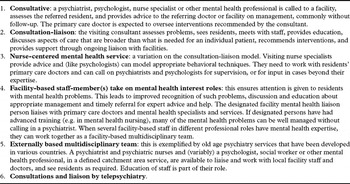
Table 1 summarizes different models of mental health service delivery in LTC homes.
Summary of six models of mental health service delivery in LTC homes.

Provision of mental health care in standard nursing homes may prove ineffective or beyond the resources and capabilities of such facilities, even with outside help. In such cases, transfer to a special treatment unit (Mintzer et al., Reference Mintzer1993), psychogeriatric nursing home (as in Melbourne) or old age psychiatry unit in hospital is indicated – after appropriate consultation or liaison.
Optimization of mental health care within LTC homes
Educational interventions
Several studies have suggested that targeted educational interventions may be successful in changing treatment practices within nursing homes (Bartels et al., Reference Bartels, Moak and Dums2002). Chartock et al. (Reference Chartock, Nevins, Rzetelny and Gilberto1988) described a program that was effective in building knowledge and improving job-skills for all levels and types of staff. Moniz-Cook et al. (Reference Moniz-Cook1998) found that staff training to recognize and manage behavioral disturbance helped them to manage difficult behaviors in the short term but was ineffective in changing 12-month levels of behavioral problems. They commented that the care home environment or “milieu” is an important determinant of whether staff training can improve the care of elderly residents. An interdisciplinary educational program in a large Canadian nursing home was reported as leading to substantial reductions in the number of residents receiving antipsychotic medication over a period of six months (Monette et al., Reference Monette2008).
In addition, the concept of the “teaching nursing home” (Williams, Reference Williams1985) should not be forgotten, the general objective being to blend the teaching and research capabilities of the academic medical centre with the unique clinical population and organization of the nursing home (Borson et al., Reference Borson, Liptzin, Nininger and Rabins1987). Collaborations were expected to result in improved quality of care, administrative innovations, better training of clinicians and useful research. Burton (Reference Burton1994) discussed how nursing homes could evolve into comprehensive geriatrics centers, with on-site physicians providing care. Academic units for training nursing home physicians have been developed in the Netherlands during the past 20 years. Their training has equipped them to teach and to be advocates in the LTC sector, and to lead multidisciplinary teams that deal with mental health problems, comorbid with long-standing and acute physical conditions. Nursing home medicine departments at several Dutch universities have formal affiliations with LTC homes.
Structure and organization of LTC homes
Residents of long-term care facilities are more likely to become demoralized, depressed, anxious, insecure and/or behaviorally disturbed if their environmental situation is demoralizing, depressing or anxiety-provoking. It would seem unarguable that surroundings, attitudes, availability of support and organizational factors within residential settings all affect the likelihood that mental health problems will develop, persist or abate in those homes. Individual factors (personality, biological changes, life events) will largely determine how residents will respond to particular circumstances, but various studies and descriptions point to the importance of environment in affecting prevalence and incidence. The guidelines of the Canadian Coalition for Seniors’ Mental Health (2006) declare that the main focus of care for persons in LTC homes should be on overall well-being and quality of life. Social and physical environments are important determinants of psychosocial and health outcomes for the residents.
Payne et al. (Reference Payne2002) reported a substantial decrease at 6 and 12 months in the prevalence of depression among newly admitted residents at a nursing home in California, probably attributable in part to environmental factors. Accounts of nursing homes that use Eden Alternative philosophies also point to beneficial effects of organizational and situational factors on the prevalence of mental health problems (Robinson and Rosher, Reference Robinson and Rosher2006). Many other examples could be given, including Group Living facilities in the Netherlands. Verbeek et al. (Reference Verbeek, van Rossum, Zwakhalen, Kempen and Hamers2009) reviewed descriptions from 11 countries of domestic-style small-scale care settings that emphasize normalized living and meaningful activities. Among them were Group Living (Sweden, Netherlands, Belgium), Green House (U.S.A.), Cantou (France) and CADE units (Australia). They referred to the importance of the kitchen for socialization, and of staff being integrated as members of the household. Improvement of residents’ quality of life is the main priority.
One aspect of organization that affects mental health service delivery concerns the recognition by facilities that individual residents have mental health problems. Use of screening tests such as the Geriatric Depression Scale (GDS; Yesavage et al., Reference Yesavage1983) or the Cornell Scale for Depression in Dementia (CSDD; Alexopoulos et al., Reference Alexopoulos, Abrams, Young and Shamoian1988) on a regular basis can help detect depressive disorders among residents. The Minimum Data Set (MDS) in the U.S.A. is being revised to improve its utility in detecting depressive features. Such tools can act as indicators that further assessment and attention are needed, but are only useful if high scores are drawn to the attention of those (e.g. primary care doctors or nurse specialists) who will take action. Tools for recording behavioral disturbance, such as the Cohen-Mansfield Agitation Inventory (CMAI; Cohen-Mansfield et al., Reference Cohen-Mansfield, Marx and Rosenthal1989) can also be useful. Staff of residential facilities need to be pro-active and positive in identifying and responding to mental health problems.
The AGS and AAGP (2003) declared that public and private insurance for U.S. nursing home residents should include coverage for appropriate mental health services and medications on parity with coverage for other medical disorders, and should pay for interventions intended to reduce behavioral symptoms. High quality mental health care in nursing homes is possible only when the level of nurse staffing is adequate to provide the necessary amount of direct care (AGS and AAGP, 2003). Resourcing of residential care is a vital consideration when planning how to provide optimal mental health services. Higher-than-average staff-to-resident ratios, individual suites and home-like amenities require higher-than-average funding.
The administration, organization and policies of individual LTC homes are factors that affect the prevalence and management of mental health problems and are themselves components of mental health service delivery. The AGS and AAGP (2003) commented that greater involvement in decision-making by nursing home residents is associated with reduced feelings of helplessness and related depressive symptoms. They recommended that nursing home staff be trained in implementing models of shared decision-making and in promoting consumer and family member participation in making healthcare choices. Family and significant others should be helped to find mutually acceptable and beneficial ways to participate in care of their loved ones.
In some countries, funding for residential care (whether from government, charities or resident payments) is limited, and mental health service delivery to LTC facilities is likely to be scarce or non-existent. Situational and organizational factors would take on even more importance. Primary care doctors and nurses would take responsibility for assessment and management of mental disorders – and where they are unable to alleviate severe symptoms they may need to transport patients long distances to regional psychiatric facilities. In some countries even these can provide only limited help.
The U.S.A. and other developed countries are much better able to afford well appointed nursing homes, with access to a range of mental health professionals, than are many countries. It is desirable that if developed countries recruit mental health professionals from developing nations to work in their services, it should be with an intention to train them and send them back better able to develop services in their own countries. However, this is an age when communication between and within countries has become much better and cheaper. Telepsychiatry provides a means by which remote areas (e.g. in Canada) can receive help, advice and support in assessing mental health problems from experts in mental health centers. If it can be done for remote Ontario it could be done for other countries. Cooperation between countries might well allow telepsychiatry to be helpful in relation to under-served long-term care facilities in developing regions, providing language and cultural understanding do not act as barriers. Travel time and costs make such support very difficult to arrange if the mental health specialists need to provide face-to-face contact. New Broadband arrangements may make telemedicine support to under-resourced countries feasible. The International Psychogeriatric Association (IPA) and World Health Organization (WHO) could discuss the idea further, as a way of ensuring that mental health services are available to LTC residents (and indeed, all older people, as necessary) in all regions of the world.
Conclusions and recommendations
1. In all countries of the world there are older persons who require supervised long-term care (whether because of physical or cognitive disabilities or both), and many of them have mental health problems. It is important that such problems be recognized and that appropriate management be initiated and maintained as necessary. It is recognized that countries vary in their cultural attitudes and arrangements for care, but it is recommended that all health and aged care departments review and (if appropriate) revise existing policies regarding mental health service provision to the long-term care sector within their jurisdictions, aiming for the optimum.
2. Where countries or regions are unable to provide optimal mental health problem assessment and care for long-term clients (at home or in residential facilities) it is recommended that discussions between countries or regions be fostered, to allow supportive arrangements (e.g. telepsychiatry) to be developed.
3. Within countries that have well-developed long-term care homes (nursing homes, assisted living, etc.) it is recommended that all such facilities have arrangements in place that allow prompt recognition of mental health problems, adequate discussion of such cases with health professionals who have mental health expertise, and (where appropriate) referral to a mental health professional or team for assessment, advice and ongoing support in overseeing ongoing management of such cases.
4. In general, it is recommended that each residential facility ensure that a consultation-liaison mental health service be available to work with facility staff and primary care doctors in dealing with mental health problems identified in the facility.
5. It is recognized that residential facilities vary, in architecture, organization and funding, and that arrangements for mental health care will differ depending on staffing, admission policies and other factors. Nevertheless, it is recommended that each facility have in place practices that allow for regular assessment of all residents to detect development or persistence of depression, delusions or other psychiatric problems. Brief questionnaires or assessment tools could be administered on a regular basis (e.g. a month after admission and then every 6 months).
6. It is recommended that each facility designate one or more staff members to take particular responsibility for overseeing identification, discussion (including with primary care doctors) and, where appropriate, referral to specialist mental health professionals, of mental health problems in the facility.
7. It is recommended that primary care doctors be recognized (and recognize themselves) as members of a multidisciplinary team working within a residential facility in dealing with mental health problems as they arise, and that the team discusses referral to consultation-liaison mental health services as appropriate.
8. It is recommended that when residential facilities are located within the catchment area of a community old age psychiatry (or equivalent) team, liaison be established between such facilities and that team, to include opportunities for education and discussion of mental health issues, not necessarily focused on individual resident problems.
Conflict of interest
None.