Though the Irish Free State at independence was a high-income economy by world standards, it was one of the least industrialised countries in Europe.Footnote 1 The manufacturing sector would be transformed by the interventionist policies of the Fianna Fáil governments of the 1930s and beyond. Even in the 1920s, however, it was more complex in structure than occasional references to a ‘beer and biscuits’ economy suggest.Footnote 2 Exports of bacon and of textiles – and, in some years, of vehicles and parts – far exceeded exports of biscuits, and such comparisons are, in any case, of limited relevance given that the manufacturing sector of the time was oriented primarily towards the home market.
An overview of the manufacturing sector can be gained from the official publications of the era. Annual trade and shipping statistics are available for the new Irish state from 1924. The first census of industrial production (C.I.P.) was produced for 1926 and the second for 1929.Footnote 3 The data in the census of industrial production pertain to establishments (i.e., factories or workplaces) rather than to firms. The 1929 census was the first to record establishment size. Of the close to 2,200 manufacturing establishments recorded, only nine employed 500 or more, while a further twenty employed between 250 and 499. Most firms in the 1920s operated a single establishment though the leading firms in sectors such as grain milling, bacon curing and fertiliser production each operated more than one.
While the number of large establishments can be determined from the C.I.P., there are no data on the number of large firms. Nor does the census reveal the identities of the establishments, as such information was provided in confidence. The present paper sets out to identify both the largest establishments and the largest manufacturing firms in the state at the time, as well as the largest in each industrial sector. Data on employment levels are drawn for the most part from newspaper archives or from the business press more generally. Since employment levels are reported only infrequently, pre-1929 numbers are generally adopted when data specific to 1929 are not available, given the massive expansion in manufacturing that occurred over the course of the 1930s.Footnote 4
Some official publications, such as the reports of the Fiscal Inquiry Commission and the Tariff Commission, and early issues of the Irish Trade Journal, identify the leading firms in a small number of sectors. More generally, the present analysis proceeds by trawling for information on employment levels in all of the firms listed in the Irish manufacturers’ directory and year book (Dublin, 1919) and on others found to have been established over the subsequent decade.Footnote 5 Other data compiled as part of the present project include firm location, date of establishment and details of ownership. With respect to the latter it should be pointed out that nationality of ownership refers not to the origins of the entrepreneur but to whether or not the firm was a subsidiary of a foreign-owned company. Foreign ownership was a matter of controversy in the newly independent state, as it would later be across the entire postcolonial world. Among the concerns expressed in Ireland in the 1920s and 1930s were that the key positions in foreign-owned firms would be reserved for foreign staff and that foreign ownership would inhibit the emergence of domestic infant industries and render it more difficult to protect the national interest.Footnote 6 Religion of ownership was also perceived to be of significance, though care must be taken not to confuse the effects of religion and social class since Protestants were strongly overrepresented in the higher echelons of most business activities.Footnote 7 There were widespread perceptions of sectarianism in recruitment, however, particularly to management positions, and in the conduct of business more generally.Footnote 8 Religion also overlapped to a large extent with political attitudes towards independence and it has been suggested that fear of capital flight by the elite – who ‘might be suspected of having scant sympathy with the new state’ – constrained the policy options available to the Cumann na nGaedheal governments of the 1920s.Footnote 9 The religion of ownership and control of Irish firms is identified for the most part through the 1901 and 1911 population censuses.Footnote 10
The article begins with a comparison of the size and structure of the manufacturing sector in the Irish Free State, and in Britain and Northern Ireland in the 1920s. The official data are drawn from the census of production rather than the perhaps more familiar census of population. The latter provides data on occupations, many of which are not specific to particular industries. The focus of the census of production, by contrast, is on industrial sectors, within which many different occupations may be employed. 1929 is adopted as the benchmark year because the census of industrial production for that year was the first to provide information on the size categories of establishments. Section II of the article explores the identities of the nine largest establishments in the Free State at the time. Following sections discuss in turn the leading firms in food, drink and tobacco; textiles, clothing and footwear; metals and engineering; and in the remaining manufacturing segments. The paper also presents snippets of individual company histories that shed light on the political and economic circumstances of the period in question.
I
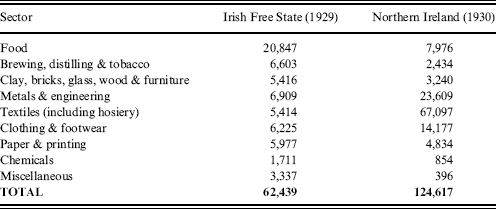
The closest year to 1929 for which a census of production was produced for the United Kingdom was 1930. As in the case of the 1929 Irish Free State C.I.P., the U.K. census of production for 1930 was the first to provide data on establishment size. Table 1 compares ‘factory’ or manufacturing employment in the Free State and Northern Ireland for these years.Footnote 11
Comparison of factory employment in the Free State and Northern Ireland

Sources: Census of industrial production, 1926 and 1929; Census of production of Northern Ireland, 1930.Footnote 12
Northern Ireland, with a population less than half of that of the Free State, had twice the number Footnote of workers employed in manufacturing.Footnote 13 The sectors accounting for Northern Ireland's dominance were textiles, metals & engineering, and clothing. Linen accounted for the vast bulk of the Northern Ireland textiles sector while metals & engineering jobs in Northern Ireland were roughly evenly divided between shipbuilding and mechanical engineering. There were strong linkages between the various Northern Irish industrial sectors.Footnote 14 In the Free State, by contrast, which strongly dominated only in food and drink, the primary backward linkages were with agriculture.Footnote 15
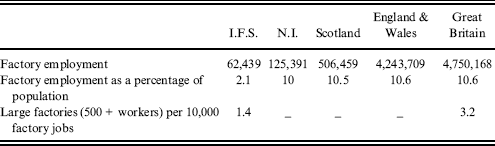
Factory employment in the Free State as a share of population lagged even further behind Britain, as seen in Table 2. A smaller proportion of the Free State manufacturing workforce, furthermore, was employed in large establishments. Compared to the nine manufacturing establishments in the Free State that employed a minimum of 500 workers, there were 1,517 such establishments in Britain, of which 535 employed 1,000 or more.Footnote 16
Comparative size of factory employment in the Free State (1929) and U.K. regions (1930)

Sources: Factory data from Census of industrial production, 1926 and 1929; Census of production of the United Kingdom, 1930. (Numbers for Northern Ireland, as published in the U.K. census, differ slightly from those reported in the N.I. census of production.) Population data: Census of population, 1926 (Dublin, 1926–34); Census of population, 1926 (Belfast, 1926–9); Census of England and Wales, 1931, preliminary report (London, 1931).
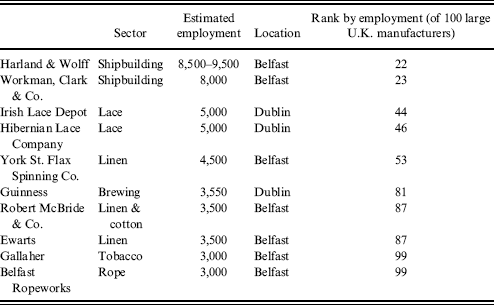
As mentioned above, a distinction must be drawn between factories and firms, since some firms had more than one factory or establishment.Footnote 17 Shaw provides a list for 1907 of 104 large U.K. firms, each of which employed a minimum of 3,000 workers.Footnote 18 Five were in Ulster (to which Bielenberg subsequently added a further two) while three were in what would later become the Free State.Footnote 19 These Irish firms are listed in Table 3.
The largest Irish manufacturing firms of 1907 (derived from Shaw and Bielenberg)Footnote 21

The importance of Dublin in the table is exaggerated, however, by the inclusion of the two lace companies, which are inappropriately categorised as manufacturing concerns. These firms are identified as wholesale agencies rather than manufacturers in a 1907 publication which points out that ‘lace making can form the occupation only of leisure hours or of those members of a family who are unfit for more strenuous work’.Footnote 20 This is corroborated by the description provided by the female patron of the Tyrconnel Hand-Embroidery Industry in 1927 of how ‘the peasant women’ sat on the hills ‘minding the cows and doing this fine embroidery … We have a thousand such women on our books but, unfortunately, we have not enough work to keep themFootnote busy.’Footnote 22 The exclusion of these companies makes it even more apparent how under-endowed the southern provinces were with large manufacturing firms.
By 1929, furthermore, three relatively large manufacturers that had been operating in the Free State area had ceased production. Birmingham firm Kynoch’s closed its Arklow explosives plant in 1918 with the loss of 3,100 jobs.Footnote 23 The other two large firms to close by 1929 – the Condensed Milk Company of Ireland and the Cork Spinning & Weaving Company – survived into the early days of the Free State and are discussed below. Other smaller operations to cease production immediately before or after the establishment of the Free State included the munitions factories established during the First World War, which had employed 2,148 in total.Footnote 24 The two distilleries operated by the (Scottish) Distillers Company Ltd at Phoenix Park and Dundalk also closed around this time. Each had a workforce of around 200.Footnote 25 The ‘Sea Banks’ hosiery factory at Balbriggan owned by the English firm Deeds, Templar & Co. never reopened following its destruction by the Black and Tans in 1920.Footnote 26 It had employed 120 factory hands and up to 300 out-workers.Footnote 27 One final British-owned operation to close was the Drinagh cement works in Wexford, which was purchased and reopened by Associated Portland Cement Manufacturers in 1918 but ceased production in 1925.Footnote 28
II
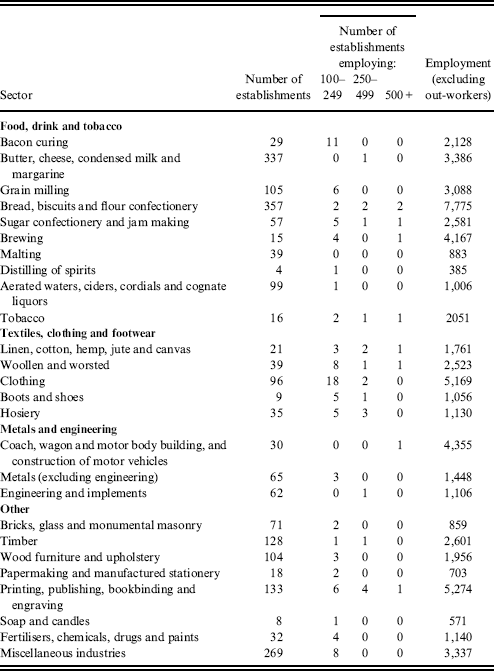
Table 4 presents the data on sectoral employment and establishment size in the Free State in 1929, as reported in the C.I.P. for that year. Of the 2,178 manufacturing establishments in the census, only 130 employed a workforce of 100 or more, compared to the more than 1,000 that employed fewer than ten workers. In most industries, furthermore, ‘small concerns with few employees and an output of little value’ were omitted from the census. Of the nine largest establishments, each of which employed 500 or more, two were in the bread, biscuits and flour confectionery sector and there was one in each of the following sectors: vehicle construction, confectionery, brewing, tobacco, woollen and worsted textiles, non-woollen textiles, and printing & publishing.
Sectoral employment and establishment size in 1929

Source: Census of industrial production, 1926 and 1929, tables I, IX.
Ford, Guinness and Jacob’s were the largest manufacturing firms in 1929. Each operated a single establishment and Ford was at various times in the late 1920s by far the largest employer. Henry Ford & Son had commenced production in Cork in 1919. Employment fluctuated hugely over the following decade as the product range shifted between tractors, cars, parts and components. 1,800 were employed there in 1920, and probably around 4,000 when the 1929 C.I.P. was undertaken.Footnote 29 Much higher levels were reached in 1929 and 1930 when the company shifted much of its global tractor production to Ireland.Footnote 30 The directors of Murphy’s brewery in Cork ascribed the improvement in their trade in 1929 to ‘Fordson’s works employing close on 7,000 men …. since concentrating on the manufacture of tractors’.Footnote 31 A contemporary newspaper account also puts Ford’s employment level at around 7,000, reporting that some 6,000 workers were laid off over a period of three weeks in 1930.Footnote 32 Guinness was, of course, by far the largest establishment in brewing. The company archives register an employment level of 3,210 at St James’ Gate in 1929.Footnote 33 The next largest brewery in the Free State is likely to have employed only around 200. Of the two large establishments in bread, biscuits and flour confectionery, Jacob’s biscuit factory on Aungier St. in Dublin is the easier to identify. It employed around 3,000 in 1928.Footnote 34 The two bakers, Boland’s and Johnston, Mooney & O’Brien, were similar to each other in employment terms. Production at Boland’s, however, was concentrated at the adjacent bakery and flour mills at Grand Canal Dock. That the bakery and flour mills were treated as a single establishment is suggested by a 1925 tax case in which Boland’s claim to be engaged separately in milling and baking was rejected. Boland’s had an employment level of 420 at the time.Footnote 35 This suggests it was likely to have been the other baking establishment recorded as employing 500 or more in the 1929 C.I.P.
Unusually, in the case of tobacco the C.I.P. notes that the single large establishment listed in the sector in fact comprised two plants operated by a single firm. The firm implicitly referred to is the Imperial Tobacco Company. Three constituent firms of the conglomerate – Players, Wills, and pipe tobacco and snuff producer William Clarke & Son – had commenced factory construction in Dublin when duties on international trade in tobacco products came into effect in 1923. Their establishment in Ireland led to protests from the postmaster-general, J. J. Walsh, one of the few protectionist ministers in the government of the time.Footnote 36 William Clarke was subsumed into Wills shortly afterwards. By 1928 the combined operations of Players and Wills had an employment level of 1,500.Footnote 37
In 1924, the Cumann na nGaedheal government introduced tariffs on confectionery, soap and candles, footwear, glass bottles and commercial motor bodies.Footnote 38 A number of these sectors were strongly impacted. Williams & Woods, the largest domestic producer of jams, confectionery and chocolate, took on ‘from 400 to 500 extra hands’ within a year of the tariff coming into effect.Footnote 39 British firms Mackintosh and Rowntree responded to the tariff by acquiring Dublin firms to produce their products for the Irish market.Footnote 40 Another U.K. firm, Crosse & Blackwell, responded similarly, acquiring Williams & Woods in 1928, by which time the latter employed 900.Footnote 41 Crosse & Blackwell closed its long-established factory at Morrison’s Quay in Cork at this time to consolidate production at its new Dublin site.Footnote 42 The largest woollen and worsted factory of the period was the Blarney Woollen Mills of Martin Mahony & Brothers. It employed 600 in 1919.Footnote 43 Goodbody’s jute factory at Clara, Co. Offaly, was the largest establishment in non-woollen textiles, registering an employment level of 800 in 1920.Footnote 44
The final remaining large plant was in the printing and publishing sector. This was the Irish Independent, which was by far the largest newspaper in the state.Footnote 45 The paper had been launched by William Martin Murphy in 1905 and by the 1920s was publishing several other titles, including the Sunday Independent and the Evening Herald. Until the 1980s its masthead noted that it incorporated the Freeman’s Journal, which it took over upon the latter’s demise in 1924. The Freeman’s Journal had employed 300.Footnote 46 Employment at the Irish Independent was recorded at 600 in 1935 and is likely to have been close to this figure in 1929.Footnote 47 There is an interesting symmetry to this list of the nine largest establishments. Three were subsidiaries of foreign corporations: Ford, Players-Wills and Crosse & Blackwell. Three of the Irish firms – Guinness, Goodbody and Jacob’s – were under non-Catholic ownership, while the remaining three – Blarney Woollen Mills, Boland’s and the Irish Independent – were owned by Catholic proprietors.
III
Unlike Irish butter, which had a poor reputation and traded at a discount to the Danish product on the London market, Irish bacon traded at a premium. The leading firms in the sector were Henry Denny & Sons of Waterford, Lunham’s of Cork, and three Limerick firms, O’Mara, Matterson and Shaw. The discovery of the Limerick ‘mild cure’ in 1880 had given Irish firms a competitive edge which the more extensive operators, Denny and O’Mara, would go on to exploit by establishing overseas operations.Footnote 48 The Denny bacon-curing business started out in Waterford in 1820 and by 1890 the firm had further plants in Limerick and Cork. By 1931 it employed around 400 workers across its Irish plants.Footnote 49 Matterson, Shaw and Lunham each employed between 150 and 200 in the slightly improved sectoral conditions of the 1930s. O’Mara’s, which dated from 1839, had acquired most of the Dublin bacon-curing business through its purchase of Donnelly’s of Cork St. in 1907.Footnote 50 Including Donnelly’s, the O’Mara enterprises are likely to have employed around 270 in the late 1920s. The Denny family established operations in Chicago and Denmark, both of which exported to London.Footnote 51 E. W. Denny, one of Henry Denny’s sons, ran the firm’s London agency and became one of the most significant operators in the international industry.Footnote 52 With the death in 1927 of the chairman, Charles Denny of Ballybrado House in Tipperary, management and control of the company transferred to the English-based branch of the family.Footnote 53 The O’Maras also ran a number of overseas operations across Europe and the Americas. At the instigation of Scottish wholesaler and retailer Lipton’s, they had invested in a bacon company in the Balkans in 1902 and participated in its management. Footnote 54 Their reputation was such that Marshal Tito invited James O’Mara to make a return visit to Yugoslavia after the Second World War but he was by then too ill to take up the invitation and died shortly afterwards.Footnote 55 The O’Maras stood out among the major bacon curing firms in being both Catholic and nationalist. Stephen O’Mara senior, son of the firm’s founder, was a home rule M.P. who took the pro-Treaty side and served briefly in the Free State senate. Two of his sons, James and Stephen, had served as Dáil Éireann envoys to the U.S. but took opposing positions on the Treaty.Footnote 56 James was, by turn, a home rule M.P., a member of the first Dáil, and a pro-Treaty T.D. He defeated a young Seán Lemass in a 1924 by-election with the assistance, ironically, of second preferences from a candidate running on a protectionist platform.Footnote 57 Stephen served several terms as mayor of Limerick and was a supporter of Fianna Fáil from its foundation.Footnote 58
In the dairy sector there was only one medium-size establishment in 1929. This was the Lansdowne plant in Limerick city of the by-then largely dismantled Condensed Milk Company of Ireland (C.M.C.I.). Until the 1960s, the Lansdowne plant continued to produce condensed and evaporated milk for consumers and sweet manufacturers.Footnote 59 It registered an employment level of 321 in 1935.Footnote 60 The original Condensed Milk Company had been established by the Canadian-born Cleeve brothers in the 1880s. It became a huge conglomerate engaged in the production of cream, butter, cheese, caramel toffee and condensed milk. It also manufactured the tin can containers at Lansdowne in which the condensed milk was sold. Its system of factories, condenseries and creameries extended across the Golden Vale region.Footnote 61 Cleeve’s history serves as a microcosm of the political, social and economic developments of the time. The company had prospered, as had a number of other leading Irish companies, from contracts to supply the British army in the First World War. At its height, the C.M.C.I. employed between two and three thousand workers and was reported to have dealt with ‘at least one-thirtieth, and possibly considerably more, of the entire dairy produce of Ireland’.Footnote 62 The Cleeve family fortune, however, crashed in the early 1920s. The post-war collapse in agricultural prices had decimated the value of the company’s produce held in stock.Footnote 63 Its creameries had not been spared by British forces engaged in reprisal actions against the rural population during the War of Independence. As unionists and ‘foreigners’ however, the Cleeves were also targeted by the nationalist side and later by the irregulars. They suffered substantially not only from the industrial unrest of the period but also from the long-running ‘war of attrition’ waged by the co-operative movement against the private creameries.Footnote 64
The C.M.C.I. was liquidated in October 1923 and, in 1927, by which time its assets had come into the hands of British wholesaler Lovell & Christmas, the government established the Dairy Disposal Company (D.D.C.) to buy out the C.M.C.I. and other proprietary creameries.Footnote 65 The D.D.C. divested itself of some creameries, closed down others and continued to operate some segments of the old C.M.C.I. It has proved impossible to track down employment numbers for the D.D.C. until 1969 when it employed almost 1,500. Smith and Quinn, however, writing in 1973, assert that since its establishment it ‘handled over 20% of manufacturing milk’, a proportion that had declined only slightly by 1972, when it remained the largest firm in the sector.Footnote 66 This suggests that it may have employed around 600 in 1929.
Flour milling in 1929 was dominated by the Goodbody and Odlum families. The Goodbodys assumed management and control of Bannatyne & Sons when the latter went public in 1894.Footnote 67 Bannatyne’s City Roller Mills, in Limerick, were the largest in the country. From 1894 the Limerick firm of J. N. Russell, the Cork firm of John Furlong & Sons, and the Goodbody mills at Clara became Bannatyne subsidiaries.Footnote 68 The Bannatyne parent company and Russell alone had a combined employment level of 600 (350 and 250 respectively) in 1926.Footnote 69 Furlong had over 200 employees in the 1930s, suggesting that employment across the entire conglomerate in the late 1920s may have been of the order of 800. All of the Bannatyne companies would come under the control of U.K. firm Ranks in 1930 and became part of Ranks (Ireland) upon the latter’s establishment in 1934.Footnote 70 Odlum’s was the second largest domestic firm, but is likely to have had substantially fewer workers as average employment per mill, other than in the very largest mills, was low.Footnote 71 Odlum’s earliest establishment, dating from 1845, was the Maryborough Mills in Portlaoise. By the 1920s the family also owned mills at Portarlington, Graiguenamanagh and Sallins.Footnote 72 In addition, it participated in the joint venture that led to the construction of the mills at Alexandra Road in Dublin in 1921 under the auspices of the Dublin Port Milling Company.Footnote 73 Other notable names involved in grain milling included the Shackletons of Co. Kildare – extended family of the famous Antarctic explorer – and the Pollexfens of Sligo, maternal family of W. B. Yeats, of whom he writes so movingly in ‘Pardon, old fathers’ and Reveries over childhood and youth.Footnote 74 The Goodbodys and Shackletons were Quakers, the Odlums and Pollexfens members of the Church of Ireland.
In the case of bread and biscuits, employment levels at Johnston, Mooney & O’Brien, at around 400–500, were close to those at Boland’s. Its manufacturing operations were more dispersed, however, with milling carried out at the Clonliffe Flour Mills on Jones’s Road and baking at Ballsbridge and Leinster Street.Footnote 75 The company also had a number of bread and cake shops across Dublin and Dun Laoghaire. The third largest Dublin bakery was Peter Kennedy’s of Parnell Street. While two of the three large Dublin bakeries were Catholic-owned, the owners of F. H. Thompson’s of Cork, the largest bakery outside Dublin, were Methodist. Thompson’s employed at least 250 in 1928.Footnote 76 Its managing director, Alfred Reilly, also a Methodist, was killed by the I.R.A. in 1921.Footnote 77 It was claimed that he was a member of a group that provided intelligence to the authorities, though he had home rule and Liberal political sympathies and had earlier organised a Methodist church petition for Lord Mayor Terence MacSwiney’s release while on hunger strike.Footnote 78
Besides the tariff-jumping British toffee and chocolate producers, there were a number of significant Irish firms in the confectionery sector.Footnote 79 Urney Chocolates – named for the parish in west Tyrone where the business was started in 1917 – shifted production to Dublin in 1924, following a fire at its Tyrone factory. The proprietors, Eileen and Harry Gallagher, were Catholic, but there was a Quaker connection, common in the industry, on Harry Gallagher’s mother’s side.Footnote 80 Urney’s employed over 200 by 1928.Footnote 81 One of the oldest established confectionery firms, dating from 1842, was Graham Lemon of the Confectioners’ Hall on Lower O’Connell St. Lemon’s makes an appearance in Joyce’s Ulysses, when Leopold Bloom muses on its being ‘Lozenge and comfit manufacturer to His Majesty the King. God. Save. Our. Sitting on his throne sucking red jujubes white.’Footnote 82 The Lemons were Methodists. The earliest employment number available for the firm is for 1936, when it employed 160.Footnote 83 Devlin’s was larger. Though established only upon the introduction of the tariff in 1924, it already employed 225 at its inner-city Dublin sweet factory in 1929. Its proprietor, Liam Devlin, had operated a licensed premises on Parnell St. that served as unofficial headquarters for Michael Collins’s intelligence team during the War of Independence, and his funeral in 1964 would be attended by both Éamon de Valera and W. T. Cosgrave.Footnote 84
The Irish whiskey sector, in stark contrast to confectionery, was in the doldrums in the early decades of the Free State, with fewer than 400 employees across the entire sector as recorded in the 1929 census. By 1900 it had been completely overtaken by Scotch whisky and would continue to lose ground for decades. Bielenberg estimates that spirit production in 1926 was at less than one-fifth of the 1912 level for the Free State area.Footnote 85 All three of the distilleries that had amalgamated in 1891 to form the Dublin Distillers Co. Ltd (D.D.C.) closed in the 1920s.Footnote 86 There were at least fourteen other breweries besides Guinness still in operation at the time, with concentrations in Dublin, Cork, Louth and the south-east.Footnote 87 While Guinness employed over 3,000, Murphy’s Lady’s Well Brewery in Cork, which was probably the second largest, employed only around 200.Footnote 88 Maltsters were all small in size, though a new firm, Minch Norton, which would become the largest firm in the sector, emerged through the amalgamation of two existing maltsters in 1921. An employment level of 700–800 was recorded for 1921 for the firm D. E. Williams, which had maltings at Banagher and Birr, though this included a range of other manufacturing and services businesses in which the firm was involved, one of which was Tullamore Dew (an acronym formed from the company name).Footnote 89 The firm of Thwaites, which was claimed to have invented the concept of aerated waters in 1799, was the largest in the soft drinks sector. It would form a joint venture – Mineral Water Distributors – in 1927, from which derives the acronym ‘MiWadi’.Footnote 90 Carroll’s would long remain the leading indigenous firm in the tobacco sector, but was very much smaller than Players-Wills. It had employed around 250 in Dundalk in 1905.Footnote 91 This would expand to 400 by 1934.Footnote 92 In 1929, it took over the Goodbody family’s tobacco enterprise off Dublin’s South Circular Road, which employed 200 workers around this time.Footnote 93
IV
The largest firm by far in textiles, clothing & footwear was the conglomerate of Dwyer and Co. Established in Cork city as a drapery and general-purpose wholesalers in the 1820s, by the 1920s it controlled a range of companies that included the Lee Shirt Factory, Lee Hosiery, Lee Clothing, Lee Cap, Lee Boot and the Hanover Shoe Company.Footnote 94 800 employees participated in a Dwyer staff excursion in 1929.Footnote 95 One of the younger generation of the Dwyer family would go on to found the hugely successful Sunbeam Knitwear Co. (later to become Sunbeam Wolsey) in 1928.Footnote 96 Other clothing companies of note included Wilson & McBrinn, the Limerick Clothing Factory and Todd, Burns & Co. Wilson & McBrinn was a Northern Irish ‘tariff jumper’ that established in Drogheda in 1926. By 1927 it employed 200.Footnote 97 The Limerick Clothing Factory had a particularly rich history. Founded by a Scottish immigrant, Peter Tait, in 1850, it employed the recently-invented steam-powered sewing machine to produce ready-made clothes and was, for a time, the biggest such concern in the world.Footnote 98 Its first major contract was to produce uniforms for the British army’s Crimean campaign.Footnote 99 It was also a noted supplier of uniforms for the Confederate army in the U.S. civil war. Within a few years of establishment it employed around 1,000.Footnote 100 By independence, however, it had passed its heyday. Employment fell from 800 in 1899, to 400 in 1911, to 320 in 1936.Footnote 101 Todd, Burns and Co., was a department store on Mary Street in Dublin which dated from 1895. It employed 500 in 1902 and 620 in 1935.Footnote 102 Like many department stores of the era it produced its own range of clothing and furniture. As it is impossible to allocate employment across the firm’s manufacturing and sales activities, neither it nor the other department stores discussed later are included as manufacturing firms. By the 1920s it was controlled by the Presbyterian Boyd Dunlop family.Footnote 103
Within textiles, there was a clear religious divide between the woollen and worsted segment, which was populated primarily by Catholic firms, and producers of other textiles, such as linen, cotton, rayon, jute and canvas, where Protestant-owned firms dominated. Within woollen and worsteds, the largest firm after Blarney Woollen Mills had been St Patrick’s Woollen Mills of Douglas, County Cork. Owned by the O’Brien brothers, employment had fallen from 400 in 1920 to below 150 by 1926.Footnote 104 Another Douglas-based textile firm, that of the Morrogh Brothers, employed around 300.Footnote 105 A similar figure was recorded for the Providence Woollen Mills in Foxford, Co. Mayo, founded in 1881 by Agnes Morrogh-Bernard of the Sisters of Charity.Footnote 106 The industrialist and T.D. Andrew O’Shaughnessy, who had purchased the assets of the Condensed Milk Company in 1924 before selling them on to British wholesaler Lovell & Christmas, was also prominent in this sector. He had purchased the woollen mills at Dripsey and Sallybrook in the early years of the century and, in 1929, took over the Kilkenny Woollen Mills which were then in liquidation. These three mills together employed around 200–300 in the late 1920s.Footnote 107 Another significant woollen manufacturer was Hill & Son of Lucan. Established in 1863, it employed around 300 in 1907, though employment had declined to 150 by the mid-1930s.Footnote 108 Unusually for this sector, the Hills were Quakers.
The Quaker firm of Goodbody, as seen earlier, was the largest in non-woollen textiles. Its jute business remained a significant exporter in the early 1920s.Footnote 109 The family had put an end to attacks on its properties during the War of Independence by posting a notice at the factory warning that ‘any further interference with us … may very easily cause the closing down of the works which are at present being carried on for your benefit under great difficulties and at a heavy loss’.Footnote 110 The Greenmount & Boyne Linen Company was the next largest firm in non-woollen textiles. It came into being in 1925 when Boyne Weaving of Drogheda acquired the assets of the Greenmount Weaving Co., which had been operating in Harold’s Cross in Dublin since 1808.Footnote 111 The Drogheda firm was founded in the 1860s by Benjamin Whitworth, a Congregationalist who would serve several terms as a Liberal M.P. for the town.Footnote 112 The managing director of Greenmount & Boyne in the 1920s was Methodist, and employment at the firm was recorded at 590 in 1929.Footnote 113 Both Dundalk Linen and Usher & Co. were substantially smaller. The former employed 135 in 1929, the latter 107.Footnote 114 Dundalk Linen dated from 1899, Usher & Co. from 1879. Dundalk Linen was founded by the Achesons, a Presbyterian family from Co. Tyrone, whose original factory continued to operate in Northern Ireland.Footnote 115 Usher’s founder, Robert Usher, was a member of the Church of Ireland. Upon his death in 1901 the business was acquired and run by Charles F. Allen, a Quaker and son of Usher’s former business partner.Footnote 116 The 1932 Tariff Commission report on linen also mentioned the much smaller Balbriggan linen manufacturer Charles Gallen and Co., which employed 35 in 1929. This firm was unusual in the sector in being Catholic-owned, though the Gallen family also had Ulster roots. A final linen firm of note was the Cork Spinning & Weaving Company. Established in 1889 by the Presbyterian industrialist James Ogilvie, it went into liquidation in 1926.Footnote 117 The Irish Times reported that most of its 900 employees were absorbed into the Ford Motor Company.Footnote 118
Within footwear, Lee Boot – one of the Dwyer companies – appears to have been the largest. Following the imposition of the tariff in 1924, employment at the firm expanded from 200 part-time workers to 300 working full-time.Footnote 119 Other firms in the boot and shoe sector in 1924 included Michael Governey of Carlow, Hilliard of Killarney, Winstanley of Dublin and Hearne & Cahill of Waterford.Footnote 120 The Leeds firm Halliday was the first foreign ‘tariff jumping’ footwear firm to come to Ireland. They brought skilled workers with them from Leeds to assist when they began production in Dundalk in 1928, at which time they employed around 100.Footnote 121 Halliday would later operate as a ‘front company’ for Clark’s shoes as part of the latter’s efforts to circumvent the restrictions imposed by the control of manufactures acts introduced by Fianna Fáil in the 1930s.Footnote 122
The largest and most famous hosiery firm was Smyth & Co. of Balbriggan, which had been established in 1768, though the original factory burnt down and was rebuilt in 1855.Footnote 123 Throughout the nineteenth century it won an array of prizes and awards at international exhibitions.Footnote 124 In 1898, one of its workmen was presented with a signed portrait gifted by Queen Victoria in recognition of his having produced a range of stockings for her for some sixty years.Footnote 125 Smyth’s employed around 450 – the majority of them outworkers – in both 1898 and 1936.Footnote 126 The fame of Smyth’s had attracted other hosiery firms such as Deeds Templar, mentioned earlier, to establish in Balbriggan. By the time of independence, the firm had passed into the ownership of the family of its managing director, Lewis Whyte.Footnote 127 Others of the medium-sized establishments involved in hosiery production were likely to have been part of larger firms such as the Dwyer family conglomerate.
V
Within metals & engineering, Pierce’s of Wexford was next in size to Ford. Established in 1839, Pierce’s started out producing fire fans and commenced production of horse-powered threshing machines in 1846. It moved in the following year to the site of what became the Mill Road Iron Works.Footnote 128 400 men were employed in the company’s agricultural machinery and cycle factory in 1911.Footnote 129 There was a cluster of engineering firms and foundries in Wexford town, which benefited from good rail links and easy access to imported raw materials. The other firms in the cluster included the Selskar Ironworks of W. Doyle & Co., which dated from 1860, and the Wexford Engineering Company’s Star Foundry, which dated from 1893. Both of these also specialised in agricultural machinery and equipment.Footnote 130 A statement made in the Dáil in 1926 pointed out that: ‘In normal times Messrs. Pierce employ anything between 800 and 1,000 men. In consequence of the agricultural depression that firm is employing today 220. The Star Iron Works in normal times employ almost 200 men. Today there are 50 employed there. The Selskar Iron Works, which would employ 100 normally, at present employ 20.’Footnote 131 Pierce’s would have been the sole medium-sized establishment (employing between 250 and 499) in the 1929 C.I.P.
Most of the other establishments in metals & engineering were general purpose foundries. Some, such as the Drogheda Iron Works, established by Thomas Grendon in 1835, had been significant employers in the past. It had, in its time, built ships, bridges, barges and steam locomotives. It also built the diving bell that now stands as a piece of industrial archaeology on the south bank of the Liffey.Footnote 132 By the time of the ‘Drogheda Soviet’ of 1921 employment at the Iron Works had fallen to twenty.Footnote 133 Shipyards also occasionally did general foundry work, but fared poorly over the 1920s. The Cork shipyards were decimated by the closure of the British admiralty yard at Haulbowline in 1923.Footnote 134 Employment at the Dublin dockyard fluctuated hugely, though 300 workers were employed there during a particularly busy period in 1930.Footnote 135 Employment at the Ringsend Dockyard, by contrast, was fairly consistent at around 100.Footnote 136 The C.I.P. provides no details of establishment size in ship and boat building (which are included in the ‘miscellaneous’ category in the 1929 C.I.P.), nor in ‘Railways and Tramways’, which, though they provided substantial industrial employment, are excluded from the present study as non-manufacturing firms.
Dublin also, of course, had a cluster of foundries and engineering firms. Four foundries had disappeared from the area around Hammond Lane within living memory when Scotsman David Frame revived the foundry of that name in 1902.Footnote 137 It employed 150 in 1913 and by the 1930s would employ 500 or more.Footnote 138 Maguire & Gatchell of Dawson St. specialised in the provision of heating systems for buildings and workplaces, though the firm might be more appropriately classified as plumbers rather than manufacturers.Footnote 139 It featured prominently in the newspapers of the 1920s, and by the 1930s would employ 300.Footnote 140 The Newcomen Ironworks, established in 1901 by Smith and Pearson, a partnership between a British firm and a local Quaker entrepreneur, had an employment level of 200 in 1922.Footnote 141 Other notable foundries were smaller in scale. The engineering and foundry works of W. Spence & Son of Cork St., which built locomotives and other equipment for Guinness, Murphy’s and Jameson’s, employed around eighty in 1913.Footnote 142 George Watt Ltd., engineers and boilermakers of Bridgefoot St., employed around fifty in 1920.Footnote 143 Two foundries that left an enduring legacy were J. & C. McGloughlin and Tonge & Taggart. McGloughlin, which dated from 1875, engaged particularly in art metalworking. The firm was responsible for many decorative pieces across Dublin, including the metal canopy above the entrance to the Mansion House and the decorative metalwork at the entrance to the Phoenix Park at Islandbridge.Footnote 144 The firm employed 120 in 1914.Footnote 145 Patrick Pearse’s half-sister, Mary Emily, married into the family, whose workshop on Great Brunswick St. was close to the Pearse family home. Tonge & Taggart was established in 1869 and is famous today for its manhole covers, inscribed with the company name and/or the logo ‘Cast in the South City Foundry’. The company also made lampposts, railings and other metal items.Footnote 146 By 1936, when its casting process had been automated, it employed eighty-five.Footnote 147
VI
As seen in the earlier table, establishments engaged in producing furniture or materials for the building trade were generally small in scale. Many of the department stores of the era, such as Switzer’s and Todd Burns & Co. of Dublin, and Robertson, Ledlie, Ferguson & Co. of Cork, manufactured their own furniture and other items sold in their stores.Footnote 148 One specialist furniture producer of substance was the Dublin firm of Michael O’Dea (later to become known for its ‘O’Dearest’ mattresses). It would employ 230 in the mid-1930s, but even in 1925 was stated to be ‘a very large employer’.Footnote 149 Its proprietor was a Cumann na nGaedheal member of the first Free State senate.Footnote 150 Many builders’ providers mixed merchandising and production of timber and metal products. These included the Dublin firms, Brooks Thomas, Dockrell’s, and T. & C. Martin, Limerick timber and hardware suppliers Francis Spaight & Sons and James McMahon Ltd., Robert McCowen & Sons of Tralee, Graves & Co. of Waterford and John Atkins Ltd of Dunmanway, Co. Cork. Two specialist firms of note in the wood products sector (though included in the ‘miscellaneous’ category for reasons of confidentiality) were tobacco pipe maker Kapp & Peterson and brush maker I. S. Varian. Kapp & Peterson dated from 1895 and employed 200 in 1925.Footnote 151 Varian had been established in Cork in 1798, but moved premises to Dublin in 1856. It remains in existence today. It is likely to have employed 100 or more in the 1920s.Footnote 152
The paper and paper products sector comprised both paper mills and producers of stationery and packaging materials. The paper mills of the era went through frequent changes of ownership and long periods of inactivity and, by 1928, employed only forty-one in total.Footnote 153 Stationery, box and packaging producers tended to overlap with print and publishing firms. There are a surfeit of candidates – most of them Dublin-based – for the four medium-sized establishments in this segment. Mary Daly, writing on the 1880s, mentions Browne & Nolan and M. H. Gill as among the firms that catered to a captive Catholic and nationalist market at that time.Footnote 154 Browne & Nolan, which was established in 1827, was likely to have been one of the larger firms in the 1920s. It would employ 300 in 1937 across its operations in Dublin, Cork and Belfast.Footnote 155 Gill, on the other hand, was never a particularly large employer. Among the other firms Daly mentions in discussing the 1880s, and that remained of significance in the 1920s, were Alexander Thom & Co., Hely’s, and Cherry & Smalldridge. Thom’s employed 400 in 1921.Footnote 156 Hely’s registered an employment level of 300 in 1935.Footnote 157 Cherry & Smalldridge employed 250 in 1883 and a similar number in the 1930s.Footnote 158 Other substantial firms for which employment data for the 1920s are available include Cahill & Co. and Sealy, Bryers & Walker. Cahill’s employed 250–300 in 1920.Footnote 159 Sealy, Bryers & Walker employed in the region of 200 in 1924.Footnote 160 James Walker, one of the owners of Sealy, had a separate colour-printing house, which was the first in the country.Footnote 161 It also employed around 200 in 1924.Footnote 162 Other firms likely to have recorded employment levels of around 200 in the 1920s were Bailey, Son & Gibson, A. Armstrong & Co. and P. O’Reilly in Dublin, and Eagle Printing and Guy & Co. in Cork.Footnote 163 The owners of these paper and printing firms were of various religious denominations, though the largest were Protestant-owned.
The single firm of moderate size in the soap and candles segment was the U.K. firm Lever Brothers of Port Sunlight in Cheshire. Subsequent to the imposition of tariffs in 1924 it opened the Castle Forbes works on Sheriff St. in Dublin to produce soap and soap powders. It had acquired the old Dublin Quaker soap manufacturer Barrington’s in 1910, which it integrated into the new operation.Footnote 164 By 1929, two years after Castle Forbes opened, it employed over 300 mostly-female staff.Footnote 165 The famous Sunlight Chambers building on Dublin’s Essex Quay is of an earlier vintage. It was constructed in 1901 as Lever’s Irish headquarters. The soap bar had become a common household item by that time and the building’s ornate friezes served to advertise the company’s products.Footnote 166 James Crean of North King St. in Dublin was the other main soap producer but was significantly smaller in scale. Crean also produced candles. Another candle maker, Rathborne, though also small in employment terms, is particularly worthy of mention. The Rathborne family had been involved in candle making in Dublin since 1488. The firm remains in existence and is recognised as the longest-surviving manufacturer in the state.Footnote 167 It was acquired by Barrington in 1914 and became part of the Lever group upon the latter’s acquisition of Barrington’s.Footnote 168
One further firm of scale was the match producer Maguire & Paterson. Maguire of Liverpool had merged with Paterson of Dublin and Palmer of London in 1919. The Dublin business was assigned to a newly-formed company, Maguire & Paterson, in 1922.Footnote 169 Paterson’s had employed 270 in 1913, while Maguire & Paterson employed around 300 in 1928.Footnote 170 Other smaller chemicals firms included the paint manufacturers Harrington’s of Cork and William Preston of Dublin. Both merged with or were acquired by British firms in the 1920s to become Harrington & Goodlass Wall and Preston & Hadfield respectively.
Fertilisers comprised by far the largest chemicals segment of the era. The dominant firm here was W. & H. M. Goulding. By 1920 it had at least six plants in the Free State area.Footnote 171 Its original premises in Cork had been purchased in the mid-1850s. A new and larger factory was opened in East Wall in Dublin in 1869 and a Waterford plant was added in 1872.Footnote 172 By 1881 Goulding’s was reported to be the largest fertiliser producer in the United Kingdom, with half its output destined for the export market.Footnote 173 The Dublin plant employed around 200 and the Cork plant a further 150 at that time.Footnote 174 In 1899 Goulding’s purchased a controlling interest in the Dublin docklands company Morgan Mooney & Co. and, in 1919, acquired both Drogheda Chemical Manure Company and the Dublin & Wicklow Manure Company. The latter in turn owned the Dublin Vitriol Works.Footnote 175 Since the Cork plant alone employed 300 in 1919, the firm is likely to have had at least 700 on its payroll in the Free State in the 1920s.Footnote 176 It operated a further two plants in Northern Ireland. Another fertiliser company, McDonogh’s, owned by Cumann na nGaedheal T.D. Thomas McDonogh, commenced production in Galway in 1925 but employed no more than a few dozen.Footnote 177
VII
The aftermath of the First World War and the period surrounding Irish independence wrought substantial change within southern Irish manufacturing. The munitions factories of the First World War period closed, as did Kynoch’s plant at Arklow and a number of other smaller British concerns. The Condensed Milk Company of Ireland collapsed in the early 1920s, followed a number of years later by the largest southern linen manufacturing employer. These losses were offset to some extent by the expansion of the Ford plant at Cork, the entry of British tobacco manufacturers triggered by the imposition of import duties, and the emergence of new concerns under the moderate protectionism of the Cumann na nGaedheal governments.
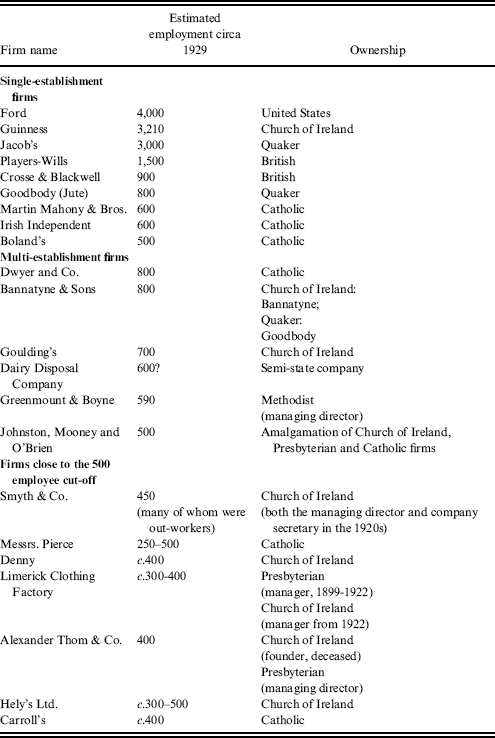
Taking the 1929 C.I.P. as a benchmark, the aim of the article has been to identify the largest manufacturing firms and establishments in the Free State at that time. The results are presented in Table 5, which shows the various categories of firms with workforces of around 400 or more in the late 1920s. Estimated employment levels, nationality of ownership, and – in the case of Irish firms – the religion of ownership or control of the firm are also included.Footnote 178
Firms employing c.400 or more in 1929

Three of the five largest firms were subsidiaries of foreign parent companies. Of the large Irish firms, the majority had been established – and were owned or controlled – by Protestant industrialists, most of whom had been unionist in their politics in the pre-independence era. The future direction of this research project will involve tracking how the composition of the group of leading firms and the political allegiances of their owners changed over the course of the protectionist 1930s and beyond.