INTRODUCTION
The shrimp scad, Alepes djedaba (Forsskål, 1775) is a widespread marine fish species from the Carangidae family. It is widely distributed in the tropical and subtropical western Indian Ocean and areas of the eastern Pacific Ocean (Yukio & Kimura, Reference Yukio and Kimura1996; Carpenter & Niem, Reference Carpenter and Niem2001; Sey et al., Reference Sey, Nahhas, Uch and Vang2003). It was for the first time recorded in Palestine as Caranx calla (Steinitz, Reference Steinitz1927), and 33 years later in the Aegean Sea (Bini, Reference Bini1960). Alepes djedaba currently occur in Cyprus (Demetropoulos & Neocleous, Reference Demetropoulos and Neocleous1969), Greece (Çinar et al., Reference Çinar, Bilecenoglu, Öztürk, Katagan and Aysel2005), Egypt (Ertan & Murat, Reference Ertan and Murat2001), Lebanon (Ertan & Murat, Reference Ertan and Murat2001), Libya (Shakman & Kinzelbach, Reference Shakman and Kinzelbach2007), Israel and Turkey (Golani, Reference Golani1998). It is currently a dominant species in the eastern Mediterranean inshore where it has become a significant fishery resource (Golani, Reference Golani, Öztürk and Basusta2002). In the present paper we report the first record of A. djedaba from Tunisia (Gulf of Gabès, southern-east Tunisian coast, central Mediterranean).
MATERIALS AND METHODS
Approximately 100 individuals of Alepes djedaba were caught on 14 June 2012 by purse seine in the Gulf of Gabès (34°10′240; 10°58′180) (Figure 1) among which three specimens were randomly sub-sampled. The identification was made using descriptions given by Smith-Vaniz (Reference Smith-Vaniz, Whitehead, Bauchot, Hureau, Nielsen and Tortonese1986). In the laboratory, morphometric characters (body lengths and width, head length, horizontal eye diameter, spaces between tip of snout to first and second dorsal fin origin, first and second dorsal and anal fins bases, snout to pectoral, ventral and anal fins distances and pectoral fin length) were measured to the nearest mm and expressed as percentages of the fork length (FL). In addition, main meristic characters (number of rays, gillrakers and lateral line scales) and body weight (BWt in g) were measured.
The Gulf of Gabès area (Tunisia: southern Mediterranean Sea) with indication of Alepes djedaba capture (*).

RESULTS
Description
The body is ellipsoid and laterally compressed; the dorsal and ventral profiles are almost regularly convex. The chest is completely scaled. The lateral line, arched in its anterior part with small scutes, becomes straight in its posterior part with larger scutes. The mouth is small. The teeth are arranged in a single continuous row on the two jaws. Well-developed adipose eyelid covers the posterior portion of the eye. Dorsal fins are well separated and the anal fin has two detached spines, followed by one spine connected to the soft rays.
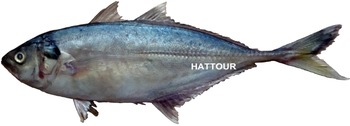
The body is silvery grey with yellow caudal fin and posterior lateral line. It has a distinct black blotch, bordered above by a smaller white spot on the upper margin of operculum (Figure 2).
The shrimp scad Alepes djedaba (specimen number 3—see Table 1) 310 mm fork length caught off the Gulf of Gabès (south-east Tunisia) on 14 June 2012.

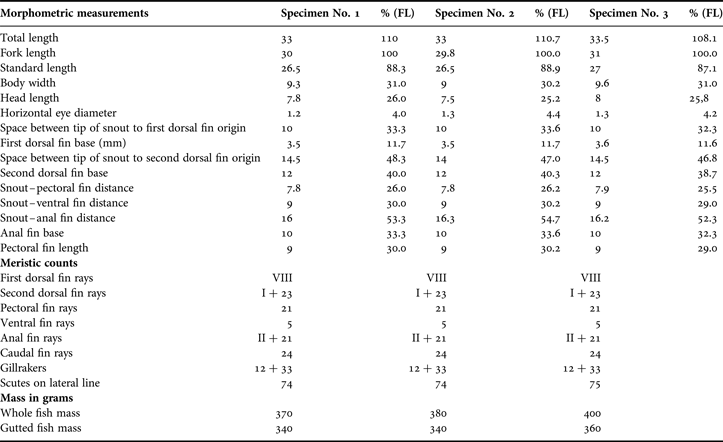
Morphometric measurements, meristic counts and mass of the three sampled Tunisian specimens are given in Table 1.
Morphometric measurements (in cm and as % fork length (FL)), meristic counts and masses (g) recorded in the three Tunisian specimens of Alepes djedaba.

Metric and meristic characteristics of the observed specimens confirm the taxonomic identity of Alepes djedaba.
CONCLUSION AND DISCUSSION
Seven genera grouping 13 species of the Carangidae family are actually known along Tunisian coasts with four non-indigenous species: three of tropical Atlantic origin (Seriola fasciata (Bloch, 1793), Seriola carpenteri Mather, 1971 (Bradai et al., Reference Bradai, Quignard, Bouain, Jarboui, Ouannes-Ghorbel, Ben Abdallah, Zaouali and Ben Salem2004b) and Seriola rivoliana Cuvier, 1833 (Mansour et al., Reference Mansour, Azzouz, Boumaîza, Ben Amor and Capapé2011)); and Alepes djedaba (Forsskål, 1775) of tropical Indo-Pacific origin, recorded for the first time in this paper. The present record of a school of the latter species might indicate a recent establishment of this species in the area. In fact, increased variability in the abundance and distribution of living organisms is one of the expected effects of global change. The thermophilic taxa showed northward trend, and the Carangidae family was found to increase over time in abundance in the Mediterranean (Azzurro et al., Reference Azzurro, Moschella and Maynou2011).
Alepes djedaba is a coastal pelagic schooling fish that can reach a maximum size of 300 mm (FL), the common size is approximately 200 mm (Smith-Vaniz, Reference Smith-Vaniz, Whitehead, Bauchot, Hureau, Nielsen and Tortonese1986). On the north-west coast of India, maturity of female individuals was reached at 190 mm (FL) (Raje, Reference Raje1993). The sampled Tunisian specimens with lengths 298, 300 and 310 mm (FL) are thus considered adults while the third specimen exceeds the up-to-date maximum length for this species.
In terms of feeding preference, Alepes djedaba mainly feeds on juvenile fish and crustaceans followed by nematodes and insect larvae (Sivakami, Reference Sivakami1990; Raje, Reference Raje1993).
During an ecological investigation for medusae symbionts in the eastern and south-eastern Asian waters, Rhopilema hispidum and Versuriga anadyomene (Rhizostomae: Scyphozoa) were found to harbour the shrimp scad A. djedaba (Ohtsuka et al., Reference Ohtsuka, Kondo, Sakai, Shimazu, Shimomura, Komai, Yanagi, Fujita, Nishikawa, Miyake, Venemathi Maran, Go, Agaguchi, Yamaguchi, Dechsakulwatana, Srinui, Putchkaran, Mulyadi Mujiono and Yussoff2010). Juvenile fish utilize medusae as refuge against predation (Lynam & Brierley, Reference Lynam and Brierley2007; Masuda et al., Reference Masuda, Yamashita and Matsuyama2008; Ohtsuka et al., Reference Ohtsuka, Koike, Lindsay, Nishikawa, Miyake, Kawahara, Mujiono, Hiromi and Komatsu2009, Reference Ohtsuka, Kondo, Sakai, Shimazu, Shimomura, Komai, Yanagi, Fujita, Nishikawa, Miyake, Venemathi Maran, Go, Agaguchi, Yamaguchi, Dechsakulwatana, Srinui, Putchkaran, Mulyadi Mujiono and Yussoff2010).
On the eastern coast of the Mediterranean Sea, A. djedaba juveniles are reported to be associated with Rhopilema nomadica Galil (1990); both, fish and medusa, are lessepsian migrants through the Suez Canal (Spanier & Galil, Reference Spanier and Galil1991).
Blooms of jellyfish (mainly Rhizostoma pulmo) started to become frequent in the Gulf of Gabès in 2008. It is to be mentioned that over the recent years (2008–2010), the proliferation of R. pulmo started to show up earlier (May and June) instead of September (Bradai, Reference Bradai2010). Moreover, R. nomadica was recently observed in the Gulf of Gabès. The bloom of several species of jellyfish could have a positive effect for the recruitment of A. djedaba in the Gulf of Gabès.
In Libya, A. djedaba became firstly common on the eastern Libyan coast (Shakman & Kinzelbach, Reference Shakman and Kinzelbach2007). Today, it is considered as a commercially valuable species in many areas in the eastern and south-central Mediterranean Sea. The observation of a school of this species in the Gulf of Gabès could predict a similar situation for the Tunisian waters in the near future. It is believed that the Gulf of Gabès is already colonized by A. djedaba, or at least that it will become significant in the near future, with important economic outputs for the local communities.
This work confirms the subtropical nature of the southern Tunisian waters (Bradai et al., Reference Bradai, Ktari, Ben Souissi, Ben Hadj-Hamida, Ghorbel, Jarboui, Bouain and Missaoui2004a, Reference Bradai, Quignard, Bouain, Jarboui, Ouannes-Ghorbel, Ben Abdallah, Zaouali and Ben Salemb; Bradai, Reference Bradai2010). This character is accentuated by the arrival of other lessepsian and tropical Atlantic species with warm water affinities. The intrusion of species with tropical Atlantic and Indian Ocean origin in Tunisian waters has become a salient feature. These changes correlate with the increase in sea surface temperature (Zouari et al., Reference Zouari, Bouzid, Bousnina, Chayeb, Karray and Bradai1996).
ACKNOWLEDGEMENTS
We are grateful to fishermen who informed us about their captures and made three specimens of Alepes djedaba available to us. We also thank the two anonymous referees for helpful and useful comments that helped to improve our manuscript.