Introduction
Soil-transmitted helminths (STH) are listed as one of the world's neglected parasites in tropical regions (Molyneux et al., Reference Molyneux, Hotez and Fenwick2005). Soil contaminated with helminth eggs is a potential source of infection that poses a threat to the public, especially young children, to Toxocara, Ascaris, Ancylostoma and Trichuris eggs. Children are at risk when playing in sandpits in playgrounds and parks contaminated with infective eggs or larvae of parasites (Glickman & Schantz, Reference Glickman and Schantz1981; Duwel, Reference Duwel1984) and mainly acquire infection after ingestion of eggs embedded under unwashed fingernails.
Many worldwide reports have highlighted the importance of STH to children, especially in developing countries, where reduced physical activity, impaired learning ability and poor growth have been reported (Stephenson et al., Reference Stephenson, Latham, Kinoti, Kurz and Brigham1990; Nokes et al., Reference Nokes, Grantham-McGregor, Sawyer, Cooper and Bundy1992; Adams et al., Reference Adams, Stephenson, Latham and Kinoti1994; Koroma et al., Reference Koroma, Williams, De La Haye and Hodges1996). However, most studies have focused on soil contaminated with Toxocara eggs, especially in industrialized countries, with prevalences ranging from 1.2% in Brazil (Chieffi & Muller, Reference Chieffi and Muller1976), 2.7% in Argentina (Sommerfelt et al., Reference Sommerfelt, Degregorio, Barrera and Gallo1992), 15.5% in Iraq (Mahdi & Ali, Reference Mahdi and Ali1993), 20.6% in Kansas (Dada & Lindquist, Reference Dada and Lindquist1979), 24% in urban areas in Italy (Habluetzel et al., Reference Habluetzel, Traldi, Ruggieri, Scuppa, Marchetti, Menghini and Esposito2003) and up to 67.7% in Kobe, Japan (Zibaei & Uga, Reference Zibaei and Uga2008) and 97.5% in Greece (Himonas et al., Reference Himonas, Antoniadou-Sotiriadou and Frydas1992). Only a small number of studies has highlighted soil contamination with other helminths, including eggs of Ascaris, Ancylostoma and Trichuris (Ajala & Asaolu, Reference Ajala and Asaolu1995; Blaszkowska et al., Reference Blaszkowska, Kurnatowski and Damiecka2011).
To date, there are only a few studies on helminth contamination of public playgrounds in Malaysia, although Loh & Israf (Reference Loh and Israf1998) reported high prevalences of over 50% of Toxocara in soil from public playgrounds in Serdang and Petaling Jaya. In addition, Noor Azian et al. (Reference Noor Azian, Sakhone, Hakim, Yusri, Nurulsyamzawaty, Zuhaizam, Rodi and Maslawaty2008) reported on contamination of 182 soil samples examined from urban (Setapak, Kuala Lumpur) and rural residential parks (Kuala Lipis, Pahang); 12.1% were contaminated with Toxocara eggs, followed by Ascaris (7.4%), hookworm (4.9%) and Trichuris (1.6%).
Helminth and protozoan infections are also common in Malaysian schoolchildren. Rajeswari et al. (Reference Rajeswari, Sinniah and Hasnah1994) reported that faecal samples from 456 schoolchildren in Gombak, Malaysia showed an overall prevalence of 62.9%, mainly comprising Trichuris trichiura (47.1%), Giardia intestinalis (14.7%), Entamoeba coli (11.4%), Entamoeba histolytica (9.9%) and Ascaris lumbricoides (7.9%). Bundy et al. (Reference Bundy, Kan and Rose1988) found that 66% of 1574 children living in a slum area of Kuala Lumpur, Malaysia, were infected with T. trichiura, 49.6% with A. lumbricoides and 5.3% with hookworm. Moreover, Rahman (Reference Rahman1998) showed that intestinal infections in schoolchildren from an urban area in Penang were dominated by Trichuris (100%), Ascaris (37.9%) and hookworm (18.7%).
Therefore the present study was undertaken to provide a comprehensive update on soil contaminated primarily with helminths in public playgrounds in Peninsular Malaysia. The determination of sources of contamination and confounding factors such as season, together with differences in soil types in both urban and suburban areas, are also considered.
Materials and methods
Study sites
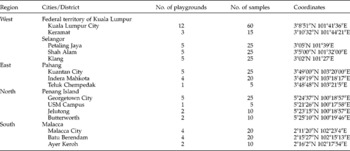
Soil samples were collected from playgrounds in urban and suburban areas from five states in Peninsular Malaysia (table 1). These included Kuala Lumpur, the capital city of Malaysia, together with Petaling Jaya, Klang and Shah Alam districts in Selangor representing the west, the town of Kuantan in the state of Pahang representing the east, Georgetown (Penang) representing the north, and Malacca city representing the south state of Peninsular Malaysia (table 1). Kuala Lumpur is the largest city, with a population of 1.6 million, and is an enclave within the state of Selangor, in the central west coast Peninsular Malaysia. Petaling Jaya, Klang and Shah Alam districts are located in the state of Selangor, neighbouring Kuala Lumpur and comprising mostly residential and some industrial areas. The coastal city of Malacca, located approximately 130 km south of Kuala Lumpur, has a population of 788,706. Georgetown is the capital of Penang Island and located on the north-west coast of Peninsular Malaysia on the Straits of Malacca. Finally Kuantan, which is another coastal city in the state capital of Pahang, is situated along the east coast of Peninsular Malaysia, near the mouth of the Kuantan River and faces the South China Sea.
The location and number of sampling sites/samples from five geographical regions in Peninsular Malaysia from August 2009 to July 2010; mean temperature range from 25.5°C to 28.6°C.

Malaysia features a tropical rainforest climate which is hot and humid throughout the year, along with abundant rainfall. Generally, the wet season occurs from April to May and October to December, with the dry season occurring between January to March and June to September. Temperatures remain constant, with maximum temperatures ranging between 31 and 37.2°C (88–99.0°F) and minimum temperatures between 17.7°C (63.9°F) and 23.5°C (72–74°F), as detailed in Meteorology Malaysia (2010). The survey was conducted during both wet and dry seasons, with the mean temperature ranging between 25.5 and 28.6°C, and rainfall between >0.1 mm and 32.4 mm.
Soil and faecal sampling
Between August 2009 and July 2010, a total of 300 soil samples was collected and examined from sandpits of 60 playgrounds, including public parks and residential playgrounds, from five localities in Peninsular Malaysia (table 1). All playgrounds surveyed were unfenced or semi-fenced, allowing access by animals and the public at all times. Using a small shovel, five soil samples, each weighing approximately 300 g, were taken at a depth of 0–5 cm from an area of 1.0 m2 selected randomly per 5 m2 of each sandpit and surrounding play areas. Samples were taken from the sites without grass to avoid intensified drainage on grassy soil.
Playgrounds were classified according to location, either in open public parks or residential areas, and the condition of the soil texture was noted as being either silty (0.02–0.10 mm) or sandy (0.11–2.0 mm). All samples were kept in air-tight plastic containers at room temperature, labelled with the name of playground, number of sample and date of collection, and immediately transported to the laboratory for analysis. Results from this study were presented as infection rates rather than prevalence as the experimental design was not ideal for obtaining a reliable estimate of the prevalence of STH in soil samples in Malaysia. In addition, from January 2011 to February 2012, faecal samples from 100 stray cats and 100 stray dogs were screened from public and residential areas within the vicinity of Kuala Lumpur and from animal shelters, in association with the Society for the Prevention of Cruelty to Animals (SPCA) and the Animal Pound, Vector Control Unit of Kuala Lumpur City Hall (DBKL). Up to 10–20 g of faecal samples were collected using a wooden spatula and classified according to their texture (hard, smooth or runny). The date of collection was recorded and samples were placed in a stool container and kept at 4°C until examination.
Detection of eggs/cysts in soil and faeces
Samples of 1 g in weight were air-dried at room temperature and thoroughly ground in a pestle and mortar with a small amount of distilled water. The suspension was washed and sieved through a 2-mm mesh sieve to remove debris, and placed in a 15-ml centrifuge tube for centrifugation at 1500 g for 2 min. The supernatant was discarded, and the sediment re-suspended in 15 ml of saturated sodium chloride solution (SG1.25) using a Pasteur pipette and thoroughly mixed until all particles were evenly distributed. These procedures were replicated three times for each sample.
Helminth eggs and protozoan cysts were recovered using the modified McMaster flotation technique (Dunn & Keymer, Reference Dunn and Keymer1986), which uses a counting chamber in a known volume of sample suspension (0.15 ml). For every sample, the number of eggs present within the grid chamber was counted and their genus determined microscopically. The mean number of eggs/cysts per gram (EPG) was calculated when both the weights of soil or faeces and the volume of flotation fluid used were known. Samples of the suspension were drawn off with a Pasteur pipette and added to the chambers of the McMaster slide (0.15 ml). Eggs/cysts present within the grid were counted and identified using the McMaster slide under low magnification ( × 10) and five replicates were counted.
Data analysis
The overall infection rate and EPG for each parasite species were calculated and analysed using the software Quantitative Parasitology 3.0 (Reiczigel & Rózsa, Reference Reiczigel and Rózsa2001) with 95% confidence intervals (Margolis et al., Reference Margolis, Esch, Holmes, Kuris and Schad1982). The infection rates were compared using Fisher's Exact Test proposed by Rozsa et al. (Reference Rozsa, Reiczigel and Majoros2000) and the frequency distribution of eggs/cysts in soil samples was tested using a reformulated method of measuring the k parameter (Pal & Lewis, Reference Pal and Lewis2004). Helminth egg burdens were analysed using the SPSS version 16.0 (SPSS Inc., Chicago, Illinois, USA), together with GLIM (generalized linear models) and a Poisson regression model (Wilson & Grenfell, Reference Wilson and Grenfell1997) using two–way interactions between selected independent variables. These were transformed into two levels to confirm any significant differences, given as P< 0.01 unless otherwise stated, between variables such as wet and dry seasons, soil textures comprising sand and silt, and public and residential playgrounds.
Results
Soil screening
All 60 playground samples from the five states in Peninsular Malaysia were mainly contaminated with helminth eggs, comprising four nematode genera. Soil contamination with Toxocara was the highest (95.7%), followed by Ascaris (93.3%), Ancylostoma (88.3%) and Trichuris (77%). Toxocara also showed the highest EPG with a mean of 251.51 ± 220.51, followed by Ascaris (116.64 ± 149.02), Ancylostoma (105.25 ± 101.82) and, finally, Trichuris (56.45 ± 50.18) (table 2).
The infection rate (%) and mean number of eggs per gram (EPG±SD) of four nematode genera in soil samples from playgrounds in five sites from Peninsular Malaysia, August 2009 to July 2010.

Relative to sites, playgrounds in Penang (northern coast) and Selangor (western coast) were the most contaminated, with all four nematode genera exhibiting 100% infection rates. Similar infection rates were shown for Toxocara and Ancylostoma in Malacca, with slightly lower values of 98% being recorded for Ascaris and Trichuris (table 2). Playground soils in Kuantan were slightly less contaminated with Toxocara (90%), Ascaris (76%), Ancylostoma (76%) and Trichuris (52%) and, similarly, in Kuala Lumpur, with Toxocara (89.3%), Ascaris (90.7%), Ancylostoma (70.7%) and Trichuris (40%). All ten playgrounds in Penang also exibited high EPG for all nematodes, especially the playground in Popus Lane Park (5°25′10″N 100°19′46″E) with egg counts for Toxocara as high as 856.4 ± 1.054, and Kota Lama Esplanade Park with counts of 388.40 ± 1.21 for Ancylostoma and 189.20 ± 0.24 for Trichuris.
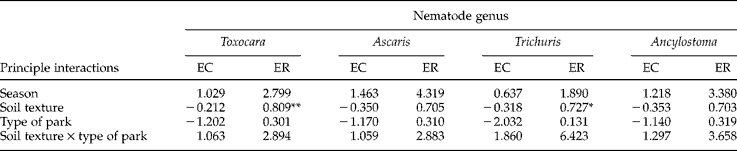
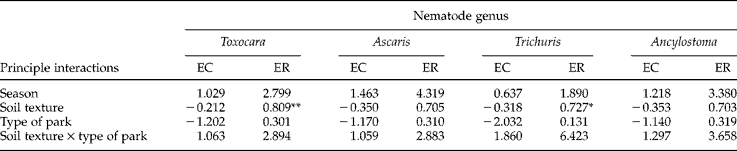
All four nematode genera comprising Toxocara sp., Ascaris sp., Trichuris sp. and Ancylostoma sp. showed infection rates above 70%. The Poisson regression model, using two-way interactions, showed significant effects for soil contamination in all nematode genera relative to season, soil texture and, especially, the type of park contaminated (table 3). With reference to seasonality, soil contamination was highest during the wet compared with the dry season for all four nematodes (P< 0.001). However, across the four genera, the two-way interaction was highly significant for soil texture with type of park only (table 3).
Variation in the infection rate of parasitic eggs in soil samples relative to season (wet and dry), soil texture (sand and silt) and type of park (public and residential), using a Poisson regression model. EC, expected log count for one unit of increase in each parameter; ER, expected infection rate of nematode eggs and level of significant differences given as P<0.01, except for *, P<0.05; and **, P<0.10.
Faecal screening
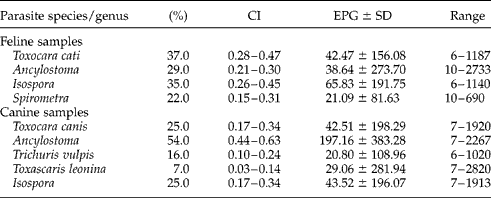
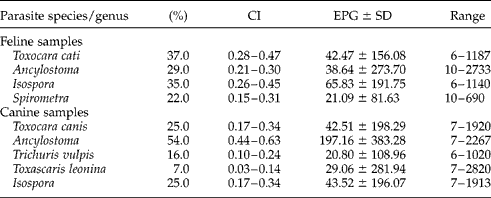
More than half of the stray cat and dog populations were infected with parasites. Of the feline faecal samples screened, 54% were positive for two nematodes, one cestode and one protozoan species. The highest contamination in feline samples comprised eggs of Toxocara (37%; EPG, 42.47 ± 156.08) followed by the protozoan Isospora (35%; EPG, 65.83 ± 191.75), Ancylostoma (29%; EPG, 38.64 ± 273.70) and the cestode Spirometra (22%; EPG, 21.09 ± 81.63) (table 4). Up to 57% of canine samples were infected with four nematodes and one protozoan species. This included a high infection rate for Ancylostoma (54%; EPG, 197.16 ± 383.28) followed by Toxocara (25%; EPG, 42.51 ± 198.29), Isospora (25%; EPG, 43.52 ± 196.07), Trichuris (16%; EPG, 20.80 ± 108.96) and Toxascaris leonina (7%; EPG, 29.06 ± 281.94). In both canine and feline hosts, the frequency distribution of eggs within the faeces was found to be overdispersed and fitted a negative binomial distribution with k values ranging from 0.041–0.078 in feline and 0.009–0.121 in canine samples. With regard to stool texture and consistency there was little association between parasitic infections in both types of faeces, although in feline samples the protozoan Isospora tended to occur in runny stools (P< 0.05) whereas Ancylostoma was more frequent in runny stools of canines (P< 0.01).
The infection rate (%) and mean number of eggs /cysts (EPG±SD) in each of 100 stray feline and canine faecal samples from animal shelters in Kuala Lumpur, January 2011 to February 2012; CI, 95% confidence intervals.
Discussion
Soil samples from playgrounds in five states from Peninsular Malaysia were found to be highly contaminated with helminth eggs and occasionally protozoan cysts. Four genera of nematodes dominated the infections, with Toxocara being the most frequent (95.7%), which was similar to the results of previous studies undertaken by Himonas et al. (Reference Himonas, Antoniadou-Sotiriadou and Frydas1992), Correa et al. (Reference Correa, Michelon and Lagaggio1995), Uga et al. (Reference Uga, Matsuo, Kimura, Rai, Koshino and Igarashi2000) and Alonso et al. (Reference Alonso, Stein, Chamorro and Bojanich2001), but higher than prevalences of 54.5% and 12.1%, respectively, recorded by Loh & Israf (Reference Loh and Israf1998) and Noor Azian et al. (Reference Noor Azian, Sakhone, Hakim, Yusri, Nurulsyamzawaty, Zuhaizam, Rodi and Maslawaty2008).
It was also noted that high levels of contamination were observed, with egg counts as high as 800 EPG in one study site in Penang. Higher infection rate of zoonotic nematodes, especially with Toxocara eggs, were likely to be linked with playgrounds being exposed to stray animals scavenging and defecating in residential areas. Such high incidences, especially of Toxocara, Ancylostoma and Trichuris eggs in the soil, were due to the open access of playgrounds, with no fencing to protect these locations from stray animals. These animals were free to roam and defecate repeatedly, thus contaminating the soil with eggs that can survive for many years (Zibaei et al., Reference Zibaei, Abdollahpour, Birjandi and Firoozeh2010). On the other hand, the presence of Ascaris eggs was possibly due to human defecation. Similar findings were also found by Horiuchi et al. (Reference Horiuchi, Paller and Uga2013) in the Philippines, where helminth egg counts in soil were as high as 410 (A. lumbricoides), 134 (Toxocara spp.) and 134 (Trichuris spp.). These authors concluded that contamination of soil was mainly due to stray animal and human defecation.
These circumstances, combined with optimum temperatures and high levels of humidity and moisture in the soil, particularly during the wet season in Malaysia, would undoubtedly enhance the survival and viability of ascarid and trichurid eggs and larval stages of hookworms such as Ancylostoma.
Higher infection rates of other nematode species were also observed in the playgrounds under investigation, including Ascaris (93.3%), Ancylostoma (88.3%) and Trichuris (77%), and these findings were significantly higher than those reported by Noor Azian et al. (Reference Noor Azian, Sakhone, Hakim, Yusri, Nurulsyamzawaty, Zuhaizam, Rodi and Maslawaty2008) in Malaysia, Ajala & Asaolu (Reference Ajala and Asaolu1995) in Nigeria, Mandarino-Pereira et al. (Reference Mandarino-Pereira, de Souza, Lopes and Pereira2010) in Brazil and Blaszkowska et al. (Reference Blaszkowska, Kurnatowski and Damiecka2011) in Poland. Playgrounds in the two states of Penang and Selangor were found to be more highly contaminated than other sites, with all nematode genera being present with high numbers of helminth EPG, especially in Penang.
It may seem premature to conclude the role of strays in contaminating playgrounds based on only one sampling site in Kuala Lumpur. However, Mohd Zain et al. (Reference Mohd Zain, Norhidayu, Pal and Lewis2013) confirmed the presence of Toxocara cati, Toxocara malaysiensis, Ancyclostoma ceylanicum and Ancyclostoma brasiliensis in stray cat populations from four states in Malaysia, while Mahdy et al. (Reference Mahdy, Yvonne, Ngui, Siti Fatimah, Choy, Yap, Al-Mekhlafi, Ibrahim and Surin2012) recorded A. ceylanicum and Ancyclostoma caninum in stray dogs. This further confirms the role of strays as a source of environmental contamination, particularly for Toxocara and Ancylostoma, but molecular approaches are required to identify eggs of other helminth species.
Although several authors have reported that dogs can mechanically transmit human parasites such as Ascaris (Traub et al., Reference Traub, Robertson, Irwin, Mencke and Thompson2002, Reference Traub, Robertson, Irwin, Mencke and Thompson2005; Shalaby et al., Reference Shalaby, Abdel-Shafy and Derbala2010), the present study found no evidence of Ascaris eggs despite screening up to 100 dog faecal samples. The relatively high incidence of Ascaris was more likely to originate from human defecation, because potential animal sources of infection, such as pigs, were strictly confined to farms on the outskirts of urban areas as a result of Islamic prohibitions. Therefore, pigs are unlikely to inhabit playgrounds in residential sites. Previous studies in Malaysia have shown that children are infected with Ascaris lumbricoides, Trichuris trichiura and A. ceylanicum (Bundy et al., Reference Bundy, Kan and Rose1988; Rajeswari et al., Reference Rajeswari, Sinniah and Hasnah1994; Rahman, Reference Rahman1998; Ngui et al., Reference Ngui, Lim, Traub, Mahmud and Mistam2012) and therefore molecular characterization is also necessary to confirm whether or not playgrounds contaminated with Ascaris are of human or animal origin.
In the case of zoonotic helminths, the arrival of the wet season in playgrounds significantly increased the number of eggs of all four nematode genera compared with the dry season. Stojcevic et al. (Reference Stojcevic, Susic and Lucinger2010) also reported an increase in the number of helminth eggs during the rainy season, as embryonation of eggs increases in tropical temperatures with high soil humidity. This result is similar to the results of studies by Uga & Kataoka (Reference Uga and Kataoka1995), Rai et al. (Reference Rai, Uga, Ono, Rai and Matsumura2000) and Nurdian (Reference Nurdian2004), where high levels of rainfall contributed to higher diversities and prevalence of parasite species. In addition, helminth eggs such as those of Toxocara and Ascaris possess thick external layers, which provide protection from environmental factors (Mizgajska, Reference Mizgajska1997).
The effects of two factors, the type of soil and size of playgrounds, also played a significant role in determining the number of helminth eggs recovered from soil samples. Ayaji & Duhlinska (Reference Ayaji and Duhlinska1998), Duwel (Reference Duwel1984) and Omudu et al. (Reference Omudu, Amuta, Unoqur and Okoye2003) observed that Toxocara eggs were found more readily in soil rich with sand compared with other soil types, and also that particle size was important.
High levels of contamination with eggs of Toxocara, Ascaris and Trichuris occurred in smaller residential playgrounds compared with public parks and these results are similar to those of Mizgajska (Reference Mizgajska2001) and Dubna et al. (Reference Dubna, Langrova, Jankovska, Vadlejch, Pekar, Napravnik and Fechtner2007). The open access of smaller residential playgrounds allowed stray animals, pets and the public to defecate repeatedly and indiscriminately in confined spaces, thereby increasing the density of eggs in the soil. On the other hand, a significant reduction in contamination with eggs was found in the soil of public playgrounds as these tend to be protected with fencing. Nevertheless, the presence of eggs of Toxocara, Ancylostoma and Trichuris in playground soil and stool samples suggests that stray animal populations play an important role in contaminating sandpits in both public and residential areas. Dogs, in particular, exhibit behavioural patterns by selecting previously used defecation sites (Rubel & Wisnivesky, Reference Rubel and Wisnivesky2005).
Canine faeces in the present study revealed a high infection rate of Ancylostoma (54%) followed by Toxocara canis (25%), Isospora (25%), Trichuris (16%) and T. leonina (7%), and these results were significantly higher than those reported by Noor Azian et al. (Reference Noor Azian, Sakhone, Hakim, Yusri, Nurulsyamzawaty, Zuhaizam, Rodi and Maslawaty2008) in Malaysia for T. canis (12.1%), Ancylostoma (4.9%) and Trichuris (1.6%). Subsequent reports by Mahdy et al. (Reference Mahdy, Yvonne, Ngui, Siti Fatimah, Choy, Yap, Al-Mekhlafi, Ibrahim and Surin2012) in Malaysia showed that both hookworm species A. caninum and A. ceylanicum were found in urban stray dogs, with A. ceylanicum being the more prevalent species (76.2%), which was comparable with Ancylostoma (88%) recorded by Tanwar & Kachawha (Reference Tanwar and Kachawha2007) in India. Kutdang et al. (Reference Kutdang, Bukbuk and Ajayi2010) also recorded a high infection rate of hookworms, with up to 50% infected in a dog population in Nigeria, together with 38.2% and 31.8% infected with T. canis and Trichuris vulpes, respectively. In the present investigation on feline faeces, the other Toxocara species (T. cati/T. malaysiensis) was also most frequently recovered (37%), followed by Isospora (35%), Ancylostoma (29%) and Spirometra (22%). On the other hand, Jittapalapong et al. (Reference Jittapalapong, Inparnkaew, Pinyopanuwat, Kengradomkij, Sangvaranond and Wongnakphet2007) reported much lower infections of Toxocara spp. (3.5%) and Anyclostoma spp. (9.9%) in Thailand.
Apart from host parameters, extrinsic factors such as faecal texture may also be linked with infectivity, as in the present study the number of infective stages of Ancylostoma (P< 0.01) and Isospora (P< 0.05) was higher in runny compared with soft/hard stools, but whether the viability of eggs or cysts is related to texture of stools requires further investigation.
Dubinsky et al. (Reference Dubinsky, Havasivoa-Reiterova and Petko1995) reported that the main source of food for most stray cats and dogs included small mammals such as rodents, which can act as paratenic hosts for helminths, thus increasing levels of infection in these feline and canine definitive hosts. The large numbers of parasite eggs recovered in this study clearly highlight the potential health risk to children, who may acquire infection when playing in the sandpits of playgrounds located in various sites in Peninsular Malaysia.
The present study has revealed high numbers of helminth eggs contaminating soil in playgrounds surveyed in Peninsular Malaysia, and such high levels of environmental contamination, especially with Toxocara, were mainly due to defecation by stray animals (and also domestic pets), or the public in the case of Ascaris. The origins of some helminth genera (Trichuris, Ancylostoma) were not determined, but high prevalences of Toxocara and Ascaris clearly confirm that both animals and humans are important sources of contamination. However, molecular approaches are now required to identify helminth species from soil samples, notably the identification and host origin of Ascaris since dog faeces were free from infection.
Factors contributing to soil contamination with helminth eggs include the type of playground, soil texture and season. In addition, the presence of helminth eggs/larvae in the stools of dogs and cats can be influenced by faecal texture. Nevertheless, highly contaminated soil in playgrounds in urban areas does highlight the need for substantially improving the management of stray animals and enhancing hygiene practices in Malaysia. Municipalities nationwide must be responsible for the control of stray animals and should include awareness programmes; improve playground designs for children, to exclude strays and the public from defecating in public and residential parks; and promote better hygiene practices within the community.
Acknowledgements
Special thanks are extended to the staff of the Society for the Prevention of Cruelty to Animals (SPCA), Vector Control Unit of Kuala Lumpur City Hall (DBKL), Setapak and staff members from Institute of Biological Science, University of Malaya, for their support and assistance.
Financial support
This research was fully supported by the Fundamental Research Grant Scheme (FP005/2008C) from the Ministry of Education and Postgraduate Research Fund (PV098/2011A) from the University of Malaya, Kuala Lumpur, Malaysia.
Conflict of interest
None.
Ethical standards
The study approach was approved by the University of Malaya Ethical Committee, reference number ISB/31/01/2013/SNMZ (R).