


Highlights
-
• Lifetime Markov analysis shows endoscopic and open microdiscectomy have comparable long-term outcomes and costs.
-
• Endoscopic microdiscectomy yields small QALY gains with minimal added cost (ICER $434/QALY).
-
• No approach demonstrates a definitive cost-utility advantage across sensitivity analyses.
Introduction
Lumbar disc herniation (LDH) is a leading cause of radiculopathy and physical disability, contributing substantially to the global healthcare and socioeconomic burden.Reference Amin, Andrade and Neuman1 For instance, low back pain alone incurs an annual cost exceeding $100 billion in the United States.Reference Andersson2,Reference Martin, Deyo and Mirza3 When conservative management fails to relieve persistent pain, neurological deficits, or functional decline, surgical intervention is indicated.
Open microdiscectomy (OM) has long been regarded as the standard operative approach, often referred to as the gold standard for treating LDH due to its established safety and effectiveness.Reference Eun, Lee and Sabal4,Reference Gadjradj, Rubinstein and Peul5 Over the past decade, advances in optics and instrumentation have driven the increasing adoption of endoscopic microdiscectomy (EM), including techniques such as percutaneous transforaminal endoscopic discectomy (PTED) and full endoscopic lumbar discectomy (FELD), as a minimally invasive alternative.Reference Gadjradj, Rubinstein and Peul5 EM has been associated with less postoperative back pain, shorter hospital stay and faster recovery.Reference Gadjradj, Rubinstein and Peul5 Comparative effectiveness research consistently demonstrates that EM and OM provide similar long-term improvements in leg pain and function.Reference Eun, Lee and Sabal4,Reference Cong, Zhu and Tu6 However, the EM approach provides distinct perioperative advantages, including shorter hospital length of stay and faster return to work.Reference Barber, Nakhla and Konakondla7,Reference Li, Yan and Cong8 Furthermore, meta-analytic evidence supports that EM procedures are associated with a lower overall complication rate and lower risk of dural tears compared with OM.Reference Yang, Chen and Lin9,Reference Perez-Albela, Singh and Kim10 However, meta-analytic evidence has also reported higher rates of transient dysesthesia and residual disc fragments in some endoscopic cohorts, particularly during early adoption phases.Reference Yang, Chen and Lin9 These mixed findings highlight ongoing uncertainty regarding the net clinical advantage of EM relative to OM.
Health-related quality of life (HRQoL), measured in quality-adjusted life years (QALYs), is the central endpoint for evaluating surgical benefit in cost-utility analysis.11 EM procedures have been associated with substantial postoperative HRQoL improvement, demonstrated by mean postoperative EQ-5D utility scores averaging 0.81 at two years.Reference Kim, Choi and Chung12,Reference Rapčan, Kočan and Witkovsky13 Clinical success is often benchmarked using metrics like the validated minimal clinically important difference (MCID) of 0.22 for the EQ-5D-5L in endoscopic spine surgery.Reference Yakdan, Joseph and Ruiz-Cardozo M14 Economically, the comparison is nuanced: while one study found that the endoscopic approach can be associated with greater total in-hospital costs, primarily due to specialized disposable supplies,Reference Findlay, Hamrick, Kim, Twitchell and Mahan15 a major randomized controlled trial (RCT) found that EM (PTED) was a dominant strategy (less costly and more effective) from a societal perspective, owing to major savings realized from earlier return to work.Reference Gadjradj, Rubinstein and Peul5,Reference Gadjradj, Broulikova and van Dongen16
Most comparative trials of LDH surgery provide follow-up for only 12 months,Reference Gadjradj, Broulikova and van Dongen16 despite evidence that recurrence and reoperation risk may continue for up to a decade.Reference Kim, Chung and Choi17 To capture these long-term clinical trajectories and their economic consequences, a lifetime modeling framework is required. However, to our knowledge, no lifetime cost-utility analysis comparing EM and OM from the perspective of a publicly funded Canadian healthcare system has been performed. The economic implications of adopting EM may vary across healthcare systems, as procedural reimbursement, device pricing and capital investment in endoscopic infrastructure differ substantially between publicly funded and mixed or private payer environments. In addition, although endoscopic approaches may offer perioperative and societal advantages, institution-level adoption may require upfront equipment and training costs that have not been consistently incorporated into prior economic evaluations and may substantially influence cost-effectiveness, particularly in lower-volume centers.
The objective of this study is to evaluate the lifetime cost-utility of EM compared with OM for the treatment of LDH using a state-transition Markov model informed by contemporary clinical and economic evidence.
Material and Methods
This cost-utility analysis was conducted in accordance with the Consolidated Health Economic Evaluation Reporting Standards (CHEERS) 2022 statement.Reference Husereau, Drummond and Augustovski18 The completed CHEERS 2022 checklist is available in Supplementary Table S1. The objective was to compare the lifetime cost-effectiveness of EM and OM in adults with symptomatic LDH by estimating total costs and QALYs accrued over the patient’s remaining lifetime.11 In this analysis, EM refers to FELD techniques, including both transforaminal and interlaminar approaches, rather than exclusively PTED. The analysis was performed from the perspective of the Canadian publicly funded healthcare payer. A lifetime time horizon was selected to reflect the chronic nature of LDH and to capture long-term risks such as recurrence and reoperation, which may require up to 10 years of follow-up.Reference Kim, Chung and Choi17,Reference Parker, Xu, McGirt, Witham, Long and Bydon19 Costs and utilities were discounted at an annual rate of 1.5%.11 A one-year cycle length was used to model clinically meaningful transitions in postoperative response, symptom recurrence, clinical deterioration and HRQoL. A summary of the health economic design is presented in Table 1.
Study design elements for the cost-utility analysis comparing endoscopic versus open microdiscectomy

Table 1. Long description
A table with two columns: Element and Description, and 11 rows detailing the study design elements for a cost-utility analysis. Row 1: Element: Type of economic evaluation, Description: Cost-utility analysis. Row 2: Element: Disease, Description: Lumbar disc herniation. Row 3: Element: Model structure, Description: Probabilistic Markov model with embedded Monte Carlo probabilistic sensitivity analysis (1,000 iterations). Row 4: Element: Analytic perspective, Description: Healthcare payer. Row 5: Element: Target population, Description: Adults (≥18 years) with symptomatic lumbar disc herniation undergoing microdiscectomy. Row 6: Element: Comparators, Description: Endoscopic versus open microdiscectomy. Row 7: Element: Outcomes, Description: Primary: Incremental costs, QALYs, incremental cost-effectiveness ratios and net monetary benefit. Row 8: Element: Willingness to pay threshold, Description: $50,000 per QALY (with sensitivity analyses at $0–150,000). Row 9: Element: Cycle length, Description: 1 year (initial postoperative year and subsequent follow-up years). Row 10: Element: Time horizon, Description: Lifetime horizon (60-year model: age 40 to 99). Row 11: Element: Setting, Description: Canadian publicly funded healthcare system.
QALY = Quality-adjusted life years.
Model population
The model population represented adults undergoing surgery for symptomatic LDH, defined using demographic and clinical characteristics consistently reported across RCTs and large observational studies of OM and EM.Reference Gadjradj, Rubinstein and Peul5,Reference Kim, Choi and Chung12,Reference Rapčan, Kočan and Witkovsky13,Reference Kim, Chung and Choi17,Reference Choi, Shim and Kim20 Patients entered the model at 40 years of age, aligning with the typical demographic of surgically treated LDH and allowing a 60-year lifetime horizon (age 40–99) to capture long-term risks such as recurrence and reoperation.Reference Eun, Lee and Sabal4,Reference Choi, Shim and Kim20 At model entry, individuals received either OM or EM, after which transitions between postoperative improvement, symptom recurrence, deterioration and death were simulated annually.
Outcomes
Interventions were evaluated based on total discounted costs and QALYs. The principal economic outcome was the incremental cost-effectiveness ratio (ICER) comparing EM with OM. The ICER represents the additional cost required to gain one additional QALY when adopting EM relative to OM and was calculated as:
 $$ICER={{\rm Total\ Cost}_{EM}-{\rm Total\ Cost}_{OM} \over {\rm Total\ QALY}_{EM}-{\rm Total\ QALY}_{OM}}$$
If the ICER was below the prespecified willingness-to-pay (WTP) threshold, the intervention was considered cost-effective. A WTP threshold of $50,000 per QALY was selected in accordance with Canadian health technology assessment guidelines, with additional analyses exploring thresholds from $0 to $150,000 per QALY.11 To further characterize the relative value of each strategy, the net monetary benefit (NMB) was calculated as:
 $$NMB=\left({\rm QALY\ }\times {\rm \ WTP}\right)-{\rm Total\ Cost}$$
The incremental NMB (ΔNMB) was computed as: ΔNBM = NMBEM− NMBOM
A higher NMB indicates a more cost-effective strategy, and a ΔNMB >0 signifies that EM provides greater net monetary value than OM at the specified WTP threshold.
Model structure and assumptions
The postoperative course and natural history of LDH, including surgical response, symptom persistence and recurrence, were represented using a three-state Markov model with annual cycles. The mutually exclusive health states were:
-
1. Responder (R), defined as achieving clinically meaningful improvement in pain and function consistent with the MCID on the EQ-5D scale.
-
2. Non-responder (N), defined as persistent postoperative symptoms, recurrence, or clinical deterioration.
-
3. Death (D), which functioned as an absorbing state.
A schematic representation of the overall model is provided in Figure 1.
Markov model structure. (A) Overview of the decision analytic Markov model used to compare endoscopic and open microdiscectomy for lumbar disc herniation. Patients enter the model after surgery and transition among three health states (responder, non-responder and death) at each cycle. Immediate postoperative events, including perioperative complications, are incorporated at model entry. (B) Conceptual representation of the clinical pathways underlying transitions between responder and non-responder states. Late recovery, recurrent symptoms, persistent pain and revision surgery are incorporated indirectly through changes in postoperative response status rather than as independent health states. This framework captures both short-term postoperative outcomes and long-term symptom trajectories over the lifetime horizon. LDH = lumbar disc herniation.

The model intentionally adopted a parsimonious three-state structure to balance clinical realism with parameter uncertainty. Recurrence, revision surgery and persistent postoperative symptoms were not modeled as independent health states but were instead incorporated indirectly through transitions between responder and non-responder states and associated costs. This approach was selected because long-term comparative data informing recurrence-and revision-specific transition probabilities remain limited and because these events primarily influence HRQoL and healthcare utilization through changes in postoperative response status.
Perioperative complications were modeled exclusively in cycle 0, corresponding to the index surgical episode. Given their relatively low incidence and generally transient nature following lumbar discectomy, complications were treated as temporary events rather than independent Markov health states. Beginning in cycle 1, all patients were allowed to transition between responder and non-responder states annually, reflecting postoperative failure, recurrence, or late improvement. These transitions continued throughout the time horizon. Background mortality was incorporated in every cycle using age-specific annual mortality probabilities (q x) from the Statistics Canada 2021–2023 life table.21 Surgery-related mortality was not modeled separately because its incidence in microdiscectomy is extremely low.Reference Parker, Xu, McGirt, Witham, Long and Bydon19,Reference Ohya, Oshima and Chikuda22
The model allowed failure rates (transition from R to N) and recovery rates (transition from N to R) to differ between surgical techniques, reflecting heterogeneity in the available comparative evidence.Reference Gadjradj, Rubinstein and Peul5–Reference Yang, Chen and Lin9 Revision surgery and late postoperative improvement were assumed to contribute to transitions from the non-responder to responder state. Utility values were assumed to remain constant within each health state, other than standard discounting applied annually.11
Internal validity was assessed by plotting state-occupancy over time, confirming clinically plausible distributions of responders, non-responders and death across the lifetime horizon. Additional conceptual model structures incorporating recurrence and revision surgery states were considered during model development but were not pursued because of limited long-term comparative evidence and uncertainty regarding reliable estimation of additional transition parameters.
Within-cycle events and transition probabilities
Transitions between health states were modeled using annual probabilities derived from high-quality RCTs and systematic reviews.Reference Gadjradj, Rubinstein and Peul5,Reference Yang, Chen and Lin9 Because long-term comparative data extending beyond randomized trial follow-up remain limited, transition probabilities were derived from the best available evidence and selected to reflect clinically plausible long-term postoperative trajectories. The annual transition from responder to non-responder (R→N) was intended to capture recurrent symptoms, residual disc fragments, late clinical deterioration and treatment failure, whereas transitions from non-responder to responder (N→R) reflected delayed recovery, successful nonoperative management and revision surgery.
The direction and magnitude of transition probabilities were informed by the mixed clinical profile of EM reported in the literature, which demonstrates lower complication rates and faster postoperative recovery but potentially higher rates of residual disc fragments and transient dysesthesia during early adoption phases.Reference Gadjradj, Rubinstein and Peul5,Reference Yang, Chen and Lin9 Consequently, model assumptions were selected to incorporate both potential advantages and disadvantages of endoscopic techniques. Importantly, these transition probabilities were derived from separate evidence sources and should therefore be interpreted as evidence-informed approximations of long-term postoperative trajectories rather than direct comparative estimates of treatment effect. Table 2 summarizes all transition probabilities and their distributional assumptions. The derivation and clinical interpretation of transition probabilities, including annualization methods and conditional recovery calculations, are provided in Supplementary Table S2.
Model input parameters used in the base-case and sensitivity analyses

Table 2. Long description
A table with 18 rows and 6 columns comparing model input parameters for base-case and sensitivity analyses. The columns are labeled Parameter, Open (SD), Endoscopic (SD), Sensitivity range (Low–High), Probabilistic distribution, and Source. The table is divided into sections: Demographics, Utilities, Transition probabilities, Costs (2025 Canadian dollars), and Discounting. Each row lists specific parameters with corresponding values and sources. Notable parameters include Age (years), Responder utility (uR), Non-responder utility (uN), Annual probability R→N, Perioperative complication, Index procedure cost, Annual cost (Non-responder), and Quality-adjusted life year discount rate.
* SD approximated from Beta distribution using: SD = √(mean × (1 − mean) / (α + β + 1)).
** Gamma SD = 0.5 × mean.
SD = Standard deviation.
The annual probability of losing response (R→N) was 0.0188 (SD 0.010, range 0.007 to 0.04) for OM and 0.0256 (SD 0.012, range 0.005 to 0.03) for EM. These values were calculated from the pooled RCT data reported in the systematic review by Yang et al.Reference Yang, Chen and Lin9 The annual probability of recovery (N→R) was 0.25 (SD 0.078, range 0.10 to 0.50) for OM and 0.42 (SD 0.126, range 0.20 to 0.70) for EM. These values were derived from the RCT by Gadjradj et al. and reflect differences in postoperative improvement between techniques.Reference Gadjradj, Rubinstein and Peul5 Perioperative complications were modeled only in cycle 0. The probability of an index-surgery complication was 0.1037 (SD 0.018, range 0.05 to 0.15) for OM and 0.0548 (SD 0.013, range 0.03 to 0.08) for EM, calculated from the pooled RCT data in the systematic review by Yang et al.Reference Yang, Chen and Lin9
Utilities
Utilities were derived from validated EQ-5D HRQoL measures. Since no high-quality comparative studies have shown statistically significant differences in postoperative HRQoL between OM and EM, the same utility values were applied to both strategies to avoid bias from unequal utility assignment.
Responder utilities were obtained from Kim et al., who reported EQ-5D outcomes following FELD.Reference Kim, Choi and Chung12 The two-year average postoperative EQ-5D score from this cohort was used as the base-case utility for all responders in the model. The resulting responder utility was 0.81 (SD 0.018, range 0.70 to 0.90) and was modeled with a Beta distribution.Reference Kim, Choi and Chung12
To distinguish between meaningful improvement and persistent symptoms, we incorporated the EQ-5D-5L MCID reported by Yakdan et al.Reference Yakdan, Joseph and Ruiz-Cardozo M14 This study established an MCID of 0.22 (SD 0.05, modeled with a normal distribution) for patients undergoing full endoscopic spine surgery, representing the minimum improvement required for patients to perceive postoperative benefit.Reference Yakdan, Joseph and Ruiz-Cardozo M14
The non-responder utility was calculated by subtracting the MCID from the responder utility, ensuring that the decrement reflected a clinically meaningful decline in health status. This yielded a non-responder utility of: U Non − responder = 0.81 − 0.22 = 0.59, with a plausible range of 0.40 to 0.75. The utility for the death state was set to 0. These utilities were applied uniformly across OM and EM, consistent with the assumption that postoperative HRQoL is determined by clinical response status rather than surgical technique. Since Canadian procedure-specific utility estimates are limited and internally consistent comparative utility datasets are uncommon, utility values were derived from standardized EQ-5D instruments in comparable lumbar discectomy populations to minimize heterogeneity arising from differences in case mix, baseline severity and outcome measurement.
Costs
Cost estimates for OM and EM were obtained from published North American economic evaluations and standardized to 2025 Canadian dollars ($) using the Consumer Price Index (CPI multiplier 1.21). All cost parameters and distributional assumptions are presented in Table 2.
The index cost of OM was based on Glennie et al. who reported direct hospital costs for lumbar microdiscectomy in Ontario.Reference Glennie, Urquhart and Koto23 After inflation to 2025 values, the OM index cost was $4,981, modeled using a Gamma distribution with an SD equal to 50% of the mean.
The index cost of EM was calculated by first inflating the OM index cost to 2025 values and then applying the 15.1% cost differential reported by Findlay et al.Reference Findlay, Hamrick, Kim, Twitchell and Mahan15 This approach yielded an EM index cost of $5,728, which was modeled using a Gamma distribution with a SD equal to 50% of the mean. To reflect variation in endoscopic equipment, specialized disposable supplies and processing costs, a sensitivity range of $3,500 to $10,000 was applied.
Annual health care utilization costs for non-responders, representing ongoing outpatient management, imaging and analgesics, were set at $2,875, which was obtained by inflating the 2019 nonoperative care cost for lumbar radiculopathy reported by Glennie et al. to 2025 values.Reference Glennie, Urquhart and Koto23 This cost was modeled using a Gamma distribution.
Costs associated with perioperative complications and revision microdiscectomy were assumed to be equivalent to the Gamma-distributed index cost of OM, as this was one of the model assumptions regarding resource use. All costs were discounted at 1.5% annually in accordance with Canadian guidelines.11
Capital cost scenario analysis
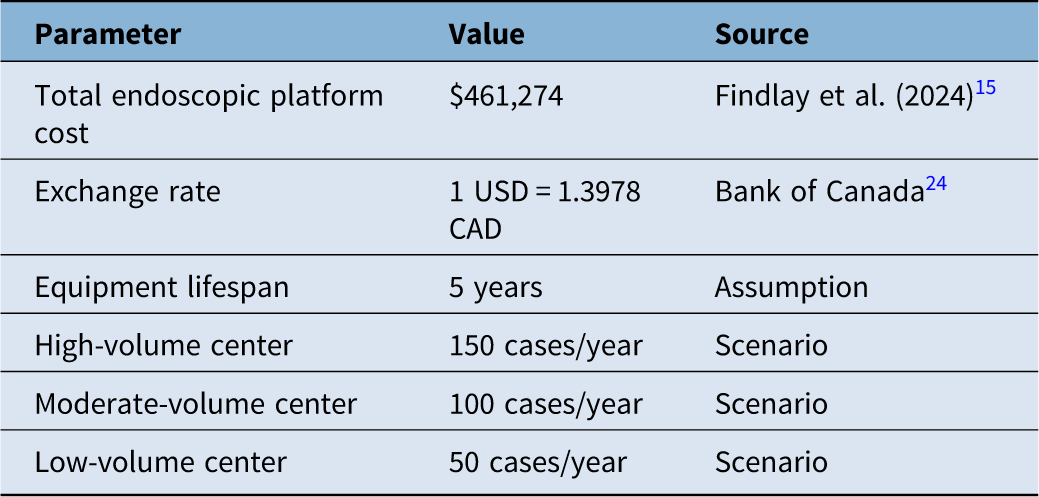
Additional scenario analyses were performed to evaluate the potential impact of institutional capital investment associated with endoscopic spine surgery. Capital equipment costs were derived from Findlay et al.Reference Findlay, Hamrick, Kim, Twitchell and Mahan15 and included endoscopic visualization systems, video equipment, radiofrequency generators, dedicated instrumentation and institution-level infrastructure requirements associated with adoption of endoscopic programs. Published costs were converted to 2025 Canadian dollars using an exchange rate of 1 USD = 1.3978 Canadian Dollar (CAD)24. Equipment costs were amortized over a five-year lifespan assuming annual procedural volumes of 50, 100 and 150 lumbar discectomy cases, corresponding to low-, moderate-and high-volume centers, respectively (Table 3). These assumptions were selected to reflect plausible implementation scenarios within Canadian practice. Because many Canadian centers already possess operative microscopes and conventional spine instrumentation, capital cost analyses were considered exploratory and were therefore not incorporated into the base-case healthcare payer model. Detailed derivation of endoscopic platform capital costs, including equipment components, currency conversion and amortization assumptions, is provided in Supplementary Table S3.
Capital cost scenario parameters

Table 3. Long description
The table presents capital cost scenario parameters for endoscopic spine surgery. It has six rows and three columns. The columns are labeled Parameter, Value, and Source. The rows are as follows: Row 1: Parameter, Total endoscopic platform cost; Value, 461274 USD; Source, Findlay et al. (2024). Row 2: Parameter, Exchange rate; Value, 1 USD = 1.3978 CAD; Source, Bank of Canada. Row 3: Parameter, Equipment lifespan; Value, 5 years; Source, Assumption. Row 4: Parameter, High-volume center; Value, 150 cases/year; Source, Scenario. Row 5: Parameter, Moderate-volume center; Value, 100 cases/year; Source, Scenario. Row 6: Parameter, Low-volume center; Value, 50 cases/year; Source, Scenario.
Parameter uncertainty and microsimulation
Parameter uncertainty was evaluated using deterministic and probabilistic approaches. One-way sensitivity analyses were conducted by varying each model parameter across its full plausible range to assess its influence on incremental NMB. Two-way sensitivity analyses examined the joint impact of selected pairs of influential parameters, including the comparative failure probabilities (R→N) of OM and EM, and the interaction between the EM failure probability and the EM index cost.
Probabilistic sensitivity analysis (PSA) incorporated the parameter distributions specified in Table 2 and used 1,000 Monte Carlo microsimulation iterations. In each iteration, costs were sampled from Gamma distributions, utilities from Beta or Normal distributions and transition probabilities from Beta or Normal distributions based on the underlying data. PSA outputs included the incremental NMB across a range of WTP thresholds, cost-effectiveness scatterplots with confidence ellipses, the incremental cost-effectiveness plane, the efficient frontier and the cost-effectiveness acceptability curve.
Statistical analysis
All statistical analyses were conducted in R (version 4.3). The Markov model, parameter sampling routines and probabilistic sensitivity analyses were implemented using custom R code.Reference Alarid-Escudero, Krijkamp and Enns25–Reference Krijkamp, Alarid-Escudero and Enns29 Figures and graphical outputs were generated using the ggplot2 library and supporting visualization packages.
Results
Base-case analysis
Base-case results for OM and EM are summarized in Table 4. Total discounted costs were $11,144 for OM and $11,162 for EM, yielding an incremental cost difference of +$18 for EM. Discounted QALYs were 24.55 for OM and 24.59 for EM, corresponding to an incremental effectiveness of +0.042 QALYs in favor of EM. Both strategies produced identical discounted life expectancy of 43.5 years.
Results of the base-case cost-effectiveness analysis

Table 4. Long description
A table comparing the cost-effectiveness of two medical strategies, Open and Endoscopic, across several metrics. The table has six columns: Strategy, Cost, Incremental Cost, Effectiveness (QALYs), Incremental effectiveness (QALYs), Incremental cost-effectiveness ratio ($/QALY), Incremental NMB, Incremental NMB, and Life-years. Row 1: Strategy, Open, Cost, $11,144, Incremental Cost, —, Effectiveness (QALYs), 24.55, Incremental effectiveness (QALYs), —, Incremental cost-effectiveness ratio ($/QALY), —, Incremental NMB, $1,216,369, Incremental NMB, —, Life-years, 43.5. Row 2: Strategy, Endoscopic, Cost, $11,162, Incremental Cost, +$18, Effectiveness (QALYs), 24.59, Incremental effectiveness (QALYs), +0.042, Incremental cost-effectiveness ratio ($/QALY), +434, Incremental NMB, $1,218,427, Incremental NMB, +$2,058, Life-years, 43.5.
QALY = Quality-adjusted life years; NMB = net monetary benefit.
The resulting ICER for EM relative to OM was +$434/QALY. At a WTP threshold of $50,000/QALY, the NMB was $1,218,427 for EM and $1,216,369 for OM, yielding an incremental NMB of +$2,058 in favor of EM.
Capital cost scenario analysis
Incorporating institutional capital acquisition costs increased the ICER for EM but did not materially alter the conclusions. Assuming a five-year amortization period, additional per-case endoscopic capital costs were estimated at $615, $923 and $1,845 for high-, moderate-and low-volume centers, respectively. Corresponding ICERs increased to $15,072/QALY, $22,394/QALY and $44,359/QALY, respectively (Table 5). EM remained below the prespecified $50,000/QALY WTP threshold in all implementation scenarios.
Scenario analysis incorporating endoscopic capital costs

Table 5. Long description
The table has four rows and four columns. The columns are labeled Scenario, Additional capital cost/case, Total incremental cost, Incremental QALYs, and Incremental cost-effectiveness ratio ($/QALY). The rows are labeled Base case, High-volume center (150/year), Moderate-volume center (100/year), and Low-volume center (50/year). Row 1: Base case, $0, $18, 0.042, $434. Row 2: High-volume center (150/year), $615, $633, 0.042, $15,072. Row 3: Moderate-volume center (100/year), $923, $941, 0.042, $22,394. Row 4: Low-volume center (50/year), $1,845, $1,863, 0.042, $44,359.
QALY = Quality-adjusted life years.
State occupancy over time
Long-term state occupancy trajectories are shown in Figure 2. The proportion of the cohort in the non-responder state remained low for both strategies, with broadly comparable non-response trajectories over time. At year 1, non-responder prevalence was 2.56% for EM and 1.88% for OM; at year 5, 5.49% and 5.42%; and at year 10, 5.78% and 6.46%, respectively. By year 20, estimates were 5.80% for EM and 6.70% for OM. Responder proportions declined gradually with age-related mortality, while the death state increased correspondingly over the 60-year horizon.
Markov state–occupancy over time for endoscopic and open microdiscectomy. Proportion of the cohort residing in each health state (responder, non-responder, death) over a 60-year horizon for endoscopic (left) and open (right) microdiscectomy. Both strategies show a high initial proportion of Responders, with a small proportion entering the non-responder state and a gradual increase in mortality over time due to background age-related mortality. The trajectories for both procedures are similar, with endoscopic microdiscectomy demonstrating a slightly lower long-term prevalence of non-responders and a correspondingly higher proportion of time spent in the responder state.

One-way sensitivity analysis
One-way sensitivity analysis results are presented in Figure 3. Incremental NMB was most sensitive to variation in the annual transition probabilities. Varying the OM failure probability (R→N) shifted the incremental NMB from −$14,190 to +$28,311, a total range of $42,500. The EM failure probability produced a similar effect, with incremental NMB ranging from +$21,094 to −$18,415 ($39,509 difference).
One-way sensitivity analysis on incremental NMB comparing endoscopic versus open microdiscectomy. Tornado diagram displaying the impact of varying individual model parameters across prespecified low–high ranges on the incremental NMB (Endoscopic – Open) at a willingness-to-pay threshold of $50,000/QALY. Transition probabilities between responder and non-responder states (R→N and N→R) exerted the greatest influence on cost-effectiveness, followed by index procedure costs for both strategies. Utilities, complication rates, discount rates and annual non-responder costs had comparatively smaller effects. Positive values favor endoscopic microdiscectomy, while negative values favor open microdiscectomy.

Figure 3. Long description
Panel A: A horizontal bar graph comparing the incremental net monetary benefit (NMB) of endoscopic versus open microdiscectomy. The x-axis represents the NMB in Canadian dollars, ranging from -20,000 to 30,000. The y-axis lists different parameters affecting the NMB, such as transition probabilities, index costs, utilities, complication rates, discount rates, and annual costs. Bars are colored red for high parameter levels and teal for low parameter levels. Positive values favor endoscopic microdiscectomy, while negative values favor open microdiscectomy. Notable parameters include transition probabilities and index procedure costs, which have the greatest influence on cost-effectiveness.
Recovery probabilities (N→R) also had substantial influence. The OM recovery probability resulted in an incremental NMB range of $29,158 to −$9,354 ($38,512 difference), while variation in the EM recovery probability shifted incremental NMB from −$17,736 to +$12,769 ($30,505 difference).
Cost parameters exerted moderate effects. The EM index cost altered incremental NMB by $6,500 and the OM index cost by $6,000. Utility parameters had smaller impacts: the non-responder utility changed incremental NMB by $3,303 and the responder utility by $1,888.
Perioperative complication rates, complication-related costs, revision-related costs and discount rates produced minimal variation in incremental NMB relative to the transition probabilities.
Two-way sensitivity analysis
Two-way sensitivity analyses evaluated the combined effects of key clinical and economic parameters (Figure 4). When jointly varying OM and EM failure probabilities (R→N), a clear threshold was observed at which the preferred strategy shifted (Figure 4A). EM remained favored unless its failure probability substantially exceeded that of OM.
Two-way sensitivity analyses (TWSA) evaluating joint uncertainty in key model parameters. (A) TWSA comparing failure rates between strategies (annual probability R→N for open vs endoscopic microdiscectomy). The diagonal frontier line shows the parameter space where both strategies yield equal NMB. (B) TWSA varying the annual probability of losing response for endoscopic microdiscectomy (R→N (Endo)) and the endoscopic index procedure cost. The frontier delineates conditions under which endoscopic microdiscectomy remains cost-effective relative to open microdiscectomy.

Figure 4. Long description
Panel A: A two-way sensitivity analysis graph comparing failure rates between open and endoscopic microdiscectomy strategies. The x-axis represents the annual probability of losing response for open microdiscectomy (R→N (Open)), and the y-axis represents the annual probability of losing response for endoscopic microdiscectomy (R→N (Endoscopic)). The graph is divided into red and blue regions, with a diagonal frontier line indicating the parameter space where both strategies yield equal net monetary benefit (NMB). Panel B: A two-way sensitivity analysis graph varying the annual probability of losing response for endoscopic microdiscectomy (R→N (Endo)) and the endoscopic index procedure cost. The x-axis represents the annual probability of losing response for endoscopic microdiscectomy, and the y-axis represents the index cost of endoscopic surgery in Canadian dollars (CAD). The graph is divided into red and blue regions, with a frontier line delineating conditions under which endoscopic microdiscectomy remains cost-effective relative to open microdiscectomy.
The interaction between the EM failure probability and the EM index cost is shown in Figure 4B. EM remained cost-effective across a wide range of index costs unless its failure rate increased markedly.
Probabilistic sensitivity analysis
Results from 1,000 Monte Carlo simulations are summarized in Figures 5–7. Mean PSA costs were $11,808 (SD $4,327; 95% CI $6,775–$23,013) for OM and $11,830 (SD $3,933; 95% CI $7,411–$21,667) for EM. Mean PSA QALYs were 24.5 (SD 0.550; 95% CI 23.3–25.6) for OM and 24.5 (SD 0.549; 95% CI 23.5–25.6) for EM.
Probabilistic sensitivity analysis (PSA) results. (A) Incremental net monetary benefit (NMB) of endoscopic versus open microdiscectomy across a range of willingness-to-pay (WTP) thresholds ($0–$150,000/QALY). The vertical line indicates the base-case WTP of $50,000/QALY. Incremental NMB increases with higher WTP thresholds and is positive at the base-case threshold, indicating that additional QALYs gained offset the small incremental cost on average. (B) Cost-effectiveness plane displaying 1,000 Monte Carlo simulations comparing endoscopic and open microdiscectomy. Each point represents a paired cost and effectiveness outcome, with ellipses denoting 95% uncertainty regions. Endoscopic microdiscectomy clusters slightly to the right (higher QALYs) with similar or marginally higher costs, illustrating uncertainty around the base-case estimates. QALY = quality-adjusted life years; NMB = net monetary benefit.

Cost-effectiveness frontier and acceptability curve. (A) Cost-effectiveness (CE) frontier illustrating the relationship between total discounted lifetime costs and QALYs for open versus endoscopic microdiscectomy. The frontier connects the non-dominated strategies, showing that endoscopic microdiscectomy lies on the efficient frontier due to its slightly higher effectiveness at a marginally higher cost. (B) Cost-effectiveness acceptability curve (CEAC) comparing the probability that each strategy is cost-effective across a range of willingness-to-pay (WTP) thresholds ($0–$100,000/QALY). At the base-case WTP of $50,000/QALY (vertical dashed line), endoscopic microdiscectomy has a higher probability of being cost-effective, with this probability increasing at higher WTP thresholds. QALY = quality-adjusted life years.

Figure 6. Long description
Panel A: A line graph illustrates the cost-effectiveness frontier, showing the relationship between total discounted lifetime costs in Canadian dollars and quality-adjusted life years (QALYs) for open and endoscopic microdiscectomy. The x-axis represents the effect in QALYs, ranging from 24.5 to 24.64, while the y-axis represents the cost in dollars, ranging from 11,810 to 11,830. The graph shows that endoscopic microdiscectomy lies on the efficient frontier due to its slightly higher effectiveness at a marginally higher cost. Panel B: A line graph depicts the cost-effectiveness acceptability curve (CEAC), comparing the probability that each strategy is cost-effective across a range of willingness-to-pay (WTP) thresholds from $0 to $100,000 per QALY. The x-axis represents the WTP threshold, and the y-axis represents the probability of being cost-effective. At the base-case WTP of $50,000 per QALY, endoscopic microdiscectomy has a higher probability of being cost-effective, with this probability increasing at higher WTP thresholds.
Incremental cost-effectiveness plane for endoscopic versus open microdiscectomy. Incremental costs and QALYs from 1,000 Monte Carlo simulations are shown, with points colored by the preferred strategy at a willingness-to-pay (WTP) threshold of $50,000 per QALY. The 95% uncertainty ellipse and WTP reference lines ($50,000, $100,000 and $150,000 per QALY) are displayed. Simulations cluster near the origin with points distributed across both positive and negative incremental cost and effectiveness regions, indicating small incremental differences between strategies and substantial overlap under parameter uncertainty. At a WTP of $50,000 per QALY, endoscopic microdiscectomy is cost-effective in a modest majority of simulations. OM = open microdiscectomy; EM = endoscopic microdiscectomy; WTP = willingness-to-pay; QALY = quality-adjusted life years.

Incremental PSA outcomes showed a mean cost difference of −$21 (95% CI −$8,973 to $8,230), a mean incremental QALY gain of 0.040 (95% CI −0.563 to 0.611) and a mean incremental NMB of $1,983 (95% CI −$36,198 to $37,468).
Incremental NMB increased linearly with higher WTP thresholds (Figure 5A). The PSA scatterplot with 95% confidence ellipses demonstrated substantial overlap between strategies (Figure 5B). The efficient frontier (Figure 6A) showed that both OM and EM were non-dominated. The cost-effectiveness acceptability curve indicated that EM was cost-effective in 55.2% of simulations at a $50,000/QALY threshold, compared with 44.8% for OM (Figure 6B).
The incremental cost-effectiveness plane (Figure 7) showed that most simulations fell near the origin, reflecting minimal cost and QALY differences between strategies across uncertainty distributions.
Discussion
This study presents one of the first lifetime cost-utility analyses comparing EM and OM for symptomatic LDH from a Canadian healthcare payer perspective. Both procedures generated substantial long-term health gains, with nearly identical lifetime QALYs and life expectancy. In the base case, EM demonstrated a modest economic advantage, with slightly higher QALYs and a marginally greater NMB at the $50,000 WTP threshold. However, this advantage was highly sensitive to transition probabilities and procedural costs, whereas utility parameters exerted comparatively smaller effects. PSA demonstrated substantial overlap in cost and QALY distributions, with EM favored in only 55.2% of simulations. Together, these findings suggest that neither strategy demonstrates a definitive cost-utility advantage when uncertainty is fully incorporated, consistent with clinical evidence showing comparable long-term outcomes.
Comparison with existing literature
The present findings contrast with the economic evaluation accompanying the Dutch PTED RCT by Gadjradj et al., which found EM to be dominant from a societal perspective, largely because earlier return to work reduced productivity losses.Reference Gadjradj, Broulikova and van Dongen16 The current analysis intentionally adopted a Canadian healthcare payer perspective and therefore excluded indirect costs. This difference in analytic perspective likely explains the smaller cost differences and greater uncertainty observed here. Because earlier functional recovery and return to employment are important to patients, the present model may underestimate the broader value of EM from societal and patient-centered perspectives.
Economic analyses from Asian healthcare systems have reported more favorable cost-effectiveness profiles for endoscopic techniques.Reference Kim, Choi and Chung12,Reference Choi, Shim and Kim20 Choi et al. reported lower ICERs for EM compared with OM at one year, while Kim et al. observed a low cost per QALY gained for full-endoscopic surgery within the Korean National Health Insurance framework.Reference Kim, Choi and Chung12,Reference Choi, Shim and Kim20 However, these studies were conducted in distinct reimbursement environments with different device pricing, labor costs and hospital financing structures. Consistent with this, EM index cost emerged as a key driver of incremental NMB in the present model, underscoring the importance of local cost structures in determining economic value.
Recent North American evidence has further highlighted the importance of implementation costs. Findlay et al. demonstrated that EM requires dedicated investments in visualization systems, radiofrequency generators and specialized instrumentation.Reference Findlay, Hamrick, Kim, Twitchell and Mahan15 Additional scenario analyses in the present study demonstrated that incorporation of institutional capital costs increased the ICER associated with EM but did not materially alter study conclusions, with EM remaining below the prespecified $50,000/QALY threshold across all modeled implementation scenarios. Importantly, modern operative microscopy systems may themselves require substantial acquisition costs, suggesting that the incremental implementation costs associated with endoscopic programs may be smaller than commonly assumed.
The broader clinical literature aligns closely with these findings, with systematic reviews demonstrating similar long-term improvements in pain, function and patient satisfaction between EM and OM.Reference Gadjradj, Harhangi and Amelink30 While endoscopic approaches may offer perioperative advantages, such as shorter hospital stay and faster recovery, these benefits appear to have limited impact on lifetime QALYs.Reference Park, Song and Ham31,Reference Jarebi, Awaf, Lefranc and Peltier32
The systematic review by Golan et al. further highlights the heterogeneity in economic findings and the central role of analytic perspective.Reference Golan, Elkaim, Alrashidi, Georgiopoulos and Lasry33 Studies incorporating societal costs tend to favor endoscopic approaches, whereas payer-focused analyses show more mixed results.
Overall, existing evidence suggests that EM and OM achieve comparable long-term outcomes and that economic conclusions are highly dependent on analytic perspective, cost inputs and modeling assumptions. Although EM is associated with lower complication rates and faster recovery, some studies have reported higher rates of transient dysesthesia and residual disc fragments, particularly during early phases of adoption.Reference Yang, Chen and Lin9,Reference Perez-Albela, Singh and Kim10 This study therefore contributes jurisdiction-specific evidence demonstrating that, within a publicly funded Canadian system, neither strategy shows a clear cost-utility advantage when uncertainty is considered.
Interpretation and clinical implications
This analysis demonstrates that EM and OM provide comparable long-term value for the surgical management of LDH. Although EM showed a small base-case advantage, this difference was minimal and highly sensitive to key inputs, suggesting that short-term perioperative benefits do not translate into meaningful long-term QALY gains. These findings suggest that neither strategy demonstrates clear long-term economic superiority. Nevertheless, earlier postoperative recovery and accelerated return to work may represent important patient-centered benefits that are not fully captured within a healthcare payer framework.
From a system perspective, adoption decisions should consider procedural costs, operating-room efficiency, case volume, surgeon expertise, existing infrastructure and capital investment. Capital-cost scenarios showed progressively higher ICERs at lower procedural volumes, although EM remained below the prespecified $50,000/QALY threshold in all modeled scenarios. This may be particularly relevant in centers that already possess operative microscopy infrastructure, where endoscopic equipment represents a genuinely incremental investment. Centralized implementation and greater procedural throughput may therefore improve the economic attractiveness of endoscopic programs. These findings suggest that institution-specific implementation factors may substantially influence the cost-effectiveness of EM in real-world practice.
Additional implementation costs related to surgeon training, learning-curve effects and procedure-specific disposable equipment were not quantified. During early adoption, longer operative times, greater resource use and dedicated training may temporarily reduce economic attractiveness; these effects may diminish as proficiency and procedural volume increase.
For patients, both approaches remain reasonable options with comparable long-term outcomes, allowing decision-making to focus on preferences, recovery expectations and surgeon experience. Collectively, these findings suggest that the economic value of EM is highly dependent on analytic perspective and implementation context. From a healthcare payer perspective, both strategies appear to provide comparable value, although societal analyses may favor endoscopic approaches.
Strengths and limitations
This study has several important strengths. It represents one of the few lifetime cost-utility analyses comparing EM and OM, capturing long-term recurrence and HRQoL beyond typical follow-up durations. Model inputs were derived from RCTs and systematic reviews, and extensive deterministic and probabilistic sensitivity analyses were conducted to characterize uncertainty. Internal validity was further supported by clinically plausible state-occupancy trajectories over the lifetime horizon. The Canadian healthcare payer perspective provides decision-relevant evidence for publicly funded systems.
Several limitations should be considered. First, the model has not undergone external validation against real-world datasets, and results should be interpreted cautiously when extrapolated to other populations. Second, transition probabilities were derived from studies with relatively limited follow-up durations, requiring extrapolation over the lifetime horizon. Because long-term comparative evidence remains heterogeneous and demonstrates both advantages and disadvantages for EM, uncertainty remains regarding the precise magnitude of long-term transition risks and recurrence trajectories. Nevertheless, extensive deterministic and probabilistic sensitivity analyses demonstrated that the principal conclusions remained robust across plausible parameter ranges.
Third, utility estimates were derived primarily from Korean cohorts because Canadian procedure-specific utility data for lumbar discectomy are currently limited. Although use of standardized EQ-5D instruments improves cross-jurisdictional applicability, these estimates may not fully reflect patient preferences or postoperative recovery trajectories within Canadian populations. Nevertheless, selecting utility estimates from internally consistent lumbar discectomy cohorts minimizes heterogeneity related to patient selection, disease severity and health-state definitions. Future Canadian studies reporting procedure-specific utility outcomes would improve the precision and generalizability of economic evaluations in this field.
Fourth, the simplified Markov structure may not fully capture heterogeneous or time-dependent clinical trajectories. Although recurrence and revision surgery were not modeled as independent health states, their health and economic consequences were incorporated through transitions between responder and non-responder states. This parsimonious approach was selected to minimize model complexity while preserving clinically relevant long-term trajectories. Future studies with longer-term comparative data may permit development of more granular model structures incorporating explicit recurrence and revision states.
Fifth, although additional scenario analyses incorporating institutional capital costs were performed, these estimates relied on assumptions regarding equipment lifespan, procedural volume and acquisition costs derived from published literature.Reference Findlay, Hamrick, Kim, Twitchell and Mahan15 Actual implementation costs may vary substantially between institutions depending on existing infrastructure, purchasing arrangements, program maturity, surgeon learning curves and disposable equipment requirements.
Finally, societal costs including productivity losses, caregiver burden and earlier return to work were not incorporated into the base-case analysis. This omission was intentional, as the present study was designed from the perspective of the Canadian publicly funded healthcare payer in accordance with national economic evaluation guidelines. However, previous studies have demonstrated substantial indirect cost savings associated with EM, suggesting that the present analysis may underestimate the broader economic value of EM from both societal and patient-centered perspectives. Future studies incorporating societal costs and patient-reported recovery trajectories may provide a more comprehensive assessment of the value of endoscopic surgery.
Conclusion
In this lifetime cost-utility analysis conducted from a Canadian healthcare payer perspective, EM and OM demonstrated comparable long-term health outcomes and economic value. Although EM showed a modest base-case advantage, this difference was sensitive to variation in key clinical and cost parameters and was not robust when parameter uncertainty was fully considered. The economic attractiveness of EM appears highly dependent on procedural volume, implementation costs and analytic perspective, suggesting that local institutional factors and societal considerations should guide adoption decisions.
Supplementary material
The supplementary material for this article can be found at https://doi.org/10.1017/cjn.2026.10705.
Data availability statement
All data used in this study were obtained from publicly available sources, including published literature and economic data. Additional details regarding model inputs are available from the corresponding author upon request.
Acknowledgements
The authors would like to thank Petros Pechlivanoglou and Beate Sander who provided methodological and conceptual guidance during the development of this study.
Author contributions
JS: Conceptualization, Methodology, Software, Formal analysis, Data curation, Investigation, Validation, Visualization, Project administration, Resources, Writing – Original Draft, Writing – Review & Editing.
PT: Conceptualization, Methodology, Formal analysis, Writing – Original Draft, Writing – Review & Editing.
CSL: Investigation, Methodology, Writing – Review & Editing.
VK: Methodology, Writing – Review & Editing.
HS: Conceptualization, Investigation, Methodology, Writing – Review & Editing.
AKM: Conceptualization, Validation, Writing – Review & Editing.
YH: Project administration, Resources, Software, Writing – Review & Editing.
SBA: Project administration, Supervision, Writing – Review & Editing.
DSL: Resources, Supervision, Writing – Review & Editing.
JRW: Methodology, Project administration, Resources, Supervision, Writing – Review & Editing.
CWN: Methodology, Project administration, Resources, Supervision, Validation, Writing – Original Draft, Writing – Review & Editing.
CDW: Conceptualization, Methodology, Project administration, Resources, Supervision, Visualization, Writing – Review & Editing.
Funding statement
This study received no external funding. The first author was supported by the Surgeon Scientist Training Program through the Department of Surgery, University of Toronto.
Competing interests
The authors declare that there are no conflicts of interest relevant to this work.
Ethical standards
This study involved secondary analysis of published data and did not require research ethics board approval. No human participants or identifiable data were included.






 Open access

