INTRODUCTION
Depression is known to significantly affect neurocognitive functioning, particularly in the domains of learning, memory, processing speed, and working memory (Lam, Kennedy, Mcintyre, & Khullar, Reference Lam, Kennedy, Mcintyre and Khullar2014; Rubin & Maki, Reference Rubin and Maki2019; Shenal, Harrison, & Demaree, Reference Shenal, Harrison and Demaree2003; Zakzanis, Leach, & Kaplan, Reference Zakzanis, Leach and Kaplan1998). Further, depression is hypothesized to be associated with changes in frontal (Rogers et al., Reference Rogers, Kasai, Koji, Fukuda, Iwanami, Nakagome and Kato2004) and limbic (Thomas & Elliott, Reference Thomas and Elliott2009) structures, as well as neuroinflammatory changes (Del Guerra, Fonseca, Figueiredo, Ziff, & Konkiewitz, Reference Del Guerra, Fonseca, Figueiredo, Ziff and Konkiewitz2013), that are also associated with HIV-related neurocognitive impairment (du Plessis et al., Reference du Plessis, Vink, Joska, Koutsilieri, Stein and Emsley2014; Rubin & Maki, Reference Rubin and Maki2019). Accounting for depression is an important factor to consider when rendering a neurocognitive diagnosis. It is well-known that people living with HIV (PLWH) experience higher levels of depression than the general population, with reports estimating that depression is three times higher among PLWH than in the general population (Ciesla & Roberts, Reference Ciesla and Roberts2001). While depression may confound neurocognitive functioning, and therefore complicate the diagnosis of neurocognitive disorders among PLWH, the prevalence of both depressive symptoms and neurocognitive impairment in this population is high (Ciesla & Roberts, Reference Ciesla and Roberts2001).
Existing research examining the relationship between depression and neurocognitive functioning in PLWH suggests that depression can significantly influence neurocognitive performance in PLWH. Some landmark studies, including the CNS-HIV Antiretroviral Therapy Effects Research (CHARTER) Study, have identified associations between depressive symptoms and worse neurocognitive function (Cross, Önen, Gase, Overton, & Ances, Reference Cross, Önen, Gase, Overton and Ances2013; Heaton et al., Reference Heaton, Franklin, Deutsch, Letendre, Ellis, Casaletto and Teshome2015; Stern et al., Reference Stern, McDermott, Albert, Palumbo, Selnes, McArthur and Marder2001), while one study failed to identify associations between depression and neurocognitive performance (Cysique et al., Reference Cysique, Deutsch, Atkinson, Young, Marcotte, Dawson and Heaton2007). Alternatively, Stern et al. (Reference Stern, McDermott, Albert, Palumbo, Selnes, McArthur and Marder2001) previously reported that depression was a risk factor for developing what was then called HIV Dementia. More recently, Heaton et al. (Reference Heaton, Franklin, Deutsch, Letendre, Ellis, Casaletto and Teshome2015) found that depressive symptoms were associated with a poorer neurocognitive performance both during the pre- and post-combination antiretroviral therapy (cART) eras. Further, depression has been independently associated with HIV-Associated Neurocognitive Disorder (HAND) in other research studies (Cross et al., Reference Cross, Önen, Gase, Overton and Ances2013), including longitudinal studies examining how the presence of depression predicted later neurocognitive performance (Gibbie et al., Reference Gibbie, Mijch, Ellen, Hoy, Hutchison, Wright and Judd2006). Thus, apart from the one conflicting finding by Cysique et al. (Reference Cysique, Deutsch, Atkinson, Young, Marcotte, Dawson and Heaton2007), there is a broad consensus that depressive symptoms can affect neurocognitive performance in PLWH, as reflected in the diagnostic criteria for HAND (Antinori et al., Reference Antinori, Arendt, Becker, Brew, Byrd, Cherner and Wojna2007; Cross et al., Reference Cross, Önen, Gase, Overton and Ances2013).
Another essential element in the neurocognitive evaluation of PLWH is considering sociocultural factors that have also been shown to influence neurocognitive functioning among diverse PLWH (Rivera Mindt et al., Reference Rivera Mindt, Byrd, Ryan, Robbins, Monzones, Arentoft and Henniger2008, Reference Rivera Mindt, Miranda, Arentoft, Byrd, Monzones, Fuentes and Morgello2014). In 2016, 26% of new HIV diagnoses occurred among Latinx adults in the United States (US), despite the fact that Latinx adults only make up 18% of the total US population (United States Census Bureau, 2018). Further, Latinx adults appear to be at risk for greater rates of HAND than their non-Hispanic white counterparts (Marquine et al., Reference Marquine, Heaton, Johnson, Rivera-Mindt, Cherner, Bloss and Heaton2018; Rivera Mindt et al., Reference Rivera Mindt, Byrd, Ryan, Robbins, Monzones, Arentoft and Henniger2008, Reference Rivera Mindt, Miranda, Arentoft, Byrd, Monzones, Fuentes and Morgello2014). Thus, it is important to better understand how sociocultural factors impact neurocognitive functioning HAND diagnosis among Latinx PLWH, who face elevated rates of HAND.
Cultural variation regarding the expression of depressive symptoms remains a salient sociocultural factor that has yet to be investigated in the context of HIV. Cultural idioms of distress, or the ways in which distress is expressed, can vary greatly between cultures (Kohrt et al., Reference Kohrt, Rasmussen, Kaiser, Haroz, Maharjan, Mutamba and Hinton2014). For example, in Western cultures, depressive symptoms are commonly expressed through verbally articulating one’s mood (i.e., affect), whereas, in some Latinx cultures, depressive symptoms are more likely to be expressed as ataques de nervios (i.e., “nerves”) rather than verbally articulating one’s mood (Kohrt et al., Reference Kohrt, Rasmussen, Kaiser, Haroz, Maharjan, Mutamba and Hinton2014). This work is highly relevant, as culturally diverse populations can manifest depression differently from Westernized conceptualizations of depression that emphasize significant cognitive and/or affective symptoms, such as feelings of sadness (Iwata & Buka, Reference Iwata and Buka2002).
In contrast, members of Latinx, Asian/Asian-American, and African American communities often exhibit somatic/functional depressive symptoms, such as headaches or exhaustion (Kleinman, Reference Kleinman1977; United States Department of Health and Human Service, 2001). Researchers theorize that persons from other cultures often exhibit somatic/functional symptoms as opposed to cognitive and affective depressive symptoms because those particular depressive symptoms may be stigmatized in non-Westernized cultures (Kleinman, Reference Kleinman1977; United States Department of Health and Human Service, 2001). In Latinx cultures specifically, the literature suggests that the somatic/functional presentation of depressive symptoms may be due to sociocultural factors such as stigma, language, and cultural idioms of distress, such as the manner in which depressive symptoms are expressed (Jorge, Reference Jorge2003; Tófoli, Andrade, & Fortes, Reference Tófoli, Andrade and Fortes2011).
Further, cross-cultural research conducted regarding depressive and anxiety symptoms suggests that people from non-Western cultures are more likely to view themselves interdependently and contextually within their social group, which may influence the way they express depressive or anxiety symptoms (Hofmann & Hinton, Reference Hofmann and Hinton2014). For example, people in non-Western cultures may be anxious about acting in a way that embarrasses another person (not themselves), whereas people in Western cultures tend to be more anxious about acting in a way that would embarrass themselves (Hofmann & Hinton, Reference Hofmann and Hinton2014). Thus, feelings of guilt, punishment, and worthlessness felt by people of non-Western cultures may represent feelings based on interdependent, collectivistic societal structures in which interaction with others significantly influences one’s self-construal and identity (Hofmann & Hinton, Reference Hofmann and Hinton2014). These aspects of interdependence may relate to self-monitoring of one’s physical behavior and self-portrayal, potentially representing an alternative category of symptoms aside from those typically represented by the cognitive/affective descriptor. Further, these symptoms (e.g., feelings of guilt, punishment) overlap with the symptoms of ataques de nervios (i.e., “nerves”), a cultural idiom of distress for experiencing anxiety and depression in Latinx cultures (Kohrt et al., Reference Kohrt, Rasmussen, Kaiser, Haroz, Maharjan, Mutamba and Hinton2014; American Psychiatric Association, 2013). Thus, alternative categories of depressive symptoms (i.e., aside from cognitive/affective) may better represent depressive symptoms among persons of Latinx descent.
Among PLWH, one prior study identified a “Mood-Motivation Disturbance” factor, on which several somatic/functional items (e.g., sleep disturbance, loss of appetite, etc.) had high factor loadings (Castellon et al., Reference Castellon, Hardy, Hinkin, Satz, Stenquist, van Gorp and Moore2006). Another study conducted by the CHARTER group suggested that three factors (i.e., cognitive, affective, somatic) more adequately described depressive symptoms among PLWH (Hobkirk et al., Reference Hobkirk, Starosta, De Leo, Marra, Heaton and Earleywine2015). While neither of these studies considered cultural differences, their results point to the existence of different categories of depressive symptoms in HIV. Understanding differences in the manifestation of depressive symptoms across cultures is critical to the neurocognitive evaluation of Latinx PLWH because the instrumentation typically used to evaluate depressive symptoms among PLWH emphasizes the evaluation of cognitive and affective depressive symptoms, which are less likely to be endorsed among Latinx PLWH. Further, the clinical tools traditionally used to measure depression in PLWH are used to determine whether a patient, client, or participant meets criteria for depression; thus, the specific symptoms endorsed – and their potential diagnostic implications – may be ignored.
One of the most common instruments used to evaluate depressive symptoms is the Beck Depression Inventory-II, which assesses for somatic/functional, cognitive, and affective depressive symptoms (Beck, Steer, & Brown, Reference Beck, Steer and Brown1996). Typical measures of depressive symptoms containing somatic/functional symptoms present a problem for PLWH, who may often experience HIV-related somatic/functional symptoms unrelated to depression (Kalichman, Rompa, & Cage, Reference Kalichman, Rompa and Cage2000). This could result in inaccurately identifying PLWH with a clinically significant level of depressive symptoms (Kalichman et al., Reference Kalichman, Rompa and Cage2000). Thus, it is difficult to attribute somatic/functional symptoms in PLWH who may be experiencing such symptoms, due to either HIV or depression or both conditions. To address this, some researchers and care providers use the Beck Depression Inventory Fast-Screen (BDI-FS) to evaluate depression in PLWH to gain an isolated assessment of cognitive and emotional depressive symptoms (Beck, Steer, & Brown, Reference Beck, Steer and Brown2000; Kalichman et al., Reference Kalichman, Rompa and Cage2000; Wang & Gorenstein, Reference Wang and Gorenstein2013). Previous work in the Women’s Interagency HIV Study (WIHS), the largest study of HIV in women in the US, has successfully used the Centers for Epidemiological Depression-Scale (CESD; Radloff, Reference Radloff1977) by eliminating somatic/functional symptoms of depression to address the inflation of depressive symptoms among HIV-seropositive participants (Cook et al., Reference Cook, Cohen, Burke, Grey, Anastos, Kirstein and Young2002). However, this method prevents the analysis of whether somatic/functional symptoms of depression are unique predictors of neurocognitive functioning in diverse PLWH. Thus, while the BDI-FS may be an adequate tool for assessing depressive symptoms in non-Hispanic white PLWH, no study to date has examined whether different types of depressive symptoms differentially affect neurocognition in Latinx PLWH and other culturally diverse PLWH.
Depression continues to be common among PLWH (Rubin & Maki, Reference Rubin and Maki2019) and can negatively impact neurocognitive test performance (Rubin & Maki, Reference Rubin and Maki2019; Shenal et al., Reference Shenal, Harrison and Demaree2003; Zakzanis et al., Reference Zakzanis, Leach and Kaplan1998). Within-group studies of depressive symptoms among racial/ethnic minority PLWH also indicate significant levels of depression (Kong, Nahata, Lacombe, Seiber, & Balkrishnan, Reference Kong, Nahata, Lacombe, Seiber and Balkrishnan2012; Logie, James, Tharao, & Loutfy, Reference Logie, James, Tharao and Loutfy2013). Latinx adults often express depressive symptoms differently than non-Hispanic white adults, but it remains unclear whether there are ethnic differences in how different types of depressive symptoms (i.e., somatic/functional vs. cognitive/affective) can affect neurocognition (Jorge, Reference Jorge2003; Kleinman, Reference Kleinman1977; Tófoli et al., Reference Tófoli, Andrade and Fortes2011). While cognitive/affective symptoms of depression are well-validated in non-Hispanic white populations, in Latinx populations, the literature suggests that somatic/functional symptoms of depression may be a more salient measure of depressive symptomology (Jorge, Reference Jorge2003; Kleinman, Reference Kleinman1977; Tófoli et al, Reference Tófoli, Andrade and Fortes2011). Consequently, understanding potential ethnic differences in the association between distinct types of depressive symptoms and neurocognitive functioning is important to advance an evidence-based, culturally-tailored approach to understanding brain-behavior relationships and valid assessments of these associations (Manly, Reference Manly2006) and to better address an understudied and underserved population (US Latinx population) who bear a disproportionate burden of numerous brain health disparities, including HIV-infection. To that end, the aim of this study was to examine whether distinct types of depressive symptoms differentially predict neurocognitive performance in Latinx versus non-Hispanic white PLWH. It was hypothesized that: (1) somatic (e.g., sleep disturbance)/functional (e.g., feelings of guilt) depressive symptoms would be significantly related to worse neurocognitive performance in the Latinx group but not in the non-Hispanic white group and (2) cognitive/affective depressive symptoms would be significantly related to worse neurocognitive performance in the non-Hispanic white group but not in the Latinx group.
METHODS
Participants
This study included 140 PLWH. Participants were a part of a larger Medication Adherence Study at the Icahn School of Medicine at Mount Sinai in New York, NY (PI: M. Rivera Mindt, NIMH # K23MH079718). Inclusion criteria included being HIV-seropositive, medically stable, and/or on ART medications for at least 12 weeks, either of Latinx origin (any race) or non-Hispanic white, between the ages of 18–80, fluent in English, having at least 6 years of education, and completing the BDI-II. Exclusion criteria included self-reported complex neurological history (e.g., hemorrhagic stroke, brain tumor) or serious psychiatric comorbidity (e.g., bipolar disorder, schizophrenia), and plans to change ART regimens within the next month due to requirements of the larger Medication Adherence Study. Latinx participants were predominantly of Caribbean (i.e., Puerto Rican) origin. Participants were recruited via community outreach, referral from related studies, and self-referral.
Procedures
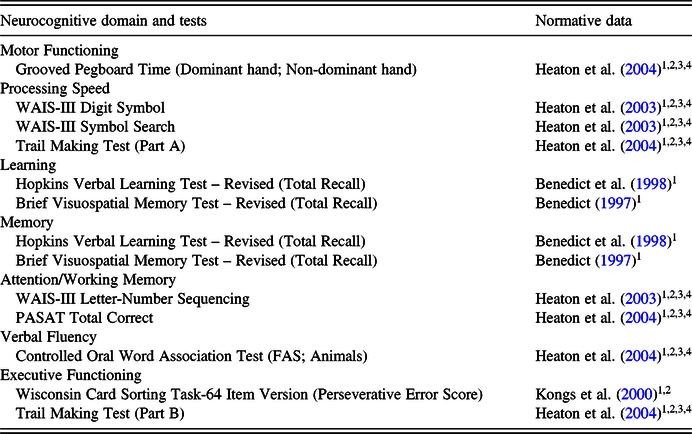
All participants completed a comprehensive neurocognitive battery that is well-validated for use among PLWH and is summarized in Table 1 (Heaton, Miller, Taylor, & Grant, Reference Heaton, Miller, Taylor and Grant2004). The domains of executive functioning, attention/working memory, learning, memory, motor functioning, processing speed, and verbal fluency were evaluated using the neurocognitive assessments listed in Table 1. Quality of Education (QoE) was measured using a well-validated measure, the Wechsler Test of Adult Reading (WTAR; Holdnack, Reference Holdnack2001). The WTAR was used as a proxy for QoE given that word-reading tests have shown to be better estimate of premorbid functioning as opposed to years of education in diverse groups due to the structural inequalities associated with schools in the US (Cosentino, Manly, & Mungas, Reference Cosentino, Manly and Mungas2007; Manly et al., Reference Manly, Jacobs, Sano, Bell, Merchant, Small and Stern1999, Manly, Jacobs, Touradji, Small, & Stern, Reference Manly, Jacobs, Touradji, Small and Stern2002, Manly, Byrd, Touradji, & Stern, Reference Manly, Byrd, Touradji and Stern2004). Word-reading tests such as the WTAR have been used previously in Latinx samples to evaluate QoE (Coulehan et al., Reference Coulehan, Byrd, Arentoft, Monzones, Fuentes, Fraser and Mindt2014; Miranda et al., Reference Miranda, Rentería, Fuentes, Coulehan, Arentoft, Byrd and Mindt2016; Rivera Mindt et al., Reference Rivera Mindt, Miranda, Arentoft, Byrd, Monzones, Fuentes and Morgello2014). Neurocognitive batteries were administered and scored by trained psychometrists supervised by a board-certified neuropsychologist (MRM). Raw test scores were converted to demographically adjusted T-scores using the best norms available to create an average domain and global T-scores (Heaton et al., Reference Heaton, Miller, Taylor and Grant2004).
Neurocognitive tests and corresponding normative data

Notes. WAIS = Wechsler Adult Intelligence Scales; PASAT = Paced Auditory Serial Arithmetic Test. Normative data is demographically corrected by 1age, 2education, 3sex, 4ethnicity.
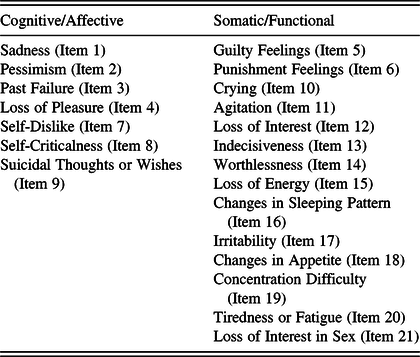
Participants also completed a comprehensive neuromedical interview and the BDI-II (Beck et al., Reference Beck, Steer and Brown1996). The cognitive/affective subscale for this study was derived by calculating the BDI-Fast Screen (BDI-FS) subscale using previously published, standardized procedures (i.e., adding the BDI-II responses from items 1–4 and 7–9 to measure the presence of cognitive/affective depressive symptoms; Beck et al., Reference Beck, Steer and Brown2000; Kalichman et al., Reference Kalichman, Rompa and Cage2000; Wang & Gorenstein, Reference Wang and Gorenstein2013). The BDI-FS is a validated subscale of the BDI-II for use in medical populations (Kalichman et al., Reference Kalichman, Rompa and Cage2000; Wang & Gorenstein, Reference Wang and Gorenstein2013). Examples include items such as “Sadness,” on which participants are asked to rate their feelings of sadness on a scale of 0 (“I don’t feel sad”) to 3 (“I am so sad or unhappy that I can’t stand it”), and “Loss of Pleasure,” on which participants are asked to rate their loss of pleasure on a scale of 0 (“I get as much as I ever did from the things I enjoy”) to 3 (“I don’t get any pleasure from the things I used to enjoy”), with higher scores indicating more symptoms.
The novel BDI-Non Fast Screen (BDI-NFS) subscale was created for this study by subtracting the BDI-FS from the BDI-II total score to evaluate the presence of somatic (e.g., distorted body image, sleep disturbance) and functional (e.g., feelings of guilt, social withdrawal) types of depressive symptoms and was theoretically derived by the authors based on cultural theory regarding depressive symptoms among Latinx adults (i.e., ataque de nervios) and prior research indicating multiple factors of the BDI-II (Castellon et al., Reference Castellon, Hardy, Hinkin, Satz, Stenquist, van Gorp and Moore2006) to measure somatic/functional symptoms not evaluated by the BDI-FS. The BDI-NFS subscale is comprised of items 5-6 and 10-21 of the BDI-II. Examples of items include “Concentration Difficulty,” on which participants are asked to rate their concentration on a scale of 0 (“I can concentrate as well as ever”) to 3 (“I can’t concentrate on anything”) and “Agitation,” on which participants are asked to rate their agitation on a scale of 0 (“I am no more restless or wound up than usual”) to 3 (“I am so restless or agitated that I have to keep moving or doing something”), with higher scores indicating more symptoms. Feelings of guilt, punishment, and worthlessness were included in this category, given that they may be associated with interdependent self-construal of identity that is more common in non-Western cultures (Hofmann & Hinton, Reference Hofmann and Hinton2014). Table 2 further illustrates which items are associated with each category. To our knowledge, the BDI-NFS subscale has not been used previously in the study of depression in culturally and linguistically diverse PLWH.
BDI-IIa item categorization

Note. aBeck depression inventory.
Statistical Analysis
IBM SPSS Version 25 was used to perform statistical analyses. Independent samples t-tests were used to evaluate ethnic group differences between the Latinx and non-Hispanic white groups, which included: age, WTAR Reading Standard Score, and HIV clinical characteristics. An independent-samples t-test (for the binary detectable viral load variable) and bivariate correlations (for the continuous variables, age, and WTAR Reading Standard Score) were conducted to examine whether any of these group differences were associated with global and domain neurocognitive performance (global and domain average T-scores).
Stratified multiple regression analyses were conducted to separately evaluate whether the BDI-FS and BDI-NFS differentially predicted global and domain-specific neurocognitive functioning in the Latinx and non-Hispanic white groups. The covariates were entered into the model in the same step as the independent variables, BDI-FS and BDI-NFS. The outcome variable for each model was either average global or domain neurocognitive T-scores. Follow up regression models, using interaction terms (BDI-FS by ethnicity and BDI-NFS by ethnicity), were also computed with the entire sample to examine whether there was an interaction between different types of depressive symptoms (BDI-FS vs. BDI-NFS) and ethnicity (Latinx vs. non-Hispanic white) in the prediction of neurocognitive performance.
RESULTS
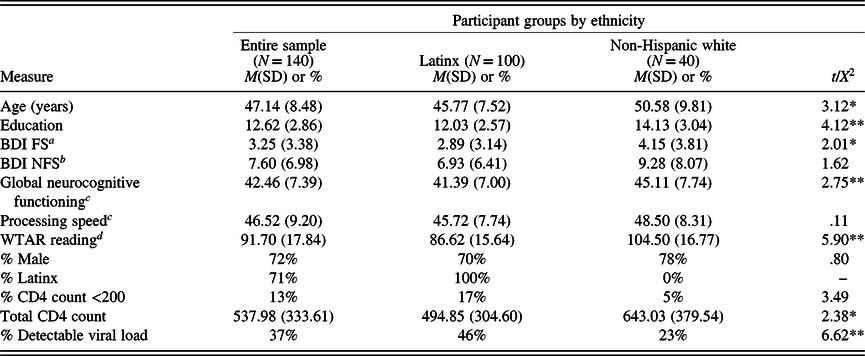
Table 3 summarizes the demographics of the sample. The sample was predominantly Latinx (71%), male (72%), and had a mean (M) age of 47.14 years (SD = 8.48) and a mean education of 12.62 years (SD = 2.86). Of the entire sample, 13% were immunosuppressed (CD4 count < 200), and 37% had a detectable viral load. The average score for the BDI-FS fell into the mildly depressed range for the full sample (M = 3.25; SD = 3.38; range: 0–17). The average score on the BDI-NFS was 7.60 (SD = 6.98; range: 0–35). Compared to the non-Hispanic white group, the Latinx group was significantly younger, had fewer years of education, had fewer cognitive/affective depressive symptoms, performed worse in terms of global neurocognitive function, were more likely to have a detectable viral load, had a lower overall CD4 count, and performed worse on the WTAR reading (all p < .05). The groups did not differ statistically on the BDI-NFS (p > .10).
Participant demographics

Notes. aBeck Depression Inventory – Fast Screen; b Beck Depression Inventory – Non Fast Screen; cAverage T-scores; d Wechsler Test of Adult Reading; p < .05*, p < .01**.
In the Latinx group, results of the preliminary analyses showed that detectable viral load was associated with learning and memory; and WTAR Reading Standard Scores were associated with global functioning, attention/working memory, fluency, learning, and memory (all p < .05). In the non-Hispanic white group, results of the preliminary analyses indicated that detectable viral load was associated with processing speed; and WTAR Reading Standard Scores were associated with global functioning, fluency, learning, and memory all p < .05). Where these group difference variables were associated with neurocognitive outcomes, they were included as covariates in the subsequent multiple regressions conducted to evaluate the hypotheses of this study. The Latinx group was significantly younger than the non-Hispanic white group, but age was not included as a covariate given that demographically adjusted (i.e., for age, race, ethnicity, education) norms were used as the neurocognitive outcomes.
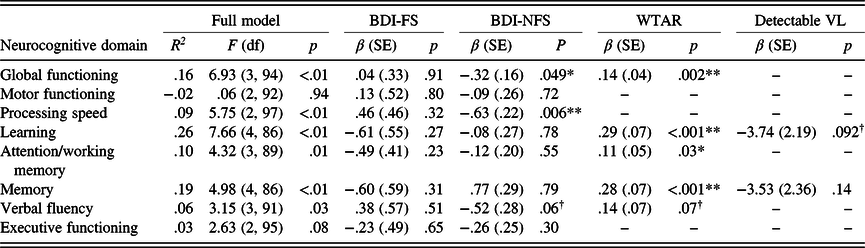
Table 4 illustrates the results of multiple regression analyses conducted to examine the potential interactive effects of depressive symptom type (BDI-FS vs. BDI-NFS) and ethnicity (Latinx vs. non-Hispanic white) on neurocognitive functioning. To assure the validity of this study’s linear regression analyses detailed below, a multicollinearity analysis of the association between BDI-NFS and BDI-FS was computed and revealed no significant multicollinearity between these variables (VIF = 1.00; typical VIF cut-off is 10.00; Neter, Kutner, & Nachtsheim, Reference Neter, Kutner and Nachtsheim1996). The results of these analyses revealed that in one model, this interaction term significantly predicted executive functioning (β = −2.31, p = .011), such that Latinx participants with higher BDI-FS symptoms performed worse on executive functioning measures than participants who were non-Hispanic white and/or reported fewer BDI-FS symptoms of depression. No other interaction terms were significant (all p > .10).
Linear regressions predicting global and neurocognitive domain function BDI-FS and BDI-NFS in the full sample (N = 140)

Notes. †.05 < p < .10; *p < .05; **p ≤ .01; BDI-FS = Beck Depression Inventory – Fast Screen; Ethnicity = Latinx versus non-Hispanic white; BDI-NFS = Beck Depression Inventory – Non Fast Screen; WTAR = Wide Range Achievement Test; VL = Viral Load.
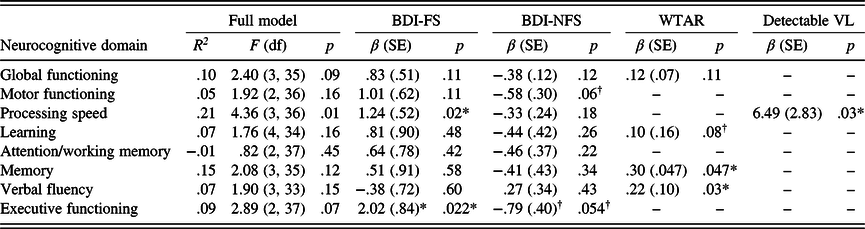
Tables 5 and 6 summarize the results of a series of linear regression analyses, which examined how well our model (i.e., relevant demographic and clinical characteristics, the BDI-FS, and the BDI-NFS) predicted global and domain-specific neurocognitive function. Overall, the results of the regression analyses demonstrated that the model significantly predicted global neurocognitive function in the Latinx group, executive functioning in the non-Hispanic white group, and processing speed in both ethnic groups. The model did not significantly predict any of the other neurocognitive domains (all p > .05).
Linear regressions predicting global and neurocognitive domain function BDI-FS and BDI-NFS in the Latinx group (N = 100)

Notes. †.05 < p < .10; *p < .05; **p ≤ .01; BDI-FS = Beck Depression Inventory – Fast Screen; BDI-NFS = Beck Depression Inventory – Non Fast Screen; WTAR = Wide Range Achievement Test; VL = Viral Load.
Linear regressions predicting global and neurocognitive domain function BDI-FS and BDI-NFS in the non-Hispanic White Group (N = 40)

Notes. †.05 < p < .10; *p < .05; **p ≤ .01; BDI-FS = Beck Depression Inventory – Fast Screen; BDI-NFS = Beck Depression Inventory – Non Fast Screen; WTAR = Wide Range Achievement Test; VL = Viral Load.
In the Latinx group (Table 5), a linear regression model that included the BDI-FS and the BDI-NFS as predictors and the WTAR Reading Standard Score as a covariate, significantly predicted global neurocognitive function (R 2 = .16, F (3,94) = 6.93, p < .01). In this model, the BDI-NFS was a significant predictor (β = −.32, p = .049), as was the covariate, the WTAR Reading Standard Score (β = .14, p < .01), such that lower BDI-NFS scores and higher WTAR Reading Standard Scores predicted better global neurocognitive function. Similarly, a linear regression model including the BDI-FS and the BDI- NFS significantly predicted processing speed performance (R 2 = .09, F (2,97) = 5.75, p < .01). In this model, the BDI-NFS significantly predicted processing speed performance (β = −.63, p < .01) such that greater BDI-NFS scores significantly predicted poorer processing speed performance. The BDI-FS was not a significant predictor in any of the models for global or domain-specific neurocognitive performance in the Latinx group.
In the non-Hispanic white group (Table 6), a linear regression model that included the BDI-FS and the BDI-NFS as predictors and detectable viral load as a covariate significantly predicted processing speed (R 2 = .21, F 3,36 = 4.36, p = .01). The BDI-FS was a significant predictor in this model (β = 1.24, p = .02) such that higher BDI-FS scores predicted better processing speed performance. The covariate of detectable viral load was also a significant predictor (β = 6.49, p = .03), such that higher HIV viral load was related to worse processing speed. However, BDI-NFS did not contribute to the model (p >. 10). The model, including the BDI-FS and the BDI-NFS, predicted executive functioning at the trend level (R 2 = .09, F 2,37 = 2.89, p = .07. In this model, the BDI-FS was a significant predictor (β = 2.02, p = .02) and the BDI-NFS predicted executive functioning at a trend level (β = −.79, p = .06).
Upon further comparing results from the stratified models, the unstandardized beta weights of the BDI-NFS were similar in predicting global functioning (non-Hispanic white BDI-NFS β = −.38, p = .12; Latinx BDI-NFS β = −.32, p = .049), suggesting that the larger Latinx subsample size may have driven the significance of the predictor as opposed to a true difference between cultures in how BDI-NFS predicted global functioning. However, for processing speed, the effect of BDI-NFS was stronger in the Latinx subsample (β = −.63, p = .006) than in the non-Hispanic white subsample (β = −.33, p = .18), suggesting there may be cultural differences in how the BDI-NFS predicted processing speed specifically for this domain.
DISCUSSION
The results of this study demonstrate important ethnic differences in how depressive symptoms affect neurocognitive function in PLWH. While the Latinx group did not endorse greater somatic/functional depressive symptoms than their non-Hispanic white counterparts, the results revealed that the somatic/functional symptoms endorsed by the Latinx participants were uniquely salient in predicting worse neurocognitive performance in global neurocognitive functioning and processing speed in the Latinx group. In contrast, the non-Hispanic white participants endorsed, on average, a greater number of cognitive/affective depressive symptoms, and these symptoms were uniquely salient in predicting better processing speed and executive functioning in the non-Hispanic white group. Overall, this study supports and extends prior findings that depression can significantly predict neurocognitive functioning in PLWH by demonstrating that cultural variation in the expression of depressive symptoms is a salient predictor of neurocognitive functioning in this population (Cross et al., Reference Cross, Önen, Gase, Overton and Ances2013; Heaton et al., Reference Heaton, Franklin, Deutsch, Letendre, Ellis, Casaletto and Teshome2015; Stern et al., Reference Stern, McDermott, Albert, Palumbo, Selnes, McArthur and Marder2001). Importantly, however, the effects of the BDI-NFS on global neurocognitive functioning in both subsample groups are similar in magnitude, indicating that the larger Latinx subsample size may have driven the significance of this predictor for global neurocognitive functioning in the Latinx model, but not in the non-Hispanic white model. Thus, conclusions regarding how the BDI-NFS differentially predicts global neurocognitive functioning between Latinx and non-Hispanic white participants should be further investigated with more equal subsample sizes.
The findings also indicate that, contrary to hypotheses, BDI-FS symptoms interact with ethnicity to significantly predict poorer executive functioning among Latinx participants who reported more BDI-FS symptoms. This may reflect a threshold effect phenomenon in which those Latinx participants who report increased BDI-FS symptoms are experiencing more severe depressive symptoms than Latinx participants who do not report higher BDI-FS symptoms, thus negatively affecting executive functioning via frontal neural structures that are often implicated in executive functioning, shown to be particularly associated with cognitive/affective depressive symptoms (du Plessis et al., Reference du Plessis, Vink, Joska, Koutsilieri, Stein and Emsley2014; Koenigs & Grafman, Reference Koenigs and Grafman2009).
The disparate findings between our models conducted in a stratified manner (i.e., separate within-group regression models conducted in only the Latinx subsample and only the non-Hispanic white subsample) and our models conducted in the full sample with interaction terms warrants a discussion of best approaches to examining racial/ethnic brain health disparities. Ward et al. (Reference Ward, Gartner, Keyes, Fliss, McClure and Robinson2019) argue that only testing statistical models in samples that include multiple racial/ethnic groups to investigate race/ethnicity-based interaction terms contributes to losing critical qualitative data needed for better understanding of racial/ethnic health disparities and diversity within racial/ethnic groups, such as those provided in this study. This within-group approach to understanding cultural variance in brain-behavior relationships and brain health disparities has been previously utilized and validated in numerous prior cultural neuropsychology studies across different patient populations, including HIV-infection (Arentoft et al., Reference Arentoft, Byrd, Robbins, Monzones, Miranda, Rosario and Rivera Mindt2012; Byrd, Jacobs, et al., Reference Byrd, Jacobs, Hilton, Stern and Manly2005; Byrd, Sanchez, et al., Reference Byrd, Sanchez and Manly2005; Manly, Reference Manly2006; Manly et al., Reference Manly, Walden, Heaton, Byrd, Reilly and Velasquez1998, Reference Manly, Byrd, Touradji and Stern2004; Miranda et al., Reference Miranda, Rentería, Fuentes, Coulehan, Arentoft, Byrd and Mindt2016; Robbins et al., Reference Robbins, D’Aquila, Morgello, Byrd, Remien and Mindt2012). Thus, findings from both the stratified models (i.e., that somatic/functional symptoms of depression significantly predict global functioning and processing speed in Latinx participants but not non-Hispanic white participants) and from the interaction term models (i.e., that cognitive/affective symptoms and Latinx ethnicity significantly interact to predict worse executive functioning) are meaningful contributions to the field of cultural neuropsychology and HIV.
The current findings point to the necessity of considering sociocultural influences on the expression of depressive symptoms when evaluating neurocognitive functioning in culturally diverse PLWH. Notably, this study demonstrated that increased somatic/functional depressive symptoms significantly predicted poorer processing speed in the Latinx group, while increased cognitive/affective depressive symptoms significantly predicted better processing speed in the non-Hispanic white group. Prior research supports the finding that depressive symptoms are associated with impaired processing speed and executive function (Koenigs & Grafman, Reference Koenigs and Grafman2009; Lam et al., Reference Lam, Kennedy, Mcintyre and Khullar2014; McDermott & Ebmeier, Reference McDermott and Ebmeier2009; Rubin & Maki, Reference Rubin and Maki2019; Shenal et al., Reference Shenal, Harrison and Demaree2003), and this study suggests that there may be some domain specificity associated with somatic/functional symptoms and cognitive/affective symptoms. Despite evidence demonstrating that processing speed varies widely by culture, it is often still used as a “culture-free” aspect of cognition due to its predominantly non-verbal nature (Ardila, Reference Ardila2005). However, this study highlights the impertinence of using processing speed measures in this way by demonstrating that differential cultural expression of depressive symptoms significantly influence processing speed in Latinx and non-Hispanic white PLWH. Moreover, the current findings add to the growing body of literature that highlights the important role of culture in processing speed performance (Cores et al., Reference Cores, Vanotti, Eizaguirre, Fiorentini, Garcea, Benedict and Cáceres2015; Harris et al., Reference Harris, Tulsky and Schultheis2003; Razani, Burciaga, et al., Reference Razani, Burciaga, Madore and Wong2007; Razani, Murcia, et al., Reference Razani, Murcia, Tabares and Wong2007). Finally, further examining racial and/or ethnic differences in the expression of depressive symptoms may help researchers and clinicians better understand well-documented disparities in neurocognitive performance and neurocognitive aging trajectories between Latinx and non-Hispanic white PLWH (Heaton et al., Reference Heaton, Franklin, Deutsch, Letendre, Ellis, Casaletto and Teshome2015; Marquine et al., Reference Marquine, Heaton, Johnson, Rivera-Mindt, Cherner, Bloss and Heaton2018; Rivera Mindt et al., Reference Rivera Mindt, Miranda, Arentoft, Byrd, Monzones, Fuentes and Morgello2014).
While not specifically hypothesized, the finding that increased cognitive/affective depressive symptoms predicted better processing speed in the non-Hispanic white group was unexpected. This may be interpreted as a “worried well” effect, in which people who are worried about their neurocognitive functioning may have healthier cognitive profiles, despite higher depressive symptoms, than those who are not worried or perform in the impaired range neurocognitively (Verity et al., Reference Verity, Kirk, O’connell, Karunanayake and Morgan2020).
Study Limitations
This study’s limitations also merit consideration. First, an important study limitation was the lack of a previously validated scale to assess somatic/functional depressive symptoms and that factor analysis was not conducted. However, a strength of the novel BDI-NFS scale utilized in this study addresses these symptoms within the widely used and well-validated measure of the BDI-II, making it easy to include in research and clinical assessments and address somatic/functional-based expressions of depressive symptoms prevalent in Latinx PLWH that are not captured by the BDI-FS. Further, this is the first study to validate this scale and demonstrate that somatic/functional symptoms of depression are relevant to neurocognitive performance among Latinx PLWH.
Secondly, the results of this study may not be generalizable to other HIV populations, given that this sample was predominantly male and included Latinx adults of primarily Caribbean origin. Thirdly, it is possible that the finding regarding the differential significance of somatic/functional depressive symptoms in predicting neurocognitive functioning in the Latinx PLWH group could have been confounded by the fact that this group was also clinically worse than the non-Hispanic white PLWH group as evidenced by their higher prevalence of detectable HIV viral load. However, this concern is mitigated by the fact that there were no significant ethnic group differences in the overall levels of somatic/functional depressive symptoms. Fourthly and finally, given that this sample was largely virally suppressed, these findings may not translate to populations that do not have wide access to cART medication and/or are not virally suppressed.
Future Directions
The current findings have implications for future research and evidence-based practice. With regard to future research, studies should assess how somatic/functional depressive symptoms relate to acculturation to majority culture (i.e., non-Hispanic white) and language dominance. The field would benefit from future psychometric characterization (e.g., reliability analysis, factor analysis) of this new subscale created primarily to assess somatic/functional depressive symptoms in clinical populations, such as PLWH and those with other chronic medical conditions (e.g., diabetes, arthritis), as well as identifying relevant items on more highly structured, existing clinical interviews (e.g., Structured Clinical Interview for DSM-5 [SCID]; First, Williams, Karg, & Spitzer, Reference First, Williams, Karg and Spitzer2015). Additionally, future studies should examine these associations in different racial/ethnic and HIV-seronegative populations. With regard to evidence-based practice, this study suggests that clinicians may benefit from attending to the different types of depressive symptoms that Latinx and non-Hispanic white participants endorse, as these may have unique implications for neurocognitive functioning.
SUMMARY
The current study investigated ethnic differences in how depressive symptoms may differentially affect neurocognitive function in Latinx and non-Hispanic white adults. This study represents an important and novel contribution to the literature, as it is the first to identify the existence of differential associations between subtypes of depressive symptoms (i.e., somatic/functional vs. cognitive/affective) predicting neurocognitive functioning at both the global and domain-specific level in culturally diverse PLWH. Moreover, the novel and easily administered and calculated BDI-NFS scale developed and investigated in this study will allow researchers to evaluate somatic/functional symptoms within an existing framework (utilizing the BDI-II). This study also represents a clinically significant and novel line of research relevant to an understudied population (US Latinx population) who bear a disproportionate burden of numerous brain health disparities, including HIV-infection. Future psychometric studies are needed to further investigate this new BDI-NFS scale for evaluating somatic/functional depressive symptoms.
Acknowledgments
This work was supported by the National Institutes of Health (MRM, Grant Number K23MH079718; VG & MRM, Grant Number 1F31MD011582-01A1) and the Alzheimer’s Association (MRM, Grant Number AARGD-16-446038). The authors would like to thank the Manhattan HIV Brain Bank (MHBB; Grant Number U24MH100931); Drs. Susan Morgello (MHBB Principle Investigator) & Uraina Clark (MHBB Co-Investigator); Research Coordinator Rhonda Burgess; Students Micah J. Savin and Maral Aghvinian; and our participants.
Conflict of interest
The authors have nothing to disclose.