Symbiotic relationships are very common in the marine environment and some taxa seem particularly prone to be involved in associations. Crustaceans probably associate with other phyla more than any other marine animals (Wirtz et al., Reference Wirtz, Melo and Grave2009). Cleaning interactions usually occur at traditional sites (Youngbluth, Reference Youngbluth1968), thus facilitating the occurrence of repeated activity between cleaners and clients. These cleaning stations might act as ‘safe havens’ in which predatory interactions are diminished (Cheney et al., Reference Cheney, Bshary and Grutter2008).
The yellowline arrow crab, Stenorhynchus seticornis (Herbst, 1788), belongs to the family Majidae and its distribution range is from the Caribbean to southern Brazil. Due to the wide variety of habitats and life strategies, yellowline arrow crabs are important targets for ecological studies (Cobo, Reference Cobo2006). This species presents as diagnostic features: triangular body with long pointed snout (rostrum), carapace decorated with fine dark lines and claws often have violet tips (Humann & Deloach, Reference Humann and Deloach2003a). According to Wirtz et al. (Reference Wirtz, Melo and Grave2009), S. seticornis is most commonly associated with anemones, in groups ranging from one to six individuals in south-eastern Brazil.
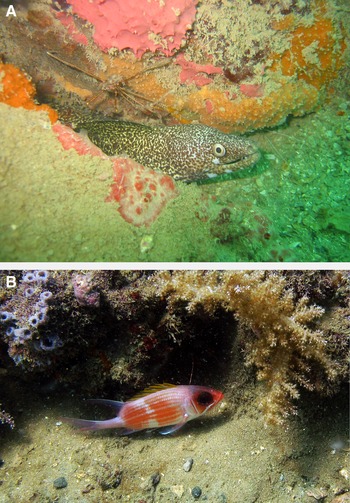
There are approximately 200 recognized species of moray eels (Muraenidae) (Smith & Böhlke, Reference Smith, Böhlke, Quero, Hureau, Karrer, Post and Saldanha1990; Böhlke & Smith, Reference Böhlke and Smith2002), green moray, Gymnothorax funebris (Ranzani, 1840), purplemouth moray, G. vicinus (Castelnau, 1855), spotted moray, G. moringe (Cuvier, 1829) (Figure 1A) and longjaw squirrelfish, Holocentrus adscencionis (Figure 1B), ranging in adult length from just a few centimetres to more than 3 m (Böhlke & Randall, Reference Böhlke and Randall2000). Their diet includes fish, crustaceans and octopuses (Randall, Reference Randall1967).
(A) The painted moray eels Gymnothorax moringa in the Quebra Mar Sul artificial reef (photograph by José de Anchieta C.C. Nunes); and (B) the squirrelfish Holocentrus adscencionis in the Barra reef (photograph by Diego V. Medeiros) both being cleaned by yellowline arrow crab Stenorhynchus seticornis.

The Holocentridae family consists of 65 species and eight genera (Froese & Pauly, Reference Froese and Pauly2010). Seven species are found along the Brazilian coast and oceanic islands (Freire & Carvalho-Filho, Reference Freire and Carvalho Filho2009). The longjaw squirrelfish Holocentrus adscencionis (Osbeck, 1765) is distributed in the western Atlantic, from North Carolina to Santa Catarina and the Brazilian oceanic islands. It is a nocturnal fish that can reach 35 cm in length and is eventually captured for food or ornamental trade in the State of Bahia (Randall, Reference Randall1967; Carvalho-Filho, Reference Carvalho-Filho1999; Sampaio & Nottingham, Reference Sampaio and Nottingham2008).
The present study reports on the yellowline arrow crab acting as a cleaner of moray eels and squirrelfish in two coastal reefs, eastern Brazil.
Observations were made during four free-diving sessions between August 2007 and February 2010 on two coastal reefs: Barra rocky shore (13°00′S 38°31′W) and Quebra Mar Sul artificial reef (12°58′S 38°31′14″W), located at Baía de Todos os Santos, Bahia, eastern Brazil. ‘Focal animal’ methodology was used and all occurrences were recorded (Lehner, Reference Lehner1979). All data were recorded on plastic sheets and photographic records were made with digital cameras. Number of events, depth and horizontal water visibility were also recorded.
Events occurred in depths of 2–12 m and horizontal visibility ranged from 3 to 10 m. The yellowline arrow crab cleaned four species of reef fish: Gymnothorax funebris (Ranzani, 1840), G. vicinus (Castelnau, 1855), G. moringa (Cuvier, 1829) (Figure 1A) and Holocentrus adscencionis (Figure 1B). The activity for Gymnothorax funebris, G. vicinus and H. adscencionis occurred in Barra reef and the one for G. moringa in Quebra Mar Sul. The yellowline arrow crab cleaned the moray eels and squirrelfish with its chelipeds and cleaning lasted from four to ten minutes. Throughout the observation span, no aggressive behaviour was recorded between the yellowline arrow crab and reef fish. Nevertheless, moray eels and squirrelfish can be considered dangerous clients, since crabs are important elements of their diets (Randall, Reference Randall1967).
There is a considerable number of reports on cleaning symbiosis among reef fish (e.g. Sazima et al., Reference Sazima, Gasparini and Moura1998, Reference Sazima, Moura and Sazima1999, Reference Sazima, Sazima, Francini-Filho and Moura2000, Reference Sazima, Krajewski, Bonaldo and Sazima2005; Feitoza et al., Reference Feitoza, Dias, Gasparini and Rocha2002; Grutter, Reference Grutter2004; Coni et al., Reference Coni, Nunes and Sampaio2007, Reference Coni, Nunes, Ferreira, Maia-Nogueira, Medeiros and Sampaio2010; Francini-Filho & Sazima, Reference Francini-Filho and Sazima2008; Bertoncini et al., Reference Bertoncini, Machado, Barreiros, Hostim-Silva and Verani2009), and other studies reported fish as clients of invertebrates (Johnson & Ruben, Reference Johnson and Ruben1988; Van Tassell et al., Reference Van Tassell, Brito and Bortone1994; Humann & Deloach, Reference Humann and Deloach2003b; Becker & Grutter, Reference Becker and Grutter2004; Becker et al., Reference Becker, Curtis and Grutter2005; Nilsson et al., Reference Nilsson, Becker and Nilsson2005; Sampaio et al., Reference Sampaio, Medeiros, Ilarri, Souza and Grempel2007; McCammon et al., Reference McCammon, Sikkel and Nemeth2010). It is known that some diurual reef fishes act as cleaner of nocturnal reef fishes (Johnson & Ruben, Reference Johnson and Ruben1988; Sazima et al., Reference Sazima, Moura and Sazima1999, Reference Sazima, Sazima, Francini-Filho and Moura2000, Reference Sazima, Krajewski, Bonaldo and Sazima2005; Coni et al., Reference Coni, Nunes, Ferreira, Maia-Nogueira, Medeiros and Sampaio2010), but for crabs were rare records at cleaning symbiosis, especially nocturnal reef fishes. Van Tassele et al. (Reference Van Tassell, Brito and Bortone1994) and Wirtz (in litt, 2011) observed in the Canary Islands for the first time the arrow crab, S. lanceolatus (Brullé, 1837), cleaning Muraena helena Linnaeus, 1758, Enchelycore anatina (Lowe, 1838) and Scorpaena sp. respectively. Interestingly, all clients recorded in the Canary Islands and the present study are carnivorous of nocturnal habits.
The symbiosis behaviour and predation were recorded for S. seticornis in aquaria, cleaning the rock hind, Epinephelus adscensionis (Osbeck, 1765), and the comb grouper, Mycteroperca acutirostris (Valenciennes, 1828), where the last grouper attacked and devoured the yellowline arrow crab (Freitas, 1982). In the natural environment, the grouper Epinephelus morio (Valenciennes, 1828) is known as an important predator of this species (Hulings & Hemlay, Reference Hulings and Hemlay1963). Sampaio et al. (2007) showed the cleaning and predation event between an unidentified crab (Grapsidae) and the hairy blenny Labrisomus nuchipinnis (Quoy & Gaimord, 1824). These authors suggest that this association seemed to be an occasional event in which both species interacted as the client, somehow, recognized the small crab as a potential cleaner.
Curiously, despite the wide geographical distribution and abundance in shallow waters off the Brazilian coast, this study is the first record of the yellowline arrow crab acting as a reef fish cleaner species in the natural environment in Brazilian waters.
This study is the first record of the yellowline arrow crab acting as a reef fish cleaner species in a natural environment in Brazilian waters. We believe that other reef fish species participate in the cleaning activity carried out by yellowline arrow crab and that this activity occurs throughout its distribution. Future observations will indicate the role played by yellowline arrow crab on the reef fish parasites' removal, as being an important component of cleaning stations or a mere opportunistic cleaner.
ACKNOWLEDGEMENTS
The authors thank Vanessa Medeiros, Raissa Frazão, Lua Porto, Ricardo Marques, Pedro H.C. Pereira, João L. Feitosa and Lais C.T. Chaves for revising the manuscript.