Changes in living arrangements are among the most observable and influential indicators of how individuals and families adapt to changing circumstances. Residential status is therefore one of the most widely examined features of social demography world-wide. Decisions about where and with whom one lives change over the life course depending on preferences, norms, needs, and resources. In later life, these decisions are often associated with functional health (Korinek et al., Reference Korinek, Zimmer and Gu2011; Michael et al., Reference Michael, Berkman, Colditz and Kawachi2001; Zhou et al., Reference Zhou2018a), mental health (Ren and Treiman, Reference Ren and Treiman2015), institutionalization (Gu et al., Reference Bromell and Cagney2014), mortality (Feng et al., Reference Feng, Falkingham, Liu and Vlachantoni2017), and quality of life (QoL) (Chen et al., Reference Chen, Hicks and While2014; Sun et al., Reference Sun, Lucas, Meng and Zhang2011). Residential status is thus also often taken as a starting point for research on aging in low- and middle-income countries (Bongaarts and Zimmer, Reference Bongaarts and Zimmer2002), including China (Sereny, Reference Sereny2011).
Hewing to Confucian doctrine, Chinese have traditionally lived in large families that help ensure the cooperation required to meet individual and collective needs (Fei et al., Reference Fei, Hamilton and Wang1992; Phillips and Feng, Reference Phillips and Feng2015). The custom for older adults to live with one married child further assures intergenerational support (Kincannon et al., Reference Kincannon, He and West2005). However, the implementation of open-door economic reform and the one-child population control policy in the early 1970s triggered a steep rise in single-person households and a marked reduction in average household size (Yeung and Cheung, Reference Yeung and Cheung2015; Zeng and Wang, Reference Zeng and Wang2003). These reconfigured households affect older adults’ living arrangements (Song and Xie, Reference Song and Xie2014; Xiangming, Reference Xiangming1985), as shifts in social norms and cultural values about intergenerational relationships have led to declines in their expectations and practice of co-residency (Li and Chen, Reference Li and Chen2011).
More recently, China’s thriving economy has spurred governmental housing reform. Rapid growth of the real estate industry in urban China has allowed older adults to achieve high rates of homeownership (Li and Chen, Reference Li and Chen2011; Song and Xie, Reference Song and Xie2014). Further economic reforms and relaxation of the household registration system (hukou) have also sparked massive migration of younger generations from rural areas to urban centers (Ye et al., Reference Ye, He, Liu, Wang and Chen2016), leaving large numbers of older adults to live alone in rural areas (He and Ye, Reference He and Ye2014; Logan et al., Reference Logan, Bian and Bian1998) – a potentially undesirable outcome according to Silverstein et al. (Reference Silverstein, Cong and Li2006), who found that with the effects of support exchanges controlled, living in a three-generation household continues to represent an important fulfillment of a cultural ideal for older adults in rural China. Finally, although government social security is modest, it does enable many beneficiaries to act on a preference to live alone in exchange for more personal freedom and less family conflict (Song and Xie, Reference Song and Xie2014).
Positive outcomes for the large and growing numbers of older adults in China who live independently may be offset by health, mental health, and social vulnerabilities, especially with advancing age. Zhou et al. (Reference Zhou2018a) found that older adults in China who had co-residents reported better self-rated health than their age peers who lived alone. Likewise, living alone was associated with mobility problems, pain and discomfort, and anxiety and depression in a study of urban older adults’ health-related QoL (Sun et al., Reference Sun, Lucas, Meng and Zhang2011). On the other hand, Huang et al. (Reference Huang, Liu and Bo2019) found that Chinese older adults who lived with adult children had lower QoL than those who did not live with adult children.
To enjoy the option and benefits of living independently, older adults must access and maintain the necessary resources. Sun et al. (Reference Sun, Lucas, Meng and Zhang2011) found that social interaction buffered the negative effects of living alone on health-related QoL, and in a qualitative study in Hong Kong, Lou and Ng (Reference Lou and Ng2012) reported that understanding and accepting one’s situation motivated older adults who lived alone to identify effective strategies to manage daily tasks and life crises. Chief among these strategies are resources in the social environment.
The social environment encompasses interpersonal relations (e.g. social support and social networks), social inequalities (e.g. socioeconomic status and income inequality, racial discrimination), and neighborhood and community characteristics (e.g. social cohesion and social capital, neighborhood factors) (Mcneill et al., Reference Mcneill, Kreuter and Subramanian2006a) – which can directly or indirectly affect QoL. Social cohesion is defined as “…cohesive community relationships with high levels of participation in communal activities and public affairs, and high levels of membership of community groups” (Marmot and Wilkinson, Reference Marmot and Wilkinson2006, p. 162).
There is evidence that social cohesion plays an important role in QoL (Berger-Schmitt, Reference Berger-Schmitt2002), especially in later life and for older adults who live alone (Engel et al., Reference Engel, Chudyk, Ashe, McKay and Whitehurst2016). Bromell and Cagney (Reference Bromell and Cagney2014) found that social cohesion predicts extra-familial companionship for older adults who live alone, but not those who live with others. In a study by Rios et al. (Reference Rios, Aiken and Zautra2012), social cohesion mediated the relationship between neighborhood contexts and health and mental health outcomes. Finally, Huang et al. (Reference Huang, Liu and Bo2019) reported that the negative effects of living alone on QoL were partially mediated by social cohesion among older adults in China.
Community relationships and social cohesion vary geographically in China, as cultural practices, economic development, social and health policies, and housing stock differ greatly in urban and rural areas of the country (Lee and Xiao, Reference Lee and Xiao1998; Norstrand and Xu, Reference Norstrand and Xu2012; Wang, Reference Wang2006). Tang et al. (Reference Tang, Lin and Chen2019) found, for example, that the effects of living arrangements on mental health are contingent on older adults’ social networks and that these vary between rural and urban areas of China. Further, Zhou et al. (Reference Zhou, Zhou, Gao, Lai and Chen2018b) reported that health-related QoL is better for urban than rural older adults and that it varies by different living arrangements in urban and rural areas.
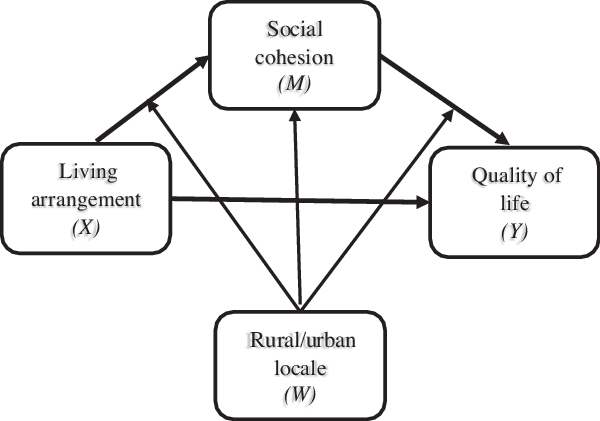
Drawing on this literature, we used data from a national probability sample of 9,663 adults aged 50 years and older in mainland China to test three hypotheses: (1) QoL will differ for older adults who live alone and those who live with others, (2) social cohesion will mediate that relationship, and (3) geographic locale (rural vs. urban) will moderate direct and indirect pathways in the association of living arrangement and QoL. As noted, aging in urban and rural China differs greatly in terms of our study variables, but there is insufficient evidence to suggest a singular pathway. We thus tested four moderating pathways: three are direct (living arrangement with QoL [Chen et al., Reference Chen, Hicks and While2014; Liu et al., 2020; Sun et al., Reference Sun, Lucas, Meng and Zhang2011], living arrangement with social cohesion [Miao et al., Reference Hayes and Rockwood2019], and social cohesion with QoL [Tang et al., Reference Tang, Lin and Chen2019; Zhou et al., Reference Zhou, Zhou, Gao, Lai and Chen2018b; Huang et al., Reference Huang, Liu and Bo2019]) and one is indirect (living arrangement–social cohesion–QoL [Tang et al. Reference Tang, Lin and Chen2019; Zhou et al., Reference Zhou, Zhou, Gao, Lai and Chen2018b]). Figure 1 shows the proposed mediation model with direct and indirect pathways (Hayes and Rockwood, Reference Hayes and Rockwood2019). We used Hayes’s (Reference Hayes2018) PROCESS program (SPSS ver. 26) to test two sets of hypotheses about these pathways. The first set tests for mediation (model 4) and the second set tests for moderated mediation (model 59).
Conceptual path diagram of moderated mediation.

Hypotheses
Unconditional mediation hypotheses:
-
1. Older adults who live alone will have higher levels of social cohesion.
-
2. Social cohesion will have a positive direct association with QoL.
-
3. Social cohesion will mediate the effects of living arrangements on QoL.
Conditional moderated direct and indirect effects hypotheses:
-
1. Residential locale will moderate the direct association of living arrangements and social cohesion.
-
2. Residential locale will moderate the direct association of living arrangements and QoL.
-
3. Residential locale will moderate the direct association of social cohesion and QoL.
-
4. Residential locale will moderate the indirect effect of living arrangements and QoL (living arrangement → social cohesion → QoL).
Methods
Data source
Data are from Wave 1 (2007–2010) of the World Health Organization Study on Global AGEing and Adult Health (SAGE). SAGE examines the health and well-being of adults aged 50 years and over in China, Ghana, India, Mexico, Russia, and South Africa. Smaller samples of adults aged 18–49 years provide comparative data. SAGE China used a probability sampling design and a 5-stage cluster sampling strategy to select 15,066 persons aged 50 years for individual interviews. Response rates exceeded 98%. After deleting cases with missing values, our sample was 9,663. The sample was drawn from eight provinces using a multistage stratified cluster sample design. The National Bureau of Statistics Chinese Statistical Yearbook 2009 served as the reference population, and post-stratification corrections were made to weights to compensate for under-coverage. All analyses use these normalized probability weights, and variance estimations take into account the complex design. Design weights were calculated accounting for the specific sample design. For additional details on the study design, see Kowal et al. (Reference Kowal2012).
Measures
Details on measures in the SAGE questionnaires are available at the study website (http://www.who.int/healthinfo/systems/sage/en/index.html). We recalibrated scaled scores to a scale of 0–100 to aid in interpretation. Sociodemographic variables were sex (female = 0), age (50–59 = 0; 60–69 = 1; 70+ = 2), marital status (married = 1, never married, separated/divorced/widowed = 0), education, and household wealth quintile. Education level was mapped to an international standard, classified into six groups, and combined as follows: no formal education = 0; completed secondary school = 1; higher than secondary school = 2. Household wealth was based on a set of assets and dwelling characteristics and ranged from 1 (poorest) to 5 (richest). The two lowest categories = 0, mid-range = 1, and two highest = 2.
Dependent variable
QoL is defined as an “individual’s perceptions of their position in life in the context of the culture and value systems in which they live and in relation to their goals, expectations, standards and concerns” (WHO Quality of Life (WHOQOL Group, 1998). QoL was measured by the 8-item version of the WHOQOL-Bref (Power, Reference Power, Nosikov and Gudex2003). Higher scores mean better QoL.
Independent variables
Living arrangement was assessed as living alone = 0 or living with family = 1. We excluded participants who reported other living arrangements.
Social cohesion is a 9-item index with the following stem: ‘How often in the last 12 months have you…’ attended any public meeting in which there was discussion of local or school affairs; met personally with someone you consider to be a community leader; attended any group, club, society, union, or organizational meeting; worked with other people in your neighborhood to fix or improve something; had friends over to your home; been in the home of someone who lives in a different neighborhood; socialized with co-workers outside work; attended religious services; and gotten out of your house to attend social meetings, activities, programs or events or to visit friends or relatives. Options (1 = never to 5 = daily) were summed for an overall score (Ramlagan, 2013). Higher scores mean greater cohesion.
Health state was assessed by the WHO framework for measuring state of health as a vector of capacities in multiple domains (Salomon et al., Reference Salomon, Mathers, Chatterji, Sadana, Ustun, Murray, Murray and Evans2003). Responses were summed for 18 health-related questions ranging from “no difficulty or problem” = 1 to “extreme difficulty/inability” = 5. Two questions assessed general health: one measured overall self-reported health and energy and the other assessed affect. Higher scores mean better health.
Functional ability was measured using the 12-item WHO Disability Assessment Schedule, version 2 (WHODAS-II) (Ustün et al., Reference Ustün, Kostanjsek, Chatterji and Rehm2010). Participants were asked about difficulty during the past 30 days performing activities of daily living, for example, standing, taking care of household responsibilities, learning a new task, and instrumental activities of daily living, for example, getting dressed and participating in community activities. Response options were “no difficulty” = 1 to “extreme/cannot do” = 5. Higher scores indicate better functioning.
Cognitive impairment was assessed with three performance tests: memory and learning (wordlist learning task); working memory (digit span forward and backward); and verbal fluency (category fluency test) (Carroll et al., Reference Carroll, Kowal, Naidoo and Chatterji2012). Verbal recall was a 10-word learning task comprising summed scores from four trials, three immediate recall, and one that was delayed 10–15 minutes. Scores on digit span forward and backward were determined by a first or second attempt to correctly recite each number series – two points or one point per row, with a total of eight rows in each of the two tests. The final task, verbal fluency, was the sum of all admissible words in the task of naming animals. A score of 4 or less on verbal learning and on verbal recall signaled impairment in these categories, as did scores of 8 or lower in word fluency. Higher scores indicate greater impairment.
Anxiety was a single question which asked respondents how much of a problem they had with worry or anxiety during the past 30 days on a scale of none = 1 to extreme = 5.
Subjective well-being used an abbreviated Day Reconstruction Method module developed for SAGE (Miret et al., Reference Miret2012). The measure assesses the evaluative well-being/happiness component of subjective well-being (Kahneman et al., Reference Kahneman, Krueger, Schkade, Schwarz and Stone2004). Higher scores mean higher levels of subjective well-being.
Depression was assessed using the World Mental Health Survey version of the Composite International Diagnostic Interview. Per the International Classification of Diseases, 10th revision (ICD-10) diagnostic criteria for research for depressive episodes (WHO, 1993), we used an algorithm based on symptoms reported during the prior 12 months (Ustün et al., Reference Ustün, Ayuso-Mateos, Chatterji, Mathers and Murray2004). Per ICD-10 criterion B, at least two of the three symptoms of depressed mood, loss of interest, and fatigability must be present. Persons who endorsed 4 or more of 10 depressive symptoms lasting 2 weeks most or all of the day met criteria for depression (yes = 1; no = 0).
Loneliness was measured by a single item: “did you feel lonely for much of the day yesterday” (yes = 1; no = 0).
Statistical methods
Analyses were carried out using normalized weights for each individual to compensate for under-coverage, based on selection probability, nonresponse, and post-stratification adjustments. Figure 1 shows hypothesized mediation and moderation involving Process models 4 and 59. We first examined descriptive statistics, correlations, and internal consistency. We then used conditional process analysis to test the study hypotheses. Interaction terms were grand-mean centered to facilitate interpretation. Using the bootstrap method to test for indirect effects, we first tested for mediation. Then, to determine whether a mediation effect was constant for people in urban and rural areas, we used hierarchical regression to test for direct and indirect moderating effects. Control variables included sociodemographics and health and mental health measures. Assumptions for ordinary least squares were met. Scatterplots showed linearity of independent and dependent variables, no major outliers, and normality of residuals and constant variance.
Ethics statement
Study protocols were approved by the ethical review committee of the Chinese Center for Disease Control and Prevention to ensure that the rights and welfare of participants are adequately protected, and potential risks are outweighed by potential benefits. All participants provided written inform consent.
Results
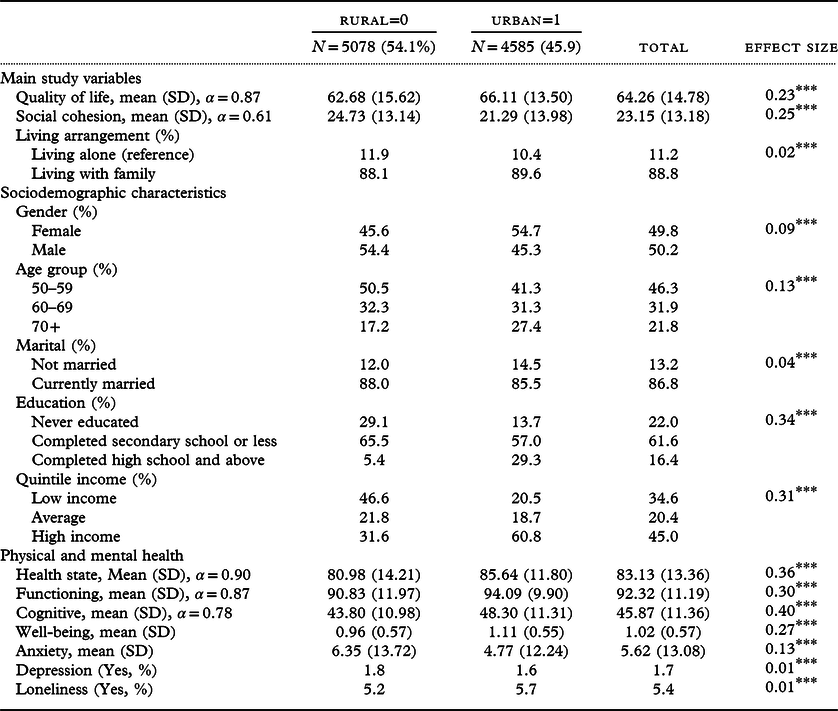
Table 1 presents descriptive statistics, effect size (ES) (Cramer’s V for chi-square and Cohen’s d for t-test) and significance levels for tests of rural versus urban differences in QoL, social cohesion, living arrangement, sociodemographic variables, and physical and mental health. The sample was evenly divided between men and women, almost half were aged 50–59 years and the vast majority were married. Overall, respondents rated their QoL as moderate (M = 64.26, SD = 14.78) and social cohesion as low (M = 23.15, SD = 13.18). Those in urban areas reported higher QoL (ES = 0.23) but lower social cohesion (ES = 0.25). A large majority of respondents lived with family, slightly more so in urban areas. Urban dwellers reported higher levels of education (ES = 0.34) and income (ES = 0.31) and enjoyed better health (ES = 0.36), functional (ES = 0.30) and cognitive (ES = 0.40) status, and well-being (ES = 0.27). By smaller margins, older adults in urban areas also reported lower levels of depression (ES = 0.01) and anxiety (ES = 0.13), but greater loneliness (ES = 0.01).
ES and significance tests (chi-square or t-test) for study variables by rural and urban (N = 9663)

*** p < 0.001.
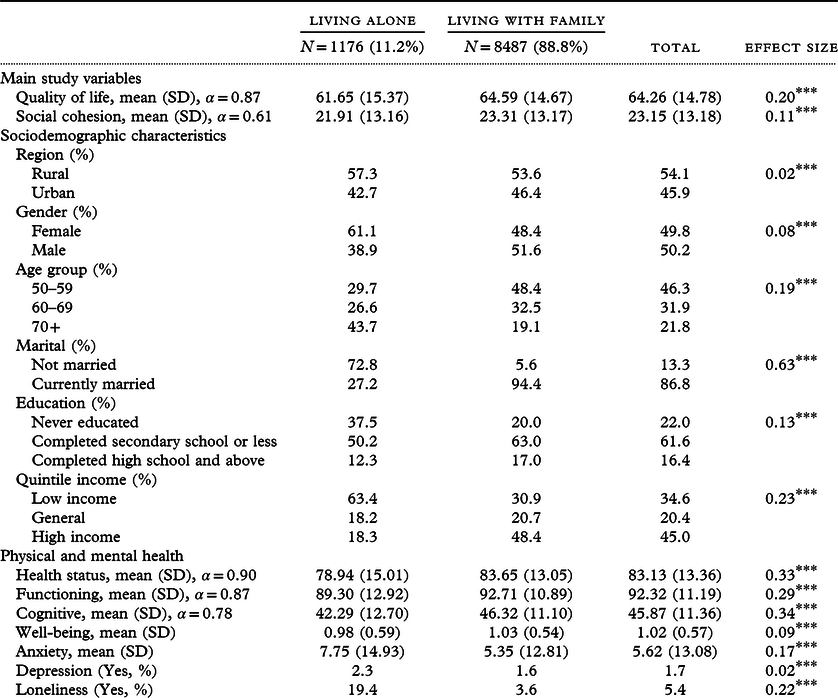
Table 2 shows the ES (Cramer’s V for chi-square and Cohen’s d for t-test) and significance levels for tests of living arrangement differences in the main study variables. Older adults living with family reported better QoL (ES = 0.20) and greater social cohesion (ES = 0.11). With the exception of marital status (ES = 0.63), ESs for sociodemographic group differences were small. Older adults who lived alone were more likely to live in rural areas (ES = 0.02), to be older (ES = 0.19), to be female (ES = 0.08), and to have lower levels of education (ES = 0.13) and household wealth (ES = 0.23).
ES and significance tests (chi-square or t-test) for study variables by living arrangement (N = 9663)

Similar to rural versus urban differences, when compared to older adults living with family, those who lived alone reported worse health (ES = 0.33), functioning (ES = 0.29), cognitive status (ES = 0.34), and well-being (ES = 0.09). This group also reported higher levels of anxiety (ES = 0.17), depression (ES = 0.02), and loneliness (ES = 0.22).
Moderated mediation analysis
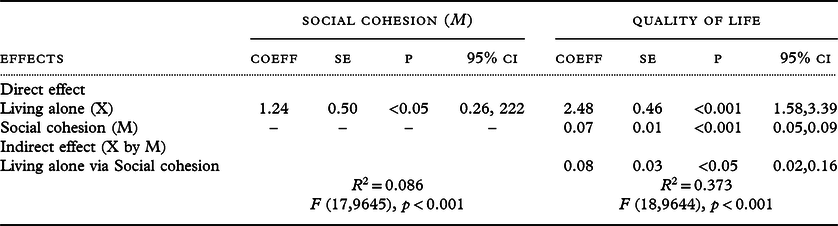
Table 3 shows the results of the three mediation hypotheses. In support of the first hypothesis, after controlling for sociodemographics and health and mental health measures, older adults who lived with family scored, on average, 1.24 units lower on social cohesion than those lived alone (p < 0.05). Likewise, controlling for social cohesion and geographic area, living with family was directly associated with lower QoL (…−2.48, p < 0.001) Data also supported the second hypothesis. Controlling for living arrangement, social cohesion had a positive direct effect on QoL (…−0.07, p < 0.001). Finally, concerning the indirect pathway, older adults who were living with family reported on average 0.09 units (p < 0.001) lower QoL compared to those living alone. These findings suggest that owing to the negative effects of living with family on social cohesion, higher levels of social cohesion might improve QoL for older adults who live alone. The overall model explained 37.3% of the variation in QoL.
Social cohesion as a mediator of living arrangement and quality of life

Controlling for sociodemographic and health and mental health variables.
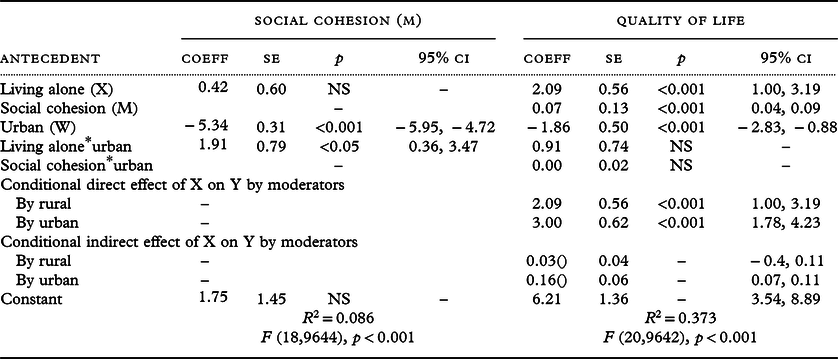
Table 4 presents the results of the hierarchical Ordinary Least Squares (OLS) regression to assess direct and indirect moderation hypotheses. With the effects of other variables in the model controlled, we first tested three conditional direct effects: geographic locale * living arrangements on social cohesion, geographic locale * social cohesion on QoL, and geographic locale * living arrangement on QoL. To claim moderation of indirect effects, the coefficients of the first two paths must be significant; otherwise, conditional indirect effect cannot be interpreted. Results supported the first direct moderation hypothesis, showing that for older adults in urban areas, levels of social cohesion for those who lived with families decreased 1.91 units more than their counterparts in rural areas (SE = 0.79, p < 0.05). Interactions of the second and third paths were not statistically significant. We thus accept only the hypothesis that geographic locale moderates the direct association of living arrangement and social cohesion.
Conditional mediation of living arrangement and quality of life

Controlling for sociodemographic and health and mental health variables.
Discussion and conclusions
This study is set in the context of growing numbers of older adults who live alone in the rapidly aging and most populous nation in the world. This demographic trend signifies a radical departure from long-standing traditional patterns of co-residency that can profoundly influence older adults’ QoL. Our findings advance the large body of research on late-life living arrangements and well-being in China in two ways. First, we use data from a large national probability sample of adults aged 50 years and older to examine the mediating effects of social cohesion on that relationship. Second, because there are fundamental differences in policies, programs, and lifestyles in urban and rural China that can affect older adults’ QoL, we use conditional process analysis to determine whether residence in these two geographic locales moderates this relationship.
Counter to common assumptions, we found that living alone did not have much worse outcomes for older adults than living with family. Descriptive data suggested disadvantages for those living alone; however, consistent with Bromell and Cagney (Reference Bromell and Cagney2014), after controlling for the effects of demographic characteristics and physical and mental health, this group had higher levels of social cohesion and QoL than older adults who were living with family. In light of their higher levels of social cohesion and the positive effects of social cohesion on QoL, we conclude that older adults who live alone can have a higher level of QoL if they can achieve sufficient levels of social cohesion through community involvement. This finding has significant policy implications given that social isolation has major effects on physical and mental health and mortality (Bhatti and Haq, Reference Bhatti and Haq2017; Pantell et al., Reference Pantell, Rehkopf, Jutte, Syme, Balmes and Adler2013; Valtorta et al., Reference Valtorta, Kanaan, Gilbody, Ronzi and Hanratty2016; York and Waite, Reference York and Waite2009).
We also investigated whether pathways in the mediation model differed by rural versus urban residential status. Only locale moderated the association of living arrangement and social cohesion, leading us to conclude that the effects of the former on cohesion is far stronger for older adults in urban areas. In other words, social cohesion mattered more for older adults living with family in urban areas than it did for their age peers in rural area.
Fei et al. (Reference Fei, Hamilton and Wang1992) describe rural China as a society without strangers, based on the familiar. Residents feel comfortable and safe in interacting with one another in their communities. Urban dwellers, on the other hand, originate from different places and the environment does not support the same level or types of social interaction. Building new networks may be especially challenging for rural older adults who follow their children to cities. Living with family may reduce or negate the need for them to communicate and interact externally. This is an important area for future research and will benefit especially from analyses of longitudinal data. Other productive avenues for future studies include the need to explore multiple mediation analyses and to determine why older adults who live alone report better QoL, despite deeply engrained cultural values for shared residency.
This study advances current knowledge about older adults’ QoL in urban and rural China in several ways. Ongoing monitoring of population demography will improve the targeting of policies, program, and practices vis-à-vis the changing needs and preferred living arrangements of older adults and available housing stock and options. Using data from the China Health and Retirement Longitudinal Study, Li et al. (Reference Li, Strauss, Tian and Zhao2015) also estimated that about 9% of older adults (11.2% of women and 6.7% of men) live alone and that roughly another third reside with a spouse only. Given their preponderance in the population of older adults who now live alone and the likelihood that they will outlive their spouses, attention is needed to the status and needs of older women. This imperative is reflected in the large ES in living arrangements of men and women (Table 2). Moreover, large ESs for persons with low education and low income in rural areas (Table 1) underscore this point for rural women as they are overrepresented in the low levels of both categories.
Another issue identified by Chen et al. (Reference Chen, Conwell and Chiu2014) which our findings also reinforce is the pressing need to recognize the public health significance of loneliness and isolation, which negatively affect health and mental health and diminish QoL. Here again, older adults in urban areas fared better on physical health, functioning, cognitive ability, and well-being. Although the ES for differences in depression, anxiety, and loneliness were quite small by comparison, this could be due to less robust measures or to differences in reporting on these issues by rural and urban respondents. It will be important not to dismiss the importance of these conditions because of a small observed ES. Likewise, the same can be said for the magnitude of difference in measures of mental health well-being among older adults who live alone and those who live with others.
Efforts to strengthen neighborhood social cohesion through safe, secure environments that foster access, inclusion, and meaningful participation are needed in rural and urban areas alike. Initiatives such as Global Age-Friendly Cities initiative (WHO, 2007) can promote QoL by strengthening opportunities and access to social participation for older adults in China, especially but not only in urban areas.
Finally, consistent with our finding that living alone did not have much worse outcomes for older adults than living with family, Meng et al. (Reference Meng, Xu, He, Zhang and Lin2017) reported a trend toward preference for living near, not with, adult children in urban China and that age has a positive effect on this preference. Housing and community development entities ought to take these sorts of preferences into account in their future planning and development.
In closing, there are several limitations to this study. First, a potential problem with social cohesion as a mediating variable is that it has been measured using many different scales, making it is difficult to generalize or compare its attributes as a mediator from study to study (Bruhn, Reference Bruhn2009). Second, we only examined social cohesion as a mechanism of the association of living arrangements and QoL. Other conditions may influence the pathways we studied, independently or interactively with social cohesion. Third, endogeneity of living arrangement status was not controlled. Even after we controlled for the effects of a range of factors that may be related to QoL, people who reported higher QoL might tend to live alone. Lastly, because our focus was on the growing number of older adults who live alone, we compared them with those who live with family and did not examine the full range of relationship permutations, such as multiple generations within households.
Conflict of interest
None.