

Introduction
Acquired brain injury (ABI) refers to focal or diffuse brain damage occurring after birth and is a leading cause of childhood disability worldwide (Giustini, Pistarini & Pisoni, Reference Giustini, Pistarini and Pisoni2013). It may arise from external forces including head trauma (e.g., motor vehicle accident, known as traumatic brain injury [TBI]) or internal mechanisms including stroke, inflammation, brain tumor, or metabolic imbalances (O’Rance & Fortune, Reference O’Rance and Fortune2007; Fleminger & Ponsford, Reference Fleminger and Ponsford2005; Segui-Gomez & MacKenzie, Reference Segui-Gomez and MacKenzie2003).
In Australia alone, 219–345 cases per 100,000 are reported annually, a likely conservative estimate based on hospital presentations only (Crowe, Babl, Anderson & Catroppa, Reference Crowe, Babl, Anderson and Catroppa2009). The common sequalae of childhood ABI are well documented and include a range of cognitive, behavioral, and everyday functional impairments (van Tol, Gorter, DeMatteo & Meester-Delver, Reference van Tol, Gorter, DeMatteo and Meester-Delver2011; Eve et al., Reference Eve, O’Keeffe, Jhuty, Ganesan, Brown and Murphy2016). In particular, impairments in attention (Allen et al., Reference Allen, Leany, Thaler, Cross, Sutton and Mayfield2010; Catroppa, Anderson, Godfrey & Rosenfeld, Reference Catroppa, Anderson, Godfrey and Rosenfeld2011; Königs et al., Reference Königs, Heij, van der Sluijs, Vermeulen, Goslings, Luitse and Oosterlaan2015) and memory (Catroppa & Anderson, Reference Catroppa and Anderson2007; Ward, Shum, McKinlay, Baker & Wallace, Reference Ward, Shum, McKinlay, Baker and Wallace2007) are among the most profound and disabling consequences of childhood ABI and have significant implications for quality of life, psychological well-being, and functional independence (Howell, Wilson, Kirkwood & Grubenhoff, Reference Howell, Wilson, Kirkwood and Grubenhoff2019).
Attention involves several inter-related components that are vulnerable to the effects of childhood ABI. Models of attention (Gilboa et al., Reference Gilboa, Kerrouche, Longaud-Vales, Kieffer, Tiberghien, Aligon and Paule Chevignard2015; Limond, Adlam & Cormack, Reference Limond, Adlam and Cormack2014; Mirsky, Anthony, Duncan, Ahearn & Kellam, Reference Mirsky, Anthony, Duncan, Ahearn and Kellam1991) distinguish between various aspects of attentional skills, including sustained attention (i.e., vigilance), selective attention (i.e., focusing on relevant stimuli and ignoring irrelevant stimuli), shifting attention (i.e., changing attentional focus in an adaptive and flexible manner), divided attention (i.e., dividing attention between two or more sources of information), attentional control (i.e., ability to inhibit responses), and speed of processing (i.e., rate of completing responses). There is substantial evidence that children with ABI are vulnerable to deficits in each of these domains (McKay et al., Reference McKay, Richmond, Kirk, Anderson, Catroppa and Cornish2019; van’t Hooft, Andersson, Sejersen, Bartfai & von Wendt, Reference van’t Hooft, Andersson, Sejersen, Bartfai and von Wendt2003). For example, in a sample of 71 children with TBI, Catroppa and Anderson (Reference Catroppa and Anderson2005) showed deficits on measures of sustained, selective, and shifting attention, as well as slowed processing speed, particularly for children with more severe injuries. Similarly, a review by Ginstfeldt and Emanuelson (Reference Ginstfeldt and Emanuelson2010) found that children with TBI performed poorest on tasks of sustained and divided attention, with difficulties commonly persisting into adulthood. More recently, Araujo et al. (Reference Araujo, Antonini, Anderson, Vannatta, Salley, Bigler and Yeates2017) reported that children with ABI, including TBI, stroke, and brain tumor, had significantly lower scores on tests of attentional control (inhibition), shifting attention, and working memory, relative to controls.
Childhood ABI has also been linked to impairments in memory, a complex multidimensional construct that incorporates several inter-related skills, including immediate, long-term memory, prospective, and working memory (Anderson & Catroppa, Reference Anderson and Catroppa2007; Jonsson, Smedler, Ljungmark & Emanuelson, Reference Jonsson, Smedler, Ljungmark and Emanuelson2009; Anderson & Moore, Reference Anderson and Moore1995; Thatcher, Reference Thatcher1991). Memory difficulties following ABI have received substantial research attention, with evidence suggesting that following ABI, children perform significantly poorer than their age-matched healthy peers on measures of immediate and short-term memory (Catroppa & Anderson, Reference Catroppa and Anderson2009), visual memory (Farmer et al., Reference Farmer, Haut, Williams, Kapila, Johnstone and Kirk1999), prospective memory (Ward et al., Reference Ward, Shum, McKinlay, Baker and Wallace2007), and working memory (Mandalis, Kinsella, Ong & Anderson, Reference Mandalis, Kinsella, Ong and Anderson2007). For many children with TBI, these deficits persist into the long-term post injury and contribute to difficulties with everyday functioning and reduced quality of life (Catroppa, Anderson, Beauchamp & Yeates, Reference Catroppa, Anderson, Beauchamp and Yeates2016).
Although attention and memory difficulties are a common consequence of childhood ABI, few evidence-based interventions are available to treat and manage the impact of these difficulties on day-to-day functioning (Catroppa, Stone, Rosema, Soo & Anderson, Reference Catroppa, Stone, Rosema, Soo and Anderson2014; Catroppa et al., Reference Catroppa, Stone, Hearps, Soo, Anderson and Rosema2015; Robinson, Kaizar, Catroppa, Godfrey & Yeates, Reference Robinson, Kaizar, Catroppa, Godfrey and Yeates2014). One relatively well-studied intervention is the Amsterdam Memory and Attention Training program for children (Amat-c), originally developed by Hendriksen and van den Broek (Reference Hendriksen and Van den Broek1996) for children recovering from cancer. The Amat-c is an 18-week treatment program, which has been adapted for children with ABI. The program aims to optimize post-injury attention and memory skills by supporting the child’s direct engagement and participation in range of drill-based attention and memory training exercises. The treatment efficacy of Amat-c was evaluated in 38 children with a hospital-confirmed diagnosis of ABI, with results suggesting that the Amat-c intervention was associated with significant improvement on tests of sustained and selective attention and working memory (van’t Hooft et al., Reference van’t Hooft, Andersson, Bergman, Sejersen, von Wendt and Bartfai2005). Encouragingly, these improvements were maintained at six-month follow-up (van’t Hooft et al., Reference van’t Hooft, Andersson, Bergman, Sejersen, von Wendt and Bartfai2007). A further study supported these treatment effects when administered in a school setting (Sjö, Spelleberg, Weidner & Kihlgren, Reference Sjö, Spellerberg, Weidner and Kihlgren2010). In an English adaptation of the Dutch program for children with ABI, Catroppa et al. (Reference Catroppa, Stone, Rosema, Soo and Anderson2014, Reference Catroppa, Stone, Hearps, Soo, Anderson and Rosema2015) found significant improvements in attention and memory immediately post-intervention and at six-month follow-up, with these improvements generalizing to everyday functional outcomes. An overall summary of the effectiveness of the Amat-c was provided by Dvorak and van Heugten (Reference Dvorak and van Heugten2018), where it was reported that the Amat-c was feasible and effective in treating attention and memory disturbances in children with ABI.
Despite preliminary evidence for the feasibility and efficacy of Amat-c, the strength of existing findings is weakened by several methodological limitations, including the notable absence of high-quality evidence (e.g., randomized controlled trial [RCTs]), small sample sizes, and absence of ecologically valid, functional outcome measures to capture real-world impact (Catroppa et al., Reference Catroppa, Stone, Rosema, Soo and Anderson2014, Reference Catroppa, Stone, Hearps, Soo, Anderson and Rosema2015; Sjö et al., Reference Sjö, Spellerberg, Weidner and Kihlgren2010; van’t Hooft et al., Reference van’t Hooft, Andersson, Bergman, Sejersen, von Wendt and Bartfai2005). Further studies addressing these limitations are needed to build the evidence base of the Amat-c program and support implementation into routine clinical practice.
Extending on the work of Catroppa et al. (Reference Catroppa, Stone, Rosema, Soo and Anderson2014, Reference Catroppa, Stone, Hearps, Soo, Anderson and Rosema2015), this study will evaluate the efficacy of an online, clinician-supported delivery of Amat-c for children and adolescents (age 8–16 years) with a diagnosis of ABI. Traditional face-to-face delivery of the program involves weekly, hospital-based sessions including (i) a clinician-led introduction to the weekly content and (ii) clinician support to address potential barriers to the implementation of the weekly training strategies. Weekly clinic visits are often associated with significant financial and non-financial costs to families, including travel time, parking fees, and/or lost parental income due to disruption to paid work commitments. For children and families living in regional and remote locations, long travel distances can limit regular participation in rehabilitation programs. To address these significant limitations and barriers to participation, the proposed pilot program will involve online, clinician-supported delivery of Amat-c using a secure telehealth platform. It is anticipated that online delivery of Amat-c will enable greater access and equity for regional and remote families who would not otherwise have capacity or resources to participate due to long travel distances and/or financial constraints.
Using an RCT design, we hypothesize that relative to the active-control group: (i) children/adolescents receiving Amat-c will display significantly greater improvements in attention and memory immediately post-intervention and at follow-up, as measured by standardized neuropsychological tests, and; (ii) children in the Amat-c intervention group will display significantly greater improvements on standardized parent report measures of everyday social functioning and health-related quality of life.
Method
Study approval and trial registration
This study has been approved by the Human Research Ethics Committee (HREC) of the Royal Children’s Hospital (RCH), Melbourne (29099) and prospectively registered with the Australian New Zealand Clinical Trials Registry (ACTRN1216001414404).
Study setting
Participants will be identified and assessed for study eligibility using the following methods: (i) retrospective audits of RCH clinical records, (ii) referrals from RCH clinicians and/or service providers, and (iii) social media.
Study design
The study will employ a double-blinded RCT design. Neuropsychological assessments and standardized parent-and-teacher-questionnaire measures will be collected at four separate intervals. In the screening phase (T0), participants will be screened for attention and memory problems on standardized neuropsychological tests and/or parent questionnaires. In the pre-intervention baseline phase (T1), eligible participants will complete detailed baseline evaluations of neuropsychological and everyday functioning in addition to those done in T0. These evaluations will be repeated immediately post-intervention assessment (T2) and at six-month follow-up (T3). At all four time points, data will be collected from both the treatment group and the active-control group (see Table 1).
Study Measures
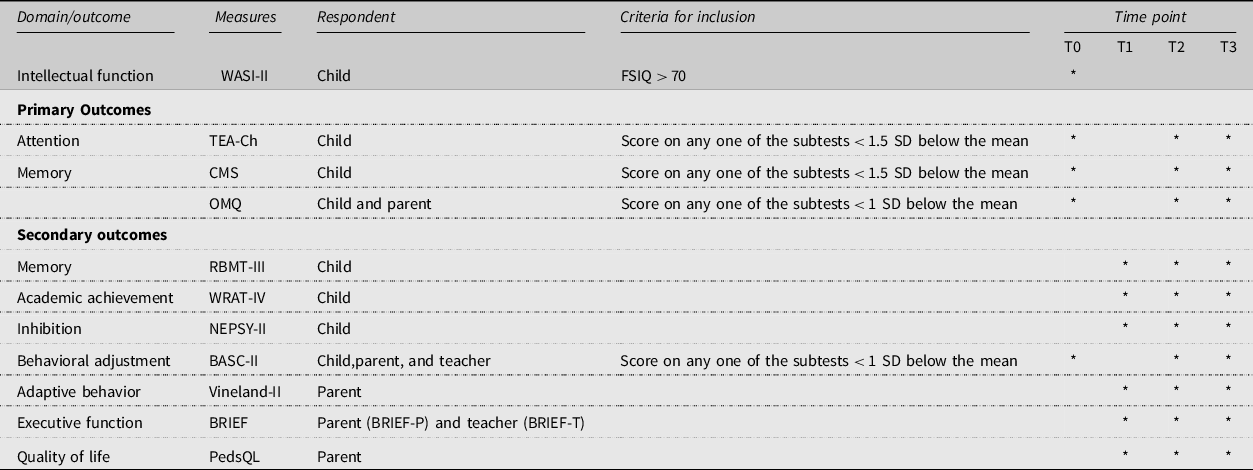
WASI-II, Wechsler Abbreviated Scale of Intelligence – Second Edition (Wechsler, Reference Wechsler2011); TEA-Ch, Test of Everyday Attention for Children (Manly et al., Reference Manly, Anderson, Robertson and Nimmo-Smith1999): Sky Search, Score and Score DT; CMS, Children’s Memory Scale (Cohen, Reference Cohen1997): Family Pictures I & II and Stories I & II; OMQ, Observer Memory Questionnaire (Gonzalez et al., Reference Gonzalez, Anderson, Wood, Mitchell, Heinrich and Harvey2008); RBMT-III, The Rivermead Behavioural Memory Test (Wilson et al., Reference Wilson, Greenfield, Clare, Baddeley, Cockburn, Watson and Crawford2008); WRAT-IV, The Wide Range Achievement Test: Fourth Edition (Wilkinson & Robertson, Reference Wilkinson and Robertson2006); NEPSY-II, A Developmental Neuropsychological Assessment – Second Edition (Brooks, Sherman & Strauss, Reference Brooks, Sherman and Strauss2009); BASC-II, Behavior Assessment System for Children (Reynolds & Kamphaus, Reference Reynolds and Kamphaus2004); Vineland-II, Vineland Adaptive Behavior Scales – Second Edition (Sparrow, Cicchetti & Balla, Reference Sparrow, Cicchetti and Balla2005); BRIEF, Behavior Rating Inventory of Executive Function (Gioia, Isquith, Guy & Kenworthy, Reference Gioia, Isquith, Guy and Kenworthy2000); PedsQL, Paediatric Quality of Life (Varni, Seid & Rode, Reference Varni, Seid and Rode1999); T0, screen; T1, pre-intervention baseline; T2, immediate post-intervention; T3, six months post-intervention.
*Indicates time point of assessment at which measure was completed.
Primary outcomes
The pilot program will evaluate the efficacy of the English-translated Amat-c intervention program with online delivery. Specifically, the program expects improvement in the following primary outcomes.
Attention
Two subtests of Test of Everyday Attention for Children (TEA-Ch; M = 10; standard deviation [SD] = 3; Manly, Anderson, Robertson & Nimmo-Smith, Reference Manly, Anderson, Robertson and Nimmo-Smith1999), Sky Search (selective attention), and Score! DT (sustained attention) will be used to assess attention. These will be administered in standardized format and both raw and standardized scores will be derived.
Memory
Memory will be assessed using the subtests of Children’s Memory Scale (CMS; M = 100; SD = 15; Cohen, Reference Cohen1997), namely, stories (verbal memory) and family pictures (visual memory). An attention and memory global score will be created by combining the scaled scores from TEA-Ch and CMS.
The possibility of a composite score will also be considered for the primary outcome measures. Factor analysis will be performed to derive this composite score for use in the primary outcome analyses.
Secondary outcomes include measures of functional memory (Rivermead Behavioural Memory Test – Third Edition; Wilson, Cockburn, & Baddeley, Reference Wilson, Cockburn and Baddeley1985, and Observer Memory Questionnaire [OMQ]; Gonzalez, Anderson, Wood, Mitchell, Henrich & Harvey, Reference Gonzalez, Anderson, Wood, Mitchell, Heinrich and Harvey2008), affect recognition (Affect Recognition subtest of the Developmental Neuropsychological Assessment-II; Korkman, Kirk, & Kemp, Reference Korkman, Kirk and Kemp2007), and academic achievement (Wide Range Achievement Test 4; Wilkinson, & Robertson, Reference Wilkinson and Robertson2006). Standardized parent-and-teacher-report measures will be collected to assess the following domains: everyday executive function (Brief Rating Inventory of Executive Function; Gioia, Isquith, Guy, & Kenworthy, Reference Gioia, Isquith, Guy and Kenworthy2000), adaptive behavior (Vineland Adaptive Behaviour Scales – Second Edition; Sparrow, Cicchettim, & Balla, Reference Sparrow, Cicchetti and Balla2005), behavioral adjustment (Behaviour Assessment System for Children; Reynolds & Kamphaus, Reference Reynolds and Kamphaus1992), and health-related quality of life (Paediatric Quality of Life Inventory – Generic Core Scale; Varni, Seid, & Rode, Reference Varni, Seid and Rode1999).
Feasibility measures
The current pilot study of online, clinician-supported delivery of Amat-c will incorporate the following feasibility measures: (i) number of eligible participants that agree to participate or decline, (ii) number of participants that complete the weekly activities and follow-up measures, (iii) number of modules completed and homework completion rate, (iv) rates of parent and child participation in weekly online clinician-support meetings, and (v) family feedback regarding strengths and areas for improvement for each weekly module (collected at completion of each module).
Participants
Forty (N = 40) children with an ABI (traumatic, e.g., traffic accident and fall; non-traumatic, e.g., cerebral infection, tumor, and stroke) will be contacted to participate in the study. To be eligible for participation, children will be required to meet the following criteria: (a) hospital-confirmed diagnosis of ABI; (b) aged 8–16 years at recruitment; (c) minimum of 1-year post-injury; (d) IQ above 70 (Full Scale Intelligence Quotient (FSIQ)); and (e) score at least 1.5 SD below the mean on selected subtests of the CMS (Cohen, Reference Cohen1997) and/or the TEA-Ch (Manly et al., Reference Manly, Anderson, Robertson and Nimmo-Smith1999) and/or score of at least one SD below the mean on the OMQ (Gonzalez et al., Reference Gonzalez, Anderson, Wood, Mitchell, Heinrich and Harvey2008) and/or the Behavioral Assessment System for Children (Reynolds & Kamphaus, Reference Reynolds and Kamphaus2004). Exclusion criteria are (i) children and families from non-English-speaking backgrounds, (ii) IQ at or below 70 (FSIQ) on initial screening assessment, and (3) medically confirmed intractable seizures. The sample size is based on a priori power estimation on the CMS (Cohen, Reference Cohen1997). This sample size will allow detection of differences in visual and verbal memory at a power of 80%, alpha value of .05 and an effect size of .90.
Recruitment and allocation
A tracing letter will be issued via mail to parents and/or guardians of children who meet eligibility criteria. The tracing letter has been approved by the HREC at the RCH Melbourne. The tracing process complies with relevant privacy legislation by limiting the amount of personal information conveyed in the letter and requesting consent to initiate further contact with the family. Families will be encouraged to return the tracing letter, indicating whether they wish to opt-in and receive further study information. For those families expressing interest, a more detailed assessment of study eligibility will be completed using a screening survey administered via phone. If the child meets the criteria, the family will receive a formal invitation via mail/e-mail, including a detailed study information statement and consent form/s. Pending return of parent and child consent forms, children will complete a neuropsychological screening assessment, including measures of IQ, memory, and attention. If the child continues to meet the screening criteria, a more detailed baseline assessment is conducted and subsequently, the child will be randomly allocated to the Amat-c treatment or active-control group (see Fig. 1).
Consolidated Standards of Reporting Trials (CONSORT) flow diagram.

Randomization
Eligible participants will be randomized 1:1 to the treatment group or the active-control group. The randomization list will be generated using online software (sealed envelope) by a statistician who is blind to study details. Treatment allocations will be generated via block randomization. At the time of randomization, participants will be assigned the next available sequential study number in an opaque-sealed envelope. The chief investigator (CC5) will manage the allocation of participants to the relevant study group, and will remain blind to the participant, their family, and other trial team members. The participants will also be blinded as to which program they have been allocated to. Nonetheless, once the program is initiated, treatment assignment may become clear to participating families.
Intervention program: the Amat-c program
The Amat-c is a cognitive training program for enhancing children’s attention, memory, and executive functioning skills. Participants in the treatment group will be administered the Amat-c program (see Appendix 1 for example). The Amat-c is a restorative or direct intervention program and includes three phases of six-week duration. Phase 1 (six weeks) involves training in sustained attention (e.g., focusing on learning to concentrate on one task for a sustained period of time). Phase 2 relates to selective attention (e.g., ignoring distraction) and divided attention (e.g., focusing attention quickly and flexibly). Phase 3 relates to mental tracking and memory and involves techniques to assist memory, including repetition, coding/sorting, and visual imagery. These strategies that underpin memory functioning aim to train and improve immediate, short-term, and long-term memory.
Participants will complete the Amat-c program for 30 min per day for 18 weeks. Families will receive 1 h of online, clinician-delivered support at the commencement of each training week. During these family sessions, the clinician will initiate a video call, which will involve training and psychoeducation regarding the weekly focus activities and techniques. The clinician will also address any questions or concerns regarding the training activities from the previous week. Following this, the Amat-c program will be delivered by a parent for the rest of the week. Weekly meetings with the clinician will serve as a method of monitoring and evaluation of weekly assigned homework. Parents will also contribute in providing feedback for each session to improve and optimize future adaptations of the program. Successful attendance to sessions and completion of homework activities and written workbook will determine child-and-parent adherence to the intervention.
Active-control group intervention
Participants randomly assigned to the active-control group will be encouraged to engage with psychoeducation resources specifically designed for families of children living with an ABI (see Appendix 2 for example). This resource booklet has been designed to provide psychoeducation regarding the common behavioral, physical, and emotional sequelae of childhood ABI, without any explicit coverage of attention and/or memory difficulties. The active-control group will also receive weekly 1-h video sessions with a clinician trained in ABI support. In addition to the educational benefits, these sessions ensure that the treatment and active-control groups are matched on clinical contact hours. At the completion of the study, families in the active-control group will be offered the Amat-c intervention if it is shown to be efficacious.
Since the online meetings with the clinician require reliable Internet access, families with no Internet access will be provided with an Internet-enabled iPad for the duration of the study.
Data storage
Both pen–paper and digital formats of data will be collected and securely stored at Murdoch Children’s Research Institute (MCRI) under restricted access. The data collected are entered onto a password-protected computer database by study staff and are identifiable by a unique study identification number. Identifiable data, such as names and contact details, are kept in a separate file, which can only be accessed by study team members as specified by ethics. The information collected as part of this study will be retained until the youngest participant turns 25.
Data analysis
This RCT will be conducted and reported in accordance with the Consolidated Standards of Reporting Trials (CONSORT) guidelines. An intention-to-treat approach will be used for all the participants. Repeated measures multivariate planned comparisons using the SPSS General Linear Model procedure will compare pre- and post-intervention and six-month follow-up performance on the outcome measures. Secondary analysis will involve exploring the effect of mediators on attention, memory, and the functional outcomes.
Further analysis will include sensitivity analysis to investigate adherence to the intervention with respect to differences in training outcomes for those who completed the training (≥80%) and those who did not, and the compliance with the weekly clinician meetings.
Discussion
Attention and memory impairments are disabling consequences of childhood ABI (Anderson, Catroppa, Morse, Haritou & Rosenfeld, Reference Anderson, Catroppa, Morse, Haritou and Rosenfeld2005; Catroppa et al., Reference Catroppa, Anderson, Godfrey and Rosenfeld2011, Reference Catroppa, Stone, Rosema, Soo and Anderson2014; van Heugten et al., Reference Van Heugten, Hendriksen, Rasquin, Dijcks, Jaeken and Vles2006). Despite the significant functional implications of post-injury cognitive dysfunction, there exists a dearth of evidence-based interventions for addressing attention and memory difficulties following childhood ABI. In the Australian context, there is preliminary evidence that an English adaptation of Amat-c is a feasible and effective intervention for improving attention and memory functioning in children with a history of ABI (Catroppa et al., Reference Catroppa, Stone, Rosema, Soo and Anderson2014, Reference Catroppa, Stone, Hearps, Soo, Anderson and Rosema2015). Despite these encouraging preliminary results, existing evidence has methodological weaknesses. As such, further studies using an RCT methodology, an active-control group, functional outcome measures, and a more accessible mode of program delivery (online clinician support), will be beneficial in further developing the evidence base for the use of the Amat-c for children following ABI.
To extend the current evidence base for Amat-c in the childhood ABI population, this pilot study will evaluate the efficacy of an online clinician-support version of the Amat-c intervention using an RCT design involving an active-control group. To address potential costs and barriers to participation among families living in rural and remote regional Australia, the proposed pilot program will involve online, clinician-supported delivery of Amat-c using a secure telehealth platform. It is anticipated that online delivery of Amat-c will enable greater access and equity for families who would not otherwise have capacity or resources to participate due to long travel distances and/or financial constraints. This online, clinician-supported program will emphasize a holistic, family-centered approach to rehabilitation and will be delivered by facilitators with extensive clinical- and intervention-specific training.
It is expected that, compared to the active-control group, children and adolescents receiving the Amat-c program will display significantly greater improvements on standardized measures of memory, attention, and everyday functioning. It is anticipated that provision of weekly, online clinician support will maximize engagement and rapport with families. Equally, the weekly clinician-supported sessions will support adherence to RCT methodology, which is essential for yielding high-quality evidence needed to guide further research and recommendations for clinical practice. Specifically, the study will extend current evidence regarding the efficacy of Amat-c in optimizing attention and memory outcomes in children and adolescents living with ABI.
Acknowledgements
The authors thank the Murdoch Children’s Research Institute (clinical researchers and volunteer staff), the RCH, and study families, the University of Melbourne (Melbourne School of Psychological Sciences and Department of Paediatrics), the Victorian Government Operational Infrastructure Scheme and Rian Dob for her role in the English translation of the program.
Authors’ Contributions
All authors contributed to the study concept, the trial, and this manuscript. All authors read and approved the final manuscript.
Financial Support
This trial received a grant from the Telematics Course Development Fund. This grant has been utilized for the initial project setup including the ethics protocol and procurement of recruitment materials (i.e., study letters, consent forms, outcome measures, and questionnaires).
Conflicts of Interest
None.
Ethical Standards
The authors assert that all procedures contributing to this work comply with the ethical standards of the relevant national and institutional committees on human experimentation and with the Helsinki Declaration of 1975, as revised in 2008.
Trial Status
Ongoing.
Ethics Approval
Ethics approval was granted by the Human Research Ethics Committee (HREC) of the RCH, Melbourne (29099). All study procedures will be conducted according to this ethically approved protocol.
Trial Registration
Australian New Zealand Clinical Trials Registry (ACTRN1216001414404).
Amat-c Program: Example
Week 3
INSTRUCTIONS DAY 1.
1) LISTENING TO THE RADIO
- method: with parent, siblings, or grandparent
- materials: radio, tape player, tape, pen, diary sheet, extra sheets of paper, preparation sheet
Record a one-minute segment of the radio playing or a YouTube video (for example, an interview). Listen carefully to the different KINDS of sounds that you can hear (for example, creaking, a male voice, and so on) and write these sounds in your diary sheet. Your parent will listen too, and also record what he or she can hear in as much detail as possible (on the extra sheets of paper). Check with your parent whether you have heard the same sounds; are there things that you have heard but your parent hasn’t, or the other way around? Listen to the tape again and try to listen for the sounds that one person has heard but the other hasn’t. Record your findings on your diary sheet.
2) ONLY ONE IS CORRECT
- method: on your own
- materials: attachment, pen, diary sheet, preparation sheet, stopwatch
Put the attachment for day 1 in front of you. On this page, you will see four pictures that all look alike, but they are not all the same! If you look carefully, you will see that in three of the pictures, different things have been left out, OR added, OR drawn differently. Compare all 4 pictures and circle all the differences you can find and write them down. You should do this for at least TEN minutes (you can use the stopwatch to keep track of time)! After the exercise, complete your diary sheet.
3) PREPARATION SHEET AND HOMEWORK
- method: on your own
- materials: attachment, pen, diary sheet, preparation sheet
For this week, use your PREPARATION SHEET when you do your homework (if you have any). Also try to memorise the questions on the PREPARATION SHEET, so that you can also use them if you do not have the preparation sheet with you. If you are in a school where (sometimes) no homework is given, you can skip this exercise on the days that you do not have any homework. Do try to memorise the rules on the PREPARATION SHEET. Complete your diary sheet.
Control Program Example
Week 1
Physical effects of an ABI A child’s current physical state may be an influencing factor (or ‘trigger’) for their behaviour. Changes in physical state can be physiological, where your child may experience, for example, frequent tiredness and/or headaches. It is well known that an ABI can alter a child’s physical state, which can subsequently affect the intensity, frequency, or duration of challenging behaviours. You child may sometimes feel frustrated due to the changes they are experiencing and as a result exhibit certain behaviours.
Factors such as the extent of the brain injury mean that physical effects will vary for each child. Listed below are some of the short and long-term physical effects that your child may experience as a consequence of an ABI:
-
Headache;
-
Fatigue/tiredness;
-
Dizziness;
-
Sensitivity to sound or light
Questions for today
-
1. Did your child experience any changes in their physical state following their brain injury?
□ YES □ NO
-
2. If yes, please indicate which of these symptoms your child experienced:
□ Headache
□ Fatigue/tiredness
□ Dizziness
□ Sleep disturbances
□ Sensitivity to sound or light.
Kindly explain your child’s experiences in a few words (optional).



