Introduction
Emergency Medical Services (EMS) professionals in the United States are serving an increasingly diverse population. By 2050, minorities are projected to represent >50% of the US population, with Hispanics and African-Americans constituting around 30% and 15% of the total populace, respectively.Reference Crowe, Levine, Eggerichs and Bentley 1 Meanwhile, the population of EMS providers, although increasing in numbers, is not experiencing the same rise in diversity. The profession of prehospital care providers continues to see an over-representation of white males. 2 This lack of diversity is not unique to prehospital EMS, but is present in other health care-related fields, particularly within the physician workforce. In 2000, African-Americans and Hispanics made up <10% of all US physicians and surgeons.Reference Chapman, Lindler and Kaiser 3 The Association of American Medical Colleges (Washington, DC USA) defines under-represented in medicine as “those racial and ethnic populations that are underrepresented in the medical profession relative to their numbers in the general population.” 4
Diversity that is representative of the population served by health care providers is important to reduce existing disparities in patient care received by minority patients. The Institute of Medicine (Washington, DC USA) reported that racial and ethnic minorities tend to receive a lower quality of health care than white Americans even with access-related factors, such as insurance and income, controlled. 5 Additionally, minority patients face cultural and linguistic barriers, which health care professionals from racial and ethnic minorities can help reduce while improving cultural competence.Reference Smedley, Stith and Nelson 6 Cultural competence is particularly critical in the setting of emergency medicine, which tends to be more vulnerable to racial bias since patients must be rapidly evaluated and treated properly.Reference Heron, Lovell, Wang and Bowman 7 , Reference Bowman, Moreno-Walton, Ezenkwele and Heron 8
Little research has been conducted analyzing diversity in EMS. Furthermore, few investigations have attempted to describe the characteristics of members of under-represented populations who enter the profession. Factors such as income and satisfaction are important as they have been associated with career success and longevity in emergency medicine.Reference Richardson, Babcock Irvin and Tamayo-Sarver 9 A baseline understanding of racial/ethnic diversity and of the characteristics of minority EMS professionals in prehospital environment is needed. The objective of this paper was to compare key characteristics, including demographics, work-life, satisfaction, and motivation for entering the field, of EMS professionals of under-represented races/ethnicities with members of the majority race/ethnicity.
Methods and Data
Study Design
The design and data collection procedures for the Longitudinal Emergency Medical Technician (EMT) Attributes and Demographic Study (LEADS) are described in detail in the first paper of this supplement. Briefly, an annual survey was administered to nationally certified EMS professionals for 10 years from 1999 through 2000. The LEADS sample was stratified based upon certification level (EMT-Basic or Paramedic), EMS experience level (new: <2 years or old: ≥2 years), and race/ethnicity (nonminority or minority). Survey weights were calculated based upon the individuals in each stratum’s likelihood of being selected from the overall nationally certified EMS population. This project received approval from the American Institutes of Research Institutional Review Board (Washington, DC USA).
Measurements
Race was constructed utilizing a self-reported race/ethnicity variable in which participants were able to select one or more categories. Based on these responses, individuals were classified as follows: white, Hispanic, African-American, Asian, Native American/Alaskan Native, or biracial/multiracial (for individuals who selected two or more races).
Main areas of interest for comparisons by race/ethnicity included the following: (1) demographics, (2) work-life characteristics, (3) satisfaction, and (4) motivation for entering EMS. Demographics included gender, age, education, and marital status. Work-life characteristics looked at certification level, income, EMS experience, community size, weekly call volume, service type, and intent to leave the EMS profession. The satisfaction section described the average satisfaction (1=very dissatisfied, 2=dissatisfied, 3=satisfied, 4=very satisfied) with respect to current EMS assignment, EMS profession, working relationships, pay and benefits, job excitement, technical challenges, variety of tasks, work schedule, opportunity for advancement, working without close supervision, and being able to help others. Finally, motivation for entering the EMS profession included the following factors: having a friend or family member who worked in EMS, enjoy performing medical care, pay and benefits, fell into it, an accident or situation where I was unable to help, wanted a job that was exciting, opportunity for a new career, job requirement, to learn if I wanted to pursue other health career opportunities, and job provided financial incentives.
Data Analysis
Descriptive weighted statistics were used to discern study objectives. Ninety-five percent confidence intervals (CIs) were calculated and statistical significance was assessed by comparing these CIs. Comparisons were made both longitudinally and between different categories of the race/ethnicity variable. Findings were determined as statistically significant based on lack of CI overlap. Statistical calculations were performed using STATA version 12.1 (StataCorp LP; College Station, Texas USA) and SAS version 9.3 (SAS Institute; Cary, North Carolina USA) utilizing PROC SURVEYFREQ and PROC SURVEYMEANS.
Results for all races/ethnicities are reported in tabular form. However, the small number of respondents for Asian, Native American/Alaskan Native, and biracial/multiracial produce less stable estimates. Consequently, only the results for white, Hispanic, and African-American are detailed below. Furthermore, the results from the 1999 LEADS survey are not included due to a data processing error.
Results
From 2000 through 2008, the range of proportions of nationally certified EMS professionals by race/ethnicity was as follows: whites: 83.5%-86.0%, Hispanics: 4.2%-5.9%, and African-Americans: 2.5%-4.6%. There were no significant changes in the proportion of minority EMS professionals over the course of this study. Hispanics and African-Americans combined increased slightly from 6.7% of the population in 2000 to 9.9% in 2008. Likewise, the proportion of all under-represented races/ethnicities together increased slightly from 2000 (14.0%) to 2008 (16.5%).
Demographics
All data related to demographics are displayed in Table 1. As in the overall population of EMS professionals, females were under-represented across three races/ethnicities with no consistent statistical differences between groups. The proportion of female EMS professionals among whites ranged from 34.8% to 37.7%, among African-Americans from 23.9% to 39.3%, and among Hispanics from 24.1% to 38.8%.
Demographics of EMS Professionals by Race/Ethnicity and Year

Abbreviation: EMS, Emergency Medical Services.
In eight of the nine survey years, the average age of Hispanic EMS professionals was less than the average age of white respondents and was significantly lower in 2004. Similarly, African-American EMS professionals were, on average, younger than white EMS professionals in eight of the nine survey years; however, these differences were not statistically significant.
With respect to education, there were no significant differences between the proportion of whites, African-Americans, or Hispanics who answered “high school/some college” as their highest level of education completed. Likewise, for “Associate’s degree,” there were no significant differences between groups. On the other hand, a significantly higher proportion of whites reported having a Bachelor’s degree than Hispanics in 2003, 2007, and 2008 (whites: 23.5%, 25.9%, and 22.6%; Hispanics: 10.9%, 16.5%, and 12.3%).
With respect to marital status, a larger proportion of whites reported themselves as “married” compared with Hispanics and African-Americans across all nine survey years. Significant differences were found between the proportion of married whites and African-Americans in 2000 (whites: 59.8%, African-Americans: 37.4%), 2002 (whites: 61.9%, African-Americans: 38.2%), and 2007 (whites: 61.2%, African-Americans: 41.7%). In 2005, there was a significant difference between the proportion of married whites (60.9%) and Hispanics (43.6%). The proportion of African-Americans who responded “divorced, separated, or widowed” differed significantly from that of whites and Hispanics in 2004 (African-American: 16.0%, whites: 9.2%, Hispanics: 7.9%) and in 2006 (African-Americans: 16.8%, whites: 9.8%, Hispanics: 11.1%). The three groups also differed significantly from each other for “member of unmarried couple” in 2005 (African-Americans: 1.0%, whites: 8.3%, Hispanics: 11.4%) and in 2008 (African-Americans: 3.6%, whites: 7.5%, Hispanics: 14.6%).
Employment Characteristics
Data related to employment characteristics can be found in Table 2. With regard to certification level, a significantly higher proportion of African-Americans were EMT-Basics (range: 77.0%-87.3%) compared with whites (range: 63.6%-71.4%) in all survey years except 2001. The proportion of Hispanic EMT-Basics, ranging from 68.7% to 86.7% across all survey years, was significantly higher than the proportion of whites who were EMT-Basics in 2001, 2004, and 2005. Consequently, since only EMT-Basics and Paramedics were included in the sample, a larger proportion of whites were nationally registered as paramedics in all nine years than Hispanics and African-Americans with statistical significance in the same years as the findings for EMT-Basics.
Employment Characteristics of EMS Professionals by Race/Ethnicity and Year

Abbreviations: EMS, Emergency Medical Services; EMT, Emergency Medical Technician.
There were no statistical differences in the annual income received from EMS between races/ethnicities: however, in all nine years whites reported the lowest annual EMS income. A significantly larger proportion of African-Americans reported working in urban communities (population >25,000) compared with whites from 2002 to 2008 (African-Americans: 75.5%-88.8%, whites: 43.2%-47.2%). Similarly, a significantly larger proportion of Hispanics worked in urban communities compared with whites in 2002 (Hispanics: 76.2%, whites: 45.2%) and from 2005 to 2008 (Hispanics: 67.9%-78.8%, whites: 45.5%-47.2%).
When asked if they were planning to leave the profession, there were no statistically significant differences between groups. The percentage of whites who responded that they would “definitely or probably leave” within the next 12 months was 3.6%-6.0%, while the proportions for African-Americans ranged from 3.2% to 16.1% and for Hispanics from 2.3% to 11.3%.
From 2000 to 2004 more African-Americans and Hispanics worked for a fire-based service than whites, although the only statistically significant difference was in 2001 between Hispanics (50.1%) and whites (36.0%). In 2001, 2002, 2005, and 2006 a significantly larger proportion of whites (28.5%, 26.6%, 15.7%, and 16.6%) reported working for a county, municipal, or other public system compared with both African-Americans (14.2%, 11.6%, 3.2%, and 7.9%) and Hispanics (9.0%, 10.0%, 5.4%, and 7.6%).
Satisfaction
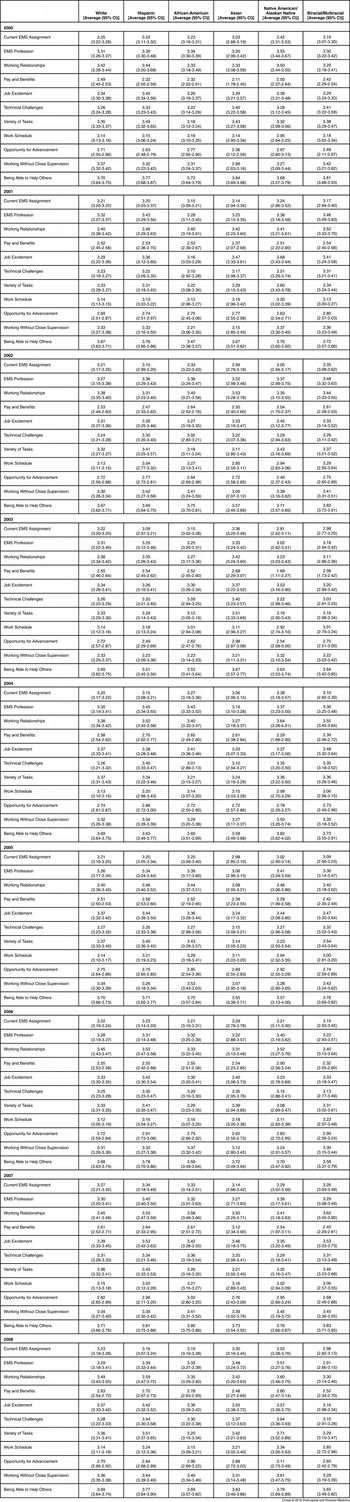
Satisfaction-related data are contained in Table 3. While some differences existed between minorities and whites, there were no consistent tendencies in average satisfaction related to race/ethnicity longitudinally. Regardless of race/ethnicity, respondents were most satisfied with helping others (whites: 3.67-3.71, Hispanics: 3.51-3.81, African-Americans: 3.47-3.80) and least satisfied with pay and benefits (whites: 2.49-2.63, Hispanics: 2.32-2.70, African-Americans: 2.32-2.78) and opportunity for advancement (whites: 2.69-2.82, Hispanics: 2.49-2.96, African-Americans: 2.62-3.02).
Average Satisfactiona of EMS Professionals by Race/Ethnicity and Year

Abbreviation: EMS, Emergency Medical Services.
aSatisfaction was rated on a scale with 1=Very Dissatisfied, 2=Dissatisfied, 3=Satisfied, and 4=Very Satisfied.
Motivation for Entering EMS
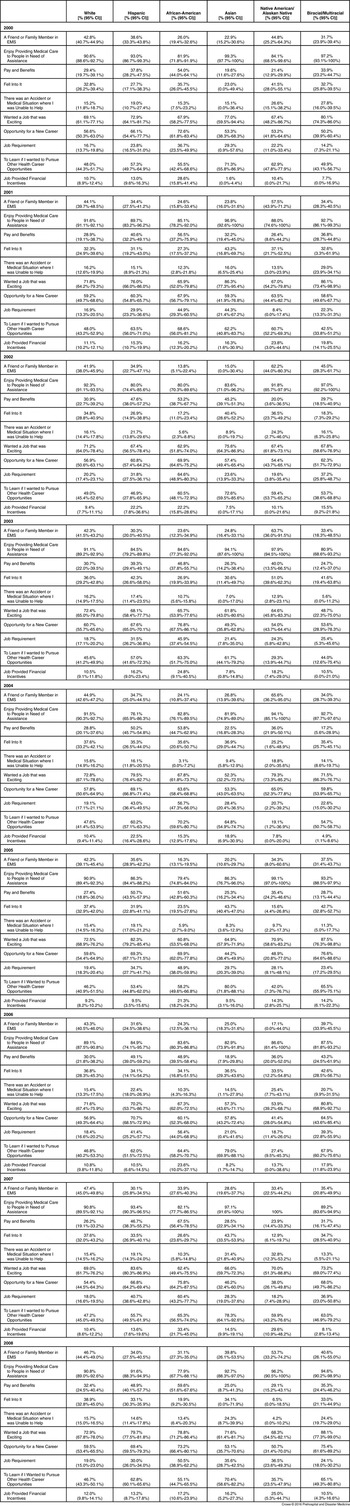
Data describing motivations for entering EMS are contained in Table 4. A higher proportion of whites (41.9%-47.4%) reported having a friend or family member in the field as a motivating factor for entering EMS compared with African-Americans (13.8%-33.9%) and Hispanics (30.1%-38.6%). These differences were statistically significant for African-Americans in all years except 2004 and for Hispanics in 2003 and from 2006 to 2008. The percentage of whites (89.1%-92.3%) who included that they felt they would enjoy providing medical care to people in need of assistance among their factors for entering the field was higher than African-Americans (77.9%-85.1%) and significantly higher in 2002 and from 2004 to 2008. Enjoyment of providing medical care was also less frequently selected as a factor for entering EMS among Hispanics (76.1%-93.4%) and significantly less in 2002, 2004, and 2005. From 2004 to 2007, a significantly larger percentage of African-Americans (48.9%-67.5%) and Hispanics (49.1%-50.7%) indicated pay and benefits as factors for entering EMS compared with whites (26.2%-30.0%). The percentage of whites (16.7%-20.2%) who reported EMS training as a job requirement among their motivations for entering EMS was significantly lower than African-Americans (36.7%-64.6%) and Hispanics (23.8%-43.0%) from 2002 to 2008.
Motivation for Entering EMS by Race/Ethnicity and Year

Abbreviation: EMS, Emergency Medical Services.
Discussion
The 2004 Institute of Medicine report, In the Nation’s Compelling Interest: Ensuring Diversity in the Healthcare Workforce, detailed the need for health care professionals from different ethnic and racial backgrounds to improve access to care and increase patient satisfaction.Reference Hall, Wakeman, Levy and Khoury 10 Achieving diversity within the health care workforce in order to be more representative of the general population has been a priority since the 1990s.Reference Smedley, Butler and Bristow 11 This objective has not yet been met as Hispanics represent over 12% of the population but only 3.5% of physicians and 2% of registered nurses, while African-Americans constitute over 12% of the US population and about 5% of the physician workforce.Reference Hall, Wakeman, Levy and Khoury 10 The results of this study show that Hispanics are slightly better represented in the field of EMS than in other health care professions (4.2%-5.9%) of the sample population. African-Americans are also under-represented in EMS (2.5%-4.6%). Furthermore, this under-representation is likely to be greater at the paramedic level since a larger proportion of Hispanics and African-Americans were nationally registered at the EMT-Basic level. Finally, there is no evidence that the EMS workforce has become more diverse over the 2000-2008 period.
In order to increase diversity within the prehospital workforce a baseline understanding is needed as to how successful under-represented groups are once they are in the profession. Judge et alReference Nunez-Smith, Pilgrim and Wynia 12 define measures of objective career success as observable metrics that include annual salary, while subjective success refers to an individual’s own judgment of her success and would include satisfaction. A study conducted by Russ-Eft et alReference Judge, Cable, Boudreau and Bretz 13 showed that minority EMS professionals have equal or better objective career success (annual EMS earnings) than their white counterparts. While this current paper did not find statistical differences in annual EMS income between minority and nonminority EMS professionals, the finding that minority EMS professionals had higher incomes in all 10 years lends support for the results of the Russ-Eft et al investigation. Meanwhile, for subjective career success there were no findings to suggest that Hispanics and African-Americans were less satisfied than their white counterparts in EMS.
An understanding of what motivates minorities to join EMS can be used in the development of recruitment and retention strategies to increase the number of EMS professionals from under-represented groups in medicine. More mentors and role models may be needed for minorities who are less likely to have a friend or family member in the field that they can go to for career advice according to the results of this study. The findings from this study indicate that a large proportion of members from under-represented groups in medicine are entering EMS due to job requirements, such as EMS cross-training often required by fire departments. Efforts should focus on developing recruitment strategies aimed to increase awareness and encourage members from under-represented groups in medicine to consider a career in EMS.
This study examined characteristics of two of the under-represented racial/ethnic populations in EMS. Future investigations should examine other under-represented groups including racial/ethnic populations as well as females. Additionally, research should focus on the recruitment and retention of under-represented groups in prehospital care to increase diversity and better represent the population served by EMS in the United States. Studies should be conducted to determine if any barriers exist to minority participation in EMS training, especially at the paramedic level. Finally, race/ethnicity should be examined in relation to access to emergency care in the prehospital setting.
Limitations
As with any study, this study has inherent limitations. First, race/ethnicity was self-reported by survey respondents and could therefore be overestimated or underestimated. Second, over the LEADS study period, response rates never surpassed 50%; nonresponder bias may be present. However, a nonresponder questionnaire was conducted each year, and very few differences were found between those who participated and those who did not. Furthermore, the LEADS cohort is comprised of nationally certified EMS professionals. Forty-six states require national certification to obtain an initial state license. However, many states do not require maintenance of this certification. Thus, while individuals in the LEADS cohort are representative of nationally certified EMS professionals from all states and territories, generalizability to all EMS professionals should be cautious.
Conclusion
As minority populations are rapidly growing in the United States, medical professions, including prehospital EMS, have not seen the same rise in diversity. Similar to other health care professions, Hispanics and African-Americans are under-represented in EMS compared with the US population. The ethnic/racial diversity of the population of nationally certified EMS professionals is not representative of the population served and has not improved over the 2000-2008 period. Increasing diversity in the health care workforce is a national priority that aims to improve access to patient care and reduce cultural and linguistic barriers for under-represented populations in medicine. This study provides a baseline to examine under-represented populations in the EMS profession.