Aedes japonicus japonicus (Theobald) (Diptera: Culicidae) is an aggressive biter (Kampen and Werner Reference Kampen and Werner2014) with one study estimating that over one third of its blood meals are taken from humans (Molaei et al. Reference Molaei, Farajollahi, Scott, Gaugler and Andreadis2009). In part due to its willingness to bite humans, it is a competent vector of disease for humans in both its native (Takashima and Rosen Reference Takashima and Rosen1989) and expanded range (Turell et al. Reference Turell, O’Guinn, Dohm and Jones2001). Aedes j. japonicus, native to eastern Asia, was first documented in North America in 1998 when specimens were collected during a standard mosquito collection program in New York and New Jersey, United States of America (Peyton et al. Reference Peyton, Campbell, Candeletti, Romanowski and Crans1999). Since its initial introduction to North America, A. j. japonicus has spread rapidly and is now found in over 30 states in the United States of America (Kampen and Werner Reference Kampen and Werner2014). In 2001, the first collections of this species were made in Canada (southern Ontario and Québec) during an annual West Nile virus surveillance programme (Thielman and Hunter Reference Thielman and Hunter2006). The mosquito species has since spread east in Canada, through Québec and New Brunswick by 2005 and Nova Scotia by 2008 (J. Ogden, Department of Natural Resources, Nova Scotia, Canada, personal communication).
While insular Newfoundland is geographically isolated from mainland Canada, non-native insects have been known to arrive through various routes (e.g., drift migration via air currents), making direct mosquito migrations possible (Morris Reference Morris1983). There is also potential for insect transfer through travel and commerce (Reiter and Sprenger Reference Reiter and Sprenger1987). Sampling of the mosquito fauna of insular Newfoundland in 2005 (Hustin Reference Hustins2006) and in 2011 (K.B., personal observation) did not include A. j. japonicus within their collections. However, in 2013 A. j. japonicus larvae did appear within an array of containers that were placed (with some experimental attractants, see below) in search of another container breeder, Culex pipiens Linnaeus (Diptera: Culicidae). The appearance of A. j. japonicus was unanticipated and, consequently, any life history details that can be gleaned from this initial sampling are limited in scope. However, A. j. japonicus was the most abundant within our collections suggesting a rapid spread after introduction that is characteristic of this species (Kaufman and Fonseca Reference Kaufman and Fonseca2014).
Twenty-seven containers (potential oviposition sites) were deployed at residential or residential-adjacent sites within the city of St. John’s, Newfoundland and Labrador, Canada, non-systematically covering an area of ~4 km2. Each container was an 11.4 L translucent white plastic bucket measuring 34 cm high with a radius of 10.3 cm. A volume of attractant solution was added to each trap sufficient to result in a depth of 5 cm (~1.7 L). The attractant solutions that we describe here were part of an experiment investigating the use of an established attractant (grass: Allan et al. Reference Allan, Bernier and Kline2005), a potential attractant (white button mushrooms containing 1-octe-3-ol: Berendsen et al. Reference Berendsen, Kalkhove, Lugones, Baars, Wösten and Bakker2013; Mathew et al. Reference Mathew, Ayyanar, Shanmugavelu and Muthuswamy2013) and a unique local ingredient, indeterminately aged moose feces (collected from Salmonier Nature Park, Newfoundland and Labrador). Fielden (Reference Fielden2014) contains a full description of this experiment and outcomes. Attractant solutions that were used within the area that lured A. j. japonicus consisted of either mushrooms, moose feces, or a mixture of the two aforementioned solutions and grass clippings (collected from the St. John’s area) blended with 5 L of tap water in each case. Of particular note, during the period this manuscript was in submission, we observed A. j. japonicus adults emerging from a bucket containing rainwater and cigarette butts. An identical comment was made by Thielman and Hunter (Reference Thielman and Hunter2006). Both notes highlight the enormous range of larval habitats these mosquitoes are capable of using. Traps were positioned in the shade beneath trees to reduce evaporation rate of the attractant solution. Also, increased shade cover is known to increase pupal productivity (Vezzani and Albicocco Reference Vezzani and Albicócco2009). Aedes japonicus japonicus larvae were collected from nine of the 27 containers. Buckets were monitored weekly and when larvae were detected they were collected and transferred to mosquito breeders (BioQuip, Rancho Dominguez, California, United States of America) that were kept in a laboratory with windows open, such that the temperature approximated exterior conditions.
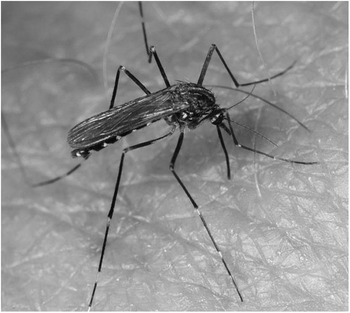
Emerged adult mosquitoes were killed by freezing, pinned and identified to species using Darsie and Ward (Reference Darsie and Ward2005). Identification was corroborated and a voucher specimen was retained by The National Identification Service of Agriculture and Agri-Food Canada (Ottawa, Ontario, Canada). Additional specimens are available in room SN-4113 at Memorial University of Newfoundland. In total, 99 A. j. japonicus adult females emerged from the collected larvae. The eclosion of larvae in the laboratory occurred between 13 August and 29 September 2013. Additionally, a single adult specimen that was naturally seeking a blood meal from a human was photographed in Outer Cove, Newfoundland and Labrador (~10 km north of St. John’s) on 24 September 2013 (Fig. 1). This photograph, submitted by M.E. to the citizen science website NLNature.com (which is administered by Y.F.W.), clearly shows the lyre shaped pattern of gold coloured thoracic scales, and silvery-white scale patches on the lateral thorax and abdomen indicative of this species (Darsie and Ward Reference Darsie and Ward2005). The detection of a new species for the province via NLNature.com is an example of how citizen science may contribute to early detection of range expansions (Catlin-Groves Reference Catlin-Groves2012).
Photograph of Aedes japonicus japonicus from the area of Devereaux Lane, Outer Cove, Newfoundland and Labrador, Canada during the evening of 24 September 2013. Mardon Erbland took the photograph using a Canon EOS-1D Mark IV camera equipped with a Canon MP-E 65 mm f/2.8 1–5× Macro Photo lens and Canon Macro Twin Lite MT-24EX flash. A manual exposure (f/16, 1/160 sec, ISO 250) and manual flash were used. The image shows both the characteristic lyre shaped pattern of gold coloured thoracic scales, and silvery-white scale patches on the lateral thorax and abdomen indicative of this species (Darsie and Ward Reference Darsie and Ward2005).

Our identification of A. j. japonicus in insular Newfoundland marks an ultimate eastern boundary of the species in North America. The introduction and establishment of A. j. japonicus has the potential to alter mosquito community dynamics by outcompeting congeneric and intergeneric mosquito species (Kaufman and Fonseca Reference Kaufman and Fonseca2014). Consequently, this mosquito also holds the potential to indirectly alter the viral risks of a region and, therefore, requires monitoring (Kaufman and Fonseca Reference Kaufman and Fonseca2014). Kaufman and Fonseca (Reference Kaufman and Fonseca2014) projected a continued but slowed expansion of A. j. japonicus into more northern regions of North America. The observations made here support a continued expansion; however, the speed of the expansion requires more substantial evaluation. A study focused on the geographic connectivity of Newfoundland and Labrador populations with populations in neighbouring and distant regions is currently underway.
Acknowledgements
The authors thank the funding bodies that enabled this work: Natural Sciences and Engineering Research Council of Canada; Animal Health Division, Newfoundland and Labrador Department of Natural Resources; Memorial University. They are grateful for the help of H. E. Caravan, P.G. Chaffey, P. J. Coates III, and S.C. Dufour.