Introduction
Mild Cognitive Impairment (MCI) and conversion to dementia due to Alzheimer's disease (AD) is a growing and costly epidemic. Of the 5.3 million Americans currently diagnosed with AD, about a quarter of cases are in the mild or early stage (Alzheimer's Association, 2015). By the year 2050, prevalence is expected to triple and the associated costs are projected to rise to >$1 trillion a year (Alzheimer's Association, 2015). One cost-containment strategy is for afflicted individuals to remain in their family home with formal homecare services (e.g. home health aides, adult day care) retained as needed. Over time, however, up to three quarters of those with dementia will transition into institutional settings (Hermann et al., Reference Herrmann2006). Among community-dwelling cases, annual dementia-related costs generally double as people transition from mild to severe stages of illness: $1,300–$5,300 (mild), $6,000–$7,200 (moderate), and $2,300–$18,100 (severe). In institutionalized patients, total annual care costs show similar variability across stages of dementia severity: $6,600–$15,500 (mild), $14,200–$34,900 (moderate), and $18,300–$56,100 (severe) (Quentin et al., Reference Quentin, Riedel-Heller, Luppa, Randolph and Konig2010).
Identifying patient-level predictors of risk for needing homecare assistance and institutionalization may help defray costs by guiding when to institute treatment strategies that could delay onset to higher levels of care. For example, increasing the dose of cholinesterase inhibitors has been shown to delay starting home health services by an average of two months and reduced overall home health service use by 37 hours per year; this corresponds to an annual cost saving of $2,600 per person (Wattmo et al., Reference Wattmo, Paulsson, Minthon and Londos2013). Additionally, a randomized controlled trial of an intervention to reduce caregiver burden lessened AD patients’ nursing home (NH) admissions by 28% overall and delayed time to NH admission by ~1.5 years (Mittelman et al., Reference Mittelman, Haley, Clay and Roth2006).
Although dementia tends to be the strongest predictor of institutionalization (Luppa et al., Reference Luppa, Luck, Weyerer, König, Brähler and Riedel-Heller2010), MCI determined via consensus diagnosis also predicts institutionalization several years following diagnosis (Gnjidic et al., Reference Gnjidic2012). Other notable predictors include prior use of formal community-based services (Gaugler et al., Reference Gaugler, Kane, Kane and Newcomber2003), female sex (Luppa et al., Reference Luppa, Luck, Wyerer, Konig and Riedel-Heller2009), and males living without a spouse (Luppa et al., Reference Luppa2012).
Strain et al. (Reference Strain, Blandford, Mitchell and Hawranik2003) examined relative risks for institutionalization in community-dwelling cognitively impaired elders, finding that those with the highest risk were of advanced age, had severe cognitive impairment, required assistance with basic and instrumental activities of daily living (ADLs/IADLs), and demonstrated behavioral problems. The medium-risk group was also older, but had moderate cognitive impairment, only needed assistance with IADLs, and exhibited fewer behavioral problems. The low-risk group was younger, with less cognitive impairment, no behavioral problems, and low rates of informant-reported caregiver burden.
Diagnosing MCI and dementia, and collecting information about where people fall on Strain et al.’s risk profiles may require time-consuming and potentially expensive face-to-face screening, as well as collateral input. Many (including those at highest risk of needing more intensive support) may be indirectly precluded from completing such lengthy and detailed assessments for multiple reasons, including poor toleration of procedures, lack of collateral informants, transportation difficulties, financial hardship, disability, and distress. Therefore, telephone-administered cognitive screenings may provide a convenient, efficient, and low-cost means of screening such individuals.
Several screening instruments have been developed and tested for telephone administration with older adults suspected of or diagnosed with dementia (e.g. Smith et al., Reference Smith, Tremont and Ott2009; Martin-Khan et al., Reference Martin-Khan, Wootton and Gray2010). Perhaps the most widely used of these is the Telephone Interview for Cognitive Status (TICS) and its modification (TICSm) (Martin-Khan et al., Reference Martin-Khan, Wootton and Gray2010). Banaszak-Holl and colleagues (Reference Banaszak-Holl2004) used the TICSm as a method for classifying dementia and found that dementia severity predicted NH admission in a longitudinal population-based cohort. Utilizing previously established psychometric cut-offs, hazards for mild-to-moderate dementia were 1.8X–2.6X greater than for non-impaired participants. Risks for severe dementia ranged from 2.3X to 4.2X greater.
Although the aforementioned study provides encouraging evidence that telephone-administered cognitive screening cut-scores offer useful information about eventual NH placement, there is no way of knowing whether screened individuals indeed had dementia nor the underlying etiology. This raises questions about generalizability to specific patient groups (e.g. those with suspected AD). Additionally, other types of costly services besides NH placement were not predicted, including homecare and assisted living facility (ALF) admissions. Furthermore, the study did not assess risk in persons suspected of MCI, the group for whom clinicians may have the best chance at delaying disability and reducing associated costs.
Therefore, more research is needed on the utility of telephone screening to predict time to starting a range of formal services during the early stages of disease. To this end, while the TICSm demonstrated 99% sensitivity and 86% specificity for discriminating AD from non-impaired individuals (Gallo and Breitner, Reference Gallo and Breitner1995), it only classified 42.9% of people with MCI correctly relative to 78.3% of cognitively healthy and 69% of dementia cases (Knopman et al., Reference Knopman2010). Two additional studies found that nearly half of individuals who screened positive for MCI on the TICSm were cognitively intact on further examination (Lines et al., Reference Lines, McCarroll, Lipton and Block2003; Yaari et al., Reference Yaari, Fleisher, Gamst, Bagwell and Thal2006). Thus, it would be useful for investigations predicting a range of service use by those with MCI or mild AD to evaluate the utility of other telephone-based screening measures.
Although the TICSm was found to be grossly equivalent to the telephone version of the Montreal Cognitive Assessment (T-MOCA) in people with Transient Ischemic Attack and Stroke (Pendlebury et al., Reference Pendlebury, Welch, Cuthbertson, Mariz, Mehta and Rothwell2013), no head-to-head comparisons have been made between the TICS/TICSm and other telephone screeners in individuals suspected of or with AD. However, the telephone-administered Minnesota Cognitive Acuity Screen (MCAS) has distinguished people with mild-to-moderate dementia in NHs from non-impaired community-dwelling older adults at a sensitivity of 97.5% and a specificity of 98.5% (Knopman et al., Reference Knopman, Knudson, Yoes and Weiss2000). Subsequent reports found that MCAS adequately separated MCI from healthy controls (HC) (sensitivity = 86%, specificity = 78%) and MCI from AD (sensitivity = 86%, specificity = 77%) (Tremont et al., Reference Tremont2011). Baseline MCAS scores were also associated with functional status cross-sectionally (Springate et al., Reference Springate, Tremont and Ott2012), and predictive of cognitive and functional declines, as well as conversion from MCI to dementia (Tremont et al., Reference Tremont, Papandonatos and Kelley2016).
Given MCAS's strong psychometric properties and extant clinical validation, we hypothesized that the MCAS would significantly predict increasing risk of service utilization over time across levels of cognitive impairment even in the absence of other predictive factors (e.g. presence of neuropsychiatric symptoms and caregiver burden). Using a competing risks framework that accounted for death, the present study aimed to predict time to (1) institutionalization (i.e. ALF/NH placement) and (2) the provision of any formal services (i.e. homecare/institutionalization) on the basis of baseline MCAS scores in HCs, MCI, and AD cases over eight years.
Methods
Participants
Participants were drawn from a group of 200 older adults who have been previously described (Tremont et al., Reference Tremont2011). The present sample comprised 146 individuals, aged 56–86 years, for whom we had long-term follow-up data. Participants needed to be English-speaking with access to a telephone. Individuals were precluded from having severe hearing loss, histories of psychiatric disturbance, alcohol or substance abuse/dependence within the preceding two years, other neurologic or developmental disorders affecting cognition, or current depression. MCI and AD cases were recruited from a memory disorders center. HCs were recruited via advertising and among patients’ families.
HCs were required to have scores on the Mini-Mental Status Examination (MMSE) within the normal range for age/education; they could not have cognitive complaints. MCI and AD diagnoses were established at baseline via multidisciplinary conference among neurologists, neuropsychologists, and neuropathologists, without knowledge of MCAS scores. Disagreements were resolved by majority vote. Participants with MCI met Petersen and colleagues’ (Reference Petersen, Smith, Waring, Ivnik, Tangalos and Kokmen1999) criteria; they were required to have a memory complaint, cognitive impairment in objective memory test scores ≥1.5 standard deviations below age-adjusted means on any aspect of memory testing (learning, delayed recall, recognition/discriminability), as well as a Clinical Dementia Rating (CDR) score of 0.5, and largely preserved ADLs. Participants with AD were required to have a CDR score of 1.0 or 0.5 (so long as ADL impairment was present) and to meet the diagnostic criteria for probable or possible AD based on the recommendations of the National Institute on Aging and the Alzheimer's Association (NIA–AA) (McKhann et al., Reference McKhann2011).
Measures
The MCAS (Knopman et al., Reference Knopman, Knudson, Yoes and Weiss2000; Springate et al., Reference Springate, Tremont and Ott2012; Tremont et al., Reference Tremont2011; Tremont et al., Reference Tremont, Papandonatos and Kelley2016) is a multi-item telephone-administered cognitive screen, which takes approximately 15 minutes to complete. It results in a total score, reflecting the sum of nine domains: (1) orientation (person, place, time – eight points); (2) digit span (repetition of digit sequences – six points); (3) comprehension (follow two- and three-step commands – three points); (4) repetition (sentences – four points); (5) naming (based on verbal descriptions – four points); (6) computation (basic mental calculations – eight points); (7) judgment (reason through problematic scenarios – eight points); (8) verbal fluency (naming fruits and vegetables in 30 seconds – one point per word (no maximum)); and (9) delayed word recall (recall 10 words presented two times previously – ten points). Higher scores reflect better cognition (score range = 0 to no upper limit). MCAS has excellent split-half reliability (0.91) and internal consistency (0.93) (Knopman et al., Reference Knopman, Knudson, Yoes and Weiss2000).
A Living Situation Questionnaire was developed for this study. Participants, a designated informant or medical records (when information was judged to be reliable/complete) were consulted for information regarding (a) whether participants were alive and the date of death if deceased; (b) current living situation was updated with information on whether participants: lived independently at home without professional services; lived at home with formal professional services due to decline in memory/thinking (i.e. home health aide or adult daycare); or resided in an ALF or NH. We obtained dates when participants started using professional services at home and/or ALF/NH admission dates. When exact start/admission dates were unknown, we documented the interval between the last date the participant lived independently and the earliest date of known service use or a facility admission. Institutional placement in an ALF/NH was the primary outcome. Receipt of homecare and institutionalization were combined into a secondary outcome to reflect retention of any formal service to offset functional decline.
Procedure
The institutional review board at Rhode Island Hospital approved this study.
Participants were recruited between 2007 and 2010. Everyone was capable of giving and provided informed consent, completed an office visit with a neurologist who conducted a neurological exam and CDR testing, and a neuropsychologist or trained research assistant who administered a standardized neuropsychological test battery. MCAS was administered within a month of the initial visit.
Participants returned for annual visits up to three times after the baseline assessment. Thereafter, participants were re-contacted via telephone for updates on their living situations every six months for an additional three years. To identify outcomes, we used data collected from these follow-up periods and medical record review. Medical records were reviewed through August 2016. Once individuals were known to have been admitted into an ALF/NH, they were no longer followed.
Data analysis
All analyses were conducted in R. Descriptive statistics and frequencies were computed to characterize the sample. Independent sample t-tests and χ 2 analyses compared individuals with baseline data alone to individuals with follow-up data across demographics and MCAS performances. We further compared those who died within the observation period to those who did not.
Using a competing risks framework, which accounted for informative censoring due to death by modeling death as a separate outcome (Scrucca et al., Reference Scrucca, Santucci and Aversa2010), associations between baseline MCAS total scores and time from MCAS administration to institutionalization or homecare/institutionalization were examined via semi-parametric Cox regression models. Unadjusted models were examined initially, followed by models controlling for baseline age, years of education, and sex. Cumulative hazards were estimated non-parametrically via a Breslow-type estimator (Scrucca et al., Reference Scrucca, Santucci and Aversa2010). The proportional hazards (PH) assumption (i.e. presuming hazard rates will remain proportional overtime) was tested by adding covariate by time interaction terms to the model, as well as by graphical means (i.e. inspecting Schoenfeld residual plots and stratified cumulative incidence curves).
Previous analyses (Tremont et al., Reference Tremont2011) established three MCAS total score cut-points: the AD/MCI boundary (42.5), the mid-point of the MCI range (47.5), and the MCI/HC boundary (52.5). MCAS scores were, therefore, standardized as (MCAS – 47.5)/10, so that exponentiation of the log-hazard rate (β) captured the effect of a ten-point difference in MCAS test scores between the MCI/HC (52.5) and AD/MCI boundaries (42.5). This reflects increasing cognitive impairment as scores move from the cognitively healthy range into a dementia range.
Statistical significance levels were set to two-sided α = 0.05 for all analyses.
Results
Sample characteristics
Of 200 initial participants, 146 had follow-up data (73% retention rate), of whom 14 (9.6%) died within the follow-up period. Those with long-term follow-up data were 58.2% female, aged 56–86 years at baseline (72.75 ± 6.88) and with 5–20 years of education (13.97 ± 3.05). The vast majority were Caucasian (97.3%), with three African–Americans (2.0%) comprising the remainder of the sample. Per consensus diagnosis, 37 were initially classified as HCs, 70 were diagnosed with MCI, and 39 with AD. The mean MCAS total score was 47.03 ± 9.28 and the median was 47.5.
Among those lost to attrition, 13 were initially classified as HCs, 30 were diagnosed with MCI, and 11 with AD. Individuals lost to attrition had fewer years of education (12.56 ± 2.74 vs. 13.97 ± 3.05, p = 0.003). There were no between-group differences in baseline age, sex, or MCAS total scores. The 14 deceased participants were significantly older at baseline (77.79 ± 5.37 vs. 72.22 ± 6.80, p = 0.004) than the remaining 132 participants, without significant differences in years of education. Deceased participants also had lower baseline MCAS total scores (42.29 ± 8.50 vs. 47.53 ± 9.24, p = 0.044). More men died than women (14.8% vs. 5.9%, p = 0.074).
Death, placement, and homecare rates
Over the eight-year observation period, males died at a rate 3.5X higher than females (23.1% vs. 6.7%), with median time to death being slightly faster among males (3.9 years vs. 4.2 years). Although males were less than half as likely to be institutionalized as females (23.3% vs. 50.0%), their median time to institutionalization was 2.7 years shorter (4.1 years vs. 6.8 years). Homecare service rates without subsequent institutionalization were almost identical across sexes (Males = 16.6% vs. Females = 17.8%), with median times to service provision among those receiving homecare 0.7 years shorter for males (5.3 years vs. 6.0 years).
Analysis of event time data: overall sample
All event times were administratively censored at 3,000 days (~8.2 years), as inspection of cumulative incidence rates by study group (HC, MCI, AD) showed that extending the observation period beyond this point would have violated the PH assumption. In particular, MCI institutionalization rates overtook those of AD cases after 3,000 days (data not shown). We inferred a healthy survivor bias, such that AD cases may have died at a faster rate, leaving only healthier MCI cases in the risk set to continue being institutionalized or securing homecare.
Unadjusted regression models revealed significant linear effects of MCAS scores on the hazards of institutionalization (p < 0.001) and homecare/institutionalization (p < 0.001), that did not violate the PH assumption. At the MCI midpoint, absolute cumulative risks for institutionalization and homecare/institutionalization reached highs of 40% and 60%, respectively. Scores at the AD/MCI boundary, rather than the MCI midpoint, were associated with a one-third increase in the hazards of institutionalization (HR = 1.34, 95% CI = 1.15, 1.57) and homecare/institutionalization (HR = 1.37, 95% CI = 1.20, 1.56). Scores at the MCI/HC boundary, rather than the MCI mid-point, were associated with a one-quarter decrease in the hazards of institutionalization (HR = 0.75, 95% CI = 0.63, 0.87) and homecare/institutionalization (HR = 0.73, 95% CI = 0.64, 0.83). Therefore, the combined ten-point difference between the MCI/HC and the AD/MCI boundary conferred a nearly two-fold increase in the hazards of institutionalization (HR = 1.81, 95% CI = 1.32, 2.48) and homecare/institutionalization (HR = 1.87, 95% CI = 1.44, 2.42).
Whereas adjustment for sociodemographic characteristics showed no main effects for age at baseline or for years of education, there was a significant main effect for sex across both institutionalization (p = 0.004) and homecare/institutionalization (p = 0.002). However, visual inspection of residual plots and sex-stratified cumulative incidence curves revealed that adding sex as a covariate violated the PH assumption for both outcomes. Therefore, we fit separate regression models for females and males.
Female-specific analyses
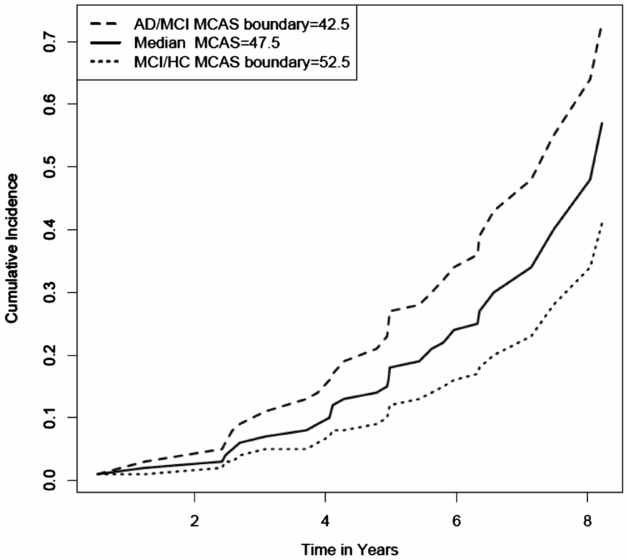
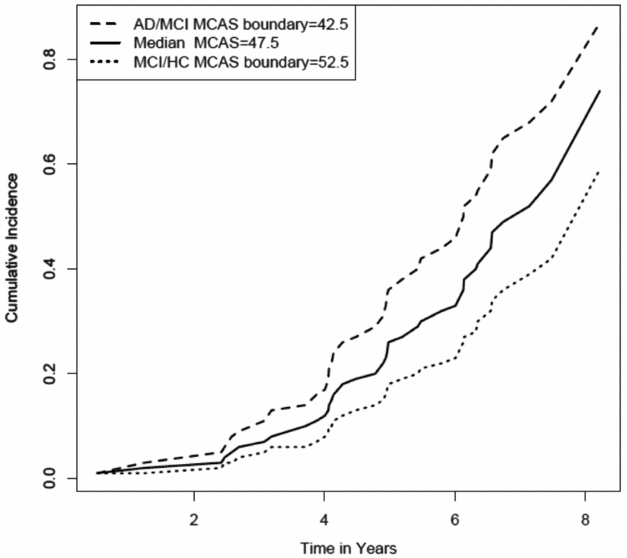
As depicted in Figures 1 and 2, among females at the MCI mid-point, absolute cumulative risks for institutionalization and homecare/institutionalization reached highs of 57% and 74%, respectively. Females with scores at the AD/MCI boundary, rather than the MCI mid-point, had a 1.5X increase in the hazards of institutionalization (HR = 1.55, 95% CI = 1.24, 1.93) and homecare/institutionalization (HR = 1.52, 95% CI = 1.29, 1.79). Scores at the MCI/HC boundary, rather than the MCI mid-point, were associated with a one-third reduction in the hazards of institutionalization (HR = 0.65, 95% CI = 0.51, 0.81) and homecare/institutionalization (HR = 0.66, 95% CI = 0.56, 0.78). Therefore, greater baseline cognitive impairment – as measured by a ten-point difference between the MCI/HC and the AD/MCI boundary – conferred a greater than two-fold, statistically significant, increase in females’ hazards of institutionalization (HR = 2.39, 95% CI = 1.53–3.74) and homecare/institutionalization (HR = 2.31, 95% CI = 1.66, 3.21).
Parametric cumulative incidence curve of time to institutionalization in the presence of death (N = 146), depicted for females at three MCAS total score cut-offs (median = 47.5, MCI/HC boundary = 52.5, AD/MCI boundary = 42.5).

Parametric cumulative incidence curve of time to any formal service (i.e. homecare and institutionalization) in the presence of death (N = 146), depicted for females at three MCAS total score cut-offs (median = 47.5, MCI/HC boundary = 52.5, AD/MCI boundary = 42.5).

Male-specific analyses
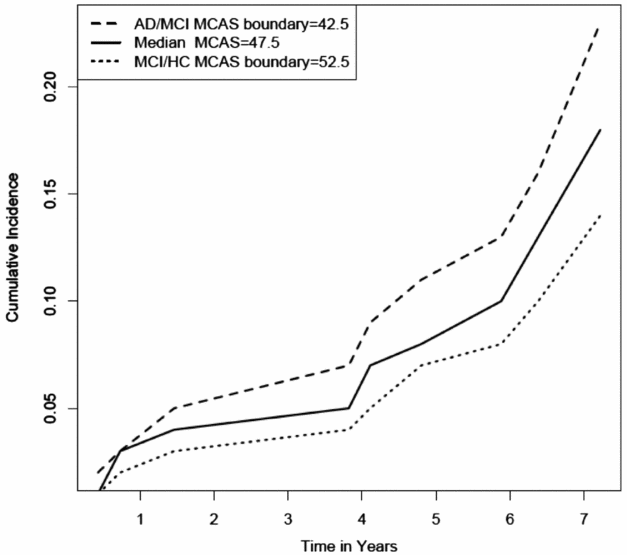
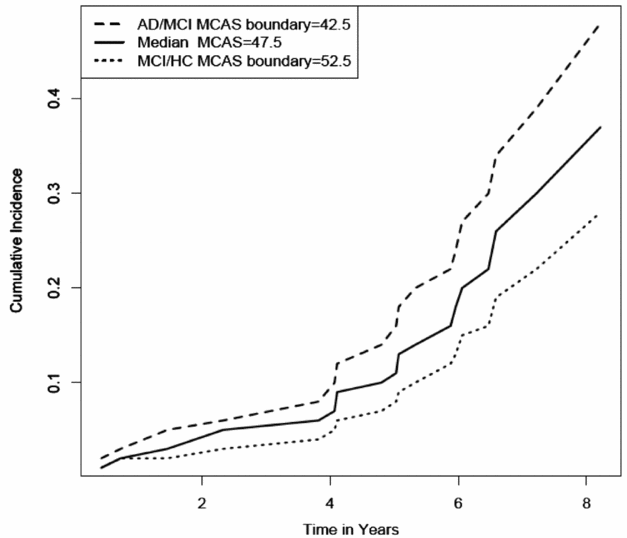
As depicted in Figures 3 and 4, among males at the MCI mid-point, absolute cumulative risks for institutionalization and homecare/institutionalization reached highs of 18% and 37%, respectively. Males with scores at the AD/MCI boundary, rather than the MCI mid-point, had a 1.29X increase in the hazard of institutionalization (HR = 1.29, 95% CI = 1.01, 1.66) and 1.41X for homecare/institutionalization (HR = 1.41, 95% CI = 1.15, 1.72). Those with scores at the MCI/HC boundary, rather than the MCI mid-point, were associated with hazard decreases of 23% for institutionalization (HR = 0.77, 95% CI = 0.60, 0.99) and 29% for homecare/institutionalization (HR = 0.71, 95% CI = 0.58, 0.87). Therefore, greater baseline cognitive impairment – as measured by a ten-point difference between the MCI/HC and the AD/MCI boundary – conferred a statistically significant increase in males’ hazards for institutionalization (HR = 1.68, 95% CI = 1.02–2.76) and homecare/institutionalization (HR = 1.98, 95% CI = 1.32, 2.96), albeit to a lesser extent than females.
Parametric cumulative incidence curve of time to institutionalization in the presence of death (N = 146), depicted for males at three MCAS total score cut-offs (median = 47.5, MCI/HC boundary = 52.5, AD/MCI boundary = 42.5).

Parametric cumulative incidence curve of time to any formal service (i.e. homecare and institutionalization) in the presence of death (N = 146), depicted for males at three MCAS total score cut-offs (median = 47.5, MCI/HC boundary = 52.5, AD/MCI boundary = 42.5).

Discussion
This study demonstrates that the MCAS, a telephone-administered cognitive screen, provides useful information about future/costly functional outcomes in a well-characterized sample of older adults who were either cognitively healthy at baseline or had diagnosed amnestic MCI or mild AD. To our knowledge, this is the first study showing that a telephone-based measure can predict ALF/NH placement in such a sample. These results extend Banaszak-Holl et al.’s (Reference Banaszak-Holl2004) findings, which reported that members of a population-based cohort with scores below the TICSm dementia cut-off had increased risk of NH admissions over seven years. To our knowledge, ours is also the first study to use a telephone cognitive screen to predict the start of services addressing functional dependencies in general (i.e. homecare plus institutionalization). This is a particularly important contribution, as each service adds to rising societal costs (Quentin et al., Reference Quentin, Riedel-Heller, Luppa, Randolph and Konig2010).
Another strength of this study is that we treated MCAS scores as a continuous variable, but summarized the findings at three previously established cut-points (Tremont et al., Reference Tremont2011) for ease of interpretation: the AD/MCI boundary, the mid-point of the MCI range, and the MCI/HC boundary. MCAS had significant effects on the hazards of institutionalization and homecare/institutionalization. A standardized ten-point difference between MCAS total scores (equivalent to moving from the cognitively healthy range into a dementia range) was associated with 1.7X–2.0X higher rates for males and 2.3X–2.4X higher rates for females, depending on the outcome.
We also observed that the eight-year cumulative incidence of institutionalization for females was more than twice as high as males, despite median time to institutionalization being 2.7 years longer for females. Per Luppa et al. (Reference Luppa, Luck, Wyerer, Konig and Riedel-Heller2009), gender discrepancies in institutionalization rates are well described in the literature and may be accounted for by females’ higher life expectancy and tendency to marry older partners; widowed men's tendency to remarry younger female counterparts; and widowed females’ tendency to live alone. Furthermore, Gonyea (Reference Gonyea and Hudson1997) indicates that more than a third of community-dwelling males with functional dependencies are primarily cared for by spouses relative to 4% of similarly disabled married females.
Although cumulative incidence rates for homecare did not differ between our male and female participants, this does not necessarily imply that males received similar amounts of homecare as females. According to Katz and colleagues (Reference Katz, Kabeto and Langa2000), when married women with disabilities receive homecare, they tend to receive fewer hours compared to married disabled men. As such, clinicians may wish to monitor female elders more closely to help ensure that cognitive/functional deficits are not overlooked.
Our results also suggest that the telephone-administered MCAS may offer a means of monitoring individuals at the precipice of needing greater functional assistance. This has important clinical/research implications, as Huss et al.’s (Reference Huss, Stuck, Rubenstein, Egger and Clough-Gorr2008) systematic review and meta-analysis of randomized controlled trials of home visitation programs for community-dwelling elders did not find that pooled effects significantly reduced NH admissions or functional status decline. Although future research will assess the cost-effectiveness of the MCAS in particular, Crooks et al. (Reference Crooks, Clark, Petitti, Chui and Chiu2005) estimated that telephone-administered cognitive screening was 5% of the cost of in-person assessments. Therefore, it may be more effective and less costly for researchers to examine whether a telephone-administered means of monitoring risk can guide implementation of care strategies aimed at delaying home health services and institutionalization.
The present study must be viewed in light of its limitations. MCI and AD cases were recruited from a memory disorders center and the vast majority of our sample was Caucasian. Additionally, there are no data on the feasibility and acceptability of using the MCAS in general clinical practice. Therefore, replication in a more diverse, real-world community-based, sample would strengthen the generalizability of these findings. Nevertheless, our results add to the MCAS's construct validity.
Prior reports have found that the telephone-administered MCAS provides diagnostic information for cognitive screening purposes (Knopman et al., Reference Knopman, Knudson, Yoes and Weiss2000; Tremont et al., Reference Tremont2011), relationships with patients’ functional status (Springate et al., Reference Springate, Tremont and Ott2012), and prognostic insight into time to dementia conversion (Tremont et al., Reference Tremont, Papandonatos and Kelley2016). The present study showed that the MCAS also provides useful information on older adults’ relative risk of needing to retain formal services to offset functional disability. Such risk estimates should take patients’ sex into account, as the hazards of institutionalization were generally higher for females than males despite males being institutionalized sooner. Although telephone screening is no substitute for comprehensive clinical work-ups including neuropsychological assessment, the telephone-based MCAS offers a brief and convenient means of assessing cognition and estimating when additional support services may be indicated when a more comprehensive in-person assessment is not feasible.
Conflict of interest
Grant support for research assistant time was provided to Dr Brian Ott and his institution (Rhode Island Hospital) by LTCG, a third-party long-term care administrator. Although LTCG uses the MCAS as a screening test for life and long-term care insurance in the USA and provided funds for this research, LTCG had no role in the design, conduct, or analysis of the study, or production of the paper.
Description of authors’ roles
Dr Margolis – study concept and design; analysis and interpretation; paper preparation. Dr Papandonatos – study concept and design; analysis and interpretation; paper preparation. Dr Tremont – study concept and design; analysis and interpretation; critical revision of the paper for important intellectual content. Dr Ott – study concept and design; study supervision; acquisition of data; analysis and interpretation; critical revision of the paper for important intellectual content.
Acknowledgments
The MCAS was developed by Drs David Knopman and Dean Knudson and Assessment Services, Inc., based out of the University of Minnesota for LTCG. Copyright for the MCAS is held by LTCG. Researchers or clinicians who would like to use the instrument can obtain permission by contacting Dr Stephen Holland at stephen.holland@ltcg.com.