Italy is one of the European countries with the highest population density of goats and produces of more than 110,000 tonnes of goat milk per year (ISTAT 2006) almost exclusively used for cheese production though recently there is increasing consumption of fluid milk on a commercial basis.
For promoting the Italian goat dairy breed and products there is a clear need to know the quality and technological aspects milk produced. Among the native breeds, the Jonica is considered as a good milk producer and has presented significant increase in productivity when bred in adequate feeding conditions (Laudadio & Tufarelli, Reference Laudadio and Tufarelli2010).
Furthermore, in the last years an increasingly significant role in the human diet has been attached to goat milk, since it possesses unique properties which distinguish it from cow milk and make it a valuable alternative for infants given that goat milk supplies a higher fat percentage (Kondyli et al. Reference Kondyli, Katsiari and Voutsinas2007). There are also qualitative differences in milk proteins between cow and goat milk, especially the casein in goat milk contributes to a softer curd than does that in cow milk. This is probably another reason for the better digestion of goat milk compared with cow milk (Barrionuevo et al. Reference Barrionuevo, Alferez, Lopez, Sanz Sampelayo and Campos2002).
Studies on the effects of Se and VitE supplementation on production and quality of caprine milk are limited if compared with the considerable works conducted on bovine and ovine milk (Guyot et al. Reference Guyot, Spring, Andrieu and Rollin2007; Pechova et al. Reference Pechova, Janstova, Misurova, Drackova, Vorlova and Pavlata2008). In fact, Zhao et al. (2008) showed that supplementing Se and VitE to the diet improved milk fat yield and percentage in dairy cow, whereas Lacetera et al. (Reference Lacetera, Bernabucci, Ronchi and Nardone1999) reported that milk production in Sardinian sheep was enhanced when receiving dietary Se and VitE. Conversely, Juniper et al. (Reference Juniper, Phipps, Jones and Bertin2006) observed that dietary Se and VitE concentration had no effect on milk yields and milk components. However, little is known about the effects of Se and VitE supplementation on specific milk performance and quality in goat. Since the feeding is the fastest way to modify the milk production and quality, even if the relations between the diet and the milk composition are quite complex, in this study we hypothesized that increasing dietary Se and VitE supplementation should increase the quality of milk in terms of fat and rheological properties also in dairy goat. Consequently, the aim of this work was to evaluate the effects of Se and VitE supplementation on lactation performance and milk quality in Jonica dairy goats.
Material and Methods
Animal, diet and milk trial
The experiment was carried out (from September to December) in Taranto province of the Apulia region in Southern Italy (latitude: 41° 7′ and longitude: 16° 52′) for 135 d and involved 40 multiparous lactating Jonica goats (40 d after kidding). The trial included 15 d of adaptation to the diet followed by 120 d of feeding the two experimental diets. At kid weaning, goat were divided into two groups of 20 each, balanced for age, parity, time of kidding, number of kids suckled, body weight (48·7±4·22 kg) and milk yield and composition. The animals were dewormed before start of the experiment and maintained under strict hygiene and uniform management. Goat health was checked throughout the study period and no cases of clinical mastitis were recorded. Goats were housed in two 100 m2 pens inside a building, with a 300 m2 outdoor paddock before the start of trial. The experimental design was completely randomized, with 20 replicates per treatment. Goats were kept in individual pens and fed once daily, after morning milking. Fresh water was provided to all the animals ad libitum.
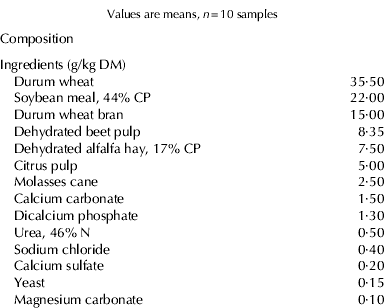
During the whole trial, the animals were fed individually the same basal diet composed of ad libitum mixed vetch-oat hay and a definite amount of a pelleted concentrate (Table 1). The first group (control) was fed the pelleted concentrate containing background Se only (dietary concentration of 0·11 mg Se/kg as fed) that supplied 1·0 times goats’ daily requirements, whereas the second group (Se-VitE) were fed the same pelleted concentrate, but containing a vitamin-mineral premix that provided 0·25 mg Se/day per head (Na-selenite) and 20 mg/day per head of vitamin E (91% of α-tocopherol), that supplied 1·2 times goats’ daily requirements.
Ingredient composition of experimental concentrate fed to lactating Jonica goats

The diets were balanced according to goats’ requirements of energy, protein and minerals in accordance with INRA (1989), taking into consideration a goat body weight of 50 kg and 2·0 kg of daily milk production.
Each goat was offered 0·5 kg/day (as-fed basis) of concentrate (pellets, diameter, 8 mm) split in two equal meals during the morning and afternoon milking. The refusals were weighed daily and the quantity of hay adjusted to the mean intake. Body weight of goats was recorded at the beginning and at the end of the experimental period. Goats were milked twice daily (7:00 and 19:00 h) using pipeline milking machines.
Feeds analysis
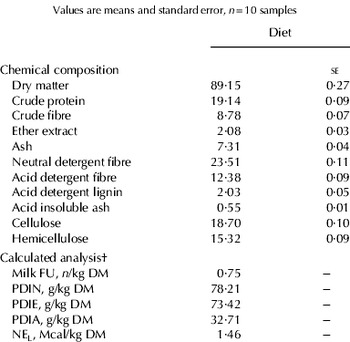
Diet samples were ground in a hammer mill provided with a 1 mm size screen and analyzed in duplicate for its content in dry matter (DM), ash, crude protein (CP, N×6·25), crude fibre (CF) and ether extract (EE, with previous hydrolysis in compound feeds samples) according to the procedures outlined by the AOAC (2000). Neutral detergent fibre (NDF), acid detergent fibre (ADF) and acid detergent lignin (ADL) were also determined according to Van Soest et al. (Reference Van Soest, Robertson and Lewis1991), and were corrected for residual acid insoluble ash. Hemicellulose and cellulose were also estimated as NDF (ash free) – ADF (ash free) and ADF (ash free)−ADL (ash free), respectively (Table 2).
Chemical composition (% of dry matter) and analysis of basal diet fed to lactating Jonica goats

† Calculated according to INRA (1989)
Selenium content of the specific premixes and feedstuffs was determined using inductively coupled plasma mass spectrometry (ICP–MS Elan 6100, PerkinElmer, Norwood, MA).
Energy value of diets (NEL) were calculated according to INRA (1989). The protein (PDIA, PDIN, and PDIE=digestible crude protein in the intestine from dietary origin, from microbial protein synthesis when availability of fermentable N in the rumen is limiting, and from microbial protein synthesis when availability of energy in the rumen is limiting, respectively) and energy values (Milk FU) were estimated (INRA 1989).
Milk analysis
Daily milk production of each goat was recorded by means of graduated measuring cylinders attached to individual milking units. Individual milk samples, consisting of proportional volumes of morning and evening milk, were taken after cleaning and disinfection of teats and discharging the first streams of foremilk. Milk samples were collected in 100 ml sterile plastic containers at fortnightly intervals through the lactation period and taken to our laboratory under refrigeration.
The following measurements were made: total protein (N×6·38), fat and lactose content, using an infrared spectrophotometer (Milko Scan 133B; Foss Electric, DK-3400, Denmark); casein content (AOAC, 2000); somatic cell count (SCC) was expressed in Linear Score (LS=log2 SCC/100 000+3) using a Foss Electric Fossomatic 90 cell counter according to Ali & Shook (Reference Ali and Shook1980), and urea by the urease method-kits (Boheringer). Milk yield was furthermore corrected to 4% fat corrected milk, as FCM=(0·4 kg milk yield) + (15 kg fat yield).
The three renneting properties were determined for milk samples according to Zannoni & Annibaldi (Reference Zannoni and Annibaldi1981) by Formagraph apparatus (Foss Italia, Padova): rennet clotting time (r), as the time from rennet addition to the beginning of coagulation; curd firming time (k20), as the time from coagulation until reaching the curd firmness corresponding to an amplitude of 20 mm on the Formagraph trace; and curd firmness (a30), as the amplitude of the trace 30 min after the rennet addition.
Statistical analysis
Milk production and quality parameters of goats were analyzed as repeated measures using univariate analysis of variance with the General Linear Model of SAS procedure (SAS 2001). Sources of variation included dietary treatment and goats. Goats within treatment were fitted as term of error. Test of equality between variances and covariances (sphericity test) was examined. In all cases, no adjustment in F probabilities needed. Pearson's correlation coefficients were calculated for all parameters measured. Data of each parameter were presented as means of each treatment and standard errors. When significant effect was found, means were compared using Student's t-test.
Results and Discussion
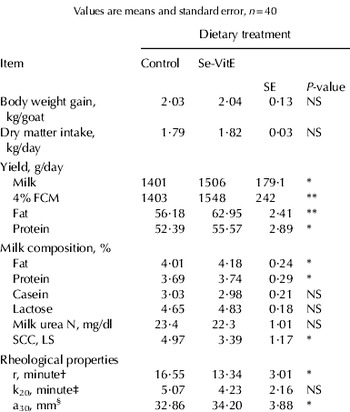
During the whole experimental period, no specific symptoms were observed for goats in different dietary groups. In Table 3 are reported the main productive results of the lactating Jonica goats in the experiment, in terms of BW gain, DM intake and milk yield and composition.
Effect of experimental diets on body weight gain, dry matter intake, milk yield and composition, and renneting properties of lactating Jonica goats

NS, not significant
Significance level:
* P<0·05; **P<0·01
† r, rennet clotting time
‡ k20, curd firming time
§ a30, curd firmness
The BW gain and total DM intake did not differ significantly among the different dietary groups. These results confirm those of Goetsch et al. (Reference Goetsch, Detweiler, Sahlu, Hayes and Puchala2003) and Tufarelli et al. (Reference Tufarelli, Dario and Laudadio2009) who reported that a feeding composed by ad libitum good quality hay and a defined amount of concentrate did not influence DM intake for different physiological functions in dairy ruminants, specially in lactating goat. The total DM intake in our study was similar and ranged from 1·79 to 1·82 kg/day per head. This finding is justified because, after kidding, DM intake of goats gradually increased and reached the maximum between the 8th and 14th weeks of lactation, which corresponds to the period of high weight gain and increased milk production.
Furthermore, during this period, the goats were in positive energy balance, as the DM intake was increasing. These values were slightly lower than those reported by Landau et al. (Reference Landau, Kababya, Silanikove, Nitsan, Lifshitz, Baram, Bruckental and Mabjeesh2005) in crossbred goats, however the lower DM intake reported in this study in lactating Jonica goats as compared with Landau et al. (Reference Landau, Kababya, Silanikove, Nitsan, Lifshitz, Baram, Bruckental and Mabjeesh2005) might be due to fact that they were fed concentrate and wheat straw as roughages in 50:50 ratio, whereas in the present study goats were fed ad libitum hay. Moreover, the variation in DM intake might be due to type and quality of roughage, time and frequency of feeding and watering and also climatic conditions as reported by Ravi Kumar et al. (Reference Ravi, Tiwari and Anil2005).
The effects of experimental diets on milk yield, composition and renneting properties of Jonica goats in lactation are summarized in Table 3. Raw milk yield was rather high during the period and differed significantly (P<0·05) among dietary treatments. In particular, milk yield ranged between 1·4 to 1·5 kg/day per goat, in control and Se-VitE treatments respectively. This result is consistent with the findings obtained by Liu et al. (Reference Liu, Yang, Chen, Dong and Wang2008) in subjects fed diets supplemented with Se and VitE. Conversely, Petrera et al. (Reference Petrera, Calamari and Bertin2009) reported in Saanen dairy goats similar milk production when goats were fed diets containing either selenium derived from Na-selenite or Se–yeast. However, these differences can be ascribed to goat breed.
Milk fat and protein yield and content was statistically different between the two dietary treatments. Both percentage and yield of milk fat and protein were significantly (P<0·05) increased when diets where supplemented with Se-VitE. Our result confirms the findings of previous works where diets supplemented with Se and VitE for dairy cows (Calamari et al. Reference Calamari, Petrera and Bertin2010), goats (Pechova et al. 2008a) and ewes (Lacetera et al. Reference Lacetera, Bernabucci, Ronchi and Nardone1999) improved milk fat and protein. In fact, according to these previous studies, our data showed that Se and VitE were capable of reducing the extent of diet-induced milk fat depression.
In the present study the positive effects in milk yield, fat yield due to Se-VitE supplementation level in the diet might be due to better utilization of nutrients. The change in milk composition is a parameter used to characterize its aptitude for producing cheese. So, the more concentrated milk produced by Jonica goats of Se-VitE group, possibly, has an advantage for the cheese production.
The milk casein, lactose and urea N content was similar (P>0·05) among dietary treatments, whereas there was a significant decrease (P<0·05) in milk SCC in goats fed Se-VitE diet. Milk urea concentration is the major index for monitoring protein and energy utilization in ruminants. Feeding supplemented diets led to reduction of the milk urea N concentration compared with control diet, which reflects better efficacy of nutrient utilization. Lee et al. (Reference Lee, Hwang and Chion2001) reported increase in blood urea N in goats fed low CP in diets (32% of dietary protein) which resulted in a high aspartate amino transferase level causing increase in liver load and also increase in milk urea N, whereas lowered blood and milk urea N were recorded with medium and high CP in ration (35 and 38% of dietary protein, respectively).
Considering the milk rheological properties, in the present study the dietary treatment significantly affected milk coagulation attitude (P<0·05). We could not locate any literature concerning the effects of dietary supplementation with Se-VitE on goat milk renneting properties, therefore, this subject should be considered in new investigations. From these findings it can be deduced that milk produced by the goats fed with supplemented diet was not only of better quality, but also had a better aptitude for coagulation as determined by a low value of r, k20 and by a high value of a30. Then, our data show that the milk produced during lactation by goats fed diet containing more Se and VitE led to a better and significant suitability of milk for cheese making. In particular, experimental treatment did not decrease the milk clotting aptitude. These results are important since most goat milk is destined for cheese production for human consumption (Tufarelli et al. Reference Tufarelli, Dario and Laudadio2009; Laudadio & Tufarelli, Reference Laudadio and Tufarelli2010).
In conclusion, the results of this study confirm that Se and VitE can be successfully supplemented into dairy Jonica goat diets, significantly increasing yield, fat, protein and rheological parameters of milk.