Introduction
The International Union for Conservation of Nature (IUCN) sets out various criteria to identify a species as critically endangered, endangered or vulnerable (IUCN 2001); however, nearly all these criteria require information on trends in population. Information on trends in populations is also required to enable European member states to meet their reporting obligations under the Habitats Directive, Article 17, and to assess if they are meeting international commitments with respect to the conservation of biodiversity (European Council 2001; United Nations Environment Programme 2002). Measurement of progress against these criteria requires sufficient data on species' distributions and populations to determine 1), ‘baseline’ conditions of population size and geographical distribution and 2), trends in these parameters in order to assess rates of decline or expansion in range or population size, along with the main pressures or threats.
Recent reviews of existing biodiversity monitoring programmes, across Europe and more widely, are very critical of the ability of most current conservation monitoring programmes to provide the necessary data with which to assess progress in halting the decline of biodiversity (Balmford et al. Reference Balmford, Crane, Dobson, Green and Mace2005; Legg & Nagy Reference Legg and Nagy2006; Kull et al. Reference Kull, Sammul, Kull, Lanno, Tali, Gruber, Schmeller and Henle2008; Lengyel et al. Reference Lengyel, Déri, Varga, Horváth, Tóthmérész, Henry, Kobler, Kutnar, Babij and Seliškar2008). A particularly common problem is the failure to collect sufficient information to enable statistically valid conclusions to be drawn about species' trends over the timescales required (Kull et al. Reference Kull, Sammul, Kull, Lanno, Tali, Gruber, Schmeller and Henle2008; Hovestadt & Nowicki Reference Hovestadt and Nowicki2008). Critical for detection of trends in population size is the accuracy with which we can measure the parameter of interest (observational error) and also its natural year-to-year variability (process error). Many schemes fail to take this into account, with the result that the data collected is inadequate to detect even very large trends over the required timescale. On the other hand, expectation of the trends which may be detected should be realistic, given the resources available. For example, European Article 17 reporting normally considers species that have more than a 1% annual decline in population within a 6-year reporting period to have an unfavourable conservation status. Hovestad & Nowicki (Reference Hovestadt and Nowicki2008) showed that detection of such a trend over such a short time period is almost impossible unless populations could be measured with 100% accuracy; to detect a 1% trend at all would require a very high precision population estimate and a time series of at least 15 years (with annual data).
Collecting data on lichens to assess both the IUCN criteria and to meet national reporting requirements is problematic, as no statistically rigorous scientific monitoring scheme exists. In Scotland, national reporting is required for species on the Scottish Biodiversity List (SBL) (Scottish Executive 2004). The SBL lists species of principal importance for biodiversity conservation action in Scotland and includes 89 lichen species that were originally identified in the UK Biodiversity Action Plan (BAP). Information on trends in the population of these species is required but currently no method exists to gather this data. Therefore a major conservation need is the development and implementation of surveillance and monitoring for lichens that will enable trends in populations and threats to be identified at the earliest opportunity. An ideal monitoring scheme would provide data on:
-
1. The number of ‘individuals’ within each local population
-
2. The area of habitat which the species occupies (Area Of Occupancy—AOO)
-
3. The spatial distribution of the areas occupied (Range).
For species such as lichens, an ‘individual’ may not be well defined or easy to recognize in the field. It must also be considered what unit comprises a functional individual for the purposes of population dynamics. For long-lived, late successional, corticolous species, Scheidegger & Werth (Reference Scheidegger and Werth2009) suggested that all conspecific thalli occupying a single tree could be considered as a single functional individual, because their fate is intimately linked to that of the host tree. When considering very rare species however, such as those known only from a single tree or fence post, pragmatism may require that some assessment of the species abundance is made at a scale below the usual minimum functional unit.
The diversity of SBL lichen species, in terms of the habitats they occupy and their distributions, is such that any general monitoring scheme would require adaptation on a case by case basis to suit the needs of the species being considered. To allow an initial exploration of the problems and constraints involved in setting up a cost-effective monitoring scheme for SBL lichens which may be classed as relatively widespread (those occurring in 20 or more 10 km squares in Scotland; Britton et al. Reference Britton, Mitchell, Potts and Genney2013), we selected Pseudocyphellaria norvegica as an example species. Pseudocyphellaria norvegica (Gyeln) P. James is a substantial foliose lichen occurring on basic mossy trunks and boulders in deciduous woodland or sheltered ravines in humid, oceanic areas and is recorded in 98 10 km squares in Scotland. Its relatively large size, and the fact that it can be reliably identified in the field, were considered to make this species choice a ‘best case’ scenario for detectability, since many species on the SBL are considerably more cryptic or difficult to identify in the field. The habitat of P. norvegica is also typical of a large number of conservation priority species in Scotland.
Sampling design requires a number of pieces of information about the population of the species: population density and distribution, and information about the efficiency and repeatability of the survey (e.g. repeatability between surveyors, time taken for different survey methods, detectability of the species). This information was not readily available for P. norvegica (or any of the SBL lichen species) and so this study aimed to include the collection of such information alongside the development of a survey method. No monitoring methodology would be able to census the entire population of a lichen species unless exceptionally rare or restricted, therefore populations are sub-sampled on the basis of either constrained search area or constrained time spent searching for the lichen. Here we compare these two types of sub-sampling: fixed transects within a 1 ha cell against 20 minute searches of any areas of the 1 ha cell deemed suitable by an experienced surveyor. The aim of these sub-samples was not to enable calculation of the entire population but to develop a repeatable measure of population size to allow assessment of changes through time. Specifically, we aimed to: 1) test differences in survey efficiency of 3 transect methods, 2) test differences in survey efficiency of a 20 minute search against a fixed transect method, 3) record differences in time taken for different survey methods, 4) test differences between surveyors when surveying the same 1 ha plots, 5) assess if recording presence/absence data is more efficient than recording population density.
Methods
Survey 1
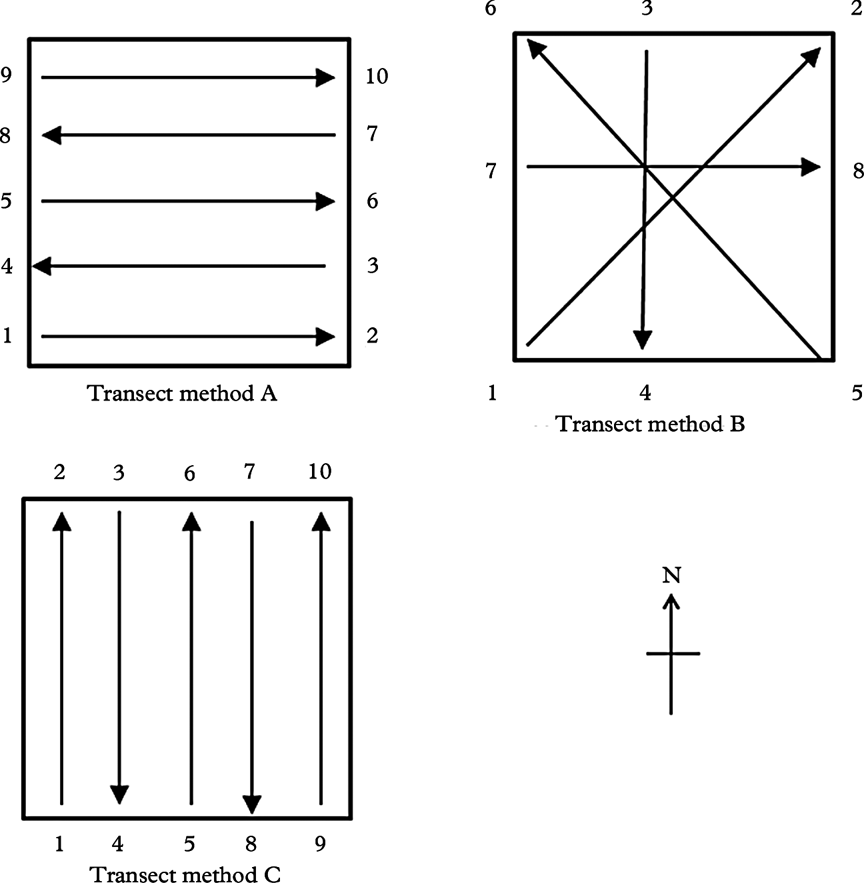
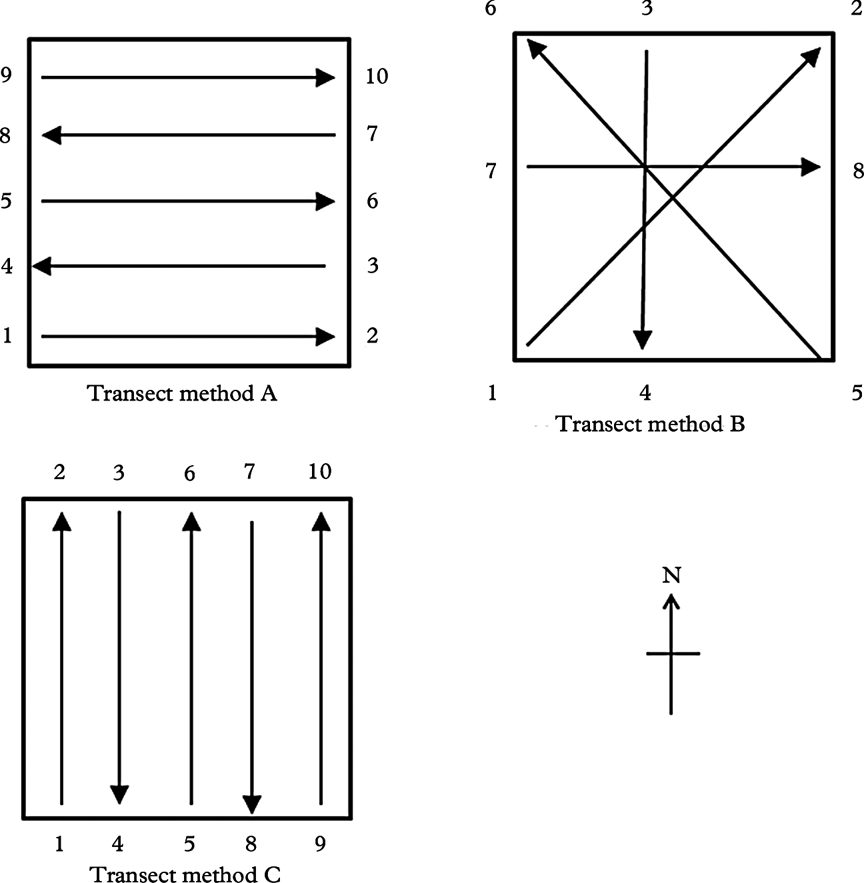
In February 2012, a small-scale trial of survey methodologies for estimating the population at the 1 ha cell level and for assessing inter-surveyor variability was conducted for Pseudocyphellaria norvegica using an example 1 km square in Glen Nant, Western Scotland (latitude 56°24′N, longitude −5°13′W). This 1 km grid square was chosen for the trial as being typical of the habitat and physical terrain likely to be encountered on a survey of the wider species' range and having a known presence of P. norvegica. The 1 km square was divided into a grid of ten by ten 1 ha (100×100 m) cells. We used a pre-existing habitat map of the site (Highland Birchwoods, undated) to exclude 1 ha cells composed of entirely unsuitable habitat (e.g. coniferous plantations and non-woodland areas). From the remaining 1 ha cells, 10 cells known to include suitable habitat and likely to contain P. norvegica (Acton Reference Acton2005; Griffith Reference Griffith2010) were selected and used to compare transect methods. In each of these cells, 3 transect patterns (Fig. 1) and a fixed search period method were trialled. Transect method A was 5 parallel transect sections running east-west across the square, 20 m apart. Transect method B consisted of 4 transect sections forming a star shape; one section ran north to south, the second ran west to east, the third ran from the south-west corner to the north-east corner and the final section from the south-east to north-west corner. Transect method C was 5 parallel transect sections running north-south across the square, 20 m apart. In transect method B, the section running north-south (section 3 to 4, Fig. 1) was offset from the centre of the cell by 10 m to the west, and the section running east-west (section 7 to 8, Fig. 1) was offset by 10 m to the north of the centre of the cell. This ensured that these sections were not the same routes as section 5 to 6 in pattern A and section 5 to 6 in pattern C. All transect methods gave c. 500 m total transect length. These three transect patterns were chosen to test if transects running in one particular direction were more consistent in the results they produced (e.g., lichens occurring more frequently on one aspect of the tree and therefore more likely to be detected when walking in one direction). The star shape transect was used to reduce any effects of linear habitat patterns or structure.
Three transect methods used in Survey 1. The numbers indicate the order in which the transects were walked within each 100×100 m cell.
Along each transect, the number of trees visible from the line (within a distance of c. 2·5 m either side of the transect) which were occupied by P. norvegica was recorded. Each occupied tree was counted only once. The transect was only searched where it passed through suitable habitat as determined by the surveyor; areas of open ground, Pinus sp. plantation etc. were not surveyed. For each 1 ha cell and each transect pattern, the total length of transect searched (suitable habitat), the number of occupied trees identified, and the time taken to complete the transect were recorded and used as response variables in the analysis. The transect walks were completed using pre-programmed routes on handheld Garmin GPS units (GPS62s MAP). This enabled the surveyors to follow the directions given by the GPS while focusing on identification of occupied trees, and was intended to minimize variability between surveyors due to navigational issues.
Before the three transects were completed, the 1 ha cell was searched for 20 minutes, looking in any likely areas of habitat as interpreted by each surveyor, and the total number of occupied trees was recorded. Neither the 20 minute search nor the transects were intended to census the entire cell, rather both methods provided a sub-sample with the transects being constrained by area and the 20 minute searches by time.
The four different methods were repeated for each of the ten 1 ha cells by two independent surveyors. This provided a measure of inter-surveyor differences and allowed an assessment of repeatability of the survey methods, since when the survey is applied at larger scales and/or repeated through time it is unlikely that a single surveyor would be gathering all of the data.
Survey 1 was repeated for seven of the 1 ha cells using transect method C in October 2012 with two additional surveyors (Surveyors 3 and 4), in order to assess surveyor variability across a wider selection of surveyors. It is unlikely that the lichen population would have changed within the eight months between Surveyors 1 and 2 doing the work and Surveyors 3 and 4 doing the work, and we therefore assumed that differences were due to observational error rather than being real changes in the lichen population.
Survey 2
In November 2012, a second survey was carried out to assess if recording presence/absence data was more efficient than recording population density. The second survey was carried out at two 1 km squares in Western Scotland: Glen Nant (latitude 56°24′N, longitude −5°13′W) and Collias Nathais (latitude 56°25′N, longitude −5°16′W). Within each 1 km square, 35 1 ha cells were identified that contained potentially suitable habitat for P. norvegica according to a pre-existing habitat map, as for Survey 1, and which the surveyors had not previously visited. The surveyors searched each 1 ha cell for P. norvegica for 20 min. As soon as P. norvegica had been found, its presence and location were recorded, together with the time taken to find the lichen. The surveyor then continued to search the cell to record the total number of occupied trees found within the cell in 20 min. The surveyors recorded the route they took within each cell using a GPS. Surveyor variability between presence/absence data (the first record of the lichen in each 1 ha cell) and population data (number of occupied trees) was compared. Each cell was recorded by two independent surveyors (Surveyors 1 and 3 above) in order to assess surveyor variability and the repeatability of the survey.
Data analysis
All statistical analysis was carried out in GenStat 14 (VSN International 2011).
Survey 1. The number of occupied trees per cell was analyzed using a Poisson generalized linear mixed model (GLMM) with surveyor and survey method as fixed effects and both cell and cell-method combination as random effects. In the first analysis we only included the three transect patterns (as survey methods), and in a second analysis we also included the 20 min search. The significance of the fixed effects was assessed using approximate F statistics. Length of suitable habitat, number of trees per unit length and time taken were analyzed using Analysis of Variance (ANOVA) with the same fixed and random effects. For both the GLMM and the ANOVA, the data were summarized by forming totals for each combination of 1 ha cell, transect pattern, and surveyor. The number of trees per unit length was log transformed [log (x + 0·1)] to make residuals normal.
Differences between all four surveyors using transect method C were assessed using an analysis at the transect section level (this could not be done when comparing across survey types as different methods had different numbers of transect sections). Length of suitable habitat was analyzed by ANOVA and number of occupied trees was analyzed using a Poisson GLMM with cell and transect section within cell as random effects and surveyor as a fixed effect.
Survey 2. The analysis for Survey 2 was similar to that for Survey 1, with distance walked and time taken analyzed using Analysis of Variance (ANOVA) and count data for the number of occupied trees analyzed using a Poisson Generalized Linear Mixed Model (GLMM). Cell was the only random effect.
Presence/absence data were analyzed by a binomial test that used only those trees where one surveyor recorded presence while the other recorded absence. A test was carried out to determine whether the probability that it was the first surveyor who recorded presence was significantly different from 0·5. In the event that this was the case, it would indicate significant differences between surveyors.
Results
Survey 1
In general, the density of P. norvegica was quite high, with up to 28 occupied trees being recorded per 1 ha cell. Between 0 and 435 m of suitable habitat (from a maximum of 500 m) were identified along transects, with cells taking between 10 and 75 min to complete.
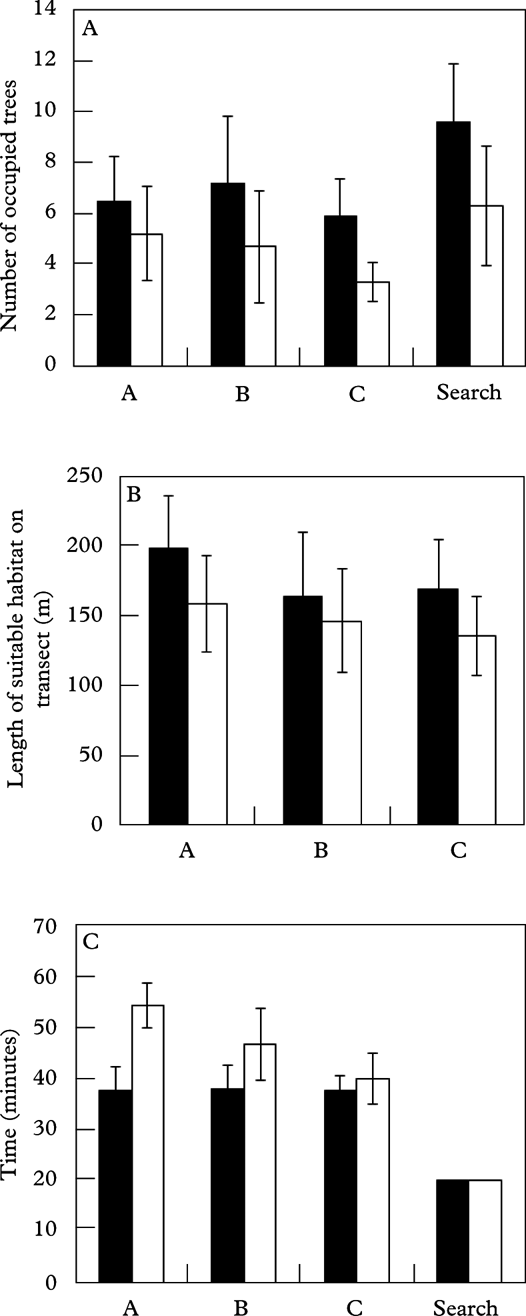
There was no significant difference between transect methods A, B and C in terms of the number of occupied trees identified (Fig. 2A), or the amount of suitable habitat searched (Fig. 2B). The three fixed transect patterns were also compared with a 20 minute search of the 1 ha cell where surveyors were free to search any areas they identified as being suitable (this was carried out before the transect searches were conducted). On average, a 20 minute search found 8 occupied trees, whereas the fixed transect patterns found 6 trees (patterns A and B), and 5 trees (pattern C). The difference in terms of number of occupied trees found between the timed search and the fixed transect patterns was significant (P=0·002). The average time taken to complete the transects was 44 min for pattern A, 41 min for pattern B and 39 min for pattern C, but the differences between the methods were not significant (Fig. 2C). This compared with the 20 minute period used for the standard search method.
Survey 1 results. Comparison between 2 surveyors (▪ surveyor 1, □ surveyor 2); A, number of trees occupied by Pseudocyphellaria norvegica in each 1 ha cell by survey method (transects A, B and C or 20 minute search); B, length of suitable habitat identified in each 1 ha cell by transect type (A, B or C); C, time taken to survey each 1 ha cell by survey method (transects A, B and C or 20 minute search). Means±1SE are shown (n=10).
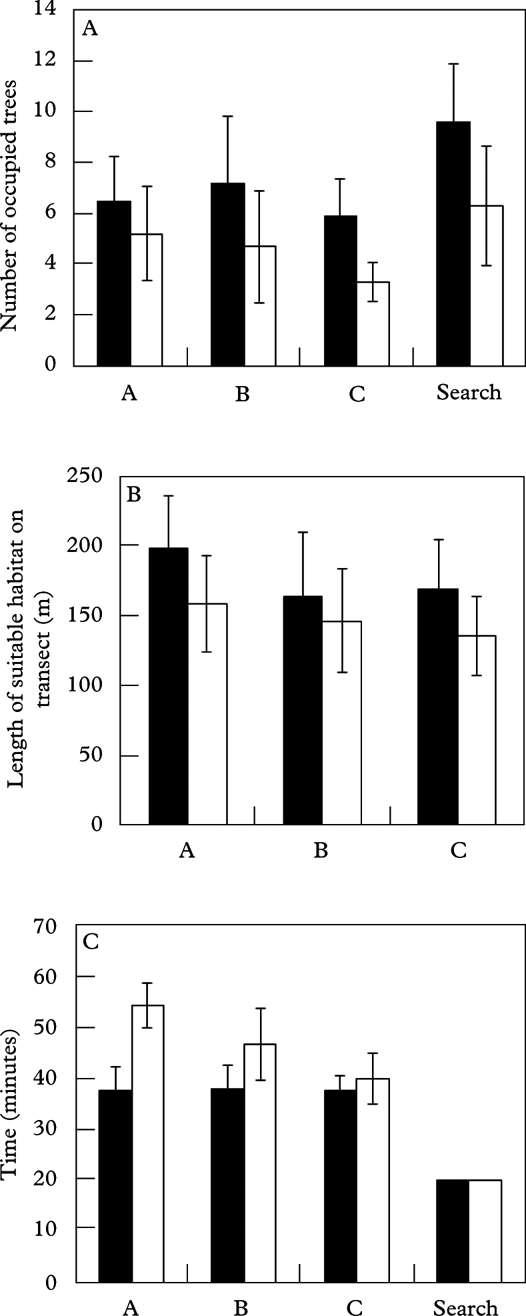
By far the greatest source of variability in data recording was inter-surveyor differences. This included differences in time taken to complete the transects, amount of suitable habitat identified and the number of occupied trees recorded. Surveyor 1 identified a total of 292 occupied trees across all cells and all transect survey methods, and Surveyor 2 identified 195. This was based on a length of suitable habitat (m of transect) of 5306 m for Surveyor 1 and 4401 m for Surveyor 2. These between surveyor differences were significant for both number of trees occupied (P<0·001, Fig. 2A) and the transect length identified as suitable habitat (F 1·27=6·50, P=0·017, Fig. 2B). The variability between surveyors in terms of the number of occupied trees identified per unit of suitable habitat was also tested, to see whether between surveyor variability could be explained by the amount of habitat being identified as suitable and subsequently searched. Surveyor 1 identified 0·04 and Surveyor 2 identified 0·03 occupied trees per metre of suitable habitat; this difference was significant (F 1·27=7·86, P=0·009), showing that inter-surveyor differences were not solely due to the differences in transect length searched. There were also significant differences in the time taken to complete the transects by the two different surveyors, with Surveyor 1 taking an average of 38 minutes to complete a transect and Surveyor 2 taking 47 minutes (significant difference F 1·17=17·53, P<0·001, Fig. 2C). Despite these obvious differences in the surveyors' interpretation of suitable habitat and their likelihood of finding occupied trees while searching it, the overall patterns of between-cell variability in target species density identified by the two surveyors were similar (interaction term between surveyor identity and survey method was not significant).
When the data was assessed as presence/absence data there was no inter-surveyor variability at the 1 ha scale. However, at the transect section scale (100 m for methods A and C; and either 100 m or 141 m for method B) there was considerable variation between surveyors. The same result (presence/absence) was recorded by the two surveyors in 76% of transect sections in method A, 74% in method B, and 71% in method C.
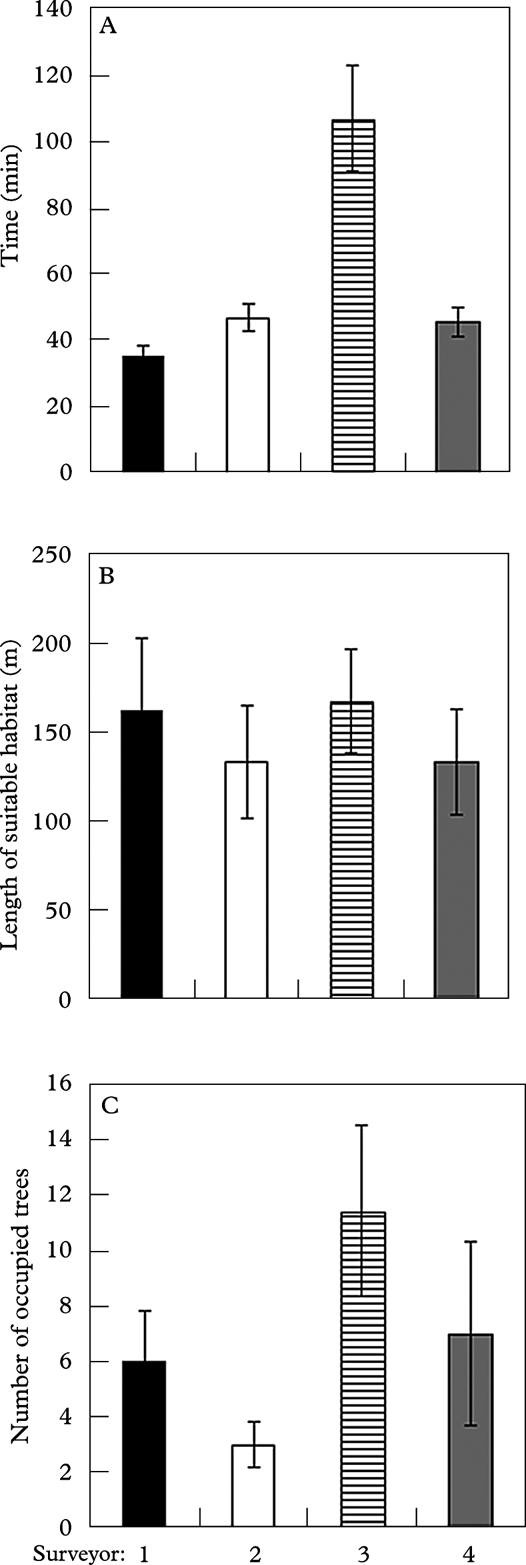
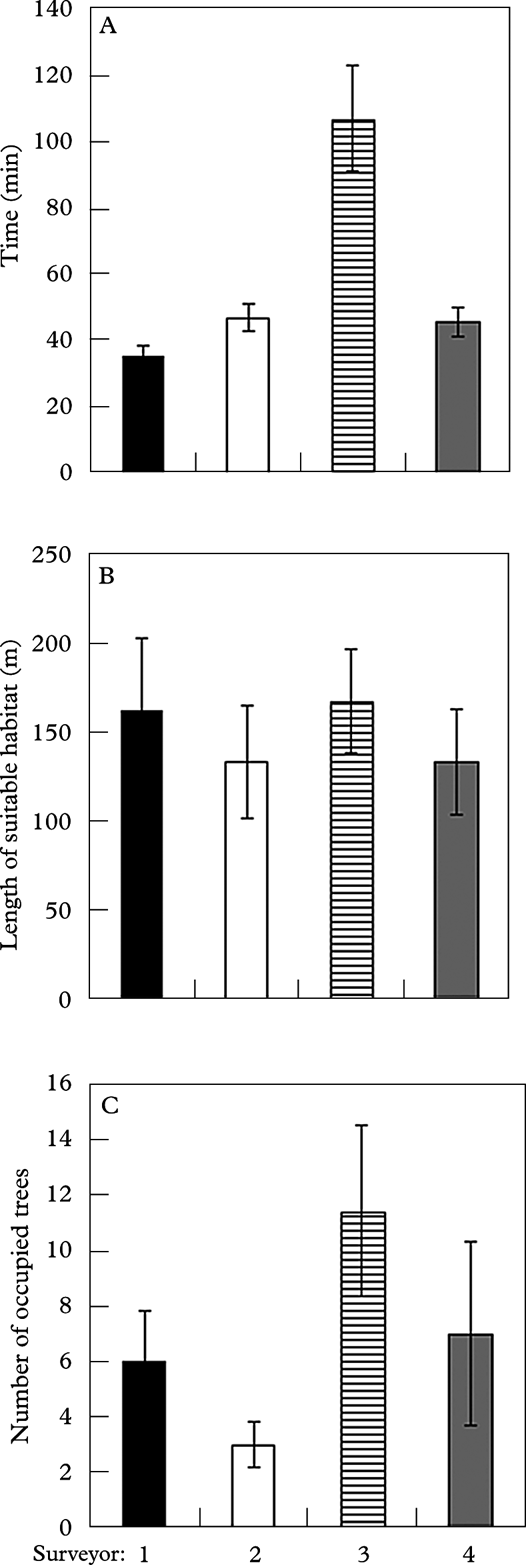
When transect method C was repeated with an additional two surveyors, significant differences were found between the surveyors in terms of length of suitable habitat identified (F 3·96=3·42, P=0·02) and number of occupied trees found (F 3·96=11·15, P<0·001) (Fig. 3). Although Surveyor 3 found a greater number of occupied trees, there was also a highly significant difference in the time taken, with Surveyor 3 taking an average of 107 minutes to complete the survey of each cell. In the 7 cells that were surveyed by all 4 surveyors using transect method C, Surveyor 3 found 80 occupied trees, Surveyor 4 found 49, Surveyor 1 found 41 and Surveyor 2 found 21. As the aim of Survey 2 was to study methods to reduce surveyor variation, Surveyors 1 and 3 were chosen to take part, Surveyor 2 being unavailable.
Comparison of 4 surveyors carrying out transect method C. A, time taken to survey each 1 ha cell; B, length of suitable habitat identified; C, number of occupied trees in each 1 ha call. Means ± 1SE are shown (n=7).
Survey 2
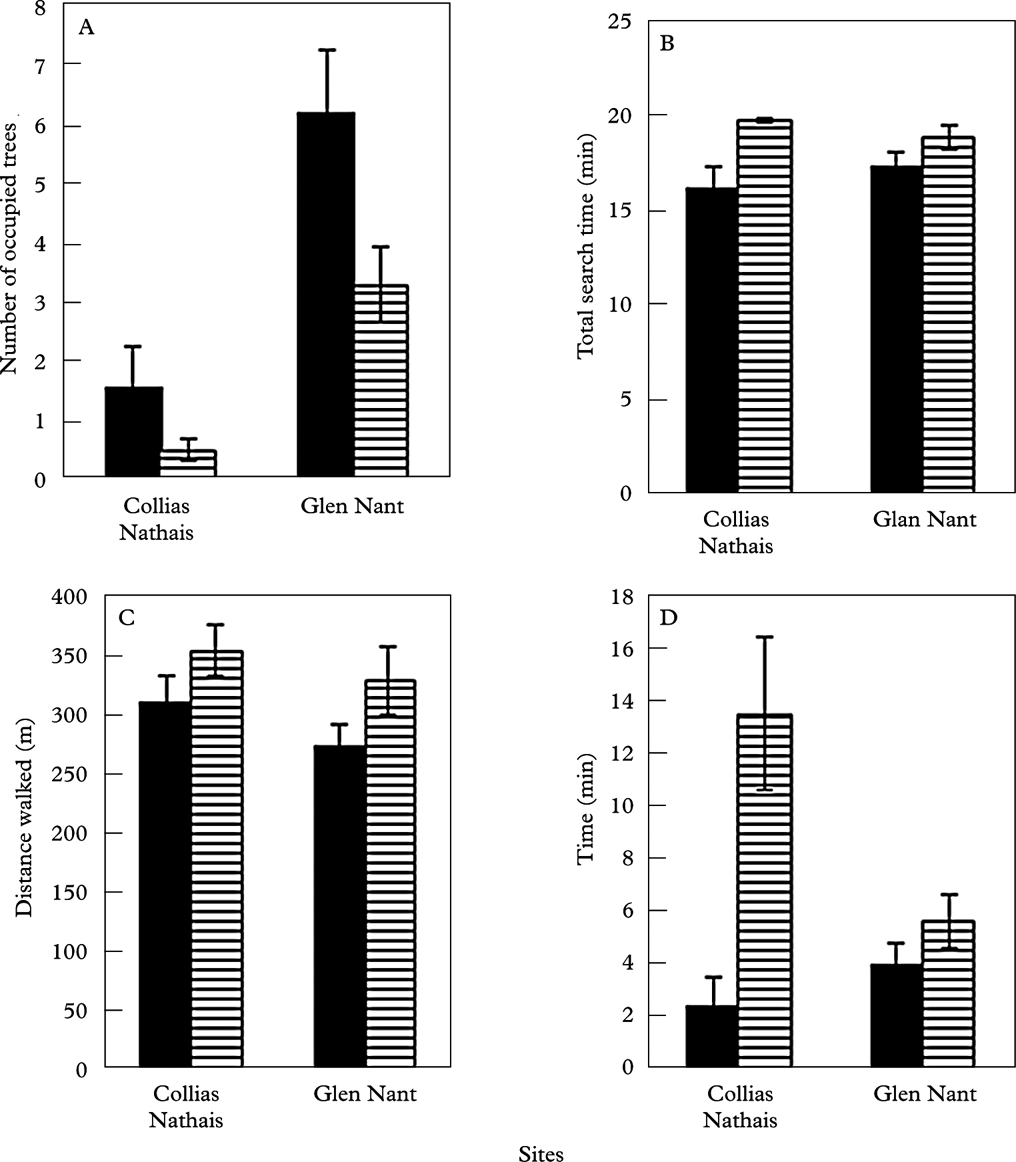
In Survey 2, 34 1 ha cells were surveyed at Glen Nant and 20 at Collias Nathais. Surveyor 1 consistently found more occupied trees per cell than Surveyor 3, averaging 6·2 trees/cell at Glen Nant and 1·6 trees/cell at Collias Nathais compared to 3·3 trees/cell and 0·5 trees/cell, respectively, found by Surveyor 3 (Fig. 4A). This led to a significant overall difference between surveyors in the number of occupied trees found (P<0·001). If the surveyors were confident they had searched all suitable habitat before the end of 20 minutes, they could move on to the next cell. In every case the time spent by Surveyor 1 in each cell was less than or equal to the time spent by Surveyor 3. On average, Surveyor 1 spent 16 minutes in each cell at Collias Nathais and 17 at Glen Nant, compared to 19 and 20 minutes respectively for Surveyor 3 (Fig. 4B).
Survey 2 results. Comparison between 2 surveyors (▪ surveyor 1, □ surveyor 3); A, average number of trees occupied by Pseudocyphellaria norvegica found within a 20 minute search; B, search time (minutes) spent within each cell; C, average distance walked within each 1 ha; D, time taken to find first occupied tree. Means ± 1SE are shown. For A–C, n=34 for Glen Nant and 20 for Collias Nathais; for D, n=21 for Glen Nant and 5 for Collias Nathais.
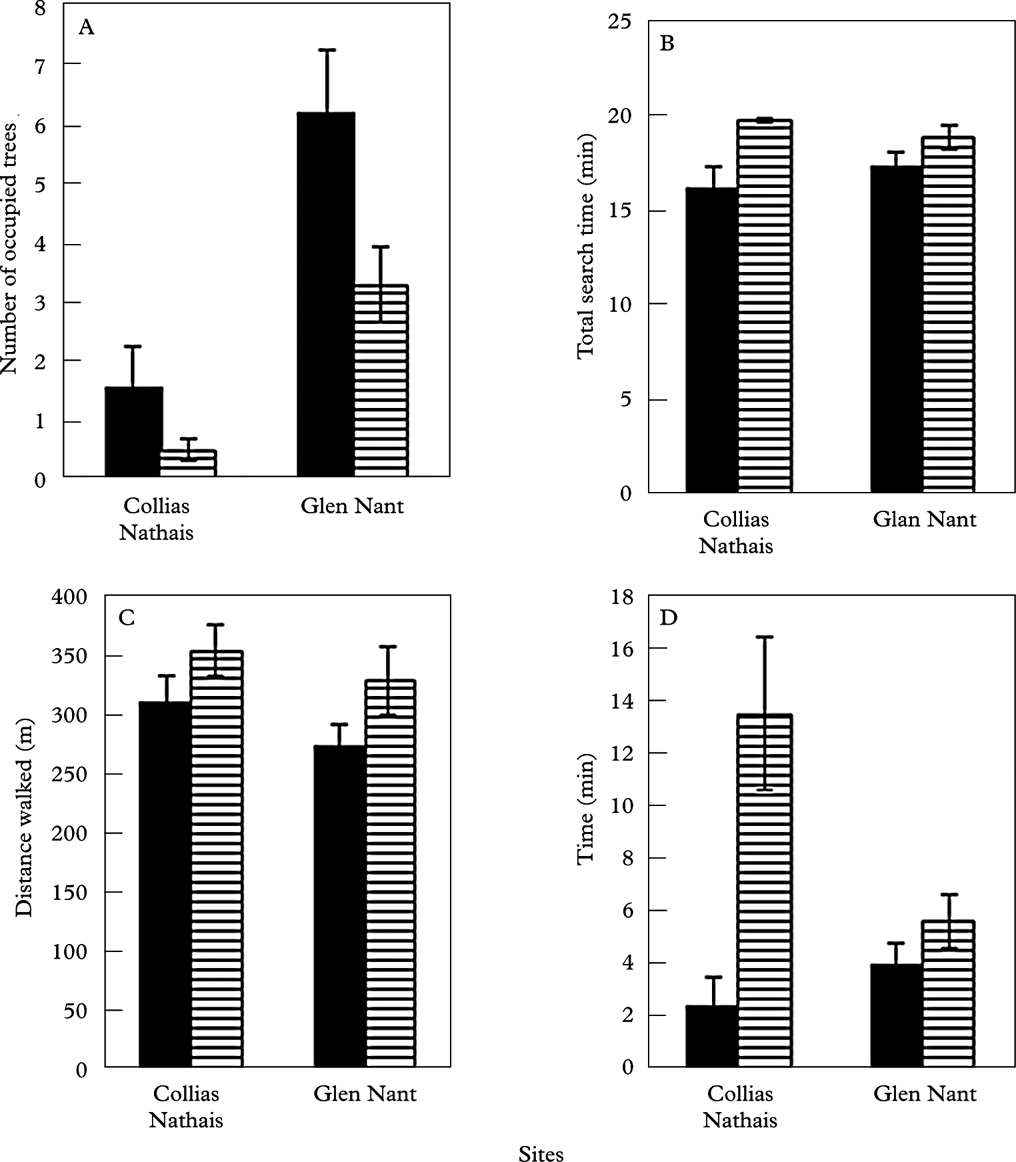
The surveyors walked between 92 m and 774 m during the searches of the cells. There was a significant difference between the surveyors in the distance walked, with Surveyor 3 walking on average around 60 m further than Surveyor 1 (Fig. 4C) but, due to Surveyor 3 also spending longer in each cell, there was no significant difference in the speed of walking. The time taken to find the first P. norvegica in the 26 cells where both surveyors found occupied trees (excluding one cell, where the time was not recorded by one of the surveyors) showed that Surveyor 1 was significantly faster at finding occupied trees than Surveyor 3 (F 1·24=5·55, P=0·027, Fig. 4D).
Presence/absence data at the 1 ha scale showed no significant difference between surveyors. However, presence/absence provides a less powerful test of differences than the number of occupied trees, and in view of the small sample size and the statistically significant differences in the time taken to find the first occupied tree, it is quite likely that with a larger sample size, a significant difference between surveyors would be found. Of the 54 1 ha cells surveyed, Surveyor 1 found P. norvegica in 35 cells and Surveyor 3 found P. norvegica in 30 cells. There were 26 cells where both surveyors found occupied trees and 15 cells where both surveyors did not find any occupied trees. There were 9 cells where Surveyor 1 found occupied trees and Surveyor 3 did not, and 4 cells where Surveyor 3 found occupied trees and Surveyor 1 did not (this included one cell which Surveyor 1 assessed as having no suitable habitat, yet Surveyor 3 found P. norvegica to be present).
Discussion
Transect versus searches
In terms of collecting baseline data on species distribution and density, we found no evidence to suggest that controlled survey methodologies using fixed transect patterns were any better with regard to consistency between surveyors than 20 minute timed searches of the areas in the cell deemed most suitable by an experienced surveyor. Given that following the fixed transect patterns took approximately twice as long as a 20 minute search, the search method would clearly be more cost-effective when there are large numbers of cells to survey. Fixed transect patterns might be considered to be worth the extra time investment, and hence cost, if there was evidence that these methods were more repeatable between surveyors than the search method; however, there was no evidence that this was the case, since between surveyor variability did not change between survey methods.
Surveyor variability
This small-scale trial of survey methodologies leads to the clear conclusion that differences between surveyors are an important issue when planning and implementing any survey of lichen species. Other studies have also found significant differences between teams of highly skilled lichenologists (McCune et al. Reference McCune, Dey, Peck, Cassell, Heiman, Will-Wolf and Neitlich1997; Brunialti et al. Reference Brunialti, Giordani, Isocrono and Loppi2002, Reference Brunialti, Frati, Cristofolini, Chiarucci, Giordani, Loppi, Benesperi, Cristofori, Critelli and Di Capua2012; Giordani et al. Reference Giordani, Brunialti, Benesperi, Rizzi, Frati and Modenesi2009). Brunialti et al. (Reference Brunialti, Frati, Cristofolini, Chiarucci, Giordani, Loppi, Benesperi, Cristofori, Critelli and Di Capua2012) classified the sources of error as sampling errors and non-sampling errors (including instrumental accuracy and subjectivity). Sampling errors are generated by the nature of the sampling itself and by the degree of variability in the target population. They will always occur but can be controlled by appropriate sampling design (Köhl et al. Reference Köhl, Traub and Paivinen2000). In this study, the only source of instrumentation error was the accuracy of the GPSs to locate the transects/1 ha cells; this could have been the source of some differences between the surveyors. However, as differences between surveyors were consistent across cells, in our case the variability appears to be due to the surveyors themselves rather than their equipment. As the surveyors used in this study were professional lichenologists and highly skilled, it is unlikely that sampling errors could be reduced by further training of the surveyors, as suggested by some studies (Giordani et al. Reference Giordani, Brunialti, Benesperi, Rizzi, Frati and Modenesi2009), or by employing more qualified surveyors (McCune Reference McCune, Dey, Peck, Cassell, Heiman, Will-Wolf and Neitlich1997). Given that this level of surveyor variability is encountered with highly trained lichenologists, inter-surveyor variability is likely to be a major issue in the implementation of any large-scale, multi-year survey. Survey design needs to consider all possible ways of reducing the impact of surveyor variability; otherwise it may prevent trends in species populations being detected.
Reducing or accounting for surveyor variability
Calibration
If calibration between surveyors were possible, this would enable surveyor variability to be taken into account during the analysis. However, this wasn't possible with the data collected from Survey 1 as we didn't know if Surveyor 2 was finding a subset of the trees detected by Surveyor 1, or if Surveyor 2 was finding a different set of trees. The methodology would need to be changed to calibrate between surveyors in the field; this would be costly in terms of surveyor time and, for repeat surveys, standardization between surveyors in different years would be difficult. Calibration using photograph recognition in a computer simulation model might allow comparison between years, but this doesn't equate to the difficulties of walking through a wood which will influence surveyors ‘success’ in recording. An artificial method of calibration, such as finding hidden pins in the woodlands, would include the difficulties of walking through the woodland but would only allow calibration in any given year and would not test the surveyors' ability to search for the likely niches of the lichen species. We conclude that there is currently no practicable way of calibrating between surveyors that would enable us to calibrate not only within any year but also between years. Further work on calibration methods is required. Given the unavoidable variability between surveyors, monitoring methods need to be selected which minimize the variability and its impact on detection of temporal trends in populations.
Fixed plots
Using fixed plots removes the variability due to differences in route taken that may occur despite using a very accurate GPS. However, if only plots containing the species to be monitored are established then the survey is biased to recording a declining or stable population rather than an increase (MacKenzie et al. Reference MacKenzie, Nichols, Hines, Knutson and Franklin2003). To overcome this requires that a species can be confirmed as absent in an existing plot, or identified as present in a previously unknown plot, requiring empty or blank permanent plots to be established in the initial survey. However, it is not known how many blank recording plots would be required to detect an increase in population. The establishment of permanent plots also raises a number of practical issues: 1), a large amount of time would be required to set up plots over a large area, such as the range of P. norvegica, which would be costly when limited resources are available for lichen monitoring; 2), plot markers would have to be maintained over time, probably decades, and 3) there might be difficulties in relocating plots during each survey.
Presence/absence data
Presence/absence data are relatively quick to collect, depending on the scale of measurement, and are less prone to observer error than more complex measurements which require estimation of areas, cover, or counts of individuals. Confirming absences may be problematic for rare species with low detectability which could be easily missed when surveying large areas of habitat, and this may be a source of inter-surveyor variation. Equally, depending on the size of the area to be searched, identifying areas where the species is now present but was previously absent also requires that a significant amount of time is spent searching potential habitat for species such as P. norvegica which have low prevalence and low detectability, and consequently a low likelihood of a positive outcome.
The presence/absence data at the 1 ha scale in Survey 1 showed a 100% match in results between surveyors, but when this was tested with a larger number of samples in Survey 2 only 80% of cells had the same result (presence or absence) between surveyors. However, this was an improvement on the count data in Survey 2, where only 31% of cells had the same result (2 cells with the same number of trees and 15 cells with both surveyors recording zeros). The results suggest that recording presence/absence data at the 1 ha scale, while not removing all the surveyor variability, does reduce it. If data are to be collected as presence/absence, consideration of the spatial scale of measurement is important (Hartley & Kunin Reference Hartley and Kunin2003); the area occupied decreases rapidly as grid cell sizes are reduced, and the scale of measurement may also affect the ability to detect trends in species abundance (Hartley & Kunin Reference Hartley and Kunin2003; Joseph & Possingham Reference Joseph and Possingham2008). At smaller scales, presence/absence in a grid of cells may also be used as a measure of abundance or local population size. The disadvantage of presence/absence is that the entire population has to be lost from a measurement unit before a change in population is recorded. If large-scale units (e.g. 1×1 km) are used then a substantial decrease in the population may have occurred before a change is recorded.
Recommendations
In the Introduction, three key population parameters were identified as being required to inform conservation monitoring: the number of ‘individuals’, area of occupancy (AOO) and the range. This work has highlighted the difficulties associated with measuring the number of ‘individuals’ in each population. If presence/absence data are recorded, the closest measurement to population change will be change in number of occupied 1 ha cells within a 1 km square or within a site. A method that recorded presence/absence and instructed the surveyor to move on to the next 1 ha cell as soon as P. norvegica was found would enable more 1 ha cells to be surveyed than if a full 20 minute search is carried out. This would enable more information on AOO and range to be collected for the same level of resources but at the expense of detailed (but potentially less repeatable) information on the number of individuals. Any survey method will be a compromise between assessment of area of occupancy (AOO) and population change. If data on change in number of individuals are too variable to give meaningful results, then resources should be targeted towards providing information on AOO and range. Recording at the 1 ha level allows data to be collected at a resolution 100 times greater than the 1 km square level and allows changes in both AOO and range to be assessed. The results of this study suggest that this is a suitable compromise between recording number of individuals and changes in AOO and range, and that it reduces but does not eliminate surveyor variability.
Further development of monitoring methodologies
If presence/absence data are to be collected, the expectations of the population trends that will be detected need to be realistic, with data from this study showing that only 80% of 1 ha cells had the same results when examined by two surveyors. This may require the revision of conservation definitions of threatened species, as detection of the level of change required by the current definitions may not be possible. A power analysis to calculate the number of 1 ha cells needed to detect population changes could inform the development of realistically measurable criteria for conservation assessments, but this requires background information on population turnover for each species derived from repeated surveys through time.
If the limitations of using presence/absence data are not acceptable, then the only alternative is permanent monitoring plots together with an acknowledgement that a significant amount of investment is required to establish and maintain these plots. For widespread lichens of conservation interest such as P. norvegica, there may be no quick, easy and cheap method that will allow monitoring to be done at a sufficiently high standard to detect change at the required level of precision.
An alternative to monitoring the population is the use of habitat proxies: monitoring the habitat condition rather than the species itself. In the UK, this is currently the approach taken by JNCC's common standards monitoring (JNCC 2005). When there is a time-lag between the decline/increase in the habitat condition and the decline/increase in the species population (species with slow colonization-extinction dynamics), such an approach may be beneficial as change in habitat proxies could give advanced warning of population change. Such an approach is also risky, however, as the habitat may change in some way that is not assessed and the population may decline unnoticed due to the lack of direct monitoring. A more thorough understanding of the autecology of these SBL lichen species is required before this approach could be safely tested.
Conclusion
There is no evidence that estimates of priority lichen populations using controlled survey methodologies (fixed transect patterns) were any better in terms of consistency between surveyors than a 20 minute search of areas within a 1 ha cell deemed suitable by an experienced surveyor. However, as the resources were not available to carry out exhaustive searches of each cell, we do not know the extent to which the time-constrained searches underestimated the true number of occupied trees. Fixed transect patterns took approximately twice as long to carry out as a 20 minute search, therefore the search method is clearly more cost-effective when there is a large number of cells to survey. When using count data, variability between surveyors was high, making it impossible to reliably identify temporal changes in populations and identify population trends. Using presence/absence data at the 1 ha cell level reduced, but did not eliminate, the surveyor variability and is suggested as a suitable compromise between recording ‘individuals’ within a population and changes in area occupied.
This work was jointly funded by Scottish Natural Heritage and the Scottish Government's Rural and Environment Research and Analysis Directorate. We thank the British Lichen Society for allowing us to use their lichen distribution data, and the members who collected this data. Brian Coppins, Sandy Coppins, Andy Acton and Anna Griffith all contributed to useful discussion during the design of the survey methods. We thank the Scottish Forestry Commission for access to their land and the surveyors for carrying out the work.
The authors would like to take this opportunity to thank Brian Coppins for his valued support and guidance over the years. Although he is an international lichenologist, he has always taken the time to help with Scottish lichen research (including the present study) and conservation issues, and never has to be persuaded to pick up his hazel walking staff and sample bag to get out into the field. He has patiently nurtured many new lichenologists and undoubtedly secured a stronger future for Scottish lichenology.