Background
Smoking cessation is an important public health challenge as it has immediate and long-term health benefits. Although many treatment approaches exist, long-term smoking cessation rates are still below 25% (McRobbie, Reference McRobbie2006). Exercise has been proposed as a potential adjunct to smoking cessation treatment that may improve abstinence rates (Ussher et al., Reference Ussher, Taylor and Faulkner2012).
A recent Cochrane review of exercise interventions for smoking cessation (Ussher et al., Reference Ussher, Taylor and Faulkner2012) showed that only 3 of 15 trials showed significantly higher abstinence rates in an exercise group compared with a control group at the end of 8–12 weeks’ treatment, and only one study showed a long-term (12 months) benefit of exercise at follow-up (Marcus et al., Reference Marcus, Albrecht, King, Parisi, Pinto and Roberts1999).
To attempt to address the limitations of previous trials, the ‘Fit2Quit: Exercise to enhance smoking cessation outcomes' trial was conducted in New Zealand (NZ) between July 2009 and June 2012. The primary objective of the trial was to determine the effect of an exercise intervention on smoking cessation rates at six months when added to usual care (monthly smoking cessation support via telephone for three months delivered by the NZ Quitline + eight weeks of subsidized nicotine replacement therapy) in comparison with usual care alone (Maddison et al., Reference Maddison, Roberts, Bullen, McRobbie, Jiang and Prapavessis2010; Reference Maddison, Roberts, McRobbie, Bullen, Prapavessis and Glover2014). In total 906 participants were randomised to either intervention (n = 455) or control (n = 451) groups. Participants in the intervention group received up to 10 contacts over 6 months. Participants were encouraged to attend a face-to-face meeting for their first contact to help build rapport, and then received contact via telephone thereafter. The intervention was grounded in self-efficacy theory (Bandura, Reference Bandura1986), and was designed to support participants to increase their physical activity levels. During each contact, a participant support person (PSP) prescribed exercise with the aim of increasing activity (measured by pedometer step counts) by 10% per week until the participant's unique maintenance (goal) levels were achieved (goal levels were usually set to coincide with the guidelines for moderate-vigorous physical activity of 30 min of exercise per day, 5 days a week). Each PSP was trained to use motivational interviewing and behaviour change techniques to target self-efficacy – strategies to develop confidence to perform exercise, overcome barriers to be active, increase motivation to exercise, schedule exercise into one's daily routine, goal setting, and enhance social support and networks to be physically active, as well as ensuring participant awareness of the benefit of exercise as a smoking cessation aid. PSPs were monitored twice during the trial by study researchers, who observed various participant contacts throughout the intervention, to ensure treatment fidelity. Following a telephone counselling session, a member of the research team met with the PSP to provide feedback on their performance to offer suggestions to ensure they adhered to the delivery content.
Trial results: There were no statistically significant differences between groups in self-reported smoking abstinence (7-day point prevalence and 6-month continuous abstinence) or total physical activity at 24 weeks (Maddison et al., Reference Maddison, Roberts, McRobbie, Bullen, Prapavessis and Glover2014). As assessments were conducted predominantly via telephone, we were unable to objectively verify abstinence for all self-reported abstainers, which introduced the potential for response bias. However, it is unlikely that this biased the results to favour the intervention group, as there is little evidence for statistically significant differences between intervention and control groups in false reporting of smoking abstinence (Velicer et al., Reference Velicer, Prochaska, Rossi and Snow1992).
There were statistically significant differences in self-reported leisure time physical activity, which was the target of the intervention, and an adherence effect was observed, such that those who received at least 7 of the 10 intervention calls were more likely to quit smoking than those who received less than 7 calls and those in the control group.
Given the null findings, and issues with previous trials, additional insight is needed to understand why these interventions do not work in the long-term and to determine future research directions. Although the trial findings provide important information on the effectiveness of the Fit2Quit intervention, a qualitative evaluation of the perceptions of the intervention participants is also needed to answer questions about the reasons for variations in adherence, and individual differences in barriers to exercise and smoking cessation. Considering the methodological limitations of previous trials, and the null effects observed, it was deemed imperative to collect additional information, unobtainable by quantitative means, which may explain why the Fit2Quit intervention was unsuccessful at improving abstinence rates over and above usual care. To the best of our knowledge, this is the first exercise intervention for smoking cessation to include a qualitative evaluation of the intervention.
This paper presents the results of a qualitative evaluation conducted with participants from the intervention group of the Fit2Quit trial as they completed the intervention. The objectives were to determine thoughts and perceptions regarding the acceptability of the intervention, to determine which, if any, components of the intervention were considered beneficial, and to inform future adaptations of the intervention.
Methods
Study Population
The study population included Fit2Quit intervention group participants who were eligible for the study if they were able to provide informed consent, able to participate in a phone interview, and had received the exercise intervention during the Fit2Quit trial (Maddison et al., Reference Maddison, Roberts, Bullen, McRobbie, Jiang and Prapavessis2010).
Recruitment
Participants in the Fit2Quit study intervention group (n = 455) that met the inclusion criteria were identified. Interested participants were asked to contact the study centre after receiving the letter of invitation. Participants who did not respond were contacted via telephone within 2 weeks to ask if they had received the letter and were willing to participate. Stratified purposive sampling (Patton, Reference Patton1990) was used to obtain a mix of demographics and smoking status in order to establish a broad range of participant perspectives. All participants were reimbursed for the time spent completing the interview with a $20 supermarket voucher.
Procedures
Study procedures were approved by the NZ Multi-region Ethics Committee [MEC/11/EXP/102]. A semi-structured interview protocol was developed prior to data collection and was followed throughout the study (see Appendix 1).
One-on-one semi-structured telephone interviews were conducted by the first author (VR). The second author (LPD), an experienced qualitative researcher, provided interviewing training and monitored the first two interviews to ensure the protocol was followed. Open-ended questions were used to allow for a reflexive discussion to take place and non-a priori topics to surface. The discussion revolved around reasons for participating in the study, expectations of the programme, likes/dislikes regarding the intervention, potential improvements to the intervention, feedback on the delivery of the intervention, and other lifestyle changes that may have taken place as a result of the intervention. All interviews were digitally recorded and transcribed verbatim. VR and LPD checked for consistency of transcription by listening to two of the digital recordings and checking the transcription was accurate. Both authors regularly reviewed transcripts to determine when data saturation was reached (where no new themes emerged from new participants) (Bernard, Reference Bernard2000).
Analysis
A general inductive approach was followed (Thomas, Reference Thomas2006), which allows research findings to emerge from multiple readings of the raw data. The inductive approach was chosen as it enables clear links to be established between the data and the research objectives, in this instance evaluation of the Fit2Quit intervention (Thomas, Reference Thomas2006). NVivo9 software package was used to manage the transcripts and facilitate the analysis process, and to identify themes and categories. Peer debriefing of potential codes and categories was conducted between authors as transcripts were read several times. The coding process was iterative, which allowed categories to emerge and be continually refined as broad themes began to appear. VR coded the entire sample and LPD read and coded a subsample of transcripts to enhance the trustworthiness of the data analysis. A peer debriefing process found no discrepancies between the two coders. Following this discussion, the categories were grouped into themes. A table was used to group quotes from different transcripts by theme, and VR, LPD, and ED each reviewed the themes independently to ensure the themes were sound. Towards the end of data collection no new categories or themes emerged, suggesting saturation had been reached (Bernard, Reference Bernard2000).
Results
Participant Characteristics
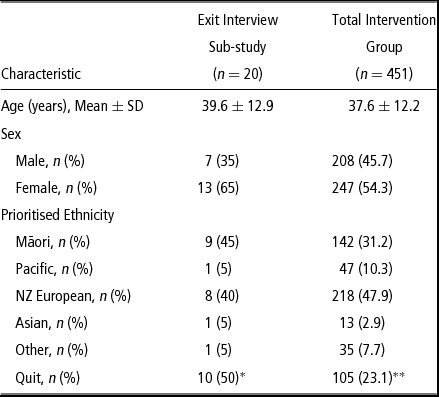
Letters were mailed to 119 Fit2Quit participants, and attempts were made to contact 42 of them by telephone, of whom 5 declined to participate, and 17 others were unable to be contacted (the remaining 77 were not contacted by telephone because data saturation had been reached). A sub-sample of 20 Fit2Quit intervention participants completed exit interviews. Participants shared key socio-demographic characteristics with the main intervention group (age, sex and ethnicity, see (Table 1)). Demographic information for the total intervention group sample is also presented for comparison. Of the 20 participants, 10 self-reported not smoking at the time they were interviewed, 9 of which had quit during the intervention period. One stated that he had quit following the end of the intervention. Of the 10 participants still smoking at the time of the interview, 7 stated that they had quit for a brief period (up to 2 weeks) but had relapsed to smoking during the programme.
Baseline demographic data for qualitative study participants and total intervention group

*Self-reported quit status at time of interview.
**Self-reported 7-day point prevalence abstinence at 24 weeks.
Thematic Analysis
The analysis of the interview data produced four themes. All quotes are presented with demographic information (age, sex, ethnicity), and quit status at time of interview (“quit” or “smoking”). Themes and sub-themes are presented schematically in Appendix 2.
Theme 1 – The support people were genuinely interested in what I was achieving.
Theme 1 describes the type and nature of the support provided in the intervention. Comments highlighted the supportiveness of the PSP who delivered the intervention and the level of individual tailoring provided throughout. All participants talked favourably of the PSPs’ genuine interest in their behaviour change processes, as well as the PSPs encouragement throughout the intervention. Many participants liked having someone to report to, and found their motivation to exercise increased knowing they were accountable to the PSP who would be checking up on their progress.
‘It was as if you needed to achieve something, rather than if you were just doing it for yourself you’d say "ah well nobody's watching." It's good to have someone to report to. And the people you were talking to sounded genuinely interested in what you were achieving' – 66-year-old male, other European, quit
Participants also appreciated that the intervention was individually tailored, focusing on unique personal barriers specific to them, which was different to their initial expectations.
‘I found that really helpful, just coming up with some of the issues that I faced um and then perhaps getting some ideas on how to mitigate those issues that I came across’. – 46-year-old female, NZ Māori, quit
Theme 2 – New awareness, new attitude, new lifestyle: ‘I could see the benefits’.
Participants reported changing their behaviour(s) as a result from participating in the intervention. Such changes included smoking behaviour, exercise, diet and alcohol consumption.
Many participants who self-reported having quit smoking felt the intervention helped them to alter their smoking behaviour.
‘I kept repeatedly quitting and starting. During the study’. – 46-year-old female, NZ European, quit
Others talked about substituting their usual smoking time with other more healthy behaviours such as walking or eating breakfast.
‘If anything it motivated me to do other things. It made me get out of my car. Away from my car and actually walk it. It helped at points where it would have been easy, easy to just pick up a cigarette I suppose’. – 33-year-old female, NZ Māori, quit
Many of the participants also said that they experienced relief from cravings both during and immediately after exercise.
‘Put it this way, if you are walking around the block or anything, you don't actually feel like stopping for a cigarette’. – 54-year-old male, NZ European, smoking
In addition to changes to smoking behaviour, participants also commented that the intervention increased their exercise levels, their awareness of the importance of exercise, and the body's physiological responses to exercise.
‘I was probably going out . . . maybe three or four times a week, and albeit it was only for half an hour because of my breathing problems and that, but that's alright it was very beneficial to me and it was good for my muscles, you know it gave them a work out. . . As I exercised more I actually started to enjoy it more. . . And I could see the benefits too as opposed to when I used to smoke’. – 66-year-old male, other European, quit
A goal of the programme was to guide participants through the behaviour change process to improve their knowledge, skills, self-efficacy, and self-motivation to continue to exercise in the long term. Although some struggled to initiate an exercise regimen, a few commented that they had maintained their behaviour beyond the intervention timeframe. Making exercise part of the routine and fitting it into their schedule were mentioned, suggesting that the intervention was successful in increasing scheduling efficacy for these participants.
‘More time with my boys. My boys are into riding their bikes and going for walks and going to the park and stuff. Like I used to take my car to the park and we are only a couple of kms away. . . .So now a couple of times a week we go down to the park. . . And I make time for that because it's for me as well as them. So that was really cool. Cause that came about from “oh how do I fit this in”, I’ve got so much going on, but like I’m spending time at the same time with them, which they appreciate’. – 28-year-old female, NZ Māori, smoking
Although the intervention focussed primarily on smoking cessation and exercise, PSPs were also encouraged to discuss other healthy lifestyle changes with participants as they arose. The most common additional lifestyle change mentioned in the interviews was eating a healthy diet to avoid gaining weight when they quit smoking.
‘Well the takeaways are completely just wiped out. . . I tend to like cooking more than the take-outs. . . I can't remember the last time I had KFC. One of my biggest things when I started this was the fact that I loved KFC. . . I find myself quite resilient to it now’. – 33-year-old female, NZ Māori, quit
Two participants also expressed that they had reduced their alcohol intake as a result of quitting smoking. They commented that smoking and drinking used to go hand in hand, and that it was difficult trying to avoid smoking when they had a few drinks.
‘Yeah I sort of don't drink so much. . . That was a big thing with smoking for myself. . . . Like a whole packet would last me a weekend and then I would go get drunk and it would be gone by the next morning’. – 28-year-old male, NZ Māori, smoking
Theme 3 – Lack of time, willpower and money stopped me from changing.
Throughout the interviews, participants also highlighted some aspects of the programme that had not worked for them. These included a range of internal (lack of motivation to exercise or to quit smoking) and external (e.g. life stressors and bad weather) barriers.
A core component of the intervention was to enhance participants' motivation to exercise. The PSPs were trained in motivational interviewing, and instructed to use such techniques throughout the intervention. Despite the emphasis of the intervention to enhance these constructs, a number of participants stated that they did not have the motivation required to get out and exercise.
‘I’d probably say, if I did the exercise like they said I should, it probably would have been more successful, but I didn't do it so I don't know. I just couldn't be bothered’. – 52-year-old female, NZ European, smoking
It was also apparent that for some the intervention was unsuccessful in aiding them to overcome external barriers to exercise or quit attempts. Barriers discussed included life stressors, lack of time and bad weather.
‘My problem is I have an extremely busy job that's 10–12 hours a day and Sundays and it was really hard for me to fit in the exercise, but you know, you always can, it's just that I didn’t, so yeah that was my personal problem with the whole thing’. – 28-year-old female, NZ Māori, smoking
‘Unfortunately it was sort of at the wrong time of the year. . . like you know, it was pouring with rain or blowing a gail, or, you know what I mean? You couldn't really get out and do stuff’. – 54-year-old male, NZ European, smoking
The PSPs were trained to encourage participation in pre-existing free physical activity community-based programmes such as Green Prescription (GRx). Despite this, two participants expressed that they would have exercised more if there wasn't a financial barrier, and the intervention could have included free or subsidised access to local exercise facilities.
‘Maybe helping people going to the gym or something like that. . . Yeah like get into the gym or something, you know, like they can't afford it. . . I was sort of hoping that there would be a green card to go to gyms and all that. For cheaper’. – 24-year-old male, NZ European, quit
Another barrier to exercise was injury. Although the exercise programme was designed to prevent injuries by starting at low intensities and short durations and slowly building up the body's tolerance for exercise, injuries did occur throughout the programme. When asked ‘how often do you exercise now?’ to explore exercise levels beyond the programme, one participant said:
‘Not as often as what I was doing sort of in the peak of it all. Um because I hurt my Achilles, sort of overdid it a bit’. – 44-year-old female, NZ Māori, quit
Theme 4 – I would have preferred a ‘more hands on’ approach: Recommendations for future programmes.
During the course of the interviews participants offered suggestions about how the intervention could be improved, including greater face-to-face contact, greater tailoring of the call schedule and greater facilitation of social support.
Many of the participants interviewed suggested that the intervention would have been more effective with greater face-to-face contact, as it would have enabled activity logs and pedometer step counts to be checked regularly throughout the intervention. This is in contrast to the favourable comments from other participants, who felt that the phone support from the PSP held them accountable.
‘They were very helpful but it was more advice over the phone. And it is kinda easy to ignore that, or easier to ignore that than, even though I really wanted to do it, than actually having someone there’. – 46-year-old female, NZ European, quit
‘Even with the checking and seeing my progress. . . I could have just made up, and most of the time I just made up lies that I had done. And they weren't able to see any evidence of me doing exercise. . . . . .’. – 27-year-old female, Samoan, smoking
As mentioned in Theme 1, the PSPs were encouraged to personally tailor the intervention to each participant as much as possible. About half of the participants liked the call schedule (weekly calls for one month, fortnightly calls for one month, and monthly calls for four months).
However, some (n = 4) participants who did not quit at the start of the programme, but quit in the last 4 months (when they were receiving monthly calls), expressed that they would have liked more frequent contacts around the time they quit. Such participants had to wait up to a month to talk to the PSP about their quit attempt, and may have already relapsed to smoking again before the next phone call.
‘I thought it would be better to ring more often. Because when I did give up, I gave up for the two weeks and I sort of felt like talking to someone about it’. – 24-year-old female, NZ European, smoking
One participant suggested that it would have been useful for participants to phone the PSPs themselves as needed, instead of having to wait for their next call.
‘Well sometimes I wished I could have called someone to say “ah my god what a terrible week I’ve had”, you know, instead of like at the end of the month because sometimes you’ve like forgotten” – 46-year-old female, NZ Māori, quit
Two participants commented that they would have benefited from exercising with a role model or as part of a group, and suggested that this could have been organised by the PSPs rather than the participants finding an exercise buddy themselves.
‘Might have been helpful to possibly be part of a support group. . . It would have been quite neat to have a session and such together. As it is always good to see other people that are struggling or making their way through a new process as well’. – 44-year-old female, NZ Māori, quit
One participant commented that they would have preferred a PSP with slightly more knowledge of specific injuries, who could provide advice on appropriate modalities of exercise for the injury concerned.
‘I have a knee injury that limited the type of exercises I can do, um I thought perhaps I would have had more sort of a coaching person on the phone that could have suggested certain kinda exercises for me to do’. – 46-year-old female, NZ Māori, quit
Discussion
This study provides important information about the Fit2Quit intervention that was not possible to obtain using the trial questionnaires. Overall, participants found the intervention acceptable in terms of delivery, frequency and duration. This was largely due to the supportiveness of the PSPs, and the tailoring of the intervention to meet their needs. We chose to make counselling available by telephone because it built on an existing delivery infrastructure offered by Green Prescription; however, this was augmented with a more intensive approach (the standard Green Prescription is 3–4 contacts over 3 months, which was increased to 10 contacts over 6 months in the Fit2Quit intervention) and strong theoretical grounding. Despite this, this approach did not suit all people, all the time. Some participants felt that the intervention could have been enhanced with greater opportunity for face-to-face contact, more tailoring of the intervention schedule and greater facilitation of a support network.
Participants liked the supportiveness of the PSPs. However, participants who did not initially stop smoking, but quit later on, felt they lacked the necessary support to sustain their quit attempt, suggesting the provision of a reactive service (where participants could telephone for support as they need it) could be a useful addition to future interventions. Moreover, the lack of face-to-face support reduced the motivation and accountability levels of some participants. When the intervention was originally designed, it included an initial face-to-face meeting between the participant and the PSP in the first session. The face-to-face meeting was included in the programme to help build rapport between the PSP and the participant. Unfortunately, there were a number of participants that, for various reasons (e.g. lack of transport), were unable to attend a face-to-face meeting, and this session was conducted over the telephone instead.
The lack of motivation expressed by some participants is an important issue. These findings demonstrate differences between highly motivated and less motivated individuals, and corresponds to the intervention adherence effect observed in the trial, which showed that those participants who adhered to the intervention (i.e. received seven or more calls) were more likely to quit smoking than those who did not receive seven calls (OR 0.88, 95% CI 0.81, 0.97, p = 0.01, (Maddison et al., Reference Maddison, Roberts, McRobbie, Bullen, Prapavessis and Glover2014). Although lack of motivation cannot completely account for lack of adherence, invariably, many participants who did not receive the calls deliberately avoided them. Although there were a number of good suggestions to improve the intervention, those participants who do not have the motivation to quit and/or exercise are unlikely to successfully change these behaviours, regardless of the delivery, frequency, intensity and duration of the intervention. Therefore, perhaps exercise interventions for smoking cessation only work for highly motivated individuals. The importance of intrinsic motivation to exercise, enjoyment, competence, and autonomous regulation has been observed previously in many studies of exercise participation (Rose et al., Reference Rose, Parfitt and Williams2005; Thøgersen-Ntoumani & Ntoumanis, Reference Thøgersen-Ntoumani and Ntoumanis2006; Wilson & Rodgers, Reference Wilson and Rodgers2004) and weight control (Silva et al., Reference Silva, Vieira, Coutinho, Minderico, Matos and Sardinha2010; Teixeira et al., Reference Teixeira, Going, Houtkooper, Cussler, Metcalfe and Blew2006; Reference Teixeira, Silva, Coutinho, Palmeira, Mata and Vieira2010). Although participants were asked during initial screening whether they were willing to engage in regular physical activity, a few participants in this sub-study stated that they did not have the motivation or willpower required to exercise. One suggestion for future research could be to assess motivation to exercise at the start of the intervention and tailor the intervention for each participant accordingly. Two separate approaches for motivated and unmotivated individuals could be implemented, which would likely increase adherence rates and reduce loss to follow-up among both groups.
As mentioned previously, the intervention was grounded in self-efficacy theory (Bandura, Reference Bandura1986), and intervention content focused on enhancing the key sources of self-efficacy (mastery experiences, social persuasion, vicarious experiences and physiological responses). There were a number of comments to suggest that the intervention successfully enhanced efficacious beliefs via these sources. The most prominent source of self-efficacy mentioned by participants was verbal (social) persuasion. Many participants were appreciative of the support provided, not only encouraging them to exercise, but also supporting them through their quit attempt.
Mastery experiences were improved by encouraging participants to partake in activities that they had previously enjoyed and/or felt confident to participate in, and also through the provision of pedometers, which enabled participants to monitor their progress throughout the programme, keep track of their step counts and set future goals. A number of participants also stated that the more they understood and realised the benefits of exercise, the greater their confidence, which enhanced adherence to the behaviour.
With regard to physiological responses, none of the interviewed participants reported that they had not exercised because they disliked the physiological responses they experienced during and after exercise, which suggests that this aspect of the intervention was covered adequately.
Throughout the intervention PSPs encouraged participants to exercise with a peer who had successfully engaged in the behaviour. Beyond this suggestion, the ability to increase vicarious experiences through self-efficacy was limited, particularly as the PSPs were all non-smokers (who had never smoked). One of the common suggestions to improve the programme was the provision of an exercise support group, buddy system, or a role model (a previous smoker to whom the participant could identify with who had successfully quit smoking with exercise).
These findings have implications for similar future interventions. Overall, the Fit2Quit intervention appears to have been appreciated by most of the participants in this sub-study. However, it appears the intervention needs to be even more individually tailored to ensure participants receive the support required at the time they require it.
Moreover, establishing a support network for participants to share their experiences and obtain social support could also be a useful addition. This could be provided via an online website, or via the provision of face-to-face support groups and/or buddy systems. Given that opportunities to exercise with others (as part of the Green Prescription programme) were offered, but not often used, in the Fit2Quit study, online support groups may result in greater uptake, and thus, may be an intervention tool worth considering for future research. Although previous studies have examined the efficacy of Internet-delivered exercise programmes (Al-Chalabi et al., Reference Al-Chalabi, Prasad, Steed, Stenner, Aveyard and Beach2008; Linke, Reference Linke2011; McKay et al., Reference McKay, Danaher, Seeley, Lichtenstein and Gau2008), no study to date has offered an online support group or buddy system in this context. Future research should also explore the use of role models in this context to enhance vicarious experiences and social support, as has been suggested in previous qualitative studies of interventions for smoking cessation (without exercise) (Whittaker et al., Reference Whittaker, Dorey, Bramley, Bullen, Denny and Elley2011) and depression (Whittaker et al., Reference Whittaker, Merry, Stasiak, McDowell, Doherty and Shepherd2012).
Only those people that were contactable throughout the Fit2Quit intervention were approached to participate in this study, which may have biased the results; however, it was important for participants to have experienced the intervention in order to determine their response to it.
The interviewer (VR) for this sub-study had a vested interest in the Fit2quit trial. VR was not a PSP, but was involved heavily in the intervention design. To account for this potential bias, all authors were involved in the design of the interview questions, and a peer-debriefing process was conducted, whereby LPD and ED both looked over the themes independently, and questioned the findings to ensure the themes were sound.
Participants were interviewed between one and six weeks after they had completed the study. This may have affected memory recall of various aspects of the intervention. In addition to interviewing participants, it would be useful in future studies to interview those who deliver the intervention, participants in the control group, and individuals who were not interested in joining the trial to gain a more thorough understanding of the perceptions of the intervention. Focus groups could also be a useful further addition.
Conclusions
A telephone counselling intervention to enhance exercise for smoking cessation was well received by most participants. Aspects of the intervention, particularly the provision of support and encouragement from the PSP, were beneficial. Suggested improvements were greater tailoring of the call schedule, greater face-to-face contact and provision of a buddy system/support group.
Financial Support
The Fit2Quit trial was an investigator-initiated study funded by the Health Research Council of New Zealand (09/338R) and the Heart Foundation of New Zealand (1405). RM was supported by a Heart Foundation of New Zealand Fellowship. VR was supported by a University of Auckland Doctoral Scholarship.
Conflict of Interest
VR, LPD, ED, and RM have no conflicts of interest to disclose. CB has received support for accommodation while a speaker hosted by a manufacturer of smoking cessation drugs but has no other interests to declare.
Ethical Standards
The authors assert that all procedures contributing to this work comply with the ethical standards of the relevant national and institutional committees on human experimentation and with the Helsinki Declaration of 1975, as revised in 2008.
Supplementary Material
To view supplementary material for this article, please visit http://dx.doi.org/10.1017/jsc.2014.16.