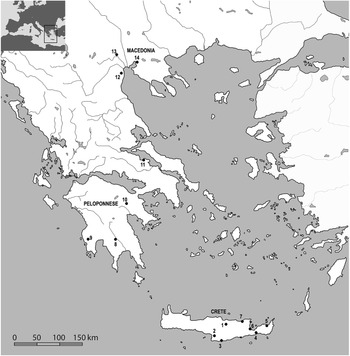


The emergence of urban settlements and strongly hierarchical societies in later prehistoric south-west Eurasia placed considerable demands on the production and mobilisation of food, triggering extensive scholarly debate on related changes in crop and livestock husbandry (eg, Childe Reference Childe1950; Renfrew Reference Renfrew1972; Gilman Reference Gilman1981; Sherratt Reference Sherratt1983; Halstead Reference Halstead and Wells1992; Wilkinson Reference Wilkinson1994). The ERC-funded AGRICURB project has combined stable carbon and nitrogen isotope analysis of crop seeds and domestic animal bones to shed new light on farming methods in contexts ranging from the Neolithic to Iron Age and from northern Mesopotamia (Styring et al. Reference Styring, Charles, Fantone, Hald, McMahon, Meadow, Nicholls, Patel, Pitre, Smith, Sołtysiak, Stein, Weber, Weiss and Bogaard2017), through northern Greece (Nitsch et al. Reference Nitsch, Andreou, Creuzieux, Gardeisen, Halstead, Isaakidou, Karathanou, Kotsachristou, Nikolaidou, Papanthimou, Petridou, Triantaphyllou, Valamoti, Vasileiadou and Bogaard2017) to central Europe (Styring et al. Reference Styring, Knipper, Müller-Scheeßel, Grupe and Bogaard2018). As a further outcome of this project, here we apply these methods to Knossos on Crete, southern Greece (Fig. 1), presenting the first such results from the site for faunal samples and new data for crop seeds, building on those reported by Nitsch et al. (Reference Nitsch, Jones, Sarpaki, Hald, Bogaard, Garcia, Orgeolet, Pomadère and Zurbach2019) and Styring et al. (in press). Knossos is one of the earliest known farming settlements, earliest major urban settlement, and centre of one of the oldest regional (Minoan and Mycenaean) states in Europe (eg, Cadogan et al. Reference Cadogan, Hatzaki and Vasilakis2004; Isaakidou & Tomkins Reference Tomkins2008). Occupied from the early 7th to 1st millennia bce, it offers the longest diachronic archive in Europe of domestic animal and crop remains and thus an exceptional opportunity to explore the relationship of settlement growth and state formation to changing husbandry practices.
Map of Greece showing location of Knossos and other sites mentioned in the text: 1. Knossos, 2. Agia Triada & Phaistos, 3. Trypiti, 4. Schinokapsala, 5. Petras-Kefala, 6. Priniatikos Pyrgos, 7. Malia, 8. Kouphovouno, 9. Pylos, 10. Mycenae, 11. Halai, 12. Makriyalos, 13. Archontiko, 14. Toumba Thessalonikis

Drawing on macroscopic analysis of these archaeobotanical and faunal archives and on palatial written documents, previous studies have sought to reconstruct aspects of crop and livestock husbandry at 7th–2nd millennia bce Knossos and of resource mobilisation by its 2nd millennium ‘palace’. Here we test and refine these piecemeal and largely circumstantial reconstructions using direct evidence for husbandry conditions of 7th–2nd millennia Knossian crops and livestock, based on stable carbon (δ13C) and nitrogen (δ15N) isotope analysis of their seeds and bones.
BACKGROUND
Knossos: from farming hamlet to urban palatial centre
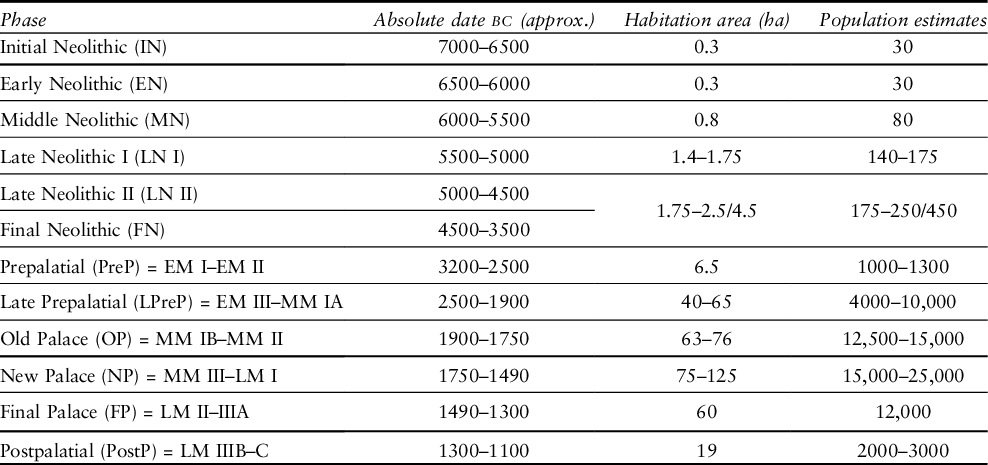
Excavation and surface survey (Evans Reference Evans1971; Hood & Smyth Reference Hood and Smyth1981; Whitelaw et al. Reference Whitelaw, Bredaki and Vasilakis2019) have elucidated the growth of Knossos (Table 1). An Initial (IN) and Early (EN) Neolithic hamlet of perhaps 30 inhabitants developed through the Middle (MN), Late (LN), and Final Neolithic (FN) into a village of up to 250 (Tomkins Reference Tomkins2008) or even 450 head (Whitelaw Reference Whitelaw, Schoep, Tomkins and Driessen2012, 147–8; Legarra Herrero Reference Legarra Herrero2019). Thereafter a suggested ‘Prepalatial’ (PreP) nucleated settlement of 1000–1300 grew rapidly to 4000–10,000 in the ‘Late Prepalatial’ (LPreP), 12,500–15,000 in the ‘Old Palace’ (OP) and 15,000–25,000 in the ‘New Palace’ (NP), before contracting to 12,000 in the ‘Final Palace’ (FP) and perhaps less than 3000 in the ‘Postpalatial’ (PostP) phase (Hatzaki Reference Hatzaki and Langohr2017; Cutler & Whitelaw Reference Cutler and Whitelaw2019, 15). It is debated (as for mainland Greece) whether ‘households’ emerged early or late in the Neolithic at Knossos, where intelligible architecture is sparse and the balance between domestic and collective control of resources was probably contested (Halstead Reference Halstead, Laffineur and Niemeier1995; Reference Halstead and Kotsakis2019; Tomkins Reference Tomkins, Barrett and Halstead2004; Kotsakis Reference Kotsakis, Tasić and Grozdanov2006). The earlier Neolithic community was small enough for egalitarian maintenance of social cohesion (cf. Forge Reference Forge, Ucko, Tringham and Dimbleby1972; Broodbank Reference Broodbank1992, 42), but, from the PreP (if not later Neolithic), Knossos exceeded this limit (Legarra Herrero Reference Legarra Herrero2019) and the ancient core of the settlement was segregated for public or elite use (Tomkins Reference Tomkins, Schoep, Tomkins and Driessen2012), including the later ‘palaces’ (cf. Whitelaw Reference Whitelaw and Branigan2001).
SITE PHASING, ABSOLUTE CHRONOLOGY & ESTIMATED SETTLEMENT AREA & POPULATION SIZE FOR PREHISTORIC KNOSSOS

Phasing and chronology: for Neolithic after Tomkins (Reference Tomkins2020); for Bronze Age after Shelmerdine (Reference Shelmerdine and Shelmerdine2008, 4–5, figs 1.1–1.2) (‘high’ LBA chronology).
Settlement area: for IN–FN after Tomkins (Reference Tomkins2008, tables 3.1–3.2); for LN II–PostP after Whitelaw et al. (Reference Whitelaw, Bredaki and Vasilakis2019, fig. 19) (for LN II–FN: lower estimates after Tomkins (Reference Tomkins and Momigliano2007) and higher after Whitelaw et al. (Reference Whitelaw, Bredaki and Vasilakis2019)).
Population estimates assume, after Whitelaw et al. (Reference Whitelaw, Bredaki and Vasilakis2019, fig. 19): habitation densities (inferred from surviving architectural remains) of: Neolithic – 100 persons/ha; PreP – 150–200/ha; LPreP – 100-150/ha; OP-FP – 200/ha; PostP – 100–150/ha
Key: EM, MM, LM = Early, Middle and Late Minoan ceramic phases
At the inter-site level, Knossos was too small for a viable breeding population in the earlier Neolithic (Isaakidou Reference Isaakidou2008, 102; Tomkins Reference Tomkins2008, 30–1) but had achieved potential demographic self-sufficiency by the PreP and conceivably by the later Neolithic. Ideological or economic pre-eminence of later Neolithic Knossos over the tiny settlements then widespread in the landscape (Tomkins Reference Tomkins2008; Reference Tomkins2020) cannot be excluded but Knossian dominance of a regional hierarchy is first evident in the palatial period. The numerous FP Linear B texts reveal selective Knossian palatial control and exploitation of agricultural, pastoral, and craft production across the central third or half of Crete (Godart Reference Godart1977; Killen Reference Killen and Bintliff1977; Bennet Reference Bennet, Olivier and Palaima1988; Halstead Reference Halstead, Galaty and Parkinson1999a). Earlier (OP–NP) Hieroglyphic and Linear A texts, documenting similar resources (eg, Palmer Reference Palmer, Laffineur and Niemeier1995), are few and enigmatic (Bennet Reference Bennet, Baines, Bennet and Houston2008), while some centres later subordinate to FP Knossos probably headed independent OP–early NP polities (Bennet Reference Bennet, Bang and Scheidel2012; Whitelaw Reference Whitelaw, Garcia, Orgeolet, Pomadère and Zurbach2019). The size of OP–NP urban Knossos, however, suggests its inhabitants already drew substantial resources from well beyond their immediate catchment (eg, Whitelaw Reference Whitelaw2004, 155 fig. 10.6; Reference Whitelaw, Garcia, Orgeolet, Pomadère and Zurbach2019).
The following section outlines previous models, and their underpinning evidence, of 7th–2nd millennia bce land use and 2nd millennium palatial resource mobilisation at Knossos, as a prelude to their evaluation in the light of stable carbon and nitrogen isotope analyses of ancient crop seeds and animal bones. In conclusion, we explore how resulting insights into past land use may enrich understanding of social change at Knossos.
From archaeobotanical and faunal archives and textual records to models of changing land use
Crete has a Mediterranean climate of mild wet winters and hot dry summers, with considerable inter-annual variability in precipitation. Knossos, in lowland central Crete, with annual rainfall over the last century of ∼500 mm (Tsiros et al. Reference Tsiros, Nastos, Proutsos and Tsaousidis2020), experiences more severe summer drought than most of mainland Greece (eg, Isaakidou Reference Isaakidou2008, 100 fig. 6.3). Proxy records across the Aegean and Mediterranean indicate a long-term trend to greater aridity through the 7th–2nd millennia bce, punctuated by regionally variable (Finné et al. Reference Finné, Woodbridge, Labuhn and Roberts2019) cold and dry episodes towards the end of the 7th, possibly 5th, and 3rd millennia, although their timing, nature, and severity are debated (eg, Dormoy et al. Reference Dormoy, Peyron, Combourieu Nebout, Goring, Kotthoff, Magny and Pross2009; Aufgebauer et al. Reference Aufgebauer, Panagiotopoulos, Wagner, Schaebitz, Viehberg, Vogel, Zanchetta, Sulpizio, Leng and Damaschke2012; Clarke et al. Reference Clarke, Brooks, Banning, Bar-Matthews, Campbell, Clare, Cremaschi, di Lernia, Drake, Gallinaro, Manning, Nicoll, Philip, Rosen, Schoop, Tafuri, Weninger and Zerboni2016; Giamali et al. Reference Giamali, Koskeridou, Antonarakou, Ioakim, Kontakiotis, Karageorgis, Roussakis and Karakitsios2019). Both long- and shorter-term changes (cf. Mauri et al. Reference Mauri, Davis, Collins and Kaplan2015, fig. S3) could influence the carbon and nitrogen isotope values (both generally raised by aridification) of plants and herbivorous fauna, but the principal climatic constraints on Cretan vegetation – summer drought, coupled with winter frost in the uplands – are relevant throughout this period.
The uncultivated vegetation of Crete (Zohary & Orshan Reference Zohary and Orshan1965; Rackham & Moody Reference Rackham and Moody1996, 109–22) comprises a mosaic of herbaceous plants, dwarf shrubs (phrygana) and, below a variable tree-line, mainly broad-leafed evergreen and deciduous arboreal species (shrubs more than trees). Significant factors shaping the herbaceous-dwarf shrub-arboreal mosaic are summer drought (reflecting climate, topography, and geology), human clearance, and especially (as protective enclosures confirm) grazing/browsing by livestock. Neolithic inhabitants faced richer vegetation, judging by evidence for deciduous oaks in pollen cores from lowland south-central, and north-west Crete (Bottema Reference Bottema1980; Bottema & Sarpaki Reference Bottema and Sarpaki2003) and in charcoal from the earliest occupation at Knossos (Badal & Ntinou Reference Badal, Ntinou, Efstratiou, Karetsou and Ntinou2013). Of particular relevance to carbon isotope values in animal bone, Cretan vegetation is heavily dominated by plants with C3 photosynthesis (and thus relatively low δ13C values). C4 plants (with higher δ13C values) are today restricted to a few crops (all or most being historical introductions), to summer weeds and ruderals in gardens or harvested fields or disturbed ground (Bergmeier Reference Bergmeier2008), and to saline coastal rough pasture (cf. Le Houérou Reference Houérou, Squires and Ayoub1994; Dimopoulos et al. Reference Dimopoulos, Tsiripidis, Bergmeier, Fotiadis, Theodoropoulos, Raus, Panitsa, Kallimanis, Sýkora and Mucina2012, 84 table 1); local tectonic and alluvial changes (eg, Ghilardi et al. Reference Ghilardi, Psomiadis, Andrieu-Ponel, Colleu, Sotiropoulos, Longo, Rossi, Amato, Gasse, Sinibaldi, Renard, Bicket, Delanghe, Demory and Fleury2018) will have affected the past extent of saline pasture. Around Knossos itself (Roberts Reference Roberts1979), limestone ridges immediately north and 5 km south of the settlement traditionally provided wet-season grazing but the dominant marls will have supported woodland offering year-round browse until Neolithic clearance expanded seasonal grazing on cultivated land.
The distinctive insular fauna of Pleistocene Crete became extinct before the 7th millennium bce introduction of domesticates (Jarman Reference Jarman and Reese1996) and the only large ‘wild’ terrestrial animals today are feral (escaped domestic) goats, widespread on inaccessible rocky terrain (eg, Xanthoudidis Reference Xanthoudidis1918, 272, ns 3, 4). Second millennium bce figurative art apparently represents feral goats (eg, Vanschoonwinkel Reference Vanschoonwinkel and Reese1996), while biometric analysis of Knossos faunal remains may indicate feral goats and pigs by the later Neolithic (Isaakidou Reference Isaakidou2005). Badger was introduced during the Neolithic and European fallow deer during the Bronze Age (Jarman Reference Jarman and Reese1996; Isaakidou Reference Isaakidou2005), but the latter were conceivably enclosed, as argued by Hubbard (Reference Hubbard1995; also Palmer Reference Palmer, Carlier, De Lamberterie, Egetmeyer, Guilleux, Rougemont and Zurbach2012, 380–1) for mainland Greece, rather than free-range.
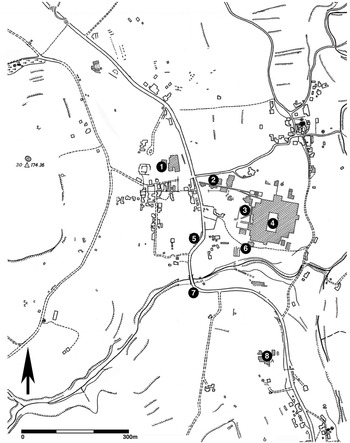
The archaeobotanical archive is relatively sparse, with early excavations in the palace reporting but not retaining stored grain (Halstead Reference Halstead and Wells1992, 108 table 1). Of available material, a range of FP cereals and pulses comes from Storeroom P in the elite ‘Unexplored Mansion’ (Jones Reference Jones1984; Fig. 2), while earlier samples derive from more diverse and socially inclusive contexts. At Knossos, as elsewhere on Crete, cultivated cereals and pulses were consumed throughout the period under review (Sarpaki Reference Sarpaki, Efstratiou, Karetsou and Ntinou2013) and, in the NP and FP phases at least, included several species of both crop types (Sarpaki & Jones Reference Sarpaki and Jones1990; Sarpaki Reference Sarpaki, Cadogan, Iacovou, Kopaka and Whitley2012; Livarda & Kotzamani Reference Livarda and Kotzamani2013). Additionally, charred pips/stones, wood charcoal, and pollen suggest increasing exploitation of olive (Valamoti et al. Reference Valamoti, Gkatzogia and Ntinou2018) and vine (Sarpaki Reference Sarpaki, Cadogan, Iacovou, Kopaka and Whitley2012) on Crete from the PreP phase onwards and perhaps of almond at Knossos itself from the later Neolithic (Badal & Ntinou Reference Badal, Ntinou, Efstratiou, Karetsou and Ntinou2013; Sarpaki Reference Sarpaki, Efstratiou, Karetsou and Ntinou2013). Lastly, two C4 crops were possibly present on palatial-era Crete: common millet, Panicum miliaceum, is well represented archaeobotanically in northern Greece (Valamoti Reference Valamoti2016) but not certainly on Crete (Livarda & Kotzamani Reference Livarda and Kotzamani2013); and the commodity CYP, listed in Linear A and associated in Linear B with feasting/offerings, perfumery, and possibly also fodder, is plausibly translated as tiger nut, Cyperus esculentus or wild C. rotundus (Melena Reference Melena1974), and starch grains attributed to the former are reported from palatial-era ceramic vessels on Crete (Tsafou & García-Granero Reference Tsafou and García-Granero2021).
Plan of Knossos showing excavation sectors that provided seed and animal bone samples for the stable isotope analysis reported below (adapted from Hood & Smyth Reference Hood and Smyth1981): 1. Minoan Unexplored Mansion (MUM), 2. Royal Road (RR), 3. West Court House (WCH), 4. Central Court (CC), 5. Road Trials (RT), 6. Early Houses 93 (EH93), 7. Aqueduct Well (AW), 8. Hogarth’s Houses (HH)

The excavated faunal archive from IN–LPreP Knossos derives from both domestic and communal contexts, but public/elite areas are overrepresented in the OP–FP assemblages. Domestic cattle, goat, sheep, and pig dominate throughout, while dog, badger, and, from the NP phase, horse and fallow deer are relatively scarce (Isaakidou Reference Isaakidou2005; Reference Isaakidou2008).
Knossian land use was shaped by its southern Aegean setting and the community’s changing size, internal organisation and regional integration. Models of ancient land use in Greece have often drawn analogies with traditional ‘extensive’ (low-input) farming, tacitly assuming shared limitations of technology and know-how (Halstead & Isaakidou Reference Halstead, Isaakidou, Gron, Sørensen and Rowley-Conwy2020). Most Neolithic settlements, however, including earlier and perhaps also later Neolithic Knossos, were small enough to have been sustained by cultivation within a few minutes’ walk and thus potentially by labour-intensive, high-yielding husbandry with cereal-pulse rotation, manuring, and weeding (Halstead Reference Halstead, Hodder, Isaac and Hammond1981a). Subsequent settlement growth, necessitating cultivation of more distant and less fertile land, will have impeded intensive husbandry, albeit perhaps partly offset by using cattle for tillage and bulk transport (Isaakidou Reference Isaakidou2008; Whitelaw Reference Whitelaw, Schoep, Tomkins and Driessen2012, 162–3).
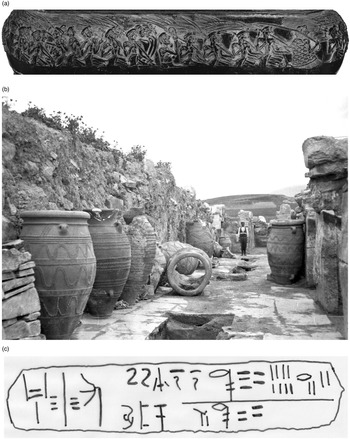
Palatial Knossos drew resources from a broad region by a combination of staple and wealth finance, issuing rations of staple grains to hundreds of craft workers whose fine finished products were exchanged for other goods and services (eg, Killen Reference Killen, Duhoux and Morpurgo Davies2008; Bennet & Halstead Reference Bennet, Halstead, Nakassis, Gulizio and James2014). To account for production of the underpinning ‘surplus’ grain, both intensification (Gilman Reference Gilman1981; Renfrew Reference Renfrew, Renfrew and Wagstaff1982) and extensification (Halstead Reference Halstead and Wells1992; Whitelaw Reference Whitelaw, Garcia, Orgeolet, Pomadère and Zurbach2019, 97–8) have again been invoked, with a combination of archaeobotanical, textual, and iconographic evidence cited in support of the latter. In the palatial phases on Crete, although charred grains include multiple pulse and cereal species, Hieroglyphic, Linear A, and Linear B texts apparently record no pulses and only two (in Linear B, conceivably three) cereals (Palmer Reference Palmer, Laffineur and Niemeier1995; Reference Palmer, Sacconi, Del Freo, Godart and Negri2008; Halstead et al. in press). Moreover, the Linear B texts refer to production/collection of just one cereal (Killen Reference Killen1995), conventionally identified as ‘wheat’. FP Knossian scribes recorded its receipt in large quantities at subordinate centres (Bennet Reference Bennet1985) and it was arguably grown with extensive methods such as regular fallowing and tillage by oxen, the latter apparently loaned by the palace (Killen Reference Killen1993), under some form of share-cropping (Halstead Reference Halstead, Betancourt, Karageorghis, Laffineur and Niemeier1999b). While textual evidence from the earlier palaces is sparser, the NP ‘Harvester Rhyton’, depicting a large gang of winnowers (Fig. 3a), suggests that extensive agriculture and share-cropping (Halstead & Isaakidou Reference Halstead, Isaakidou and Bennet2021) may likewise have contributed to filling large-scale storage facilities (eg, Christakis Reference Christakis2008; Privitera Reference Privitera2014; Fig. 3b) and financing elites. The case for palatial production of surplus ‘wheat’ by extensive methods rests on circumstantial evidence, however, while the contrast between specialised textual and diverse archaeobotanical records implies that palatial-era pulses and some/most cereals were produced on a different institutional basis and so potentially with more intensive husbandry (cf. Nitsch et al. Reference Nitsch, Jones, Sarpaki, Hald, Bogaard, Garcia, Orgeolet, Pomadère and Zurbach2019).
Palatial political economy: a) a large gang of winnowers depicted on the ‘Harvester Vase’ from NP Agia Triada, Crete (courtesy of Archaeological Museum of Heraklion; © Hellenic Ministry of Culture and Sports – Archaeological Resources Fund (TAPA)); b) palace storeroom (West Magazines) at Knossos during excavation (photograph by Ms A.M. Lloyd in 1901–04; BSA SPHS 01/2077/2566, BSA SPHS Image Collection; reproduced with permission of the British School at Athens); c) Linear B tablet De 1648 from Knossos recording (left half of tablet) two personal names and the toponym ku-ta-to, with which are associated (upper right) 58 male and 2 female sheep, and (lower right) 40 ‘missing’ male sheep (horizontal strokes = 10s, vertical strokes = units; drawn after photograph at https://collections.ashmolean.org/object/476201)

Throughout the Neolithic at Knossos, male sheep, goats, and cattle were slaughtered young, favouring meat yields over specialisation in milk, fibre, or traction, although skeletal ‘pathologies’ indicate yoking of female cattle for draught. Conversely, prepalatial Bronze Age sheep, goats, and cattle and palatial-era sheep and goats lived longer and far more males (especially of sheep) reached adulthood, consistent with greater emphasis on wool, hair, and traction, but also with selection of large adult males for conspicuous consumption in public/elite contexts (Isaakidou Reference Isaakidou, Serjeantson and Field2006). FP texts list working oxen and numerous wool-bearing male sheep (Fig. 3c), although it should be noted that regional-scale husbandry records may be unrepresentative of animals consumed at Knossos.
As with crop growing, alternative models of Neolithic animal keeping have proposed contrasting scales of livestock husbandry. Proponents of extensive husbandry have emphasised the scarcity of summer grazing in the lowlands (eg, for Knossos, Jarman et al. Reference Jarman, Bailey and Jarman1982, 147), arguing for seasonal use of upland pastures and tacitly assuming sufficient numbers of livestock to warrant such mobility. Conversely, in a largely uncultivated landscape better suited to cattle, goats, and pigs, the dominance of sheep at IN–MN Knossos (and other earlier Neolithic settlements in Greece) might reflect their close integration with cultivated land and thus maintenance in small numbers – especially so if crops were grown intensively on a small scale (Halstead Reference Halstead, Hodder, Isaac and Hammond1981a; Isaakidou Reference Isaakidou2008; Halstead & Isaakidou Reference Halstead, Isaakidou, Gron, Sørensen and Rowley-Conwy2020). During LN–FN, sheep remained dominant, but gave way somewhat to cattle, some at least used for draught (Isaakidou Reference Isaakidou2008; Reference Isaakidou, Hadjikoumis, Robinson and Viner2011), and less so to goats (Isaakidou Reference Isaakidou2008, 95 fig. 6.2). The proportional increase in goats, and their high frequencies at later Neolithic and younger sites colonising agriculturally marginal areas elsewhere on Crete (eg, Petras-Kefala, Priniatikos Pyrgos, Schinokapsala, Trypiti: Molloy et al. Reference Molloy, Day, Bridgford, Isaakidou, Nodarou, Kotzamani, Milić, Carter, Westlake, Klontza-Jaklova, Larsson and Hayden2014; Isaakidou in prep.; Fig. 1), may reflect greater reliance on browse beyond the cultivated area. Moreover, even if Knossian livestock numbers expanded only in step with community size, economies of scale (Halstead Reference Halstead1996) would potentially have facilitated separate herding of sheep and goats on grazed and browsed pasture, respectively. Pigs too could have exploited woodland browse and pannage (Jarman & Jarman Reference Jarman and Jarman1968, 260–1) and/or, as recently in northern Greece, stubble and fallow fields (Halstead & Isaakidou Reference Halstead, Isaakidou, Albarella and Trentacoste2011) but, in small numbers, may largely have consumed crop by-products and food waste around the settlement. Rough (ie uncultivated) pasture suitable for cattle was probably scarcest but these large animals were better able than sheep, goats, or pigs to survive on coarse straw and stubble, perhaps supplemented by grain when their use for work prevented grazing (eg, Halstead Reference Halstead2014, 50–3). Dogs routinely gnawed the bones of other domesticates and so consumed at least their marrow (Isaakidou Reference Isaakidou2005) but were perhaps fed mainly with cultivated grain (or, like recent herders’ dogs, bran) unless livestock were slaughtered very regularly (and thus herded on a large scale).
Through the palatial phases, urban Knossos with its monumental ‘palace’ probably drew livestock as well as agricultural produce from subordinate settlements, as textual (Godart Reference Godart1971) and faunal isotopic (Isaakidou et al. Reference Isaakidou, Styring, Halstead, Nitsch, Stroud, le Roux, Lee-Thorp and Bogaard2019) evidence confirms for the FP phase. Such flows may account for the high representation in Bronze Age faunal assemblages from Knossos, compared with other sites on Crete, of cattle (Halstead & Isaakidou Reference Halstead, Isaakidou, Albarella, Rizzetto, Russ, Vickers and Viner2017), the largest and, in elite iconography (eg, Blakolmer Reference Blakolmer2016), most prestigious common domesticate. Livestock and their products/services dominate FP texts (Halstead Reference Halstead2002), that record palatial interest in goats, pigs, cattle (including working oxen), and especially male sheep and wool across central Crete. Texts also list animals earmarked for consumption, some after ‘fattening’ or ‘finishing’ (Killen Reference Killen1994; Reference Killen, Deger-Jalkotzy, Hiller, Panagl and Nightingale1999) but offer no indication of where livestock were pastured (Bennet Reference Bennet1985). Indeed, selective coverage (eg, listing too few breeding ewes to restock recorded flocks) suggests concern with palatial rights to wool rather than animal husbandry per se (Halstead Reference Halstead, Voutsaki and Killen2001). Nonetheless, the apparent concentration of recorded sheep at toponyms with extensive arable land suggests a major role for stubble and fallow fields (Halstead Reference Halstead, Sheridan and Bailey1981b, 204), while total numbers (probably exceeding 80,000: Killen Reference Killen1964) invite speculation that (like recent dairy flocks) they grazed mountain pastures in summer, as confirmed for some FP sheep, but not goats, by incremental analysis of oxygen and carbon stable isotopes in tooth enamel carbonate (Isaakidou et al. Reference Isaakidou, Styring, Halstead, Nitsch, Stroud, le Roux, Lee-Thorp and Bogaard2019).
Despite palatial interest in large-scale herding, especially of wool flocks, a few ‘household’ pigs, goats, or sheep could have been raised intensively throughout the Neolithic and Bronze Age and even by palatial-era elite households for their day-to-day provisioning, on which the texts are silent. Recent farmers of moderate means widely kept such animals for domestic consumption of preserved pork and cooking fat, young kids/lambs, and milk/cheese (Halstead Reference Halstead1996; Halstead & Isaakidou Reference Halstead, Isaakidou, Albarella and Trentacoste2011).
While macroscopic archaeobotanical and faunal data from Knossos shed direct light on the crop and livestock species exploited over time and on the relative abundance and uses of the latter, they offer at best very indirect hints as to the scale and intensity of husbandry or the degree of integration between crops and livestock. For the palatial era, texts add a wealth of contextual detail for the husbandry and consumption especially of livestock and their products and document the farming of wheat and sheep, at least on a very large scale. The texts provide a highly selective, elite-centred perspective, however, and again shed limited light on how the recorded crops and livestock were raised. Accordingly, rival models of land use offer very different visions of the scale, intensity, and integration of Knossian land use and of the production of the staple resources that financed its palatial elite. The remainder of this paper seeks to resolve these uncertainties, using stable isotope data to clarify the conditions under which grain crops and livestock were raised at Knossos and thus the scale, intensity, and integration of land use.
CHANGING LAND USE: IMPLICATIONS FOR δ13C AND δ15N VALUES OF GRAIN CROPS AND LIVESTOCK
Supplementary text S1 sets out the methodological background for interpretation of C3 grain crop δ13C and δ15N values in relation to changing land use. Hypothesised intensive early crop husbandry (see above) on the water-retentive soils of the Knossos valley should be associated with relatively low grain δ13C values indicative of well-watered conditions, especially if the Kairatos stream was channelled for small-scale flood-irrigation (as latterly for market gardens). Subsequent expansion onto more distant and poorer/less thoroughly tilled land should be matched by lower water availability and higher δ13C values. High cereal δ15N values should characterise (earlier) Neolithic intensive husbandry close to Knossos, declining in the later Neolithic or prepalatial Bronze Age as cultivation over greater distances, albeit apparently facilitated by draught cows, enforced more extensive methods. In the palatial Bronze Age, low δ15N values are expected for ‘wheat’ grown extensively, but other grains, production of which is not recorded textually, might exhibit higher values if grown more intensively.
Supplementary text S2 and Figure S1a–b set out the methodological background for interpretation of animal bone collagen δ13C and δ15N values in relation to changing land use. If the earliest Knossian livestock were closely tied to cultivated land on intensively managed water-retentive soils (above), their diet may have exhibited a narrow δ13C range and relatively high δ15N values. From the later Neolithic onwards, if more numerous livestock exploited more distant and diverse pasture, with different species herded separately, broader dietary δ13C and δ15N ranges would be expected, with greater divergence between species and generally lower δ15N values. Yet further isotopic diversity might be introduced, at least in the palatial Bronze Age, by consumption at Knossos of animals reared elsewhere: for example, slightly higher or lower δ13C values in animals reared mainly in the drier east or wetter west of Crete, respectively.
Of the forage categories modelled in Figure S1, lowland rough browse was probably available year-round but lowland rough graze relatively scarce in summer, upland rough graze normally inaccessible in winter, and pannage limited to a few autumn–winter months. C4-rich coastal rough pasture too was traditionally exploited mainly in winter, while seasonal availability of pasture on cultivated land depended on rotation and fallowing regimes. To varying degrees, therefore, most livestock probably exploited mixtures of pastures, rather than any single modelled category, but the range of potential combinations is too large and the underpinning data currently too coarse, to warrant formal dietary mixing models.
Textual references to fattened or finished FP livestock may also imply consumption of isotopically enriched fodder, if this included C4 millet or tiger nut (with very high δ13C values) or C3 grain (with slightly higher δ13C and perhaps δ15N than corresponding straw/chaff fodder and stubble/fallow pasture). Neolithic use of C3 grain fodder has also been discussed in relation to livestock dental microwear (Mainland & Halstead Reference Mainland, Halstead, Davies, Fabiš, Mainland, Richards and Thomas2005) and both macroscopic (Valamoti & Charles Reference Valamoti and Charles2005) and isotopic (Vaiglova et al. Reference Vaiglova, Bogaard, Collins, Cavanagh, Mee, Renard, Lamb, Gardeisen and Fraser2014a) archaeobotanical data from Greece, but the bone collagen data presented below reflect long-term average diet and should be insensitive to fattening immediately before slaughter. If some livestock were reared intensively, however, fed significant quantities of grain like recent household goats, sheep, and especially pigs, their bone collagen might exhibit raised δ13C and δ15N values.
MATERIALS AND METHODS
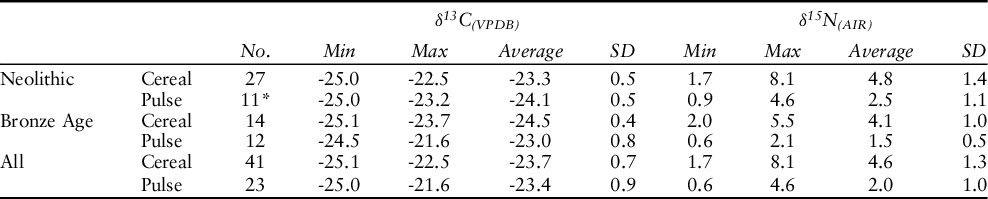
We analysed carbonised cereal grains and pulse seeds from 34 samples from John Evans’ 1969–70 Neolithic excavations, currently under final study by Sarpaki. Nitsch et al. (Reference Nitsch, Jones, Sarpaki, Hald, Bogaard, Garcia, Orgeolet, Pomadère and Zurbach2019) have previously presented δ13C and δ15N values for four additional IN samples, including free-threshing wheat grain directly AMS-dated to the early 7th millennium cal bce (Douka et al. Reference Douka, Efstratiou, Hald, Henriksen and Karetsou2017) from Evans’ 1960 excavations (Evans Reference Evans1968, 269), and for FP crops in Storeroom P of the Unexplored Mansion (Jones Reference Jones1984; Popham Reference Popham1984). Results of both new and previous analyses are presented in detail in Table S1 and in summary form in Table 2.
SUMMARY STATISTICS FOR δ13C & δ15N VALUES OF CEREAL & PULSE GRAINS FROM NEOLITHIC & BRONZE AGE KNOSSOS

(*10 for δ13C); SD = 1 standard deviation (1σ)
Samples of c. 5–10 grains were homogenised in an agate mortar and pestle. Pre-screening for contamination from the burial environment, using Fourier transform infrared spectroscopy (FTIR) as in Vaiglova et al. (Reference Vaiglova, Snoeck, Nitsch, Bogaard and Lee-Thorp2014b), detected no contamination so samples were not pre-treated. Plant data reliability was assessed by comparing δ15N values to C:N ratios (Fig. S2; Supplementary text S3) and reported values from other sites in the region.
Six hundred and fifty faunal samples identifiable to species were selected for analysis from all phases of prehistoric occupation (Table S2a–b). Because faunal material has been recovered in much larger quantities than plant remains, samples from the lengthy Late Neolithic are analysed below for two separate phases, LNI and LNII (Table 1), but separate analysis of different FN subphases awaits completion of ongoing chronological work (Tomkins Reference Tomkins and Momigliano2007; Reference Tomkins2020). Due to the taxonomic composition of the assemblage, chronological coverage is good for sheep, patchier for goats, pigs, and especially cattle, restricted to the later Bronze Age for fallow deer, and sparse for dog, badger, and especially horse (one specimen). Selection of specimens, where possible from a single anatomical zone (distal humerus), sought to minimise any effects of intra-skeletal variability (Rodière et al. Reference Rodière, Bocherens, Angibault and Mariotti1996, 181) and the risks of taking multiple samples from one individual or of sampling animals young enough to have been suckling at/shortly before death (and thus yielding elevated δ15N values: Balasse & Tresset Reference Balasse and Tresset2002). A few mandibles with teeth were also sampled, including some previously subjected to multi-isotope sequential analysis of enamel to explore the relationship of diet (δ13C) to seasonal vertical (δ18O) and lifetime horizontal (87Sr/86Sr) movement of FP sheep and goats (Isaakidou et al. Reference Isaakidou, Styring, Halstead, Nitsch, Stroud, le Roux, Lee-Thorp and Bogaard2019). For details of sampling protocol, laboratory, and quality control procedures, see Supplementary text S4.
RESULTS AND DISCUSSION: PLANT REMAINS
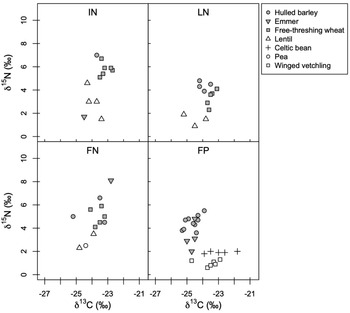
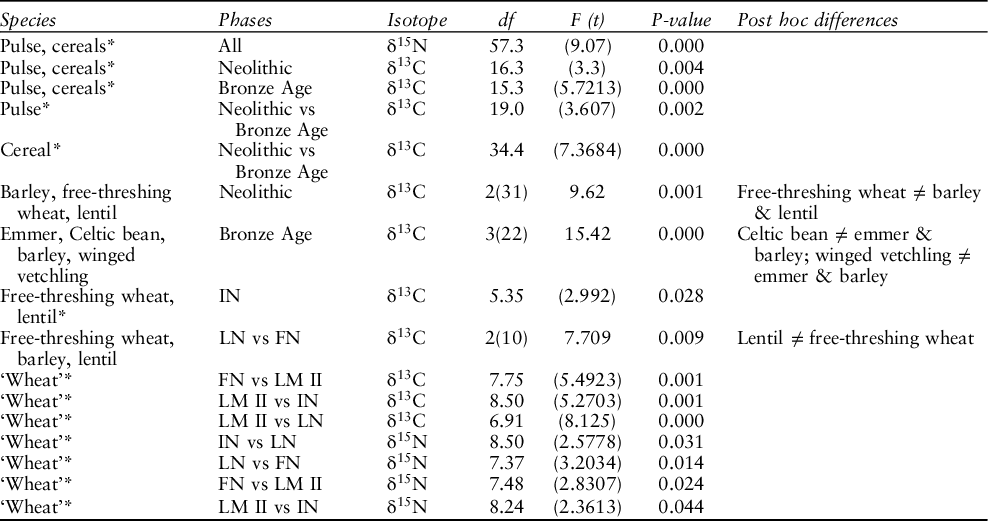
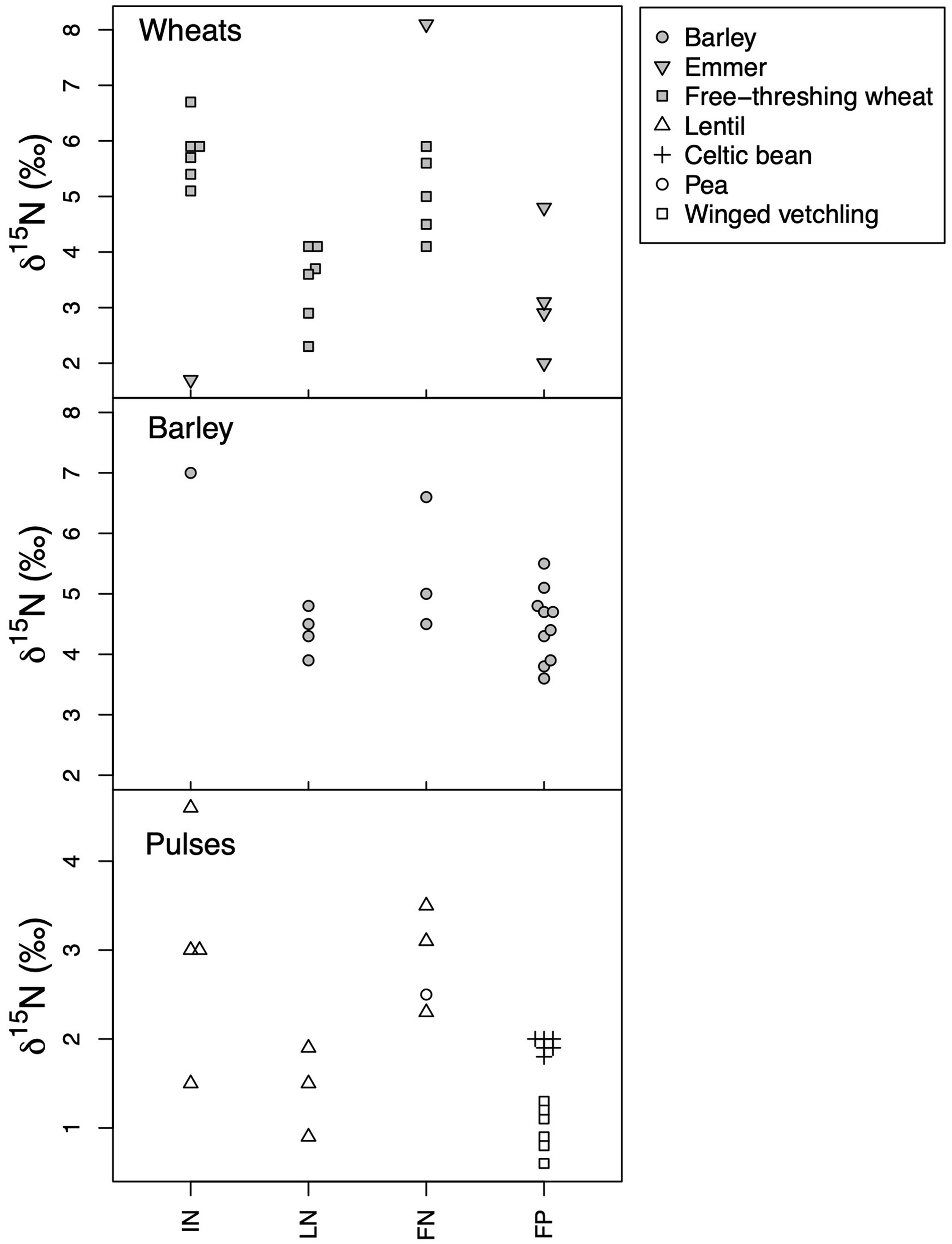
The results from stable isotope analysis of carbonised grains are detailed in Table S1, while summary δ13C and δ15N data are presented by broad crop type (cereals, pulses) and chronological period (Neolithic, Bronze Age) in Table 2 and displayed by crop taxon and chronological phase (IN, LN (including 13 cereal and two pulse samples of LN I and one pulse sample of LN II date), FN, FP) in Figure 4. The standard deviations for δ13C (cereals ±0.7‰, pulses ±0.9‰) and δ15N (cereals ±1.3‰, pulses ±1.0‰) values suggest that the samples overall represent a range of growing conditions (cf. Nitsch et al. Reference Nitsch, Charles and Bogaard2015, 11 table 5), as do those of Neolithic cereals and pulses and, in part, Bronze Age cereals (δ15N only) and pulses (δ13C only). ANOVA and Welch two-sample t-test analysis (Table 3) highlights significant differences between broad crop types and chronological periods, especially in δ13C, and between some crop taxa and chronological phases.
δ13C and δ15N values for Knossos cereal and pulse crops by phase

RESULTS OF ANOVA & WELCH 2-SAMPLE T-TEST (DENOTED BY *) ANALYSIS OF δ13C & δ15N VALUES OF CEREAL & PULSE GRAINS FROM NEOLITHIC & BRONZE AGE KNOSSOS (≥3 SAMPLES PER TEST; ONLY TESTS WITH SIGNIFICANT P-VALUE SHOWN).

Full details for post hoc test provided in Table S3
‘Wheat’ = emmer and free-threshing wheat combined
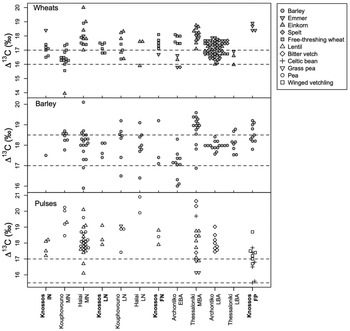
Variability in growing conditions might in principle reflect climate/weather or husbandry practices. While pulse δ13C values are lower in the Neolithic than the Bronze Age, however, and thus consistent with suggestions of long-term aridification, those for cereals exhibit the opposite tendency (Table 2, Fig. 4). This suggests that any effects of such climate change (cf. Riehl et al. Reference Riehl, Pustovoytov, Weippert, Klett and Hole2014) are overridden by differences in husbandry, both diachronically and between pulses and cereals.
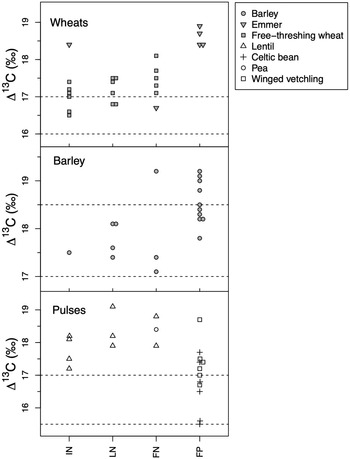
In terms of δ13C values, Figure 4 shows a striking contrast between the Neolithic and FP samples in the relative position of cereals and pulses: whereas pulses (mostly lentil) tend to be similar to or lower than the predominant cereal (free-threshing wheat) through the Neolithic, FP pulses are mostly higher than the associated cereals. Figure 5 expresses the Knossos stable carbon isotope values in terms of Δ13C, enabling comparison with modern baselines for poorly to well-watered cereals and pulses. Neolithic pulses all fall into the ‘well-watered’ band, as do most samples of the predominant Neolithic cereal, free-threshing wheat, while a few of the latter and almost all barley samples are moderately watered. By contrast, the FP cereals (emmer and barley) are mostly ‘well-watered’, while the associated pulses (winged vetchling and Celtic bean) are variously moderately or well-watered. These results suggest that the Neolithic free-threshing wheat and pulses grew under similar conditions as regards water availability and so were potentially rotated or inter-cropped on the same plots, a possibility further explored below in terms of nitrogen. The apparently drier growing conditions of Neolithic barley are potentially due to sowing, as was usual in recent pre-mechanised agriculture in Greece, later in the rotation cycle than wheat and thus with greater competition for moisture from weeds. Of the FP crops stored in the Unexplored Mansion, however, pulses and barley apparently experienced quite variable water availability and so cannot have been grown on the same plots of land as, and in rotation with, the strikingly well-watered emmer wheat (Nitsch et al. Reference Nitsch, Jones, Sarpaki, Hald, Bogaard, Garcia, Orgeolet, Pomadère and Zurbach2019).
Δ13C values for Knossos cereal and pulse crops by phase compared with modern reference bands (separated by dashed horizontal lines) representing ‘well-watered’ (uppermost), ‘moderately-watered’ (intermediate), and ‘poorly-watered’ (lowermost) growing conditions (Wallace et al. Reference Wallace, Jones, Charles, Fraser, Halstead, Heaton and Bogaard2013); reference lines for barley assume a mixture of 2- and 6-row varieties

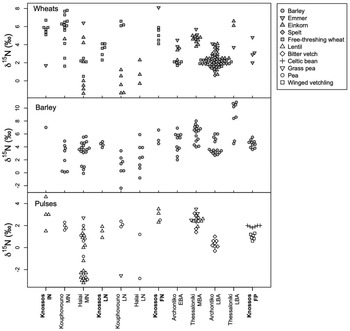
Figure 6 also reveals diachronic variation in δ15N values, which are generally higher for cereals and pulses in the IN, lower in the LN, and then again higher in the FN and lower in the FP. Manuring of cereals is plausible at moderate levels throughout the Neolithic sequence, while for pulses the elevation of many δ15N values well above 0‰, the value of atmospheric N2, suggests manuring heavy enough to inhibit their fixation of nitrogen from this source. Manuring was perhaps particularly intensive when the community was very small during the IN (when one emmer sample with a strikingly low δ15N value of 1.7‰ was potentially grown on a fertile newly cleared plot, manuring of which would have been counter-productive: Halstead Reference Halstead2018) and decreased with expanding community size during the later Neolithic. In the recent past, intensive manuring was often limited, even with animal traction, to within c. 500 m of the settlement (Halstead Reference Halstead2014, 217) and this threshold was perhaps reached (see Isaakidou Reference Isaakidou2008, 103 table 6.2) during LN II or FN if the population of Knossos approached not 250 or less but 400–500 head (Table 1). If so, the subsequent FN recovery in cereal δ15N values might reflect greater use of draught cattle to promote intensive gardening, given the increase through the Neolithic in the relative abundance of cattle and the severity of traction-related skeletal remodelling/pathologies (cf. Isaakidou Reference Isaakidou, Serjeantson and Field2006; Reference Isaakidou2008; Reference Isaakidou, Hadjikoumis, Robinson and Viner2011). Either way, δ15N values of LN and FP cereals and pulses suggest relatively light manuring that is consistent, for the latter phase, with the extensive agriculture anticipated on the basis of urban growth at Knossos and of Linear B textual evidence for grain production.
δ15N values for Knossos cereal and pulse crops by phase

RESULTS AND DISCUSSION: FAUNAL REMAINS
The results from stable-isotope analysis of faunal samples are detailed in Table S2a–b. Of 645 faunal samples, 71% yielded usable results. Failure rates decline from Neolithic (42%) to Bronze Age (14%) and through successive Bronze Age phases (Table S4), inviting attribution to length of burial. Failures are particularly high in cattle, however, identifying significant observed differences between species in culinary (Isaakidou Reference Isaakidou2005, 196–203; Reference Isaakidou, Mee and Renard2007) and discard treatment (Isaakidou Reference Isaakidou2008, 95 fig. 6.2) as possible contributory factors (eg, depletion of bone collagen by prolonged boiling of intensively fractured cattle bones – cf. Roberts et al. Reference Roberts, Smith, Millard and Collins2002).
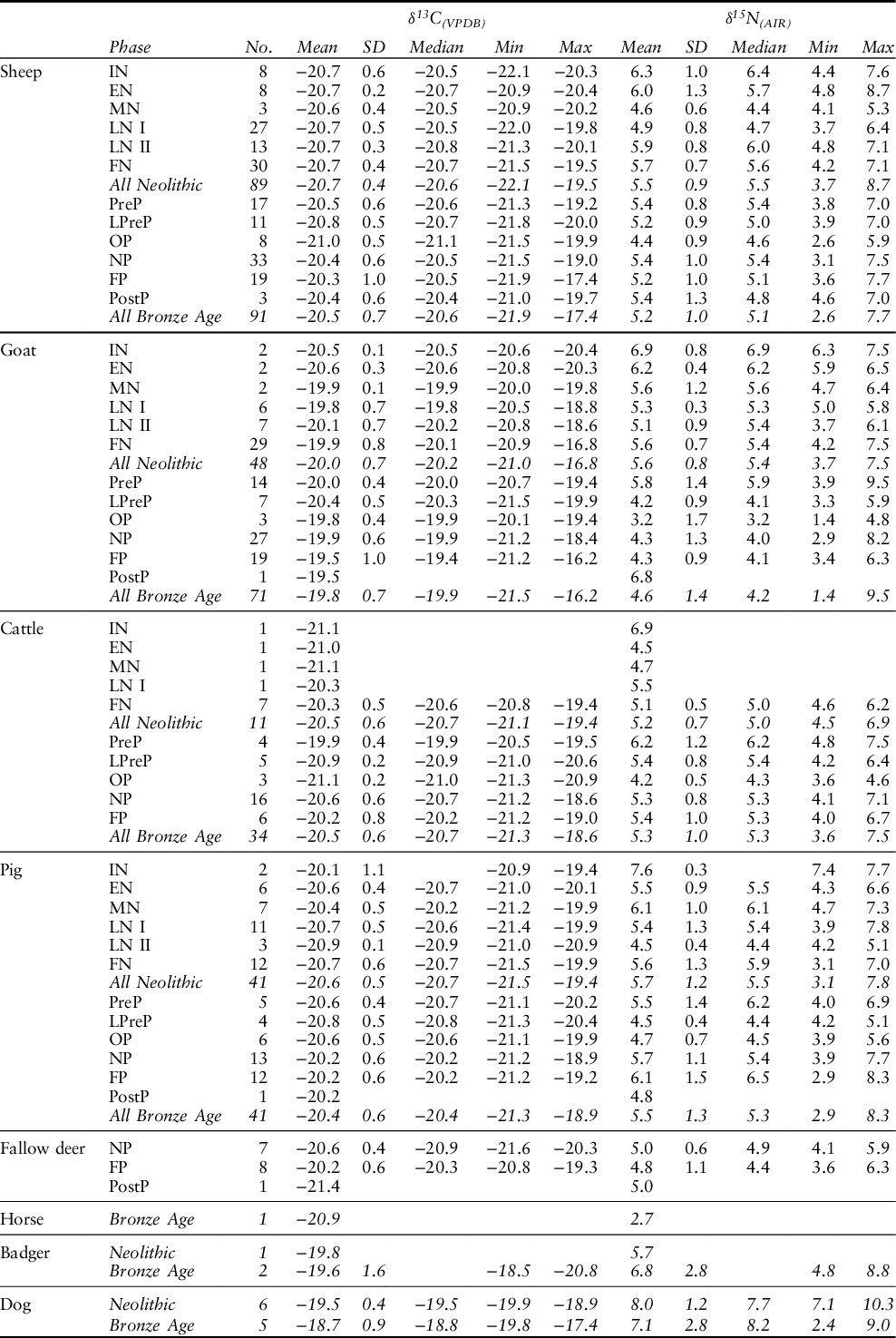
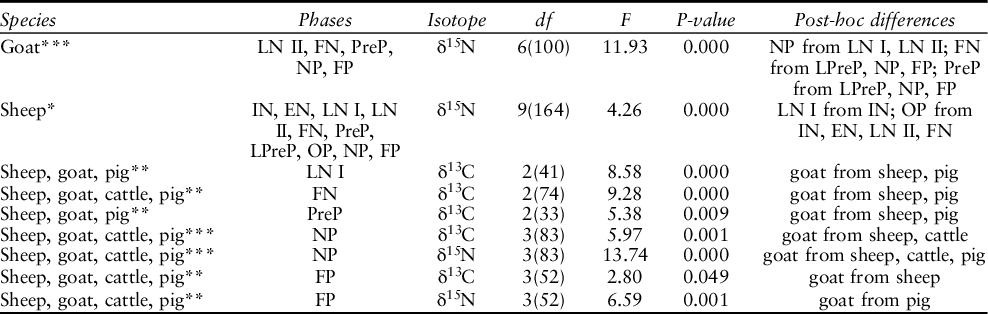
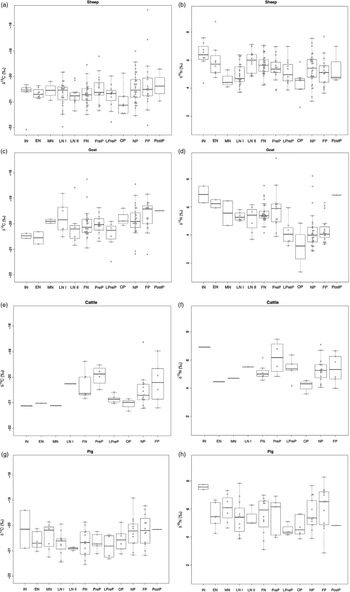
Table 4 presents summary statistics and Figure S3 scatter plots of δ13C and δ15N results by phase for all species, while Figure 7 displays these data as box-and-whisker plots (with outliers representing values exceeding interquartile range × 1.5 for each phase) for sheep (Fig. 7a–b), goat (Fig. 7c–d), cattle (Fig. 7e–f) and pig (Fig. 7g–h). Table 5, below, shows significant (p<0.05) differences (ANOVA with Tukey’s post-hoc tests) in δ13C and δ15N values between phases for both sheep and goat (the two largest samples) and between goat and other common livestock species for individual phases.
SUMMARY STATISTICS FOR δ13C & δ15N VALUES OF ANIMAL BONE COLLAGEN FROM NEOLITHIC & BRONZE AGE KNOSSOS

SD = 1 standard deviation (1σ)
RESULTS OF ANOVA ANALYSIS OF δ13C & δ15N VALUES OF ANIMAL BONE COLLAGEN FROM NEOLITHIC & BRONZE AGE KNOSSOS (ONLY TESTS WITH SIGNIFICANT P-VALUE SHOWN)

Full details for Tukey post hoc test provided in Table S5
* ≥5 samples per phase
** ≥5 samples per species
*** ≥5 samples per phase; excluding two mandibles of unweaned goats
Boxplots of Knossos bone collagen δ13C and δ15N values by phase for a–b) sheep, c–d) goat, e–f) cattle and g–h) pig

We first consider the possible impact of long-term aridification or late 7th (EN), late 5th (FN) and late 3rd (LPreP) millennia cooler, drier episodes. Aridification should raise δ13C and δ15N values, but no consistent long-term trend is evident: δ13C values rise in goats, but only slightly in sheep, and fluctuate in pigs; δ15N values fluctuate in sheep and pigs and decline in goats; data for cattle are few and uninformative (Fig. 7). Nor are expected dry episodes mirrored in short-term peaks in δ13C or δ15N values. For sheep, offering the most continuous diachronic dataset, mean δ13C and δ15N values are strikingly low in OP, but not unusually high in EN, FN, or LPreP. For goat, the highest δ13C and δ15N outliers date to climatically ‘normal’ FP and PreP, respectively; and, while the second highest δ13C outlier (-16.8‰) from a FNIB deposit might date to a late 5th millennium (Tomkins Reference Tomkins2020, 56, fig. 2) dry episode, the same excavation context yielded four other goat specimens with values (-20.2 to -19.7‰) close to the Neolithic (-20.0‰) and Bronze Age (-19.8‰) means. Husbandry thus apparently overrides climate change in shaping observed variability in livestock stable isotope values, as also in crop δ13C values (above). Likewise, since diachronic trends in δ13C and δ15N values differ between sheep, goats and pigs, husbandry practices evidently override any effects of physiological differences between species in shaping livestock stable isotope values.
Excluding the phase-by-phase outliers defined for sheep, goat, and cattle (Fig. 7), which are discussed in Supplementary text S5, we next compare the bone collagen data to modelled δ13C and δ15N values for Neolithic and Bronze Age forage categories to explore the dietary, and thus – indirectly – husbandry patterns, of each animal species consumed at Knossos. Modelled values for forage derived from cultivated land are based on measured values for ancient Knossian grain, while those for forage from uncultivated land are based on comparative east Mediterranean data assuming mean annual rainfall at Knossos of ∼500 mm. In comparing modelled forage values with bone collagen data, we assume trophic-level shifts between plant diet and animal tissue in herbivores and pigs of 5‰ for δ13C and 4‰ for δ15N (Supplementary text S2). The resulting dietary reconstructions are plausible in terms of livestock feeding preferences and Knossos’ changing size and regional status. The adoption of different values for mean rainfall (∼600 mm) and for trophic-level shifts (δ13C – 4‰ or 6‰; δ15N – 3‰ or 5‰) yields dietary reconstructions either broadly similar or less compatible with livestock feeding preferences and other known constraints (see Supplementary text S6).
Sheep
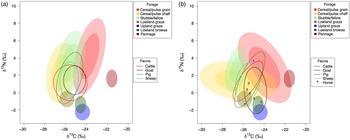
For sheep, the most abundant animal at Knossos, the range of δ13C values broadens over time, implying long-term dietary diversification, while δ15N values exhibit IN–LN I and LN II–OP cycles of decline interrupted by LN II and NP recovery (Fig. 7a–b, Table 4). Figure 8 displays these results, adjusting bone collagen values for trophic level shifts of ∼5‰ in δ13C and ∼4‰ in δ15N, as 95% confidence ellipses overlain on modelled ellipses for different forage categories at 500 mm rainfall.
δ13C and δ15N values (95% confidence ellipses, excluding phase-by-phase outliers) of domestic animal species, compared with modelled forage categories (after Fig. S1) for a) Neolithic and b) Bronze Age Knossos; bone collagen values adjusted for trophic level shifts of ∼5‰ in δ13C and ∼4‰ in δ15N values; numbers in Fig. 8b denote FP mandibular specimens of sheep (1–3) and goat (4–6) discussed in the text

For Neolithic sheep (Fig. 8a), δ13Cdiet indicates consumption overwhelmingly of C3 plants, as expected, and best matches the modelled ranges for C3 forage from cultivated land and, more marginally, lowland rough pasture. Of the former, C3 grain was apparently not of major importance, while small ruminants like sheep are ill suited to a coarse diet of cereal straw/chaff. Sheep, under traditional Mediterranean management, only consumed cereal straw/chaff if supplemented by higher-quality grain, hay, or pulse straw, but were widely and closely associated with stubble/fallow and, less so, young cereal pasture. Sheep δ15Ndiet values largely overlap the modelled range for fallow/stubble pasture, indicating the close association of Neolithic sheep with more (especially in IN and LN II, with high δ15Ndiet values) or less well-manured, cultivated land, but also extend into the range for lowland rough graze. In practice, most sheep probably exploited a mixture of cultivated and rough graze, given their partly complementary seasonal availability.
Bronze Age sheep likewise consumed a predominantly C3 plant diet, including both forage from cultivated land and rough graze (Fig. 8b). Of the former, their δ13Cdiet overlaps most with nutritionally improbable straw/chaff, moderately with grain, and least with stubble/fallow graze, but the modelled range for stubble/fallow may be misleadingly narrow and low due to derivation exclusively from analyses of cereal grain in the FP ‘Unexplored Mansion’ destruction horizon. Cereals and pulses from this complex were not grown in rotation on the same land (above), so the relatively well-watered cereals represent only part of the range of FP growing conditions. Accordingly, fallow/stubble pasture was probably again the primary contribution of cultivated land to Bronze Age sheep diet. Lower δ15Ndiet values than in the earlier Neolithic should partly reflect lighter manuring of cultivated land as a corollary of more extensive Bronze Age agriculture, but also suggest heavier use of rough pasture – primarily lowland C3 rough graze, judging by δ13Cdiet values.
Sheep consumed at Neolithic–Bronze Age Knossos were thus closely associated throughout with stubble/fallow pasture on cultivated land, with some use also of lowland rough graze. Over time, stubble/fallow-grazing included more lightly manured land (mirroring more extensive cultivation) and use of C3 rough graze expanded (mainly in the lowlands, but also – as indicated by incremental dental data – seasonally in the uplands). These changes in pasture use arguably reflect an increasing scale of herding.
Goat
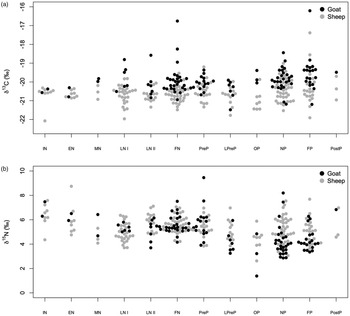
For goat, less abundant than sheep throughout the Knossos sequence, the stable isotope data again reveal a broadening of diet from Neolithic to Bronze Age, but in δ15N rather than δ13C values (Table 4, Fig. 7c–d). Thus, while the two species share very similar IN–EN δ13C and δ15N values, they differ significantly in δ13C values in most phases from the later Neolithic onwards and also in δ15N during the NP (Table 5). This progressive dietary divergence of sheep and goat (Fig. 9a–b) matches expectations that growing livestock numbers would favour their separate herding.
a) δ13C and b) δ15N values by phase for Knossos sheep and goat

Again allowing for trophic-level shifts (δ13C ∼5‰, δ15N ∼4‰), Neolithic goats share with sheep a comparable range of δ15Ndiet values (Fig. 8a), suggesting a similar association (especially in the earlier Neolithic: Fig. S3) with stubble/fallow pasture on well manured cultivated plots, but their somewhat higher δ13Cdiet values (increasingly through the later Neolithic – Fig. S3) imply intake also of browse – possibly from shrubs/trees on boundaries between cultivated plots. In mixed herds on hedged stubble fields in Greece today, while sheep graze weeds and unharvested cereal ears, goats also browse peripheral bushes and brambles (Yiakoulaki & Papanastasis Reference Yiakoulaki, Papanastasis, Alcaide, Salem, Biala and Morand-Fehr2005). Bronze Age goats (Fig. 8b) substantially overlap with sheep and with forage on cultivated land, especially in the pre-palatial phases (Fig. S3), but from LPreP onwards increasingly combine raised δ13Cdiet with low δ15Ndiet values that suggest heavy use of rough browse or possibly upland summer graze; goat feeding preferences favour browse, as do incremental dental δ13C and δ18O values suggesting that at least two FP goats (MUM78 and MUM70: Fig. 8b nos 4–5) remained year-round in the lowlands (Isaakidou et al. Reference Isaakidou, Styring, Halstead, Nitsch, Stroud, le Roux, Lee-Thorp and Bogaard2019, 50).
While earlier Neolithic goats were maintained mainly on well manured cultivated land, later Neolithic-PreP goats apparently combined stubble/fallow grazing with browsing, but possibly on the margins of cultivated plots and so were potentially herded with sheep. From the LPreP onwards, however, while some goats still grazed arable land, most exploited rough browse and so were herded separately from sheep (Figs 8b & 9a–b).
Cattle
Cattle are well represented in the faunal assemblage from MN onwards, but by very fragmented (Isaakidou Reference Isaakidou2005, table 6.12) and perhaps intensively boiled specimens and thus by sparse isotopic data. Cattle diet ostensibly broadens slightly from Neolithic to Bronze Age, with lowest and highest δ13C and δ15N values of palatial date, but Bronze Age data are more abundant than Neolithic.
With the same trophic-level adjustments, the δ13C and δ15N ranges for both Neolithic and Bronze Age cattle essentially replicate those for sheep and so again indicate heavily C3-dominated diet with reliance primarily on forage (stubble/fallow graze and/or straw/chaff fodder) from more or less manured, cultivated land, supplemented by some rough grazing (Fig. 8a–b). Among Bronze Age cattle (but not sheep), low δ13Cdiet values tend to be associated with low δ15Ndiet and high δ13Cdiet with high δ15Ndiet (Figs 8b & S3). The former may reflect the ability of cattle (unlike sheep) to survive on a coarse diet of straw (cf. Bell Reference Bell1971), while the latter may be due to feeding of C3 grain supplements to some animals.
Pig
For both Neolithic and Bronze Age pigs, modestly represented in the assemblage, the ranges of δ13C and δ15N values again largely replicate those for sheep (Fig. 7g–h). Applying the same trophic-level shifts as for sheep, goats, and cattle (Fig. 8a–b), Knossos pigs consumed a diet dominated by C3 forage from more or less manured, cultivated land (especially stubble/fallow graze) and some rough graze. C3 browse (with relatively high δ13Cdiet and low δ15Ndiet values) and pannage (with yet higher δ13Cdiet values) were not important, but Bronze Age pigs with higher δ13Cdiet and also higher δ15Ndiet values (Figs 8b & S3) had perhaps consumed waste human food or, as suggested for some Bronze Age cattle, C3 grain.
Horse
A single Postpalatial equid specimen (proximal metatarsal) is of a size suggesting horse (or conceivably mule, identified at coeval mainland Tiryns: von den Driesch & Boessneck Reference Driesch, Boessneck, Weisshaar, Weber-Hiden, von den Driesch, Boessneck, Rieger and Böser1990) rather than donkey. Assuming trophic-level shifts of 5‰ for δ13C and 4‰ for δ15N, this animal grazed rough pasture with no hint of higher-quality fodder (Fig. 8b).
Dog
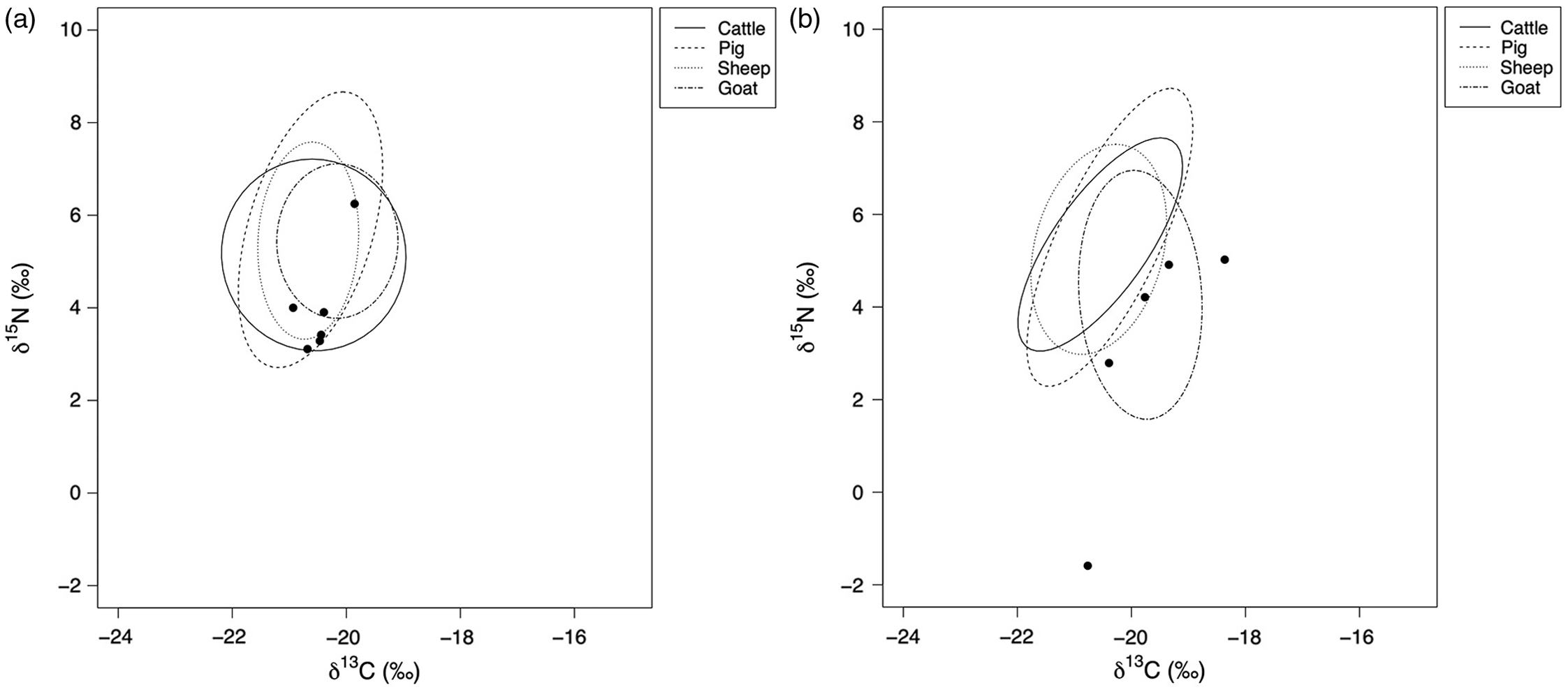
Dogs are represented by low numbers of skeletal remains in all phases. Six Neolithic samples yielded narrower ranges of both δ13C and δ15N values than five Bronze Age specimens (Table 4). To explore whether canine carnivory extended beyond the scavenging for bone marrow that is indicated by gnawing marks (Isaakidou Reference Isaakidou2005), a carnivorous dog diet is modelled assuming prey-predator trophic-level shifts of 1‰ for δ13C and 4‰ for δ15N (Supplementary text S2; Fig. 10). Most of the resulting δ13Cdiet and δ15Ndiet values are compatible with consumption of other domestic animals but would only indicate predominant carnivory if (improbably) Bronze Age dogs mainly ate goats (contrary to the evidence of gnawing traces, present on specimens of all species) and Neolithic dogs mainly ate animals that had grazed rough pasture and lightly manured stubble/fallow. Thus, Knossian dogs, and especially the Bronze Age specimen with the lowest δ15Ndiet value, probably subsisted in large measure on cultivated C3 grain and perhaps mainly, as commonly in the recent past, on cereal bran with lower δ15N values than whole grain (Nitsch et al. Reference Nitsch, Charles and Bogaard2015, table 6).
δ13C and δ15N values for dog (filled circles) compared with 95% confidence ellipses for sheep, goat, cattle, and pig at a) Neolithic and b) Bronze Age Knossos; bone collagen values for dog adjusted for potential carnivorous trophic level shifts of ∼1‰ in δ13C and ∼4‰ in δ15N values

Badger
Badgers are as well represented as dogs in the Neolithic, but thereafter very scarce. The δ13C and δ15N values of one Neolithic and two Bronze Age specimens fall largely within the ranges for dogs, consistent with the expected omnivorous diet.
Fallow deer
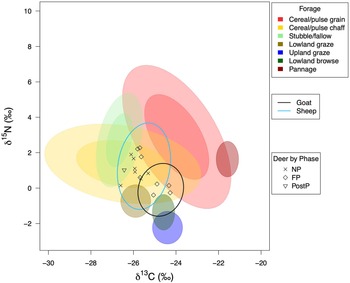
Fallow deer bones occur in small numbers at palatial Knossos and, albeit possibly due to excavation bias, only in elite contexts. Seven NP samples essentially fall within the δ13C and δ15N ranges of Knossos NP–PostP sheep, as does the single PostP specimen. Eight FP samples exhibit similar δ15N values but a broader δ13C spread across both sheep and goat ranges (Table 4). Assuming trophic-level shifts of 5‰ for δ13C and 4‰ for δ15N (Fig. 11), the NP, PostP, and four ‘sheep-like’ FP specimens suggest diet dominated by stubble/fallow grazing on variably manured land, perhaps with some rough grazing, while the four ‘goat-like’ specimens fall near the interface between arable-based forage and lowland browse. European fallow deer (Dama dama) in temperate Europe (Jackson Reference Jackson1977; Putman et al. Reference Putman, Culpin and Thirgood1993), like Persian fallow (D. mesopotamica) in the east Mediterranean (Zidon et al. Reference Zidon, Leschner, Motro and Saltz2017), are mixed grazers/browsers, while the former at least raid field-crops from wooded refuges (Thirgood Reference Thirgood1995). European fallow deer on the southern Aegean island of Rhodes, however, avoid pasture and water fouled by sheep and compete more with domestic goats (Theodoridis et al. Reference Theodoridis, Voulgaris and Papastergiou2008). It is tempting, therefore, to identify the ‘sheep-like’ specimens as enclosed on farmland (as at Dudley Castle, England: Sykes et al. Reference Sykes, Ayton, Bowen, Baker, Baker, Carden, Dicken, Evans, Hoelzel, Higham, Jones, Lamb, Liddiard, Madgwick, Miller, Rainsford, Sawyer, Thomas, Ward and Worley2016, 121 fig. 8) and their ‘goat-like’ counterparts as free-range, whether escaped or released, and more reliant on rough browse. The suggested enclosure of this imported deer species is of considerable intrinsic importance for understanding its management on Bronze Age Crete but is also methodologically significant in precluding use of stable isotope values for fallow deer as a proxy measure for ‘natural’ coarse pasture, free from anthropogenic inputs.
δ13C and δ15N values by phase for Knossos fallow deer compared with 95% confidence ellipses for Bronze Age Knossos sheep and goat and with modelled forage categories (after Fig. 8b); bone collagen values adjusted for trophic level shifts of ∼5‰ in δ13C and ∼4‰ in δ15N values

RE-ASSESSING KNOSSIAN LAND USE AND POLITICAL ECONOMY
Mixed farming: integration of crops and livestock
Perhaps the most salient feature of the Knossos stable isotope results is the implied close interdependence of arable and pastoral farming: cultivated land was throughout the Neolithic and Bronze Age a key pasture resource for livestock, especially sheep, but also pigs, cattle, and to some extent goats; and animal manure underpinned intensive crop husbandry, especially in the earlier Neolithic. The importance of manure to early crop husbandry raises questions regarding its attendant risks, distribution, and availability. First, recent Cretan farmers spread manure very sparingly, from fear of crops ‘burning’ in drought years (Halstead Reference Halstead2014, 213–15) but a generally moister Bronze Age and, especially, Neolithic climate would have mitigated this risk. Secondly, draught cattle could have eased distribution of any stall-manure and human night-soil accumulated at the settlement (Isaakidou Reference Isaakidou2008) but mild winters and lack of predators (other than stray dogs, large raptors, and other humans) would have limited need for stalling, while delivery of dung (and urine) directly by grazing or penned livestock would have saved human labour in muck-spreading (Halstead & Isaakidou Reference Halstead, Isaakidou, Gron, Sørensen and Rowley-Conwy2020). Thirdly, availability of manure depends on the scale and form of animal husbandry. Early livestock, if closely tied to small, cultivated plots, would have been few in number: a family of say 4–5 head sowing only 1–2 ha of grain crops (Halstead & Isaakidou Reference Halstead, Isaakidou, Gron, Sørensen and Rowley-Conwy2020, 91–2) might maintain at most 1–2 sheep solely on stubble/fallow pasture (at 1/ha: Le Houerou Reference Houérou and Krause1977, 259). Penning these animals overnight on such plots (in addition to grazing stubble, fallow, and, in lean seasons, rough pasture) would have made maximum use of available manure (Halstead & Isaakidou Reference Halstead, Isaakidou, Gron, Sørensen and Rowley-Conwy2020) and, thanks to deposition of both urine and faeces, may have enhanced crop δ15N values more than would dry stall manure (cf. Abell et al. Reference Abell, Quade, Duru, Mentzer, Stiner, Uzdurum and Özbaşaran2019), but seems unlikely to have maintained the fertility levels implied by crop δ15N values (Halstead & Isaakidou Reference Halstead, Isaakidou, Gron, Sørensen and Rowley-Conwy2020, 91–2). Alternatively, a family with access to working cows that sowed say twice the area of grain crops normally needed (cf. Halstead Reference Halstead and Halstead1989) and allowed livestock to graze any growing crops that failed due to drought or weeds or lodging (stem collapse – a particular risk with heavy manuring), or were surplus to human needs, might have supported 5–10 sheep or more (cf. Le Houerou Reference Houérou and Krause1977, 263 table 3). Penning of animals on sown cereal pasture entails radically closer integration of early crop and livestock husbandry than is usually envisaged but would account better than more familiar husbandry regimes for the high δ15N values of earlier Neolithic Knossos cereals and pulses (Halstead & Isaakidou Reference Halstead, Isaakidou, Gron, Sørensen and Rowley-Conwy2020).
After the earlier Neolithic there are indications of more extensive crop husbandry and of livestock management on more distant and varied pasture that extended to lightly manured arable land, rough graze (including transfer of some palatial-era sheep to uplands in summer) and, for Bronze Age goats, arboreal browse. Use of distant rough pasture would have facilitated the escape of adventurous livestock and formation of feral populations, suspected from the later Neolithic onwards on biometric grounds (Isaakidou Reference Isaakidou2005), but stable isotope data as yet neither support nor refute this scenario.
Land use in socio-political context
Other things being equal, a likely corollary of the growth of Knossos and associated expansion of crop husbandry was increasingly unequal access to good-quality, nearby land suitable for intensive cultivation, while access to draught cattle for tillage and transport would also have become more critical (Isaakidou Reference Isaakidou2008). On the other hand, communal rather than household-level production and consumption of food, as proposed by Tomkins (Reference Tomkins, Barrett and Halstead2004) for the earlier Neolithic, might initially have countered any such tendency. δ15N values for IN cereals are quite variable, but might reflect the time elapsed since, rather than intensity of, manuring. For IN–MN sheep, however, although the narrow δ13C range is compatible with shared grazing on relatively uniform pasture, variable δ15N values imply these animals were not herded together across the community’s stubble, fallow and perhaps sown plots, but were confined in small numbers on particular plots or holdings with contrasting manuring histories. Both livestock and cultivation plots, therefore, from early in the settlement’s life, were apparently managed not collectively but by small (‘household’) units. Moreover, on this scenario, the broad crop δ15N range probably does reflect manuring of variable intensity and thus differences between earlier Neolithic households in livestock numbers and also in area sown and the potential for surplus grain production. In turn, a differential capacity to provide ‘surplus’ grain to needy neighbours or meat for commensal occasions is likely to have underpinned competitive dynamics within Neolithic society (Halstead Reference Halstead and Halstead1989; Isaakidou Reference Isaakidou2008, 105–7).
Thereafter, values for δ13C (from MN) and δ15N (from LN II) progressively diverge between sheep and goats (Fig. 9a–b), implying use of increasingly different and thus distant pasture, and hence active herding of the two species independently of each other, such that the increasing proportion of goats relative to sheep from the later Neolithic onwards (Isaakidou Reference Isaakidou2008, 95 fig. 6.2) arguably represents an absolute as well as relative expansion of goat numbers. Herding labour may accordingly have displaced pasture as the limiting factor on livestock numbers, while large, excavated houses at later Neolithic Knossos, if accommodating extended households (Isaakidou Reference Isaakidou2005, 64), could better have mobilised additional labour for larger and more mobile herds (cf. Halstead Reference Halstead2014, 292–4).
While crop and livestock stable isotope values document increasingly extensive husbandry over the early 7th–late 2nd millennia bce, consistent with expectations from the expanding size and regional sway of Knossos, the pace of demographic and political change was uneven and the same might be expected of land use. Indeed, cereal δ15N values are higher in IN (5.5–7.3‰, mean 6.3‰; excluding the low outlier discussed above) and FN (4.5–8.4‰, mean 6.0‰) than intervening LN I (2.6–5.2‰, mean 4.1‰). Cereal δ15N values are not currently available for other phases of the Neolithic, but those for sheep, closely linked to arable land and thus plausible proxies for cereal growing conditions, decline from IN to LN I, before increasing in LN II-FN (Fig. 7b). The low LN I δ15N values for cereals and sheep coincide with expansion of the settlement and thus its cultivated radius, apparently resulting in less intensive crop husbandry that was subsequently reversed, perhaps by FN cessation of growth (Table 1) and/or increasing LN–FN frequencies of cattle (Isaakidou Reference Isaakidou2008), some bearing stress markers consistent with draught use (Isaakidou Reference Isaakidou, Serjeantson and Field2006). Bronze Age crop stable isotope data are limited to the elite FP ‘Unexplored Mansion’, but sheep δ15N values again offer a proxy for cereal growing conditions with a renewed cycle of decreasing values from LN II–FN to OP and then NP–FP increase. OP Knossos was one of at least three palatial towns in central Crete, but FP and perhaps NP Knossos had subsumed its largest ‘rival’ at Phaistos to the south, probably also that at Malia to the east, and many smaller centres (Bennet Reference Bennet1985; Reference Bennet, Bang and Scheidel2012, 239–41). A plausible reading of sheep δ15N values, therefore, is that rapid urban growth at OP Knossos was supported by extensive cultivation at increasing distance, but NP–FP Knossos relied more on mobilising grain and livestock raised on subordinate centres’ core rather than marginal land (as argued from FP texts for grain and sheep: Halstead Reference Halstead, Sheridan and Bailey1981b; Bennet Reference Bennet1985).
The FP texts do not document provisioning of the ruling elite itself (cf. Lane Reference Lane2004, for the mainland palace at Pylos), who presumably consumed produce from their own gardens, fields, and herds, of which the first may have occupied open spaces between urban elite buildings (Shaw Reference Shaw1993, 680) and the second appear in FP texts (Zurbach Reference Zurbach2005, 325–8). The ‘Unexplored Mansion’ pulses, judging by their elevated δ15N values, were indeed products of intensive gardens, while the cereals were grown in well-watered conditions and so probably on good land (possibly after bare fallow to eradicate weedy competitors for moisture), perhaps equivalent to that at the FP subordinate centres from which ‘wheat’ was centrally mobilised. Lastly, if fallow deer consumed at Knossos were initially penned, as stable isotope results suggest, this would have facilitated socially restricted exploitation, consistent with their recurrence in both Cretan and mainland elite art (Palmer Reference Palmer, Carlier, De Lamberterie, Egetmeyer, Guilleux, Rougemont and Zurbach2012) and reinforcing the argument that diacritical cuisine helped legitimise the palatial elite (Isaakidou Reference Isaakidou, Mee and Renard2007).
Knossos in Aegean context
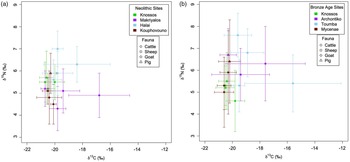
Carbon and nitrogen stable isotope values for Knossos cereals and pulses largely fall within the ranges previously reported for Neolithic and Bronze sites on the Greek mainland (Figs 12–13; Vaiglova et al. Reference Vaiglova, Bogaard, Collins, Cavanagh, Mee, Renard, Lamb, Gardeisen and Fraser2014a; Reference Vaiglova, Gardeisen, Buckley, Cavanagh, Renard, Lee-Thorp and Bogaard2020; Reference Vaiglova, Coleman, Diffey, Tzevelekidi, Fillios, Pappa, Halstead, Valamoti, Cavanagh, Renard, Buckley and Bogaard2021; Styring et al. Reference Styring, Fraser, Arbogast, Halstead, Isaakidou, Pearson, Schäfer, Triantaphyllou, Valamoti, Wallace, Bogaard and Evershed2015; Nitsch et al. Reference Nitsch, Andreou, Creuzieux, Gardeisen, Halstead, Isaakidou, Karathanou, Kotsachristou, Nikolaidou, Papanthimou, Petridou, Triantaphyllou, Valamoti, Vasileiadou and Bogaard2017), reflecting similarity in the relatively small-scale arable landscapes that early farmers created (cf. Bogaard Reference Bogaard2005), despite regional differences in climate. Livestock display greater inter-site isotopic differences (Table S6; Fig. 14a–b), reflecting use of regionally variable pasture resources beyond (and in addition to) arable land. Most strikingly, central and north Greek cattle at EN–LN Halai (Vaiglova et al. Reference Vaiglova, Coleman, Diffey, Tzevelekidi, Fillios, Pappa, Halstead, Valamoti, Cavanagh, Renard, Buckley and Bogaard2021, 11 fig. 3), LN Makriyalos (Vaiglova et al. Reference Vaiglova, Halstead, Pappa, Triantaphyllou, Valamoti, Evans, Fraser, Karkanas, Kay, Lee-Thorp and Bogaard2018, 13 table 3), late EBA-LBA Archontiko and LBA Toumba Thessalonikis (Nitsch et al. Reference Nitsch, Andreou, Creuzieux, Gardeisen, Halstead, Isaakidou, Karathanou, Kotsachristou, Nikolaidou, Papanthimou, Petridou, Triantaphyllou, Valamoti, Vasileiadou and Bogaard2017, tables S6 & S7) exhibit some high δ13C values attributable to grazing on saline coastal pasture. Conversely, in the absence of such pasture, cattle at MN–LN Kouphovouno (Vaiglova et al. Reference Vaiglova, Bogaard, Collins, Cavanagh, Mee, Renard, Lamb, Gardeisen and Fraser2014a, 209 table 2) and LBA Mycenae (Price et al. Reference Price, Krigbaum and Shelton2017, 121–2 tables 1–2) on the southern mainland and at Neolithic-Bronze Age Knossos exhibit δ13C and δ15N values close to those of sheep and probably grazed on cultivated land.
Δ13C values for Knossos cereals and pulses by phase compared with those for other Neolithic and Bronze Age sites in Greece; dashed horizontal lines separate modern reference bands representing ‘well-watered’ (uppermost), ‘moderately-watered’ (intermediate) and ‘poorly-watered’ (lowermost) growing conditions (Wallace et al. Reference Wallace, Jones, Charles, Fraser, Halstead, Heaton and Bogaard2013); reference lines for barley assume a mixture of 2- and 6-row varieties

δ15N values for Knossos cereals and pulses by phase compared with those for other Neolithic and Bronze Age sites in Greece

Bone collagen δ13C and δ15N mean values and standard deviations (± 1 σ) for Knossos sheep, goats, cattle and pigs compared with other sites in Greece: a) Neolithic and b) Bronze Age

Indeed, despite the very large scale of herding in central Crete, at least in the textually rich FP phase, the isotopic ranges of the common livestock species differ much less at Knossos (with significant differences only between goats and the other three species and only from the later Neolithic onwards: Table 5) than at Neolithic Halai, Kouphovouno and Makriyalos or Bronze Age Archontiko and Toumba (Fig. 14a–b), consistent with the importance of cultivated land (implied by relatively high δ15N values) to Knossos sheep, cattle and pigs and even, in part, goats. At LBA Mycenae, also a major southern Greek palatial centre, the ranges for all four common domesticates, including goats, are compatible with forage predominantly from cultivated land. Also, while δ15N values of Neolithic Knossos livestock are generally higher than those for Kouphovouno and Makriyalos (but not Halai), Bronze Age values for sheep, goats and pigs, and likewise for sheep and goats from LBA Mycenae, are lower than those for Archontiko and Toumba, consistent with extensive agriculture, and thus lightly/un-manured stubble/fallow pasture, of larger scale on Crete and the southern mainland than in northern Greece, where the urban settlements and complex hierarchies of the later Bronze Age southern Aegean were lacking (Andreou Reference Andreou and Cline2010).
CONCLUSIONS
Large-scale stable isotope analysis of the exceptional archaeobotanical and faunal archive from early 7th–late 2nd millennium bce Knossos has yielded significant insights at several levels. First, despite both long- and short-term climatic changes, any impact thereof on crops or livestock was not detectable isotopically and was overwritten by variation in husbandry (and, doubtless, between good and bad years), underlining the dangers (also Manning Reference Manning and Höflmayer2017) of inferring catastrophic local agricultural failures from trans-regional proxy climate records.
Secondly, in demonstrating the intensive nature of initial grain growing, the close integration therewith of livestock rearing, and the subsequent expansion through the later Neolithic and especially later Bronze Age of extensive agriculture and large-scale herding, it has provided empirical confirmation of land use models previously advanced on largely circumstantial grounds. It likewise confirms the tendency, with expanding scale of husbandry, for differential treatment of cereals and pulses and divergent pasturing especially of goats from sheep, cattle, and pigs. Sheep, however, apparently maintained a close association throughout with pasture on cultivated land and so offer a useful proxy for crop growing conditions, for which direct stable-isotope data are temporally patchy and, in the palatial era, socially selective.
Moreover, a radically unexpected outcome of the apparently close integration of all earlier Neolithic livestock with the cultivated landscape is that apparently generous manuring of grain crops was arguably achieved only by running livestock not only on stubble/fallow plots, but also on crops sown to be harvested for grain or grazed in situ as circumstances dictated. In the longer term, the close association of Neolithic–Bronze Age sheep (the commonest species), but also cattle and pigs, with pasture on cultivated land implies that the number of livestock per head of human population was modest and average human levels of meat consumption consequently low, although this does not rule out a more privileged diet for elite groups or indeed for the inhabitants of Knossos in general. A more direct assessment of human diet, by stable-isotope analysis of human remains, has not been attempted because dependable interpretation of results would require comparative data for coeval and contextually representative archaeobotanical and faunal samples (as, for later Bronze Age northern Greece, by Nitsch et al. Reference Nitsch, Andreou, Creuzieux, Gardeisen, Halstead, Isaakidou, Karathanou, Kotsachristou, Nikolaidou, Papanthimou, Petridou, Triantaphyllou, Valamoti, Vasileiadou and Bogaard2017) and no occupation phase at Knossos has yet yielded adequate samples of all three classes of bioarchaeological remains.
Thirdly, although incomplete contextual information as yet precludes meaningful spatial analysis of the archaeobotanical and faunal data, the more secure and nuanced picture of changing land use achieved for Knossos offers significant insights into the community’s social fabric: for example, implied household-scale management of arable and pastoral farming from the inception of the Neolithic settlement; increasing demands on human labour from perhaps the later Neolithic onwards for herding larger livestock numbers over greater distances and on more diverse pasture; the apparent transition from relatively self-sufficient OP Knossos, maintained by often extensive and probably distant farming of its own territory, to NP–FP Knossos, mobilising produce from previously competing and now subordinate centres; the role of introduced fallow deer in elite diacritical cuisine reinforced by probable NP–FP penning; and provisioning of the FP Knossian elite from (private?) intensive gardens and high-quality fields independent of the centrally administered extensive agriculture recorded in FP texts.
Lastly, it should be emphasised that, while presenting new and highly informative stable isotope results, we have drawn heavily on excavation and survey evidence for the history of Knossos and its region, on written (especially Linear B) records of crop and livestock management, on previous macroscopic study of archaeobotanical and faunal remains, and on ethnographically based models of past husbandry regimes and land use. Each of these strands has played a vital part in advancing understanding of Knossian land use and political economy.
Acknowledgments
Stable-isotope analysis of faunal and charred crop samples from Knossos was funded by the European Research Council (AGRICURB project, grant no. 312785, PI Bogaard). Sampling was authorised by the Greek Ministry of Culture and Sports (permit no. YΠΠOA/ΓΔAΠK/ΔΣANM/TEE/Φ44/207976/4405) with the support of the Heraklion Ephorate of Antiquities, the British School at Athens (BSA), and the directors of the relevant excavations: Nico Momigliano, David Wilson and the late John Evans, Sinclair Hood, and Mervyn Popham. We are indebted to the Hellenic Ministry of Culture and Sports and to the Archaeological Museum of Heraklio and its Director, Dr Stella Mandalaki, for permission to use Fig. 3a; and to John Bennet and Amalia Kakissis of the British School at Athens for permission to use Fig. 3b. We also thank Nina Kyparissi, Angelos Gkotsinas, and Amy Styring for advice and practical support during sampling; Peter Tomkins for the relative dating of Neolithic samples; Gideon Hartman and Alexandra Livarda, for kindly sharing unpublished data; Hervé Bocherens and Ehud Weiss, for access to literature otherwise inaccessible during COVID19 lockdown; John Bennet, Kostis Christakis, and Todd Whitelaw for help in preparing Figs 2–3 and Debi Harlan for drawing to our attention the photograph reproduced as Fig. 3b; and Amy Styring, Peter Tomkins, and two anonymous referees for valuable comments on an earlier draft of this paper.
SUPPLEMENTARY MATERIAL
To view supplementary material for this article, please visit https://doi.org/10.1017/ppr.2022.4