All too often, we bring rose-colored glasses when we look at democracy, glasses handed to us from the dead hands of Enlightened thinkers. (Christopher H. Achen and Larry M. Bartel, Reference Achen and Bartels2016: 328)
In newly democratic or democratizing countries, where people are just beginning to learn the arts of self-government, the question of citizen competence possesses an obvious urgency. (Robert A. Dahl, Reference Dahl1992: 45)
Studying people's aspiration toward democracy without carefully examining what democracy means to them would cause researchers to reach inaccurate conclusions about the relationship between people's support for democracy, regime change, and democratic consolidation. (Tianjian Shi, Reference Shi2014: 220)
For the past two decades, many social scientists and research institutes have conducted numerous public opinion surveys to study how ordinary citizens understand democracy as a political system, and how they react to the process of democratization taking place in their own countries and elsewhere (Heath et al., Reference Heath, Fisher and Smith2005; Mattes, Reference Mattes, Donsbach and Traugott2007; Norris, Reference Norris, Landman and Robinson2009). This article seeks to review and synthesize significant findings of the conceptual and empirical research based on these surveys. To this end, it first highlights puzzling findings on mass responses to democracy throughout the globe, and discusses controversial issues in defining the term ‘democracy’. Then it reviews recent advances in the conceptualization and measurement of democratic understanding. The following section introduces notable findings from the open-ended and closed-ended survey approaches, and discusses their inconsistencies and shortcomings. In view of these limitations, this paper offers a number of specific suggestions for future research.
Puzzles of mass support for democracy
The fall of the Berlin Wall on 9 November 1989 ushered in a new age of public opinion research on democratic culture and politics. Across Africa, Asia, and all other regions of the world, teams of social scientists organized regional barometer surveysFootnote 1 and conducted waves of public opinion surveys. In all of these waves, large majorities of ordinary citizens expressed an affinity for democracy as their preferred system of government (Booth and Richard, Reference Booth and Richard2014; Bratton et al., Reference Bratton, Mattes and Gyimah-Boadi2005; Chu et al., Reference Chu, Bratton, Lagos, Shastri and Tessler2008a, Reference Chu, Diamond, Nathan and Shin2008b; Dalton and Shin, Reference Dalton and Shin2006; Gilani, Reference Gilani2006; Klingemann, Reference Klingemann, Dalton and Welzel2014; Rose et al. Reference Rose, Mishler and Haerpfer1998; Tessler, Reference Tessler2015; Welzel, Reference Welzel2013; UNDP, 2013).
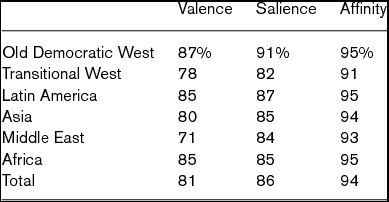
In the latest 6th wave of the World Values Survey (WVS), for example, eight out of ten (81%) global citizens approved of a democratic political system as a ‘very good’ or ‘fairly good’ way of governing their countries. A larger majority (86%) also expressed their personal desire to live in a country that is ‘governed democratically’. In the world in which we live today, more than nine out of ten people (94%) are in favor of democracy either for themselves or their country. More notably, in all regions of the world. including Africa and the Middle East, overwhelming majorities of more than 90% of the adult populations are in favor of democracy for either themselves or their country (see Table 1).
Expressing approval for democracy among global citizenries

Source: 2010–14 World Values Survey.
In a 2013 global survey by the United Nations in 194 countries, people chose democracy as one of the top three priorities for a future global development agenda (UNDP, 2013; Lekvall, Reference Lekvall2013). Even in unexpected areas such as Africa, the Islamic Middle East, Confucian East Asia, and the states of the former Soviet Union, large majorities are favorable toward democracy (Amaney and Tessler, Reference Amaney and Tessler2008; Blokker, Reference Blokker2012; Booth and Richard, Reference Booth and Richard2014; Bratton et al., Reference Bratton, Mattes and Gyimah-Boadi2005; Chu et al., Reference Chu, Diamond, Nathan and Shin2008b; Klingemann et al., Reference Klingemann, Fuchs and Zielonka2008; Rose et al., Reference Rose, Mishler and Haerpfer1998). From these findings, it is apparent that the notion of democracy has achieved overwhelming mass approbation throughout the world and that it has become ‘virtually the only political model with a global appeal’ (Inglehart, Reference Inglehart2003; see also Inglehart and Welzel, Reference Inglehart and Welzel2005; Mattes, Reference Mattes2010).
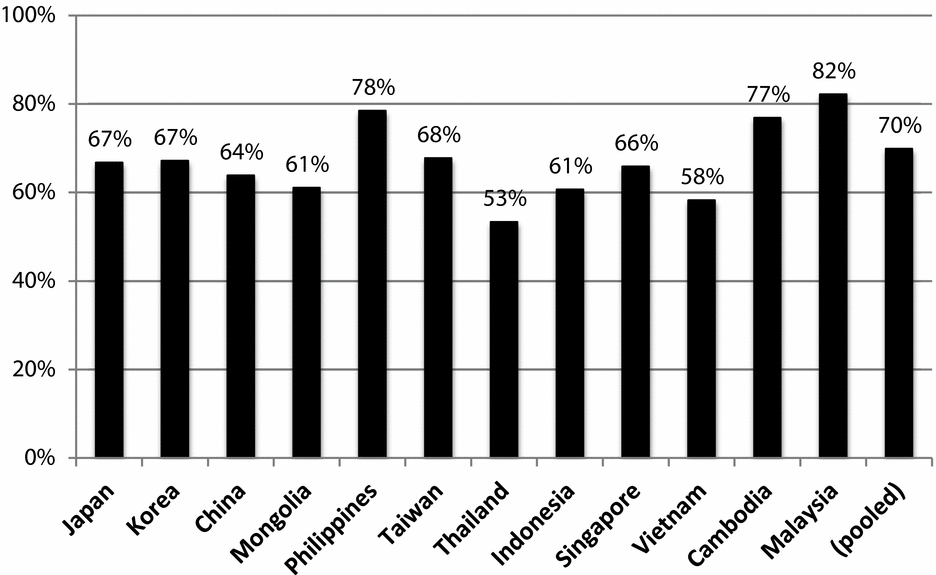
In many of the 3rd-wave democracies in Africa, Asia, Central and Eastern Europe, and Latin America, however, publicly avowed supporters of democratic regimes are known to remain attached to the practices of the authoritarian past even after experiencing decades of democratic rule (Carrion, Reference Carrión and Seligson2008; Chu et al., Reference Chu, Diamond, Nathan and Shin2008b; Bratton et al., Reference Bratton, Mattes and Gyimah-Boadi2005; Dalton and Shin, Reference Dalton, Shin, Dalton and Welzel2014; Hale, Reference Hale2011, Reference Hale2012; Rose et al., Reference Rose, Mishler and Munro2011; Schedler and Sarsfield, Reference Schedler and Sarsfield2007; Shi, Reference Shi, Yun-han, Diamond, Nathan and Shin2008, Reference Shi2014; Shin, Reference Shin2012, Reference Shin2015, Reference Shin2017; Shin and Wells, Reference Shin and Wells2005; Welzel and Alvarez, Reference Welzel, Moreno Alvarez, Dalton and Welzel2014). In all 13 East Asian countries, the latest 4th wave of the Asian Barometer surveyed, for example, majorities of their citizens in favor of democracy as a system of government refuse to reject the old methods of autocratic policymaking, which exclude ordinary citizens from its process.Footnote 2 Two-thirds of the citizens in democratic Japan, Korea, and Taiwan also favor these methods, though they have lived under democratic rule for decades.
A similar trend exists in authoritarian countries like China and Vietnam. Overwhelming majorities (90%) refuse to recognize their one-party autocratic regime as an autocracy (Chu and Huang, Reference Chu and Huang2010; Dalton and Shin, Reference Dalton and Shin2006; Huang, Reference Huang2014; Huang et al., Reference Huang, Chu and Chang2013; Shi, Reference Shi2014). As Christopher Achen and Larry Bartels (Reference Achen and Bartels2016: 6) aptly point out, ‘most people everywhere accept the proposition that their own political system is (somehow) democratic − even more accept the proposition that democracy is (somehow) a good thing’.
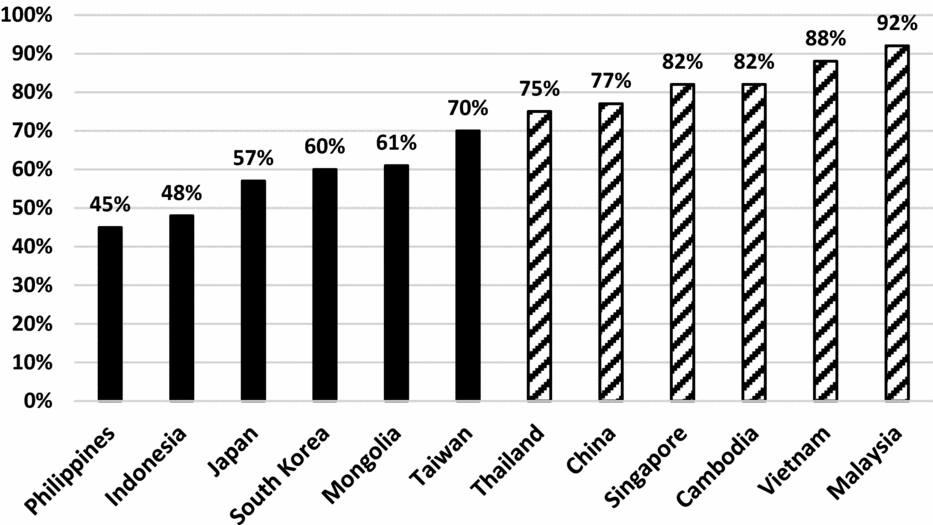
Furthermore, citizens of these autocracies often express a higher level of satisfaction with the way their country is ‘governed democratically’ than do those of democratic Japan, Korea, and Taiwan (see Figure 2). These survey findings indicate that ordinary people around the world do not agree on the meaning of democracy and that many avowed democrats may not be fully capable of differentiating democracy from its alternatives.
East Asians who favor the authoritarian method of governing while preferring the democratic type of regime to its authoritarian alternatives

The East Asians satisfied with the way their country is governed as a democracy

Ironically, those who consider themselves to be avid supporters of democracy show support for authoritarian rule, while those who live in authoritarian regimes view their countries to be more democratic than those who in democratic ones. These puzzling findings make it absolutely necessary to re-examine what democracy inherently means to ordinary citizens (Shi, Reference Shi2014: 220; see also Ariely, Reference Ariely2015; Ariely and Davidob, Reference Ariely and Davidov2011; Bratton, Reference Bratton2010; Carnaghan, Reference Carnaghan2011; King et al., Reference King, Murray, Salomon and Tandon2004). This is because support for democracy matters little if there is no clear understanding of what it means (Welzel, Reference Welzel2013: 310). Ultimately, the important question we should address is not how prevalent self-proclaimed support for democracy is but instead whether this support can be viewed as authentic or genuine.
Contending issues
In the political science literature, democracy is widely known as one of the most popular and yet highly contested concepts with many different connotations (Collier and Levitsky, Reference Collier and Levitsky1997; Dahl et al., Reference Dahl, Shapiro and Cheibub2003; Ferrin and Kriesi, Reference Ferrin and Kriesi2016; Schmitter and Karl, Reference Schmitter and Karl1991). Since the time of ancient Greece, more than two and a half millennia ago, a great deal of change has taken place regarding its ultimate ends and means. Contrary to Aristotle's notion, democracy is no longer viewed as an undesirable or pejorative form of government working exclusively for the interests of the rulers (Baker, Reference Baker1962: book 3). It also no longer allows people to participate directly in all important aspects of governance, as done in Greek city states.
As a system of representative government for the people as a whole, moreover, methods of its daily governance vary considerably from one democratic state to another (Joshi, Reference Joshi2013; Lijphart, Reference Lijphart1999). Even more confusing are the official proclamations of non-democratic one-party states and other autocracies as democracies. Such historic transformations of democracy as a form of government, and the multiplicity of its contemporary practices make it difficult to equate democracy with one particular type of political system. As a result, there is a lot of debate and division over the meaning of democracy, a concept with a long and convoluted history.
What are the contending issues that have led to a plurality of divergent conceptions? One issue concerns whether or not democracy represents a political ideal or reality. To some scholars like Robert Dahl (Reference Dahl1971), democracy can represent an ideal type of political system that responds perfectly or nearly perfectly to the preferences of its people. To others like Richard Rose (Reference Rose1996, Reference Rose2007), on the other hand, it represents an imperfect type of government that exists in the real world of politics.
Even as an imperfect government, it involves a variety of constitutionally defined regime structures and methods of daily governing. How to define democracy, therefore, depends largely upon the chosen level of its characteristics. By and large, definitions become idealistic with the conception of democracy-in-principle, while becoming realistic with that of democracy-in-practice.
Another issue is whether democracy as an existing form of government constitutes a unidimensional or multidimensional phenomenon (Dahl, Reference Dahl1971; Diamond, Reference Diamond1999; Lijphart, Reference Lijphart1999). If it is viewed as a unidimensional phenomenon, democracy is defined narrowly in terms of a few characteristics representing the chosen dimension, such as elections and universal franchise. If it is viewed as a multidimensional phenomenon, it is defined broadly in terms of characteristics of several dimensions, including those of liberalism and constitutionalism. In the political science literature, narrow and broad definitions are often called minimal and maximal or supplemental definitions. They are also called thin and thick definitions (Coppedge, Reference Coppedge1999). Broad or thick definitions encompass not only minimal definitions but also the constitutional guarantees of social rights and the political realization of those rights (Fuchs, Reference Fuchs and Norris1999: 125; Moller and Skaaning, Reference Moller and Skaaning2013: 98).
Even when democracy is viewed as a unidimensional phenomenon, there is a contending issue of which dimension embodies its true character best. When it is defined exclusively in terms of its means, it is equated with ‘government by the people’ (Fish, Reference Fish2005; Przeworski et al., Reference Przeworski, Alvarez, Antonio Cheibub and Limongi2000). When it is defined exclusively in terms of its ends, it becomes ‘government for the people’ (Shi and Lu, Reference Shi and Lu2010). Definitions based on such means as elections and other political institutions and procedures are known as procedural definitions. Those based on their substantive outcomes, such as equality, responsiveness, and welfare, are known as substantive definitions. Procedural definitions are further subdivided into liberal and illiberal categories, depending on whether undemocratic procedures of restricting political participation and competition are taken into account as a defining characteristic of democracy (Carrión, Reference Carrión and Seligson2008; Zakaria, Reference Zakaria1997, Reference Zakaria2007).
Of these two unidimensional types of minimal definitions, the procedural type is far more popular in the current scholarly literature on democratization than the substantive type. Of the two subcategories of the procedural type, liberal procedural definitions are more popular than illiberal procedural ones. As David Collier and Steven Levitsky (Reference Collier and Levitsky1997) note, empirical research on democratization to date has most often equated democracy with the institutional procedures of conducting free and competitive elections and guaranteeing freedom of speech, assembly, and association, which are known as a ‘procedural minimum’. In this minimalist view, democracy is nothing more than a set of political procedures or means, and these means are assumed to automatically ensure the achievement of its desirable outcomes.
In the real world of democratic politics, however, those procedures have often failed to respond to the preferences of the electorate, not to mention government by the people as a whole. For this reason, Terry Karl (Reference Karl and Rose2000) coined the term ‘electoralism’ to highlight the shortcomings of defining democracy exclusively in terms of a procedural minimum. For the same reason, this practice of defining it minimally and procedurally is not much favored among ordinary citizens, despite its enormous popularity among scholars of democracy and democratization. As we will discuss later, contemporary global citizenries tend to define broadly in terms of both political procedures and policy outcomes.
Conceptualization
Despite all those differences across the proposed definitions, political scientists are in agreement that understanding democracy constitutes the cognitive component of citizen attitudes toward its ideals and practices. They are also in agreement that it embraces the beliefs, information, thoughts, and knowledge we associate with democracy. Conceptually, this cognitive dimension of citizen attitudes is a highly complex subjective phenomenon, which involves much more than being merely aware of or recognizing democracy as an attitude object.
To understand democracy well, therefore, we first need to ‘decide what is, and what is not, a democracy’, as Giovanni Sartori (Reference Sartori1987: 183−5; see also Schmitter and Karl Reference Schmitter and Karl1991) admonishes. As a two-dimensional phenomenon, it consists of cognitive competence in the identification of what it is and the differentiation of what it is from and what it is not. Specifically, it entails not only the capacity to identify the essential properties of democracy but also to differentiate the democratic regime properties from those of its authoritarian and other alternatives (McClosky and Brill, Reference McClosky and Brill1983; McClosky and Zeller, Reference McClosky and Zaller1984; see also Cho, Reference Cho2013, Reference Cho2014; Shin, Reference Shin2009, Reference Shin2017). The capacity to make such a differentiation makes people accurately and fully informed about democracy and become its authentic supporters.Footnote 3
In identifying its essential properties, some citizens can be more or less able to do so than others. Temporally also, the same citizens can be more or less able to do so than they did in the past with increasing or decreasing exposure to the relevant information. Their capacity to differentiate the properties of democracy from those of its alternatives can also vary from person to person and from one point in time to another. Democratic understanding is, therefore, a phenomenon with multiple characteristics each of which varies in degree or quantity. To analyze popular conceptions of democracy accurately, therefore, we should take into account how much or little people understand what constitutes it, and how accurately or inaccurately they understand its constituents.
Nonetheless, most of the existing literature has attempted to identify what democracy means to ordinary people or the specific regime properties with which they identify democracy. Numerous public opinion surveys, for example, have asked respondents to define democracy by naming its properties. By counting the number of democratic properties they name, researchers have sought to determine not only the range and scope of their democratic conceptions but also the complexity of those conceptions (Canache, Reference Canache2012).
Put simply, those researchers have measured the range and scope of democratic understanding through the number of democratic system properties respondents are able to name. They analyzed its complexity through the number of qualitatively divergent categories that subsume those properties. The larger the number of those properties is, the broader democratic understanding is. The larger the number of those categories is, the more complex it is.
To determine substantive distinctiveness in democratic understanding, researchers have proposed a number of taxonomies whose categories vary considerably in number and content. Tianjian Shi and Jie Lu (Reference Shi and Lu2010) and Jie Lu (Reference Lu2013) developed the two categories of the procedure-based liberal conception and the substance-based minben conception to analyze how distinctively East Asians understand democracy. Jie Lu and Tianjian Shi (Reference Lu and Shi2015) proposed liberal democracy and guardianship discourses as a conceptual tool for unraveling popular democratic conceptions in authoritarian and post-authoritarian societies.
Dieter Fuchs (Reference Fuchs and Norris1999) proposed three categories – libertarian, liberal, and socialist – to compare democratic conceptions among citizens of East and West Germany. Russell Dalton et al. (Reference Dalton, Shin and Jou2007) proposed the three categories of political freedom, political process, and social benefits to identify and compare common patterns of democratic conceptions across 50 countries. Similarly, Pippa Norris (Reference Norris2011) offered three categories – procedural, instrumental, and authoritarian – for cross-national and cross-regional comparisons.
To compare democratic conceptions across ten cultural zones in the world with the 5th wave of the World Values Surveys, Christian Welzel (Reference Welzel2013) formulated four categories: liberal, social, populist, and authoritarian. To examine their variations within Europe with the same surveys, Mónica Pereira (Reference Pereira2012) proposed four different categories: procedural, indifferent, demanding, and autocratic. To analyze responses to the four different sets of closed-ended questions the 3rd wave of the Asian Barometer surveys asked, Min-Hua Huang (Reference Huang2014) developed four categories: freedom and liberty, social equality, norms and procedures, and good governance.
In her study of 13 Latin American countries, Damarys Canache (Reference Canache2012) distinguished six categories: liberty and freedom, political equality, participation, rule of law, economic and social outcomes, and negative meaning. Monica Ferrin and Hanspeter Kriesie (Reference Ferrin and Kriesi2014) also identified six categories: electoral, liberal, social, direct, inclusive, and representative. Yun-han Chu and his co-authors (Reference Chu, Diamond, Nathan and Shin2008b) identified eight categories: freedom and liberty, institutions and process, market economy, equality and justice, good government, by and for the people, generally positive terms, and generally negative terms. Siddhartha Baviskar and Mary Malone (Reference Baviskar and Malone2004) developed a list of nine categories, including civic values, and corruption and abuse of power. Michael Bratton and his co-authors (Reference Bratton, Mattes and Gyimah-Boadi2005), on the other hand, identified as many as ten categories of positive, neutral, and negative meanings in the way citizens of Southern African defined democracy in their own words. As such, there is a great deal of variation in the number and type of conceptual devices proposed to ascertain mass conceptions of democracy.
Recently, three approaches have been employed, separately or in combination, in order to answer the question of how capable ordinary citizens are of differentiating democracies from non-democratic systems. The first approach examines how conceptually capable citizens are in linking democracy to its essential properties, such as free elections, and differentiating it from those of non-democracies, such as media censorship. The second approach aims to evaluate their capability to distinguish the political systems that practice democratic politics from the systems which practice autocratic politics. The third approach focuses exclusively on citizens of newly emerging democracies by evaluating their capacity to compare and contrast the current democratic regime in which they live with the past authoritarian one they once lived in. Those who identify the former as a democracy and the latter as an autocracy are considered to be fully capable of democratic differentiation.
Measurement
To measure the capacity of ordinary people to understand democracy and assess their democratic understanding, previous surveys asked two types of questions, open-ended and close-ended. In general, open-ended questions are intended exclusively to identify the specific terms with which people associate with democracy, and discern their dimensions and complexity. The close-ended approach, in contrast, is intended to determine the breadth of democratic definitions and the priority of their various referents. This approach is also intended to address the important question of how well or poorly people understand democracy. Both closed-ended and open-ended questions are occasionally asked together to describe and evaluate their democratic understandings.
The close-ended approach
The best example of the closed-ended approach, which Andreas Schedler and Rodolfo Sarsfield (Reference Schedler and Sarsfield2007) characterize as the method tapping indirect definitions, can be seen in the 6th wave of the World Values Survey (WVS) conducted in 60 countries, and the 6th round of the European Social Survey (ESS) conducted in 29 European countries. Unlike the methods tapping open and constrained definitions, this method indirectly asks whether people agree or disagree with an individual statement that mentions a principle or institution that is known to be essential to democracy.
The latest 6th wave of the WVS, for example, asked respondents to rate on a 10-point scale the importance of nine regime properties with the following instruction:
Many things may be desirable, but not all of them are essential characteristics of democracy. Please tell me for each of the following things how essential you think it is as a characteristic of democracy. Use this scale where 1 means ‘not at all an essential characteristic of democracy’ and 10 means it definitely is ‘an essential characteristic of democracy.
The nine regime properties include: (1) taxing the rich and subsidizing the poor; (2) interpreting laws religiously; (3) electing leaders in free elections; (4) receiving state aid; (5) military intervention in politics; (6) protecting civil liberties; (7) promoting income equality (8) having citizens obeying their rulers; (9) guaranteeing gender equality. By counting the total number of properties that respondents score higher than the scale midpoint (5.5), we can measure the breadth of their democratic conceptions. By comparing the means of those properties on the scale, we can also identify the most and least important of the properties surveyed. In addition, we can evaluate the quality of their democratic conceptions by determining whether they mistake the properties of authoritarianism for those of democracy, and the vice versa.
Unlike the WVS, the ESS asked citizens of 29 European countries a long battery of 19 questions that dealt with different procedural or substantive domains of democratic politics. The questions cover the behavior of individual voters and their political leaders, and the performances of their government, and its institutions, including political parties, the mass media, and the courts. Each of these domains was rated on an 11-point scale. By counting the number of domains for which respondents score higher than the scale midpoint (5), researchers can measure the breadth of democratic conceptions among Europeans. By comparing the average scores of all the domains on the scale, moreover, they can also identify the domains citizens of each European country consider the most and least important.
Unlike the ESS, which relies on the method of tapping indirect definitions, the latest wave of the Asian Barometer Surveys (ABS) employed the most sophisticated method of tapping constrained definitions, a technique which requires comparing a number of various regime properties in terms of their essentiality to democracy. Specifically, the ABS presented respondents with four sets of statements each of which contains four statements dealing with the two procedural properties of norms and procedures and freedom and liberty, and the two substantive properties of social equity and good government.Footnote 4 Each set asked respondents to choose the one which they considered the most essential to democracy. Considering the responses to all the four sets of items together, we can identify the patterns of procedural and substantive conceptions among East Asians.
Unlike all the aforementioned multinational surveys that rely on numeric scales, the Afrobarometer program employed the vignette technique to measure the capacity of people in southern Africa to discriminate between divergent types of government. The round four of its surveys asked three vignettes, one for each of three regime types, authoritarian, electoral democratic, and liberal democratic, as described below:
Q42B Alex lives in a country with many political parties and free elections. Everyone is free to speak their minds about politics and to vote for the party of their choice. Elections sometimes lead to a change of ruling party. In your opinion, how much of a democracy is Alex's country?
Q42c Beatrice lives in a country with regular elections. It has one large political party and many small ones. People are free to express their opinions and to vote as they please. But so far, elections have not led to a change of ruling party. In your opinion, how much of a democracy is Beatrice's country?
Q42D Charles lives in a country with regular elections. It has one big political party and many small ones. People are afraid to express political opinions or to vote for the opposition. The opposition is so weak that it seems that it can never win an election. In your opinion, how much of a democracy is Charles’ country?
In answering each vignette-based question, respondents were asked to choose one of four response categories: (1) a full democracy; (2) a democracy with minor problems; (3) a democracy with major problems; and (4) not a democracy. How many of the three hypothetical countries portrayed in the vignettes did they evaluate correctly? We can count the number of correct categories, they chose for all three countries, and estimate their overall capacity to discriminate between the systems of democracy and autocracy, and between limited and full democracies.
Further, the Afrobarometer asked respondents of post-authoritarian countries, such as Nigeria, to rate their own country at the time of the survey and prior to its transition to democracy on an 11-point scale. Similarly, the Asian Barometer also asked respondents of South Korea and Taiwan to rate the political regimes of their own country before and after its transition to democracy on a 10-point scale. Ratings of the past and present regimes can be compared to determine whether people are capable of recognizing the occurrence of democratic regime change in their own country. Their ratings of various regimes in today's world can further be compared to determine whether they are capable of discriminating between non-democratic and democratic countries as well as between limited and advanced democracies. To date, however, very little effort has been made to make such comparisons across time and space in order to make a full account of the discriminating dimension of democratic understanding.
The open-ended approach
To date, these questions have been asked in three different formats. In the first format, respondents are asked to think about what democracy means to them.Footnote 5 Then they are allowed to identify or name only one of its properties. In the second format, they are asked the same question, but are allowed to name up to three or more properties. In the third format, they were asked to identify their likes and dislikes about democracy. While the first two modes encourage respondents to view democracy as a socially desirable phenomenon and identify its positive properties, the third mode is based on the neutral view that democracy is not a perfect system of government, and thus it has its shares of advantages and disadvantages.
An example of the unidimensional mode is the 1998 Hewlett surveys directed by Roderic Ai Camp (Reference Camp2001). In these surveys conducted in Chile, Cost Rica, and Mexico, respondents were asked two open-ended questions: ‘In one word, could you tell me what democracy means to you?’ and ‘In one word, could you tell me what you expect from democracy?’ The first question deals with democracy-in-principle, while the second one concerns democracy-in-practice. The properties named in response to these two questions can be compared to explore whether people hold similar or divergent conceptions of democracy as political ideals and practices. However, no such effort was made to address the question with the surveys conducted in the three Latin American countries.
Unlike the Hewlett surveys, the 2006–07 AmericasBarometer survey asked one open-ended question: ‘In a few words, what does democracy mean to you?’ Respondents were encouraged to name up to three properties to determine whether they would view it as a multi-dimensional phenomenon. The 1992 and 1995 surveys conducted in Russia and the Ukraine, in contrast, allowed the samples of average citizens and elites to identify all the political and other values and practices they would associate with democracy. These Russian surveys were designed to test the widely held belief that ‘citizens who have more to say about the meaning of democracy have more fully developed cognitions of democracy than those who say little or nothing to say about it’ (Miller et al., Reference Miller, Hesli and Reisinger1997: 164).
In 2001, Siddhartha Baviskar and Mary Malone (Reference Baviskar and Malone2004) administered written questionnaires to examine how diverse groups of citizens in Argentina, Brazil, Chile, and Guatemala understand democracy-in-practice. In these questionnaires, they included two separated questions, one on positive things about their democratic government and the other on negative things about it, and instructed respondents to list all the things they liked and disliked about it. Their responses to these two separate questions can be considered together to determine whether they are positive, negative, or mixed conceivers of democracy. Yet, the two authors were merely interested in identifying and comparing the proportions of the respondents who named positive and negative attributes of democracy.
The combined approach
A limited number of public opinion surveys to date have asked both open-ended and close-ended questions. The Post-communist Citizen Project directed by Samuel Barnes and Janos Simon (Reference Barnes and Simon1998) asked an open-ended question: ‘What does democracy mean for you?’ In addition, it asked respondents to rate on a 4-point scale the relevance of 11 political and other values to democracy.
Similarly, the 2nd wave of the Asian Barometer asked both open-ended and close-ended questions in 13 countries in East Asia. This wave first asked respondents to name as many as three properties of democracy in response to the open-ended question: ‘To you, what does “democracy” mean?’ ‘What else?’ ‘What else?’ It then asked a closed-ended question with four democratic regime properties: (1) ‘opportunity to change the government through elections’; (2) ‘freedom to criticize those in power’, (3) ‘a small income gap between the rich and poor people’; and (4) ‘basic necessities like food, clothes and shelter etc. for everyone’. Of these four, respondents were asked to choose the one which they would consider the most essential to democracy.
In these two regional surveys, responses to the open-ended question allow for exploring the specific terms in which they define democracy, and ascertaining the breadth and complexity of their democratic conceptions. Responses to the closed-ended questions, on the other hand, allow for determining how people prioritize the importance of democratic components and comparing the patterns of their priorities across the countries. With answers to both types of questions, we can measure their overall capacity to conceptualize democracy by not only expressing own personal views and but also weighing other popular views.
Notable findings
Ordinary people can be fully informed or knowledgeable about democracy when they can define it in their own words, identify and prioritize its essential properties, and differentiate them from the properties of its alternatives. In this section, we highlight notable findings in each of these domains of democratic knowledge.
Definition
Many studies analyzing responses to open-ended questions have shown a number of cross-national patterns of democratic conceptions, including the extent of awareness, scope, structure, and valence. The first patterns concerns the extent to which most people are aware of the term ‘democracy’. Russell Dalton et al.’s (Reference Dalton, Shin and Jou2007) aggregate analysis of the surveys conducted in 50 countries reveals that most citizens in nearly all those countries except Brazil and Indonesia were able to offer a definition of democracy in their own words.
According to studies based on more recent Asian Barometer and AmericasBarometer surveys, however, most people even in these two countries and all others in East Asia and Latin America were able to name at least one regime property as a constituent of democracy (Shin and Cho, Reference Shin and Cho2010; Carrión, Reference Carrión and Seligson2008). Evidently, an understanding of democracy among ordinary people has diffused across all regions of the globe, including the economically poor and politically non-democratic.
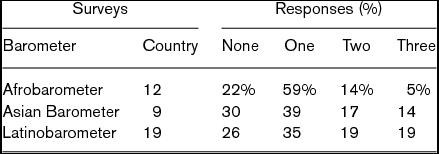
The second pattern concerns the breadth or scope of democratic conception; that is, how broadly or narrowly ordinary people define democracy. While some citizens were able to name up to three properties of a democratic system, the majority of citizens were only able to discern just one. Table 2 shows that the majority of people in three continents, Africa, East Asia, and Latin America, were only able to identify one democratic property while less than one-third were able to name two or more. Many of the respondents who named multiple properties were also known to merely repeat or restate the properties their initial answers refer to (Canache, Reference Canache2012: 11).
The number of descriptions of democracy

Note: Table entries are the number of responses to open-ended questions on the meaning of democracy.
Sources: Bratton et al. (Reference Bratton, Mattes and Gyimah-Boadi2005), Canache (Reference Canache2012), and Shin and Cho (Reference Shin and Cho2010).
The final pattern involves valence. Most citizens around the world view democracy positively rather than negatively. In fact, only 1% of the respondents in 12 Southern African countries viewed democracy negatively (Bratton et al., Reference Bratton, Mattes and Gyimah-Boadi2005: 69) while less than 5% did the same in all seven East Asian countries (Chu et al., Reference Chu, Diamond, Nathan and Shin2008b: 12). These studies together show that, with the exception of a small minority, most citizens around the globe view democracy as an essential component for the good quality of their personal lives and their countries.
In defining democracy positively, citizens seldom name the properties, which are widely known in the political science literature. In the literature, political scientists tend to equate democracy with institutional procedures, such as political participation and competition (Dahl, Reference Dahl1971). In contrast, ordinary citizens view democracy with regard to its intended outcomes, such as freedom and liberty, rather than elections, majority rule, and political parties (Dalton et al., Reference Dalton, Shin and Jou2007; Huang, Reference Huang2014). Indeed, there is a wide gap between political scientists and ordinary citizens in their views and understandings of democracy (Baviskar and Malone, Reference Baviskar and Malone2004).
In a nutshell, numerous findings from the open-ended approach show that most ordinary citizens worldwide are capable of defining democracy in their own ways. They tend to define it far more positively than negatively, while understanding it more narrowly than broadly. In substance, however, their definitions, unlike those of political scientists, tend to be oriented toward its outputs rather than its procedures.
Identification
In the same way as open-ended questions, closed-ended questions can make unique contributions to expanding our knowledge of how global citizens conceive of democracy and how they think about it. In particular, those structured questions are especially helpful when attempting to ascertain what they expect from democracy, how much they expect, and whether they expect more of political procedures or more of substantive political outcomes. As discussed earlier, the 6th wave of the WVS and the 6th round of the ESS asked a long battery of questions, which deal with many different procedural and substantive characteristics.
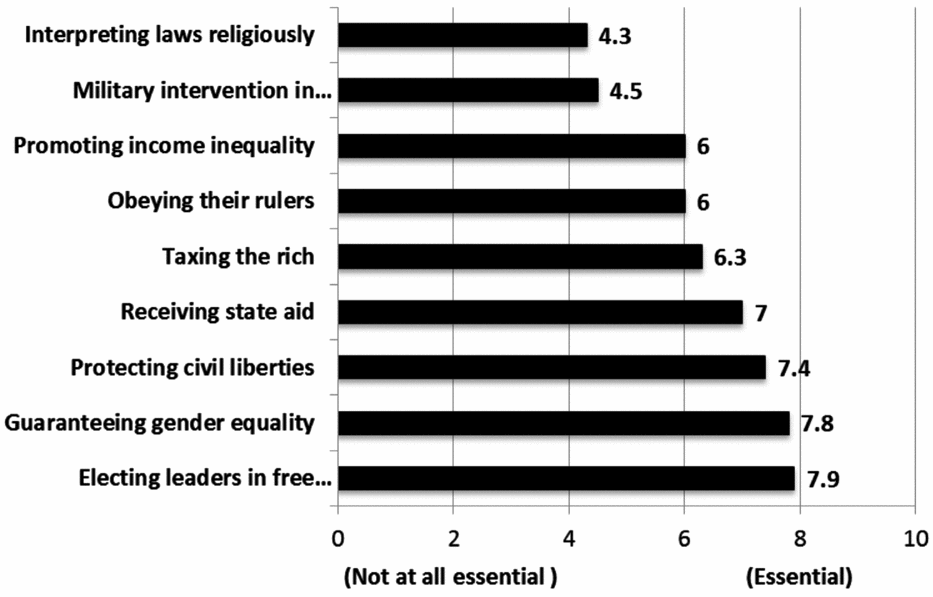
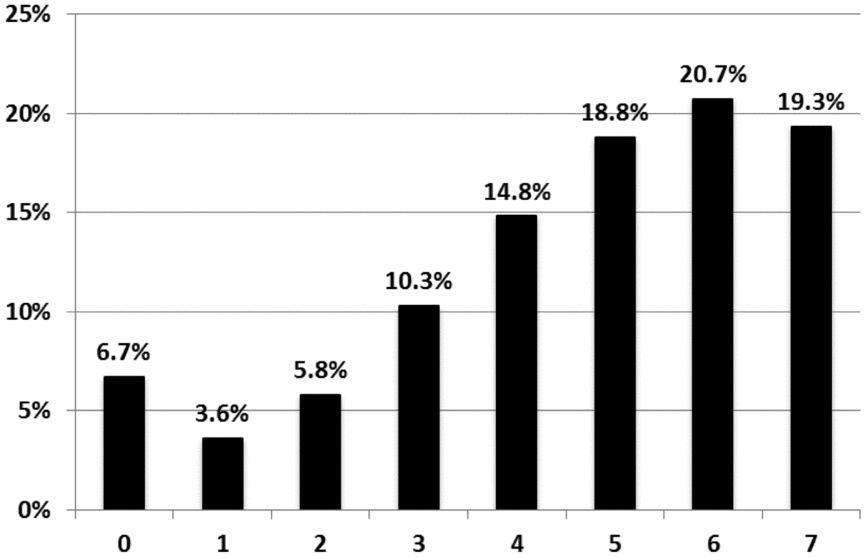
The WVS, for example, asks questions on whether or not certain regime characteristics are ‘not at all an essential characteristic of democracy’, with a score of 1, to ‘an essential characteristic of democracy’, with a score of 10. The analysis reveals that global citizenries rate seven of nine regime characteristics – except two authoritarian ones of military and religious interventions in politics – as essential, scoring 6 or higher (see Figure 3). While less than one tenth (9%) rated one or two of these seven characteristics as essential to democracy, over four times as many (40%) ranked all seven or six as essential to it (see Figure 4).Footnote 6 These findings do not accord with what is known from the open-ended approach: most ordinary people understand democracy minimally or unidimensionally.Footnote 7
The essentiality of nine regime characteristics to democracy (on a 1–10 point scale)

Number of regime characteristics as rated essential to democracy Note: Figure entries are the percentage citing various numbers of characteristics as essential to democracy (above the midpoint of the scale in Figure 1)

Further, the close-ended questions asked in both the WVS and ESS show that in Europe and elsewhere, ordinary people do not view civil liberties to be the most essential component of a democracy. In the WVS, for instance, contemporary global citizenries ranked civil liberties behind many other well-known democratic regime characteristics, such as free elections and gender equality (see Figure 3). In the ESS also, European respondents do not highly prioritize those democratic regime characteristics, such as the freedom to express political views and to criticize the government. Instead, they rate those to be relatively less essential in comparison to less known practices, such as equal citizen treatment and protection against poverty.Footnote 8 Though most citizens define democracy in terms of freedoms or liberties, they do not find these aspects to be highly salient components of democracy.
Prioritization
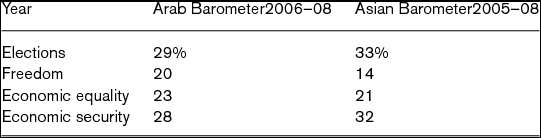
Are ordinary people, unlike political scientists, reluctant to consider liberties as the most important component of democracy, even when they most often define it in terms of freedoms or liberties? To address this question, we analyzed the Asian and Arab barometers, which asked identical closed-ended questions. The questions ask respondents to choose the most important feature out of four characteristics: elections, freedom, economic equality, and economic security. Table 3 shows that, out of the four characteristics, citizens of 12 East Asian countries prioritized elections (33%) and economic security (32%) as the two most essential to democracy, followed by economic equality (21%) and freedom to criticize government officials (14%) (Shin and Cho, Reference Shin and Cho2010).Footnote 9
The democratic regime properties Arabs and East Asians prioritize as the most and least important

Sources: 2006–08 Arab Barometer survey; 2005–08 Asian Barometer survey.
Responses from Algeria, Jordan, Lebanon, and Palestine also show a similar pattern. Elections were prioritized at 29%, while economic security followed with 28%, economic equality (23%), and freedom of speech (20%) trailed behind (Doherty and Mecellem, n.d.; de Regt, Reference de Regt2013). Like East Asia, this region found political freedom to be the least important of the properties and elections to be the most important of those.
A careful scrutiny of Table 3 further reveals that economic security and equality, when considered together, matter twice as much as political freedom. Such a preoccupation with economic concerns testifies that a liberal notion of democracy may not be as widespread and universal as it is often believed to be (Dalton et al., Reference Dalton, Shin and Jou2007; Welzel, Reference Welzel2013: chapter 10).Footnote 10 It further indicates that citizens in non-Western countries often view democracy as a form of government that works ‘for the people’ rather than ‘by the people’.
Differentiation
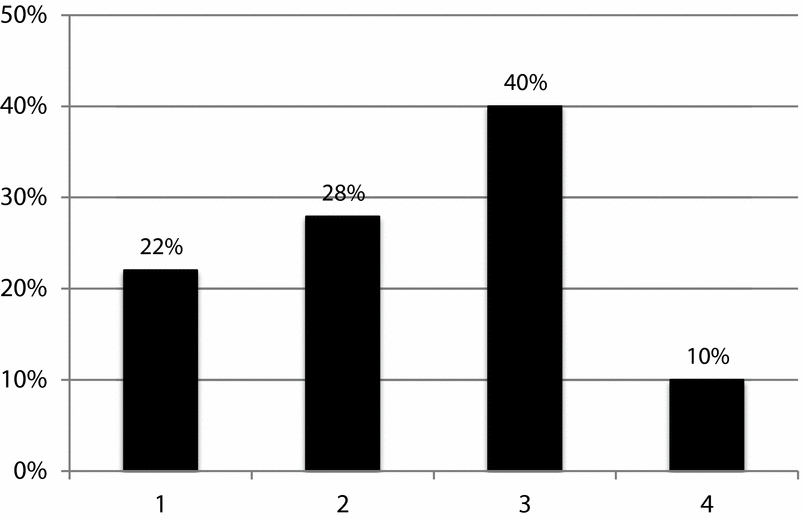
Are ordinary citizens capable of discriminating between democratic and other political systems? To explore this question, the Afrobarometer program employed three vignettes, as discussed above. Specifically, the 4th round of this barometer asked citizens of 20 sub-Saharan countries to differentiate the three types of political systems referred to in those vignettes. To measure the levels of their overall capacity to do so, we constructed a 4-point index by counting the number of vignettes to which they responded correctly.
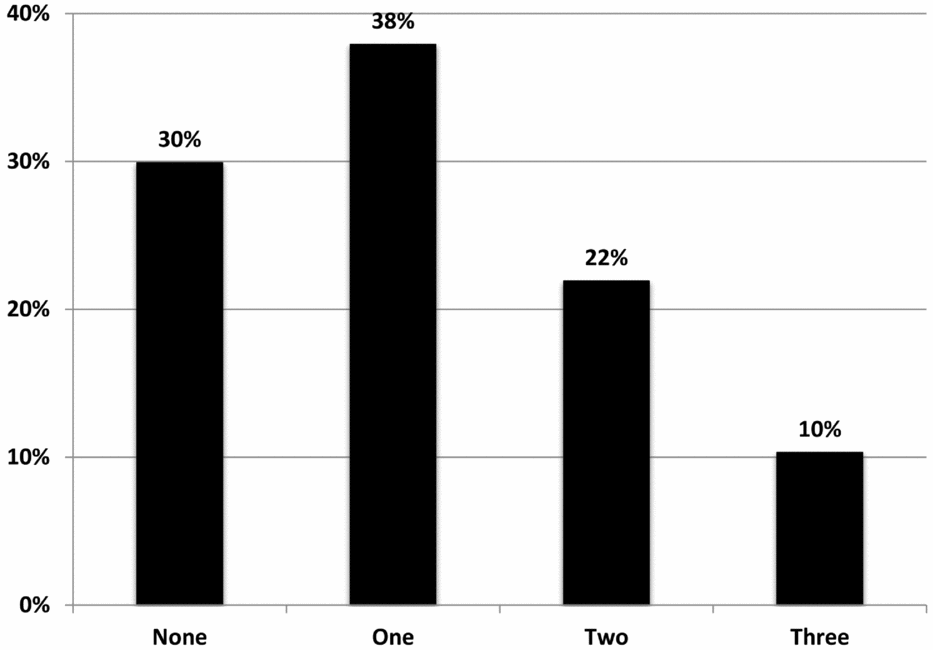
For Southern Africa as a whole, Figure 5 shows the percentages of its citizenries placed on four levels of cognitive capability. Nearly one-third (30%) is placed on its lowest level, while only one-tenth (10%) is placed on its high level. This indicates that the cognitively fully incompetent form a substantial minority and they are nearly three times more numerous than the cognitively fully competent. The mean statistic of 1.1 also indicates that the average Southern African is not capable of identifying correctly more than one of three different political systems. The prevalence of the fully incompetent over the fully competent and the mean below the midpoint of the 4-point index confirm that Southern Africans have very limited knowledge about democracy-in-practice.
The number of political systems Southern Africans identified correctly

To identify distinct types of their recognition, we analyzed the three different ways they responded to each vignette, and classified them into three types, the uninformed, the misinformed, and the well-informed. The uninformed are those who failed to answer all of three vignette questions. The misinformed are those who answered all the three vignettes, but failed to answer all of them correctly. The well-informed are those who answered all of them correctly. Of these three types, therefore, the well-informed represents the fully capable of discriminating different political systems.
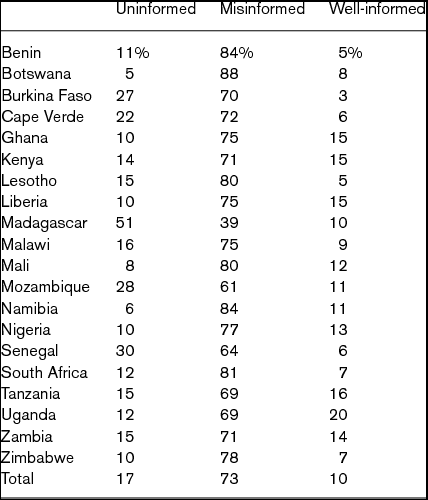
Table 4 shows the distribution of Southern Africans into the three types of recognizing three different political systems. In South Africa as a whole, the misinformed are most numerous with 73%; they are followed by the uninformed (17%) and the well-informed (10%). This pattern of system recognition prevails in 11 of 20 countries. In eight other countries, including Botswana and Ghana, the well-informed are more numerous than the uninformed. Only in Madagascar, the uninformed constitutes a majority (51%). In all 20 countries, however, the well-informed do not even comprise a substantial minority of more than one-fifth. Across the countries, moreover, their proportions vary considerably from a low of 3% in Burkina Faso to a high of 20% in Uganda. These findings indicate clearly that Southern Africans’ capacity to distinguish different types of political systems is not only very low but also highly uneven.
Types of system differentiation among Southern Africans

Source: 2008 Afrobarometer Survey.
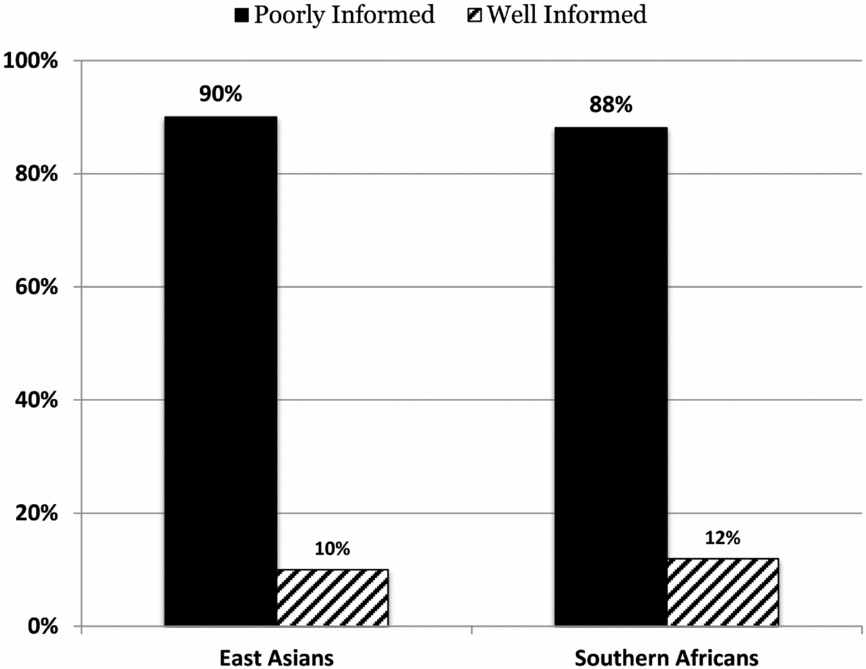
The relative paucity of the politically well-informed in South Africa raises the question of how much trust we should place on avowed approbation for democracy among its citizenries. In the region as a whole, seven in every ten people (70%) publicly avow support for democracy, affirming the statement that ‘democracy is preferable to any other kind of government’ (Q30). Yet only one in nine (11%) is fully capable of differentiating it from its alternatives. Evidently, a large majority (88%) of avowed supporters of democracy consists of either uninformed or misinformed citizens. In Southern Africa today, fully informed, authentic supporters of democracy constitute a very small minority (8%).
Unlike the Afrobarometer surveys, which asked about the hypothetical political systems with which people were largely unfamiliar, the Asian Barometer survey asked about political systems widely known as a democracy or an autocracy. Specifically, its 3rd wave survey asked respondents in 12 countries to evaluate China, the US, Japan, and India on a 10-point scale where scores of 1 and 10 mean complete dictatorship and democracy, respectively. Of these four countries, we chose China, India, and Japan to explore the extent to which East Asians are able to discriminate between democratic and authoritarian systems. China and India represent, respectively, the world's most populous autocracy and democracy, while Japan represents East Asia's oldest democracy.
To determine how capable East Asians are of identifying divergent types of political systems correctly, we followed the procedure employed in the above analysis of the Afrobarometer Survey. We first formulated a 4-point index measuring levels of their overall capability to do so by counting the number of countries whose political system they correctly identified.
Figure 6 shows how East Asians are distributed across four different levels of cognitive capability. Being placed on the lowest and highest levels of this index means, respectively, being completely incapable and completely capable of differentiating democratic and non-democratic systems. According to the percentages reported in Figure 6, the completely incapable comprise a substantial minority of over one-fifth (22%) and there are twice as many as the completely capable (10%), a pattern similar to what was observed in Southern Africa. The mean statistic of 1.5 indicates that of the three systems queried, the average East Asian is not able to correctly identify much more than one. All these findings attest to a relatively low level of their cognitive capability.
The number of political systems East Asians identified correctly

How well do East Asians recognize the political systems that exist in China, Japan, and India? As we did with Southern Africans, we classified them into three types of system recognition: the uninformed, the misinformed, and the well-informed. The uninformed are those who failed to rate all three countries on the 10-point scale either correctly or incorrectly. The misinformed are those who rated at least one of the countries incorrectly (China as a democracy, India as a non-democracy, or Japan as a non-democracy). The well-informed are those who answered all of them correctly (China as a non-democracy, and India and Japan as a democracy).
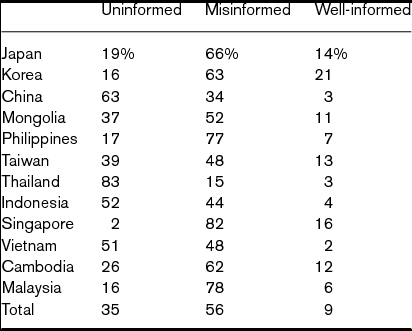
For each of 12 countries and East Asia as a whole, Table 5 reports the percentages falling into three types of systems identification. In the region, the misinformed are most numerous with 56%, followed by the uninformed with 35%, and the well-informed with 9%. As in Southern Africa, the misinformed are most numerous, while the well-informed are least numerous. Yet, there are proportionally more uninformed citizens in East Asia than in South Africa. In fact, the uninformed population forms the majority in as many as four countries in East Asia, including China (63%), Indonesia (51%), Thailand (83%), and Vietnam (52%). By striking contrast, they are the least numerous and form a puny minority (2%) in Singapore
Patterns of system differentiation among East Asians

Source: 2005–8 Asian Barometer Survey.
Despite these cross-national differences, all 12 East Asian countries are alike in that the well-informed form small minorities of their respective citizenries, which range from a low of 3% in China to a high of 21% in Korea. In all these countries, the well-informed also form small minorities of avowed supporters of democracy, ranging from 2% in Vietnam to 21% in Korea. When all the countries are considered together, only one in every ten East Asians (10%) who ‘always prefers democracy to any other kind of government’ (Q124) is informed well enough to distinguish it from non-democracy. Put simply, only one in every 15 citizens (6%) is a well-informed supporter of democracy in East Asia today.
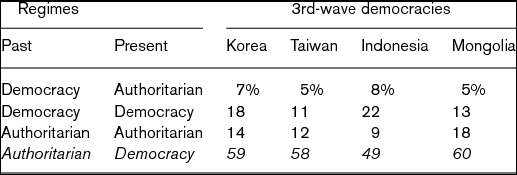
As a further test of system differentiation, the 2nd wave of the Asian Barometer surveys asked citizens of four 3rd-wave democracies – Korea, Taiwan, Indonesia, and Mongolia – in the region to rate the present democratic system and the past authoritarian system on a 10-point scale where scores of 1 and 10 mean, respectively, complete dictatorship and democracy. Scores above the scale midpoint of 5.5 indicate being democratic, while those below it refer to being authoritarian. Only those who rated the present regime as a democracy and the past regime as an autocracy are considered capable of understanding the occurrence of democratic regime change. Table 6 shows that in all four East Asian democracies, a small majority of three-fifths or less is cognitively capable of understanding the democratic regime transition that occurred in their own country. Even decades after the transition to democracy from harsh authoritarian rule, as many as four in ten citizens of East Asian 3rd-wave democracies are not able to recognize this regime change.
The capacity of East Asians to differentiate the regimes of the authoritarian past and the democratic present

Note: The fourth italicized response is the correct option.
Source: 2005–08 Asian Barometer Survey.
In summary, most people around the world meet the first condition in thinking about democracy both coherently and completely. That is, they are conceptually capable of defining it in their own words, and identifying and prioritizing its important properties. Many of those conceptually capable, however, do not meet the second cognitive condition for democratic citizenship. In other words, they are not able of discriminating between the practices of democracy and those of its alternatives. Their inability to do so keeps them from becoming authentic or informed citizens of democracy, as Figure 7 shows.Footnote 11 Therefore, we need to assess the quality of publicly avowed support for democracy before we endorse it as the globally preferred system of government (Diamond, Reference Diamond2008, Reference Diamond2013; Fukuyama, Reference Fukuyama2014; Sen, Reference Sen1999).
Assessing the quality of avowed support for democracy Note: The poorly informed comprise the uninformed and misinformed

Conclusion
To date, public opinion research on citizen conceptions of democracy has focused mostly on the questions dealing with the identification of its properties; that is, whether ordinary people are conceptually aware of it and of how or in what terms those conceptually aware understand it. Relatively little research has been done to determine how well or poorly they understand it. Much less has been done to evaluate whether their avowed support for democracy is based on an informed understanding of it.
What proportion of contemporary global citizenries holds an informed understanding of democracy? How evenly or unevenly are those well-informed about democracy distributed throughout the globe? Do they all endorse democracy as the most favored system of government? What proportion of avowed supporters of democracy comprises the well-informed? What proportion comprises the misinformed? Do well-informed democrats outnumber their ill-informed peers throughout the whole world, as assumed in the thesis of global democratization that has been popular in the West (Diamond Reference Diamond2013; Fukuyama Reference Fukuyama2014)? If not, are those authentic democrats concentrated in the old-democratic West? These are the important questions that should be addressed in future public opinion research on democracy.
In order to address these questions carefully and systematically, we first need to conceptualize democratic knowledge as a two-dimensional phenomenon, which consists of the cognitive capacity to identify the essential properties of democracy and such capacity to differentiate them from those of its alternatives. To measure each of its two dimensions, we should prepare two different sets of questions, one for open-ended and the other for closed-ended.
We should also prepare as many as four different sets of questions to tap not only affective orientations to democracy and its alternatives as a regime structure but also those orientations to their methods of daily governance. Finally, the possession of those two aforementioned cognitive capacities should be employed as a criterion for authenticating avowed support for democracy. Only when authentic supporters of democracy constitute a majority in most of the regions of the world, can we confidently endorse the claim that democracy is truly becoming the most favored system of government throughout the globe.
About the authors
Doh Chull Shin (shindc@uci.edu) is Jack W. Peltason Scholar in Residence at the Center for the Study of Democracy at the University of California, Irvine. Previously, he held Korea Foundation and Middlebush Chairs at the University of Missouri in Columbia, Missouri and numerous visiting appointments in Africa, Asia, Australia, and Europe. He is the author of Confucianism and Democratization in East Asia (Cambridge University Press, 2012) and a co-editor of East Asian Perspectives on Political Legitimacy (Cambridge University Press, Reference Achen and Bartels2016). In the 2016 IPSA World Congress held in Poznan, Poland, he received the Meisel-Laponce Award for the best article published in the International Political Science Review for the 2012–16 period. He is currently working on a volume analyzing former President Park Geun-hye's crimes and punishments.
Hannah June Kim is a PhD candidate in the Department of Political Science at the University of California, Irvine. Her research interests include public opinion, support for democracy, modernization theory, and inequality with an emphasis on East Asia. She is writing her dissertation on democratic support from the middle class in both democratic and non-democratic countries in East Asia.