1 Introduction
The present study investigates the production of the French mid-vowels by early Occitan–French bilinguals as well as the interaction between the two vowel systems of each of their languages. The analysis presented examines the phonetics of a group of elderly bilinguals residing in a situation of long-term language contact that has seen a shift in societal language dominance (followed by a shift in cognitive language dominance by some bilinguals) over the last 60 years. The long-term nature of this language contact is both societal and cognitive in that both Occitan and French have been spoken in this community over a long period of time, at least for the oldest generation, and all participants have experienced long-term exposure to both languages.
Regional varieties of French are often assumed to have resulted from contact between the national language and local varieties, such as Occitan, present in the regions before French was imposed. Various definitions of regional French have been proposed and almost all of them agree that regional French preserves features from local varieties with which it is/was in contact. While it is clear that substrate influence has a role to play in the emergence of regional French from contact, the exact mechanisms by which linguistic ‘residue’ from local languages may be preserved in regional French have not yet been fully elaborated. All speakers in this study acquired Occitan as their first language (L1) before learning French, as their second language (L2), at an early age and non-standard features of their L2 phonology are hypothesised to have resulted from L1 transfer.
Flege's (Reference Flege and Winitz1988, Reference Flege and Kent1990, Reference Flege1991) speech learning model (SLM) is used to advance hypotheses about the type of transfer that will occur during language contact and, crucially, to explain how this transfer occurs. The methodology employed is sociophonetic in nature, combining traditional Labovian data collection techniques with detailed acoustic phonetic analysis in order to explain more clearly the nature of L1 transfer and interpreting the findings using an analytical framework employed hitherto in studies of second language acquisition, and never with reference to regional varieties of French.Footnote 1
The application of a long-standing second language acquisition model to data collected in a situation of long-term language contact constitutes a novel approach to the study of contemporary regional varieties of French and informs the hypotheses of a well-established theory of linguistic transfer by investigating its predictions and outcomes in a different sociolinguistic context. The findings of this study highlight the need for research on bilingualism to consider the importance of sociolinguistic factors in determining the acquisition and production of L2 phonological and phonetic features, a consideration which is largely absent from the literature on bilingualism (Simonet Reference Simonet2010).
2 Phonetic transfer in bilingual speech
Many studies in the field of bilingualism have shown that L2 learners may experience difficulty with non-native sounds even after years of experience with their second language. Simonet (Reference Simonet2011) notes that these difficulties are commonly observed in both production (Flege, Yeni-Komshian & Liu Reference Flege, Yeni-Komshian and Liu1999, for example) as well as in perception (Pallier, Bosch & Sebastián-Gallés Reference Pallier, Bosch and Sebastián-Gallés1997, Sebastián-Gallés & Soto-Faraco Reference Sebastián-Gallés and Soto-Faraco1999, for example).
During the acquisition of an L2, the process of ‘interlingual identification’ causes words learnt in the second language to be (initially) decomposed into categories based on familiar L1 sounds (Flege Reference Flege, Bloothooft, Hazan, Huber and Llisterri1995: 98). This (initial) association of L2 sounds with L1 categories is the basis for the central tenet of the SLM: the categories making up the L1 and L2 subsystems of a bilingual exist in a ‘common phonological space’ and so have the potential to mutually influence one another (Flege Reference Flege, Cole and Hualde2007: 366). The concept of ‘equivalence classification’ is important for the investigation of transfer presented in the study of the Occitan and French mid-vowels: phonemes in the L1 and L2 that correspond structurally are hypothesised to be equated as ‘cognate phonemes’. Category formation is directly linked to equivalence classification: if an L2 sound is equated with an L1 sound, new category formation will be inhibited; if an L2 sound is not equated with an L1 sound, a new phonetic category may be formed. Establishing evidence for category formation is important to any investigation of phonological or phonetic transfer as production accuracy has been shown to depend importantly on whether new categories are created for L2 sounds not occurring in the L1 (Flege Reference Flege, Leather and James1997: 86). Equivalence classification and category formation (which are presented as mutually exclusive) predict the interaction of L1 and L2 phonetic subsystems to be governed by the two different linguistic mechanisms of ‘phonetic category assimilation’ and ‘phonetic category dissimilation’, respectively.
The SLM proposes that the L1 and L2 phonetic subsystems of a bilingual will interact through the mechanism of phonetic category assimilation when phonetic category formation has been blocked by equivalence classification. When a category is not formed for an L2 sound because it is ‘too similar’ to an L1 counterpart, the L1 and L2 sounds will assimilate, leading to a ‘merged’ L1–L2 category (Flege Reference Flege2005). Phonetic category assimilation may result in ‘non-nativelike’ pronunciation of both L1 and L2 sounds. The SLM predicts that within the merged category the L2 sound will continue to resemble the L1 sound, and that the L1 sound will begin to resemble the L2 sound – bilateral transfer (Flege Reference Flege, Cole and Hualde2007: 368). Importantly, Flege notes that depending on the nature of the input received by the merged phonetic category (more L1 or more L2), the category may resemble more closely the long-term representation of L1 and L2 monolinguals. Sancier & Fowler (Reference Sancier and Fowler1997) suggest that the exact nature of these representations will reflect the large levels of input acquired over a speaker's lifetime, with more recently encountered input being weighted more heavily than input encountered in the distant past, though this is not always the case. Simonet found that Catalan–Spanish bilinguals in Majorca transfer the phonetic features of Catalan sound categories into Spanish even after having had extensive exposure to native input in Spanish (Simonet Reference Simonet2010: 663). The evidence for phonetic category assimilation presented by Simonet focused on cognate lateral consonants and the analysis demonstrated that L2 Spanish categories appear to be classified at some phonetic level as equivalent to L1 Catalan laterals, though this process did not completely block new category formation for some of the early bilinguals examined (Simonet Reference Simonet2010: 674).
New category formation for an L2 sound may lead the L2 phonetic category to dissimilate from a neighbouring L1 category to preserve phonetic contrast in common acoustic space. This phonetic category dissimilation occurs when a newly established L2 phonetic category is relatively close in phonetic space to a pre-existing L1 category (Flege Reference Flege, Cole and Hualde2007: 375). This is particularly pertinent when L1 and L2 categories are not in one-to-one correspondence. For example, it has been demonstrated that the Catalan /e/–/ɛ/ and /o/–/ɔ/ contrasts may pose production and perception problems for native Spanish speakers because each pair is equated with one Spanish vowel in each case, /e/ and /o/, respectively (Pallier et al. Reference Pallier, Bosch and Sebastián-Gallés1997, Sebastián-Gallés & Soto-Faraco Reference Sebastián-Gallés and Soto-Faraco1999). Dissimilation of L2 and/or L1 phonetic categories after new category formation also leads to a situation whereby bilinguals’ pronunciations diverge from those of monolinguals in each of the languages because the bilingual's representation is based on different phonetic features or feature specifications to a monolingual's.
The SLM also acknowledges the possibility that L1 and L2 sounds that have been equated as ‘the same’ may not occur in the same range of phonological or phonetic contexts in both languages: phonotactic constraints and allophonic variation may differ cross-linguistically. Phonetic realisation rules may be tagged language-specifically to account for the fact that, for example, position-sensitive allophones that any two languages might be said to ‘share’ are likely to differ in their phonetic realisation (Flege Reference Flege, Bloothooft, Hazan, Huber and Llisterri1995: 98). Flege notes that the level of analysis at which the phonetic elements of a bilingual's two languages are perceptually related remains uncertain and that the influence of contextual variants on cross-language perceptual assimilation is also unclear (Flege Reference Flege, Cole and Hualde2007: 377). For example, an investigation of the production of English /b/ by native Italian speakers (MacKay et al. Reference MacKay, Meador and Flege2001) demonstrated that Italian–English bilinguals prevoice /b/ more than native English speakers but less than monolingual Italian speakers, indicating that the bilingual speakers have acquired, at least partially, a low-level phonetic feature of the L2 (short voice onset time, or VOT) that is not required for phonological contrast (see Simonet Reference Simonet2010: 664).
The large majority of research undertaken using the SLM has focused predominantly on second language learners in the traditional sense, that is speakers who have learnt a language that is not normally spoken in their nation, and who are, in essence, speaking their L2 with a ‘foreign accent’. The central emphasis of a large number of these studies, undertaken primarily by Flege in conjunction with a variety of other researchers, was on the effect of ‘age of learning’ on the perception and production of ‘non-nativelike’ sounds by L2 speakers of a variety of languages. Flege (Reference Flege1991), for example, examines VOT for the syllable-initial plosives of Spanish–English bilinguals, finding that early bilinguals, with Spanish L1, had VOT realisations that were equivalent to those of Spanish and English monolinguals while late learners had English VOT that was shorter and Spanish VOT that was longer than monolinguals. Flege views these findings as consistent with his hypothesis that an upper limit exists on how closely late learners can approximate the phonetic norms of an L2 for sounds in the L2 that differ acoustically from corresponding sounds in the L1 (Flege Reference Flege1991: 400). The focus of more recent studies, however, has been on the difficulty in adducing ‘age of learning’ as an explanatory factor in instances of transfer because it is frequently confounded with other factors that may influence performance (input, language use, bilingual dominance) (e.g. Flege Reference Flege, Cole and Hualde2007).
Flege (Reference Flege, Bloothooft, Hazan, Huber and Llisterri1995) advances seven summative data driven hypotheses for the SLM, relating both to the perception and production of L2 sound categories and sounds, of which this study will explicitly investigate one: ‘Category formation for an L2 sound may be blocked by the mechanism of equivalence classification. When this happens, a single phonetic category will be used to process perceptually linked L1 and L2 sounds (diaphones). Eventually, the diaphones will resemble each other in production’ (Flege Reference Flege, Bloothooft, Hazan, Huber and Llisterri1995: 239). The acoustic analyses presented in this article will examine, from a production perspective, the evidence for the equivalence classification of Occitan and French phonemic categories and for resultant phonetic category assimilation.
3 The study
The present transfer study analyses phonological and phonetic transfer from Occitan in the mid-vowels of the variety of French spoken by the bilingual speakers, the regional French of Béarn. The variables selected are hypothesised to constitute cognate or equivalent phonemes in the bilinguals’ mental representation of their languages, according to the SLM, such cognates would be stored in a common phonological space. The analysis begins with the Occitan mid-vowels before presenting the French mid-vowels; the final section examines phonological and phonetic transfer comprising qualitative description and quantitative statistical accounts of the evidence for L1-to-L2 transfer.
3.1 Contextual background
Béarn is the historically Romance-speaking part of the modern-day Pyrénées-Atlantiques département in southwestern France (see Figure 1) and the language traditionally spoken is a variety of Occitan, which is a southern Gallo-Romance language. The region is primarily rural and the local variety of Occitan historically spoken in Béarn, a sub-dialect of Gascon, is commonly referred to as ‘Béarnais’ (see Mooney Reference Mooney2014a). Since at least the late nineteenth century, when free and compulsory education in French was introduced (1880–1886), language contact between French and the variety of Occitan spoken in Béarn has led to linguistic transfer between the varieties, and to the subsequent obsolescence of Occitan. Over the course of the twentieth century, Occitan was gradually ousted from all domains by the dominant French language. This reduction in domains was accompanied by rapid language shift and an abrupt cessation in intergenerational transmission during the aftermath of the Second World War. Consequently, those born in Béarn after 1955–1960 to local families are almost exclusively French-speaking monoglots. Today, only the oldest generation in Béarn speak the local variety of Occitan and all of these speakers are bilingual and also speak French. It is important to emphasise, at this point, that Occitan is a typologically distinct language from French with marked differences between them at all levels of linguistic structure. As such, contact between Occitan and French is clearly a case of language contact rather than of dialect contact and it is this language contact that is hypothesised to have resulted in the distinct contemporary variety of French spoken in the region.
The region of Béarn (from Wikimedia Commons).

3.2 Participants
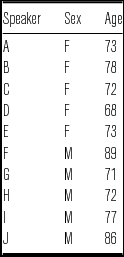
Analytic techniques from laboratory phonetics were applied to over 1200 tokens of the Occitan and French mid-vowels extracted from an original corpus, collected in 2012 (see Section 3.3 below). The corpus contains high quality acoustic data for ten bilingual Occitan–French speakers, five male and five female all over the age of 65 years, and native to the region of Béarn (see Table 1).
Participants in the language contact study.

While previous applications of the SLM have predominantly focused on second language learners who are, in essence, speaking their L2 with a foreign accent, bilingual Occitan–French speakers find themselves in a very different situation from that of the foreign language learner: the L1 and L2 varieties have been involved in long-term language contact; all speakers acquired their L2 at an early age; the levels of L1 and L2 input have varied over the course of the speakers’ lifetimes; the L1 language has become restricted to a small number of highly specific domains of use; the L2 language is dominant, both socially and in terms of language use.
The SLM would classify Occitan–French bilingual speakers as ‘early learners’ of their L2 as they began to acquire French when they entered primary education at the age of five or six. On this basis, the SLM would predict maximal ability for new category formation for L2 sounds as well as maximal ability to distinguish phonetic differences between L2 categories that are not meaningful in their L1, Occitan. Over the course of these bilinguals’ lifetimes, French has become their dominant language as well as the dominant language of the society in which they live: input from French has increased as they grew older. Levels of L1 language use and of language input have been shown to affect the L1 and L2 subsystems in different ways: ‘individuals who remain L1-dominant . . . seem to show stronger L1 to L2 effects whereas the reverse seems to hold true for individuals who become dominant in the L2’ (Flege Reference Flege, Cole and Hualde2007: 366). This complicating factor must be taken into account: the original Occitan input may have been strongly influenced by French over the course of a speaker's lifetime. Moreover, there is insufficient data available on the nature of the original French input to the bilingual's phonetic categories. It is very likely that it was not generally standard or Parisian French, since the primary input would have come from primary school teachers, normally from the region or from adjacent regions, as well as the highly accented speech of parents: ‘Southerners first contacts with French are more likely to have been through written documents and other Southerners than native speakers from Paris’ (Morin Reference Morin and Miret2009: 411). Indeed, the nature of the French input (as well as the amount of French input) has evolved steadily over the course of the bilinguals’ acquisition. The rise of industrialisation, social-mobility and in-migration to the region in the late 20th century has led to another type of contact situation: the regional variety of French that had emerged from language contact has been in contact with incoming varieties of French for some time, the most notable of which is the northern supralocal norm.
To summarise, four potentially confounding factors must be born in mind when investigating the evidence for Occitan to French transfer: (i) phonetic realisations in Occitan are likely to diverge from traditional monolingual categories established in childhood due to cross-language phonetic assimilation and due to the speakers becoming L2-dominant in French; (ii) the amount of input from Occitan and French has varied over the bilingual speakers’ lifetimes; (iii) the nature of the original French input is not clear and evaluating it relative to standardised categories may be problematic in some respects; and (iv) the nature of French exemplars has become more varied over the course of the speakers’ lifetimes.
Nevertheless, the principles governing transfer in the Occitan–French situation are the same as those described by Flege and others in situations of foreign language learning, though different social factors are likely to modify the outcomes of the SLM in each case. Examining the SLM in a situation of territorial language contact may provide a new perspective on L1-to-L2 linguistic transfer in a new context but also by investigating transfer between languages that are more typologically similar (as Romance languages) than those usually examined using the SLM (Spanish, French, Korean and German as L1, and English as L2). The traditional SLM studies often include monolingual speakers of the L1 and L2 as controls which is not possible in the present study due to the obsolescent nature of Occitan.
3.3 Data elicitation
Different data elicitation techniques were used for each of the languages: all informants had a sociolinguistic interview in French; this was supplemented by a translation task from French into Occitan.
The use of the wordlist translation task to elicit baseline data for Occitan phonological variables is open to criticism because informants may be more likely to engage in transfer when translating from one language to another than when producing casual speech. The use of a translation task to gather phonological data on Occitan may be justified on the following grounds: the focus of this study is on transfer from Occitan into French, the opposite direction to transfer potentially induced by the act of translating; the systematic nature of the study means that it is essential that the same variables be examined in the speech of all informants; since all informants were translating, they were confronted with the same potential stimulus for transfer.
Additionally, comparing Occitan wordlist data with French casual speech data may be problematic: firstly, the systems being compared and their acoustic characteristics could, of course, vary along a style continuum; secondly this comparison appears to conflate ‘style’ and ‘language’ in that all Occitan data are ‘formal’ and all French data are ‘casual’. There is evidence to suggest that, during language shift, obsolescent languages experience a reduction in their style repertoire (Dorian Reference Dorian1981). In a typical scenario, where one language is being ousted by an incoming dominant language, the formal registers of the obsolescent language are lost as it becomes progressively restricted to intimate or informal domains. In this case, rather than using formal or informal stylistic variants, speakers of obsolescent languages frequently switch codes, switching to the dominant language to signal a change in register: the dominant and obsolescent languages are used as markers of style in discourse. Therefore, the effect of ‘style’ on the elicitation of the Béarnais data may be minimal, though this is speculative.
3.4 Acoustic analysis
Sociolinguistic interviews and wordlist translation tasks were recorded using a sampling rate of 44.1 kHz and a 16-bit PCM sample size. Each token of the mid-vowels was tagged manually for onset and offset in a PRAAT text grid (Boersma Reference Boersma2001, Boersma & Weenink Reference Boersma and Weenink2012) and an extraction script was then used to measure the first two formant frequencies, F1 and F2, at the vowel midpoint. These formant frequencies are commonly held, in acoustic phonetic studies of oral vowels, to have general non-linear articulatory correlates: F1 exhibits an inverse correlation with vowel height; F2 exhibits a positive correlation with vowel frontness/backness.
3.5 Statistical analysis
Raw data (Hz) for the Occitan and French mid-vowels were first submitted to statistical analysis for each of the ten speakers individually in order to examine the degree of vowel overlap between traditional phonemic categories of each language, and to determine, for example, the extent to which the distributions of the front mid-vowels, /e/ and /ɛ/, overlap. Many methods have been proposed to examine overlap in the study of vowel splits and mergers; see Nycz & Hall-Lew (Reference Nycz and Hall-Lew2013) for discussion of Euclidean distance, mixed model regression, spectral overlap, and the Pillai-Bartlett trace. Following Nycz (Reference Nycz2013), the ‘mixed model regression’ technique was used in the present study: for each vowel pair analysed, and for each speaker, a mixed-effects regression analysis was undertaken in the R environment using the Rbrul text-based interface (Johnson Reference Johnson2008). The models were constructed as follows: F1 or F2 as the dependent variable; the lexical item in which the vowel occurred was included as a random effect, ‘word’; phonological environment and the historically appropriate ‘phoneme’ were included as fixed effects. These analyses aimed explicitly to assess the extent to which ‘phoneme’ may predict formant values after phonological context has been taken into account.
The F1 and F2 data for all speakers were then normalised using the Lobanov (Reference Lobanov1971) normalisation method to enable reliable statistical comparison across different sexes and to account for anatomical differences which may be related to speaker age. Following normalisation, the full normalised data set was submitted to statistical analysis in Rbrul. The statistical modelling technique used was, again, mixed-effects linear regression for continuous variables which included F1 or F2 as the dependent variable, ‘speaker’ and ‘word’ as random effects to take account of variation introduced by inter-speaker differences and differing lexical items, as well as a variety of fixed-effect predictors: phoneme, syllable type, preceding phoneme, following phoneme, and speaker sex. These analyses examined the maintenance of traditional phonemic contrasts in Occitan and French, as well as L1-to-L2 transfer, across speakers. Two alpha levels for statistical significance were used in all regression analyses: significant (p < .05); highly significant (p < .01).
4 Results
4.1 Occitan (L1) mid-vowels
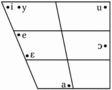
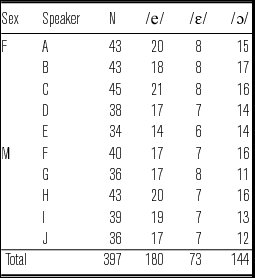
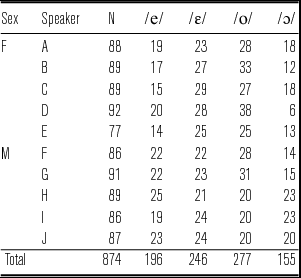
Traditionally, Occitan distinguishes between two mid-vowels, /e/ and /ɛ/, in the front of the vowel space (e.g. peis /peʃ/ ‘fish’, pè /pɛ/ ‘foot’) and has one mid-vowel, /ɔ/, in the back of the vowel space (e.g. pòrc /pɔɾk/ ‘pig’). Figure 2 presents the full Occitan oral vowel system. Token counts are presented in Table 2 for female (A–E) and male (F–J) Occitan speakers for each of the three vowels under investigation.
Occitan oral vowels (Mooney Reference Mooney2014a: 346).

Token counts for Occitan mid-vowels by speaker (F = female; M = male).

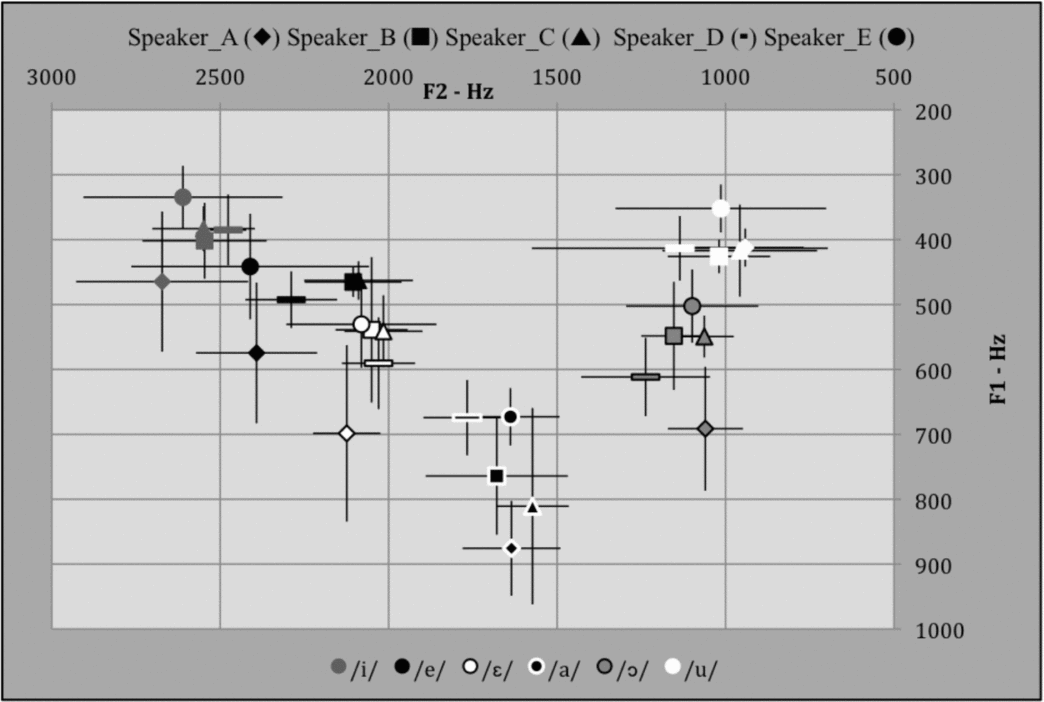
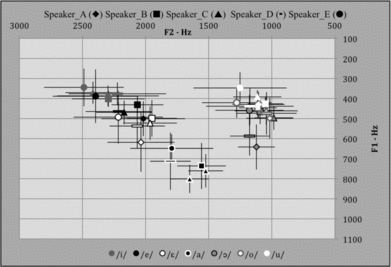
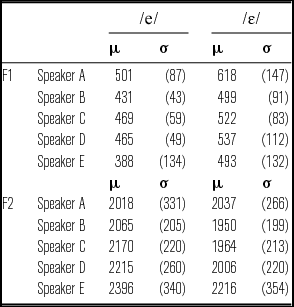
Figure 3 presents the mean F1 and F2 values and standard deviations for vowels produced by female speakers (see Appendix A, Table A1 for numeric values). This F1-F2 plot presents the mid-vowels as well as the mean values for approximately ten tokens of three peripheral reference vowels (/i u a/): /y/ has been excluded from the F1-F2 plot because it is distinguished from /i/ by the feature [+round] and labialisation correlates to a low value for F3 which is not represented in the F1-F2 plot, with the two vowels occupying a similar area in the F1-F2 plane. The placement of the vowels conforms largely to the schematised vowel space in Figure 2: two front mid-vowels, /e/ and /ɛ/, occupying the space between the reference vowels /i/ and /a/; one back mid-vowel, /ɔ/, comparable in height to /ɛ/ and located between the reference vowels /u/ and /a/. There is a tendency for /ɛ/ tokens to be lower than /e/ tokens and overlap is evident on the F1 dimension. Female speakers tend to produce values for /ɛ/ that are more ‘back’ than for those of /e/, suggesting that they may distinguish between /e/ and /ɛ/ simultaneously on the F1 dimension (vowel height) and on the F2 dimension (vowel frontness/backness). However, the mean values for F2 reveal substantial inter-speaker variability: Speakers A, D and E distinguish between /e/ and /ɛ/ by fronting the former; speakers B and C distinguish less between /e/ and /ɛ/ on the F2 dimension suggesting that they distinguish primarily between the vowels on the basis of F1, or vowel height.
Female speakers: Mean F1 and F2 values and standard deviations for Occitan mid-vowels with reference vowels.

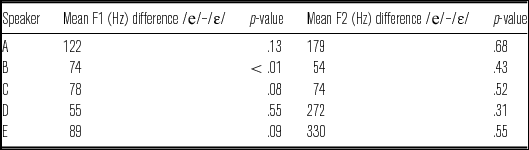
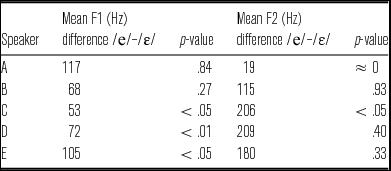
The results of the mixed model regression analyses of vowel overlap for individual female speakers are presented in Table 3 (see Appendix A, Table A1 for means and standard deviations). The significance of the mean difference between the front mid-vowels, /e/ and /ɛ/, is reported after the effect of phonological context has been taken into account, with p-values below .05 indicating that a given speaker makes a significant phonetic distinction between the Occitan front mid-vowels.
Female speakers: Vowel overlap results for Occitan front mid-vowels.

Despite consistent mean F1 differences between the front mid-vowels, only Speaker B makes a significant phonetic distinction between /e/ and /ɛ/, with p-values for Speakers C and E marginally below conventional significance levels. For F2, the tendency noted above for Speakers A, D, and E to front /e/ relative to /ɛ/ is returned as non-significant for all three speakers.
The phonetic realisations of /ɔ/ are located in a relatively compact area of the vowel space, with the exception of Speaker A who has a high F1 value, suggesting somewhat more open realisations of /ɔ/. On the F2 dimension, Speakers A, D and E are much more variable than Speakers B and C. For F1, female speakers are perhaps taking advantage of the fact that there is no phonemic close mid-vowel in the back of the Occitan vowel space and increasing variability on the height dimension. There is no comparable regression analysis for the Occitan back mid-vowel as there are no potentially contrastive phonemes in the back of the vowel space.
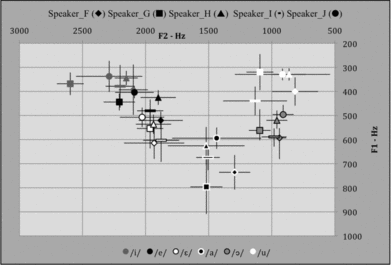
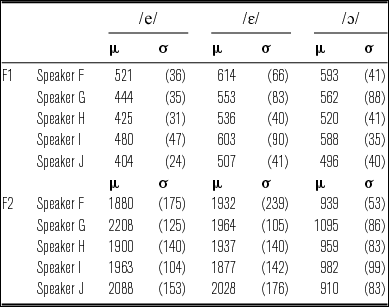
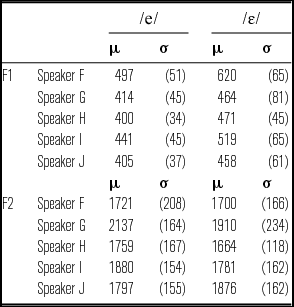
Mean F1 and F2 values and standard deviations for individual male speakers are presented in Figure 4 (see Appendix A, Table A2 for numeric values). Again, the general placement of the vowels conforms to the schematised vowel space in Figure 2 above. Male speakers appear to distinguish between /e/ and /ɛ/ phonetically by producing mean F1 values that are consistently higher for /ɛ/ than for /e/. There is, however, overlap evident between the vowels on the F1 and F2 dimensions for Speakers F and I, and on the F2 dimension alone for Speakers J and H. Table 4 presents the results of the mixed model regression analyses of vowel overlap for individual male speakers (see Appendix A, Table A2 for means and standard deviations).
Male speakers: Mean F1 and F2 values and standard deviations for Occitan mid-vowels with reference vowels.

Male speakers: Vowel overlap results for Occitan front mid-vowels.

All male speakers make a significant F1 difference between the front mid-vowels, with the exception of Speaker J; the apparent F1 overlap for Speakers F and I is therefore not significant enough to conclude that a phonemic distinction has been neutralised. No male speakers make a significant phonetic distinction between the /e/ and /ɛ/ on the F2 dimension. In Figure 4, however, Speaker G, appears different to the other male speakers in that he distinguishes between /e/ and /ɛ/ by making a front/back distinction as well as one of vowel height; the p-value for Speaker G's F2 values is just below the .05 significance level.
Male speakers exhibit a relatively compact arrangement of the back mid-vowel realisations across speakers, even before the data has been normalised. The standard deviations corresponding to the mean F1 and F2 values show similar levels of variability across speakers for both F1 and F2. Speaker G is exceptional in having a standard deviation for the mean F1 value that is over twice that of any of the other speakers. The standard deviations for the mean F2 values are, again, consistent across speakers and, with the exception of Speaker G, there is more variability in vowel frontness/backness than in vowel height.
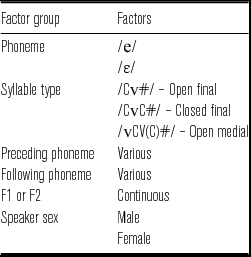
In order to model the front mid-vowels statistically across speakers, regression analyses were undertaken in Rbrul for normalised F1 and F2 as dependent variables. Table 5 details the fixed-effect factor groups and their respective factors used in the analyses, which also included ‘speaker’ and ‘word’ as random effects. This model aimed to ascertain the extent to which the historically appropriate phoneme (/e/ or /ɛ/) can predict F1 and F2 values when phonological context (syllable type; preceding and following phonemes) have been taken into account.Footnote 2 In the F1 model, F2 was also included as a fixed-effect to investigate potential significant correlations between the formant frequencies; F1 was equally included as a fixed effect in the model containing F2 as a dependent variable.
Factors groups and factors included in statistical analyses of the mid-vowels.

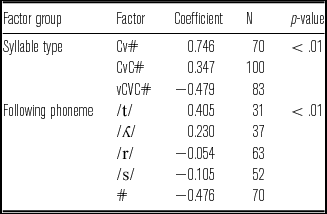
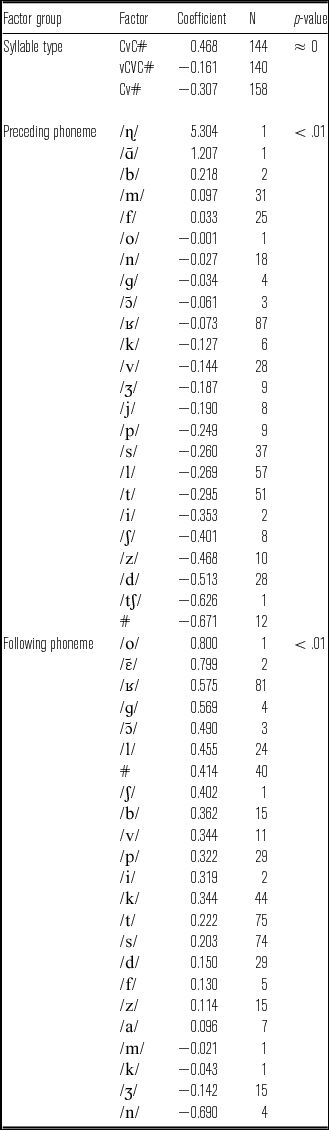
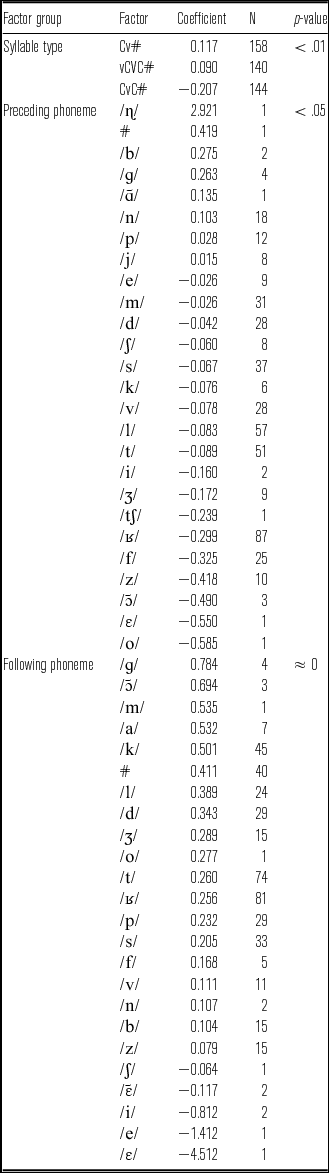
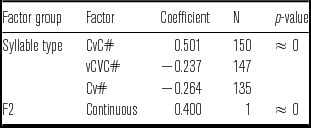
For the F1 and F2 regression models presented below (and in Section 4.2 for French), the discussion focuses explicitly on the significance attributed to the ‘phoneme’ factor group, given the focus of this study on phonological contrast and on the equivalence classification of cognate phonemes. The results for other significant fixed effects are briefly outlined in footnotes and the regression output for these effects may be consulted in Appendix C for Occitan and Appendix D for French.
For the Occitan front mid-vowels, the analysis returned ‘phoneme’ as a highly significant predictor of the value of F1 (p ≈ 0); following (p < .05) and preceding (p < .05) phoneme were also included in the model as significant predictors while syllable type (p = .06), F2 (p = .18), and speaker sex (p = .25) were non-significant fixed effects.Footnote 3 The significant effect for phoneme is negative for /e/ (– .293) and positive for /ɛ/ (+ .293) and the magnitude of the effect is strong. This finding shows that /e/ favours low F1 values while /ɛ/ favours high F1 values: /e/ is realised as a significantly higher vowel than /ɛ/. The regression models for individual speakers presented in Tables 3 and 4 above revealed five speakers (B, F, G, H, I) to make a significant F1 distinction between the front mid-vowels, two speakers (C, E) to make a distinction which was just below the .05 significance level, and three speakers (A, D, J) to not make a significant phonetic distinction between the vowels on this dimension. Nonetheless, the composite model, including normalised data for both male and female speakers, has shown F1 differences between /e/ and /ɛ/ to be significantly maintained over and above the individual variation observed; the model takes into account this variability by considering ‘speaker’ as a random effect before returning p-values for fixed-effects, increasing the generalisability of these results to the larger population.
For F2, ‘phoneme’ was returned as a non-significant predictor (p = .07), though following phoneme (p < .01) and syllable type (p < .01) were stronger predictors of the variation observed; preceding phoneme (p = .17), F1 (p = .18), and speaker sex (p = .19) were not returned as significant.Footnote 4 The non-significant effect for phoneme confirms that no phonetic distinction is made between the front mid-vowels on this dimension; the regression models for individual speakers (see Tables 3 and 4) showed nine speakers (A, B, C, D, E, F, H, I, J) not to make a significant phonetic distinction between the front mid-vowels on the F2 dimension and Speaker G to make a distinction that was just below the .05 significance level (p = .07).
4.2 French (L2) mid-vowels
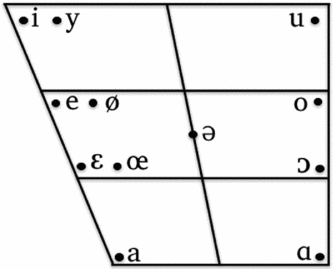
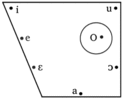
French, traditionally distinguishes between two unrounded vowels, /e/ and /ɛ/, in the front (e.g. pré /pʁe/ ‘meadow’, pêche /pɛʃ/ ‘fishing’) and two rounded vowels, /o/ and /ɔ/, in the back of the vowel space (e.g. peau /po/ ‘skin’, poche /pɔʃ/ ‘pocket’). The full phonological inventory for standard French is schematised in Figure 5.
French oral vowels (Mooney Reference Mooney2016: 31).

Token counts for the mid-vowels are presented in Table 6 for each of the four vowels under investigation. Token counts are comparable across speakers but there are more tokens for /ɛ/ and /o/ than for /e/ and /ɔ/. In the F1-F2 plots that follow, note that the front rounded vowels, /y œ ø/, have been excluded due to the difficulty involved in distinguishing them from the front unrounded vowels, /i e ɛ/, on the basis of F1 and F2 alone. The reference vowels (/i u a/) are plotted in the graphs that follow using F1 and F2 values from approximately 10–15 tokens per speaker.
Token counts for French mid-vowels by speaker (F = female; M = male).

Figure 6 presents the mean F1 and F2 values and standard deviations for vowels produced by individual female speakers (see Appendix B, Tables B1 and B2 for numeric values) and the position of the vowels relative to each other conforms largely to the schematised vowel space presented in Figure 5: two front mid-vowels, /e/ and /ɛ/, between /i/ and /a/; two back mid-vowels, /o/ and /ɔ/, between /u/ and /a/. All female speakers exhibit overlap between /e/ and /ɛ/ on both the F1 and F2 dimensions but, they show a tendency for the mean value of /ɛ/ to be lower and centralised relative to the mean value for /e/. The variation around the means shown suggests that this tendency towards opening and backing of /ɛ/ does not consistently separate these vowels for female speakers.
Female speakers: Mean F1 and F2 values and standard deviations for French mid-vowels with reference vowels.

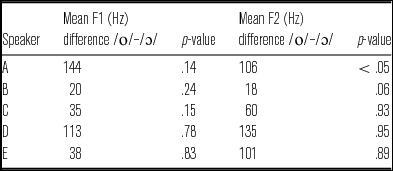
The results of the mixed model regression analyses of vowel overlap for individual female speakers are presented in Table 7 (see Appendix B, Table B1 for means and standard deviations). Three female speakers (C, D, E) make a significant phonetic distinction between the front mid-vowels on the basis of F1, while two speakers (A, C) distinguish between these vowels on the F2 dimension. Overall, when the effect of phonological context has been factored out, four of the five female speakers (A, C, D, E) realise the French front mid-vowels as phonetically distinct, with Speaker B making neither an F1 nor an F2 distinction between /e/ and /ɛ/.
Female speakers: Vowel overlap results for French front mid-vowels.

For the back mid-vowels, female speakers either exhibit complete overlap between the /o/ and /ɔ/, or a tendency towards lower, centralised realisations of /ɔ/. Three speakers (B, C, E) exhibit the first of these patterns, showing very little difference between the mean values for these vowels and a high degree of overlap between their distributions, suggesting that these speakers have a single phonetic category for the two standard French vowels. Speakers A and D, on the other hand, show a tendency towards lower centralised realisations of /ɔ/ but there is considerable overlap for both vowel height and vowel frontness/backness between the vowels for both speakers. The results of the mixed model regression analyses of vowel overlap for individual female speakers are presented in Table 8 (see Appendix B, Table B2 for means and standard deviations). These results show that no female speakers distinguish between /o/ and /ɔ/ on the basis of F1, while only Speaker A makes a front–back (F2) distinction between the back mid-vowels. When the effect of phonological context has been taken into account, these analyses provide strong evidence for neutralisation of the French /o/–/ɔ/ distinction in the speech of these female speakers.
Female speakers: Vowel overlap results for French back mid-vowels.

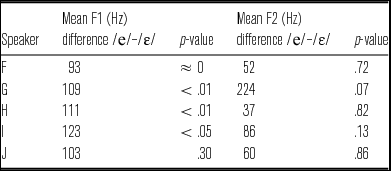
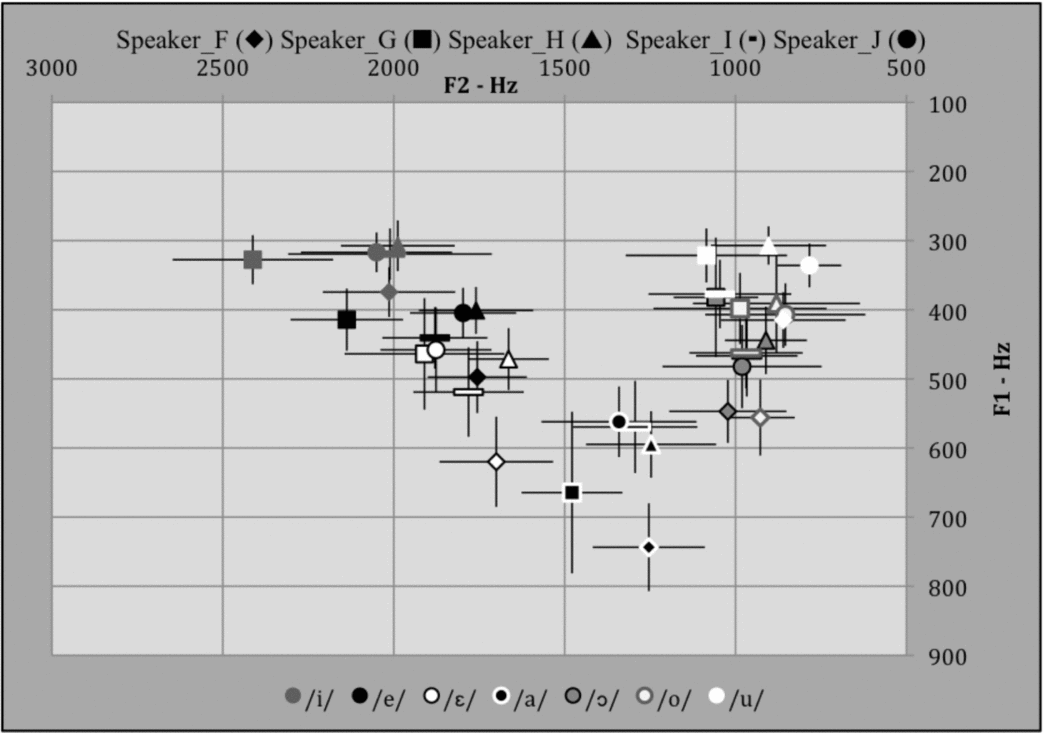
Figure 7 presents the non-normalised mean F1 and F2 values and standard deviations for the mid- and reference vowels of individual male speakers. The general position of the vowels conforms to the schematised vowel space in Figure 5 (see Appendix B, Tables B3 and B4 for numeric values). Speaker F is the only speaker to show complete separation on the F1 dimension between the front mid-vowels; for all other male speakers, varying degrees of overlap are evident between the front mid-vowels for both vowel height and vowel frontness/backness. With the exception of Speaker J, all male speakers show a tendency for the mean data point for /ɛ/ to be lower and more centralised than that of /e/. Speaker J shows this tendency on the F1 dimension in that the mean value of /ɛ/ is lower than that of /e/, but the tendency on the F2 dimension is for /ɛ/ to be fronter than /e/.
Male speakers: Mean F1 and F2 values and standard deviations for French mid-vowels with reference vowels.

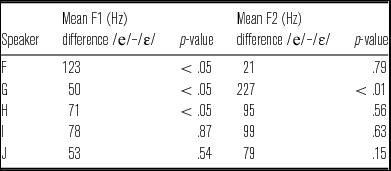
The results of the mixed model regression analyses of vowel overlap for individual male speakers are presented in Table 9 (see Appendix B, Table B3 for means and standard deviations). Three male speakers (F, G, H) make a significant F1 distinction between /e/ and /ɛ/, and Speaker G also realised /e/ as significantly different from /ɛ/ on the F2 dimension. The overlapping distributions observed for Speaker I and, in particular, Speaker J are, as demonstrated by the individual regression analyses, sufficient to return non-significant results for both formant frequencies.
Male speakers: Vowel overlap results for French front mid-vowels.

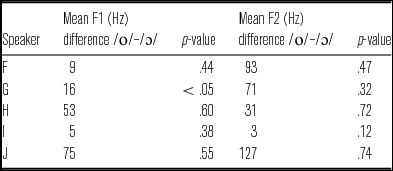
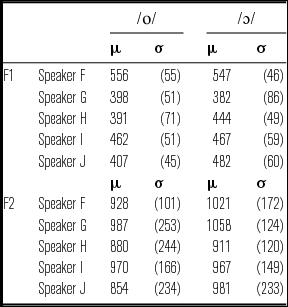
The male speakers’ phonetic realisations of the back mid-vowels are tightly clustered together; a similar distribution was evident for the single Occitan /ɔ/ vowel (see Figure 4). Three speakers (F, G, I) show extremely similar F1 values for their /o/ and /ɔ/ vowels, and exhibit only minimal mean F2 separation on the frontness/backness dimension. These mean values and their associated standard deviations suggest that /o/ and /ɔ/ are not distinguished phonetically for these speakers. For Speaker I in particular, for whom the means and standard deviations of /o/ and /ɔ/ overlap, it seems that a single phonetic category is used for both vowels. The other two speakers (Speakers H and J) exhibit similar F2 values for the back mid-vowels but show a tendency towards lower /ɔ/ vowels relative to /o/. Of these two speakers, Speaker J shows the greatest mean separation in vowel height between the back mid-vowels but the corresponding F1 standard deviations suggest that, for both speakers, the height distinction is not consistently used to distinguish between /o/ and /ɔ/. The mixed model regression analyses for individual speakers are presented in Table 10 (see Appendix B, Table B4 for means and standard deviations). These results confirm that, with the exception of Speaker G, all male speakers have neutralised the /o/–/ɔ/ contrast; Speaker G distinguished consistently between the vowels on the F1 dimension but the mean difference is small (16 Hz).
Male speakers: Vowel overlap results for French back mid-vowels.

The normalised F1 and F2 values of the French mid-vowels for all (male and female) speakers were modelled statistically using the same random effects and fixed-effect factor groups as for the Occitan analysis, for reasons of comparability (see Table 5; for the back mid-vowels, /o/ and /ɔ/ were, of course, the factors in the ‘phoneme’ factor group). Syllable type [Cv#; CvC#; vCVC#] has been explicitly included as a factor group because previous analyses of southern regional French have indicated that the mid-vowels follow the loi de position (literally: ‘position law’) whereby open variants [ɛ ɔ] occur in closed syllables, e.g. fête [fɛt] ‘party’, rose [rɔːz] ‘rose’, and close variants [e o] occur in open syllables, e.g. il sait [il se] ‘he knows’; haut [o] ‘high’. In standard French, the loi de position is by no means applied consistently, with mid-vowel pairs exhibiting numerous orthographically related and phonetically motivated exceptions to this generalised pattern.
For the front mid-vowels, the F1 analysis returned ‘phoneme’ as a significant predictor (p < .05); syllable type (p ≈ 0), preceding (p < .01) and following (p < .01) phoneme were also included in the model as significant predictors of F1.Footnote 5 F2 (p = .05) and speaker sex (p = .36) were returned as non-significant effects. The regression coefficient for ‘phoneme’ show /ɛ/ to favour higher F1 values (+ .08) while /e/ favours lower F1 values (– .08): /ɛ/ is significantly lower in the vowel space than /e/, though the magnitude of this effect is low (± .08). Nonetheless, when phonological context (syllable type; preceding and following phonemes) have been taken into account, the phonemic distinction between /e/ and /ɛ/ is realised on the F1 dimension. In the individual analyses presented in Tables 7 and 9, Speakers A, B, I, and J were shown not to realise this distinction phonetically, perhaps explaining the lower significance level returned, when compared with phonological contextual factors.
The F2 regression model for the front mid-vowels returned ‘phoneme’ as a non-significant predictor (p = .40), indicating that these speakers do not distinguish significantly between the front mid-vowels on the basis of F2. In the individual analyses, however, Speakers A, C, and G were shown to realise the front mid-vowels as phonetically different on the F2 dimension but this inter-speaker variability is not sufficient to return ‘phoneme’ as a significant predictor of F2 in the composite model (including ‘speaker’ as a random effect). Following phoneme (p ≈ 0), syllable type (p < .01), and preceding phoneme (p < .05) were included as significant predictors of F2 by the regression analysis, while F1 (p = .05) and speaker sex (p = .10) were non-significant predictors, in addition to ‘phoneme’.Footnote 6
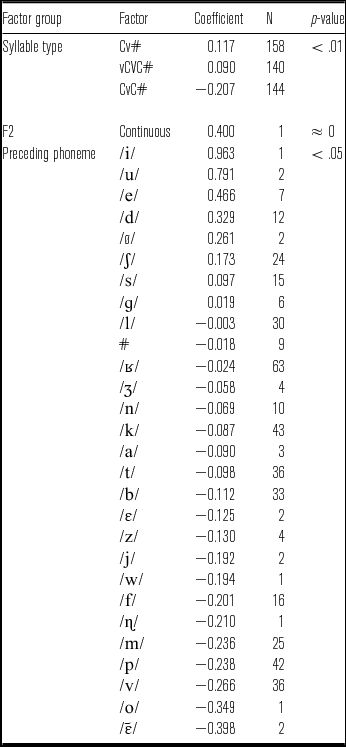
For the back mid-vowels, the F1 regression analysis returned ‘phoneme’ as a non-significant predictor of vowel height (p = .41); syllable type (p ≈ 0) and F2 (p ≈ 0) were included as significant predictors while preceding phoneme (p = .06), speaker sex (p = .14), and following phoneme (p = .24) were returned by the analysis as non-significant fixed effects.Footnote 7 The non-significant result for ‘phoneme’ confirms that neither male nor female speakers make a significant vowel height distinction between /o/ and /ɔ/, the general pattern observed in the raw data (with the exception of Speaker G; see Table 10).
The F2 analysis of the back mid-vowels also returned ‘phoneme’ as a non-significant predictor (p = .89); F1 (p ≈ 0), preceding phoneme (p < .01), and syllable type (p < .05) were returned as significant predictors of F2 while following phoneme (p = .33) and speaker sex (p = .81) were non-significant.Footnote 8 The negative result for ‘phoneme’ confirms that, across speakers, the back mid-vowels are not distinguished phonetically on the basis of F2; this is the general pattern observed in the individual analyses (see Tables 8 and 10), with the exception of Speaker A.
These analyses aimed to test the SLM hypothesis that an L2 contrast (French /o/–/ɔ/) not present in the L1 (Occitan /ɔ/) will be neutralised, as a result of equivalence classification. For both F1 and F2, no significant effect of phoneme (/o/ and /ɔ/) was revealed by the analyses: the bilingual speakers use only one mid-vowel, French [O], in the back of the vowel space, which conflates /o/ and /ɔ/ into a single phonological category; the phonetic quality of this vowel will be discussed, relative to L1 Occitan categories, in the discussion of L1-to-L2 transfer below.
4.3 L1-to-L2 transfer
This section examines evidence for phonetic category assimilation: the Occitan and French data sets for each class were combined, and regression analyses including ‘language’ as a fixed-effect factor group (with factors ‘Occitan’ and ‘French’) were used to establish significant variations in F1 and F2 that are related to cognate sounds being realised in one language or the other. These regression analyses control for inter- and intra-speaker variation as well as variability introduced into the data set by different lexical items, and all data used are normalised. These tests aim to explicitly address the SLM hypothesis, that equivalence classification of L1 and L2 phonemic categories will lead to phonetic category assimilation, by answering conclusively the following questions:
(i) Is French /e/ phonetically different from Occitan /e/?
(ii) Is French /ɛ/ phonetically different from Occitan /ɛ/?
(iii) Is French /O/ phonetically different from Occitan /ɔ/?
In acoustic terms, if the answer to these questions is ‘no’ then the F1 and F2 values would not be significantly different between each of the languages for each cognate pair.
Beginning with the front mid-vowels, all regression analyses for /e/ and /ɛ/ returned ‘language’ as a non-significant predictor of vowel height (F1) and vowel frontness/backness (F2): (p = .44; p = .95) for F1; (p = .07; p = .054) for F2. This means that, on the basis of F1 and F2, Occitan and French /e/ and /ɛ/ are not realised as significantly different and do, therefore, resemble each other phonetically.
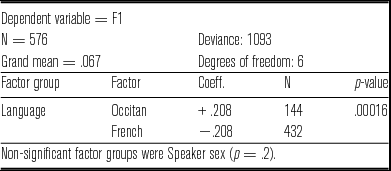
Working on the assumption that Occitan /ɔ/ and French /O/ are cognate phonemes, we can now test the hypothesis that equivalence classification has blocked the formation of a new phonetic category for French /O/. If such equivalence classification takes place, Occitan /ɔ/ and French /o/ and /ɔ/ would be realised as phonetically identical, [ɔ], via the mechanism of phonetic category assimilation. The regression analysis for F1 is presented in Table 11. ‘Language’ is returned as a highly significant predictor of F1 (p < .01): Occitan /ɔ/ has significantly higher F1 values than French /O/ which favours lower F1 values, showing the Occitan vowel to be significantly lower in the bilingual vowel space than the French vowel.
All speakers: Regression analysis for F1 values from Occitan (/ɔ/) and French (/O/).

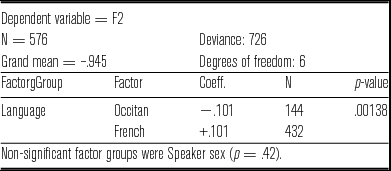
Table 12 presents the regression model for F2 where ‘language’ is also returned as a highly significant predictor of vowel frontness (p < .01). Occitan is shown to favour back vowels while French favours more centralised vowels.
All speakers: Regression analysis for F2 values from Occitan (/ɔ/) and French (/O/).

These statistical analyses reveal Occitan /ɔ/ to be phonetically distinct from French /O/ on the basis of both F1 and F2: French /O/ is higher and more centralised than Occitan /ɔ/.
5 Discussion
Moreux explicitly presents the regional French mid-vowels of older speakers in Béarn as influenced by the variety of Gascon (or Occitan) that they speak: ‘these stereotypical traits in the French of the old are linked to the Gascon that they speak’ (Moreux Reference Moreux2006: 310; my translation). The Occitan and French mid-vowel systems exhibit a one-to-one correspondence in the front of the vowel space: Occitan /e/ with French /e/, and Occitan /ɛ/ with French /ɛ/. In the back of the vowel space, Occitan /ɔ/ corresponds to both /o/ and /ɔ/ in French. The SLM predicts different types of transfer when the surface phonologies of the L1 and L2 exhibit one-to-one correspondence and when they differ. This section discusses evidence for phonological and phonetic transfer considering these correspondences and divergences between the Occitan and French mid-vowel systems. Firstly, evidence for equivalence classification is investigated by examining the parallels between phonemic categories in Occitan and French. Secondly, evidence for new category formation (predicted by the absence of equivalence classification) is assessed and the linguistic mechanisms of phonetic category assimilation and phonetic category dissimilation are discussed in detail.
5.1 Phonological transfer
Evidence for phonological transfer must be based on evidence for equivalence classification, that is, that structurally related phonemes in the L1 and L2 are linked as ‘cognates’ and exist in a common phonological space. The SLM predicts that the phonemes /e/ and /ɛ/ in Occitan will be equated, via the process of equivalence classification, with French /e/ and /ɛ/ in a common phonological space, facilitating their retention in emergent regional French. In Occitan, speakers made a statistically significant phonetic distinction between /e/ and /ɛ/ on the basis of F1 but not on the basis of F2 (see Section 4.1 above). In French, speakers also distinguished between /e/ and /ɛ/ on the basis of F1 and made no significant front/back (F2) distinction between the phonemes (see Section 4.2). Therefore, the bilingual speakers make a comparably significant phonetic distinction between the front mid-vowels on the basis of vowel height in both languages: /e/ is higher than /ɛ/. It has been noted that the existence of /e/ and /ɛ/ in Occitan may facilitate the maintenance of this contrast in the French of bilingual speakers, whereas this distinction is not realised by many, primarily northern, monolingual French speakers (Morin Reference Morin and Arnavielle2005, Moreux Reference Moreux2006, Durand Reference Durand, Baronian and Martineau2009). The existence of phonemic categories for /e/ and /ɛ/ in both of the bilinguals’ languages lends weight to the SLM hypothesis that they would be equated in common abstract phonemic categories. The maintenance of an L2 contrast, which has been lost in many other dialects of the L2, due to contact with a bilingual speaker's L1 provides strong evidence for equivalence classification.
For the back mid-vowels, the SLM predicts that the existence of a single back mid-vowel phonemic category in Occitan /ɔ/ will lead to the establishment of a single phonemic category in French (conflating /o/ and /ɔ/) since equivalence classification would equate the two French sounds with the single sound in Occitan as the phonetic height difference between French /o/ and /ɔ/ does not play a distinctive role in the speakers’ L1. The statistical analyses of F1 and F2 in French confirmed this SLM hypothesis to be true: no significant effect is returned for phoneme in either analysis (see Section 4.2). In French, the bilingual speakers do not make a significant phonetic distinction between /o/ and /ɔ/, demonstrating that these sounds occupy a single phonemic category, /O/, which is, in SLM terms, equated with Occitan /ɔ/ in a common abstract phonological representation. We can thus conclude that, based on this analysis, Occitan /ɔ/ and French /O/ are cognate phonemes for the bilingual speakers, and that, as predicted by the SLM, distinctions that are not meaningful in the speakers’ L1 are less likely to be maintained in their L2. Simonet (Reference Simonet2011) presents a similar finding for the back mid-vowels of Catalan–Spanish bilinguals: Spanish-dominant bilinguals did not produce the Catalan /o/–/ɔ/ contrast in their speech, instead using a merged Catalan back mid-vowel, which conflated two historically appropriate categories.
Durand notes the existence of many southern varieties of French which maintain a phonetic distinction between the front mid-vowels /e/ and /ɛ/ while neutralising the distinction between /o/ and /ɔ/ (and also between /ø/ and /œ/) (Durand Reference Durand, Baronian and Martineau2009: 6). Martinet views such neutralisation as a consequence of articulatory asymmetry between the possible degrees of vowel height in the front and back of the vowel space: ‘for the same number of phonemes in the front and back of the vowel space, the margins of security will be narrower in the back than in the front, and this can, at least partially, explain the differential behaviour of the front and back mid-vowels’ (Martinet Reference Martinet1955: 99; my translation). While there may exist some articulatory bias favouring the existence of a single back vowel category in French, this asymmetry is not present in most other varieties of metropolitan French and, in the case of the supralocal northern norm, there is partial assimilation of phonological contrast in the front and back of the mid-vowel space with a range of partly structured phonetic realisations. It is most likely therefore that this is language contact effect. Flege notes that this type of transfer at the phonemic category level occurs when L2 learners fail to perceive phonetic differences that distinguish contrastive sound units of the L2, or which distinguish L2 sounds from sounds in the L1: ‘As the result of pre-attentive processes established in early childhood, learners of an L2 might simply ignore phonetic differences not directly relevant to contrasts between sounds of the L1’ (Flege Reference Flege, Bloothooft, Hazan, Huber and Llisterri1995: 99). Flege, MacKay & Meador (Reference Flege, MacKay and Meador1999) illustrate this by showing that Italian speakers of English failed to discriminate significantly between pairs of English tense and lax vowels (e.g. /i/–/ɪ/) for which a single tense phonemic category existed in their L1 (e.g. /i/).
These findings provide evidence that early bilinguals, who began to learn their second language at the age of five or six years, do not acquire the socially and geographically dominant forms of the L2, instead exhibiting L1 transfer, contrary to the predictions of traditional critical period hypotheses (Penfield & Roberts Reference Penfield and Roberts1959, Borstein Reference Bornstein1989). Indeed, to adduce ‘age of learning’ as an explanatory factor in L2 acquisition may not be appropriate because it is frequently confounded with other factors that may influence performance, such as input, language use, and bilingual dominance (Bahrick et al. Reference Bahrick, Hall, Goggin, Bahrick and Berger1994, Flege Reference Flege, Cole and Hualde2007). To these we might add social and affective factors such as identity, where bilingual speakers are positively motivated to retain non-standard L2 forms as part of an identity construction process which may distinguish them from monolingual populations (Dörnyei & Ushioda Reference Dörnyei and Ushioda2009; see e.g. Dubois & Horvath Reference Dubois and Horvath1998, Sharma Reference Sharma2005, Sharma & Sankaran Reference Sharma and Sankaran2011). This is certainly plausible in the French context where southern accents, which have resulted primarily from language contact, are widely perceived as ‘melodic’ and ‘friendly’ (Paltridge & Giles Reference Paltridge and Giles1984).
There is no doubt that exposure to standard varieties of the L2 has increased dramatically over the lifespan for the bilingual speakers examined here: mass media; large-scale in-migration to the region; increasing supralocal features in the speech of younger monolingual generations (Mooney Reference Mooney2014b, Reference Mooney2016). It is striking, therefore, that these early bilinguals have not come to modify their L2 as a result of this increasing exposure, or ‘experience’ (Watson Reference Watson, Jones and Esch2002), to exemplars characteristic of the dominant L2 variety. This provides additional support to the claim that identity-based motivations may be at play during L2 acquisition in situations of long-term language contact, distinguishing this different sociolinguistic context from foreign language learning, where the target has most often been to approximate (standard) native speaker norms (Jenkins Reference Jenkins1998, Cook Reference Cook1999, Simonet Reference Simonet2010, Newlin-Lukowicz Reference Newlin-Luckowicz2013). Simonet (Reference Simonet2010: 675), for example, argues that ‘bilinguals may “choose” to have an accent for social-indexical reasons rather than this accent being the consequence of a cognitive constraint’. As such, it is not appropriate to speak of ‘L2 performance’ in this context, but rather to investigate the linguistic and social mechanisms governing the sustained deviations from standardised norms observed during L2 acquisition and production.
5.2 Phonetic transfer
The results presented above established the existence of three potential equivalence classes: Occitan /e/ and French /e/; Occitan /ɛ/ and French /ɛ/; Occitan /ɔ/ and French /O/. In each case, equivalence classification should hypothetically block new phonetic category formation for French sounds in which case the Occitan and French sounds, via the process of cross-language phonetic category assimilation, would resemble each other in production.
From the perspective of the SLM, the equivalence classification of Occitan /e/ and /ɛ/ with French /e/ and /ɛ/ has led to L2 sounds being realised as instances of L1 phonetic categories, [e] and [ɛ], which are used to process and produce perceptually linked L1 and L2 diaphones: there is no significant difference in pronunciation between the Occitan and French vowels. This confirms the SLM hypothesis that equivalence classification entails phonetic category assimilation in this context, when the surface phonologies of the bilingual speakers’ languages are in one-to-one correspondence.
We have seen that French /ɔ/ and /o/ were merged into a single phonemic category, /O/, by analogy with the single back mid-vowel phoneme /ɔ/ in Occitan. This appeared to be an instance of phonological transfer but the findings presented in Tables 11 and 12 (see Section 4.3) have shown phonetic L1-to-L2 transfer to be absent. The greater the perceived dissimilarity of an L2 sound from the closest L1 sound, the more likely a new phonetic category will be formed for an L2 sound. The establishment of a new category in the back of the vowel space, French /O/, appears to have activated the linguistic mechanism of ‘phonetic category dissimilation’, whereby a newly established L2 category disperses in the bilingual vowel space and dissimilates from neighbouring L1 and/or L2 sounds to preserve phonetic contrast. We have seen that Occitan /ɔ/ is tightly clustered in the open-mid area of the vowel space (see Figures 3 and 4) and it is possible that the wider range of variability in standard French, occupying the entire back mid-vowel space, triggered the establishment of a new phonetic category for the L2 due to the disaccord between the range on F1 values in each of the languages. In this case, the single French [O] category has moved away from Occitan [ɔ] by raising and centralising: phonemic transfer has not resulted in phonetic transfer. The new French [O] phonetic category was perhaps also ‘attracted’ to the ‘gap’ in the asymmetrical L1 vowel space between Occitan [ɔ] and Occitan [u]. It is also a possibility that the tight clustering of the Occitan [ɔ] vowel is a result of the L1 phonetic category also dissimilating, moving low in the vowel space to maximise phonetic contrast with the newly established L2 category for French [O]. Simonet (Reference Simonet2011) found that Spanish-dominant Spanish–Catalan bilinguals who had merged Catalan /o/ and /ɔ/ into a single merged back vowel by analogy with Spanish /o/, had nonetheless also developed a separate phonetic category for this merged Catalan vowel, which was significantly lower and slightly more fronted than their Spanish /o/. This finding parallels the results presented above for the Occitan–French bilinguals. In both cases, the neutralisation of an L2 phonological contrast not present in the speakers’ L1, as a result of equivalence classification, did not lead to phonetic category assimilation, as predicted by the SLM.
Figure 8 presents a schematised bilingual Occitan–French vowel space for the mid-vowels (including three reference vowels, /i a u/): [e] and [ɛ] represent merged L1–L2 phonetic categories; [O] is a French L2 phonetic category which is used to produce the historically appropriate phonemic categories /o/ and /ɔ/; [ɔ] is an Occitan L1 phonetic category.
Schematised bilingual vowel space for the mid-vowels.

The SLM hypothesis that equivalence classification leads to phonetic category assimilation is thus disproved when the surface phonologies of the L1 and L2 diverge. The loss of a phonemic contrast in the L2, maintained in other dominant varieties of the language, as a result of equivalence classification with a phoneme in the speaker's L1 does not appear to lead to cross-linguistic phonetic category assimilation. It seems that, based on the evidence presented here, in addition to the findings of Simonet (Reference Simonet2011), phonological L1-to-L2 transfer may occur when there is no one-to-one correspondence between the L1 and L2 phonologies but that the SLM hypothesis mentioned above must be modified to take account of these structural divergences when advancing predictions about phonetic category assimilation. This is because phonemic divergences between the languages in contact have been shown here to inhibit the production of an L2 sound as an instance of an L1 phonetic category, even when they have been equated as cognates from a phonological perspective.
The findings for phonetic transfer provide additional evidence for the processing and production of the L2 using pre-existing L1 categories, in the speech of early bilinguals who might otherwise be expected, if the notion of a critical period for L2 acquisition is accepted (see Birdsong Reference Birdsong1999 for discussion), to form distinct categories for their L2, even where structural correspondences exist with the L1. On the other hand, there is equal evidence for phonetic separation between the L1 and L2 which implies that, from a cognitive perspective, these early bilinguals had/have the ability to perceive phonetic differences between L1 and L2 exemplars, resulting in phonetic separation between their languages (though newly established L2 categories do not approximate monolingual native speaker norms). It has been argued that both early and late L2 learners will initially perceive and process their second language using pre-existing L1 categories, which they will then slowly come to modify in light of further ‘experience’ (Watson Reference Watson, Jones and Esch2002). Deviations from monolingual norms may thus be explained within the theory of exemplar-based language learning (Johnson Reference Johnson, Johnson and Mullennix1997, Pierrehumbert Reference Pierrehumbert, Bybee and Hopper2001): ‘the number of exemplars of monolingual-like production stored in memory is insufficient to change the overall prototype sufficiently from its original L1 setting’ (Watson Reference Watson, Jones and Esch2002: 259). I have argued the L2 input is maximal for the bilinguals presented in this study, given the social and economic dominance of French and the obsolescent nature of Occitan, with exposure to L2 exemplars (standardised and otherwise) increasing steadily over their lifetimes. Given the potentially optimal L2 acquisition abilities of early learners and the long-term exposure to L2 exemplars, we must acknowledge, once again, the possibility that deviations from monolingual norms are governed more so by social, rather than linguistic or neurological, constraints: the bilingual speakers have attained native-speaker fluency in their L2 but the continued use of non-standard transfer-induced L2 forms may be an attempt to promote ‘social distance’ (Schumann Reference Schumann1976, Ricento Reference Ricento and Hinkel2005) between themselves and monolingual populations. The effect of identity and ‘motivation’ on L2 performance has traditionally focused on foreign language learners in the classroom context (Clément, Dörnyei & Noels Reference Clément, Dörnyei and Noels1994, MacIntyre et al. Reference MacIntyre, Baker, Clément and Donovan2002, Sauro & Smith Reference Sauro and Smith2010), but in this situation of long-term language contact it appears that identity/motivation may influence the approximation of standard L2 norms rather than L2 accuracy/performance in absolute terms (see Sharma & Sankaran Reference Sharma and Sankaran2011 and Newlin-Lukowicz Reference Newlin-Lukowicz2014 for a discussion of the differential use of non-standard L2 forms in identity construction by bilinguals with different profiles).
6 Conclusion
Examining the applicability of the SLM to the situation of language contact between Occitan and French allowed this study to test the hypothesis that phonological and phonetic variation in regional French is the result of transfer from the local language spoken in the region of Béarn and also contributed to research in second language acquisition by providing a new perspective on L1-to-L2 linguistic transfer, considering ‘speech learning’ in a situation of long-term territorial language contact between typologically related Gallo-Romance languages.
In addition to raising questions about previous analyses of the French mid-vowels and producing interesting findings regarding the linguistic mechanisms active during the emergence of regional French from language contact, this study has confirmed some hypotheses advanced by Flege's SLM to be true, while also suggesting potential modifications to the model in light of the differential outcomes of contact in a sociolinguistically different situation to those normally examined within the context of L2 speech learning. The phonological and phonetic analyses had the following four findings, presented here in two sets:
(i) Equivalence classification led to cross-linguistic phonetic category assimilation when the phonemic categories of the L1 and L2 were in one-to-one structural correspondence.
(ii) Structural disaccord between the languages in contact resulted in the establishment of an analogical L2 (phonemic) category, based on the phonemic category of the L1.
These findings confirmed that, in situations of long-term language contact, phonemic contrasts present in the bilingual's L1 will favour the maintenance of equivalent (potentially unstable) contrasts in the L2 because of equivalence classification and that meaningful L2 distinctions will not be maintained when such a distinction is not present in the speaker's L1. This phonological equivalence classification contradicted the traditional assumption that neuroplasticity will be maximal for early bilinguals (Lenneberg Reference Lenneberg1967) allowing them to reproduce accurately monolingual-like L2 forms, though there is growing evidence to suggest that this conception is overly simplistic (see e.g. Frenck-Mestre et al. Reference Frenck-Mestre, Anton, Roth, Vaid and Viallet2005).
The phonological categories of emergent regional French appear, at least in the early stages of contact, to be based on phonemic categories present in Occitan. The regional French of the older, bilingual speakers was shown to make a distinction between /e/ and /ɛ/ but the distinction between conservative French /o/ and /ɔ/ was not maintained, both French sounds being equated in regional French in the same category, /O/. Three emergent L2 categories, /e/, /ɛ/ and /O/ appeared to be equated with the L1 Occitan phonemic categories, /e/, /ɛ/ and /ɔ/ by equivalence classification.
(iii) Phonological transfer did not necessarily entail phonetic transfer: the establishment of one L2 phonemic category (which conflates two monolingual L2 categories) by analogy with a single L1 category did not always lead to phonetic category assimilation via equivalence classification.
(iv) New category formation led to the establishment of new L2 phonetic categories when there was structural disaccord between the corresponding elements of the L1 and L2 phonologies.
The conflation of two L2 phonemic categories that are not meaningful in the L1 does not automatically lead to the combined L2 category being realised as an instance of an L1 phonetic category. This finding highlighted the need to incorporate more detailed information into the SLM regarding surface phonological correspondences between a speaker's L1 and L2. Furthermore, it is necessary, in light of this information, to modify the hypothesis that evidence for equivalence classification will entail phonetic category assimilation. We can perhaps view new category formation as an ‘alternative hypothesis’ such that equivalence classification leads to phonetic category assimilation when the surfaces phonologies of the languages in contact correspond, but that equivalence classification entails new phonetic category formation when the L1 and L2 phonologies diverge.
It appears that the bilingual speakers were capable of perceiving exemplars of L2 sounds as different from L1 sounds because the establishment of a new phonetic category depends on this distinction. The neurocognitive implications of this finding are that (i) the bilingual sound system is organised such that the abstract (phonemic) level is more affected by transfer than production, (ii) L2 production of a perceived distinction diverges from more recently encountered exemplars (see Sancier & Fowler Reference Sancier and Fowler1997), and (iii) the bilingual speakers do not come to modify significantly their initially established (L1-influenced) L2 categories in light of further ‘experience’ or increased L2 input over time (see Watson Reference Watson, Jones and Esch2002).Footnote 9 I have argued that the assessment of L2 performance accuracy relative to standard monolingual norms is not appropriate in this situation of long-term language contact because non-standard L2 forms may hold in-group associations for the bilingual speakers such that L1 transfer during L2 acquisition carries social indexicality: these L2 deviations may be governed by affective motivations such as the exaltation of regional identity or a will to socially distance themselves from monolingual populations.
Examining L2 speech learning in this situation of language contact has revealed the implication that equivalence classification causes cognate L1 and L2 sounds to resemble each other in production to be restricted to contexts where the original L1 and L2 surface phonologies correspond. This finding showed the phonemic and phonetic category levels of Flege's model to be markedly less dependent than the equivalence classification hypothesis would imply, the most striking inference of this being that transfer occurring at the most abstract ‘phonemic category’ level, does not invariably cause transfer at the subordinate ‘phonetic category’ level of the bilingual's sound system. It appears that, while the cognitive mechanisms governing L2 perception and acquisition are highly influenced by pre-existing L1 forms at the phonemic category level, early bilinguals do possess the ability to produce L1–L2 phonemic cognates as phonetically different. L2 production ‘accuracy’, on the other hand, may importantly be influenced by sociolinguistic, in addition to cognitive and linguistic, factors in situations of territorial language contact.
Appendix A. Means and standard deviations for Occitan mid-vowels
Female speakers: Mean F1 and F2 values (Hz) with standard deviations for Occitan front mid-vowels.

Male speakers: Mean F1 and F2 values (Hz) with standard deviations for Occitan front mid-vowels.

Appendix B. Means and standard deviations for French mid-vowels
Female Speakers: Mean F1 and F2 values (Hz) and standard deviations for French front mid-vowels.

Female speakers: Mean F1 and F2 values (Hz) and standard deviations for French back mid-vowels.

Male Speakers: Mean F1 and F2 values (Hz) and standard deviations for French front mid-vowels.

Male speakers: Mean F1 and F2 values (Hz) and standard deviations for French back mid-vowels.

Appendix C. Significant factors affecting Occitan front and back mid-vowels
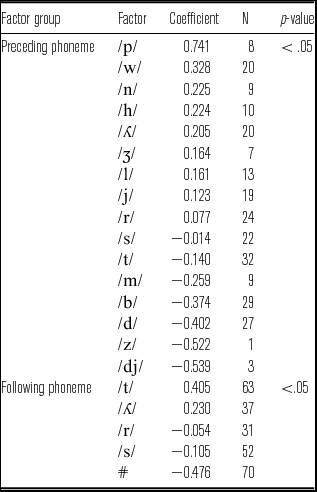
Regression output for significant factors (other than ‘phoneme’) affecting Occitan front mid-vowel height (F1).

Regression output for significant factors affecting Occitan front mid-vowel frontness/backness (F2).

Appendix D. Significant factors affecting French front and back mid-vowels
Regression output for significant factors (other than ‘phoneme’) affecting French front mid-vowel height (F1).

Regression output for significant factors affecting French front mid-vowel frontness/backness (F2).

Regression output for significant factors affecting French back mid-vowel height (F1).

Regression output for significant factors affecting French back mid-vowel frontness/backness (F2).