Introduction
In older adults, clinical depression is a significant health problem, carrying a poor prognosis (Cole et al. Reference Cole, Bellavance and Masour1999; Beekman et al. Reference Beekman, Penninx, Deeg, De Beurs, Geerings and Van Tilburg2002; Licht-Strunk et al. Reference Licht-Strunk, van der Windt, van Marwijk, de Haan and Beekman2007). Regarding the prevalence of depression, rates between 8.8% and 23.6% have been reported (Copeland et al. Reference Copeland, Beekman, Dewey, Hooijer, Jordan, Lawlor, Lobo, Magnusson, Mann, Meller, Prince, Reischies, Turrina, De Vries and Wilson1999; McDougall et al. Reference McDougall, Kvaal, Matthews, Paykel, Jones, Dewey and Brayne2007). The most important risk factor for developing late-life clinical depression is the presence of depressive symptoms not (as yet) meeting diagnostic criteria (Cuijpers et al. Reference Cuijpers, De Graaf and Van Dorsselaer2004; Smit et al. Reference Smit, Ederveen, Cuijpers, Deeg and Beekman2006). Hence, effective early interventions directed at older adults with mild to moderate depressive symptomatology are of utmost importance. Meta-analytic evidence indicates that early interventions for older adults with depressive symptoms are indeed promising in preventing depressions (Cuijpers et al. Reference Cuijpers, Smit and Van Straten2007).
Besides cognitive behavioural therapy (Cuijpers et al. Reference Cuijpers, Smit and Van Straten2007), life review has been established as an evidence-based early treatment of depression in later life (Bohlmeijer et al. Reference Bohlmeijer, Smit and Cuijpers2003, Reference Bohlmeijer, Roemer, Cuijpers and Smit2007; Pinquart et al. Reference Pinquart, Duberstein and Lyness2007). Life review involves a structured evaluation of one's own life, on the one hand aiming at coping with negative experiences and conflicts and on the other hand at giving a positive meaning to life (Haight, Reference Haight1992; Wong, Reference Wong, Haight and Webster1995; Westerhof et al. Reference Westerhof, Bohlmeijer and Webster2010). Life review seems especially suited for older adults who experience loss of meaning in life and who hold a negative view of themselves. Critical life events may increase the use of specific negative functions of reminiscence such as reviving bitter experiences or escaping past problems (Wong, Reference Wong, Haight and Webster1995; Cappeliez, Reference Cappeliez, Webster and Haight2002; Wink & Schiff, Reference Wink, Schiff, Webster and Haight2002). Associations between these functions and poorer mental health have been found recently (Cully et al. Reference Cully, LaVoie and Gfeller2001; Cappeliez et al. Reference Cappeliez, O'Rourke and Chaudhury2005; Cappeliez & O'Rourke, Reference Cappeliez and O'Rourke2006; Korte et al. Reference Korte, Bohlmeijer, Westerhof and Pot2011; O'Rourke et al. Reference O'Rourke, Cappeliez and Claxton2011).
The above underscores the importance of developing early interventions based on life review. Recently, attempts have been made to combine life review with other interventions aimed at people with clinically relevant mental distress (Watt & Cappeliez, Reference Watt and Cappeliez2000; Cappeliez, Reference Cappeliez, Webster and Haight2002; Westerhof et al. Reference Westerhof, Bohlmeijer and Webster2010), for example narrative therapy (Bohlmeijer et al. Reference Bohlmeijer, Westerhof and Emmerik-De Jong2008, Reference Bohlmeijer, Kramer, Smit, Onrust and van Marwijk2009). In narrative therapy, life stories are considered as a reconstruction of autobiographical memories (Atwood & Ruiz, Reference Atwood and Ruiz1993; Bluck & Levine, Reference Bluck and Levine1998). The most important element in life review combined with narrative therapy is to develop alternative, more agentic life stories, in which clients take responsibility for their own preferred ways of living (Bohlmeijer et al. Reference Bohlmeijer, Westerhof and Emmerik-De Jong2008, Reference Bohlmeijer, Kramer, Smit, Onrust and van Marwijk2009).
To summarize, substantial evidence supports the efficacy of life review as a treatment of depression in later life. However, most trials have not studied the effectiveness of life review in its natural setting (Bohlmeijer et al. Reference Bohlmeijer, Smit and Cuijpers2003, Reference Bohlmeijer, Roemer, Cuijpers and Smit2007; Pinquart et al. Reference Pinquart, Duberstein and Lyness2007). To fill that gap, we have conducted a large, multi-site, pragmatic randomized controlled trial (RCT) in adults aged ⩾55 years with moderate depressive symptoms, in which we compared the effectiveness of an intervention based on life review and narrative therapy (life review therapy) in its natural setting with care as usual. To study the effects in a natural setting, the Dutch health-care system was mimicked as closely as possible in terms of patient recruitment and offering the intervention. We specifically aimed at young older adults, who are in relatively good health. Life review might help to cope with age-related losses and declines, and to find meaning in this new phase of life (Haight, Reference Haight1992; Wong, Reference Wong, Haight and Webster1995; Westerhof et al. Reference Westerhof, Bohlmeijer and Webster2010). Most studies on life review interventions have included relatively small sample sizes (Bohlmeijer et al. Reference Bohlmeijer, Smit and Cuijpers2003, Reference Bohlmeijer, Roemer, Cuijpers and Smit2007; Pinquart et al. Reference Pinquart, Duberstein and Lyness2007). These small sample sizes have precluded addressing important questions about the moderating influence of client characteristics such as sociodemographic attributes, personality traits, patterns of reminiscence and level of depressive symptomatology. Here we sought to identify subgroups for which the intervention might be particularly effective. This should help to determine the suitability of the intervention for different target groups.
Method
Design
The design of the current study is described in detail by Korte et al. (Reference Korte, Bohlmeijer and Smit2009) . We carried out a pragmatic, multi-site RCT in which participants were randomly assigned to either life review therapy or care as usual.
Participants and procedure
Participants were recruited from September 2008 to September 2009, in collaboration with Dutch mental health-care services, through advertisements in newspapers and information booklets, plus a radio interview and commercial. Applicants were referred to a specifically developed website, where they could find more information about the study. Thereafter, applicants were assessed for eligibility and had to sign an informed consent form.
In total, 14 Dutch mental health-care services, in both urban and rural areas, participated in this study. They were responsible for the intake procedure, in which inclusion and exclusion criteria were examined. Therapists at these services, experienced in working with older adults, implemented the intervention. Before being allowed to offer the intervention, they were required to participate in a 2-day training program, supervised by a narrative therapist and a life review therapist. They also participated in two half-day follow-up discussion sessions and a booster training.
Inclusion criteria were age ⩾55 years and the presence of moderate depressive symptoms, operationalized by a score of ⩾10 on the Center for Epidemiologic Studies Depression Scale (CES-D; Radloff, Reference Radloff1977; Beekman et al. Reference Beekman, Deeg, Van Limbeek, Braam, De Vries and Van Tilburg1997). Applicants were excluded if diagnosed with current severe major depressive episode (MDE; eight or nine out of a total of nine symptoms) or with a moderate to high suicide risk according to the Mini International Neuropsychiatric Interview (MINI; Sheehan et al. Reference Sheehan, Lecrubier, Sheehan, Amorim, Janavs, Weiller, Hergueta, Baker and Dunbar1998; Van Vliet & De Beurs, Reference Van Vliet and De Beurs2007). Furthermore, applicants were excluded if they had a score of ⩽9 on the CES-D (Radloff, Reference Radloff1977), had started taking antidepressant medication or benzodiazepines recently (within the previous 2 months), were currently receiving any psychological treatment, or if the health-care professionals assessed the presence of other serious psychopathology, in which case they were referred for psychological treatment.
Participants were randomly assigned either to life review therapy or to care as usual, by means of a centrally conducted, independent randomization process. The randomization was stratified by gender and presence of current MDE (no current MDE or mild to moderate current MDE), using a computer-generated sequence of numbers.
Power analysis
To demonstrate an effect size of at least 0.35 (Cohen's d) in a one-tailed test at α=0.05 and a power of (1 – β)=0.80, a minimum of 80 participants in each condition was required at follow-up, estimated by power calculation in Stata 7.0 (StataCorp LD, USA). Anticipating a drop-out rate of 20% between baseline and the end of treatment, we needed to include 100 participants for each condition at baseline. This requirement was met, as we included 100 participants in the life review therapy condition and 102 participants in the care as usual condition.
Measures
All participants completed measures at baseline (t0), post-intervention (t1: 3 months after baseline) and follow-up (t2; 3 months after the end of intervention). Only the intervention condition completed an extended follow-up (t3; 9 months after the intervention) whereas the control condition received the intervention after 6 months.
The primary outcome measure was depressive symptoms (CES-D; Radloff, Reference Radloff1977; Beekman et al. Reference Beekman, Deeg, Van Limbeek, Braam, De Vries and Van Tilburg1997; α=0.83 in this study). Secondary outcome measures were anxiety symptoms measured on the Hospital Anxiety and Depression Scale (HADS; Zigmond & Snaith, Reference Zigmond and Snaith1983; Spinhoven et al. Reference Spinhoven, Ormel, Sloekers, Kempen, Speckens and Van Hemert1997; α=0.77 in this study), positive mental health (Keyes et al. Reference Keyes, Wissing, Potgieter, Temane, Kruger and Van Rooy2008; Lamers et al. Reference Lamers, Westerhof, Bohlmeijer, ten Klooster and Keyes2011; α=0.87 in this study), quality of life assessed by the Euroqol questionnaire (EQ-5D; Euroqol Group, 1990), and current mild to moderate MDE (five to seven out of nine symptoms on the MINI; Sheehan et al. Reference Sheehan, Lecrubier, Sheehan, Amorim, Janavs, Weiller, Hergueta, Baker and Dunbar1998; Van Vliet & De Beurs, Reference Van Vliet and De Beurs2007). Moderating variables were sociodemographic attributes (age, gender and educational level), personality (neuroticism, extraversion, openness to experience, agreeableness and conscientiousness; NEO-FFI; Costa & McCrae, Reference Costa and McCrae1992; Hoekstra et al. Reference Hoekstra, Ormel and de Fruyt1996; α=0.70–0.78, α=0.50 for openness to experience), reminiscence functions (identity, problem solving, bitterness revival and boredom reduction; Webster, Reference Webster1997; α=0.79–0.85 in this study), past MDEs (MINI; Sheehan et al. Reference Sheehan, Lecrubier, Sheehan, Amorim, Janavs, Weiller, Hergueta, Baker and Dunbar1998; Van Vliet & De Beurs, Reference Van Vliet and De Beurs2007), chronic medical conditions (Statistics Netherlands, 1989) and critical life events (Social Readjustment Rating Scale; Holmes & Rahe, Reference Holmes and Rahe1967). A more detailed description of the measures can be found in Korte et al. (Reference Korte, Bohlmeijer and Smit2009) .
Intervention and control condition
The intervention, ‘The stories we live by’, is conducted in groups of four to six participants and consisted of eight similarly structured sessions of 2 h each. The intervention has three core elements. First, the integration of difficult life events from the past; second, the development of agentic life stories, which helps the participants to cope with present life events and to formulate new goals; third, the retrieval of specific positive memories, which can serve as building blocks of the new life stories.
The first two elements were developed by integrating life review into a narrative therapeutic framework that connects to theories about the role of life stories in the articulation of identity and meaning (Gergen, Reference Gergen1985; Freedman & Combs, Reference Freedman and Combs1996). A narrative therapeutic framework enhances the integration of negative events and the restoration of meaning in life in several ways. It stimulates clients to adopt an attitude of curiosity and not-knowing. In this way, ample space is created for clients to explore alternative stories and preferences (White & Epston, Reference White and Epston1990). Furthermore, therapists have an arsenal of questions that may be helpful in constructing alternative, more agentic stories about negative life events and life periods (e.g. How were you able to cope with this situation? Were there any pleasant moments in this difficult time? Now, at a much later date, can you say that you have also learned from that period?). In addition, by always focusing on preferences of clients and relating them to other memories, clients are continually invited to express their values and past experiences (White, Reference White2007). Finally, alternative stories are further elaborated by relating them to identity (e.g. What does this say about the person you are?) and to future goals and action (What can you do in the near future to live by this value or meaning?). The third core element was the attention to specific positive memories, special and unique for a certain period in the participants' lives, which are expected to activate nearly forgotten memories, especially in people with depressive symptoms (Serrano et al. Reference Serrano, Latorre, Gatz and Montanes2004; Brewin, Reference Brewin2006; Williams et al. Reference Williams, Barnhofer, Crane, Herman, Raes, Watkins and Dalgleish2007).
The first five intervention sessions were focused on different life themes: origin, youth, work and care, love and conflicts, and loss and difficult times. Before each session, participants had to answer questions about those life themes. For each theme the participants had to describe one difficult life event they were still struggling with. Then they had to answer questions that helped to develop alternative stories that would help to integrate this life event. For each session they had to describe a specific positive memory as well. During the intervention sessions, participants had the opportunity to exchange and discuss the experiences with the other participants. In the last three sessions there was attention to some overarching themes that focused on creating an overview and on the near future. For example, participants had to recall an image that symbolized their lives and explain why (metaphor), they had to make an overview of ups and downs in their lives (course of life), and they had to think about how they wanted to arrange their lives with the knowledge they had gained during the intervention (new beginning).
To check whether the intervention was implemented as intended, one session was audiotaped by all participating mental health-care services. Two researchers independently scored a treatment integrity measure and solved a few disagreements by consensus. The measure addressed five criteria that were crucial in correctly delivering the intervention. First, structure involved the degree to which therapists followed the structure as described in the intervention protocol. Second, life review therapy skills encompassed skills that therapists had in asking the right therapeutic questions. Third, empathy measured whether therapists acknowledged participants' feelings and experiences. Fourth, curiosity assessed whether therapists had an attitude of curiosity and not-knowing. Fifth, group process involved the stimulation of a constructive interaction between participants, to create and elaborate alternative life stories. All criteria were assigned one (unsatisfactory), two (satisfactory) or three points (good), with a total score ranging from 5 to 15 (5–8=unsatisfactory, 9–11=satisfactory, 12–15=good). The therapists scored satisfactory (60%: eight out of 14 sessions) or good (40%: six out of 14 sessions).
Participants in the control condition received no intervention. However, they had unrestricted access to care as usual, that is they were not withheld from any treatment (e.g. they may receive psychological treatment). After conclusion of the RCT, the intervention was offered to them.
Analyses
Analyses were performed according to the intention-to-treat (ITT) approach on missing data, using Missing Value Analysis in PASW 18 (SPSS Inc., USA) to impute all missing data on the continuous measures with expectation–maximization (EM). Missing values were replaced by estimates, which were based on maximum likelihood estimates using observed data in an iterative process (Dempster et al. Reference Dempster, Laird and Rubin1977). As a comparison of results based on the imputed ITT sample versus the observed data revealed similar outcomes, only results from the ITT analyses are reported. Statistical tests were one-tailed because the hypothesis was unidirectional (assuming superiority of the intervention under the alternative hypothesis) and deemed significant at p<0.05.
First, independent-samples t tests and χ2 tests were conducted to examine differences between the conditions at baseline. Second, to examine differences between the conditions on outcome measures, regression analysis was used in the case of continuous response variables, and logistic regression was used for dichotomous variables. In both cases, the dependent variables were the post-treatment and follow-up outcome measures with the baseline outcome measures and the treatment dummy (intervention versus control condition) serving as the independent variables. Following Jacobson & Truax (Reference Jacobson and Truax1991), the proportion of participants was determined who showed a clinically significant change on the CES-D from baseline to post-treatment, defined as a reduction on the CES-D of at least 5 points between t1 and t2 while crossing the cut-off value of 16 for clinically relevant depressive symptoms (Beekman et al. Reference Beekman, Deeg, Van Limbeek, Braam, De Vries and Van Tilburg1997; cf. Smit et al. Reference Smit, Ederveen, Cuijpers, Deeg and Beekman2006; Steunenberg et al. Reference Steunenberg, Beekman, Deeg and Kerkhof2006). Participants manifesting a clinically significant improvement were coded 1 (success) or 0 (failure). This dichotomous outcome was used to calculate the odds ratio (OR) using logistic regression for participants who had a score of ⩾16 at t0. The number needed to treat (NNT) was calculated based on the clinically significant change proportions. To investigate whether the effects in the intervention condition were maintained at t2, paired-sample t tests were carried out, comparing the scores on the second follow-up with those at baseline. All analyses took into account the fact that the observations were clustered because participants were ‘nested’ in each of the 14 mental health services. Therefore, robust standard errors were computed using the first-order Taylor-series linearization method as implemented in Stata version 8.2. Standardized mean differences (Cohen's d) at post-intervention and follow-up were calculated as the difference between the means of the treatment and control condition divided by the standard error of the control condition.
Finally, to identify whether sociodemographic variables (age, gender, educational level), personality traits, reminiscence functions, clinically relevant depressive and anxiety symptoms, past MDEs, chronic medical conditions and critical life events moderated the effect of the intervention on the change of depressive symptoms at post-intervention, linear regression analyses were used. The cut-off scores for clinically relevant symptoms of depression (⩾16) and anxiety (⩾11) and the medians on the scores on personality traits, past MDEs, chronic medical conditions and critical life events at baseline were used as cut-off scores for recoding them as dichotomous variables. In linear regression models, we entered the change score of t1–t0 of depressive symptoms as a dependent variable, and the intervention dummy (intervention condition=1 versus control condition=0), the potential moderator and their interaction as independent variables.
Results
Enrolment, treatment adherence and drop-out
Figure 1 shows the flow of participants. In total, 274 older adults expressed an interest to participate in the intervention. Based on the exclusion criteria, 49 applicants were excluded before the randomization (no depressive symptoms: n=23, current severe MDE: n=7, moderate to high suicide risk: n=3, recent antidepressant medication: n=5, currently receiving psychological treatment: n=3, and other serious psychopathology: n=8). Eighteen additional participants decided not to participate because they lacked motivation, and five applicants were excluded for other reasons. The remaining 202 participants were randomly assigned to the intervention (n=100) or the control condition (n=102). After randomization, one participant decided not to start with the intervention, and seven others discontinued the intervention due to lack of motivation (n=5) or health problems (n=2). Of the participants, 85.1% filled out the questionnaires at all measurement times (80.4% in the intervention group). The total percentage of missing data was 15.1%, due to unanswered items (2.3%) or incomplete assessments (12.8%). These missing values were imputed at baseline, post-intervention and follow-up. Participants who completed the assessments did not differ significantly at baseline from those who did not complete all measures.
Flow of participants. Analyses were performed according to the intention-to-treat (ITT) approach.

Baseline characteristics
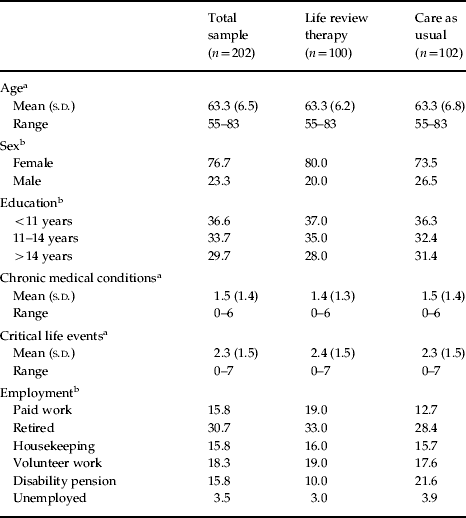
Participants had a mean age of 63 years (s.d.=6.5, range=55–83) and were predominantly female (Table 1). Their education was distributed evenly across three categories (<11 years, 11–14 years, and >14 years). About one-third of the participants were retired. On average, participants had one to two chronic medical conditions (mean=1.5, s.d.=1.4) and they had experienced two to three critical life events in the past 3 years (mean=2.3, s.d.=1.5). Table 2 shows that participants at baseline scored an average of 20.5 (s.d.=8.6) on the CES-D, reflecting clinically relevant depressive symptoms.
Baseline characteristics of participants for total sample, life review therapy and care as usual

s.d., Standard deviation.
a No significant differences between intervention and control condition (t test with p>0.05).
b No significant differences between intervention and control condition (χ2 test with p>0.05).
Means and standard deviations for all outcome measures (at baseline, post-treatment, follow-up and second follow-up) and results of the GLM repeated measures and Cohen's d for intervention effects (taking clustering into account)

GLM, General Linear Model; CES-D, Center for Epidemiologic Studies Depression Scale; HADS-A, Hospital Anxiety and Depression Scale – Anxiety Score; MHC-SF, Mental Health Continuum – Short Form; EQ-5D, EuroQol Questionnaire; MINI-MDE, Mini International Neuropsychiatric Interview – mild to moderate major depressive episode; s.e., standard error; OR, odds ratio.
*** p<0.001, ** p<0.01, * p<0.05.
Treatment effects
Table 2 presents the means and standard errors for the outcome measures at post-treatment, first and second follow-ups, the results of the regression analysis, and the effect sizes. Compared to the control condition, participants in the intervention condition reported significantly decreased depressive symptoms at post-treatment (B=−5.3, p<0.001) and first follow-up (B=−5.0, p<0.001). Effect sizes at post-treatment (d=0.60) and first follow-up (d=0.50) are medium (Cohen, Reference Cohen1992). The effects of the intervention condition were maintained at the second follow-up [t(99)=5.7, p<0.001]. The proportion of participants who reached a clinically significant change at post-treatment on the CES-D in the life review therapy condition was 31/68 (45.6%) versus 12/71 (16.9%) in the care-as-usual condition [OR 3.77, 95% confidence interval (CI) 1.38–10.30, p<0.001, NNT=3.5]. At follow-up, in the intervention condition, 35/68 (51.5%) participants versus 15/71 (21.1%) participants in the control condition showed a successful outcome (OR 3.76, 95% CI 1.45–9.72, p<0.001, NNT=3.3).
Compared to the control condition, participants in the intervention condition reported a significant decrease in anxiety symptoms (t1: B=−1.1, p<0.01, t2: B=−0.89, p<0.05) and a significant improvement in positive mental health (t1: B=4.0, p<0.001, t2: B=2.9, p<0.001). Effect sizes for anxiety symptoms (t1: d=0.28, t2: d=0.25) and positive mental health (t1: d=0.29, t2: d=0.26) were small (Cohen, Reference Cohen1992). The effects were maintained at the second follow-up in the intervention condition [anxiety symptoms: t(99)=5.0, p<0.001, positive mental health: t(99)=−4.2, p<0.05]. No significant effects were found for quality of life (t1: B=0.02, p=0.20, t2: B=−0.00, p=0.41). Improvement on current mild to moderate MDE was not statistically significant (p=0.08, OR 0.57).
Moderator analyses
We investigated whether certain groups of participants derived more benefit from the intervention with respect to depressive symptoms. Analyses showed only two significant moderators, the personality trait of extraversion (B=−4.1, p=0.03) and the use of reminiscence to reduce boredom in the present (B=4.6, p=0.03), in the sense that people with higher levels of extraversion and lower levels of boredom reduction obtained higher benefits from the intervention. No significant interactions were found for the other putative moderators, that is age, gender, educational level, traits of neuroticism, openness to experiences, agreeableness, conscientiousness, reminiscence functions of identity, problem solving, bitterness revival, clinically relevant depressive and anxiety symptoms at baseline, past MDEs, chronic medical conditions and critical life events at baseline.
Discussion
Main findings
The present study evaluated an early intervention that integrates life review and narrative therapy under real-life conditions, using a large, pragmatic, multi-site RCT in older adults with moderate depressive symptoms. The results indicate that such a life review therapy is effective in reducing depressive symptoms. These effects were maintained at 3- and 9-month follow-ups. We found medium effect sizes for depressive symptoms, both post-treatment (d=0.60) and at follow-up (d=0.50). These effect sizes are comparable to the effect size of 0.42 that was found for early interventions on psychological distress by Cuijpers et al. (Reference Cuijpers, Smit and Van Straten2007). Moreover, the likelihood of a clinically significant change in depressive symptoms was significantly and substantially higher in the intervention condition than in the care as usual condition. These results support life review therapy as an effective early intervention for older adults with depressive symptomatology. The effects on major depression at the 3-month follow-up were not statistically significant at p=0.08, but the effects on clinical cases of preventive and early interventions are most prominently found after longer periods of time (Cuijpers et al. Reference Cuijpers, Van Straten, Smit, Mihalopoulos and Beekman2008). Our finding that the average level of depressive symptoms remained below the cut-off score for possible caseness of depression at the 9-month follow-up is promising, but it needs to be substantiated by longer follow-up measurements under controlled conditions.
In addition, significant, albeit small, effects were observed for symptoms of anxiety and positive mental health. It thus seems that life review therapy has the potential not only to reduce symptoms of psychopathology but also to improve positive mental health, that is emotional, psychological and social well-being. There is growing recognition that enhancing positive mental health is an important objective in public mental health (Jané-Llopis & Barry, Reference Jané-Llopis and Barry2005; Keyes, Reference Keyes2005; Keyes et al. Reference Keyes, Dhingra and Simoes2010; Fledderus et al. Reference Fledderus, Bohlmeijer, Smit and Westerhof2011). No significant differences were found for quality of life, however. This might be explained by our method of measuring quality of life. The EQ-5D (Brooks, Reference Brooks1996) focuses on health-related quality of life across various health dimensions, which makes it unlikely that effects in a single domain are sufficient to cause a change on the EQ-5D. After all, factors such as mobility and self-care are probably difficult to influence with a psychological intervention.
Overall, the results showed that life review therapy is applicable to a broad target group of adults of 55 years and over experiencing moderate depressive symptomatology. Moderator analyses on depressive symptoms identified only two significant moderators, the personality trait of extraversion and the reminiscence function of boredom reduction. Our results demonstrate that the intervention is more effective for people having higher levels of extraversion. In addition to being more energetic, more extraverted individuals may be more able and inclined to share their feelings, emotions and thoughts with others and thus may benefit more from an intervention conducted in groups. Indeed, it has been reported that extraversion predicts a higher frequency of reminiscence in general, and in particular for conversational and relational purposes (Cappeliez & O'Rourke, Reference Cappeliez and O'Rourke2002). More extraverted individuals may also be more inclined to look at the ‘silver lining’ and thus benefit more from the components of the intervention directed at positive memories. Furthermore, older adults demonstrating higher levels of boredom reduction profit less from the intervention. High levels of boredom reduction reminiscence reflect taking solace in the past in front of an unstimulating environment or an unrewarding future (Webster, Reference Webster1997). Indeed, this function of reminiscence has been linked with the difficulty in finding meaning in the present and in seeking new goals in the future (Cappeliez & O'Rourke, Reference Cappeliez and O'Rourke2002). Importantly, the reminiscence function of boredom reduction has been strongly linked with negative physical and psychological health outcomes, including depression and anxiety (Cappeliez & O'Rourke, Reference Cappeliez and O'Rourke2006; O'Rourke et al. Reference O'Rourke, Cappeliez and Claxton2011; Korte et al. Reference Korte, Bohlmeijer and Smit2011). It is possible that older adults who have difficulty finding meaning in the present may profit more from interventions that focus on the here and now.
There has been some criticism that participating in a life review intervention would stimulate bitterness and rumination in people with depression (Cully et al. Reference Cully, LaVoie and Gfeller2001; Coleman, Reference Coleman2005). This study shows that this is not the case. Effects of the intervention were independent of level of depressive symptoms and prior MDEs. It is especially noteworthy that the personality trait of neuroticism and the use of reminiscence for bitterness revival were not found to moderate the effects of life review therapy. Bitterness revival is the repeated recall of memories about personal crisis and conflicts (Webster, Reference Webster1997). It is related to neuroticism and depression (Webster, Reference Webster1994; Cully et al. Reference Cully, LaVoie and Gfeller2001; Molinari et al. Reference Molinari, Cully, Kendjelic and Kunik2001; Cappeliez & O'Rourke, Reference Cappeliez and O'Rourke2002, Reference Cappeliez and O'Rourke2006; Cappeliez et al. Reference Cappeliez, O'Rourke and Chaudhury2005; Korte et al. Reference Korte, Bohlmeijer and Smit2011). It seems that participants with higher levels of depressive symptoms, neuroticism and bitterness revival are also capable of developing alternative stories on their lives that are more positive, meaningful and empowering. The general lack of moderating effects suggests that the intervention is broadly applicable to a variety of participants.
This is the first study to investigate the beneficial effects of combining life review with narrative therapy. Although the usefulness of narrative therapy with older adults has been advanced (Kroph & Tandy, Reference Kroph and Tandy1998), its effects have not been examined experimentally. A central focus in narrative therapy is to develop alternative stories about one's life that are more agentic (Polkinghorne, Reference Polkinghorne1996), richer and more inclusive of experience (White & Epston, Reference White and Epston1990; Payne, Reference Payne2000). A recent qualitative study on the same intervention has identified these transformations in the self-narrative (Bohlmeijer et al., unpublished observations). One interesting line of investigation would be to collect and analyze stories about therapy to ascertain whether the increase of agency in life-stories is indeed a working mechanism (Adler et al. Reference Adler, Skalina and McAdams2008).
Limitations
Some limitations of this study must be acknowledged. First, the control condition being a care-as-usual waiting list condition, there was no control for the possible influence of non-specific factors, such as attention and social interaction. It would have been optimal to compare the targeted intervention with an active group intervention, or at least with an attention placebo comparison group. Second, given the relatively long follow-up period, it was not possible for ethical reasons to compare the intervention with care as usual during the second follow-up. Although the effects in the intervention group were maintained at the 9-month follow-up, we cannot claim that these effects were uniquely caused by the intervention.
Third, this study used self-report outcome measures, which might lead to biased findings. Future research could use more physiological outcome measures. A recent study shows, for example, that life review is also effective in reducing high blood pressure (Houston et al. Reference Houston, Allison, Sussman, Horn, Holt, Trobaugh, Salas, Pisu, Cuffee, Larkin, Person, Barton, Kiefe and Hullet2011). Fourth, as the participants in our study were young older adults, generalizations regarding age should be made with some caution. However, in line with meta-analytic evidence (Bohlmeijer et al. Reference Bohlmeijer, Roemer, Cuijpers and Smit2007), we found that, with respect to depressive symptoms, young older adults profit equally from reminiscence as old older adults.
Conclusions
This study shows that life review therapy is effective as an early intervention for older adults with depressive symptomatology, that life review therapy is effective under ecologically valid conditions, and that life review therapy is effective for a large variety of older adults (with the possible exception of introverted people and those who make considerable use of reminiscence to escape the present). Although the effects of life review therapy were maintained at the 9-month follow-up, it is recommended that the long-term effects be studied in randomized controlled conditions and that active control conditions be used to control for non-specific factors.
Acknowledgments
This study was approved by the METiGG, a medical ethics committee for research in mental health-care settings in The Netherlands. In addition, this study has been registered in the Netherlands Trial Register, the primary Dutch register for clinical trials (TC=1860). The study was funded by ZonMw, the Netherlands organization for health research and development (grant no. 120 610 003). We acknowledge with many thanks therapists and participants for taking part in this study.
Declaration of Interest
None.